
A complete issue · 28 pages · 1917
Judge — December 22, 1917
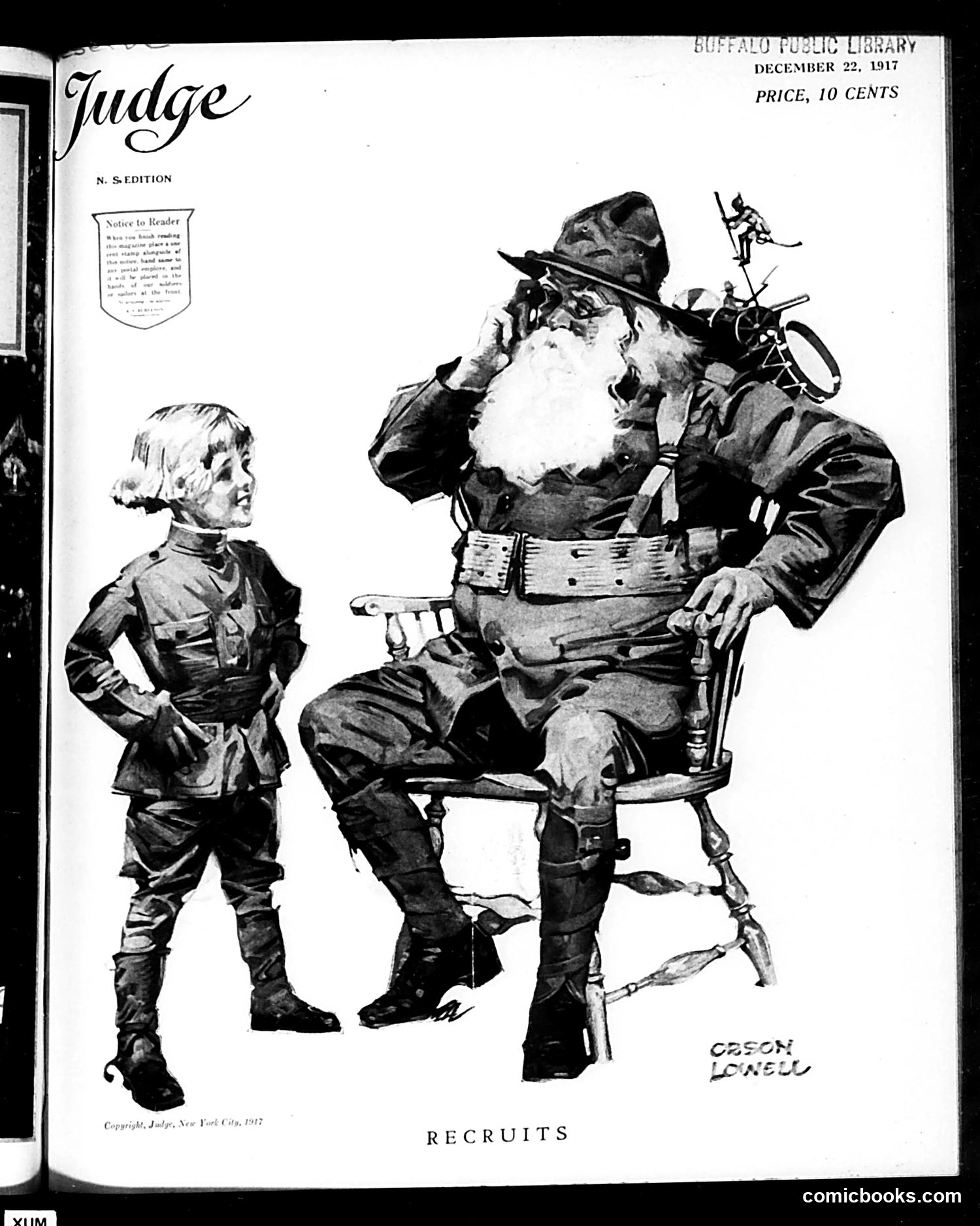
This satirical cartoon by Orson Lowell depicts military recruitment during World War I. A bearded soldier in full combat gear sits in a chair, gesturing persuasively toward a young boy in military uniform standing beside him. The soldier wears a wide belt, boots, and has a rifle propped nearby—appearing battle-hardened and authoritative. The satire targets aggressive WWI recruitment tactics, particularly the targeting of young people. The "recruits" title suggests the military's eagerness to enlist even the youngest candidates. The child's serious, almost stern expression contrasts with his diminutive size, mocking both the recruitment messaging and perhaps America's intensifying military mobilization following its 1917 entry into the war.
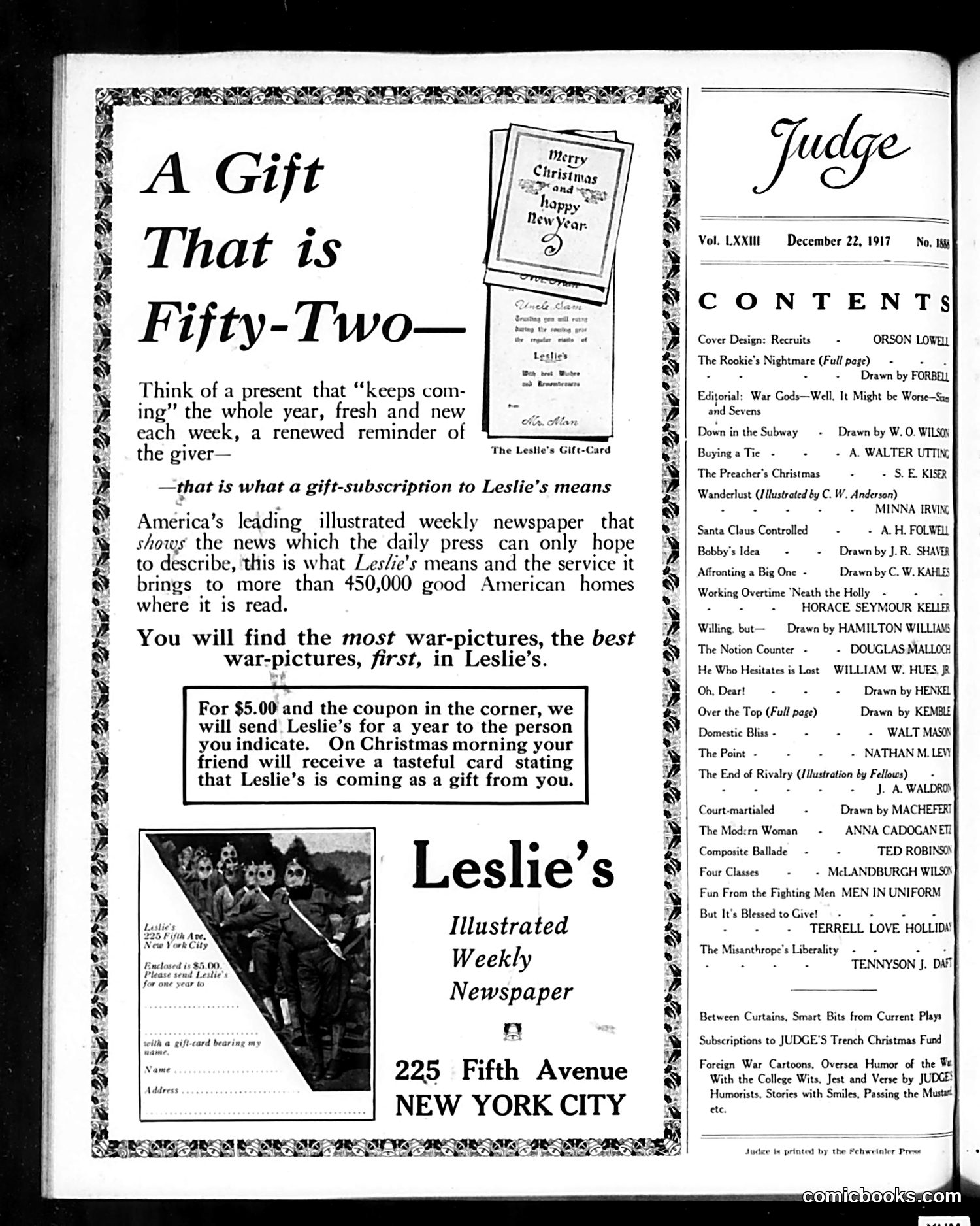
This page is primarily an **advertisement for Leslie's Illustrated Weekly Newspaper**, presented as a Christmas gift suggestion. The ad promotes a year-long subscription for $5.00, emphasizing Leslie's coverage of World War I, which was still ongoing in December 1917 (the U.S. had entered in April 1917). The pitch highlights Leslie's as offering "the most war-pictures, the best war-pictures, *first*"—positioning the magazine as the leading source for war news and imagery. The accompanying photograph shows soldiers, likely from the Great War. The contents page on the right lists various articles and illustrations typical of Judge's satirical humor, though specific cartoons aren't clearly visible in this image. This is essentially a gift-advertising page rather than satirical content itself.
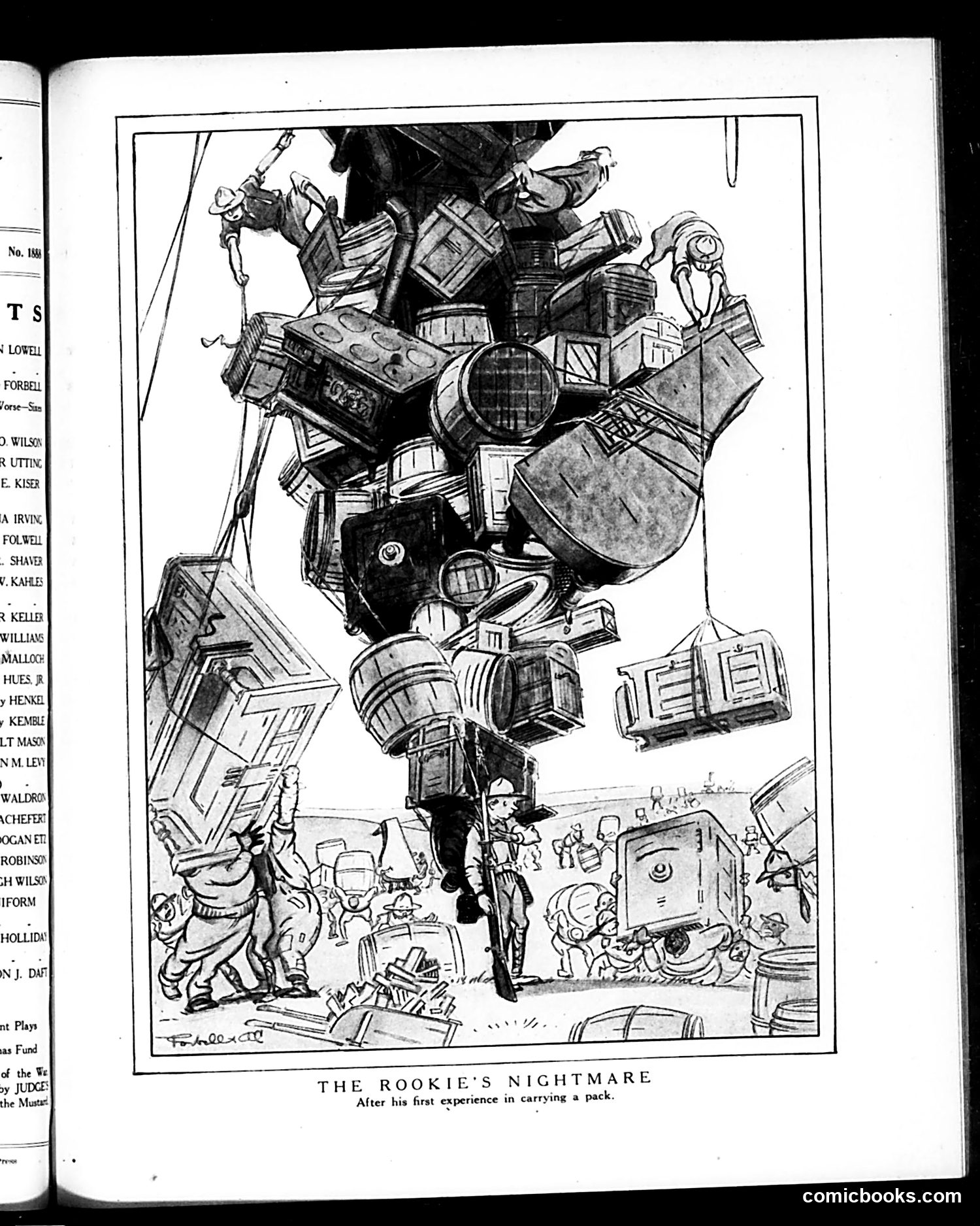
This cartoon satirizes the experience of a novice porter or bellhop during their first shift carrying luggage. The title "After his first experience in carrying a pack" indicates the humor targets new hotel workers overwhelmed by their duties. The illustration shows an impossibly towering stack of bags, trunks, and parcels precariously balanced on a single porter's head and shoulders—a visual exaggeration of the chaotic, physically demanding nature of the job. The small figures at ground level emphasize the absurd height of the load. The satire mocks both the working conditions imposed on service workers and the "hazing" tradition new employees faced. It's commentary on labor exploitation and the physical toll of hospitality industry work in the early 20th century.
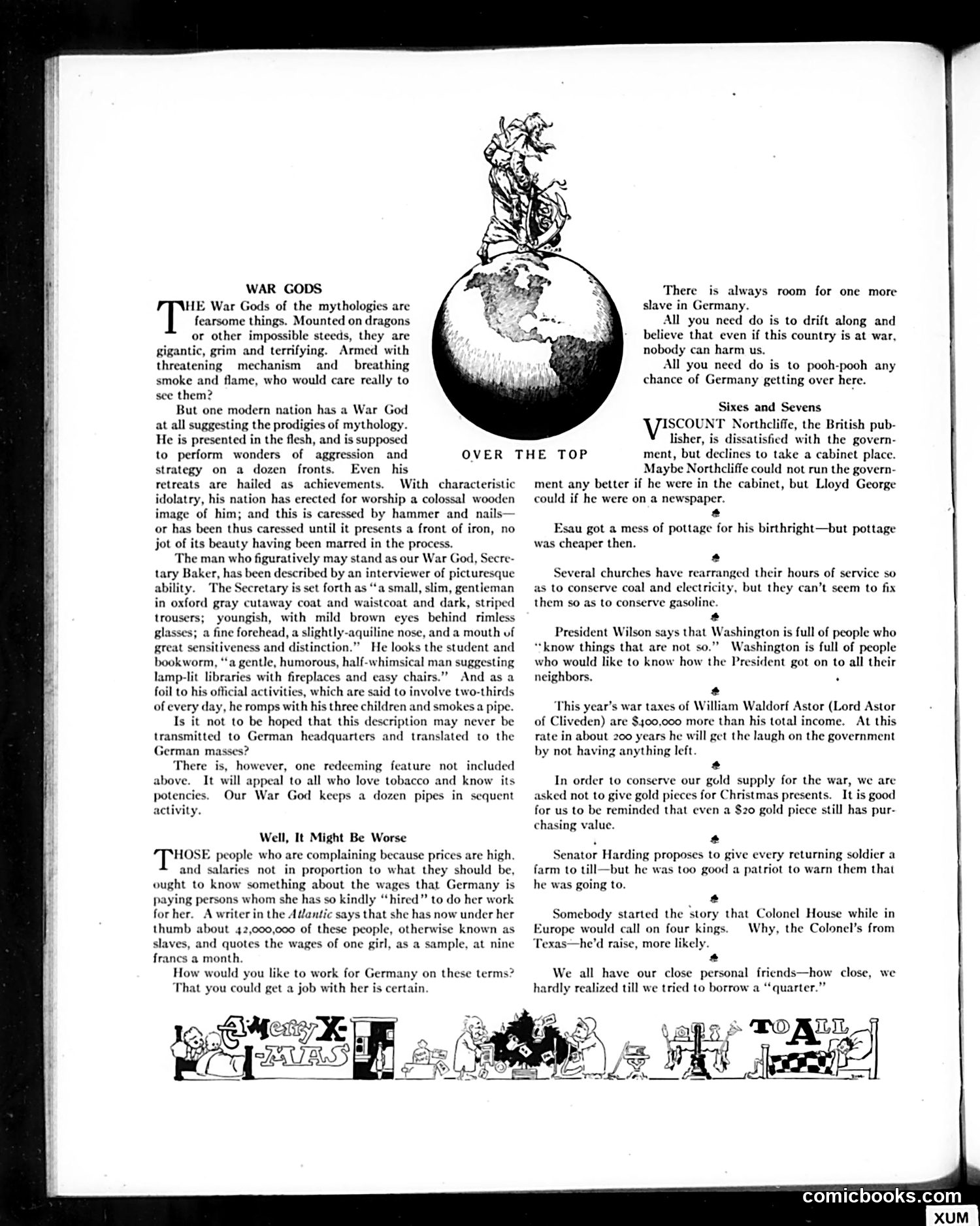
This page contains satirical commentary on World War I-era politics and society. The main article "War Gods" mocks how modern nations (particularly Germany) have created idealized, propagandistic images of military leadership—contrasting mythology's war gods with reality's bureaucratic "small, slim gentlemen" in striped trousers. The right column contains brief satirical items about wartime conditions: churches conserving fuel, President Wilson's Washington being full of people who "know things that are not so," high war taxes on wealthy industrialists like William Waldorf Astor, and proposals to give returning soldiers farms. The cartoon "Over the Top" depicts a figure standing atop a globe, likely representing militaristic ambition or German expansionism during WWI. The overall tone criticizes both military romanticism and wartime government inefficiency and excess.
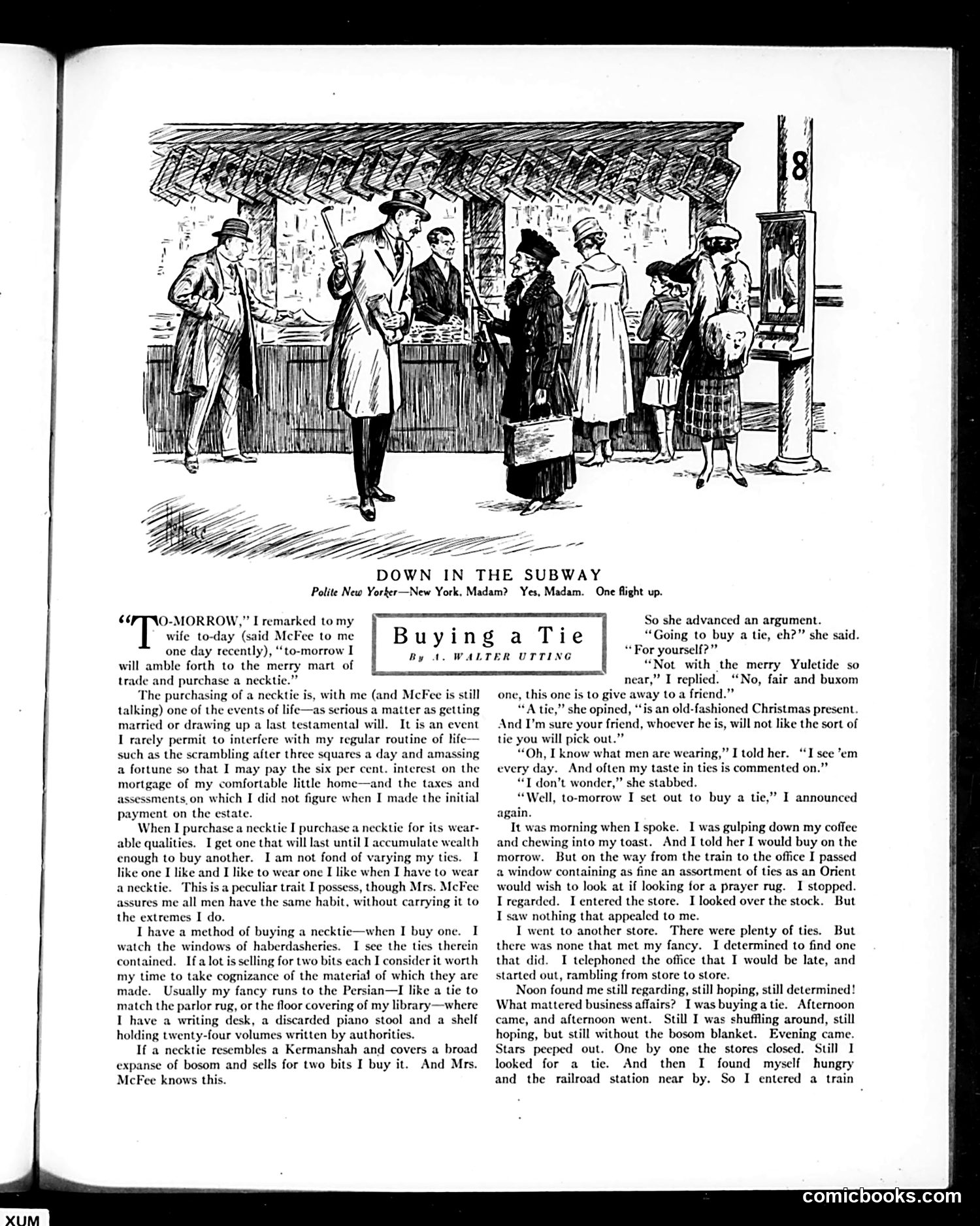
The cartoon depicts a crowded subway station scene with well-dressed commuters and vendors. The accompanying story "Buying a Tie" by Walter Utting describes a man's frustrating day-long quest to purchase a necktie as a Christmas gift for his wife. The satire targets early 20th-century consumer culture and gender dynamics: the protagonist's wife demands a specific tie, and he spends his entire day fruitlessly searching stores. The joke emphasizes how wives control household purchasing decisions and how men defer to women's preferences even for their own gifts. The "Yuletide" reference suggests this is Christmas-themed satire about commercialism and marital obligation during the shopping season.
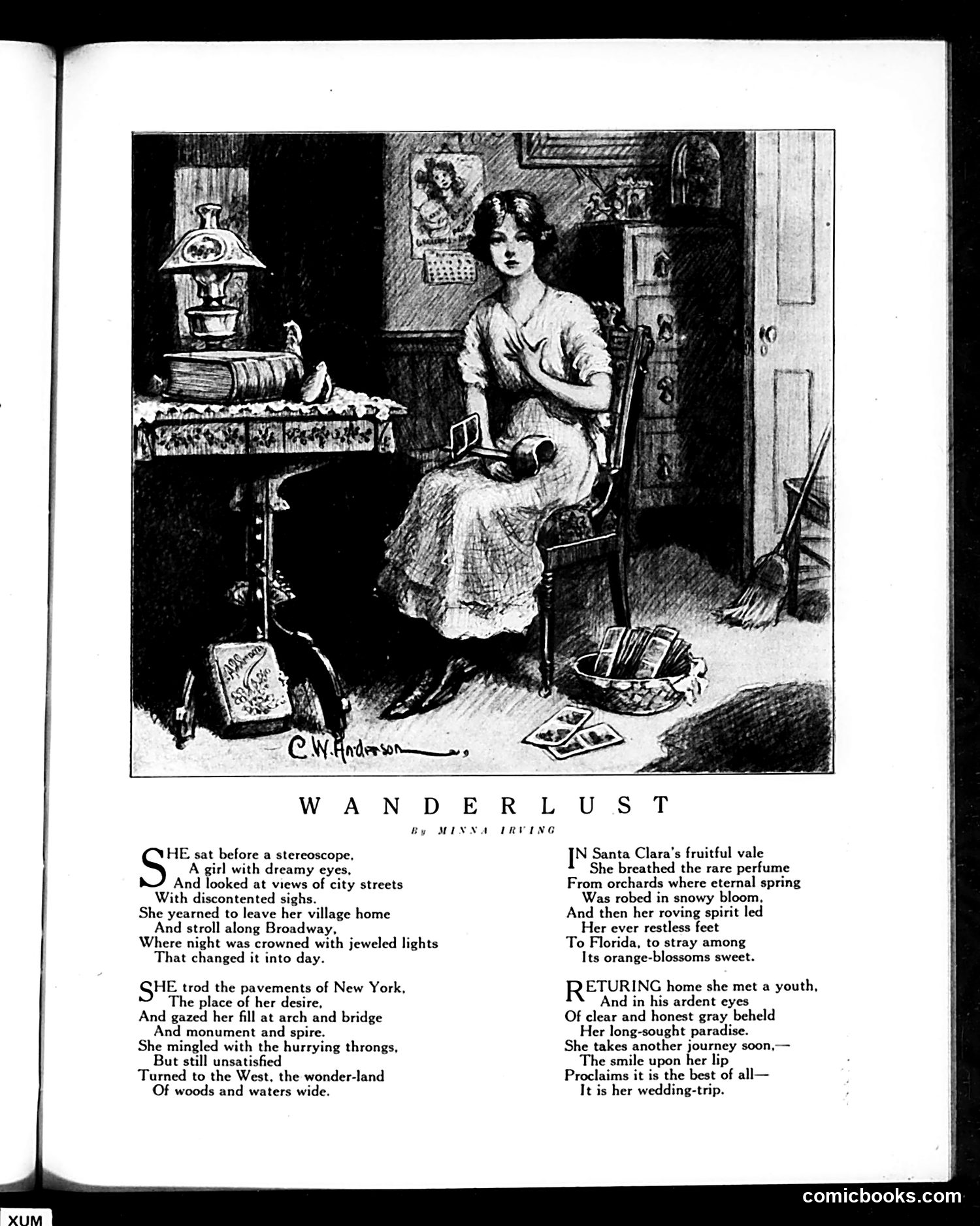
This is a sentimental illustrated poem, not political satire. It depicts a restless young woman from a village who dreams of travel. Using a stereoscope (a Victorian viewing device showing 3D images), she mentally journeys through American cities—New York's Broadway, Santa Clara's orchards, Florida's orange blossoms—seeking fulfillment. The narrative's moral: after wandering through magnificent landscapes and urban wonders, she discovers true happiness not in exotic destinations but in romantic love. Meeting an honest young man, she realizes her "long-sought paradise" was personal connection, not travel. Her upcoming "wedding-trip" represents the ultimate journey. This reflects early-20th-century attitudes about female contentment—suggesting a woman's restless ambitions should ultimately resolve into marriage and domesticity, positioning love as life's supreme destination.
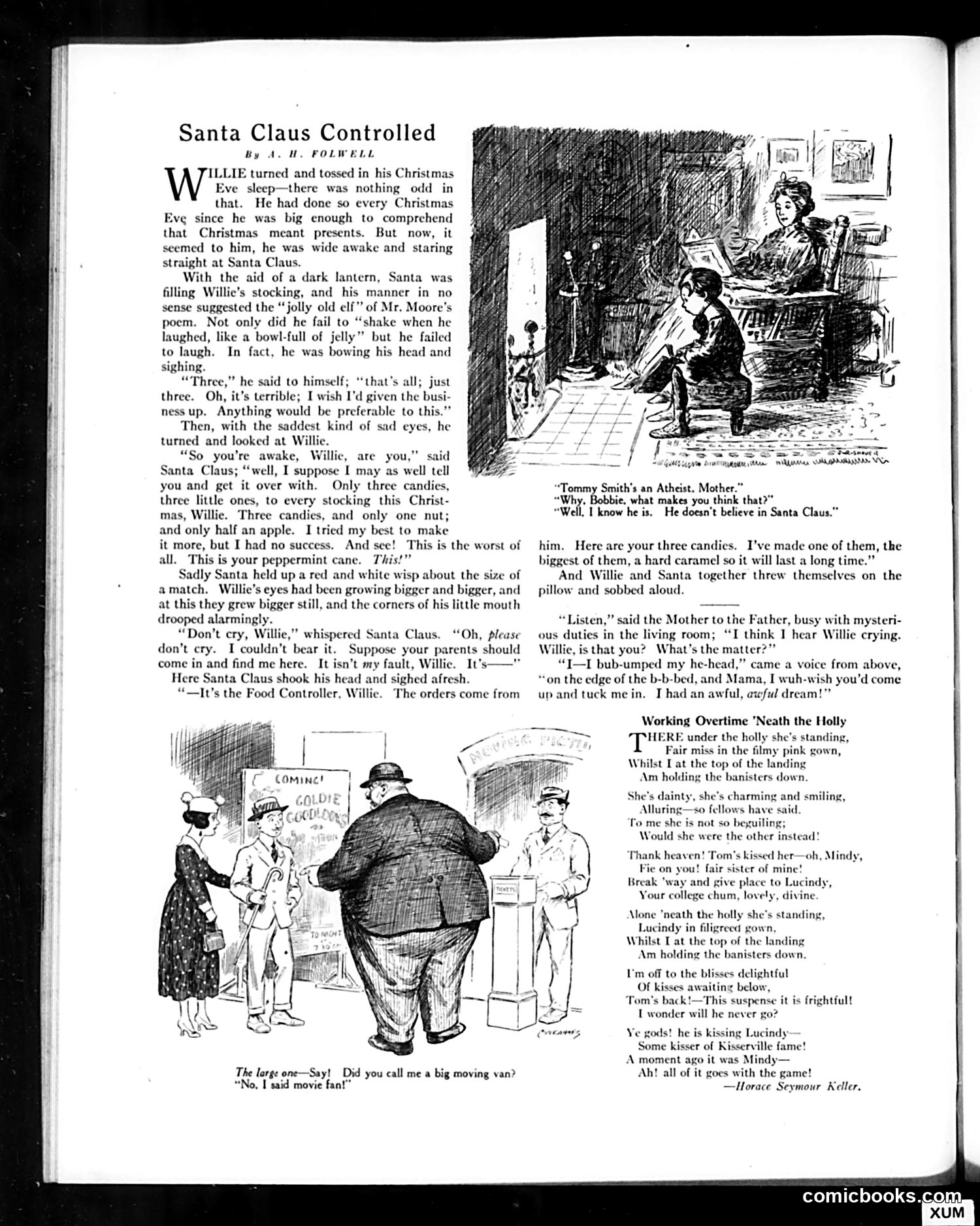
This page satirizes wartime food rationing during World War I. The main story depicts Santa Claus as a dejected bureaucrat, not a jolly figure, because he's been ordered by "the Food Controller" to give Willie only three candies, one nut, and half an apple—reflecting actual government rationing restrictions. The joke's darkness is intentional: it mocks how wartime scarcity has invaded even Christmas, turning the holiday magical figure into an enforcer of deprivation. Santa's tears and Willie's devastation underscore public resentment of rationing controls. The secondary cartoon below jokes about a large man being mistaken for a "moving van"—likely a jab at profiteering or black-market hoarders who grew fat while others went hungry. The remaining poem is unrelated social humor about romantic rivals under mistletoe.
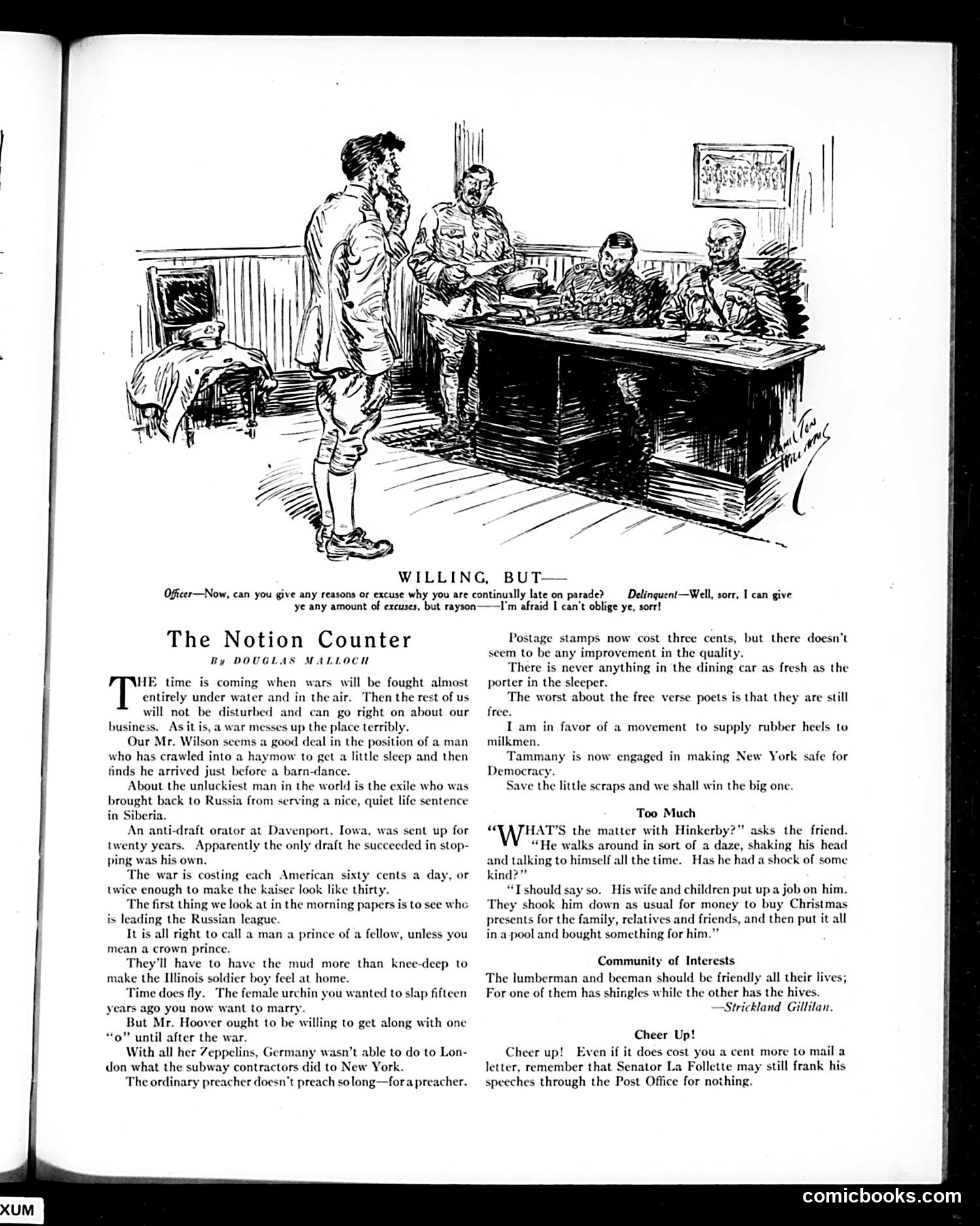
The cartoon depicts a military disciplinary scene: an officer interrogates a soldier about chronic tardiness to parade. The soldier cheerfully admits he has "any amount of excuses" but claims he cannot provide a *reason*—a witty play on words suggesting the soldier is simply unreliable rather than legitimately hindered. The satire targets military discipline and the absurdity of excuse-making during wartime (likely WWI, given the page's context). The humor lies in the soldier's Irish dialect ("sorr") and his brazen admission that excuses exist but rational justification does not—he's just habitually late. The surrounding "Notion Counter" column by Douglas Malloch contains brief wartime social commentary, including references to President Wilson, the draft, and the war's disruptions to civilian life. The page exemplifies *Judge* magazine's satirical approach to American wartime society.
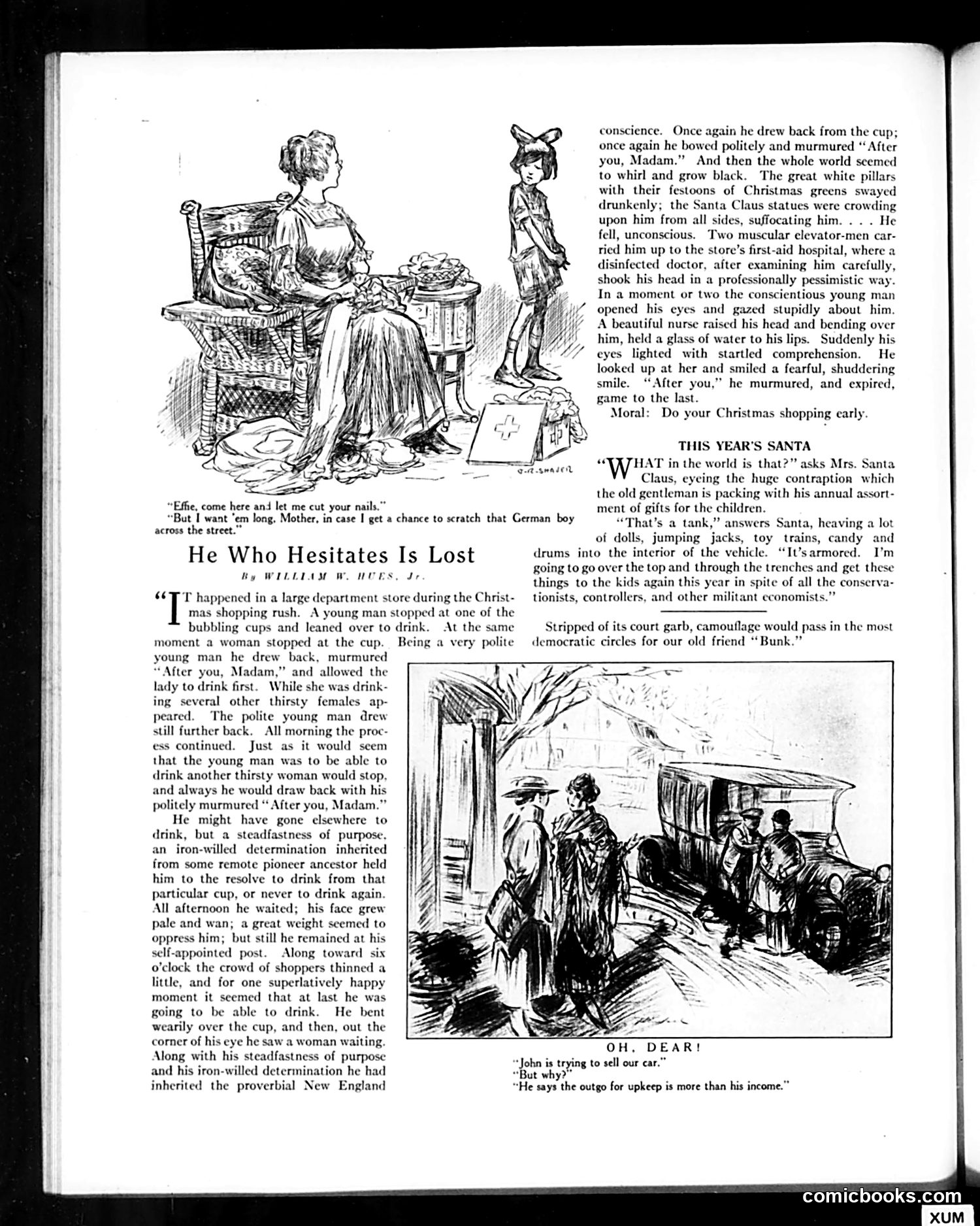
**"He Who Hesitates Is Lost"** satirizes excessive politeness during Christmas shopping season. A young man, determined to drink from a department store's public cup, keeps deferring to women ("After you, Madam") throughout the day. His obsessive politeness—inherited from "some remote pioneer ancestor"—prevents him from ever drinking. He eventually collapses and dies, still polite. The moral: shop early to avoid crowded stores and exhaustion. **"This Year's Santa"** references World War I. Mrs. Santa questions why her husband is packing toys into a tank instead of a sleigh. He explains he must "go over the top and through the trenches" to deliver gifts despite wartime "conservationists, controllers, and other militant economists" (likely rationing/resource restrictions). The cartoon satirizes how even Christmas generosity faces government/military interference during wartime. Both stories employ dark humor typical of Judge magazine's satirical style.
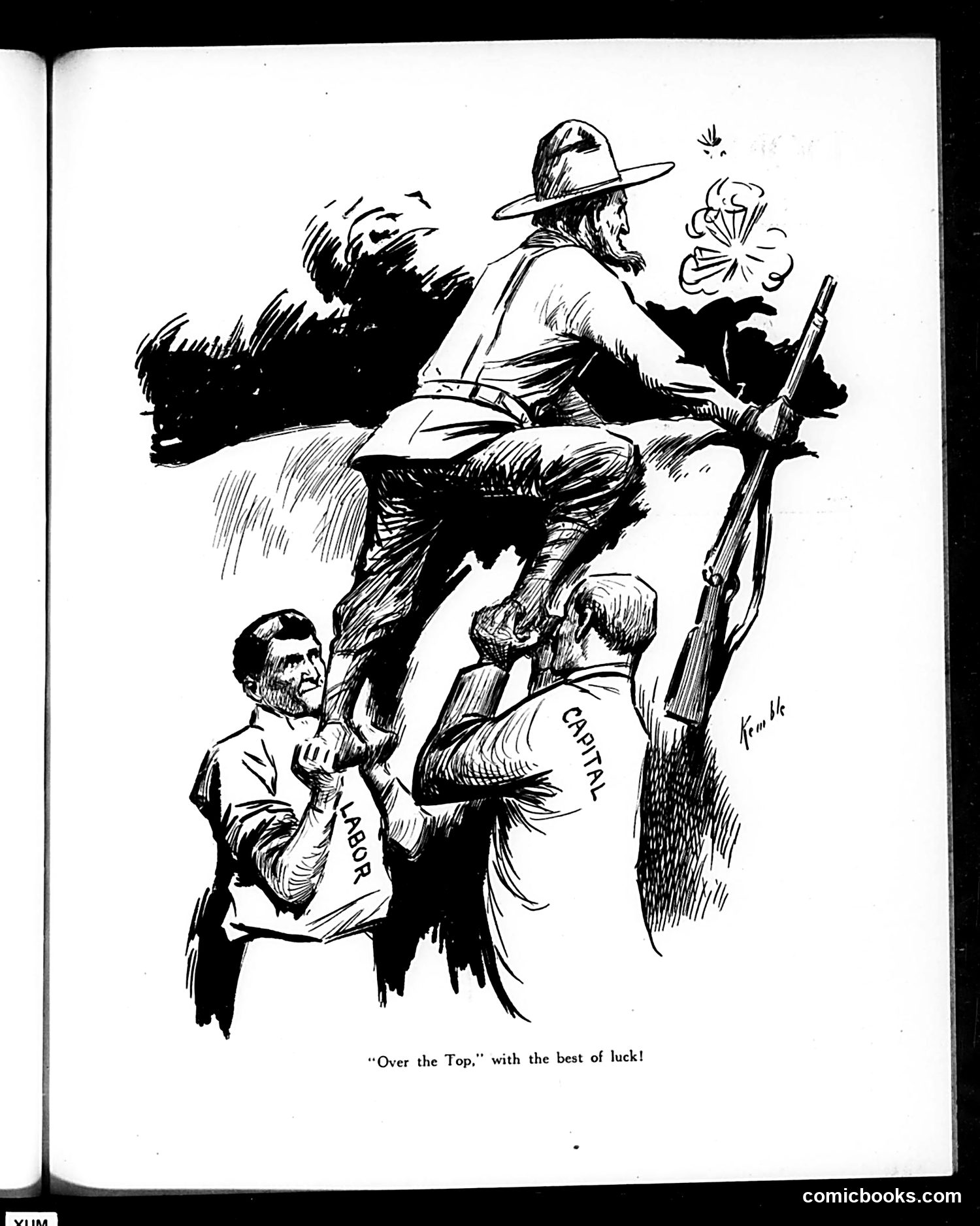
This cartoon depicts a soldier going "over the top"—a World War I term for troops climbing out of trenches to attack enemy positions, an extremely dangerous maneuver with high casualty rates. The figure labeled "LABOR" pushes a soldier (likely representing American troops) upward, while "CAPITAL" rides atop, appearing to direct or benefit from the action. The cartoon satirizes how working-class soldiers bear the physical danger of war while wealthy capitalists profit from military production and conflict. The phrase "with the best of luck" is ironic—suggesting soldiers need luck to survive what appears to be a deliberate sacrifice orchestrated by those profiting from war. This reflects anti-war sentiment and class criticism common during WWI debates in American publications like *Judge*.
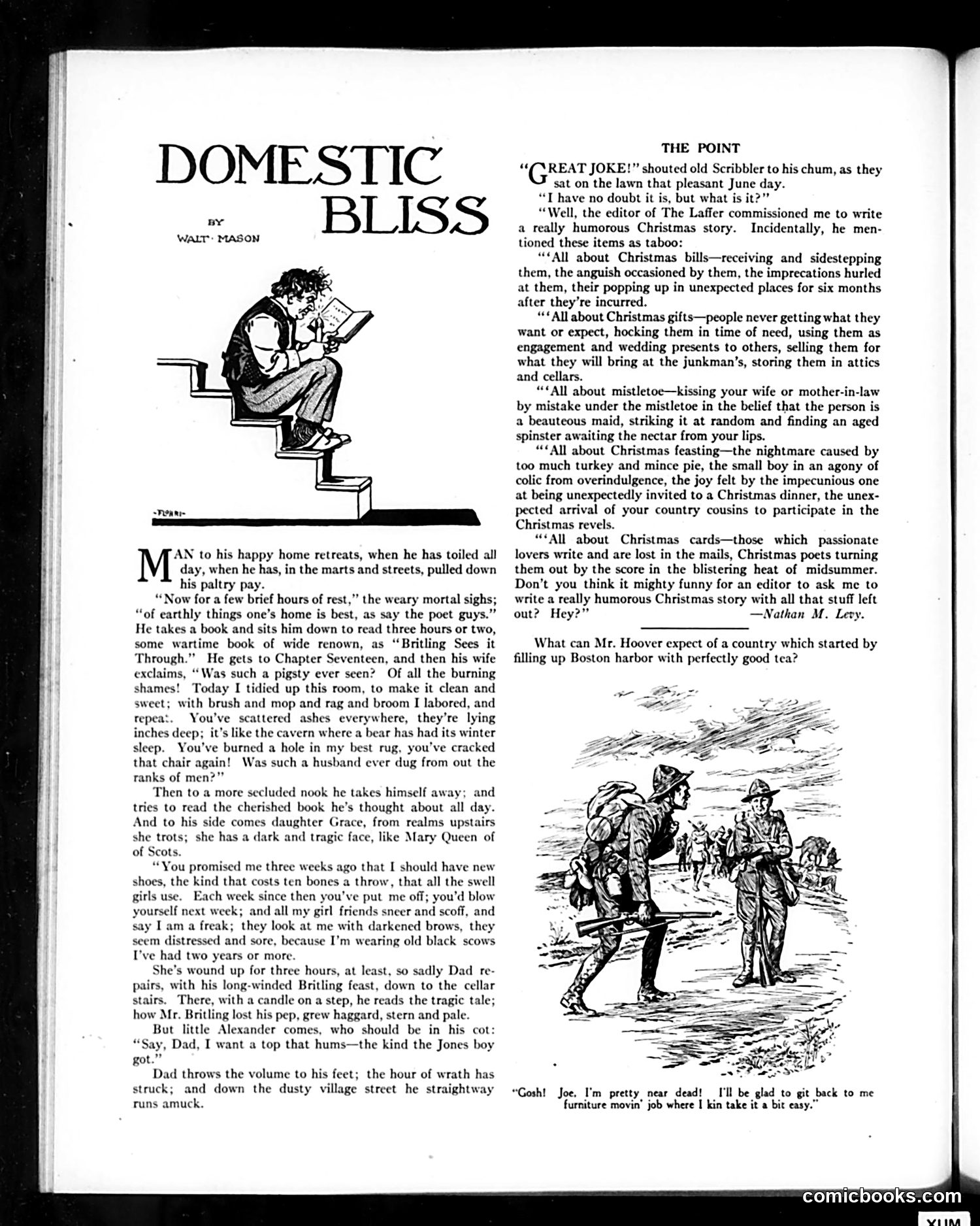
This page contains two satirical pieces about middle-class domestic life. **"Domestic Bliss"** (left) depicts a husband's futile attempt to enjoy leisure reading at home. He's repeatedly interrupted—first by his wife complaining about housekeeping, then by his daughter demanding new shoes, finally by his young son. Each interruption forces him downstairs seeking refuge, eventually driving him to flee into the streets in frustrated chaos. The satire mocks the impossibility of domestic peace and husbands' powerlessness against the endless demands of family. **"The Point"** (right) is meta-satire: two writers discuss an editor's absurd commission for a "humorous" Christmas story while prohibiting all standard Christmas humor topics—bills, unwanted gifts, mistletoe mishaps, overeating, unexpected guests, and lost cards. The joke exposes editorial hypocrisy: asking for humor while forbidding the very situations that make Christmas funny. It's satire about satire itself.
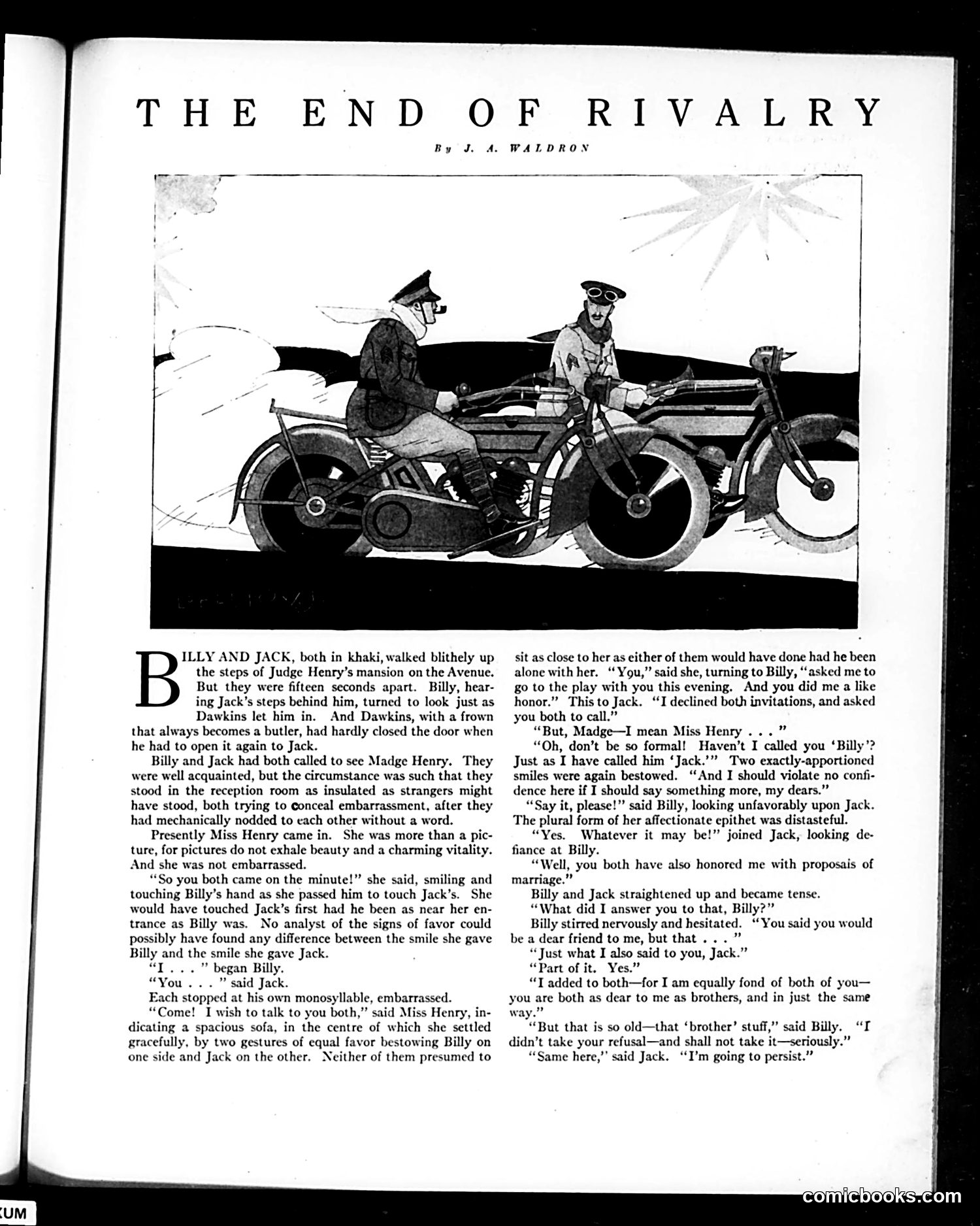
This is a romantic comedy story illustrated with a woodcut showing two men in military khaki uniforms arriving at a mansion on motorcycles/early motorcycles, competing for the same woman's affection. The plot concerns Billy and Jack, both suitors of Miss Madge Henry, who have each proposed marriage and invited her to the theater. Rather than choosing between them, Madge diplomatically treats both identically—touching their hands equally, bestowing identical smiles, and declaring she loves them both "as brothers." She refuses both marriage proposals. The men find this "brother" language old-fashioned and unsatisfying. Both announce they'll persist in their romantic efforts despite her refusal. The satire likely mocks sentimental courtship conventions and the persistence of young men unwilling to accept a woman's clear romantic decision, even when delivered with perfect equality and grace. The title's irony suggests rivalry will continue despite her attempt to end it.
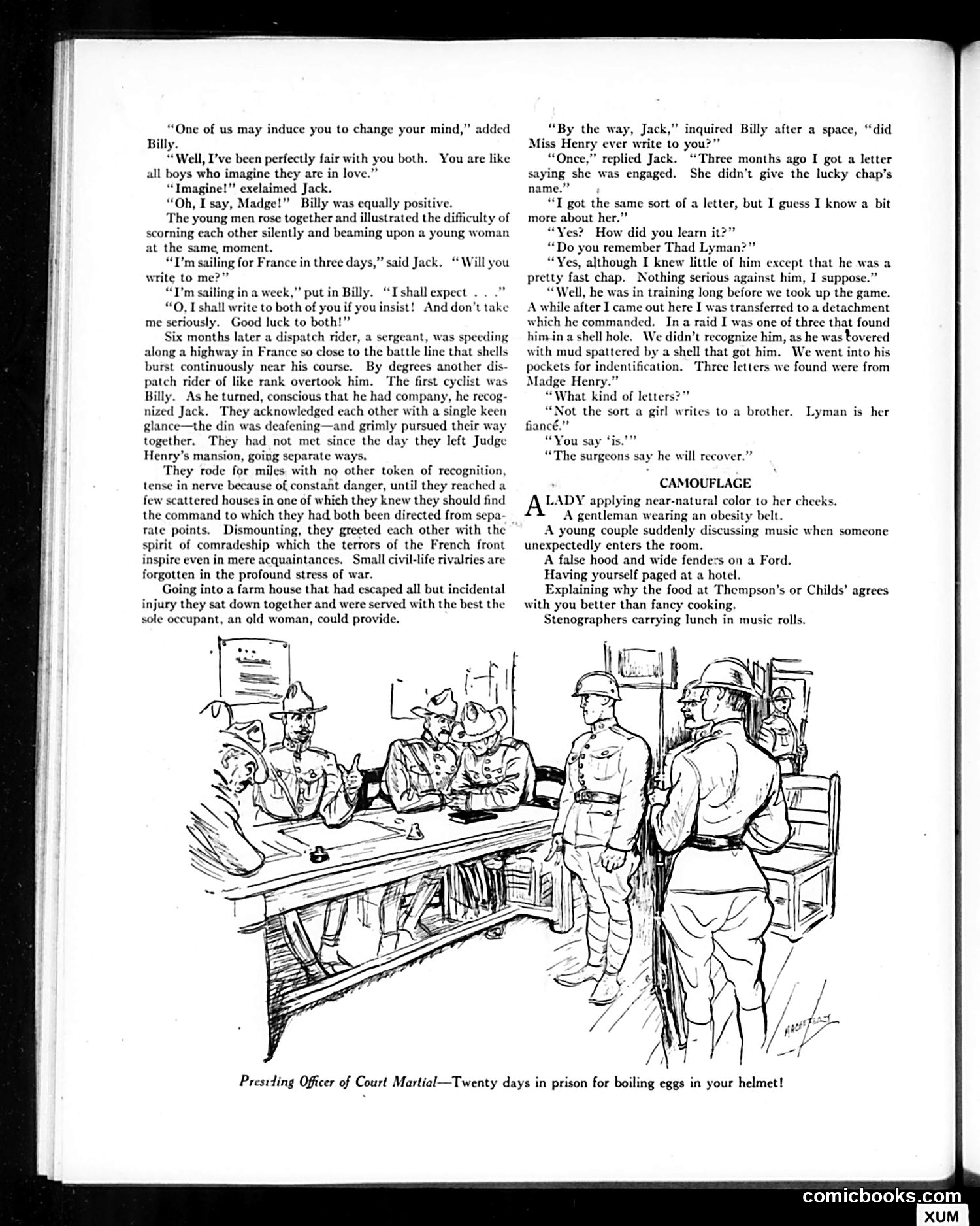
The page contains a romantic wartime narrative interrupted by satirical content. **Main Story:** Two young men, Jack and Billy, both court the same woman, Madge Henry, before sailing to France during World War I. Months later, they reunite as dispatch riders on the French front. Despite their romantic rivalry, they bond through military camaraderie. Billy reveals that Madge is engaged to Thad Lyman, a soldier they encountered wounded in a shell hole—letters found in his pockets proved his connection to her. **The Satire:** The bottom section titled "CAMOUFLAGE" humorously defines wartime deception—both literal (false car hoods) and social (pretending food tastes better than it does). The cartoon caption jokes about military discipline: a soldier faces "twenty days in prison for boiling eggs in your helmet"—mocking absurd military regulations. **Context:** The page reflects WWI-era American attitudes: romance interrupted by war, soldiers' shared danger transcending civilian rivalries, and satirical commentary on military bureaucracy and social pretense during wartime.
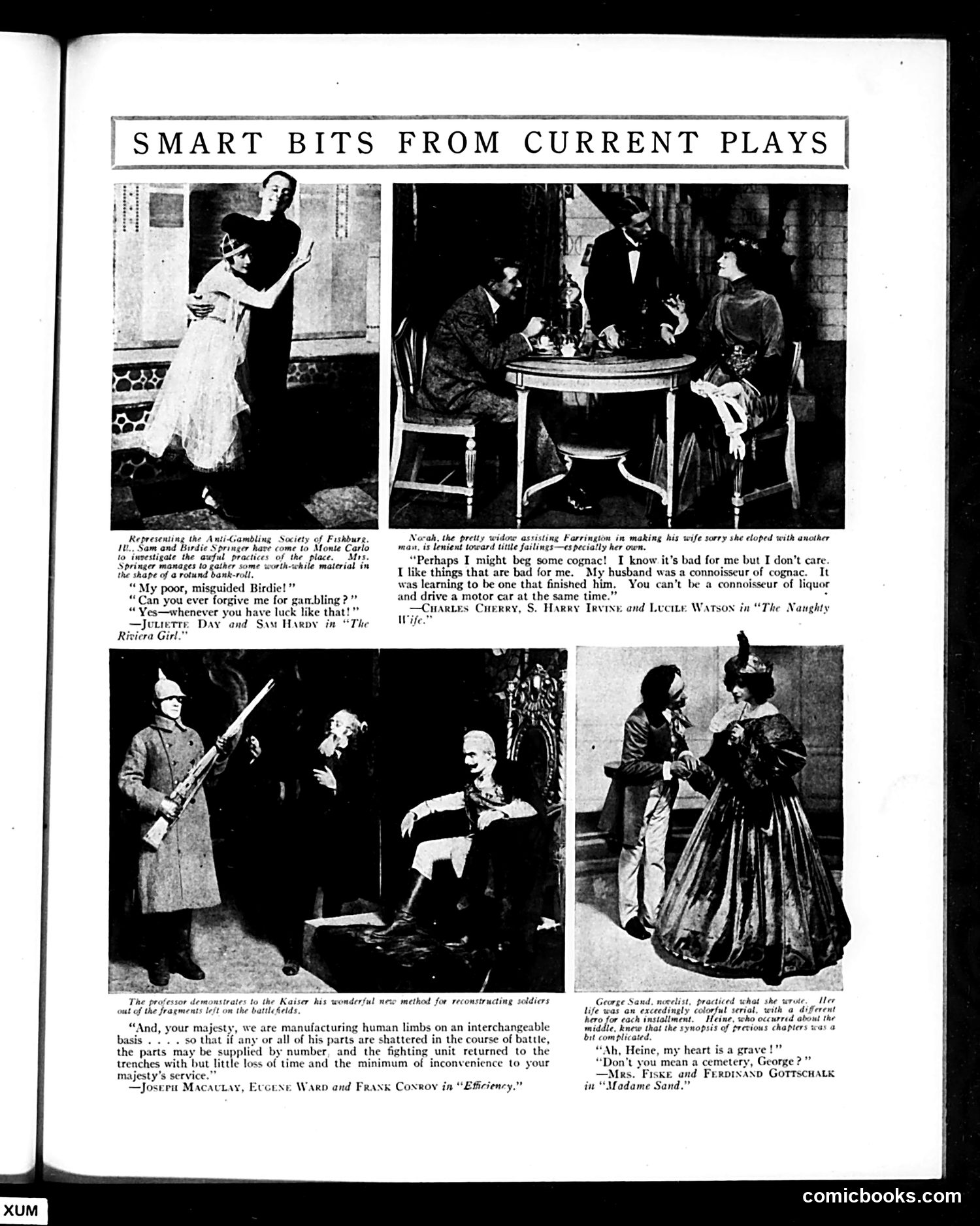
This page presents satirical excerpts from contemporary theatrical productions circa 1910s-1920s. The top image shows a scene from "The Riviera Girl" mocking wealthy tourists at Monte Carlo gambling resorts. The middle panel depicts a scene from "The Naughty Wife" where a widow rationalizes her drinking by claiming cognac consumption finished her husband—the joke being her hypocritical self-justification. The bottom image references "Efficiency," showing a German military officer demonstrating to the Kaiser a system for mass-producing replacement body parts for wounded soldiers. This is biting wartime satire, mocking German militarism's callous treatment of human casualties as mere mechanical components. The final theatrical excerpt appears to joke darkly about emotional versus literal graves. These pieces satirize both bourgeois excess and militaristic brutality through dramatic irony and dark humor typical of Judge magazine's satirical approach.
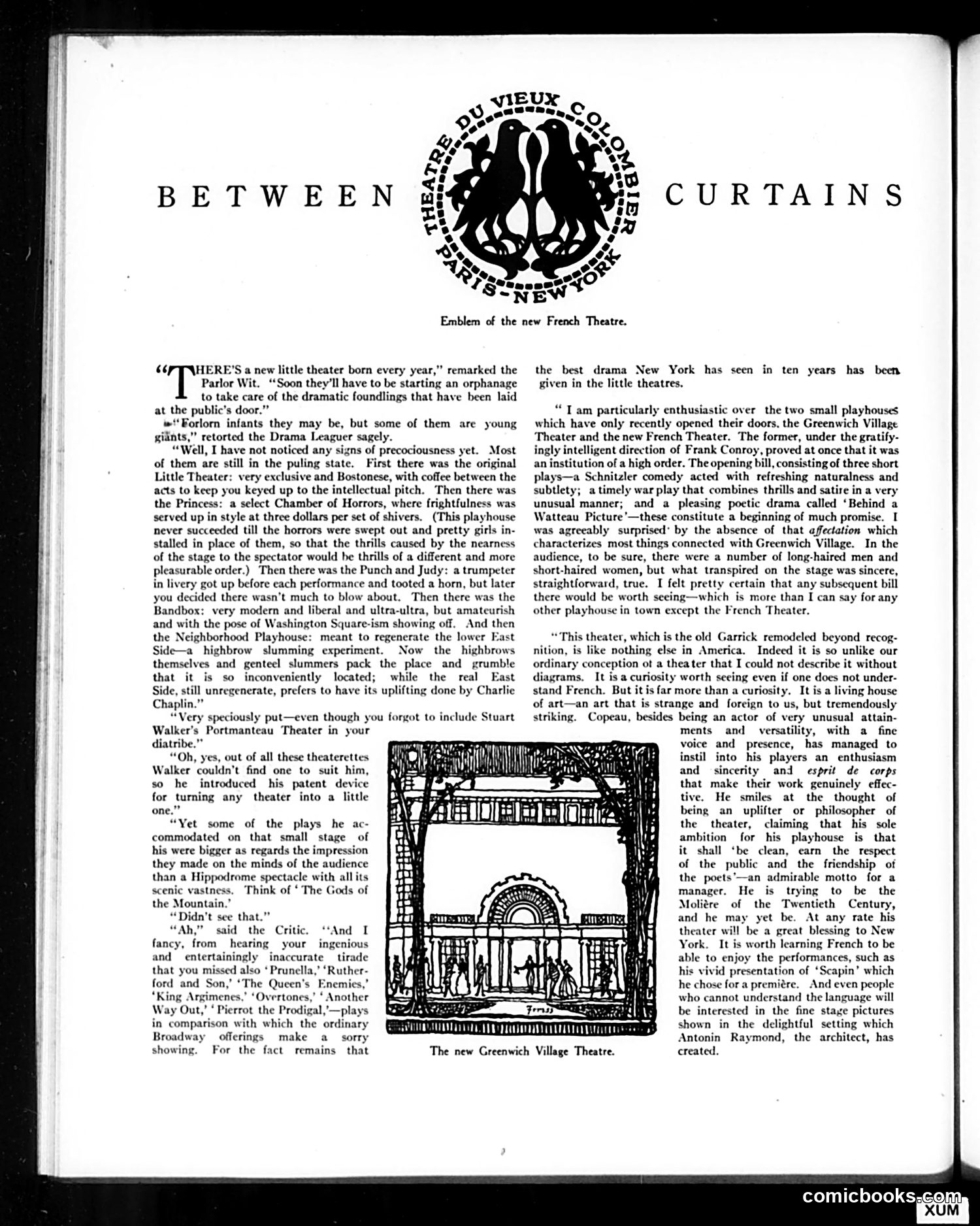
This article mocks the proliferation of small, experimental theaters in New York while paradoxically defending their artistic merit. Two characters debate whether these "theatrical foundlings" represent genuine innovation or pretentious failure. The piece catalogs existing "little theaters"—the original Little Theater (Boston, intellectual), the Princess (sensationalist), the Punch and Judy, the Bandbox (Greenwich Village poseurs), and the Neighborhood Playhouse (upper-class "slumming"). Stuart Walker's Portmanteau Theater is highlighted for adapting plays to small spaces effectively. The satire targets both the theaters' proliferation and their audiences: intellectuals, Greenwich Village bohemians, and wealthy dilettantes patronizing lower East Side venues. However, the critic ultimately concedes these venues produce superior drama compared to Broadway spectacles, citing avant-garde plays like "Prunella" and "The Gods of the Mountain." The accompanying architectural drawing depicts the new Greenwich Village Theater, embodying the bohemian aesthetic these establishments embodied.
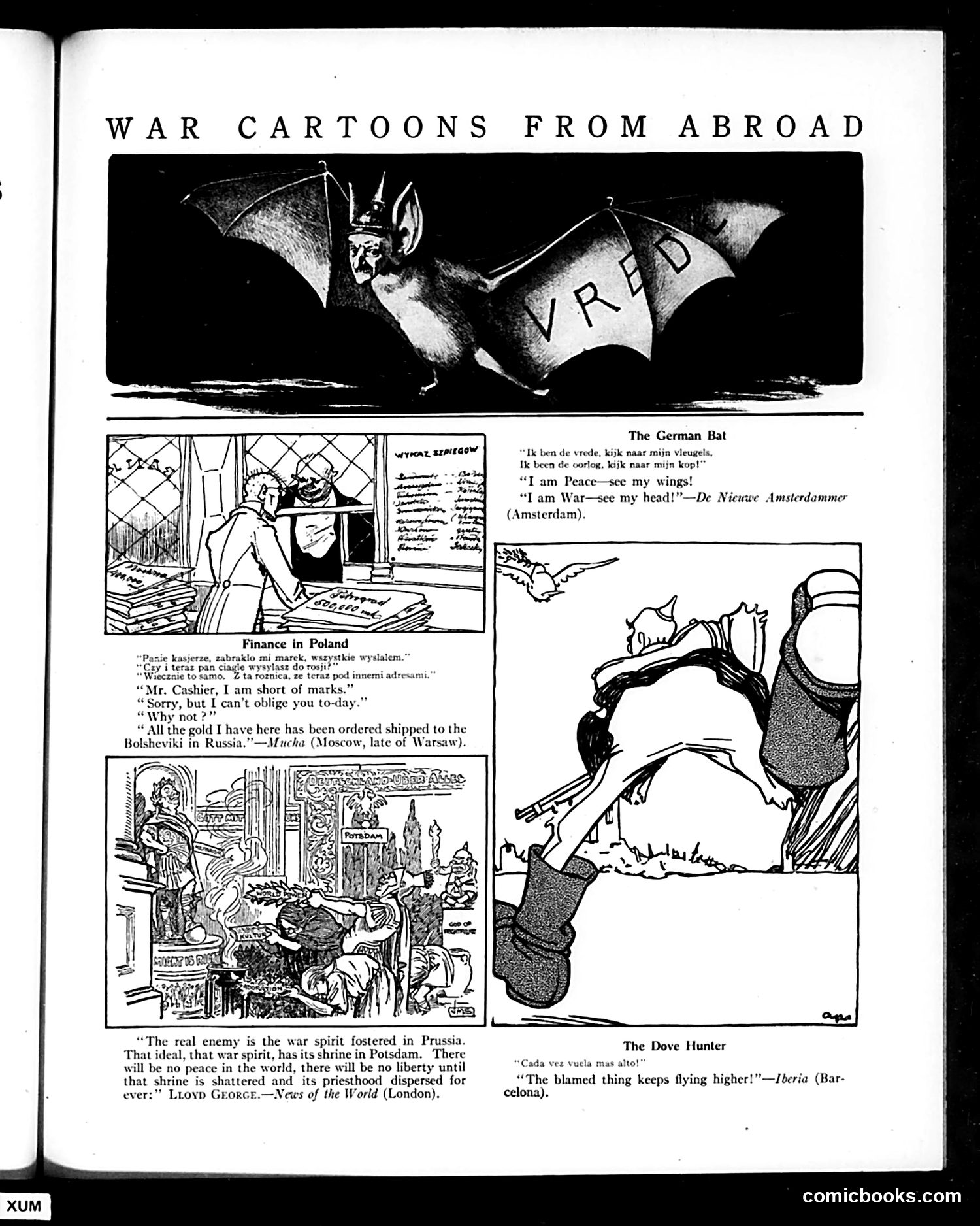
This page collects WWI-era political cartoons from European publications, commenting on the war's effects: **"The German Bat"** (Dutch): A creature with peace-dove wings but a warlike head—satirizing German hypocrisy about peaceful intentions while prosecuting war. **"Finance in Poland"** (Polish): A banker cannot provide gold because it's all being shipped to the Bolsheviki in Russia. This satirizes how Poland's resources were being drained during wartime chaos and the Russian Revolution's upheaval. **"The Dove Hunter"** (Spanish): A soldier tries shooting down a dove (peace symbol) but it keeps flying higher—mocking the futility of pursuing peace while militarism continues. **The Lloyd George quote** beneath emphasizes that Prussian militarism, centered in Potsdam, is the true obstacle to lasting peace. These cartoons reflect Allied-leaning European satire blaming German and militaristic forces for prolonging the war.
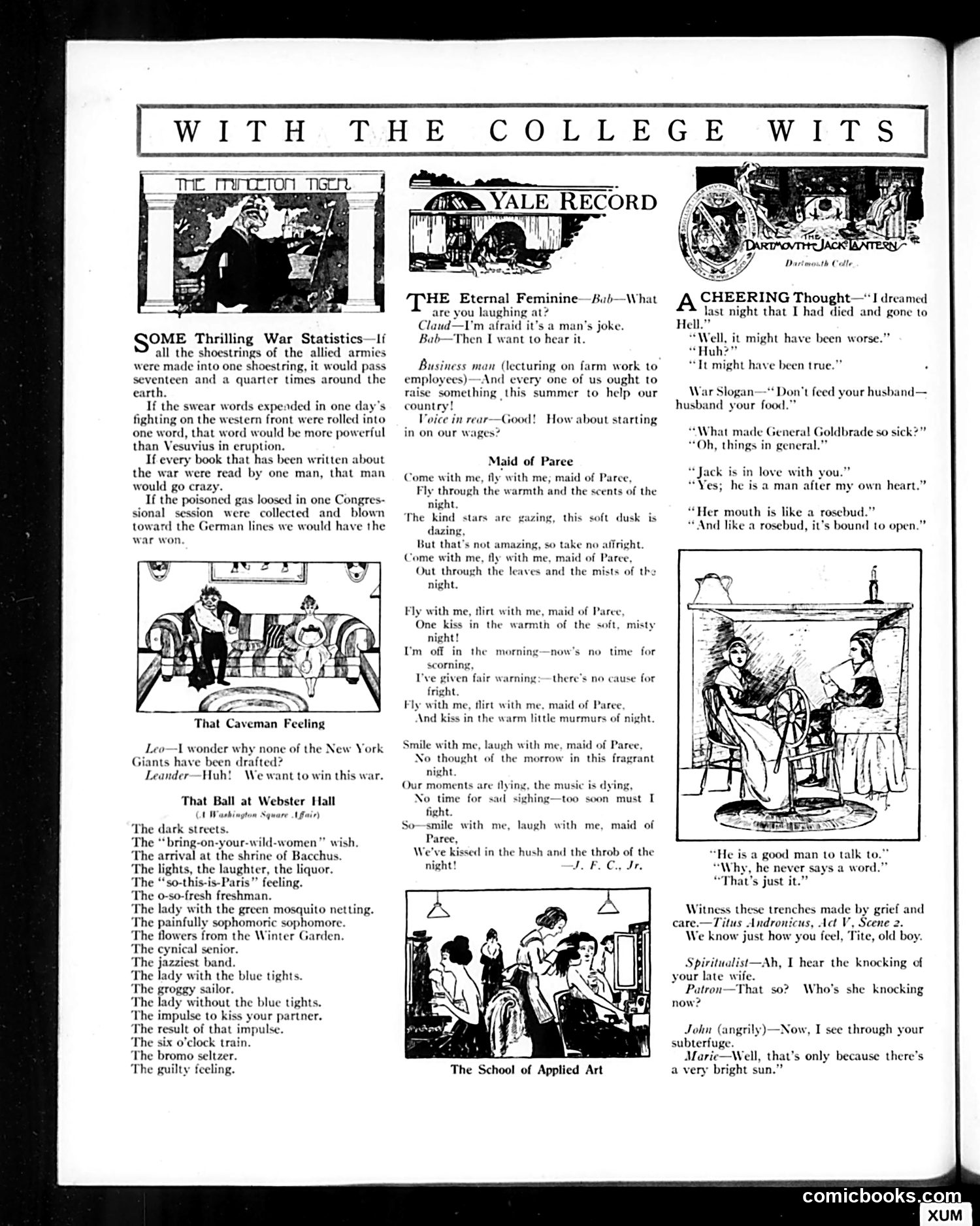
This page collects short humorous pieces targeting WWI-era American audiences. The content mixes college humor with war commentary: **"Thrilling War Statistics"** uses absurdist exaggeration to mock both the war's scale and Congressional incompetence—suggesting poisoned gas from politicians would defeat Germany better than actual combat. **"That Ball at Webster Hall"** catalogs the clichéd experiences of a Jazz Age party in Greenwich Village, satirizing both the pretentious desire to seem "Parisian" and the predictable stages of intoxication. **"Maid of Paree"** is a sentimental poem about a soldier seducing a French woman before returning to combat—likely mocking both romantic wartime literature and the casual treatment of French women by American soldiers. The shorter jokes target contemporary social hypocrisy: a wife's sarcastic "war effort" joke, the contradiction between asking workers to farm while cutting wages, and spiritualist fraudsters. The tone throughout is cynical about war, sexuality, and middle-class morality.
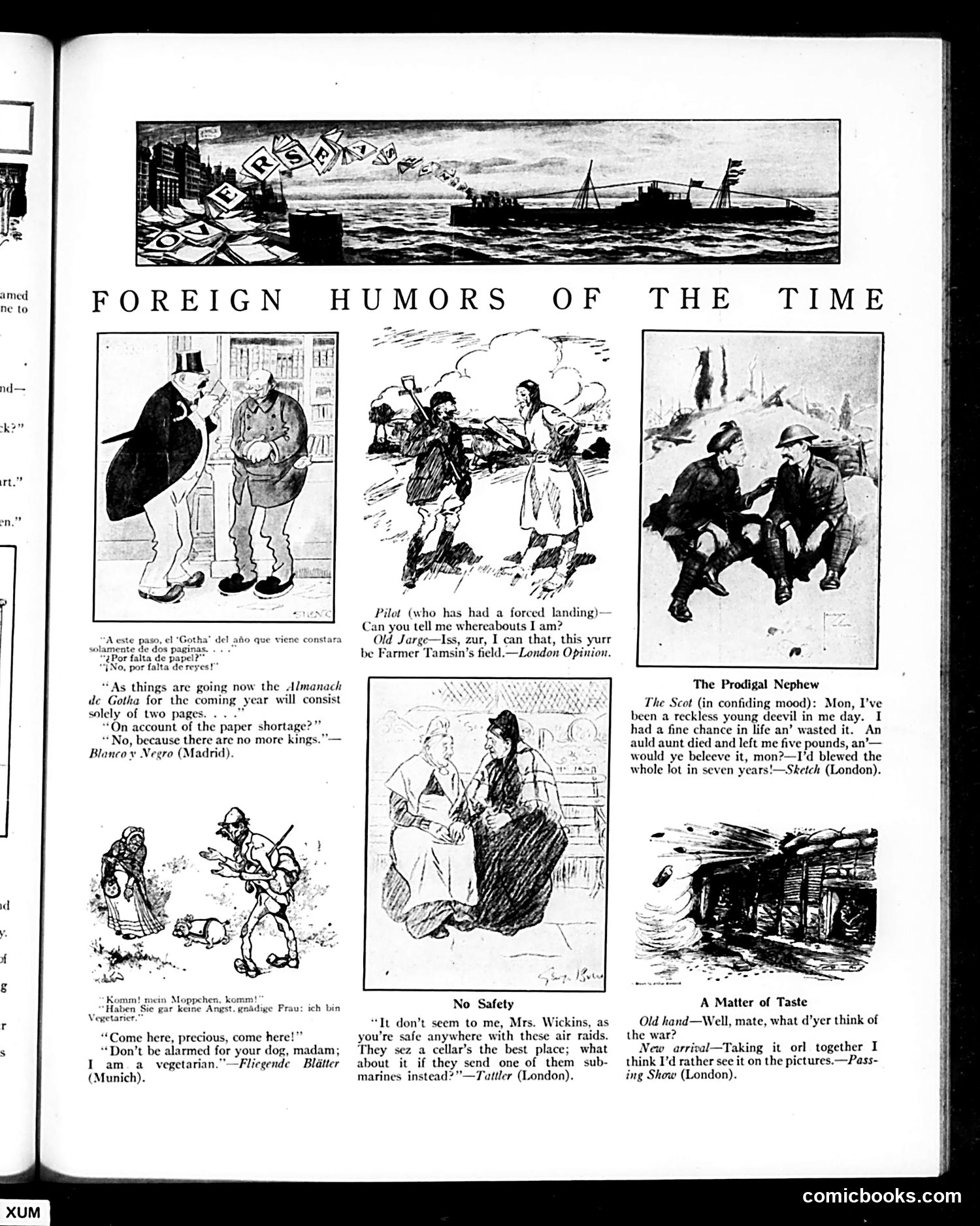
This page collects wartime satirical comics from European publications, likely from WWI era, reprinted in the American *Judge* magazine. **Key cartoons:** 1. **Spanish almanac joke**: References Europe's monarchies collapsing—the *Almanach de Gotha* (nobility registry) will shrink because there are "no more kings," not paper shortage. 2. **German vegetarian**: Dark humor about a soldier reassuring a woman he won't harm her dog because he's vegetarian—implying soldiers typically would. 3. **Air raid safety**: British satire on WWI/WWII civilian defense—a woman questions whether cellars help if submarines attack instead. 4. **Scotsman's inheritance**: Self-deprecating humor about squandering an aunt's five-pound bequest in seven years. 5. **War perspective**: A newcomer prefers watching war "on the pictures" (film) rather than experiencing it firsthand. These represent contemporary foreign perspectives on wartime anxieties: political upheaval, military threats, civilian vulnerability, and the surreal nature of modern warfare.
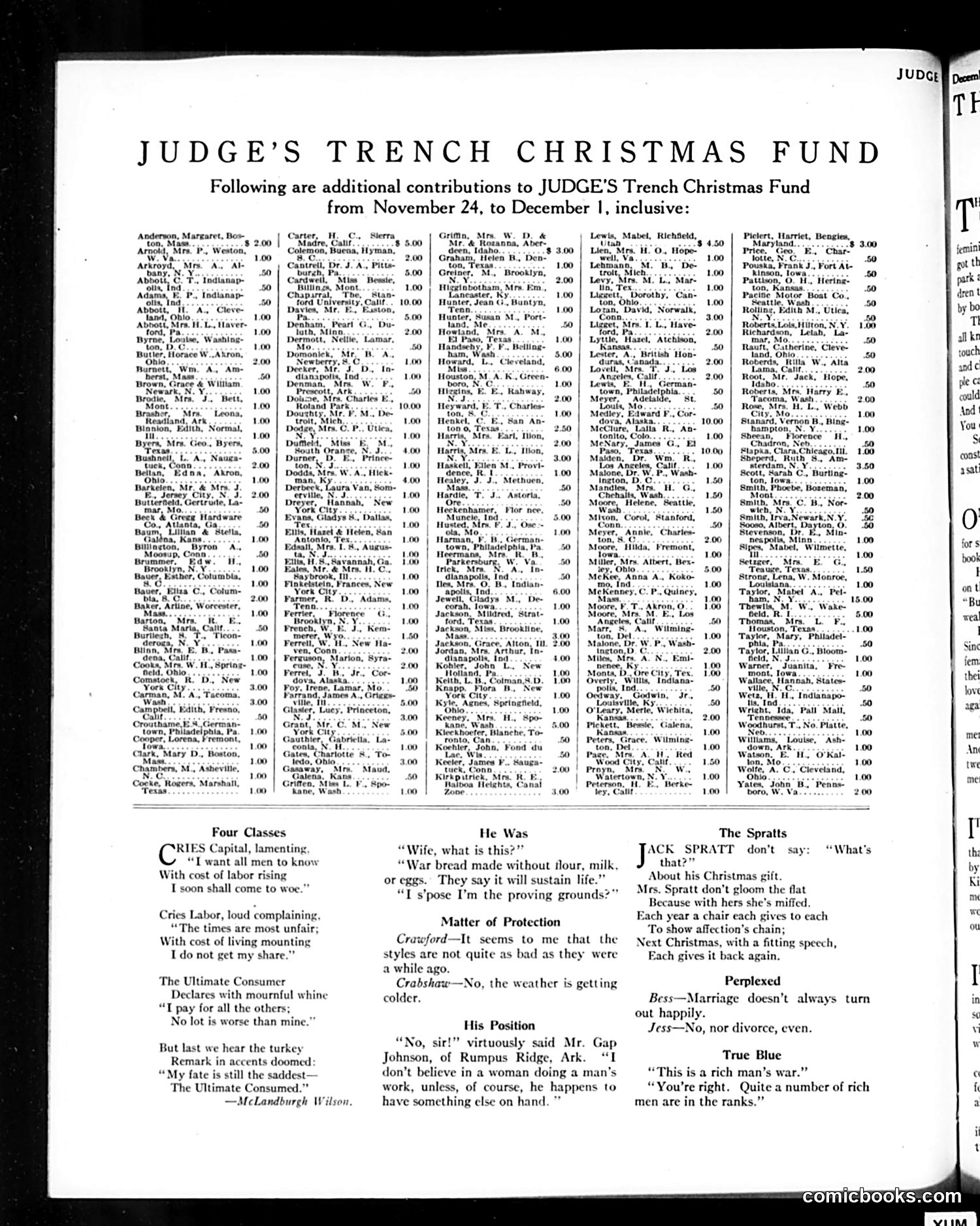
This page documents contributions to **Judge magazine's charitable fund for soldiers in World War I trenches**, a common philanthropic effort during 1917-1918. The bulk of the page is a donor list showing names, locations, and contribution amounts—evidence of widespread American civilian support for troops overseas. Below the donations appear several short humorous pieces satirizing **home-front social attitudes during wartime**. These sketches mock civilian complaints ("Four Classes" mocking whiners about labor and consumer costs) and gender-role tensions ("His Position," where a man refuses to believe women can do "men's work"). The satire targets those who complain about domestic hardships while soldiers suffer in trenches—a common wartime rhetorical device. The humor is gentle, poking fun at civilian self-centeredness and marital dynamics rather than serious political critique. This reflects Judge's role as patriotic entertainment supporting the war effort while gently ribbing American society's home-front preoccupations.
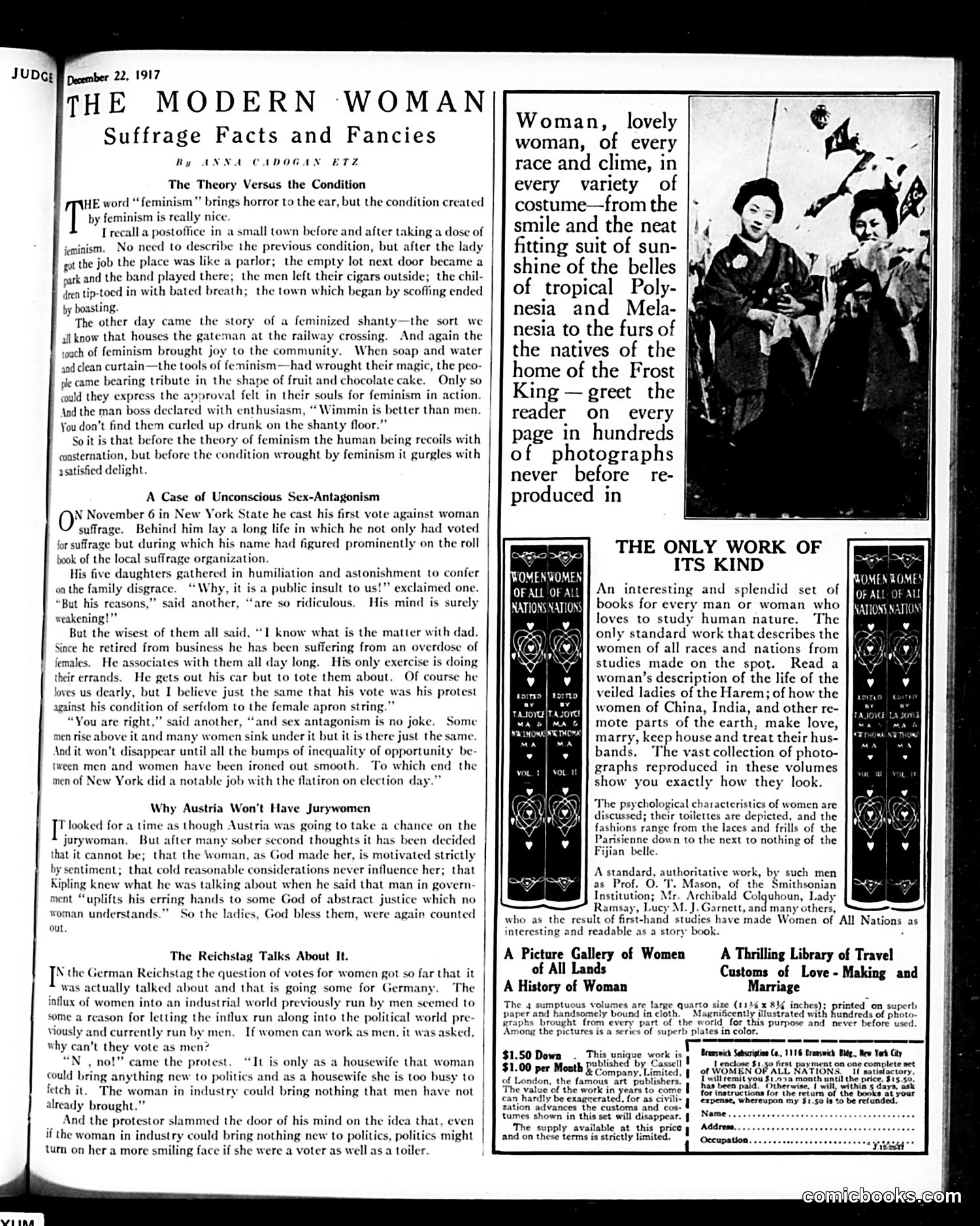
This page satirizes opposition to women's suffrage through multiple arguments presented as anti-feminist rhetoric. **Main Arguments Mocked:** 1. **"Theory vs. Condition"**: The author ironically claims feminism sounds bad but produces good results—women cleaning up towns, improving communities. The joke exposes how opponents can't actually object to feminism's *outcomes*, only the ideology. 2. **"Unconscious Sex-Antagonism"**: A man who publicly supported suffrage votes against it after retirement, spending all his time with his family. His daughters deduce he's unconsciously resentful of female dependence on him—exposing hidden misogyny beneath claimed principle. 3. **Austria/Germany sections**: Mock European objections that women are "too emotional" for juries or voting, suggesting such arguments are absurd excuses rather than legitimate concerns. **Context**: Published in 1917, this predates the 19th Amendment (1920). Judge uses satire to ridicule suffrage opponents by revealing the weakness and hypocrisy of their positions.
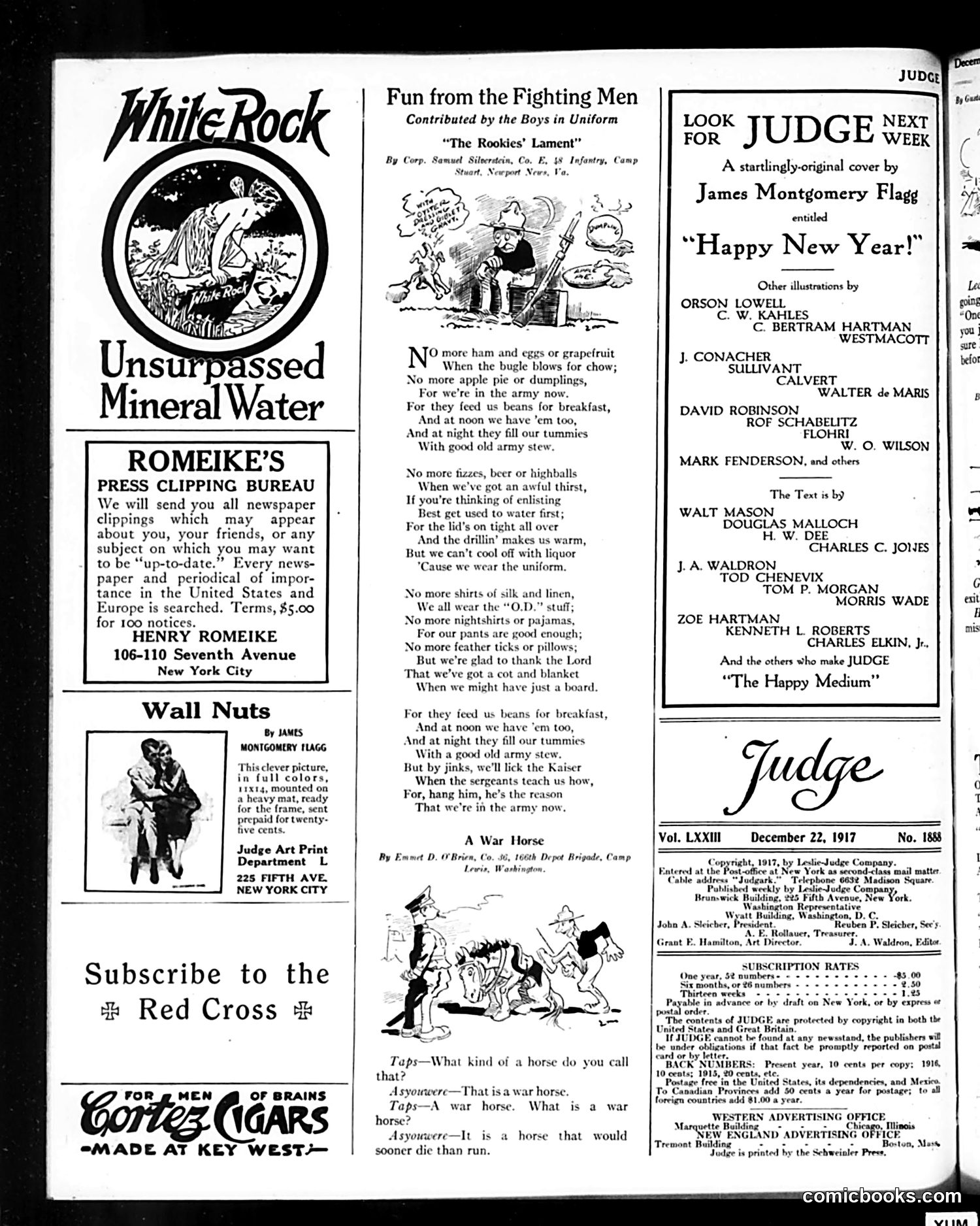
This page from Judge (a satirical weekly) features soldier humor submitted by WWI servicemen. "The Rookies' Lament" is a poem by a soldier at Camp Stuart complaining good-naturedly about military deprivations: no more ham and eggs, fancy clothes, or alcohol—replaced by beans, army stew, and regulation "O.D." (olive drab) uniforms. The tone is resigned but patriotic; the soldier concludes he'll "lick the Kaiser" once trained. "A War Horse" is a brief joke defining a war horse as "a horse that would sooner die than run"—implying soldiers must show courage. The page contextualizes these pieces as morale-boosting content "from the Fighting Men," allowing active servicemen a voice in the magazine. It reflects 1917 American entry into World War I and the cultural conversation around military service as inevitable and ultimately justified.
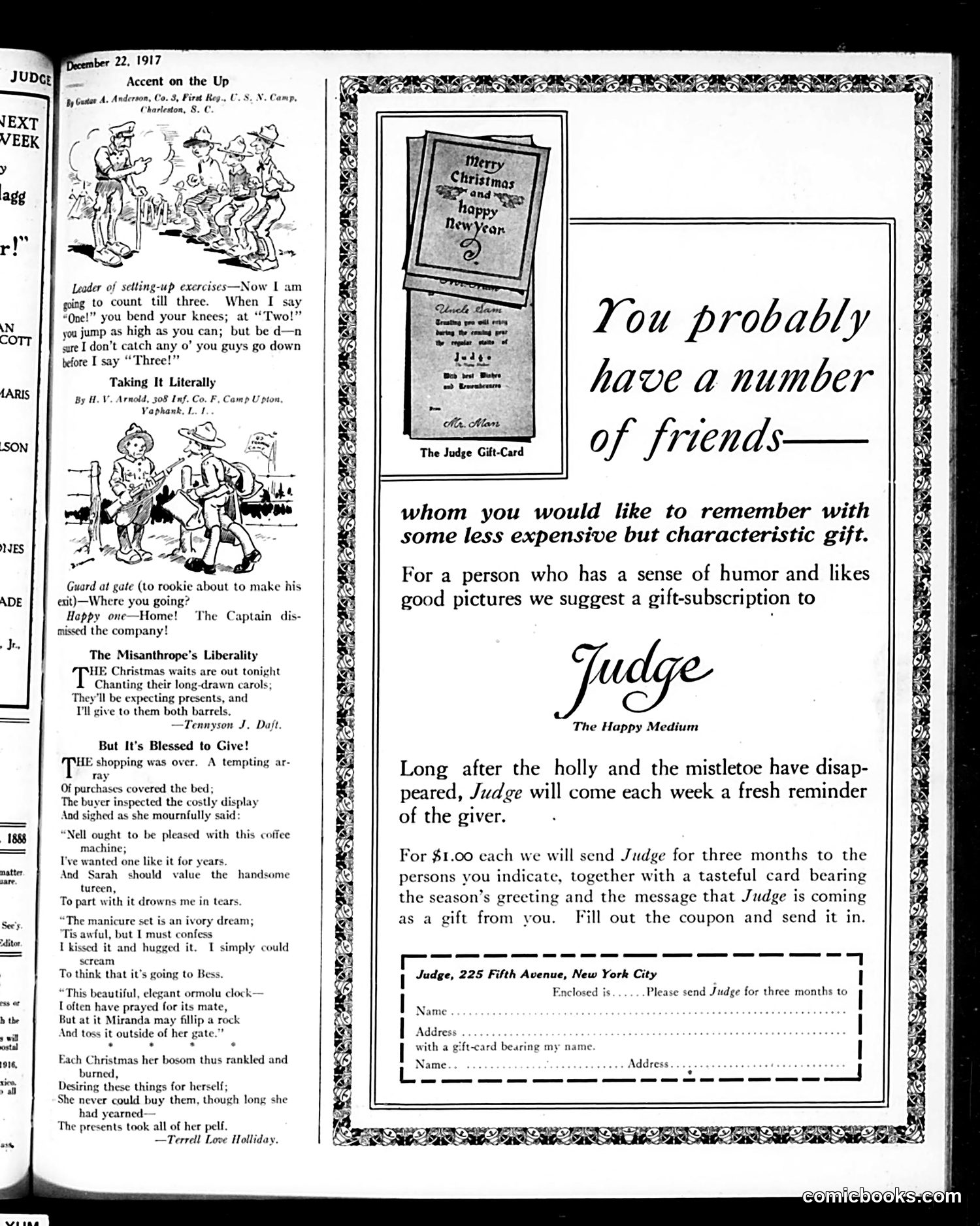
This page contains three separate cartoons satirizing military life and social customs during World War I, plus an advertisement. **"Accent on the Up"** and **"Taking It Literally"** mock newly enlisted soldiers at U.S. military training camps. The humor centers on recruits misunderstanding or literalizing drill sergeant commands—soldiers not jumping on "Two" as instructed, or a recruit claiming he must leave camp because he "missed the company." These target the perceived clumsiness of green recruits. **"But It's Blessed to Give!"** satirizes a wealthy woman's selfishness during gift-giving. She resents parting with beautiful items she covets—a coffee machine, tureen, manicure set, and ornolu clock—despite claiming to buy them as presents. The joke exposes the tension between generosity and materialism: she can only afford these luxuries by giving them away as gifts, which causes her genuine anguish. The **advertisement** promotes Judge magazine subscriptions as inexpensive Christmas gifts for friends with humor and taste, capitalizing on holiday shopping anxiety.
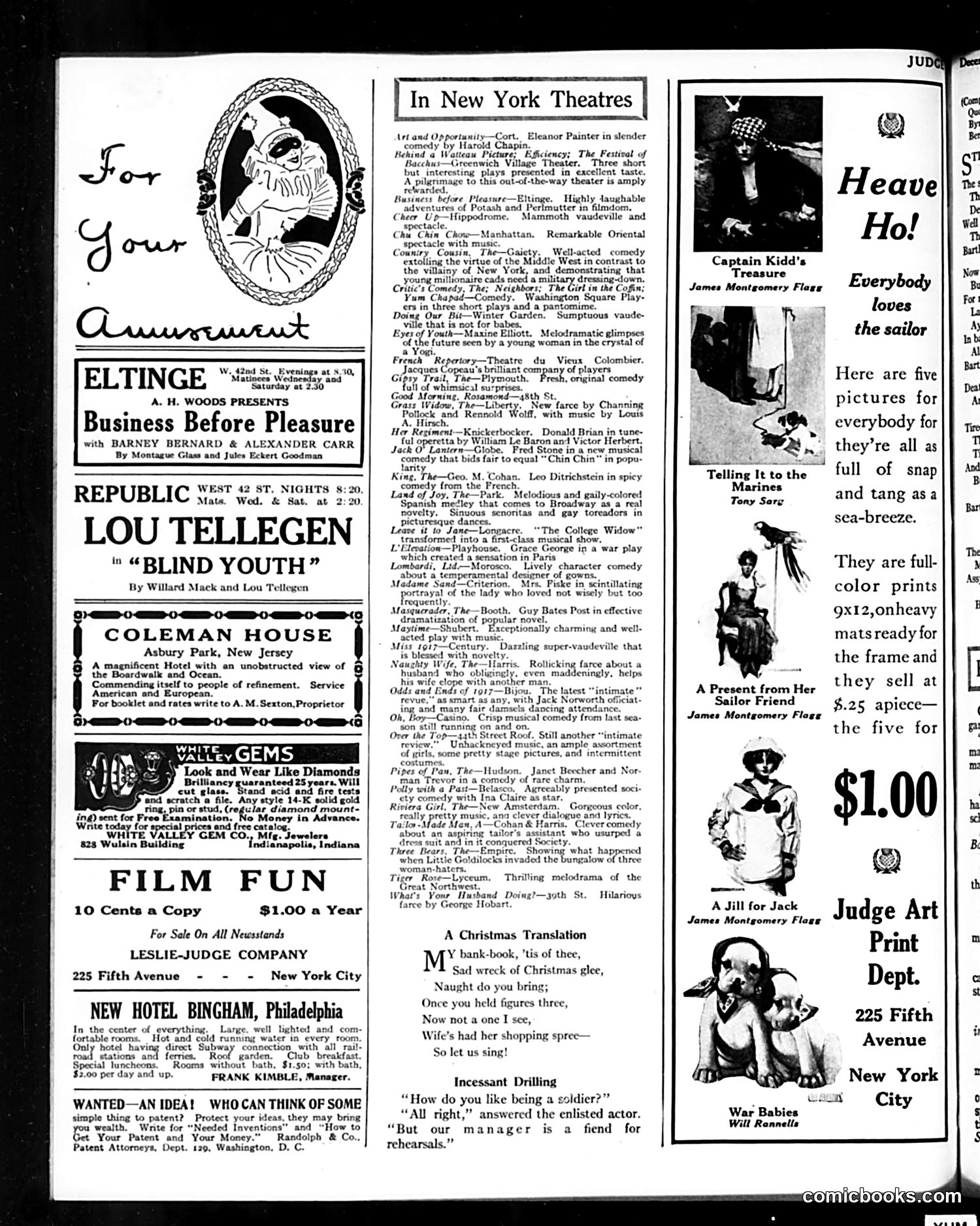
This page is primarily **advertising and theater listings**, not political satire. It's from Judge magazine and features: **Main Content:** - Theater reviews and advertisements for New York productions (Business Before Pleasure, Blind Youth, Chu Chin Chow, etc.) - Hotel advertisements (Coleman House, Hotel Bingham) - Product ads (fake diamonds, patent services) - Film Fun magazine promotion **Right sidebar:** Five illustrated nautical-themed pictures titled "Heave Ho! Everybody loves the sailor"—captioned images of sailors that appear designed as decorative prints for purchase ($1.00 for five). **Political/Social Context:** The sailor imagery likely reflects WWI-era patriotism (references to "War Babies" and "Doing Our Bit" appear in theater listings). The ads targeting middle-class consumers—hotels, patent opportunities, diamond substitutes—suggest aspirational marketing to Judge's readership. This is primarily a **commercial page**, not satirical commentary.
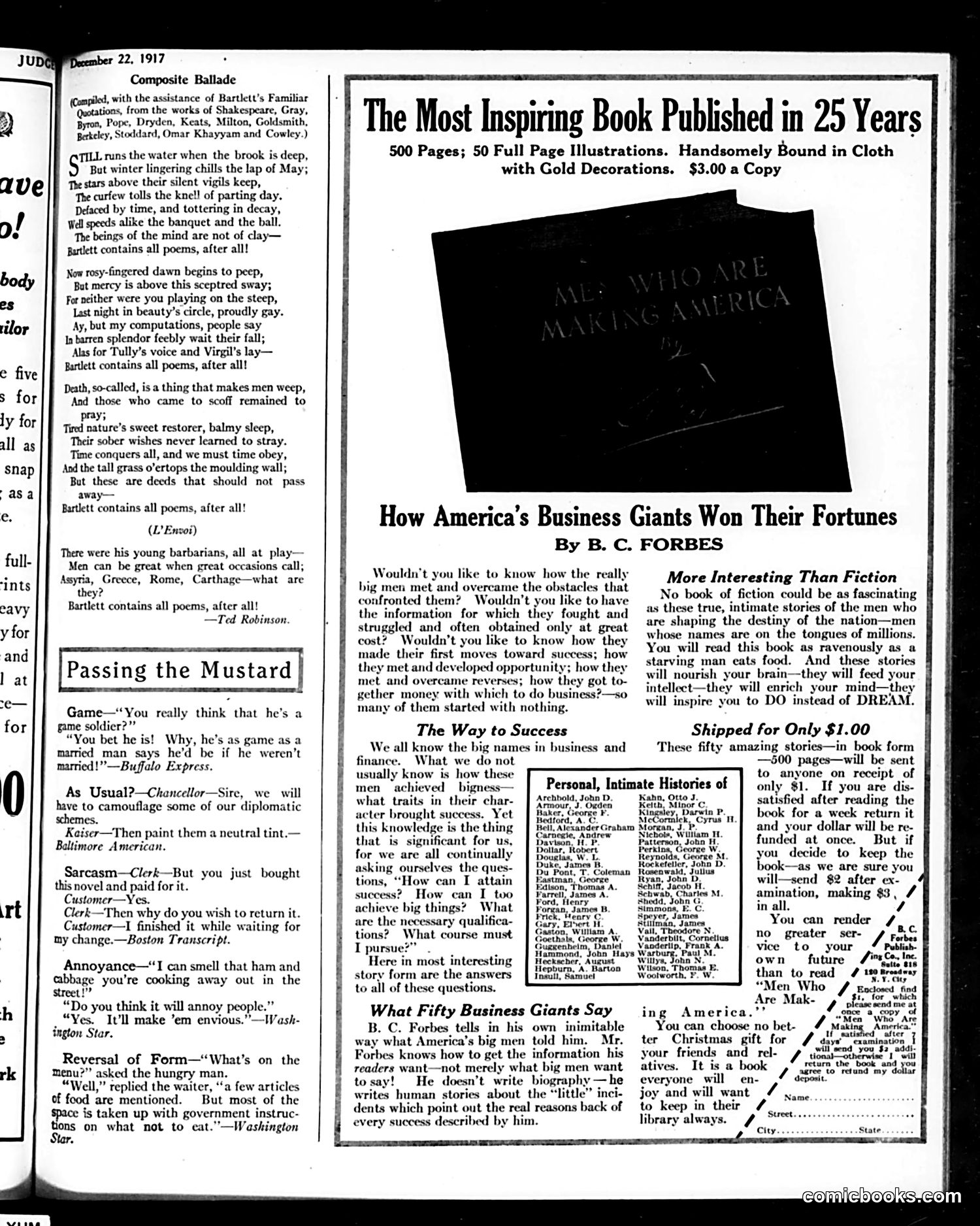
This page from Judge (December 22, 1917) contains literary satire and short joke columns, with a large advertisement. **"Composite Ballade"** by Ted Robinson is a humorous poem that mashes together famous lines from classic poets (Shakespeare, Byron, Keats, etc.) into one absurd work. The joke: no matter what literary fragments you assemble, they all somehow prove that "Bartlett contains all poems"—referencing *Bartlett's Familiar Quotations*, the famous reference book. It's satire on how thoroughly Bartlett's anthology captures literary culture. **The joke columns** ("Passing the Mustard") present brief, punchy one-liners about wartime life, marriage, and social awkwardness—typical Judge humor. **The large advertisement** promotes B.C. Forbes' business biography book (*How America's Business Giants Won Their Fortunes*), presenting it as inspirational self-help literature. This reflects the 1917 era's fascination with "rags-to-riches" narratives and business success mythology. The page shows Judge mixing literary mockery with patriotic-era content and commercial promotion.
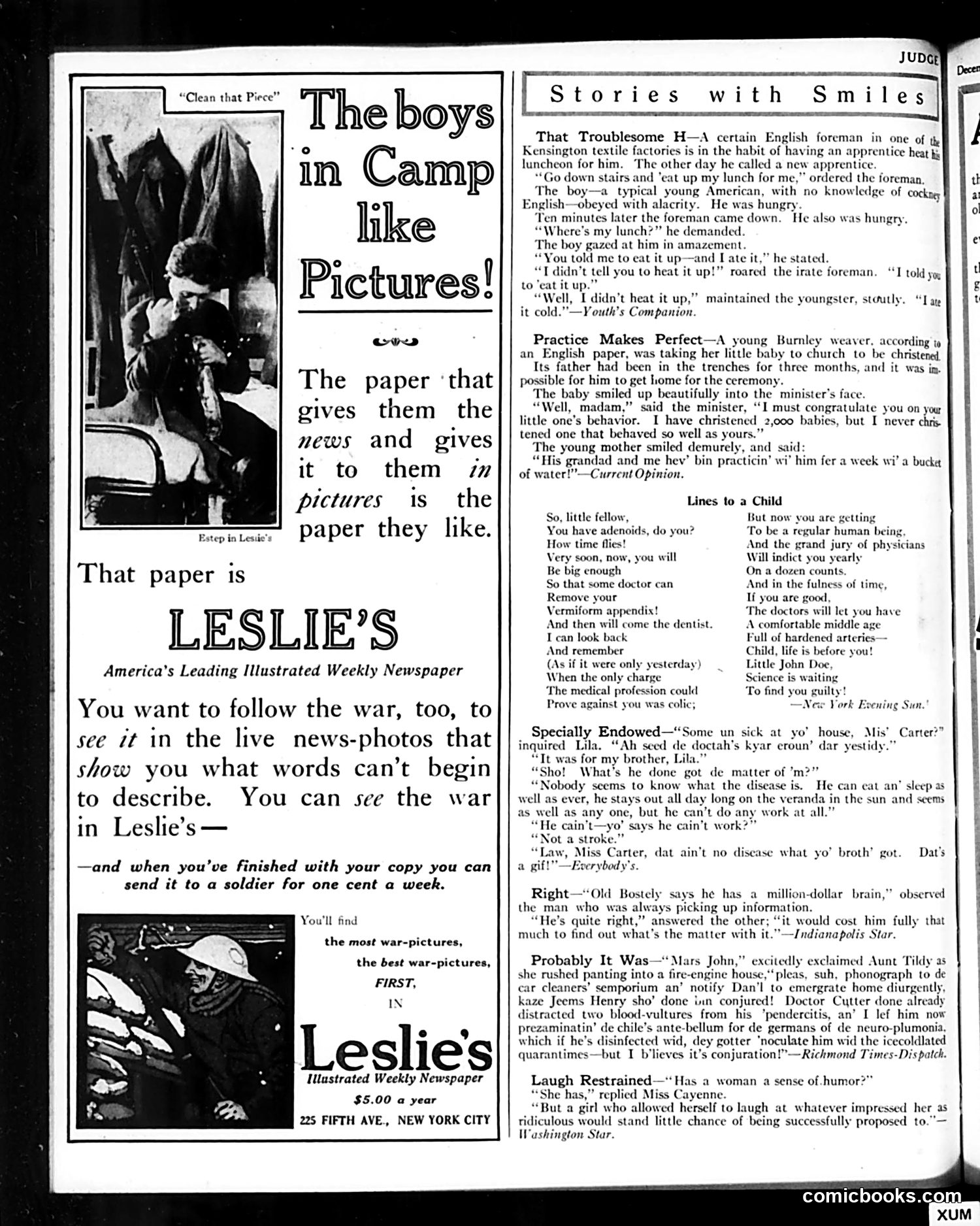
This page is primarily an **advertisement for Leslie's Illustrated Weekly Newspaper**, leveraging WWI patriotism. The main cartoon depicts soldiers in camp eagerly reading Leslie's because it provides war photographs—visual news that "words can't begin to describe." The pitch: readers should subscribe and send copies to soldiers for one cent weekly. The right column contains lighthearted humor pieces ("Stories with Smiles"), including dialect comedies featuring working-class and African American characters. These sketch brief comic misunderstandings: a young American literally "eats up" lunch instead of heating it; a baby's good behavior in church is attributed to parents practicing with a bucket of water; a doctor lists minor childhood ailments as life's inevitable punishments. The humor relies on wordplay, accent comedy, and gentle satire about medicine and class differences—typical of early-20th-century magazine humor. The page overall targets middle-class readers while promoting Leslie's as essential wartime reading superior to text-only competitors.
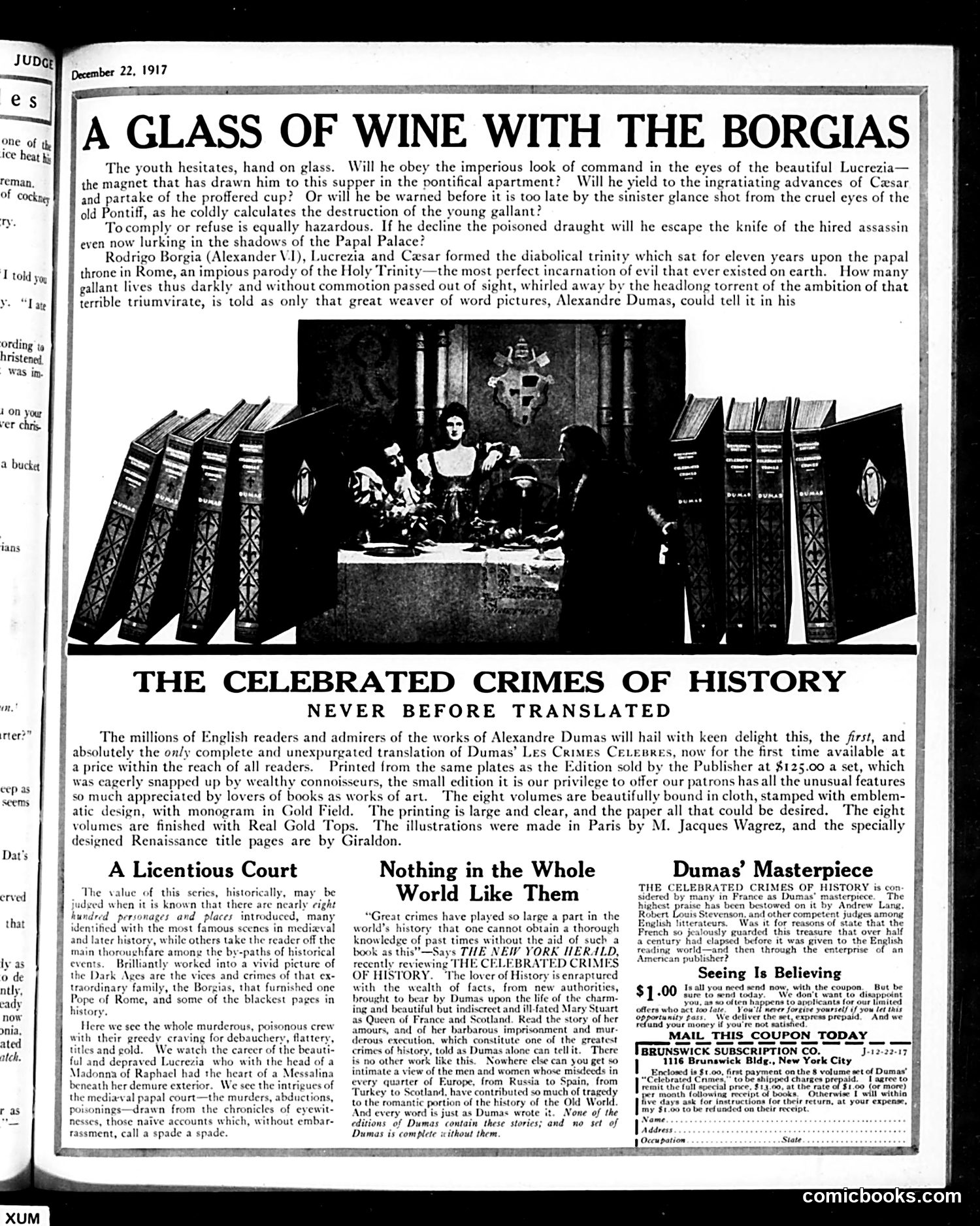
This is primarily **advertising content**, not political satire. The page promotes Alexandre Dumas's *Celebrated Crimes of History*, a newly translated eight-volume set about historical criminals. The illustration depicts a scene from Dumas's account of the Borgia family—specifically Pope Alexander VI, his daughter Lucrezia, and son Cesare. The dramatic narrative describes a young man tempted by Lucrezia's beauty while offered poisoned wine, warned only by the Pope's cruel glance, with assassins lurking nearby. This exemplifies the "diabolical trinity" the text claims ruled Rome for eleven years. The advertisement emphasizes this is the "first" complete English translation, previously available only in expensive editions ($125) for wealthy collectors. Judge is promoting an affordable new edition to ordinary readers. The historical Borgias represent ultimate corruption and evil—making their crimes sensational selling points for a mass-market book series.

This appears to be a title page or advertisement from *Judge* magazine containing only the text "Subscribe to the Red Cross" in a simple bordered box against a blank white background. There is no cartoon, caricature, or satirical content visible on this page. Rather than presenting political or social satire, this is a straightforward public service message encouraging readers to support the Red Cross organization through subscription or donation. The Red Cross was (and remains) a humanitarian organization providing disaster relief and medical services. During wartime periods when *Judge* was published, such appeals were common patriotic messaging. Without additional context about the specific publication date, I cannot determine what particular crisis or campaign this promotion supported.