
Judge, 1917-12-22 · page 13 of 28
Judge — December 22, 1917 — page 13: what you’re looking at
What you’re looking at
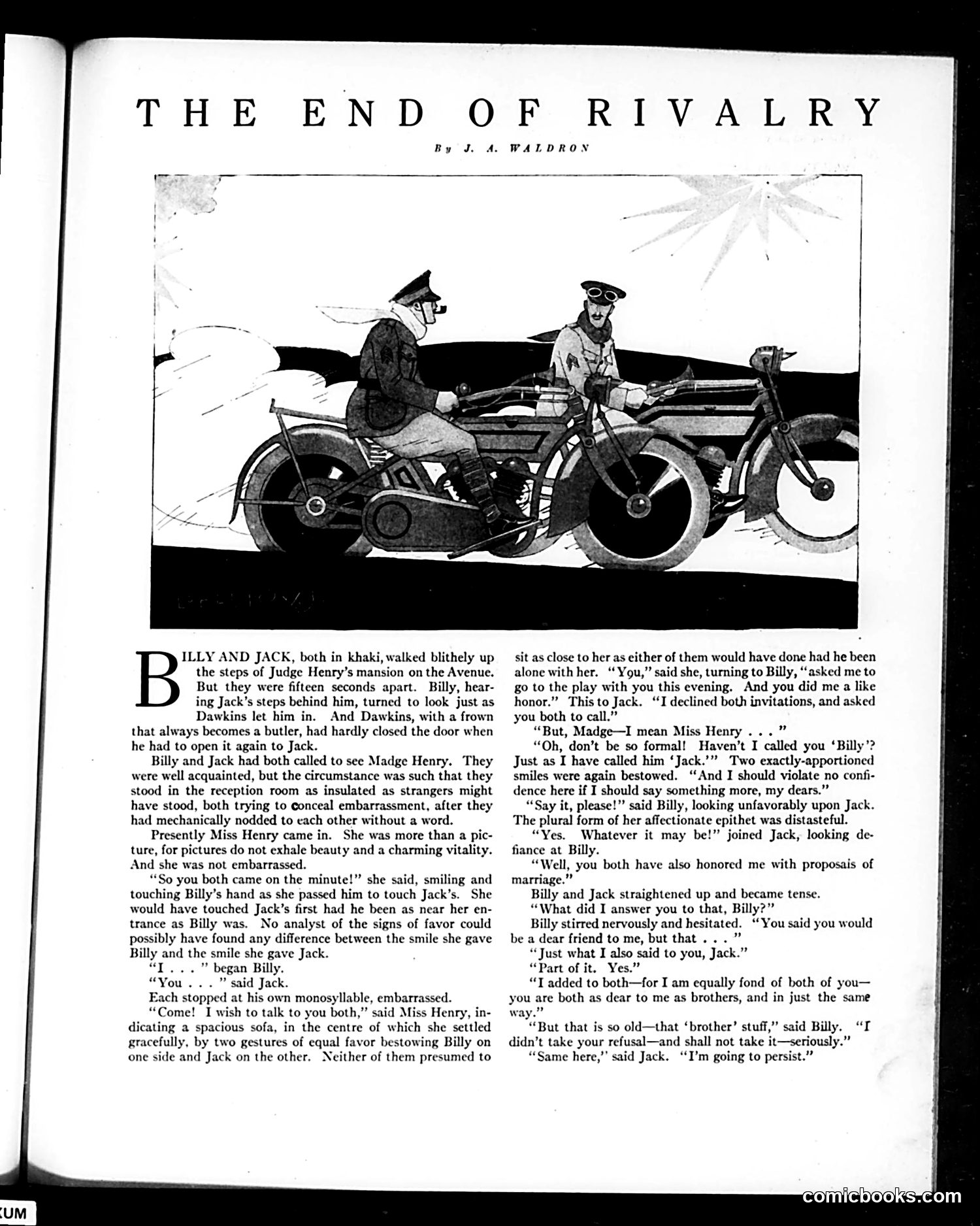
This is a romantic comedy story illustrated with a woodcut showing two men in military khaki uniforms arriving at a mansion on motorcycles/early motorcycles, competing for the same woman's affection. The plot concerns Billy and Jack, both suitors of Miss Madge Henry, who have each proposed marriage and invited her to the theater. Rather than choosing between them, Madge diplomatically treats both identically—touching their hands equally, bestowing identical smiles, and declaring she loves them both "as brothers." She refuses both marriage proposals. The men find this "brother" language old-fashioned and unsatisfying. Both announce they'll persist in their romantic efforts despite her refusal. The satire likely mocks sentimental courtship conventions and the persistence of young men unwilling to accept a woman's clear romantic decision, even when delivered with perfect equality and grace. The title's irony suggests rivalry will continue despite her attempt to end it.
📄 Transcribed text from this page (OCR, searchable)
Machine-transcribed from the original scan — historical spelling and the odd misread are preserved.
O vy J A, THE END F RIVALRY WALDRON ILLY AND JACK, both in khaki, walked blithely up the steps of Judge Henry’s mansion on the Avenue. But they were fifteen seconds apart. Billy, hear- ing Jack’s steps behind him, turned to look just as Dawkins let him in. And Dawkins, with a frown that always becomes a butler, had hardly closed the door when he had to open it again to Jack. Billy and Jack had both called to see Madge Henry. They were well acquainted, but the circumstance was such that they stood in the reception room as insulated as strangers might have stood, both trying to conceal embarrassment, after they had mechanically nodded to each other without a word. Presently Miss Henry came in. She was more than a pic- ture, for pictures do not exhale beauty and a charming vitality. And she was not embarrassed. “So you both came on the minute!” she said, smiling and touching Billy’s hand as she passed him to touch Jack’s. She would have touched Jack’s first had he been as near her en- trance as Billy was. No analyst of the signs of favor could possibly have found any difference between the smile she gave Billy and the smile she gave Jack. “IT...” began Billy. “You...” said Jack. Each stopped at his own monosyllable, embarrassed. “Come! I wish to talk to you both,” said Miss Henry, in- dicating a spacious sofa, in the centre of which she settled gracefully, by two gestures of equal favor bestowing Billy on one side and Jack on the other. Neither of them presumed to sit as close to her as either of them would have done had he been alone with her. “You,” said she, turning to Billy, “asked me to go to the play with you this evening. And you did me a like honor.” This to Jack. “I declined both invitations, and asked you both to call.” “But, Madge—I mean Miss Henry ... ” “Oh, don’t be so formal! Haven’t I called you ‘Billy’? Just as I have called him ‘Jack.’” Two exactly-apportioned smiles were again bestowed. ‘And I should violate no confi- dence here if I should say something more, my dears.” “Say it, please!” said Billy, looking unfavorably upon Jack. The plural form of her affectionate epithet was distasteful. “Yes. Whatever it may be!” joined Jack, looking de- fiance at Billy. “Well, you both have also honored me with proposais of marriage.” Billy and Jack straightened up and became tense. “What did I answer you to that, Billy?” Billy stirred nervously and hesitated. “You said you would be a dear friend to me, but that... ” “Just what I also said to you, Jack.” “Part of it. Yes.” “T added to both—for I am equally fond of both of you— you are both as dear to me as brothers, and in just the same way.” “But that is so old—that ‘brother’ stuff,” said Billy. “T didn’t take your refusal—and shall not take it—seriously.”” “Same here,”’ said Jack. “I’m going to persist.”