
Judge, 1917-12-22 · page 16 of 28
Judge — December 22, 1917 — page 16: what you’re looking at
What you’re looking at
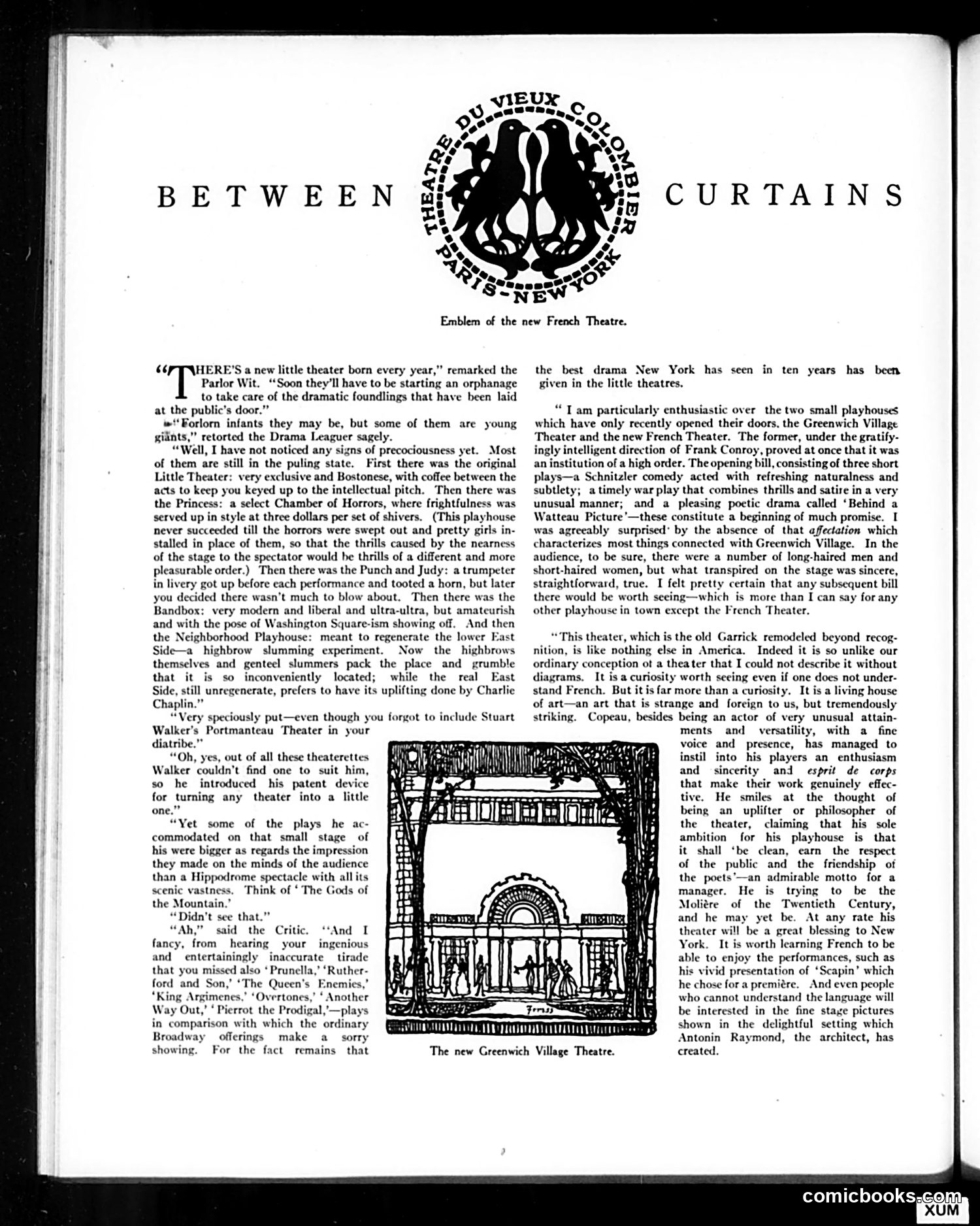
This article mocks the proliferation of small, experimental theaters in New York while paradoxically defending their artistic merit. Two characters debate whether these "theatrical foundlings" represent genuine innovation or pretentious failure. The piece catalogs existing "little theaters"—the original Little Theater (Boston, intellectual), the Princess (sensationalist), the Punch and Judy, the Bandbox (Greenwich Village poseurs), and the Neighborhood Playhouse (upper-class "slumming"). Stuart Walker's Portmanteau Theater is highlighted for adapting plays to small spaces effectively. The satire targets both the theaters' proliferation and their audiences: intellectuals, Greenwich Village bohemians, and wealthy dilettantes patronizing lower East Side venues. However, the critic ultimately concedes these venues produce superior drama compared to Broadway spectacles, citing avant-garde plays like "Prunella" and "The Gods of the Mountain." The accompanying architectural drawing depicts the new Greenwich Village Theater, embodying the bohemian aesthetic these establishments embodied.
📄 Transcribed text from this page (OCR, searchable)
Machine-transcribed from the original scan — historical spelling and the odd misread are preserved.
BETWEEN CURTAINS Emblem of the new French Theatre. 6“ HERE'S a new little theater born every year,” remarked the | Parlor Wit. ‘Soon they'll have to be starting an orphanage to take care of the dramatic foundlings that have been laid at the public’s door.” Forlorn infants they may be, but some of them are young giants,” retorted the Drama Leaguer sagely. “Well, I have not noticed any signs of precociousness yet. Most of them are still in the puling state. First there was the original Little Theater: very exclusive and Bostonese, with coffee between the acts to keep you keyed up to the intellectual pitch. Then there was the Princess: a select Chamber of Horrors, where frightfulness was served up in style at three dollars per set of shivers. (This playhouse never succeeded till the horrors were swept out and pretty girls in- stalled in place of them, so that the thrills caused by the nearness of the stage to the spectator would he thrills of a different and more pleasurable order.) Then there was the Punch and Judy: a trumpeter in livery got up before each performance and tooted a horn, but later you decided there wasn’t much to blow about. Then there was the Bandbox: very modern and liberal and ultra-ultra, but amateurish and with the pose of Washington Square-ism showing off. And then the Neighborhood Playhouse: meant to regenerate the lower East Side—a highbrow slumming experiment. Now the highbrows themselves and genteel slummers pack the place and grumble that it is so inconveniently located; while the real East Side, still unregenerate, prefers to have its uplifting done by Charlie “Very speciously put—even though you forgot to include Stuart Walker's Portmanteau Theater in your i l it diatribe.” “Oh, yes, out of all these theaterettes Walker couldn't find one to suit him, so he introduced his patent device for turning any theater into a little one.” iy “Yet some of the plays he ac- commodated on that small stage of his were bigger as regards the impression they made on the minds of the audience than a Hippodrome spectacle with all its scenic vastness. Think of ‘ The Gods of the Mountain,” “Didn't see that.” “Ah,” said the Critic. ‘‘And I fancy, from hearing your ingenious and entertainingly inaccurate tirade that you missed also ‘Prunella,’ ‘Ruther- ford and Son,’ ‘The Queen’s Enemies,’ “King Argimenes,’ ‘Overtones,’ ‘ Another Way Out,’ ‘ Pierrot the Prodigal,’—plays in comparison with which the ordinary Broadway offerings make a sorry showing. For the fact remains that The new Greenwich Village Theatre. the best drama New York has seen in ten years has been given in the little theatres. “ T am particularly enthusiastic over the two small playhouses which have only recently opened their doors. the Greenwich Village Theater and the new French Theater. The former, under the gratify- ingly intelligent direction of Frank Conroy, proved at once that it was an institution of a high order. The opening bill, consisting of three short plays—a Schnitzler comedy acted with refreshing naturalness and subtlety; a timely war play that combines thrills and satire in a very unusual manner; and a pleasing poetic drama called ‘Behind a Watteau Picture’—these constitute a beginning of much promise. I was agreeably surprised’ by the absence of that affectation which characterizes most things connected with Greenwich Village. In the audience, to be sure, there were a number of long-haired men and short-haired women, but what transpired on the stage was sincere, straightforward, true. I felt pretty certain that any subsequent bill there would be worth seeing—which is more than I can say for any other playhouse in town except the French Theater. “This theater, which is the old Garrick remodeled beyond recog- nition, is like nothing else in America. Indeed it is so unlike our ordinary conception ot a theater that I could not describe it without diagrams, It is a curiosity worth seeing even if one does not under- stand French. But it is far more than a curiosity. It is a living house of art—an art that is strange and foreign to us, but tremendously striking. Copeau, besides being an actor of very unusual attain- ments and versatility, with a fine voice and presence, has managed to instil into his players an enthusiasm and sincerity and esprit de corps that make their work genuinely effec- tive. He smiles at the thought of being an uplifter or philosopher of the theater, claiming that his sole ambition for his playhouse is that it shall ‘be clean, earn the respect of the public and the friendship of the poets’—an admirable motto for a manager. He trying to be the Molitre of the Twentieth Century, and he may yet be. At any rate his theater will be a great blessing to New York. It is worth learning French to be able to enjoy the performances, such as his vivid presentation of ‘Scapin’ which he chose for a premiére. And even people who cannot understand the language will be interested in the fine stage pictures shown in the delightful setting which Antonin Raymond, the architect, has created. ? Nt comicbooks 6 aft