
Judge, 1917-12-22 · page 14 of 28
Judge — December 22, 1917 — page 14: what you’re looking at
What you’re looking at
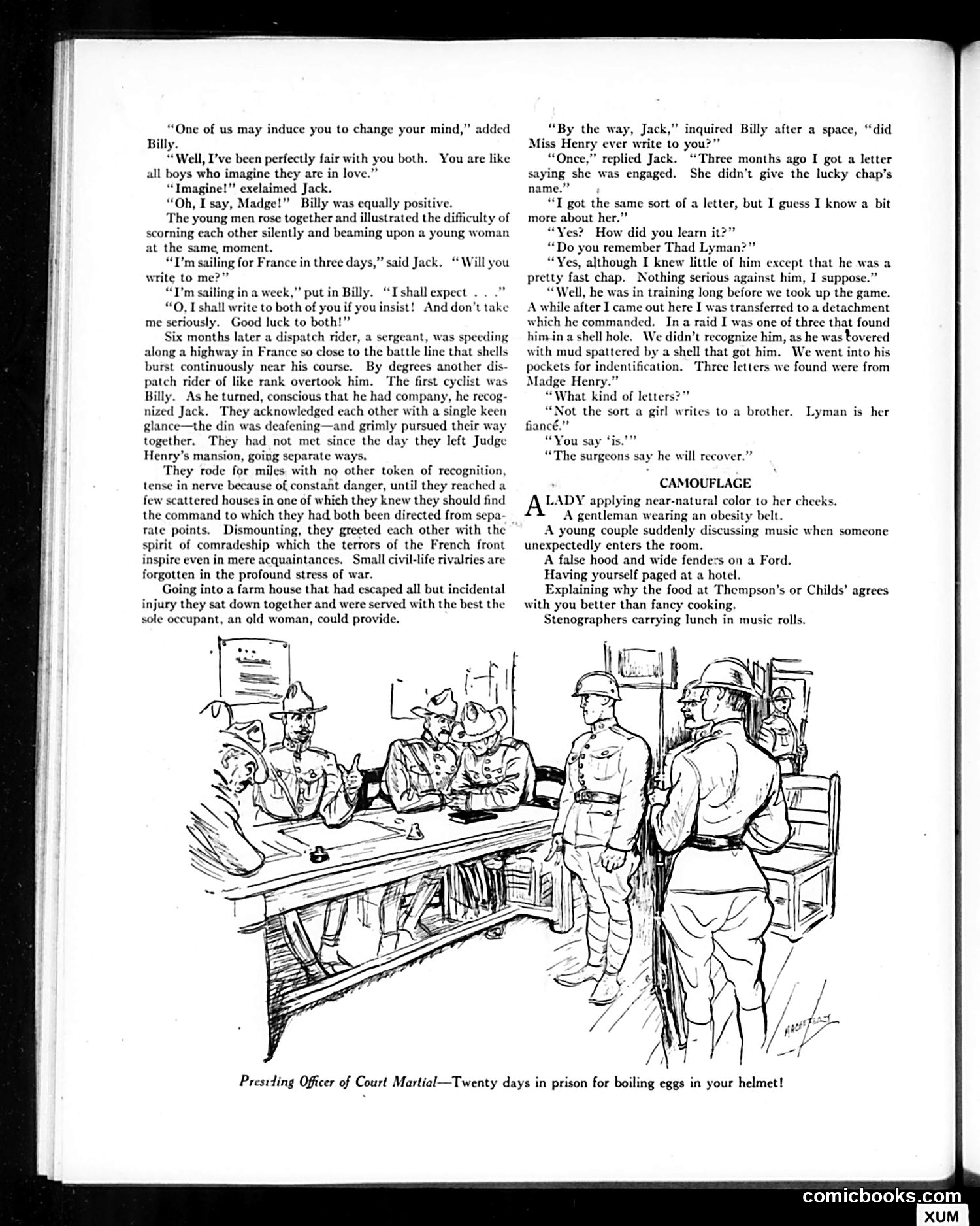
The page contains a romantic wartime narrative interrupted by satirical content. **Main Story:** Two young men, Jack and Billy, both court the same woman, Madge Henry, before sailing to France during World War I. Months later, they reunite as dispatch riders on the French front. Despite their romantic rivalry, they bond through military camaraderie. Billy reveals that Madge is engaged to Thad Lyman, a soldier they encountered wounded in a shell hole—letters found in his pockets proved his connection to her. **The Satire:** The bottom section titled "CAMOUFLAGE" humorously defines wartime deception—both literal (false car hoods) and social (pretending food tastes better than it does). The cartoon caption jokes about military discipline: a soldier faces "twenty days in prison for boiling eggs in your helmet"—mocking absurd military regulations. **Context:** The page reflects WWI-era American attitudes: romance interrupted by war, soldiers' shared danger transcending civilian rivalries, and satirical commentary on military bureaucracy and social pretense during wartime.
📄 Transcribed text from this page (OCR, searchable)
Machine-transcribed from the original scan — historical spelling and the odd misread are preserved.
“One of us may induce you to change your mind,” added Billy. “Well, I’ve been perfectly fair with you both. You are like all boys who imagine they are in love.” “Imagine!” exelaimed Jack. “Oh, I say, Madge!” Billy was equally positive. The young men rose together and illustrated the difficulty of scorning each other silently and beaming upon a young woman at the same, moment. “T'm sailing for France in three days,” said Jack. “Will you write to me?” “T'm sailing in a week,” put in Billy. “I shall expect . “O, I shall write to both of you if you insist! And don’t take me seriously. Good luck to both!” Six months later a d. tch rider, a sergeant, was speeding along a highway in France so close to the battle line that shells burst continuously near his course. By degrees another dis- patch rider of like rank overtook him. The first cyclist w Billy. As he turned, conscious that he had company, he recog- nized Jack. They acknowledged each other with a single keen glance—the din was deafening—and grimly pursued their way together. They had not met since the day they left Judge Henry’s mansion, going separate ways. They rode for miles with no other token of recognition, tense in nerve because of constant danger, until they reached a few scattered houses in ane of which th new they should find the command to which they had both been directed from sepa- rate points. Dismounting, they greeted each other with the spirit of comradeship which the terrors of the French front inspire even in mere acquaintances. Small civil-life rivalries are forgotten in the profound stress of war. Going into a farm house that had escaped all but incidental injury they sat down together and were served with the best the sole occupant, an old woman, could provide. “By the way, Jack,” inquired Billy after a space, “did Miss Henry ever write to you?” “Once,” replied Jack. “Three months ago I got a letter saying she was engaged. She didn’t give the lucky chap’s name.” “T got the same sort of a letter, but I guess I know a bit more about her.” “Yes? How did you learn it?” “Do you remember Thad Lyman?” “Yes, although I knew little of him except that he was a pretty fast chap. Nothing serious against him, I suppose.” “Well, he was in training long before we took up the game. A while after I came out here I was transferred to a detachment which he commanded. In a raid I was one of three that found himina shell hole. We didn’t recognize him, as he was tovered with mud spattered by a shell that got him. We went into his pockets for indentification. Three letters we found were from Madge Henry.” What kind of letters?” ot the sort a girl writes to a brother. Lyman is her y he will recover.” . CAMOUFLAGE A ADY applying near-natural color to her cheeks. A gentleman wearing an obesity belt. A young couple suddenly discussing music when someone unexpectedly enters the room. A false hood and wide fenders on a Ford. Having yourself paged at a hotel. Explaining why the food at Thempson’s or Childs’ agrees with you better than fancy cooking. Stenographers carrying lunch in music rolls. Prestding Officer of Court Martial—Twenty days in prison for boiling eggs in your helmet! comicbooks.com