
Judge, 1917-12-22 · page 4 of 28
Judge — December 22, 1917 — page 4: what you’re looking at
What you’re looking at
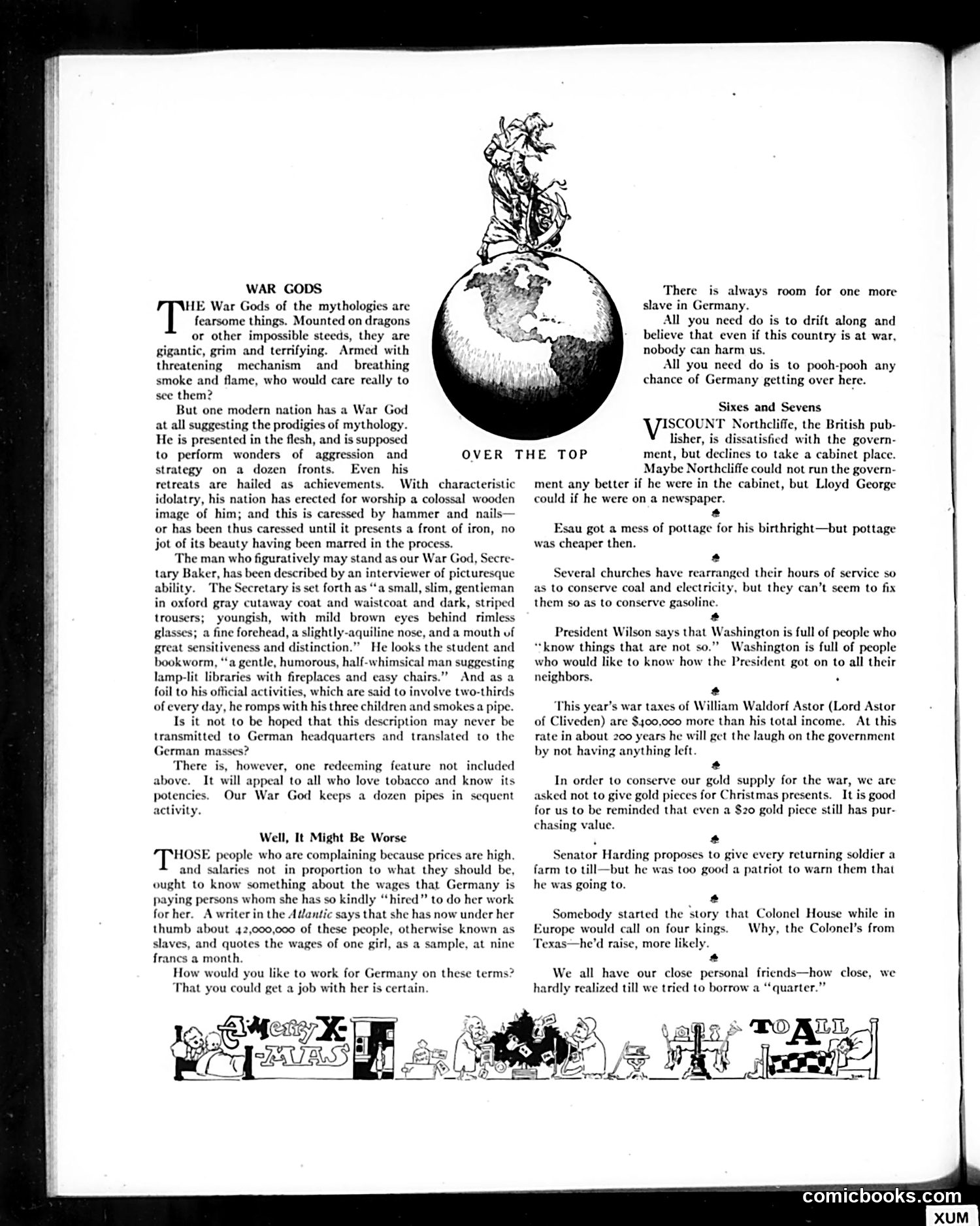
This page contains satirical commentary on World War I-era politics and society. The main article "War Gods" mocks how modern nations (particularly Germany) have created idealized, propagandistic images of military leadership—contrasting mythology's war gods with reality's bureaucratic "small, slim gentlemen" in striped trousers. The right column contains brief satirical items about wartime conditions: churches conserving fuel, President Wilson's Washington being full of people who "know things that are not so," high war taxes on wealthy industrialists like William Waldorf Astor, and proposals to give returning soldiers farms. The cartoon "Over the Top" depicts a figure standing atop a globe, likely representing militaristic ambition or German expansionism during WWI. The overall tone criticizes both military romanticism and wartime government inefficiency and excess.
📄 Transcribed text from this page (OCR, searchable)
Machine-transcribed from the original scan — historical spelling and the odd misread are preserved.
WAR GODS HE War Gods of the mythologies are T fearsome things. Mounted on dragons or other impossible s gigantic, grim and terrifying. Armed with threatening mechanism and__ breathing smoke and flame, who would care really to see them? But one modern nation has a War God at all suggesting the prodigies of mythology. He is presented in the flesh, and is supposed to perform wonders of aggression and strategy on a dozen fronts. Even his retreats are hailed as achievements. With characteristic idolatry, his nation has erected for worship a colossal wooden image of him; and this is caressed by hammer and_nails— or has been thus caressed until it presents a front of iron, no jot of its beauty having been marred in the process. The man who figuratively may stand as our War God, Secre- tary Baker, has been described by an interviewer of picturesque ability. The Secretary is set forth as “a small, slim, gentleman in oxford gray cutaway coat and waistcoat and dark, striped trousers; youngish, with mild brown eyes behind rimless glasses; a fine forehead, a slightly-aquiline nose, and a mouth of great sensitiveness and distinction.” He looks the student and bookworm, “a gentle, humorous, half-whimsical man suggesting lamp-lit libraries with fireplaces and easy chairs.” And as a foil to his official activities, which are said to involve two-thirds of every day, he romps with his three children and smokes a pipe. Is it not to be hoped that this description may never be transmitted to German headquarters and translated to the German masses: There is, however, one redeeming feature not included above. It will appeal to all who love tobacco and know its s. Our War God keeps a dozen pipes in sequent eeds, they are Well, It Might Be Worse ‘THOSE people who are complaining because prices are high, and salaries not in proportion to what they should be, ought to know something about the wages that Germany is paying persons whom she has so kindly “hired” to do her work forher. A writer in the AWantic says that she has now under her thumb about 42,000,000 of these people, otherwise known as slaves, and quotes the wages of one girl, as a sample, at nine francs a month. How would you like to work for Germany on these terms? That you could get a job with her is certain. OVER THE TOP There is always room for one more slave in Germany. All you need do is to drift along and believe that even if this country is at war, nobody can harm us. All you need do is to pooh-pooh any chance of Germany getting over here. Sixes and Sevens T Northcliffe, the British pub- lisher, is dissatisfied with the govern- ment, but declines to take a cabinet place. Maybe Northcliffe could not run the govern- ment any better if he were in the cabinet, but Lloyd George could if he were on a newspaper. es Esau got a mess of pottage for his birthright—but pottage was cheaper then. 2 Several churches have rearranged their hours of service so as to conserve coal and electricity, but they can’t seem to fix them so as to conserve gasoline. 2 President Wilson says that Washington is full of people who “know things that are not so.” Washington is full of people who would like to know how the President got on to all their neighbors. . ¢ This year’s war taxes of William Waldorf Astor (Lord Astor of Cliveden) are $400,000 more than his total income. At this rate in about 200 years he will get the laugh on the government by not having anything left In order to conserve our gold supply for the war, we are asked not to give gold pieces for Christmas presents. It is good for us to be reminded that even a $20 gold piece still has pur- chasing value. ‘ * Senator Harding proposes to give every returning soldier a farm to till—but he was too good a patriot to warn them that he was going to. * Somebody started the story that Colonel House while in rope would call on four kings. Why, the Colonel’s from Texas—he'd raise, more lik 2 We all have our close personal friends—how close, we hardly realized till we tried to borrow a “quarter.” comicbooks.com