
Judge, 1917-12-22 · page 12 of 28
Judge — December 22, 1917 — page 12: what you’re looking at
What you’re looking at
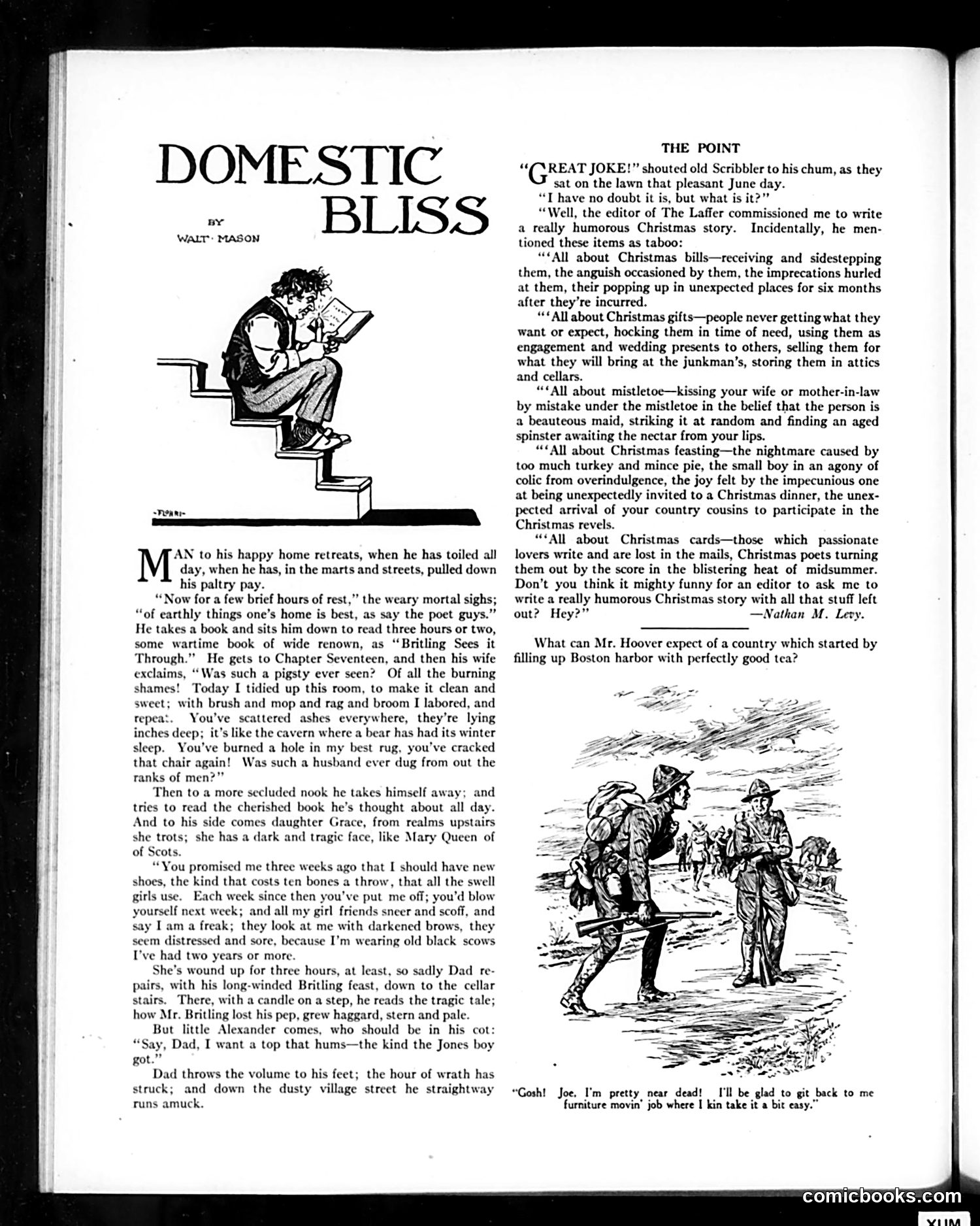
This page contains two satirical pieces about middle-class domestic life. **"Domestic Bliss"** (left) depicts a husband's futile attempt to enjoy leisure reading at home. He's repeatedly interrupted—first by his wife complaining about housekeeping, then by his daughter demanding new shoes, finally by his young son. Each interruption forces him downstairs seeking refuge, eventually driving him to flee into the streets in frustrated chaos. The satire mocks the impossibility of domestic peace and husbands' powerlessness against the endless demands of family. **"The Point"** (right) is meta-satire: two writers discuss an editor's absurd commission for a "humorous" Christmas story while prohibiting all standard Christmas humor topics—bills, unwanted gifts, mistletoe mishaps, overeating, unexpected guests, and lost cards. The joke exposes editorial hypocrisy: asking for humor while forbidding the very situations that make Christmas funny. It's satire about satire itself.
📄 Transcribed text from this page (OCR, searchable)
Machine-transcribed from the original scan — historical spelling and the odd misread are preserved.
DOMESTIC AN to his happy home retreats, when he has toiled all day, when he has, in the marts and streets, pulled down his paltry pay. “Now for a few brief hours of rest,” the weary mortal sighs; “of earthly things one’s home is best, as say the poet guys.” He takes a book and sits him down to read three hours or two, some wartime book of wide renown, as “Britling Sees it Through.” He gets to Chapter Seventeen, and then his wife exclaims, “Was such a pigsty ever seen? Of all the burning shames! Today I tidied up this room, to make it clean and sweet; with brush and mop and rag and broom I labored, and scattered ashes everywhere, they’re lying $ ¢ the cavern where a bear has had its winter sleep. You've burned a hole in my best rug, you've cracked that chair again! Was such a husband ever dug from out the ranks of men?” Then to a more secluded nook he takes himself away; and tries to read the cherished book he’s thought about all day. And to his side comes daughter Grace, from realms upstairs she trots; she has a dark and tragic face, like Mary Queen of of Scots. “You promised me three weeks ago that I should have new the kind that costs ten bones a throw, that all the swell since then you've put me off: self next week; and all my girl friends sne« say Iam a freak; they look at me with darkened brows seem distressed and sore, because I’m wearing old black scows I've had two years or more. She’s wound up for three hours, at least, so sadly Dad re- pairs, with his long-winded Britling feast, down to the cellar stairs. There, with a candle on a step, he reads the tragic tale; how Mr. Britling lost his pep, grew haggard, stern and pale. But little Alexander comes, who should be in his cot: Dad, I want a top that hums—the kind the Jones boy Dad throws the volume to his feet; the hour of wrath has struck; and down the dusty village street he straightway runs amuck. THE POINT “GREAT JOKE!” shouted old Scribbler to his chum, as they sat on the lawn that pleasant June day. “T have no doubt it is, but what is it?” “Well, the editor of The Laffer commissioned me to write a really humorous Christmas story. Incidentally, he men- tioned these items as taboo: “All about Christmas bills—receiving and sidestepping them, the anguish occasioned by them, the imprecations hurled at them, their popping up in unexpected places for six months after they’re incurred. “* All about Christmas gifts—people never getting what they want or expect, hocking them in time of need, using them as engagement and wedding presents to others, selling them for what they will bring at the junkman’s, storing them in attics and cellars. “All about mistletoe—kissing your wife or mother-in-law by mistake under the mistletoe in the belief that the person is a beauteous maid, striking it at random and finding an aged spinster awaiting the nectar from your lips. “All about Christmas feasting—the nightmare caused by too much turkey and mince pie, the small boy in an agony of colic from overindulgence, the joy felt by the impecunious one at being unexpectedly invited to a Christmas dinner, the unex- pected arrival of your country cousins to participate in the Christmas revels. “*All about Christmas cards—those which passionate lovers write and are lost in the mails, Christmas poets turning them out by the score in the blistering heat of midsummer. Don’t you think it mighty funny for an editor to ask me to write a really humorous Christmas story with all that stuff left out? Hey?” —Nathan M. Levy. What can Mr. Hoover expect of a country which started by filling up Boston harbor with perfectly good tea? “Gosh! Joe, I'm pretty near dead! I'll be glad to git back to me furniture movin’ job where I kin take it a bir easy.” comicbooks.com