
A complete issue · 28 pages · 1917
Judge — September 22, 1917
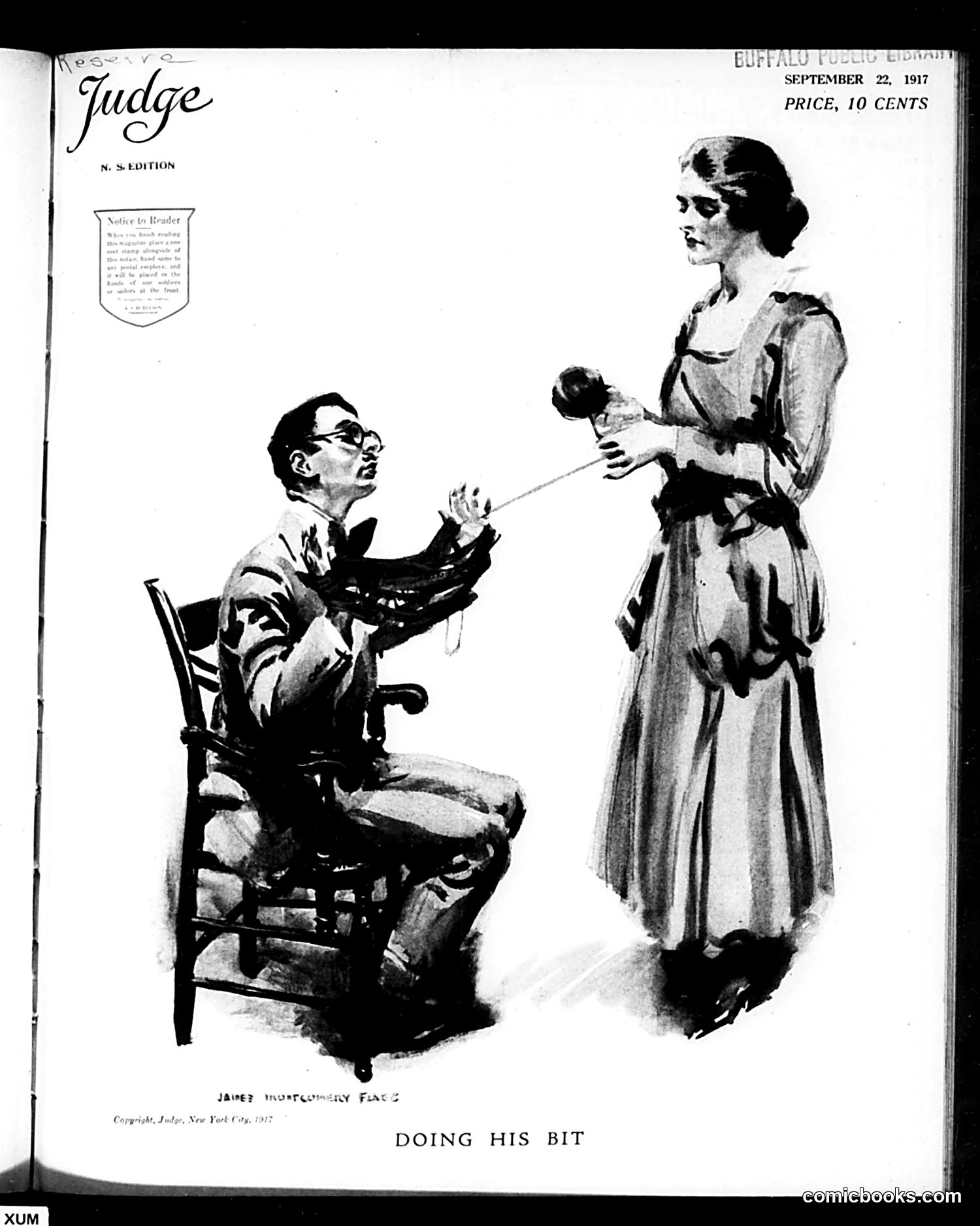
This cover illustration by James Montgomery Flagg is titled "Doing His Bit," referencing American participation in World War I (entered April 1917). The cartoon depicts a man seated while a woman hands him what appears to be knitting or yarn work. The satire mocks the domestic contribution to the war effort—civilians, particularly men unable to serve in combat, were encouraged to participate in knitting circles and other "home front" activities to support troops. The humor lies in portraying this sedentary, domestic task as a soldier's patriotic duty, gently ridiculing both the activity's modest impact and perhaps the masculinity involved in such work during wartime.
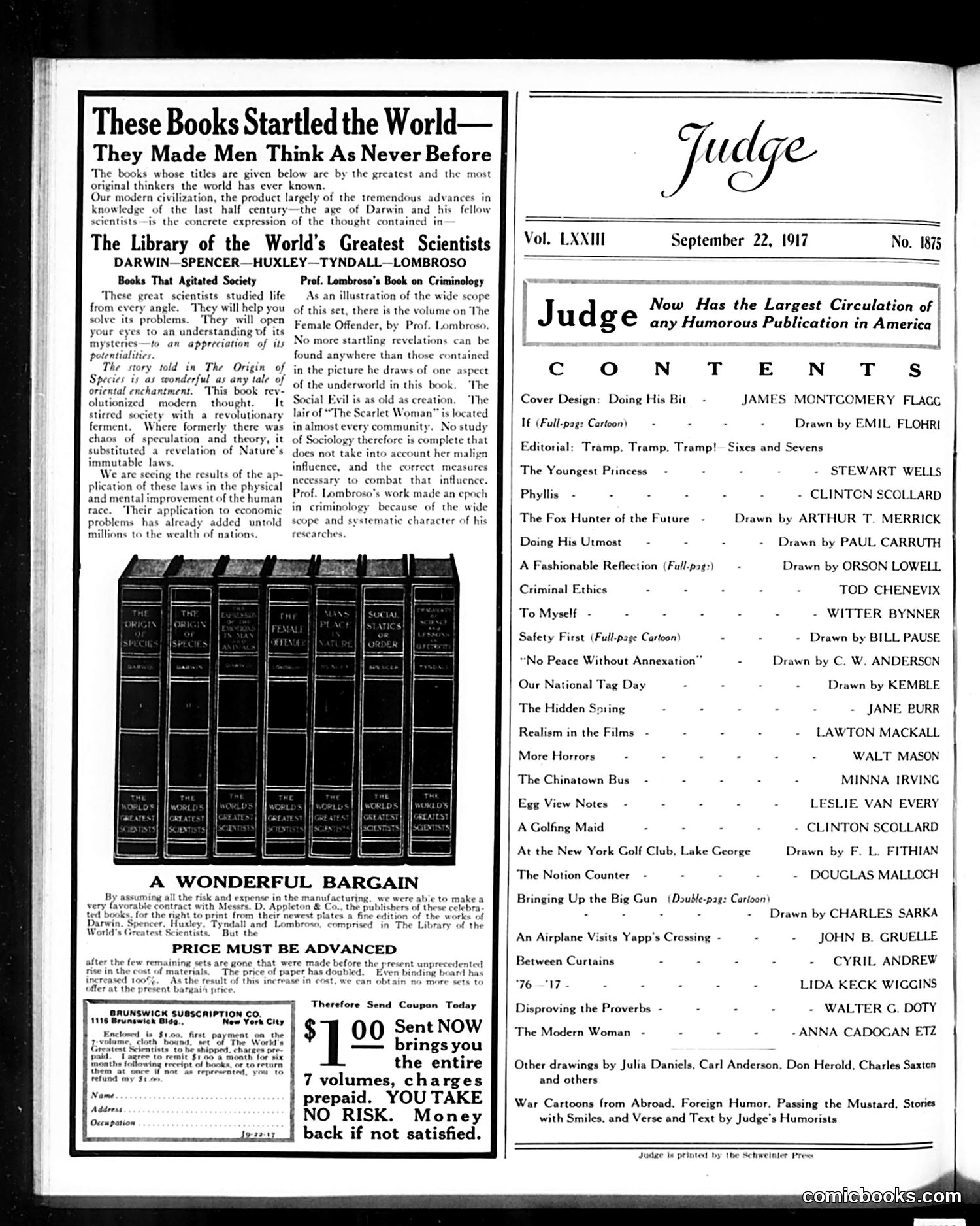
This page is primarily a **table of contents** for Judge magazine's humorous content, not a political cartoon page. It lists various cartoons and articles by contributors like James Montgomery Flagg and Emil Flohri. The left side contains **advertising** for "The Library of the World's Greatest Scientists"—a book collection featuring Darwin, Spencer, and Huxley—marketed as essential reading for understanding modern civilization. Given the **September 1917 date**, content likely reflects America's recent entry into World War I (April 1917). References to "War Cartoons from Abroad" and "Foreign Humor" suggest the magazine addressed wartime concerns, though specific cartoon subjects aren't visible in this reproduction. The page demonstrates Judge's role as a **satirical weekly** blending humor, social commentary, and commercial appeals.
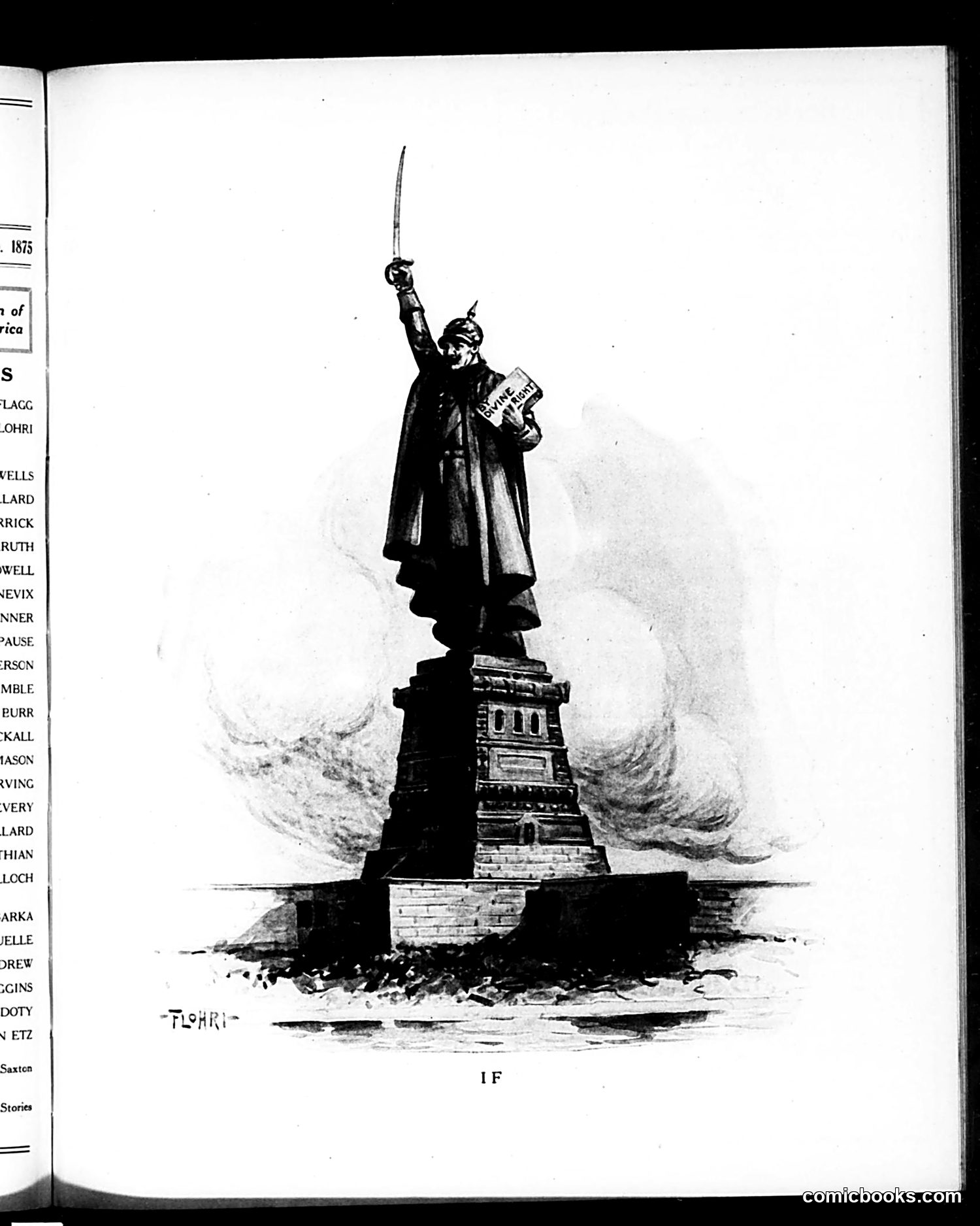
This page shows a monument statue labeled "FISHER" at the bottom. The figure holds a sword raised high in one hand and what appears to be a document or proclamation in the other. The dramatic artistic style—with swirling clouds or smoke around the base—suggests heroic commemoration or mock-heroic satire. Without additional context identifying who "Fisher" is or what specific historical event this references, I cannot confidently explain the satirical point. The statue's triumphant pose and the formal monument presentation suggest this may be commemorating or satirizing a political or military figure from Judge magazine's era, but the specific target and criticism remain unclear from the image and OCR text alone.
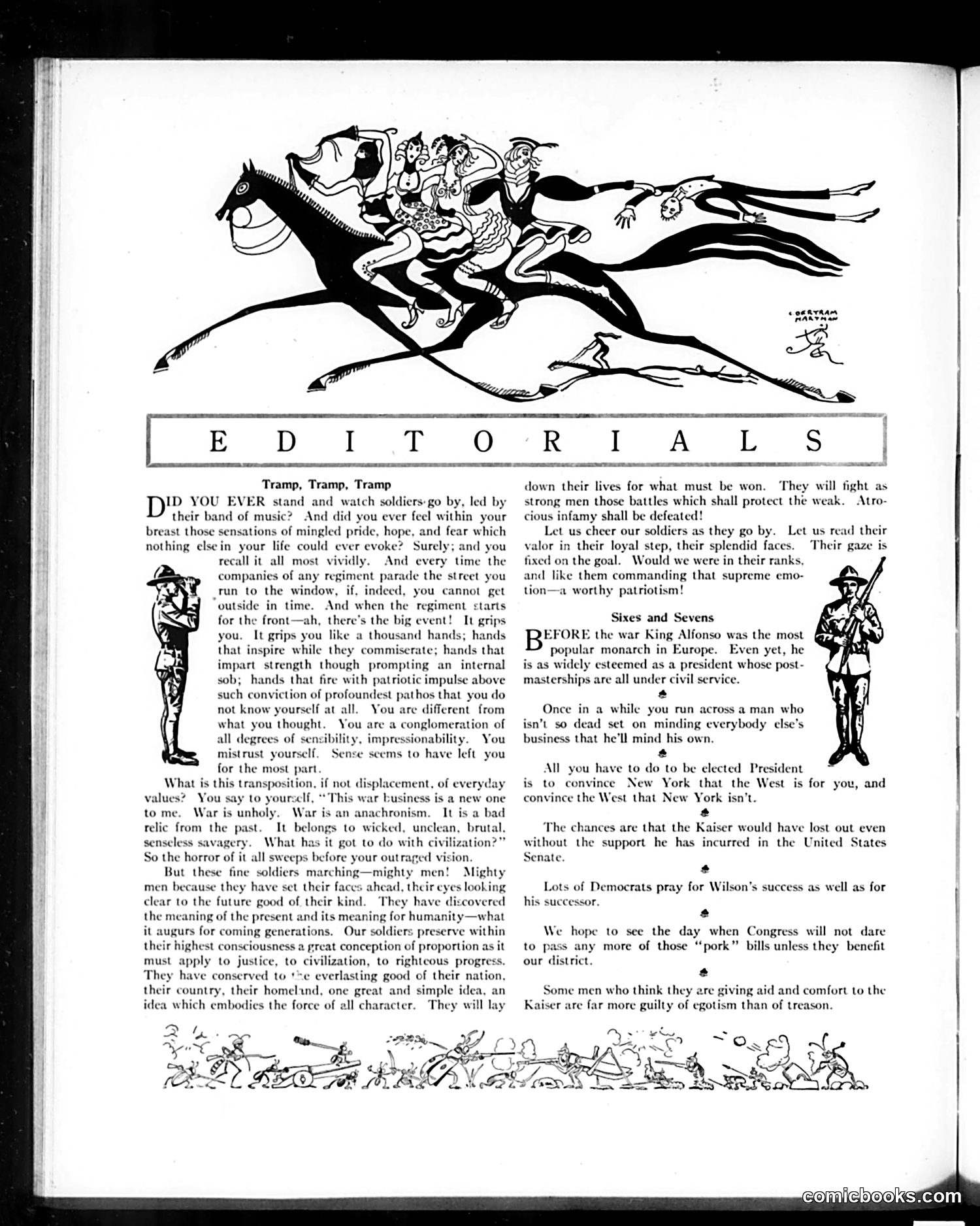
This editorial page appears from the World War I era, critiquing American political leadership. The top cartoon shows multiple figures (likely politicians and military leaders) precariously balanced on a galloping horse, suggesting governmental chaos and instability during wartime. The text references King Alfonso of Spain and discusses American presidential politics, particularly regarding Wilson's successor and Western support. The editorial criticizes politicians as self-serving, contrasts them with noble soldiers, and attacks Democrats and the Kaiser's sympathizers. The propaganda emphasizes soldiers' patriotism and sacrifice versus politicians' egotism. References to "pork" bills and Congressional spending suggest criticism of politicians profiting from war while soldiers die—a common WWI-era complaint.
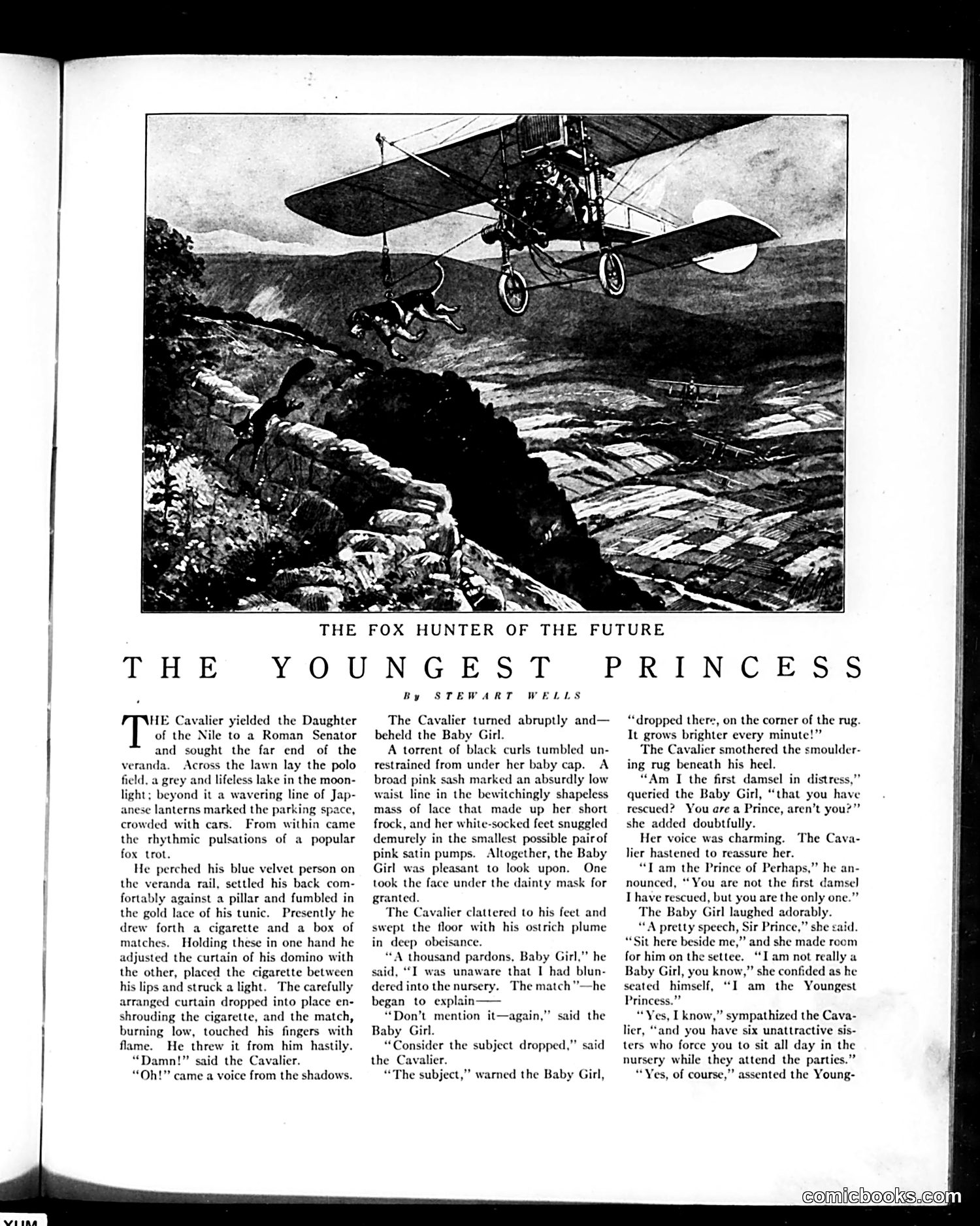
This appears to be a futuristic fantasy story rather than political satire. The illustration shows an early airplane flying over a mountainous landscape, captioned "The Fox Hunter of the Future." The text describes a Cavalier character who has won a Baby Girl (referred to as "the Youngest Princess") from a Roman Senator. The narrative involves the Cavalier bringing her to his domicile, where she proves precocious and charming—even correcting his manners and making witty observations about his six unattractive sisters. The "future" element seems to reference the airplane technology, suggesting this is speculative fiction imagining how courtship and adventure might occur in an advanced technological age. The tone is light romantic comedy rather than political commentary.
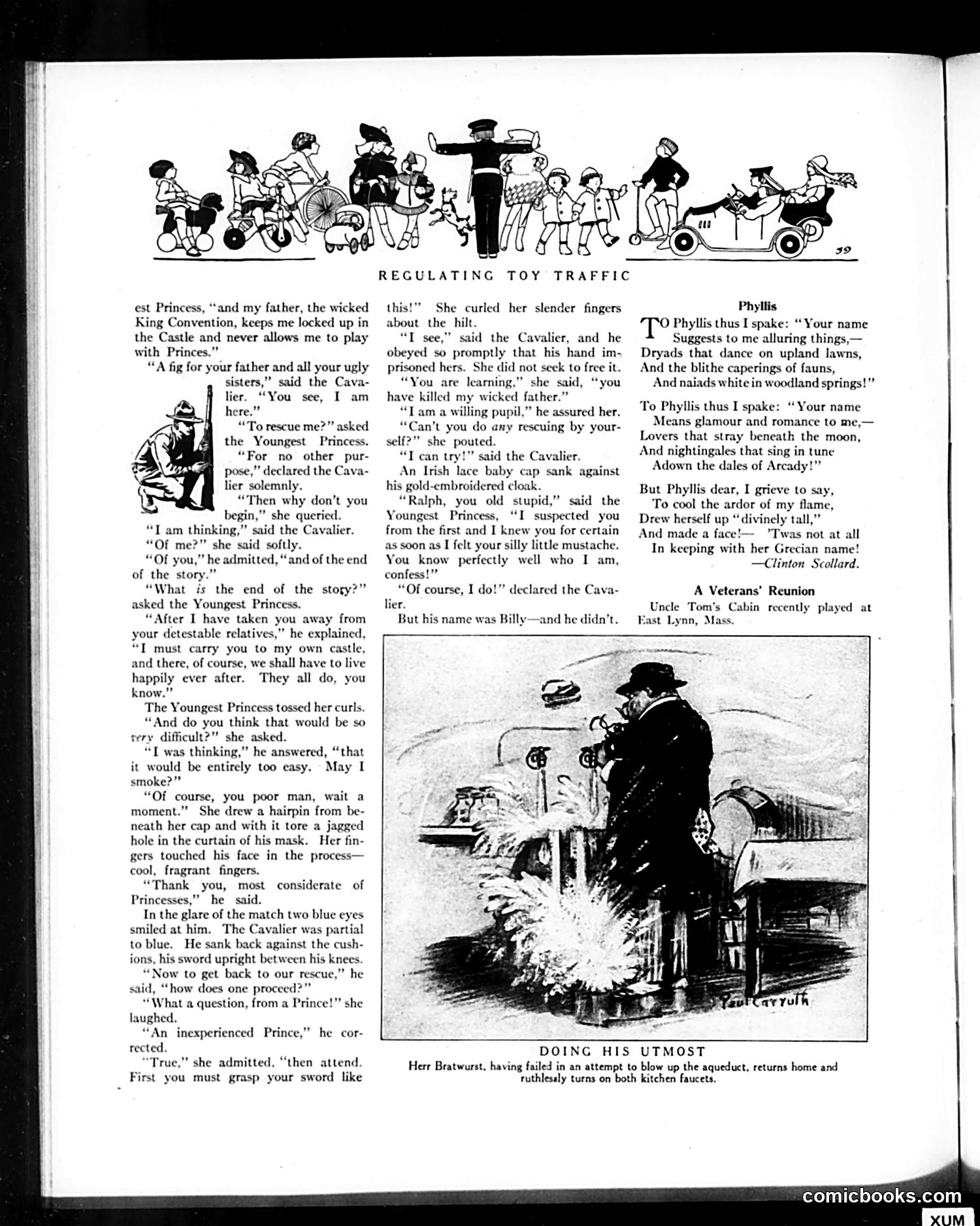
This page contains two separate pieces: **Top**: "Regulating Toy Traffic" — a decorative header illustration showing a police officer directing children with various toys and vehicles. This appears to be a visual joke about traffic control, treating children's play as organized "traffic." **Main story**: A fairy tale narrative featuring a Cavalier, a Youngest Princess, and characters named Billy and Phyllis. The text is a romantic adventure story with no apparent political satire. **Bottom cartoon**: "Doing His Utmost" shows a man at kitchen faucets with the caption explaining "Her Bratwurst, having failed in an attempt to blow up the aqueduct, returns home and ruthlessly turns on both kitchen faucets." This appears to be a joke about sabotage during wartime (likely WWI), playing on German-sounding names and anti-German sentiment. The page mixes light entertainment with wartime-era humor.
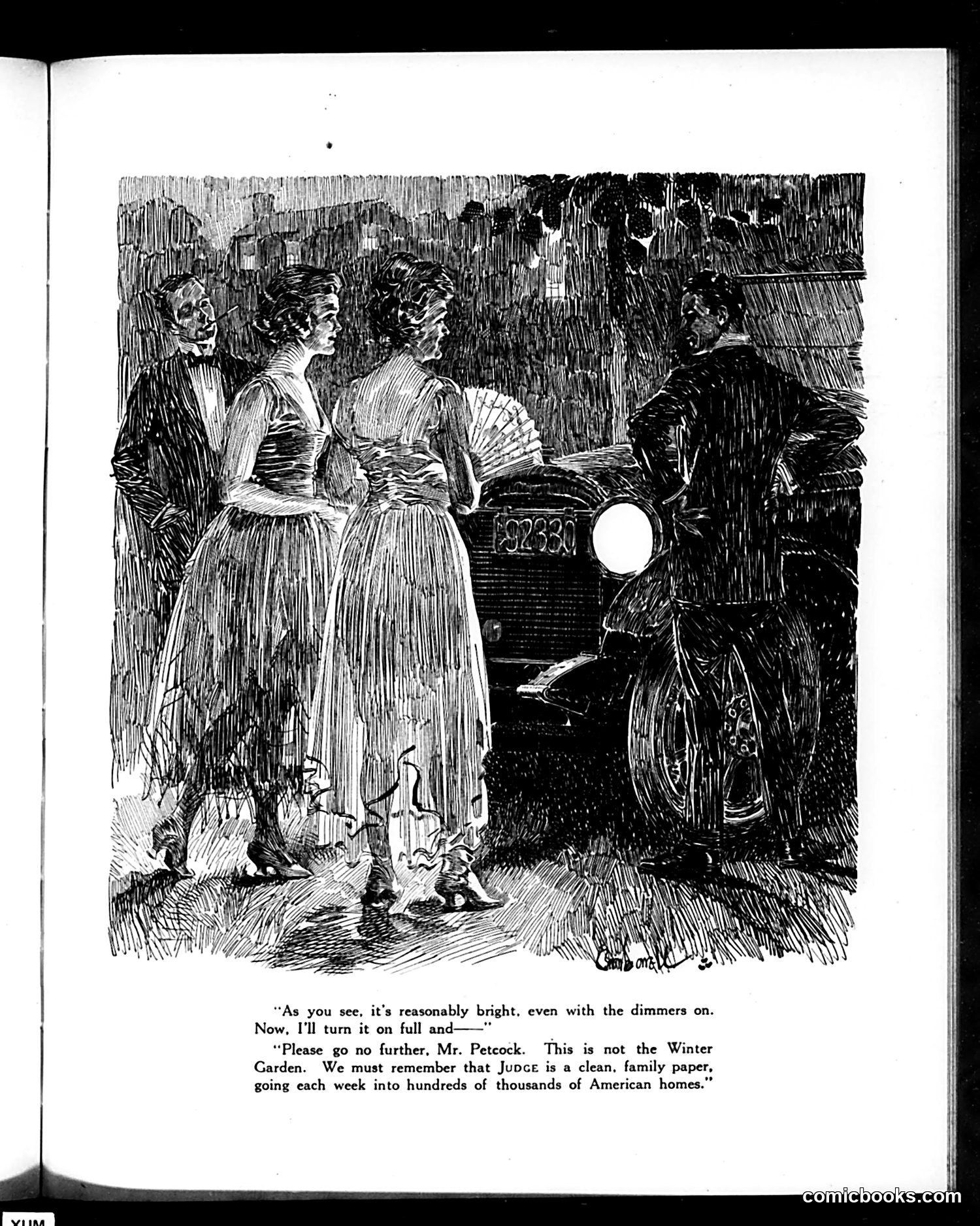
This cartoon satirizes the editorial standards of *Judge* magazine itself. Mr. Petcock (likely a character representing someone demonstrating lighting) is about to turn on bright lights, presumably to reveal something scandalous or indecent—the kind of content shown at the "Winter Garden" (a real New York theatre known for risqué entertainment). An authority figure interrupts, insisting *Judge* maintain family-friendly propriety since it reaches hundreds of thousands of American homes weekly. The humor is self-referential: *Judge* uses its own editorial caution as the punchline, ironically advertising its respectability while implying the unseen "improper" content. It's a meta-joke about the magazine's self-imposed moral standards.
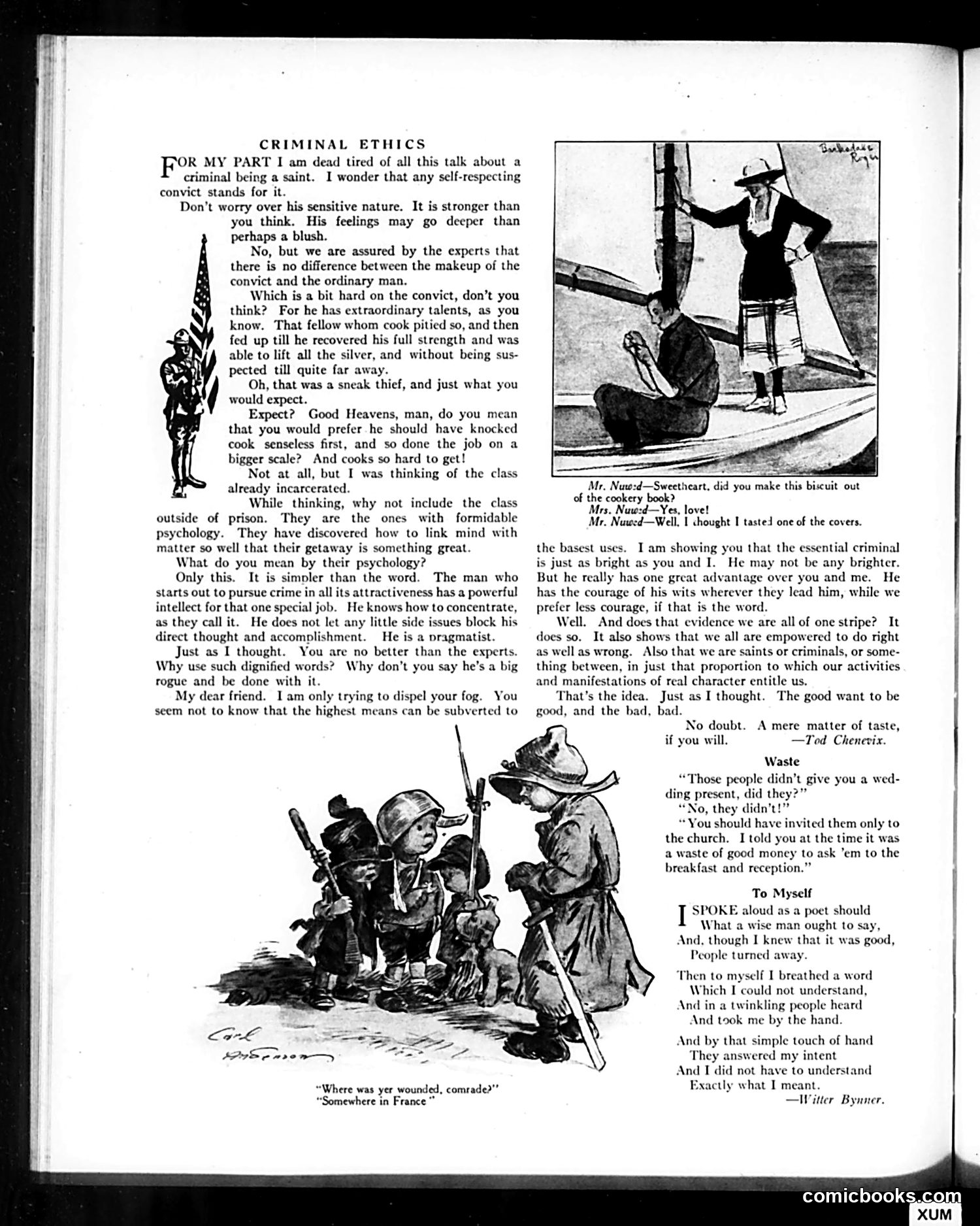
This page satirizes the popular contemporary notion that criminals possess no moral difference from ordinary citizens—a progressive criminology theory of the era. The main essay mocks experts who claim convicts and law-abiding people are psychologically identical. The author argues that criminals actually *do* differ: they possess superior intellect and "courage of their wits" that allow them to concentrate single-mindedly on crime without moral obstruction. The satire suggests that calling criminals "saints" or claiming universal human equality is naive sophistry that ignores observable criminal superiority in focus and cunning. The cartoon showing wounded soldiers asking "Where was yer wounded, comrade?" / "Somewhere in France" appears unrelated, possibly contrasting criminal cunning with military courage. Secondary items include a joke about inedible wartime cooking and Witter Bynner's poem about incomprehensible speech somehow winning approval—seemingly mocking how people accept things they don't understand.
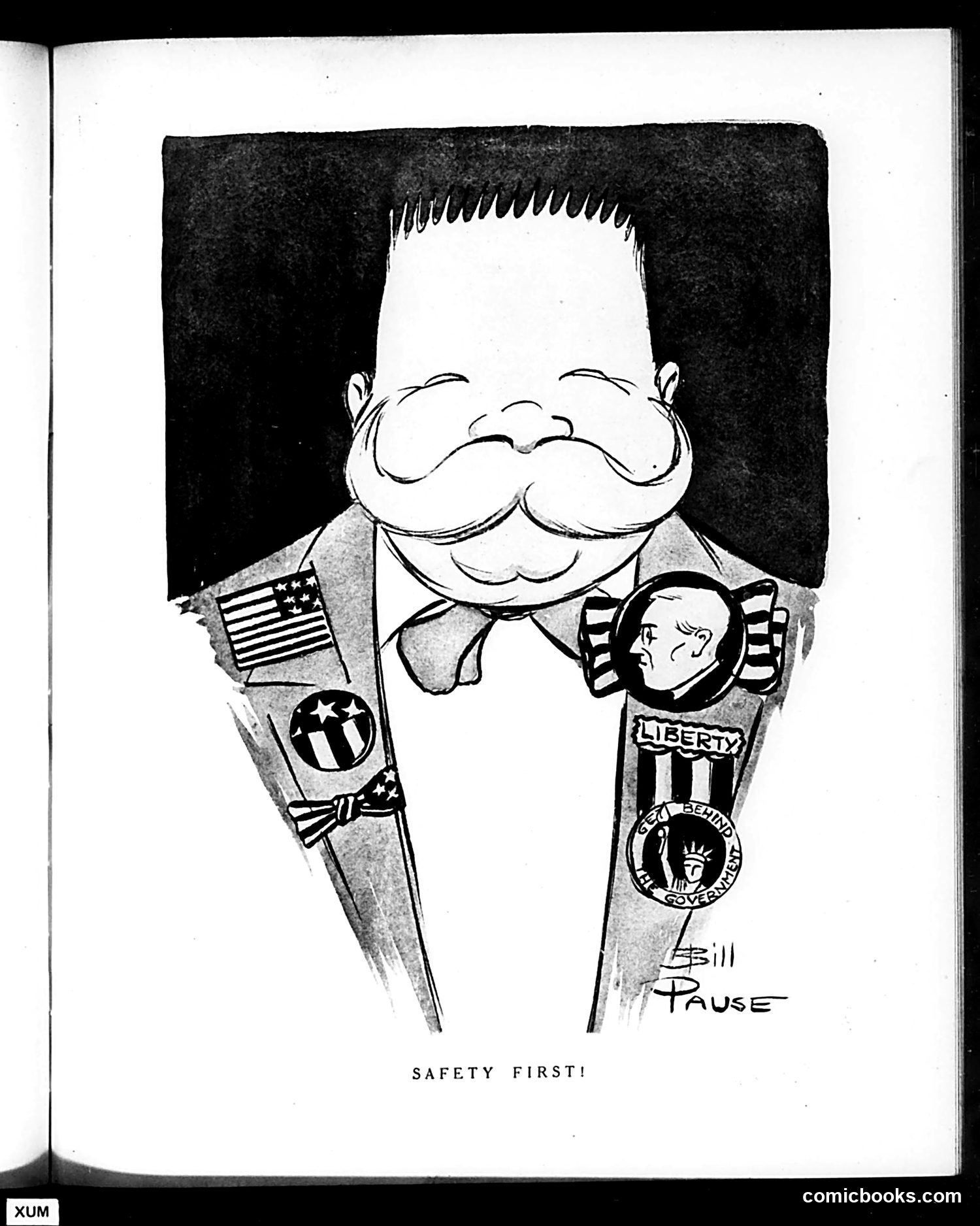
This cartoon by Bill Pause depicts a rotund, mustachioed figure—likely representing a political leader or businessman—wearing patriotic American imagery as accessories: flags, liberty emblems, and what appears to be a presidential or political portrait badge. The caption "Safety First!" suggests ironic commentary on claims of patriotism or public protection masking self-interest. The exaggerated facial features and corpulent body imply corruption or excess. The figure's prominent display of American symbols while embodying excess appears to satirize politicians or industrialists who invoke patriotism and safety concerns while pursuing their own agendas. Without the publication date, specific identification is difficult, though the style suggests early-to-mid 20th century American politics or labor relations satire.
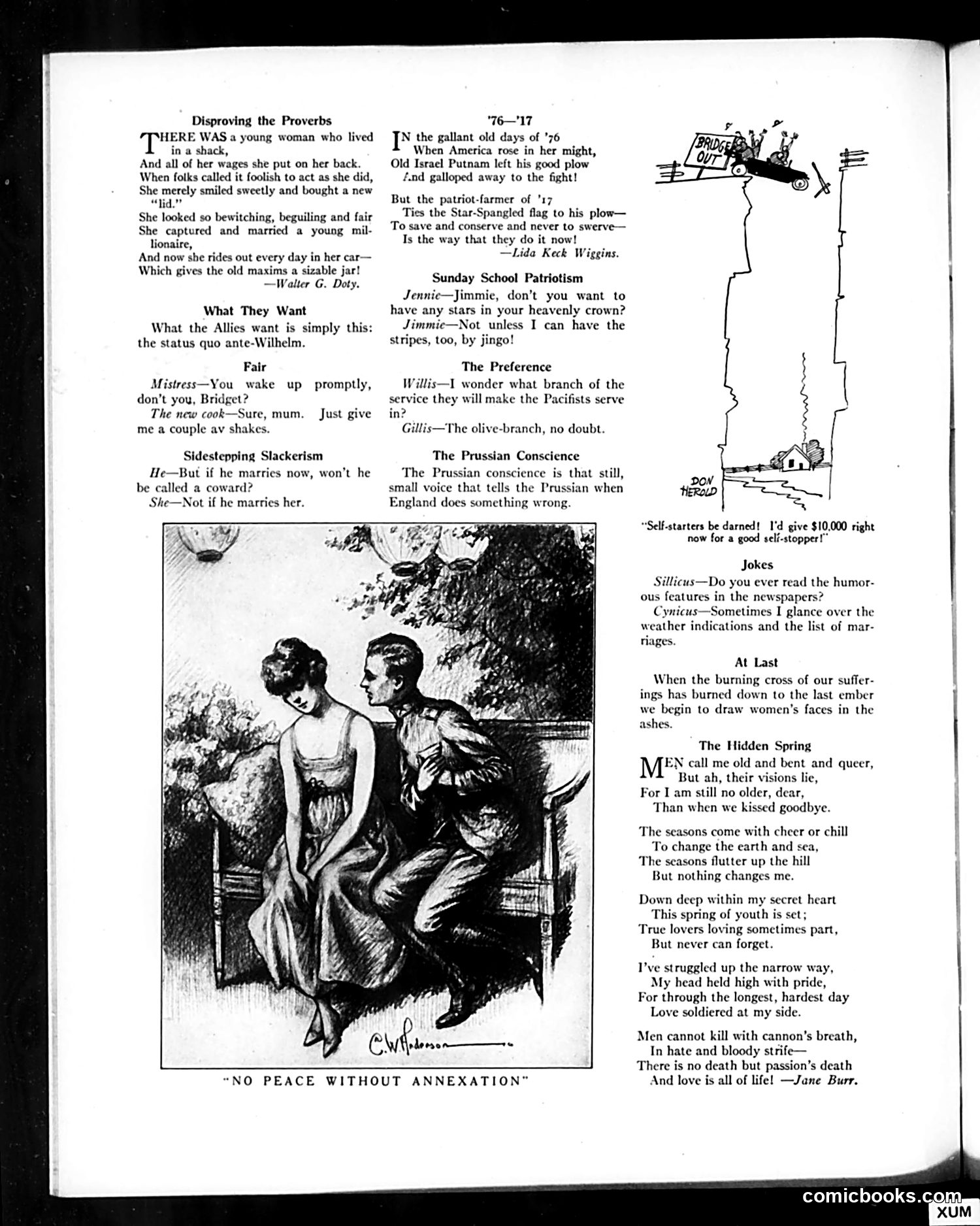
This WWI-era satirical page mocks American attitudes toward the war and patriotism. The central cartoon, "No Peace Without Annexation," depicts a couple in an intimate moment, captioned with a political demand—likely satirizing how Americans were conflating romantic/personal desires with expansionist war aims. The surrounding short pieces ridicule various hypocrisies: "Sidestepping Slackerism" jokes about men avoiding military service through hasty marriage; "The Prussian Conscience" mocks German morality as selectively applied; "Sunday School Patriotism" shows children parroting patriotic slogans without understanding; and the farmer comparison contrasts Revolutionary-era sacrifice with WWI-era reluctance to abandon commercial pursuits. The page uses humor to critique American ambivalence about entering the war, selective patriotism, and the gap between stated ideals and actual behavior—common Judge themes during 1917-1918.
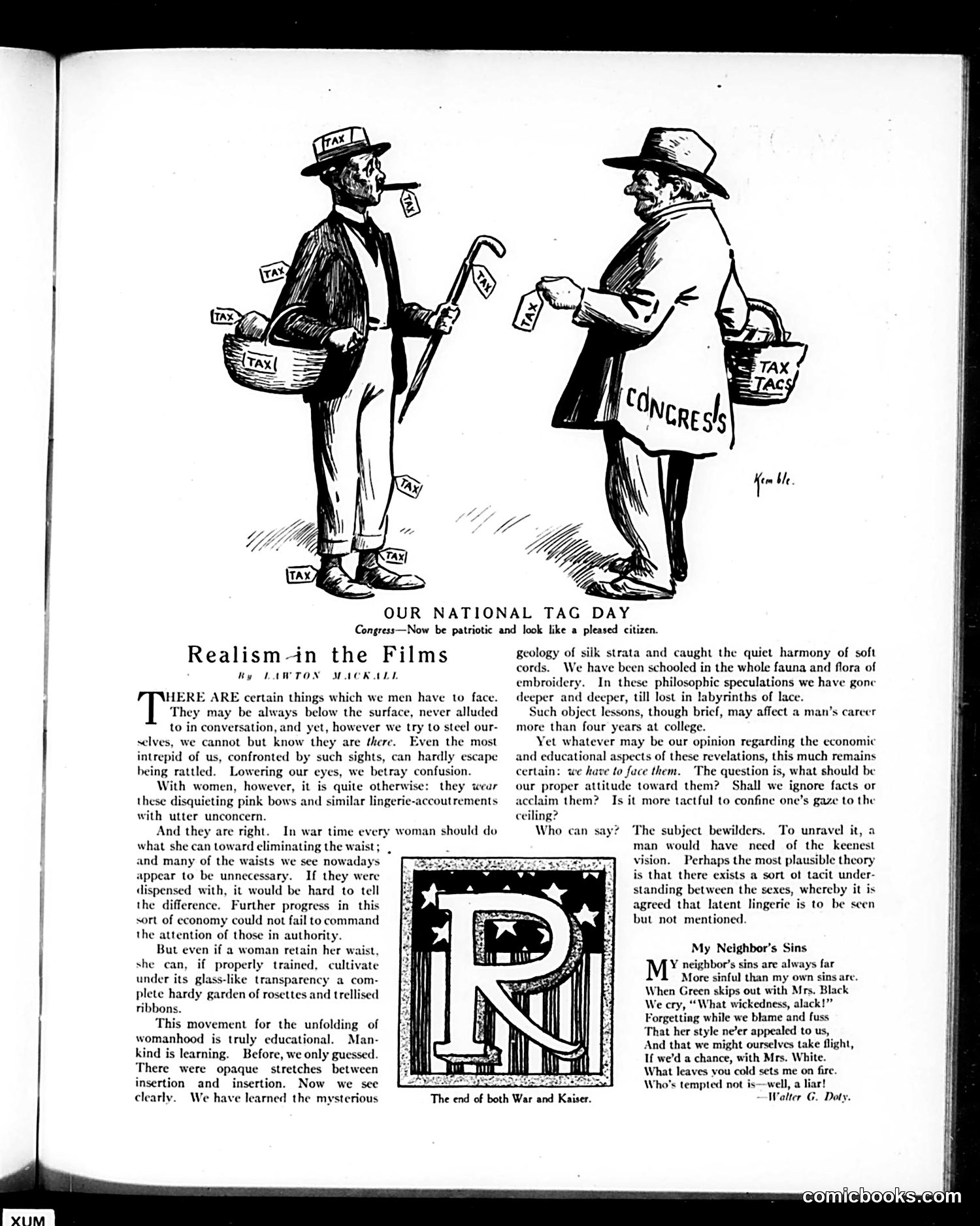
**"Our National Tag Day" (top cartoon):** This satirizes Congressional hypocrisy during wartime taxation. Two figures—one labeled a taxi driver, the other labeled "Congress"—exchange money and tax tokens. Congress instructs the citizen to "be patriotic and look like a pleased citizen" while collecting taxes. The satire suggests Congress extracts money from ordinary people under patriotic pretense while politicians themselves profit, appearing smug rather than genuinely sacrificial. **"Realism in the Films" (main article):** This discusses women's fashions and lingerie visibility in cinema. The author argues that educational benefit comes from observing women's undergarments openly rather than speculating about them. It's fundamentally a tongue-in-cheek defense of risqué film content as "educational," wrapped in pseudo-intellectual language about wartime economy and fashion progress. **"My Neighbor's Sins" (poem):** A morality commentary noting human hypocrisy: we condemn others' moral failings (infidelity) while ignoring our own temptations. The irony is that we judge neighbors' affairs as scandalous only because their partners don't appeal to us personally.
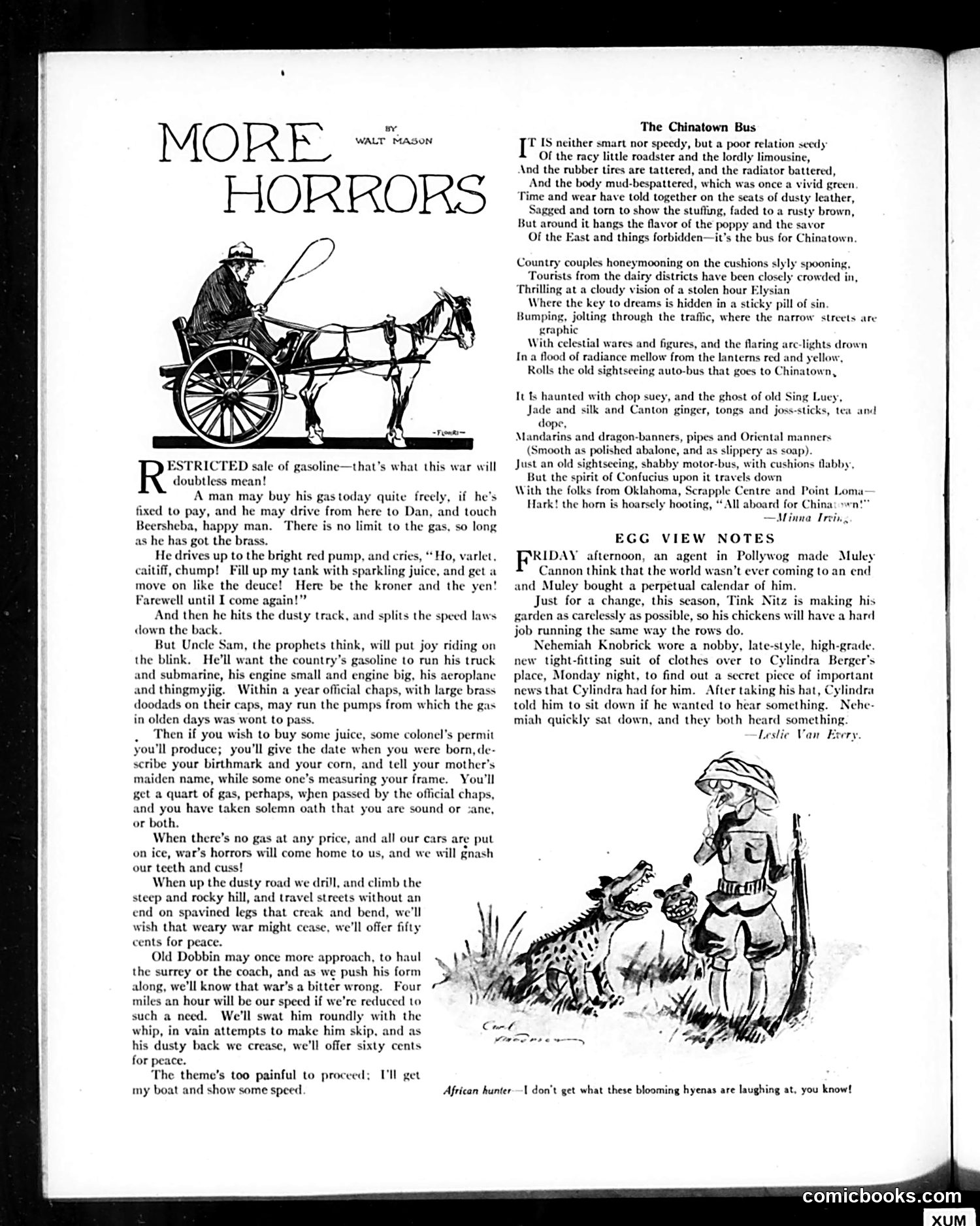
**"More Horrors" (left):** This satirical poem mocks anticipated WWI-era gasoline rationing. Mason imagines a future where the U.S. government restricts fuel for civilian joy-riding, requiring permits and personal information to purchase gas. The satire escalates absurdly—citizens will be reduced to horse-drawn carriages and offer "fifty cents for peace" rather than endure slow travel. The joke targets both wartime sacrifice and American attachment to automobiles. **"The Chinatown Bus" (right):** This poem describes a decrepit sightseeing bus touring San Francisco's Chinatown, attracting honeymooning couples and rural tourists seeking exotic thrills—"a sticky pill of sin." The verse mixes romanticized orientalism with mild moral disapproval, reflecting 1910s-era attitudes toward Asian neighborhoods as mysterious and vaguely disreputable destinations for American sightseers. The humor relies on contrasting the bus's shabby condition with passengers' exotic expectations.
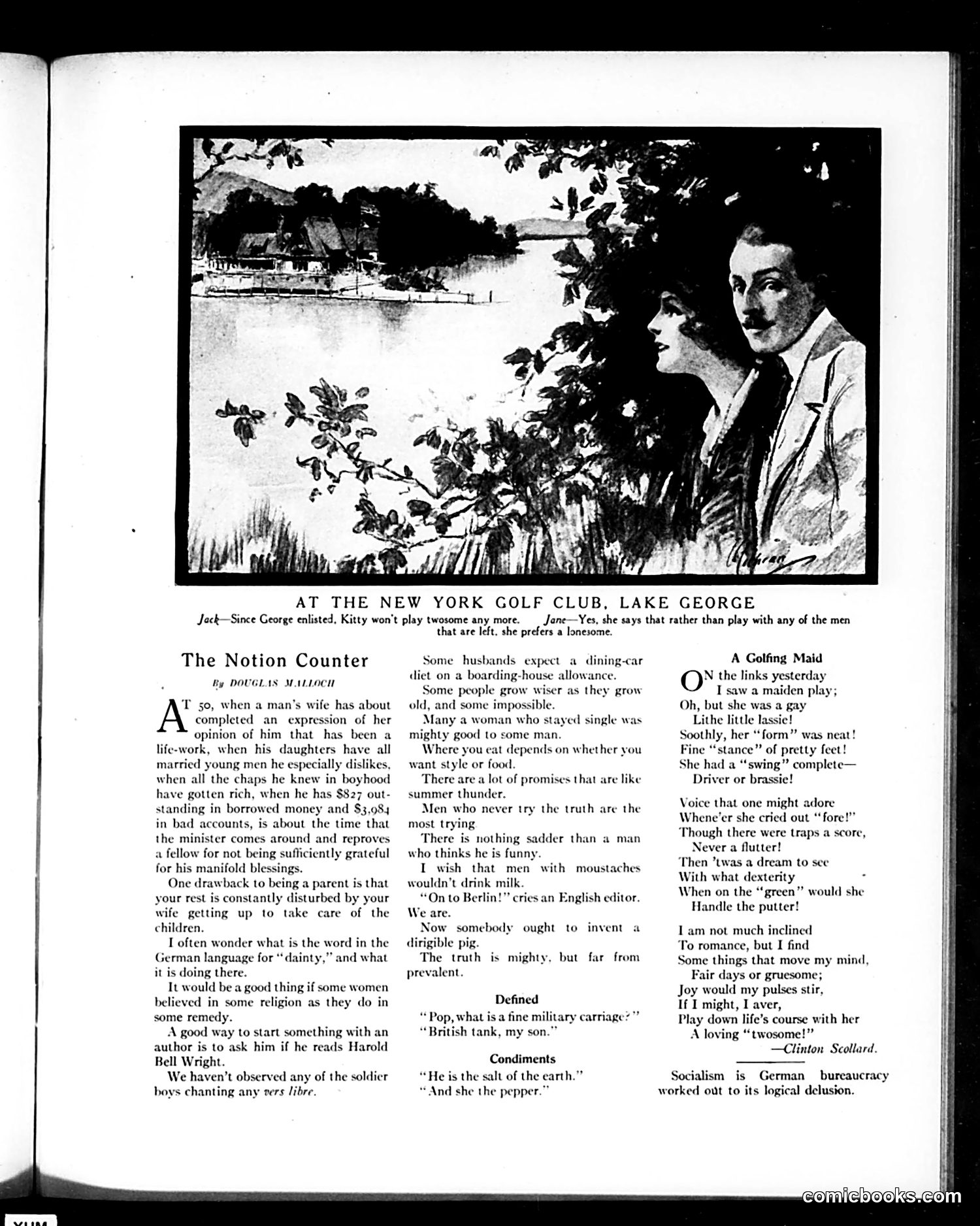
This page from *Judge* magazine contains a photograph and several satirical pieces from the WWI era. **The Photograph:** Shows a couple at the New York Golf Club, Lake George. The caption jokes that "Kitty" won't play golf as a twosome anymore since "George enlisted"—referencing men joining the military during World War I. The humor lies in a woman losing her golf partner to the war effort. **"The Notion Counter":** A satirical column by Douglas Malloch listing absurd observations about marriage, human nature, and contemporary life. Notable references include mockery of pacifist poetry ("vers libre"), criticism of English wartime rhetoric ("On to Berlin!"), and complaints about wives and parenting—typical domestic humor of the era. **"A Golfing Maid":** A romantic poem celebrating a woman golfer, unusual for the time, suggesting her athleticism and independence are attractive. The final stanza expresses desire to play life's "course" with her as a "twosome"—mirroring the photograph's romantic implication. **Final line:** A jab at German socialism, reflecting American anti-German sentiment during WWI.
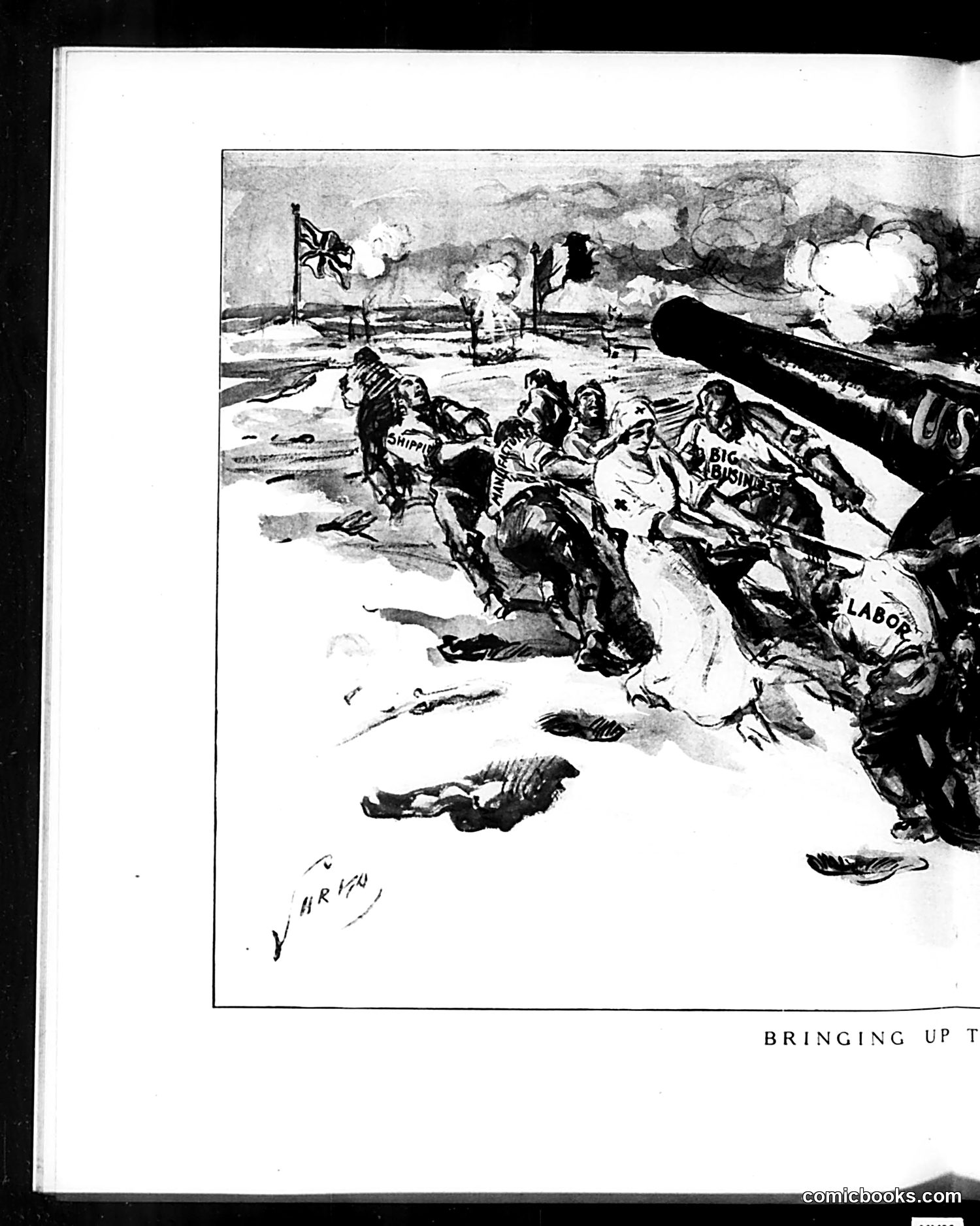
This appears to be a political cartoon from Judge magazine depicting a WWI-era scene. The image shows armed soldiers on a beach with a British flag in the background, alongside civilian figures labeled "SHIPPING," "BIG BUSINESS," and "LABOR." Dead bodies lie on the ground. The cartoon's title "BRINGING UP T[HE...]" (text cut off) suggests commentary on war production or mobilization. The juxtaposition of military combat with labeled civilian interests implies satire about how business, shipping, and labor interests profit from or benefit from warfare casualties. The visual message appears critical: while soldiers die in combat, these economic interests thrive or are "brought up" (promoted/profited) by war. This reflects American skepticism about industrial and financial interests during WWI.
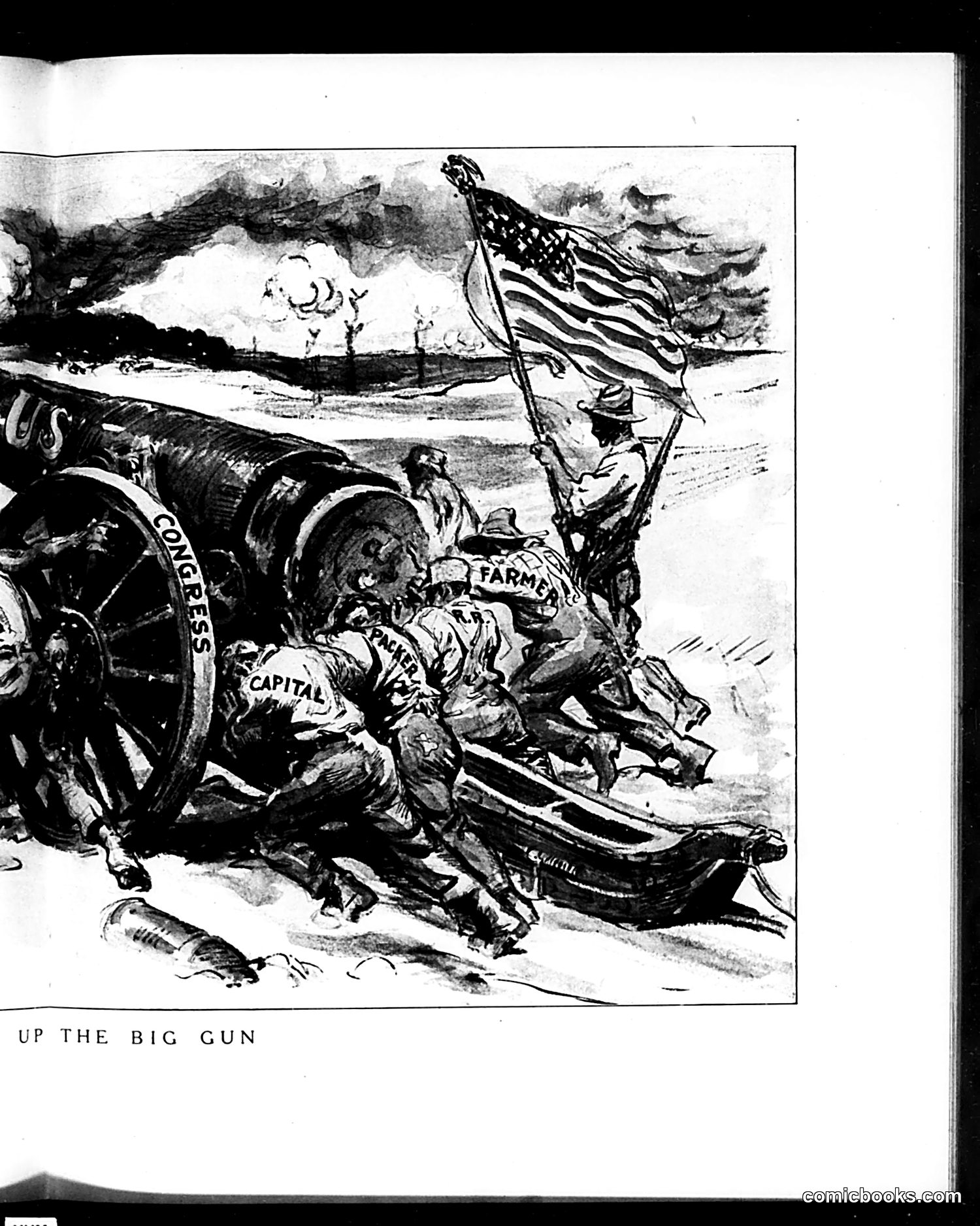
This political cartoon depicts three figures struggling to operate or control a large military cannon labeled "Congress," "Capital," and "Farm." An American flag waves prominently in the background, while smoke and explosions appear in the distance, suggesting warfare or conflict. The satire appears to critique the relationship between agricultural interests, capital/business, and Congress during what seems to be a wartime period. The figures are shown laboring together to manage the "big gun" of governmental power, suggesting tension or struggle among these three constituencies over control of national resources and policy direction. The cartoon likely comments on competing economic interests—farmers, capitalists, and politicians—all seeking to direct national power toward their own ends. Without the publication date, the specific historical conflict remains unclear, though the military context suggests either WWI or WWII era commentary.
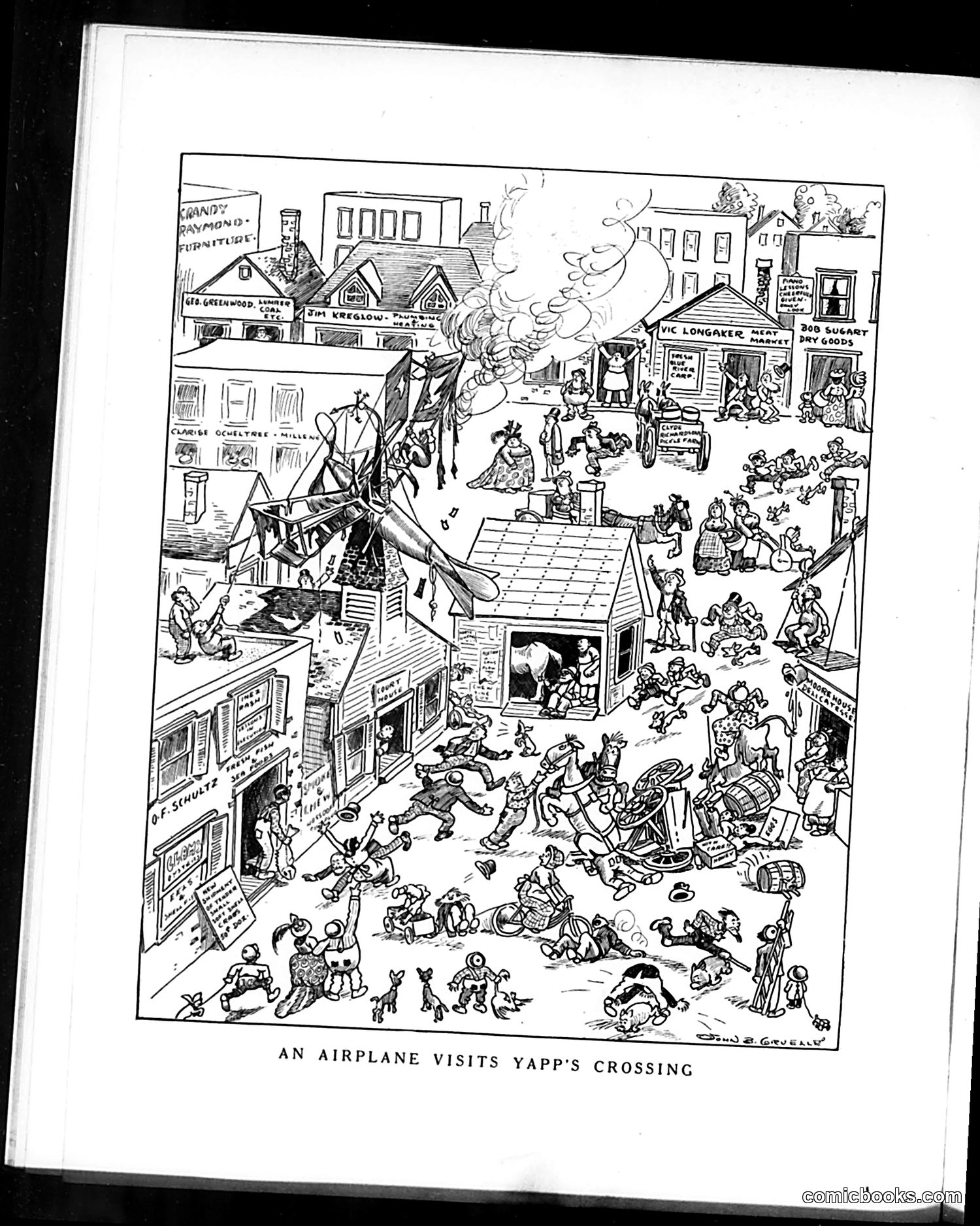
This is a satirical cartoon depicting the chaos caused by an airplane's arrival in a small town called Yapp's Crossing. The scene shows a residential/commercial street with storefronts (including what appear to be local businesses like a furniture store and market) thrown into pandemonium—people running, children scattering, buildings damaged, and general disorder spreading throughout the community. The satire targets early aviation's disruptive impact on American towns. In the early 20th century, airplane visits were novel spectacles that drew crowds but also created genuine safety hazards and property damage. The cartoon mocks both the public's fascination with aviation and the technology's chaotic, unpredictable consequences for ordinary communities. The exaggerated destruction—with families fleeing and goods scattered—emphasizes the violent disruption this "modern marvel" brought to quiet, ordered small-town life.
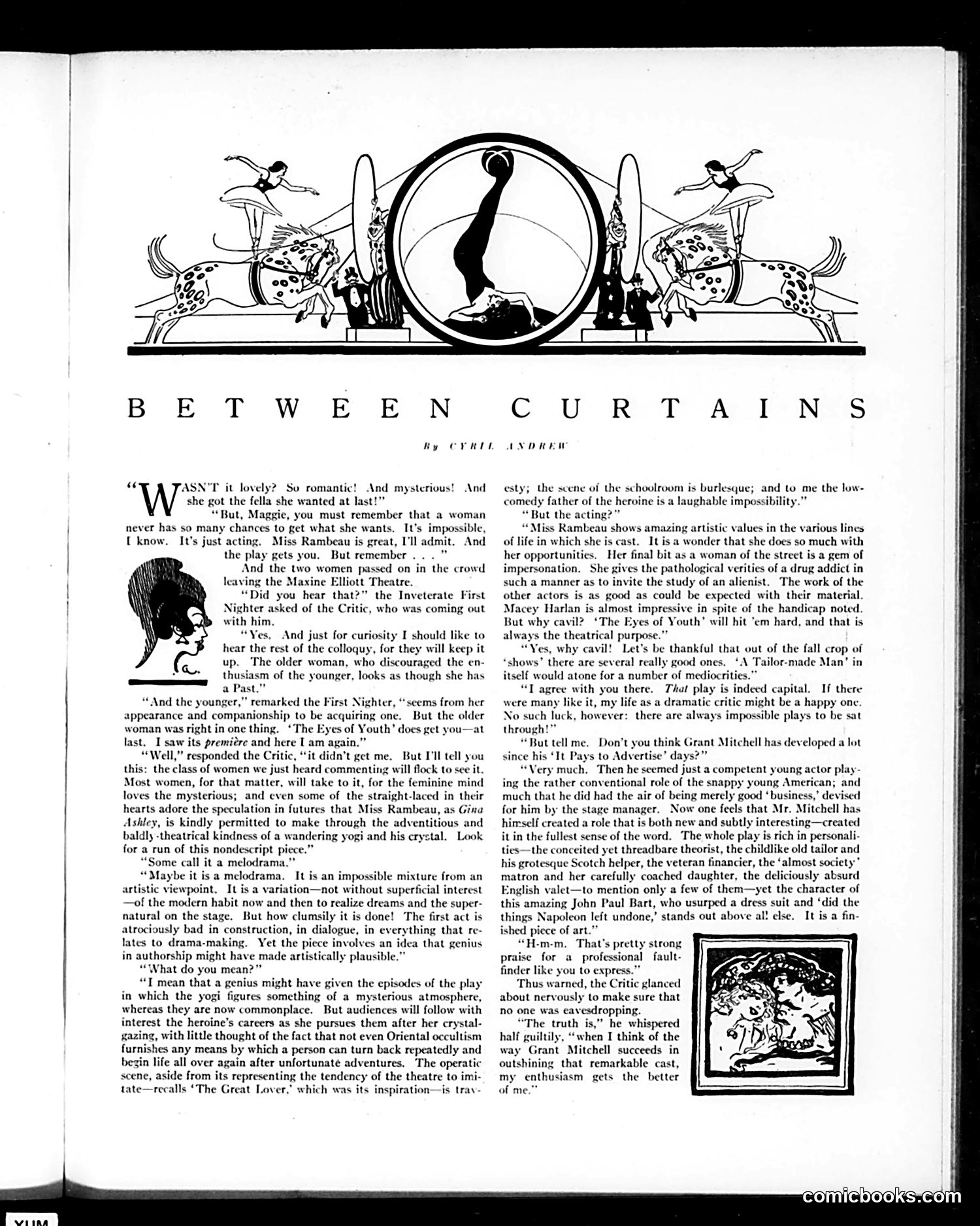
This is a theater criticism column by Cyril Andrew reviewing the play *"The Eyes of Youth,"* starring actress Gina Rambeau. The Art Deco illustration depicts a stylized acrobat/performer in a large circle, flanked by dancing figures and theatrical elements—representing the entertainment industry being discussed. The text presents a dialogue between two theater-goers: the "Inveterate First Nighter" (an enthusiastic regular attendee) and the "Critic" (skeptical professional). They debate the play's merits. The Critic acknowledges Rambeau's exceptional acting talent but dismisses the play itself as a poorly constructed melodrama—an "impossible mixture" combining crystal-gazing mysticism with realistic drama, featuring clumsy construction and laughable elements (particularly the "low-comedy father"). The satire targets theatrical pretension: audiences flock to inferior plays for star performances, while critics recognize artistic mediocrity masked by talented acting.
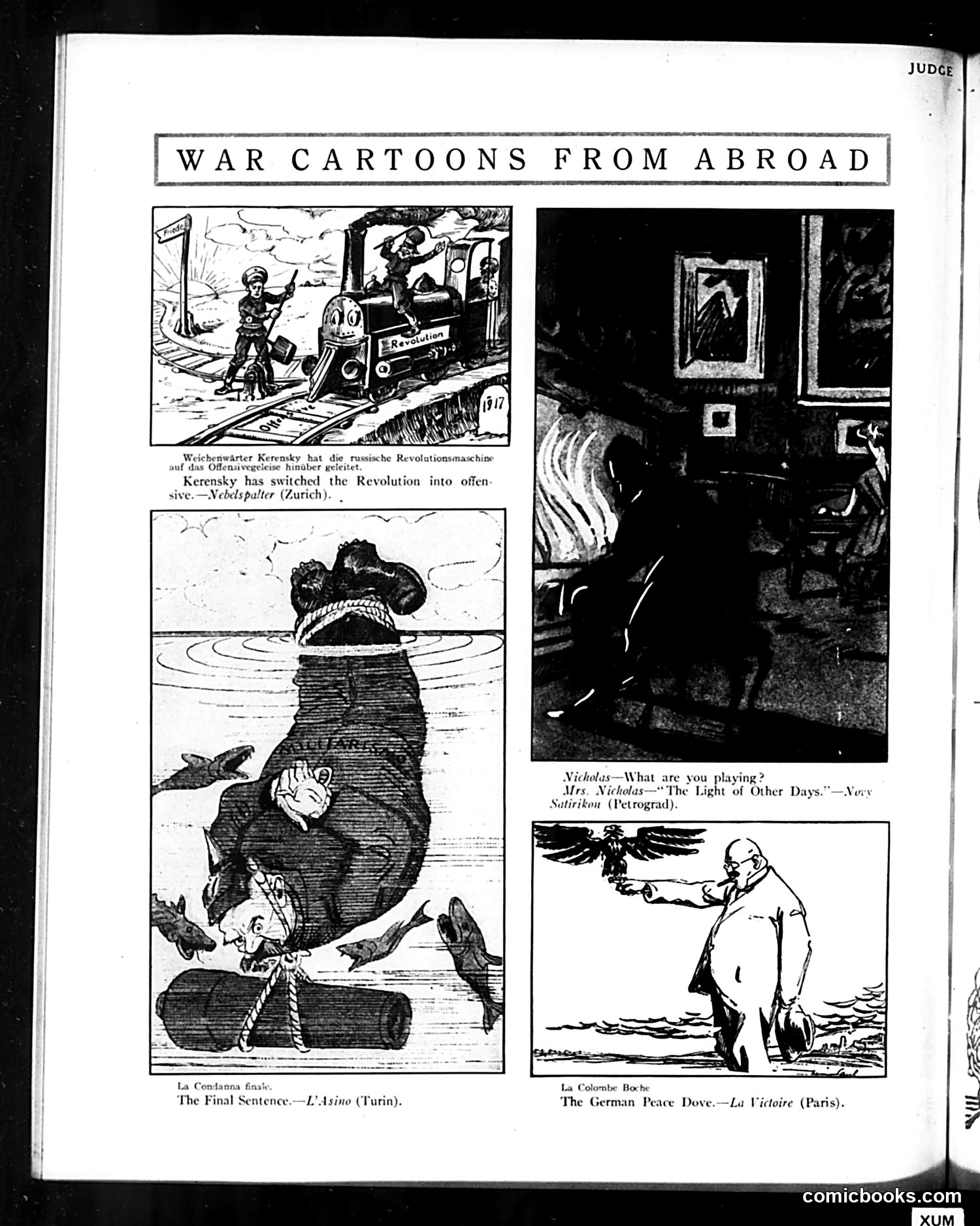
This page compiles anti-German satire from European publications during WWI. The top cartoon, from Swiss *Nebelspalter*, depicts Russian leader Kerensky as an engineer redirecting a "Revolution machine" onto an offensive track—mocking his 1917 decision to continue Russia's war effort, which ultimately proved unpopular. The second cartoon, from *Satirikon* (Petrograd), shows Tsar Nicholas II asking his wife what she's playing; she answers "The Light of Other Days"—a nostalgic reference suggesting the Russian royals are clinging to past glories while revolution engulfs them. The final cartoon from French *La Victoire* depicts a fat German man with a peace dove—likely sarcastically suggesting Germany's false claims of peaceful intentions while waging aggressive war. These foreign cartoons were reprinted in *Judge* to reinforce American anti-German sentiment during the war period.
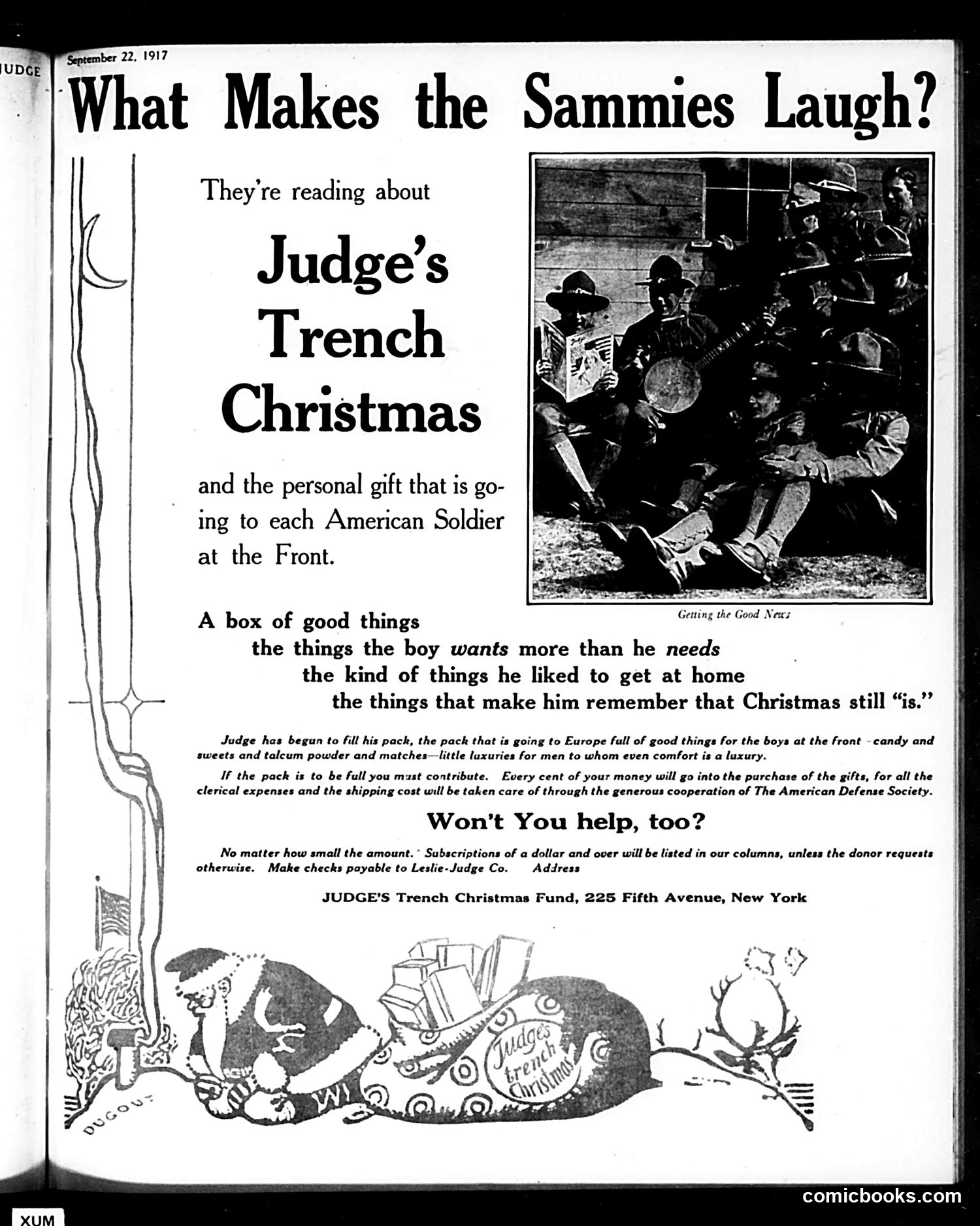
This is a fundraising advertisement rather than political satire. "Sammies" is WWI-era slang for American soldiers (from "Uncle Sam"). The page promotes Judge magazine's charitable campaign to send Christmas care packages to American troops fighting in France during World War I. The photograph shows soldiers reading about the initiative and receiving gifts—depicting morale-boosting. The appeal emphasizes emotional appeal: homesick soldiers need comfort items (candy, matches, talcum powder) that remind them of home, not just necessities. The advertisement leverages patriotic sentiment and domestic guilt—asking American civilians to contribute dollars to fill these packages, with the promise that clerical and shipping costs are covered by the American Defense Society, ensuring donations go directly to troops. The cartoonish Santa illustration at bottom reinforces the seasonal, feel-good messaging. This represents mainstream American support for the war effort in 1917, one year after U.S. entry.
This page features a pro-suffrage article by Anna Cadogan Etz arguing that women's suffrage correlates with national strength, not weakness. **Main arguments presented:** - States/provinces granting women voting rights supplied more military recruits than those opposing suffrage, proving suffragists are patriotic and vigorous - Swedish conservatives' hypocrisy: they opposed forcing votes on unwilling women, yet nominated an anti-suffragist woman for city council—contradicting their own stated principles - Women historically remain "uncounted" in society (like serfs in Russia or female birds in scientific records), treated as invisible or secondary to males **The satire targets** conservative opponents of suffrage by exposing logical inconsistencies in their position—they claim to protect women from political involvement while simultaneously placing women in political roles. The article uses comparative examples (Russia, Sweden, ornithology) to make women's historical exclusion seem absurd, thereby supporting voting rights as overdue recognition.
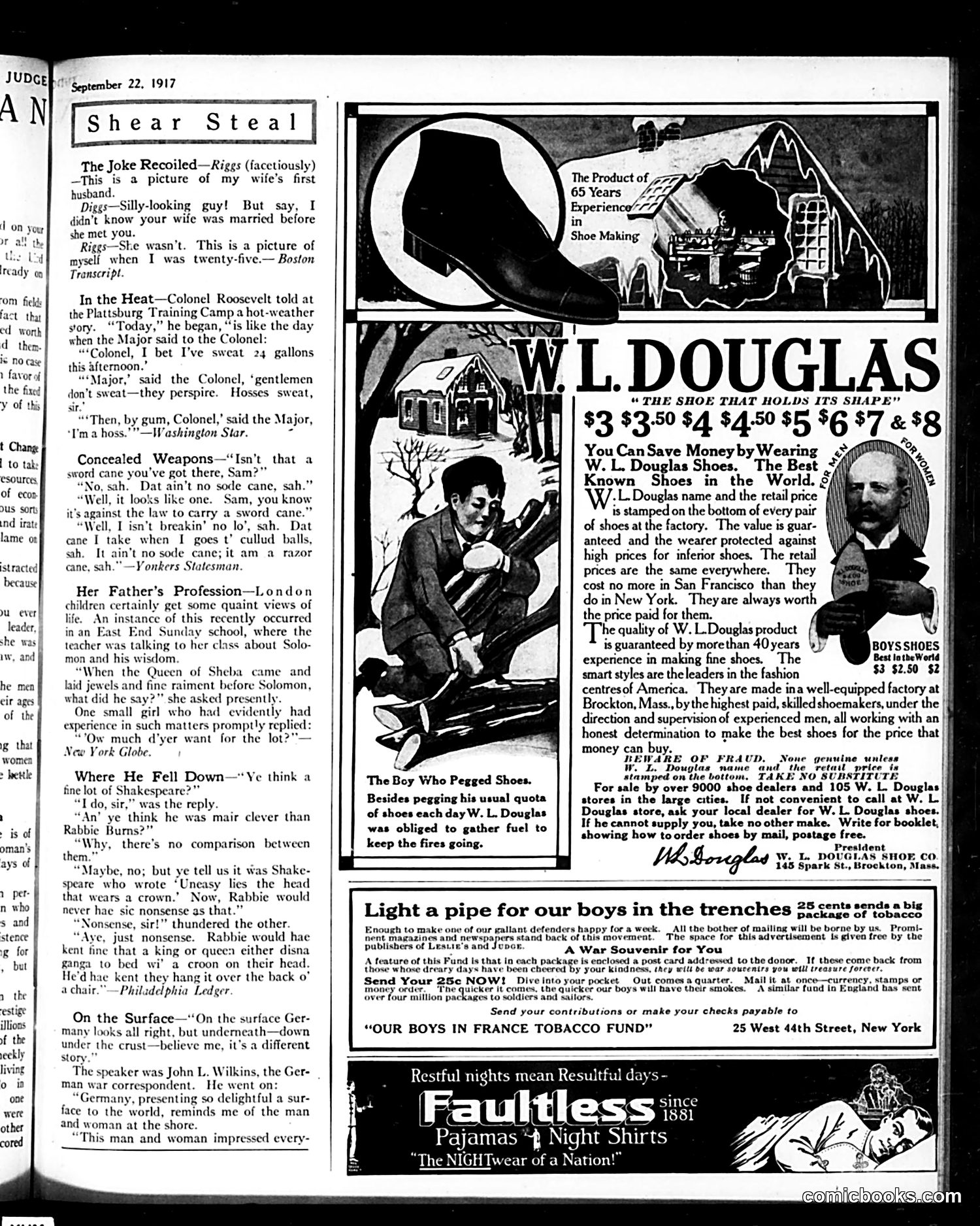
This is primarily an **advertising-heavy page** from Judge magazine (September 22, 1917), featuring brief humorous anecdotes alongside major shoe advertisements. The "Shear Steal" section contains four short jokes: one about a husband joking about his wife's "first husband" (actually himself when younger); Colonel Roosevelt's quip about soldiers sweating versus horses perspiring; a racial dialect joke about a concealed weapon; and London schoolchildren's misunderstandings of Solomon and Shakespeare. **Historical context**: Published during **WWI** (note the tobacco fund appeal "for our boys in the trenches"), these jokes reflect period attitudes, including casual racial stereotyping common to early 20th-century humor magazines. The **W.L. Douglas shoe advertisement** dominates the right side, emphasizing standardized nationwide pricing as a consumer protection against price-gouging—a concern during wartime inflation. The ads promise quality through 40 years of experience and factory-stamped pricing. The page is essentially a mix of mild social satire and commercial messaging typical of Judge's era.
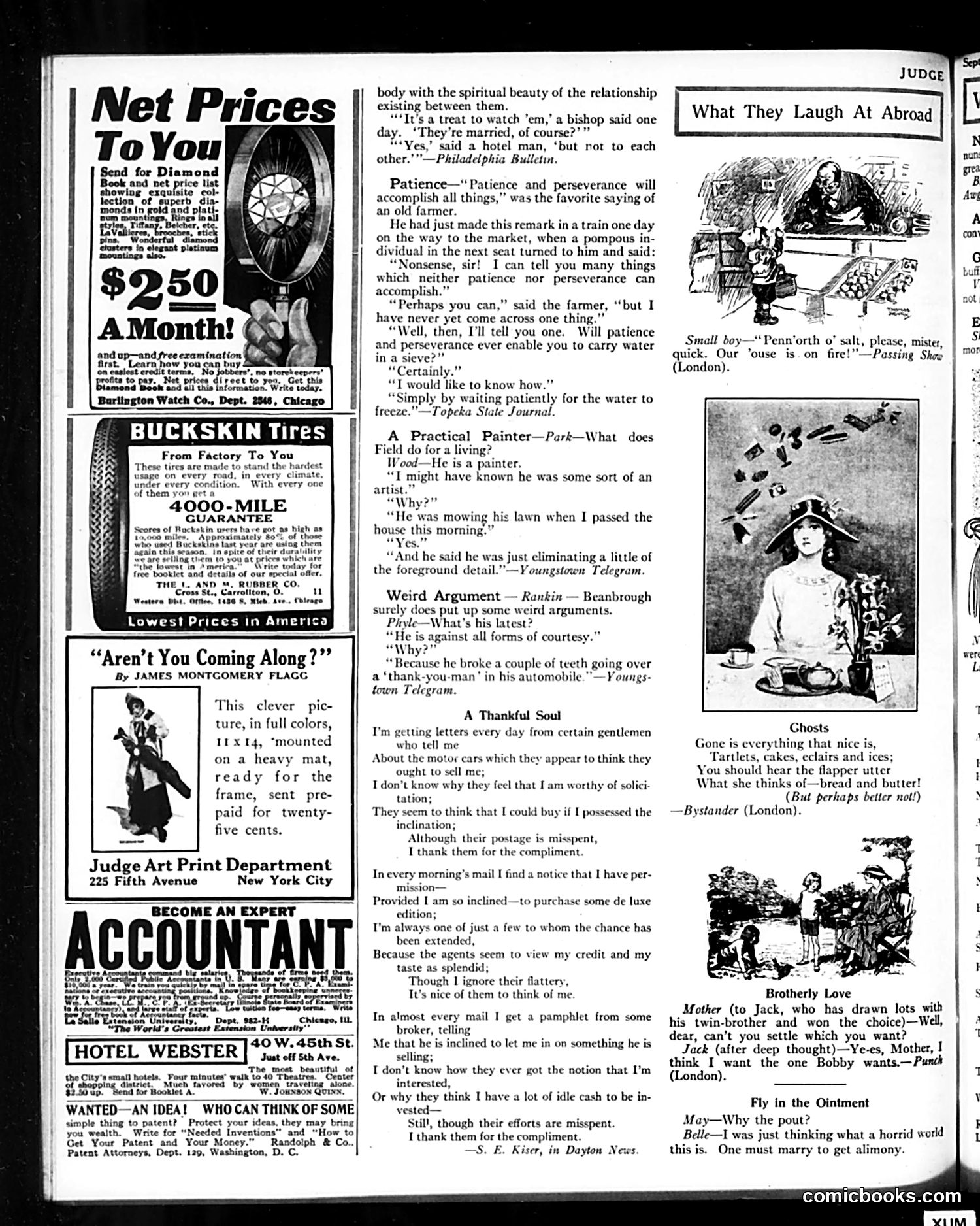
This page from **Judge** (a satirical American magazine) is primarily composed of **advertisements and humorous anecdotes**, not political cartoons. The content includes: **Advertisements** for watches, tires, accountancy courses, and hotels—typical commercial fare from the early 20th century. **Humorous short pieces** labeled "What They Laugh At Abroad," featuring jokes about patience, painters, and courtship—presented as amusing observations rather than satire. **A James Montgomery Flagg illustration** ("Aren't You Coming Along?") advertising art prints, showcasing the famous artist's work. **The humor** relies on mild wordplay and everyday social observations: a farmer's debate about patience, a painter mowing his lawn, someone breaking teeth over a "thank-you-man" in a car. These are gentle, non-partisan jokes reflecting early-20th-century domestic life. **The satire**, where present, targets no specific political figures or movements—just general human foibles and commercial absurdity. This is primarily a **commercial/entertainment page**, not a vehicle for political commentary.
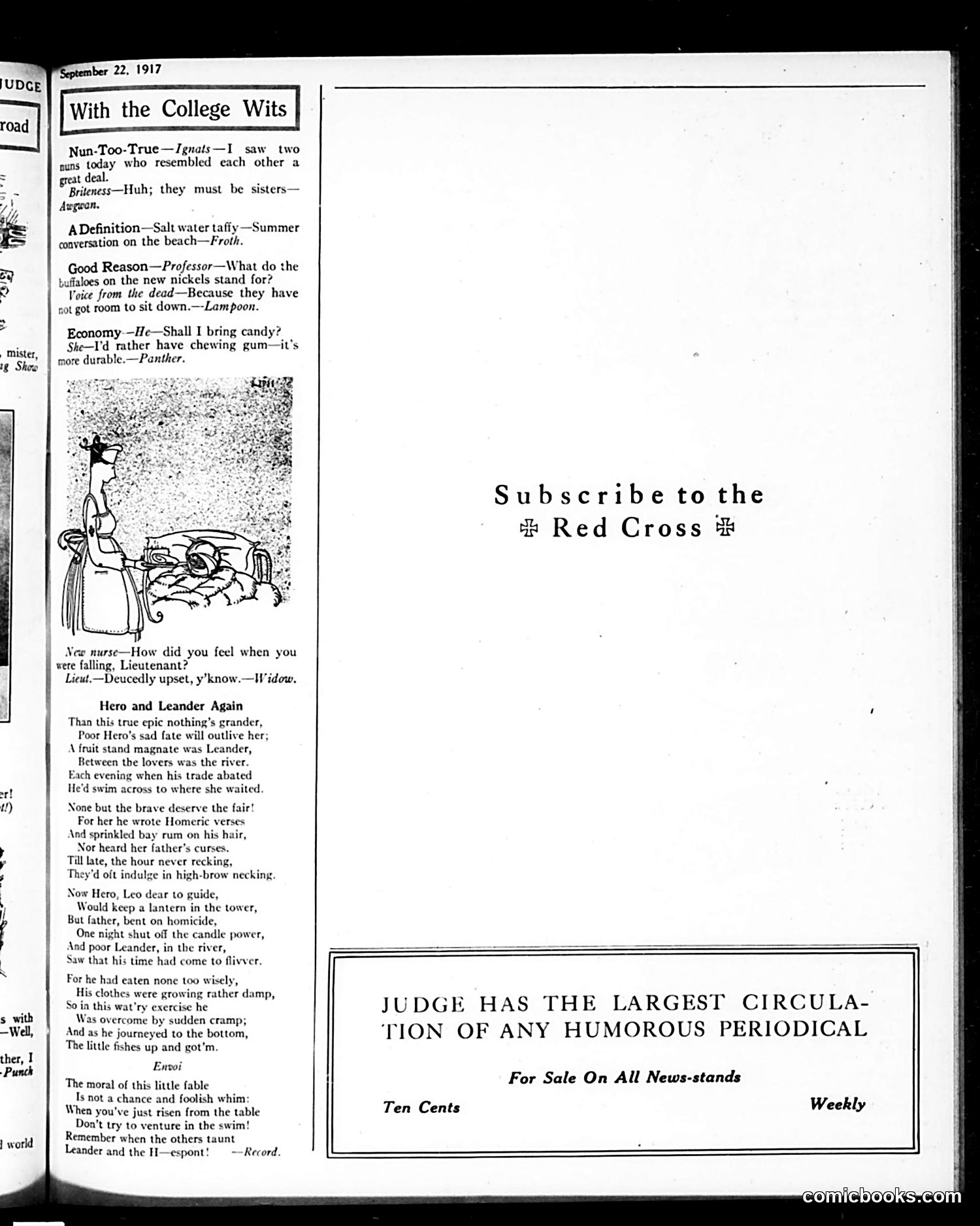
This page features humorous college jokes and a parody poem. The "College Wits" section presents short witticisms attributed to various college publications (Ignats, Lampoon, Panther, Widow, Record). The main content is "Hero and Leander Again," a comedic retelling of the classical myth of two lovers separated by the Hellespont strait. The satire updates the ancient tragedy with modern details—the lover becomes a "fruit stand magnate" instead of a nobleman, and the poem mocks romantic pretension with practical warnings: don't swim after eating. The final "Envoi" (moral) offers safety advice rather than eternal romance. The page also includes a Red Cross subscription advertisement, reflecting 1917's wartime context. The bottom advertises Judge itself as "the largest circulation of any humorous periodical," sold weekly for ten cents.
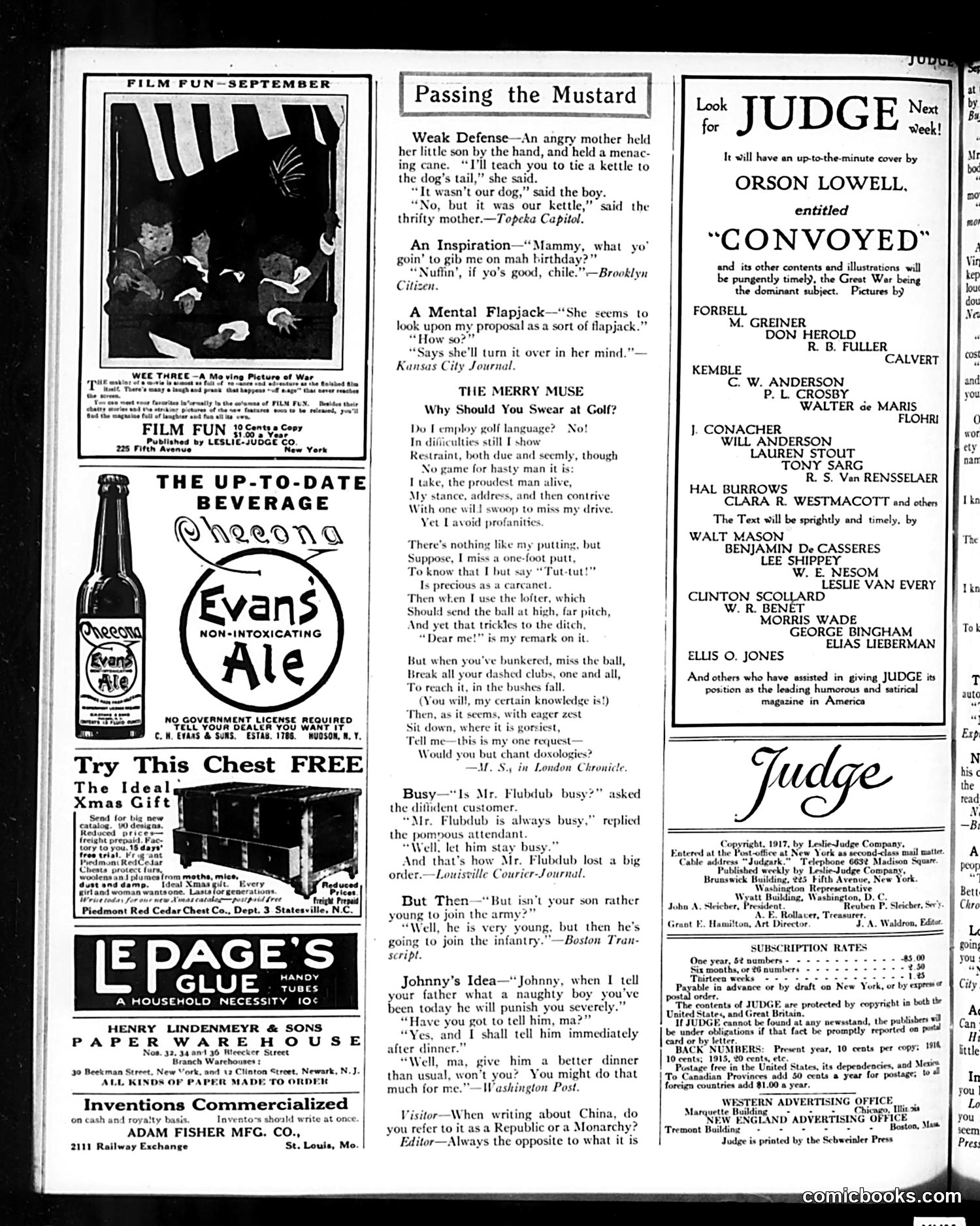
This page from **Judge** (September 1917) is primarily a **title/contents page** announcing the upcoming issue, with secondary material including advertisements and humorous filler content. **Main Content:** The page advertises Judge's next cover by illustrator **Orson Lowell**, titled "Convoyed"—a reference to **WWI convoy systems** protecting ships from German submarines. The masthead emphasizes the Great War as "the dominant subject," reflecting Judge's focus on contemporary military events. **The humor sections** ("Passing the Mustard") contain brief jokes typical of the era: domestic absurdities, golf frustration, and mild social satire. One notable item addresses a **young boy enlisting in the army**—reflecting anxiety about youth military conscription during WWI. **Advertisements** for Evans Ale (marketed as "non-intoxicating," relevant to Prohibition-era tensions) and LePage's Glue represent period commercial culture. The overall page reflects **1917 America**: wartime patriotism, emerging consumer products, and genteel satirical humor aimed at middle-class readers.
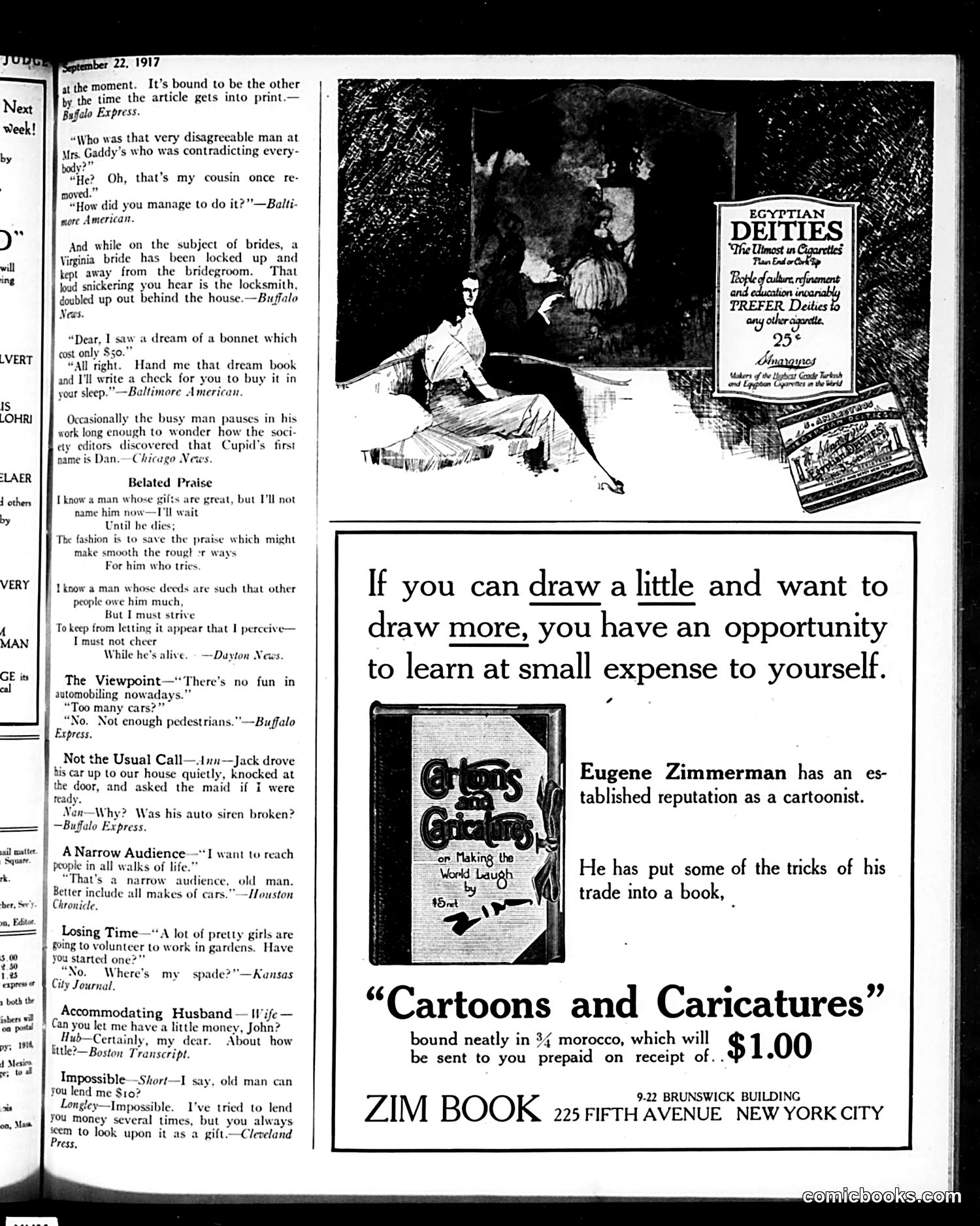
This page contains humorous short anecdotes and advertisements rather than political cartoons. The left column features satirical jokes about contemporary American life—marital relations, automotive culture, social etiquette—typical of Judge's appeal to middle-class readers. The dominant content is an advertisement promoting Eugene Zimmerman's instructional book "Cartoons and Caricatures" ($1.00), marketed to amateur artists wanting to develop drawing skills. The ad emphasizes Zimmerman's established reputation as a professional cartoonist sharing "tricks of his trade." The anecdotes mock recognizable social types: the contradictory dinner guest, lovelorn wives, society editors, and the increasingly common automobile owners. The humor is gentle domestic satire rather than sharp political commentary. One joke references automobiles' growing presence ("Not enough pedestrians"), reflecting the transformative impact of cars on American society during this WWI-era period.
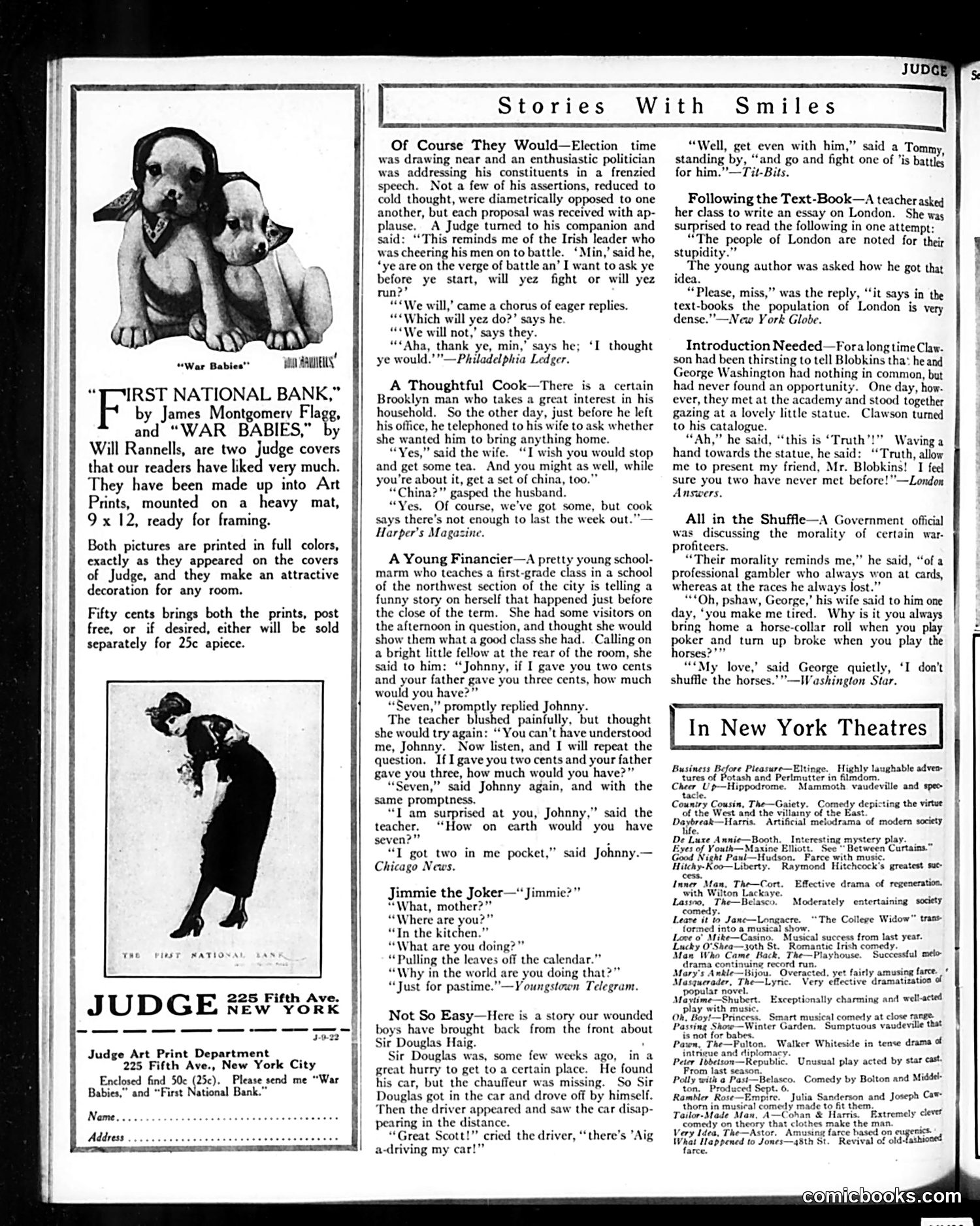
This page is primarily **advertising and humorous anecdotes** rather than political satire. The main content consists of: **Art Print Advertising**: Judge promotes two cover illustrations by James Montgomery Flagg and Will Rannells—"First National Bank" and "War Babies"—available as framed prints for 50 cents. **Comic Anecdotes**: The "Stories With Smiles" section contains six brief, lighthearted jokes: - A politician contradicting himself while campaigning - A wife requesting tea and china in the same request - A schoolteacher confused by a student's math answer (he already has coins in his pocket) - Jimmie pulling calendar leaves "for pastime" - Sir Douglas Haig accidentally driving his own car **Context**: These are gentle, family-friendly humor pieces—no sharp political commentary. The references to "election time" and a passing mention of "Sir Douglas Haig" (WWI British commander) place this during the war era, but the jokes avoid substantive critique, focusing instead on domestic absurdities and wordplay.
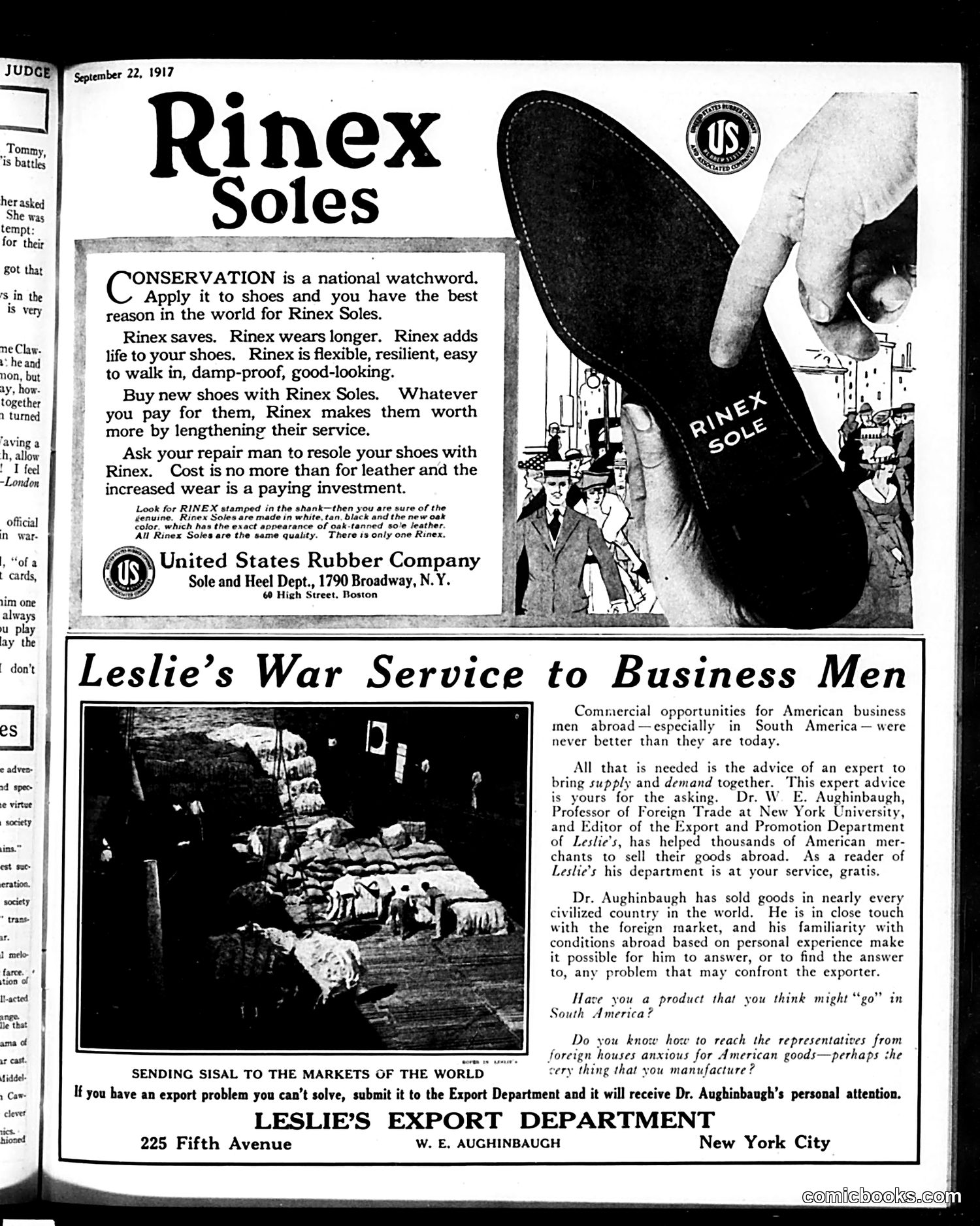
This page contains **two advertisements, not political satire**. The top half advertises **Rinex rubber shoe soles** from the United States Rubber Company. The ad frames shoe conservation as a patriotic duty—"conservation is a national watchword"—which likely references WWI rationing efforts of 1917. The pitch: buy shoes with Rinex soles to extend their life and save money. The bottom half promotes **Leslie's Export Department**, featuring Dr. W.E. Aughinbaugh, a trade professor offering free export advice to American businessmen. This appears designed to capitalize on post-WWI commercial opportunities abroad, particularly in South America. The accompanying image shows goods being shipped globally. Both ads reflect 1917 American concerns: wartime conservation and expanding post-war commercial markets. There is no cartoon or satire present—this is a straightforward advertising page from a commercial magazine.
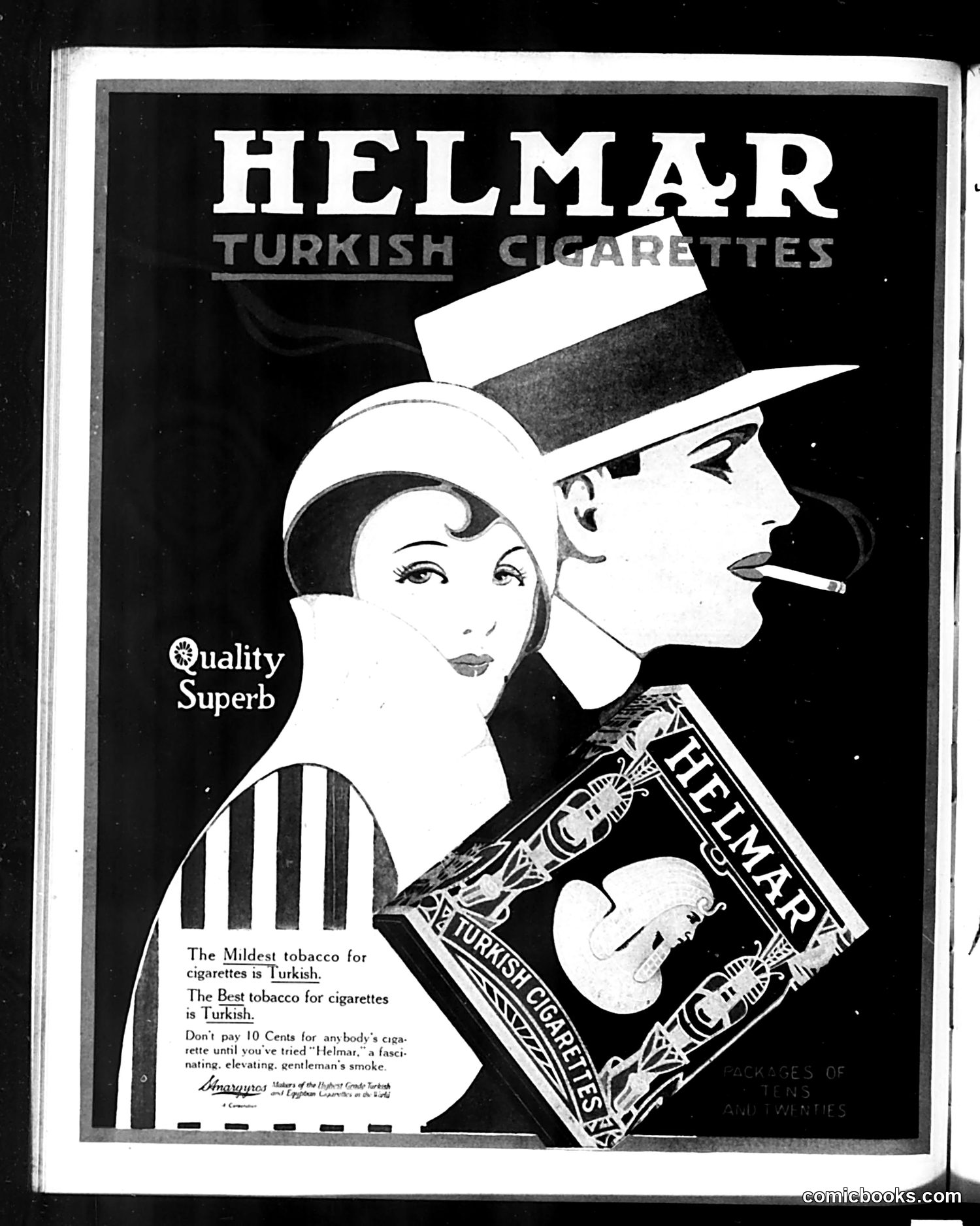
This is a **cigarette advertisement**, not political satire. It promotes Helmar brand Turkish cigarettes to an early 20th-century audience. The image shows an elegantly dressed couple in fashionable attire—the woman in a cloche hat and the man in a top hat with a cigarette—representing sophistication and modernity. The ad claims Turkish tobacco is "the mildest" for cigarettes and urges readers not to buy competitors until trying Helmar, which it describes as "fascinating, elevating, gentleman's smoke." The "Quality Superb" seal adds credibility. This reflects the era's widespread cigarette marketing before health warnings, targeting affluent consumers by associating the product with style and refinement.