
Judge, 1917-09-22 · page 17 of 28
Judge — September 22, 1917 — page 17: what you’re looking at
What you’re looking at
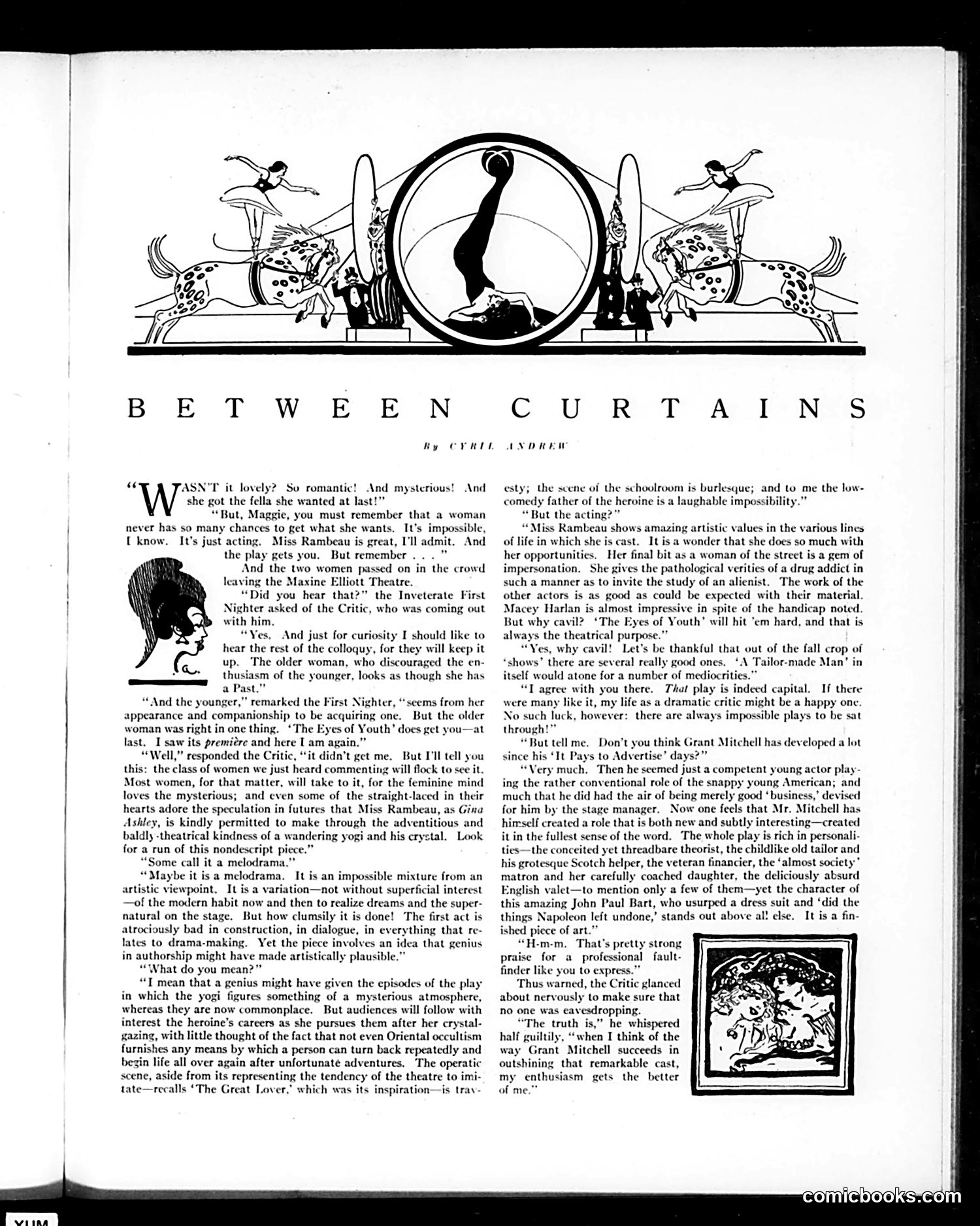
This is a theater criticism column by Cyril Andrew reviewing the play *"The Eyes of Youth,"* starring actress Gina Rambeau. The Art Deco illustration depicts a stylized acrobat/performer in a large circle, flanked by dancing figures and theatrical elements—representing the entertainment industry being discussed. The text presents a dialogue between two theater-goers: the "Inveterate First Nighter" (an enthusiastic regular attendee) and the "Critic" (skeptical professional). They debate the play's merits. The Critic acknowledges Rambeau's exceptional acting talent but dismisses the play itself as a poorly constructed melodrama—an "impossible mixture" combining crystal-gazing mysticism with realistic drama, featuring clumsy construction and laughable elements (particularly the "low-comedy father"). The satire targets theatrical pretension: audiences flock to inferior plays for star performances, while critics recognize artistic mediocrity masked by talented acting.
📄 Transcribed text from this page (OCR, searchable)
Machine-transcribed from the original scan — historical spelling and the odd misread are preserved.
wena B ET W EEN By CYRIL se ASN’T it lovely? So romantic! And mysterious! And she got the fella she wanted at last! “But, Maggie, you must remember that a woman never has so many chances to get what she wants. It's impossible, [ know. It’s just acting. Miss Rambeau is great, I'll admit. And the play gets you. But remember . . . And the two women passed on in the crowd ing the Maxine Elliott Theatre. Did you hear that?” the Inveterate First Nighter asked of the Critic, who was coming out with him. “Yes, And just for curiosity I should like to hear the rest of the colloquy, for they will keep it up. The older woman, who discouraged the en- thusiasm of the younger, looks as though she a Past. “And the younger,” remarked the First Nighter, “seems from her appearance and companionship to be acquiring one. But the older woman was right in one thing. ‘The Eyes of Youth’ does get you— last. I saw its premiere and here Tam again.” “Well,” responded the Critic, “it didn’t get me. But I'll tell you this: the class of women we just heard commenting will flock to see it. Most women, for that matter, will take to it, for the feminine mind loves the mysterious; and even some of the straight-laced in their hearts adore the speculation in futures that Miss Rambeau, as Gina Ashley, is kindly permitted to make through the adventitious and baldly -theatrical kindness of a wandering yogi and his crystal. Look for a run of this nondescript piece.” “Some call it a melodrama.” “Maybe it is a melodrama. It is an impossible mixture from an artistic viewpoint. It is a variation—not without superficial interest —of the modern habit now and then to realize dreams and the super- natural on the stage. But how clumsily it is done! The first act is atrociously bad in construction, in in everything that re- lates to drama-making. Yet the pit an idea that genius in authorship might have made artistically plausible.” “What do you mean?” “T mean that a genius might have given the episodes of the play in which the yogi figures something of a mysterious atmosphere, whereas they are now commonplace. But audiences will follow with interest the heroine’s careers as she pursues them after her crystal- gazing, with little thought of the fact that not even Oriental occultism furnishes any means by which a person can turn back repeatedly and begin life all over again after unfortunate adventures. The operatic scene, aside from its representing the tendency of the theatre to imi- tate—recalls ‘The Great Lover,’ which was its inspiration—is tray- C U RT ATI N S INDREN esty; the scene of the schoolroom is burlesque; and to me the low- comedy father of the heroine is a laughable impossibility.” “But the acting? Miss Rambeau shows amazing artistic values in the various lines of life in which she is cast. It is a wonder that she does so much with her opportunities. Her final bit as a woman of the street is a gem of impersonation. She gives the pathological verities of a drug addict in such a manner as to in’ the study of an alienist. The work of the other actors is as good as could be expected with their material. Macey Harlan is almost impressive in spite of the handicap noted. But why cavil? ‘The Eyes of Youth’ will hit ‘em hard, and that is always the theatrical purpos “Yes, why cavil! Let's be thankful that out of the fall crop ‘shows’ there are several really good ones. ‘A Tailor-made Man’ in itself would atone for a number of mediocrities. “TI agree with you there. That play is indeed capital. If there were many like it, my life as a dramatic critic might be a happy one No such luck, however: there are s impossible plays to be sat through!" “But tell me. Don’t you think Grant Mitchell has developed a lot since his ‘It Pays to Advertise’ days?” “Very much. Then he seemed just a competent young actor play- ing the rather conventional role of the snappy young American; and much that he did had the air of being merely good ‘business, for him by the stage manager. Now one feels that Mr. Mitchell has himself created a role that is both new and subtly interesting—created it in the fullest sense of the word. The whole play is rich in personali- tics—the conceited yet threadbare theorist, the childlike old tailor and his grotesque Scotch helper, the veteran financier, the ‘almost society” matron and her carefully coached daughter, the deliciously absurd English valet—to mention only a few of them—yet the character of this amazing John Paul Bart, who usurped a dress suit and ‘did the things Napoleon left undone,’ stands out above al! else. It is a fin- ished piece of art.” “H-m-m. That's pretty strong praise for a professional fault- finder like you to express.” ‘Thus warned, the Critic glanced about nervously to make sure that no one was eavesdropping. “The truth is,” he whispered half guiltily, “when I think of the way Grant Mitchell succeeds in outshining that remarkable cast, my enthusiasm gets the better of me.”