
Judge, 1917-09-22 · page 8 of 28
Judge — September 22, 1917 — page 8: what you’re looking at
What you’re looking at
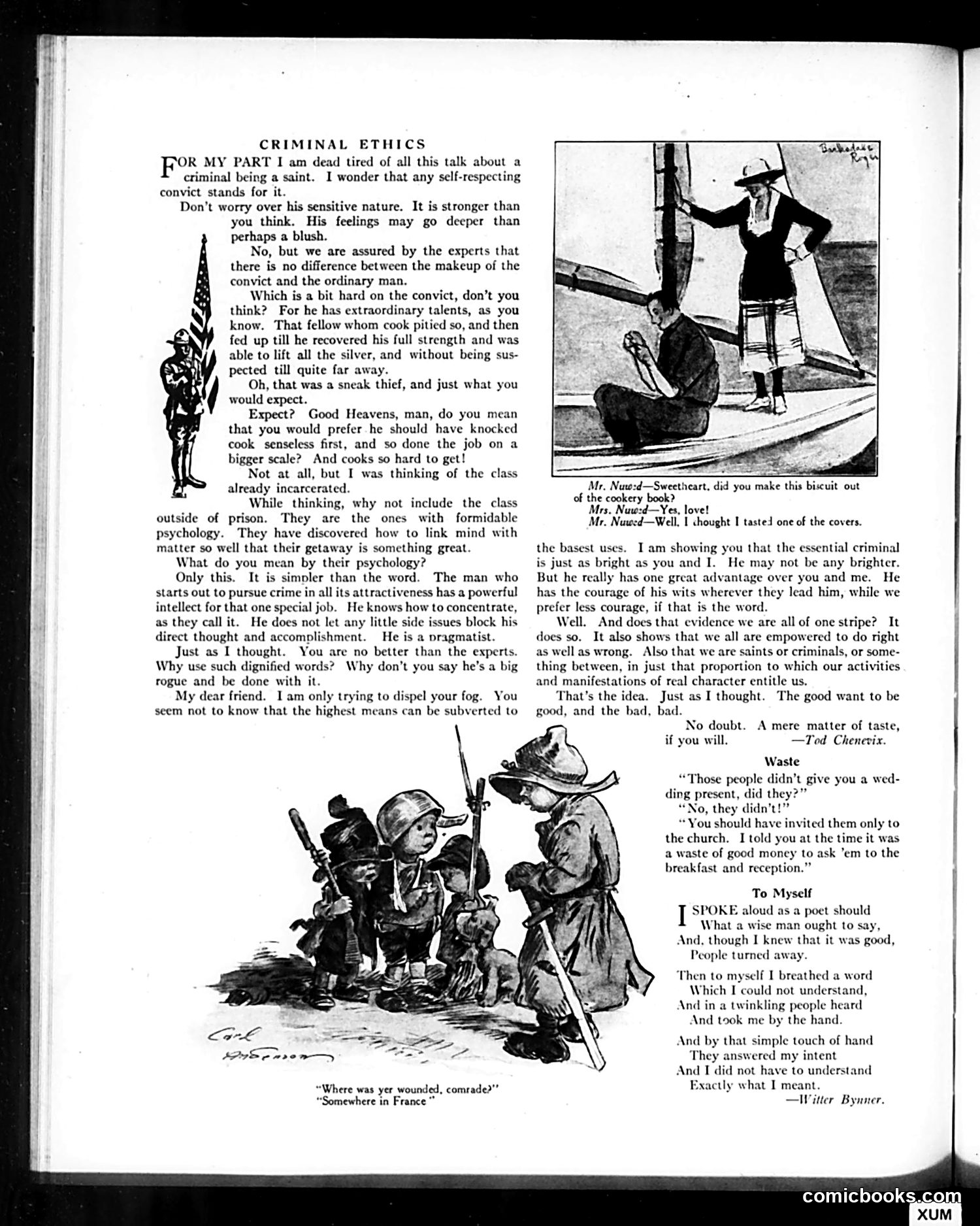
This page satirizes the popular contemporary notion that criminals possess no moral difference from ordinary citizens—a progressive criminology theory of the era. The main essay mocks experts who claim convicts and law-abiding people are psychologically identical. The author argues that criminals actually *do* differ: they possess superior intellect and "courage of their wits" that allow them to concentrate single-mindedly on crime without moral obstruction. The satire suggests that calling criminals "saints" or claiming universal human equality is naive sophistry that ignores observable criminal superiority in focus and cunning. The cartoon showing wounded soldiers asking "Where was yer wounded, comrade?" / "Somewhere in France" appears unrelated, possibly contrasting criminal cunning with military courage. Secondary items include a joke about inedible wartime cooking and Witter Bynner's poem about incomprehensible speech somehow winning approval—seemingly mocking how people accept things they don't understand.
📄 Transcribed text from this page (OCR, searchable)
Machine-transcribed from the original scan — historical spelling and the odd misread are preserved.
CRIMINAL ETHICS ‘OR MY PART I am dead tired of all this talk about a criminal being a saint. I wonder that any self-respecting convict stands for it. Don’t worry over his sensitive nature. It is stronger than you think. His feelings may go deeper than perhaps a blush. No, but we are assured by the experts that there is no difference between the makeup of the convict and the ordinary man. Which is a bit hard on the convict, don’t you think? For he has extraordinary talents, as you know. That fellow whom cook pitied so, and then fed up till he recovered his full strength and was able to lift all the silver, and without being sus- pected till quite far away. Oh, that was a sneak thief, and just what you would expect. Expect? Good Heavens, man, do you mean that you would prefer he should have knocked cook senseless first, and so done the job on a bigger scale? And cooks so hard to get! Not at all, but I was thinking of the class already incarcerated. While thinking, why not include the class outside of prison. They are the ones with formidable psychology. They have discovered how to link mind with matter so well that their getaway is something great. What do you mean by their psychology? Only this. It is simpler than the word. The man who starts out to pursue crime in all its attractiveness has a powerful intellect for that one special job. He knows how to concentrate, as they call it. He does not let any little side issues block his direct thought and accomplishment. He is a pragmatist. Just as I thought. You are no better than the experts. Why use such dignified words? Why don’t you say he’s a big rogue and be done with it. My dear friend. I am only trying to dispel your fog. You seem not to know that the highest means can be subverted to “Where was yer wounded, comrade?” “Somewhere in France” Mr. Nutwo:d—Sweetheart, did you make this biscuit out of the cookery book? Mrs. Nuw:d—Yes, love! Mr. Nuwed—Well, | chought I tasted one of the covers. the basest uses. Iam showing you that the essential criminal is just as bright as you and I. He may not be any brighter. But he really has one great advantage over you and me. He has the courage of his wits wherever they lead him, while we prefer less courage, if that is the word. Well. And does that evidence we are all of one stripe? It does so. It also shows that we all are empowered to do right as well as wrong. Also that we are saints or criminals, or some- thing between, in just that proportion to which our activities and manifestations of real character entitle us. That's the idea. Just as I thought. The good want to be good, and the bad, bad. No doubt. if you will. A mere matter of taste, —Tod Chenevix. Waste “Those people didn’t give you a wed- ding present, did they?” “No, they didn’t!” “You should have invited them only to the church. I told you at the time it was a waste of good money to ask ’em to the breakfast and reception.” To Myself SPOKE aloud as a poet should What a wise man ought to say, And, though I knew that it was good, People turned away. Then to myself I breathed a word Which I could not understand, And in a twinkling people heard And took me by the hand. And by that simple touch of hand They answered my intent And I did not have to understand Exactly what I meant. —Witter Bynner. comicbooks.com