
Judge, 1917-09-22 · page 11 of 28
Judge — September 22, 1917 — page 11: what you’re looking at
What you’re looking at
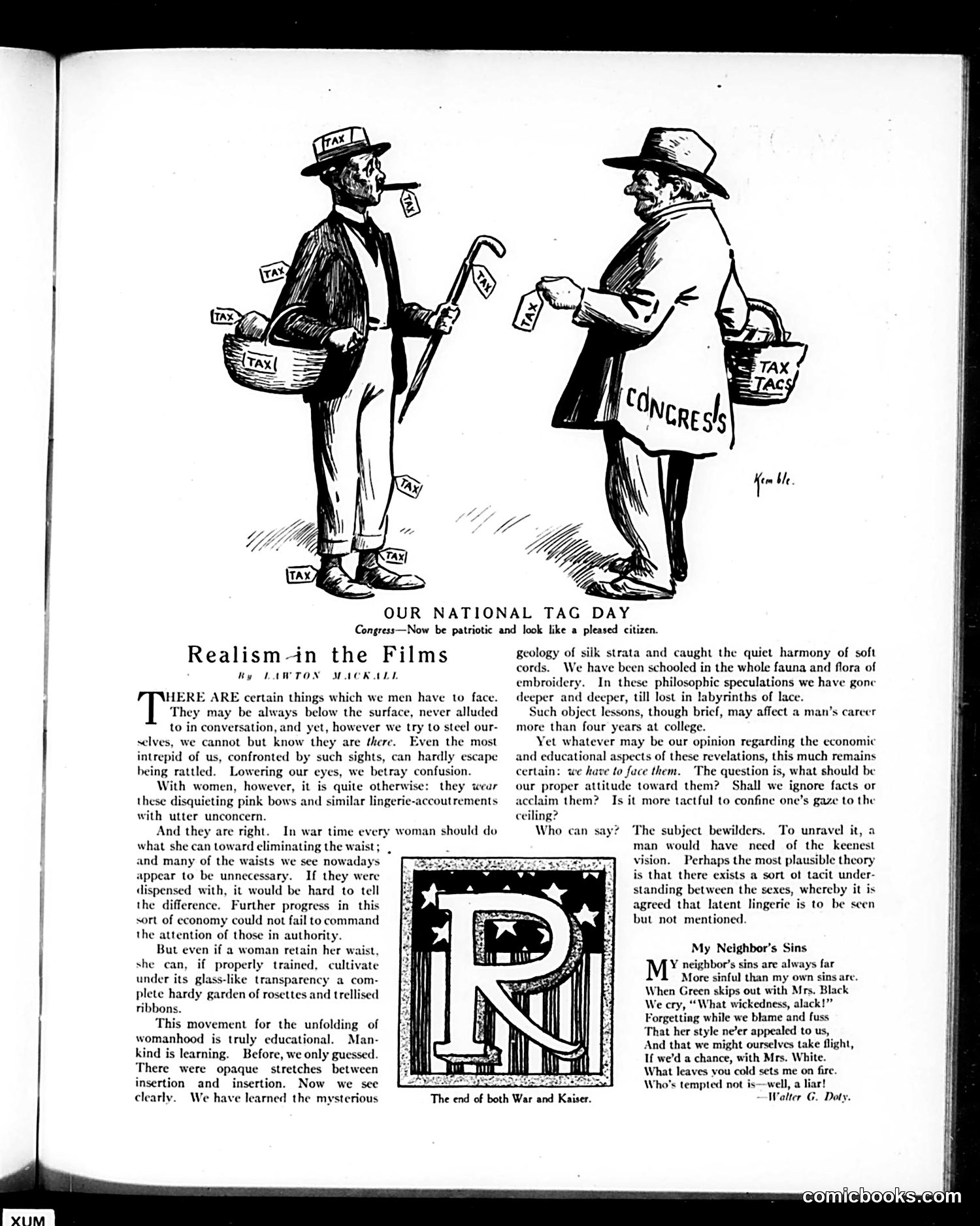
**"Our National Tag Day" (top cartoon):** This satirizes Congressional hypocrisy during wartime taxation. Two figures—one labeled a taxi driver, the other labeled "Congress"—exchange money and tax tokens. Congress instructs the citizen to "be patriotic and look like a pleased citizen" while collecting taxes. The satire suggests Congress extracts money from ordinary people under patriotic pretense while politicians themselves profit, appearing smug rather than genuinely sacrificial. **"Realism in the Films" (main article):** This discusses women's fashions and lingerie visibility in cinema. The author argues that educational benefit comes from observing women's undergarments openly rather than speculating about them. It's fundamentally a tongue-in-cheek defense of risqué film content as "educational," wrapped in pseudo-intellectual language about wartime economy and fashion progress. **"My Neighbor's Sins" (poem):** A morality commentary noting human hypocrisy: we condemn others' moral failings (infidelity) while ignoring our own temptations. The irony is that we judge neighbors' affairs as scandalous only because their partners don't appeal to us personally.
📄 Transcribed text from this page (OCR, searchable)
Machine-transcribed from the original scan — historical spelling and the odd misread are preserved.
YUM OUR NATIONAL TAG DAY Congress—Now be patriotic and look like a pleased citizen. Realism-in the Films Ry LAWTON MACK ALL HERE ARE certain things which we men have to face. T They may be always below the surface, never alluded to in conversation, and yet, however we try to steel our- selves, we cannot but know they are there yen the most intrepid of us, confronted by such sights, hardly escape being rattled. Lowering our ¢ we betray confusion. With women, however, it is quite otherwise: they wear these disquieting pink bows and similar lingerie-accoutrements with utter unconcern. And they are right. In war time e what she can toward climinating the waist; and many of the waists we see nowadays appear to be unnecessary. If they were dispensed with, it would be hard to tell the difference. Further progress in this sort of economy could not fail to command the attention of those in authority. But even if a woman retain her wais she can, if properly trained, cultivate under its glass-like transparency a com- plete hardy garden of rosettes and trellised ribbons. This movement for the unfolding of womanhood is truly educational. Man- kind is learning. Before, we only guessed. There were opaque stretches between insertion and insertion. Now we see clearly. We have learned the mysterious y woman should do geology of silk strata and caught the quict harmony of soft cords. We have been schooled in the whole fauna and flora of embroidery. In these philosophic speculations we have gone deeper and deeper, till lost in labyrinths of lace. Such object lessons, though brief, may affect a man’s career han four years at college. Yet whatever may be our opinion regarding the economic and educational aspects of these revelations, this much remains certain: we have to face them. The question is, what should be our proper attitude toward them? Shall we ignore facts or acclaim them? Is it more tactful to confine one’s gaze to the ceiling? Who can say? The subject bewilders. To unravel it, a man would have necd of the keenest vision. Perhaps the most plausible theory is that there exists a sort of tacit under- standing between the sexes, whereby it is agreed that latent lingerie is to be seen but not mentioned. mot My Neighbor's Sins Y neighbor's sins are always far More sinful than my own sins are. When Green skips out with Mrs. Black We cry, “What wickedness, alack!”” Forgetting while we blame and fuss That her style ne’er appealed to us, And that we might ourselves take flight, If we'd a chance, with Mrs. White. What leaves you cold sets me on fire. Who's tempted not is—well, a liar! Walter G. Doty.