
Judge, 1917-09-22 · page 26 of 28
Judge — September 22, 1917 — page 26: what you’re looking at
What you’re looking at
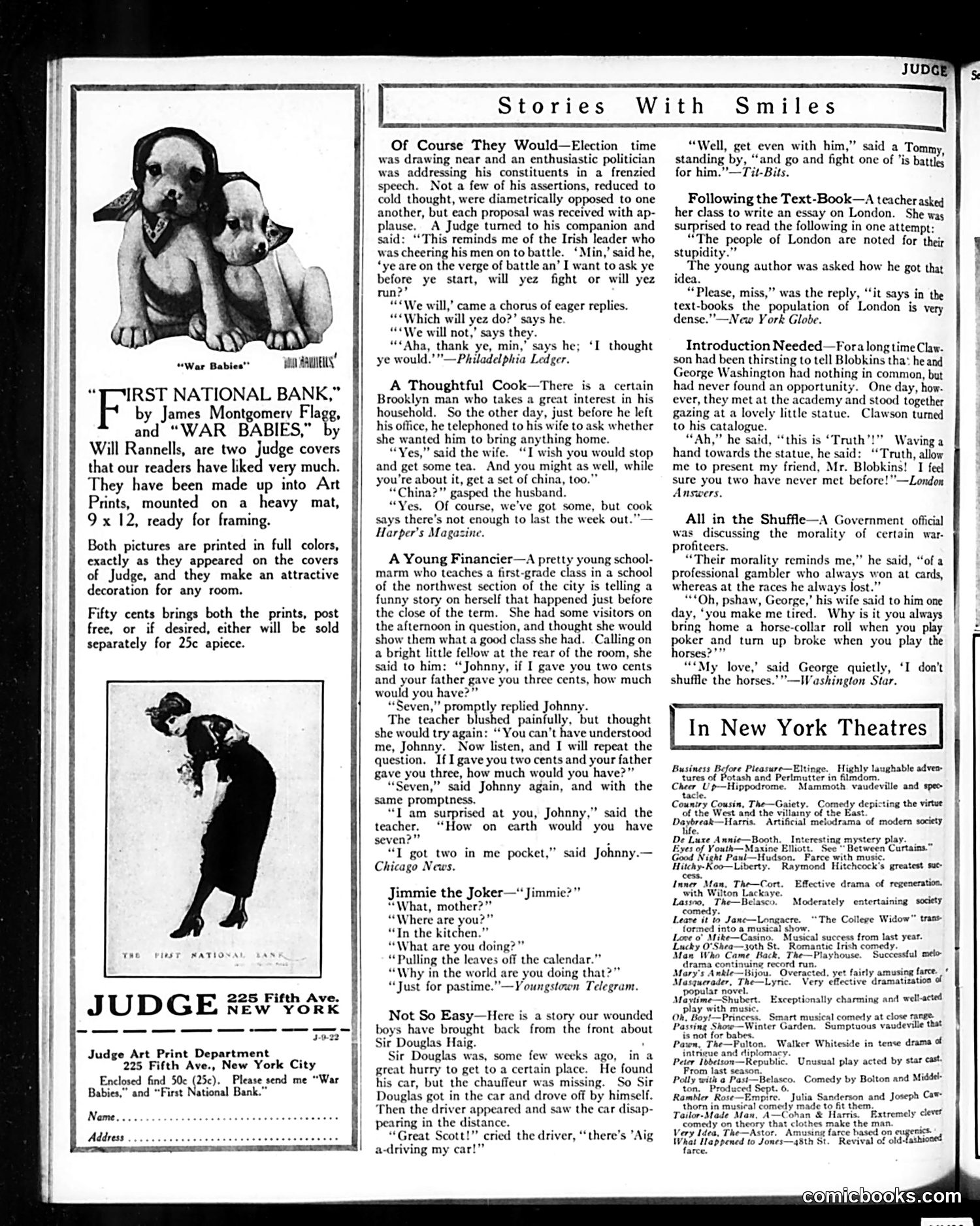
This page is primarily **advertising and humorous anecdotes** rather than political satire. The main content consists of: **Art Print Advertising**: Judge promotes two cover illustrations by James Montgomery Flagg and Will Rannells—"First National Bank" and "War Babies"—available as framed prints for 50 cents. **Comic Anecdotes**: The "Stories With Smiles" section contains six brief, lighthearted jokes: - A politician contradicting himself while campaigning - A wife requesting tea and china in the same request - A schoolteacher confused by a student's math answer (he already has coins in his pocket) - Jimmie pulling calendar leaves "for pastime" - Sir Douglas Haig accidentally driving his own car **Context**: These are gentle, family-friendly humor pieces—no sharp political commentary. The references to "election time" and a passing mention of "Sir Douglas Haig" (WWI British commander) place this during the war era, but the jokes avoid substantive critique, focusing instead on domestic absurdities and wordplay.
📄 Transcribed text from this page (OCR, searchable)
Machine-transcribed from the original scan — historical spelling and the odd misread are preserved.
“TTIRST NATIONAL BANK,” by James Montgomery Flagg, and “WAR BABIES,” ie Will Rannells, are two Judge covers that our readers have liked very much. They have been made up into Art Prints, mounted on a heavy mat, 9x 12, ready for framing. Both pictures are printed in full colors, exactly as they appeared on the covers of Judge, and they make an attractive decoration for any room. Fifty cents brings both the prints, post free, or if desired, either will be sold separately for 25c apiece. 225 Fifth Ave. NEW YORK } JUDG Judge Art Print Department 225 Fifth Ave., New York City Enclosed find 50¢ (25). Please send me “War Babies,” and “First National Bank.” Name... . Address Stories Of Course They Would—Election time was drawing near and an enthusiastic politician was addressing his constituents in a frenzied speech. Not a few of his assertions, reduced to cold thought, were diametrically opposed to one another, but each proposal was received with ap- plause. A Judge tured to his companion and said: ‘‘This reminds me of the Irish leader who was cheering his men on to battle. ‘Min,’ said he, ‘ye are on the verge of battle an’ I want to ask ye before ye start, will yez fight or will yez run?’ “We will,’ came a chorus of eager replies. “*Which will yez do?’ says he. “We will not,’ says they “*Aha, thank ye, min,” says he; ‘I thought ye would.’ —Philadelphia Ledger. A Thoughtful Cook—There is a certain Brooklyn man who takes a great interest in his household. So the other day, just before he left his office, he telephoned to his wife to ask whether she wanted him to bring anything home. “Yes,” said the wife. “I wish you would stop and get some tea. And you might as well, while you're about it, get a set of china, too.” “China?” gasped the husband. “Yes. Of course, we've got some, but co says there's not enough to last the week out.” Harper's Magazine. A Young Financier—A pretty young school- marm who teaches a first-grade class in a school of the northwest section of the city is telling a funny story on herself that happened just before the close of the term. She had some visitors on the afternoon in question, and thought she would show them what a good class she had. Calling on a bright little fellow at the rear of the room, she said to him: “Johnny, if I gave you two cents and your father gave you three cents, how much would you have?” “Seven,” promptly replied Johnny. The teacher blushed painfully, but thought she would try again: “You can’t have understood me, Johnny. Now listen, and I will repeat the question. If gave you two cents and your father gave you three, how much would you have?” “Seven,” said Johnny again, and with the same promptness. “Iam surprised at you, Johnny,” said the teacher. “How on earth would you have seven? Ps “I got two in me pocket,” said Johnny.— Chicago News. Jimmie the Joker—‘“ Jimmie “What, mother?” “Where are you?” “In the kitche “What are you doing?” “Pulling the leaves off the calenda: “Why in the world are you doing that?” “Just for pastime.” —Youngstown Telegram. Not So Easy—Here is a story our wounded boys have brought back from the front about ir Douglas Haig. ' ir Douglas was, some few weeks ago, in a great hurry to get to a certain place. He found his car, but the chauffeur was missing. So Sir Douglas got in the car and drove off by himself. Then the driver appeared and saw the car disap- pearing in the distance. “Great Scott!” cried the driver, “there's "Aig a-driving my car! With “Well, get even with him,” said a Tommy, standing by, ‘‘and go and fight one of ‘is battles for him.” —Tit-Bits. Following the Text-Book—A teacher asked her class to write an essay on London. She was surprised to read the following in one attempt: “The people of London are noted for their stupidity.” | we young author was asked how he got that idea. “Please, miss,” was the reply, ‘“‘it says in the text-books the population of London is very dense.""—New York Globe. Introduction Needed—Fora longtime Claw. son had been thirsting to tell Blobkins tha: he and George Washington had nothing in common, but had never found an opportunity. One day, how. ever, they met at the academy and stood together gazing at a lovely little statue. Clawson tured to his catalogue. “Ah,” he said, “this is ‘Truth’! Waving a hand towards the statue, he said: ‘Truth, allow me to present my friend, Mr. Blobkins! I feel sure you two have never met before! ""—London Answers. All in the Shuffle—A Government official was discussing the morality of certain war- profitcers. “Their morality reminds mi professional gambler who al: whereas at the races he alw “Oh, pshaw, George,’ hi: day, ‘you make me tired. Why "he said, “of a it you always bring home a horse-collar roll when you play poker and tum up broke when you play the jorses?'”” “*My love,’ said George quietly, ‘I don't shuffle the horses.’ —Washington Star. In New York Theatres Business Before Pleasure—Eltinge. Highly laughable advea- tures of Potash and Perlmutter in filmdom. Cheer Up—Hippodrome. Mammoth vaudeville and spec tacle. Country Cousin, The—Gaiety. Comedy depi of the West and the villainy of the East 3 Daxéreak—Hars. Artificial metodrama of modern society the virtue fe. De Luxe Annie—Booth. Interesting mystery play. Eyes of Youth—Maxine Elliott. See “ Between Curtains.” Good Night Paxl—Hudson. Parce with music. Hitchy-Koo—Liberty. Raymond Hitchcock's greatest suc cess. 5 Inner Man, The—Cort. Effective drama of regeneration. with Wilton Lackaye. Lasso, The—Belasco. comedy. Leave it 19 Janc—Longacre. formed into a musical show. Love 0° Mike—Casino. Musical success from last year. Lucky O'Shea—3oth St. Romantic Irish comedy. Man Who Came Back, The—Playhouse. Successful melo- ing record run. ijou. Overacted. y Masquerader, The Very ‘e popular novel. Mavtime—Shubert. Exceptionally charming and well-acted play with music. Oh, Boy!—Princess. Passing Show—Winter Garden. bes. Pawn, The—Pulton. intrique and diplomacy. Peter Todetion—Republic. Unusual play acted by star cast From last season. Polly with @ Past—Belasco. Comedy by Bolton and Middel- ton. Produced it. 6. Rambler Rose thorn in musical comedy made to fit them. . Tailor-Made Man, A—Cohan & Harris. Extremely clever comedy on theory tha: es make the man. Very Idea, The—Astor. Amusing farce based on a What Happened to Jones—a8th St. Revival of old-fashioned farce. Moderately entertaining society “The College Widow” trans fairly amusing farce, ve dramatization of Smart musical comedy at close range Sumptuous vaudeville that Walker Whiteside in tense drama of "Jutia Sanderson and Joseph Cae ares he