
Judge, 1917-09-22 · page 12 of 28
Judge — September 22, 1917 — page 12: what you’re looking at
What you’re looking at
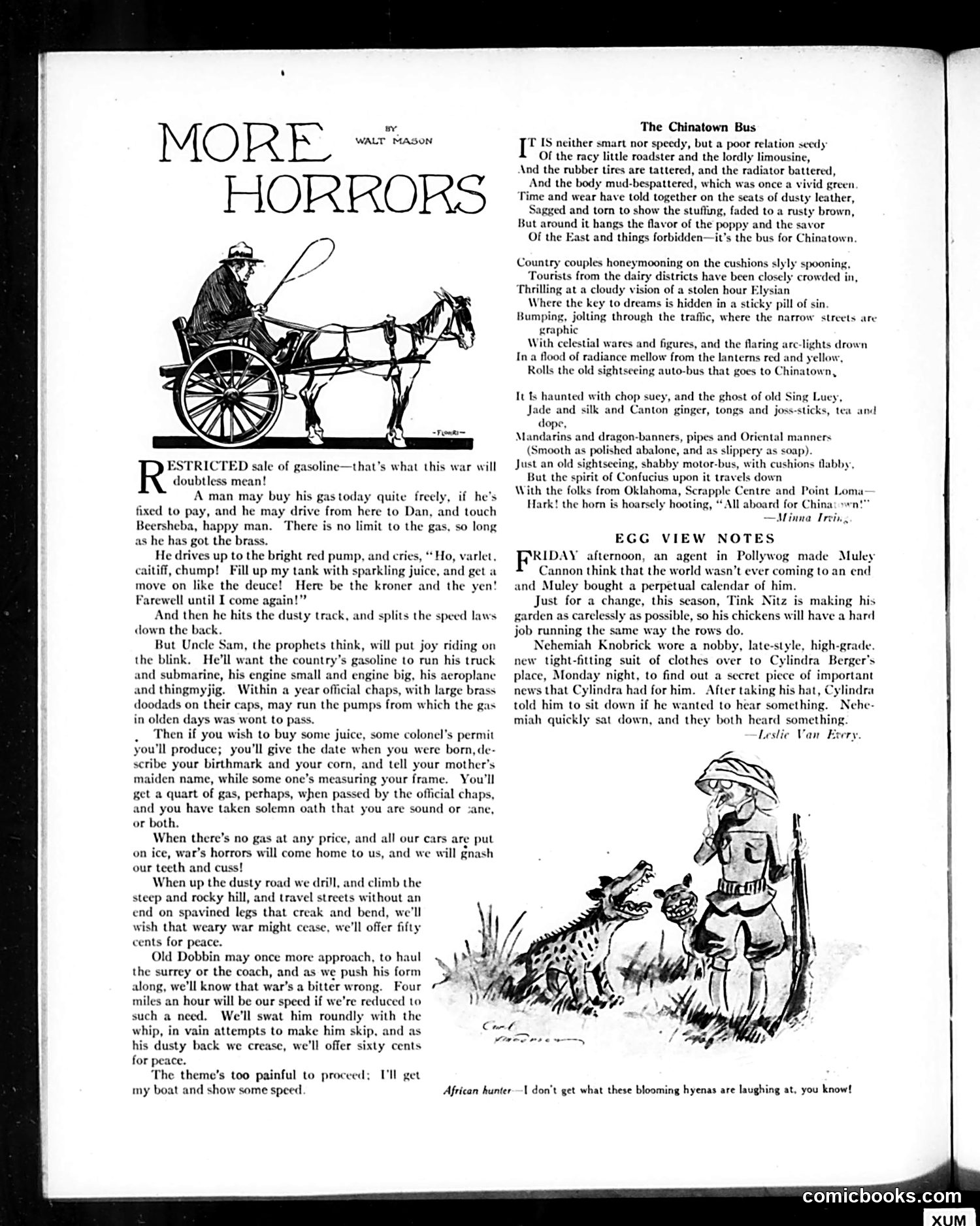
**"More Horrors" (left):** This satirical poem mocks anticipated WWI-era gasoline rationing. Mason imagines a future where the U.S. government restricts fuel for civilian joy-riding, requiring permits and personal information to purchase gas. The satire escalates absurdly—citizens will be reduced to horse-drawn carriages and offer "fifty cents for peace" rather than endure slow travel. The joke targets both wartime sacrifice and American attachment to automobiles. **"The Chinatown Bus" (right):** This poem describes a decrepit sightseeing bus touring San Francisco's Chinatown, attracting honeymooning couples and rural tourists seeking exotic thrills—"a sticky pill of sin." The verse mixes romanticized orientalism with mild moral disapproval, reflecting 1910s-era attitudes toward Asian neighborhoods as mysterious and vaguely disreputable destinations for American sightseers. The humor relies on contrasting the bus's shabby condition with passengers' exotic expectations.
📄 Transcribed text from this page (OCR, searchable)
Machine-transcribed from the original scan — historical spelling and the odd misread are preserved.
MORF, « HOKKORS ) sale of gasoline—that’s what this war will doubtless mean! y buy his gas today quite freely, if he’s fixed to pay, and he may drive from here to Dan, and touch Beersheba, happy man. There is no limit to the gas, so long as he has got the brass. He drives up to the bright red pump, and cries, “Ho, varlet, caitiff, chump! Fill up my tank with sparkling juice, and get a move on like the deuce! Here be the kroner and the yen! Farewell until I come again!”” nd then he hits the dusty track, and splits the speed laws down the back But Uncle Sam, the prophets think, will put joy riding on the blink. He'll want the country’s gasoline to run his truck and submarine, his engine small and engine big, his aeroplane and thingmyjig. Within a year official chaps, with large brass doodads on their caps, may run the pumps from which the gas in olden days was wont to pass. Then if you wish to buy some juice, some colonel’s permit you'll produce; you'll give the date when you were born, de- scribe your birthmark and your corn, and tell your mother’s maiden name, while some one’s measuring your frame. You'll get a quart of gas, perhaps, when passed by the official chaps, and you have taken solemn oath that you are sound or cane, or both. When there’s no at any price, and all our cars are put on ice, war's horrors will come home to us, and we will gnash our teeth and cuss! When up the dusty road we drill, and climb the steep and rocky hill, and travel streets without an end on spavined legs that creak and bend, we'll wish that weary war might cease, we'll offer fifty cents for peace. Old Dobbin may once more approach, to haul the surrey or the coach, and as we push his form along, we'll know that war’s a bitter wrong. Four miles an hour will be our speed if we're reduced to such a need. We'll swat him roundly with the whip, in vain attempts to make him skip, and as his dusty back we crease, we'll offer sixty cents for peace. The theme's too painful to proceed; my boat and show some speed TH get African hunter The Chinatown Bus I" IS neither smart nor speedy, but a poor relation seedy: Of the racy little roadster and the lordly limousine, And the rubber tires are tattered, and the radiator battered, And the body mud-bespattered, which was once a vivid green Time and wear have told together on the seats of dusty leather, Sagged and torn to show the stuffing, faded to a rusty brown, But around it hangs the flavor of the poppy and the savor Of the East and things forbidden—it’s the bus for Chinatown Country couples honeymooning on the cushions slyly spooning, Tourists from the dairy districts have been clo: crowded in, Thrilling at a cloudy vision of a stolen hour Elysian Where the key to dreams is hidden in a sticky pill of sin Bumping, jolting through the traffic, where the narrow streets are graphic With celestial wares and figures, and the flaring arc-lights drown In a flood of radiance mellow from the lanterns red and yellow, Rolls the old sightseeing auto-bus that goes to Chinatown, It fs haunted with chop suey, and the ghost of old Sing Luey, Jade and silk and Canton ginger, tongs and joss-sticks, tei dop. Mandarins and dragon-banners, pipes and Oriental manners (Smooth as polished abalone, and as slippery as soap). Just an old sightseeing, shabby motor-bus, with cushions flabby, But the spirit of Confucius upon it travels down With the folks from Oklahoma, Scrapple Centre and Point Lom Hark! the horn is hoarsely hooting, “All aboard for China: wn —Minna Irvin EGG VIEW NOTES RIDAY afternoon, an agent in Pollywog made Muley Cannon think that the world wasn’t ever coming to an end and Muley bought a perpetual calendar of him. Just for a change, this season, Tink Nitz is making his garden as carelessly as possible, so his chickens will have a hard job running the same way the rows do. Nehemiah Knobrick wore a nobby, late-style, high-grade. new tight-fitting suit of clothes over to Cylindra Berger's place, Monda ight, to find out a secret piece of important news that Cylindra had for him. After taking his hat, Cylindra told him to sit down if he wanted to hear something. Nehe- miah quickly sat down, and they both heard something. Leslie Van Every. I don’t get what these blooming hyenas are laughing at, you know! comicbooks.com