
A complete issue · 28 pages · 1917
Judge — August 18, 1917
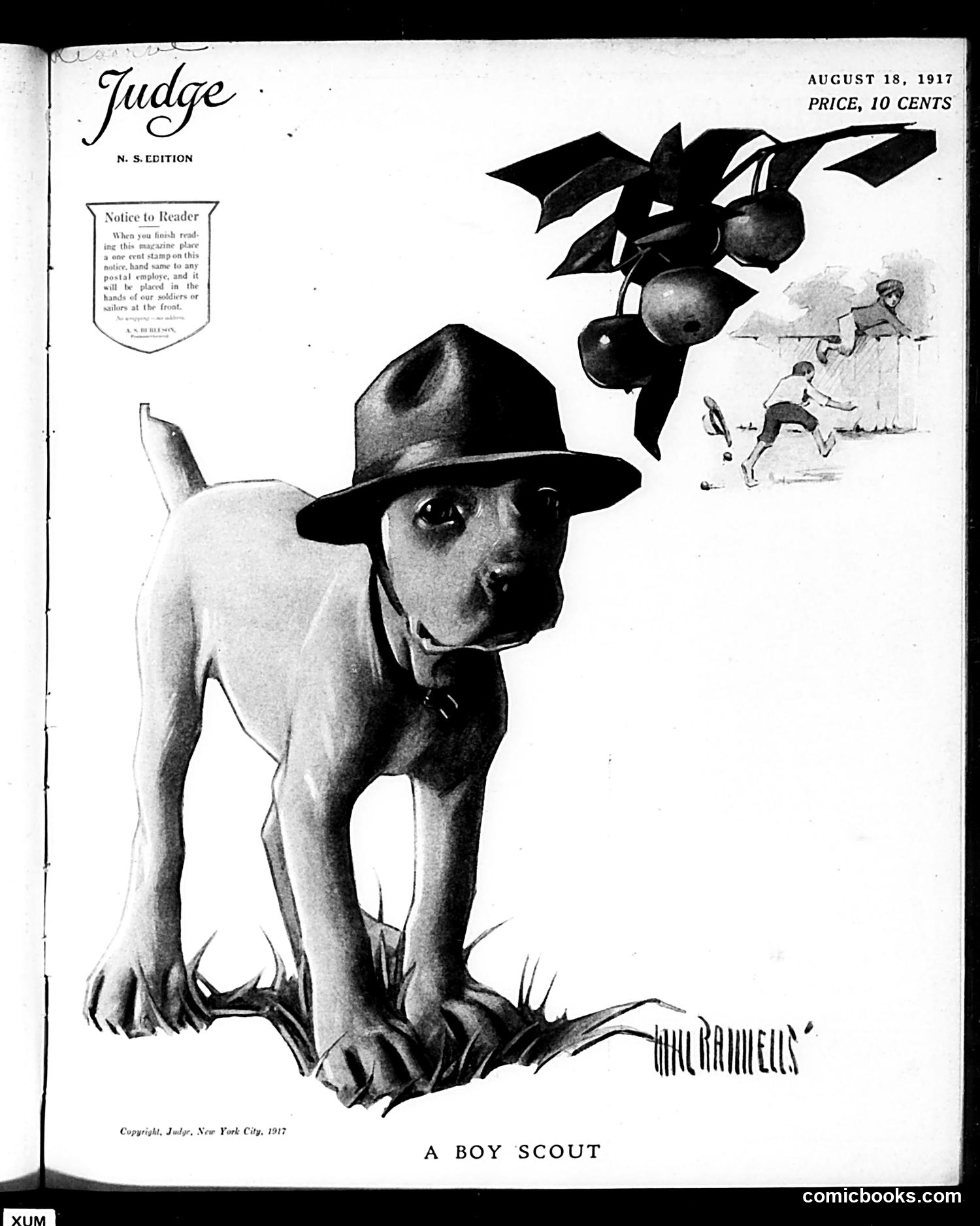
This cover depicts a dog wearing a Boy Scout hat, looking at apples hanging from a branch while children play baseball in the background. The cartoon appears to be a humorous visual pun playing on the phrase "boy scout" by literally showing a dog dressed as one. Given the 1917 publication date (during America's World War I involvement), this likely references the Boy Scouts' patriotic role during wartime—the organization promoted citizenship, discipline, and preparedness. The innocent scene with the dog suggests wholesome youth values the Scouts represented. The artist's signature reads "Cesare," though the style attribution appears as "RALEAMELS."
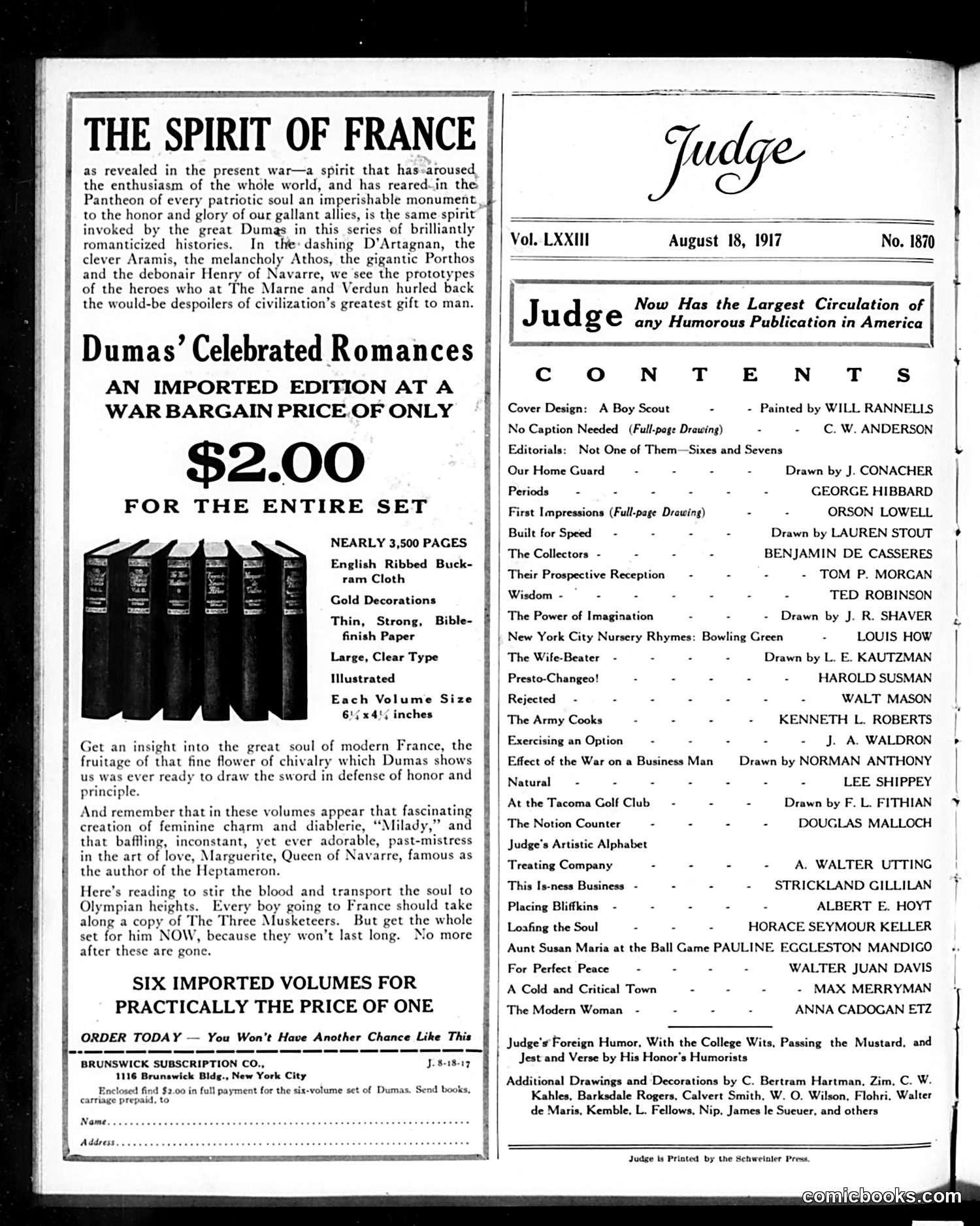
This page is predominantly **advertising and table of contents** rather than political satire. The left side features a full-page ad for Dumas's novels (Six imported volumes for $2.00), emphasizing French cultural heritage during WWI—clearly marketed to Americans supportive of the Allied cause. The right side lists the magazine's contents, including various humorous articles and drawings. Notable titles like "Effect of the War on a Business Man" and "The Modern Woman" suggest typical early-20th-century satirical subjects. The cover design, "A Boy Scout" by Will Rannells, appears patriotic. The page reflects 1917 America: pro-French sentiment, wartime cultural promotion, and conventional domestic humor—no specific political cartoon or caricature is visible here.
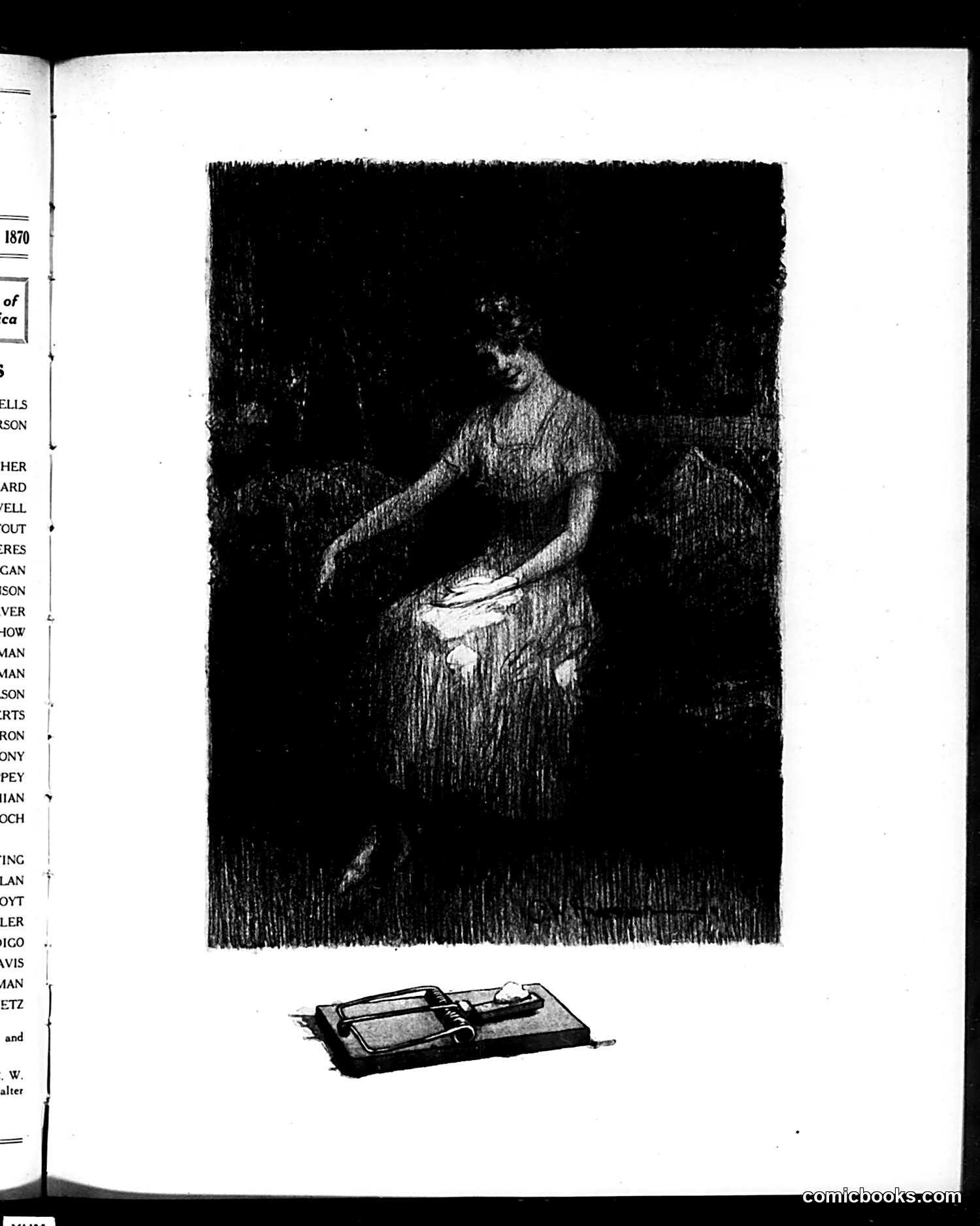
The page shows a satirical engraving above an illustration of a mousetrap. The sketch depicts a woman in classical dress holding what appears to be a pan or vessel, rendered in dramatic dark tones. Below it sits a detailed drawing of an actual mousetrap mechanism. This appears to be a visual pun or satirical commentary, likely comparing the woman's pose or action to the mechanics of a mousetrap—perhaps suggesting entrapment or a "trap" of some kind. Without clearer context from surrounding text or a visible caption, the specific political or social reference remains unclear. The juxtaposition suggests commentary on deception or manipulation, but the exact target of satire cannot be definitively determined from the image alone.
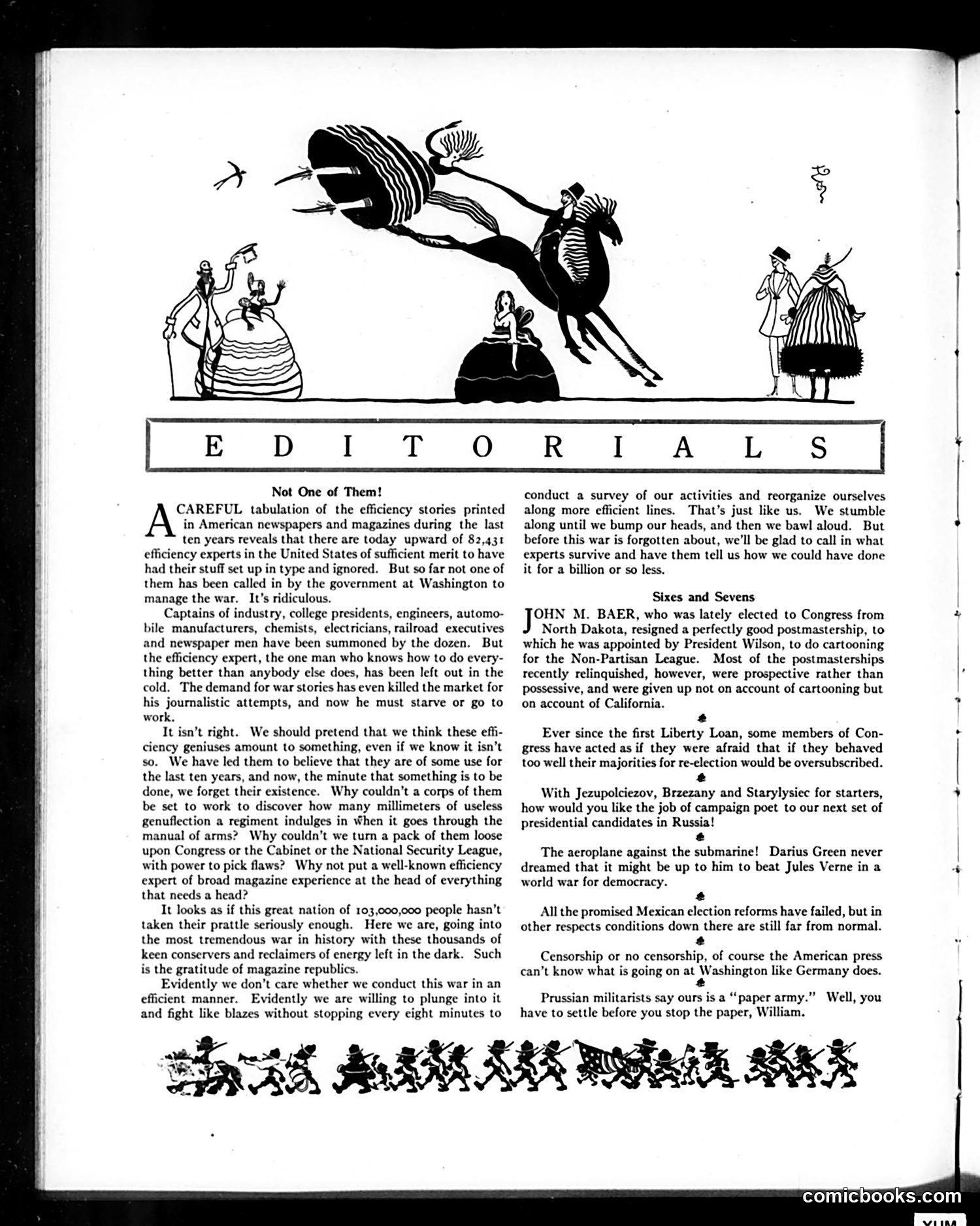
This editorial cartoon critiques American government inefficiency during WWI. The top illustration depicts a figure (likely representing government or leadership) riding a horse while juggling bureaucratic tasks—symbolizing chaotic war management. The accompanying text mocks the lack of qualified leaders managing the war effort, arguing that despite identifying thousands of "efficiency experts" in newspapers over fifteen years, none have been called to Washington. The editorial sarcastically suggests that incompetent officials should be replaced by these supposed experts. The piece references John M. Baer (a congressman) and mentions failed Mexican election reforms and debates about press censorship—typical wartime political controversies. The overall message: American leadership is dangerously incompetent and wasteful during wartime.
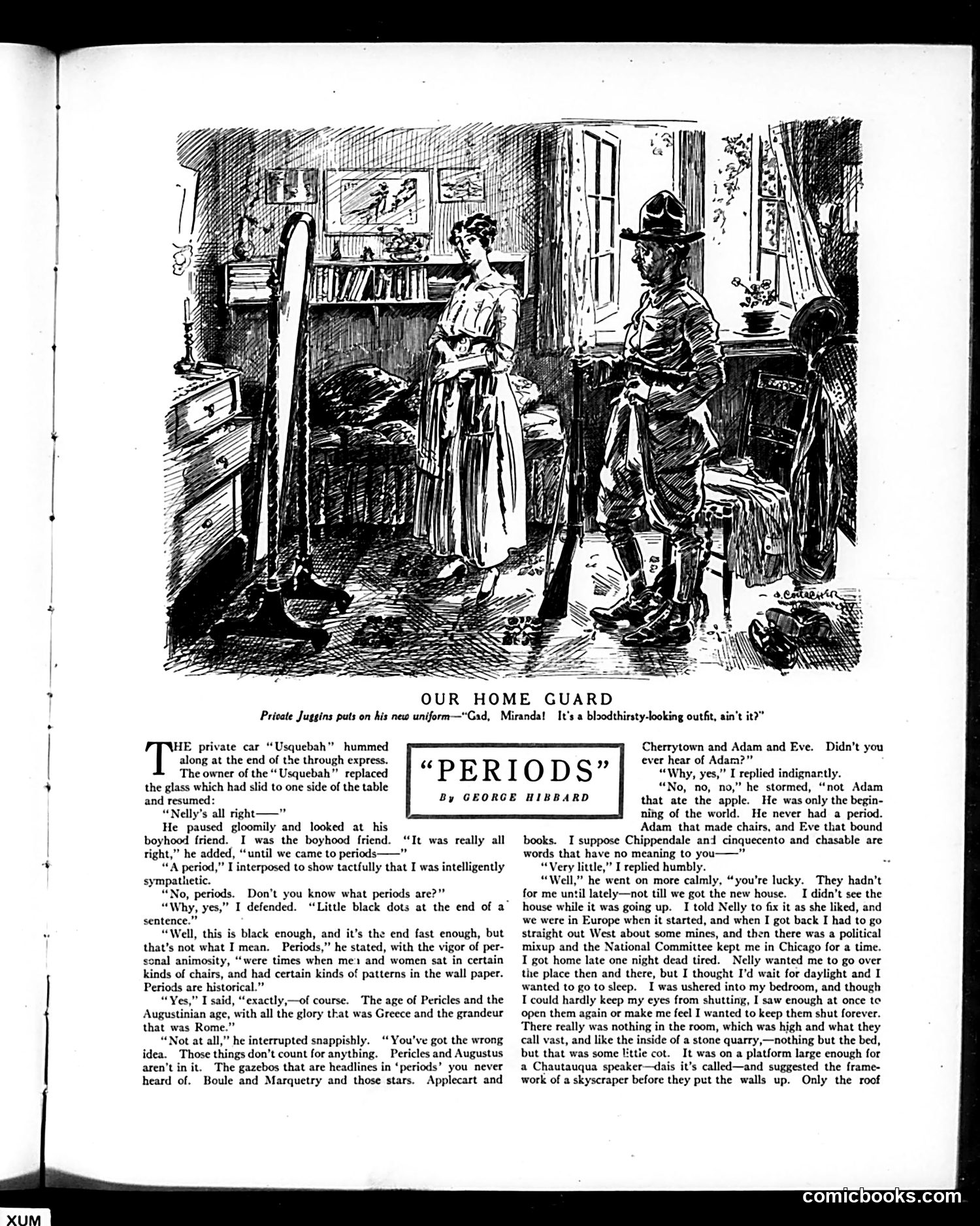
This cartoon titled "Our Home Guard" by George Hibbard depicts two figures in what appears to be early 20th-century domestic space. The illustration shows a woman in an apron confronting a man in military uniform, with the caption: "Private Justus puts on his new uniform—'Gad, Miranda! It's a bloodthirsty-looking outfit, ain't it?'" The satire targets civilian military volunteers or home defense forces ("home guard"), mocking their pretensions. The woman's reaction and the domestic setting suggest humor about ordinary citizens adopting military dress and attitudes while remaining fundamentally unchanged by their uniforms. The joke appears to be about the contrast between martial appearance and actual civilian status. The accompanying story "Periods" by George Hibbard explores historical references, though its satirical target remains unclear from the visible text.
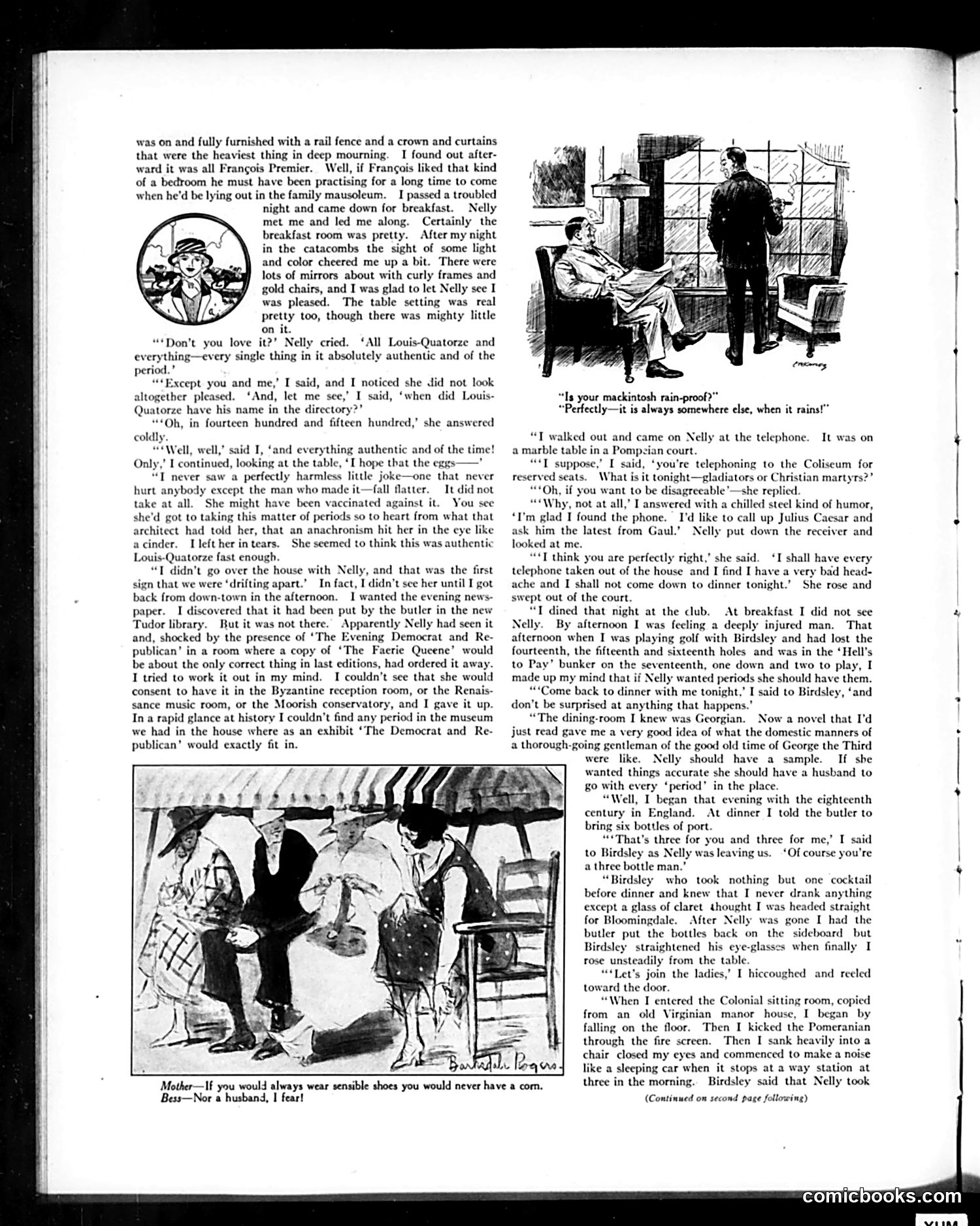
This page contains a narrative story with two illustrations rather than political cartoons. The text describes a society visit where the narrator tours a wealthy home decorated in "Louis-Quatorze" (French Renaissance) style and later attends a formal dinner. The lower cartoon depicts a domestic scene with the caption: "Mother—If you would always wear sensible shoes you would never have a com. Bess—Nor a husband, I fear!" This is a **gender-based humor joke** common to early 20th-century magazines: it satirizes the tension between women's practical comfort and the social expectation that they wear fashionable but painful footwear to attract husbands. The humor relies on the notion that sacrificing comfort for appearance is necessary for romantic success—a social critique wrapped in light satire typical of *Judge*'s domestic comedy.
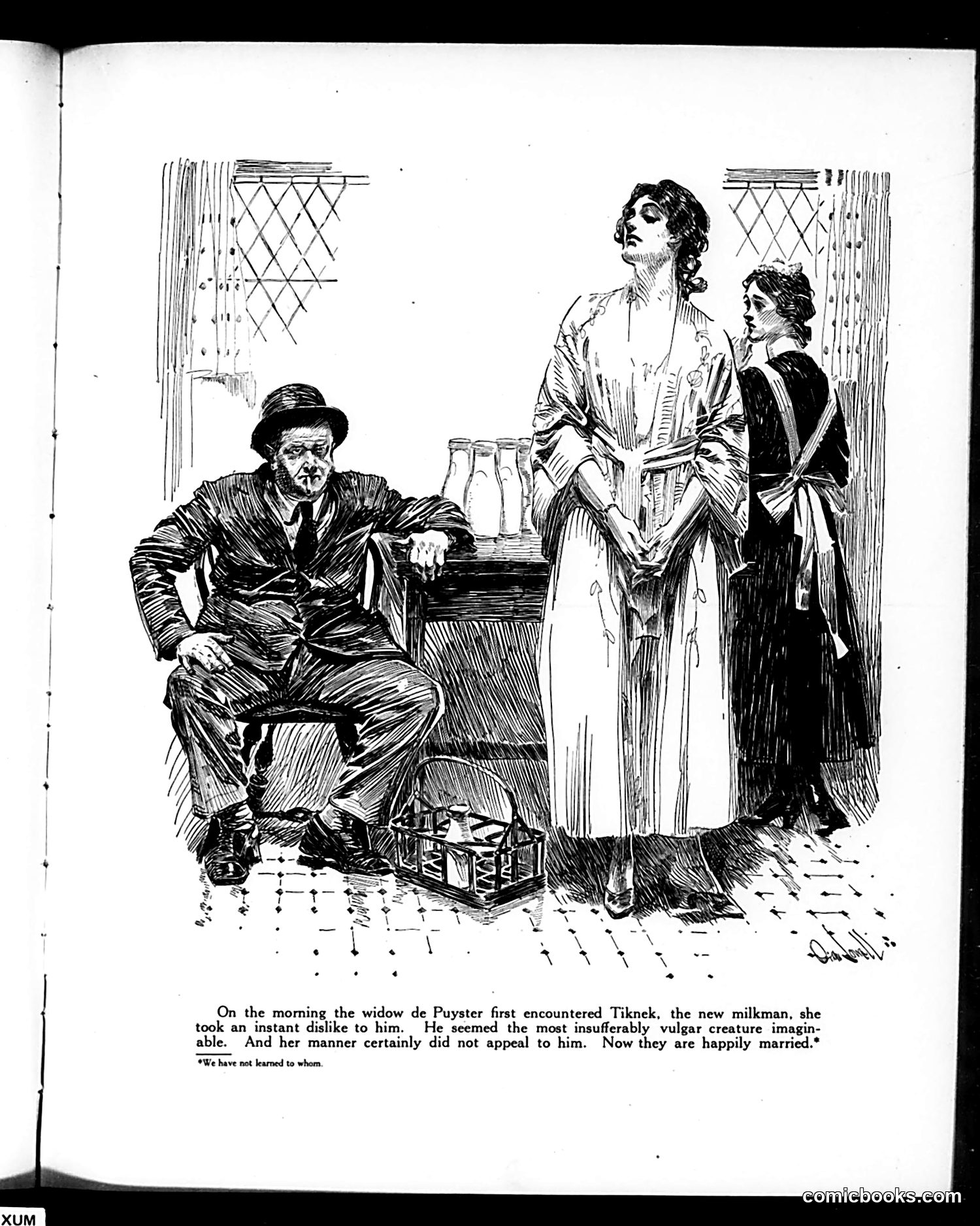
This is a satirical cartoon mocking class prejudice and social hypocrisy. The "widow de Puyster" represents an upper-class woman who initially despises Tiknek, the new milkman, finding him "insufferably vulgar"—a stock character representing working-class vulgarity. The joke's irony lies in the final line: despite her snobbish contempt, they've married. The asterisked footnote "*We have not learned to whom" suggests unclear or ambiguous details, adding to the satirical effect. The cartoon ridicules the pretensions of the wealthy widow and the notion that class barriers determine compatibility, while also poking fun at the absurdity of their union. This reflects Judge magazine's typical social satire targeting American class attitudes and romantic conventions of the era.
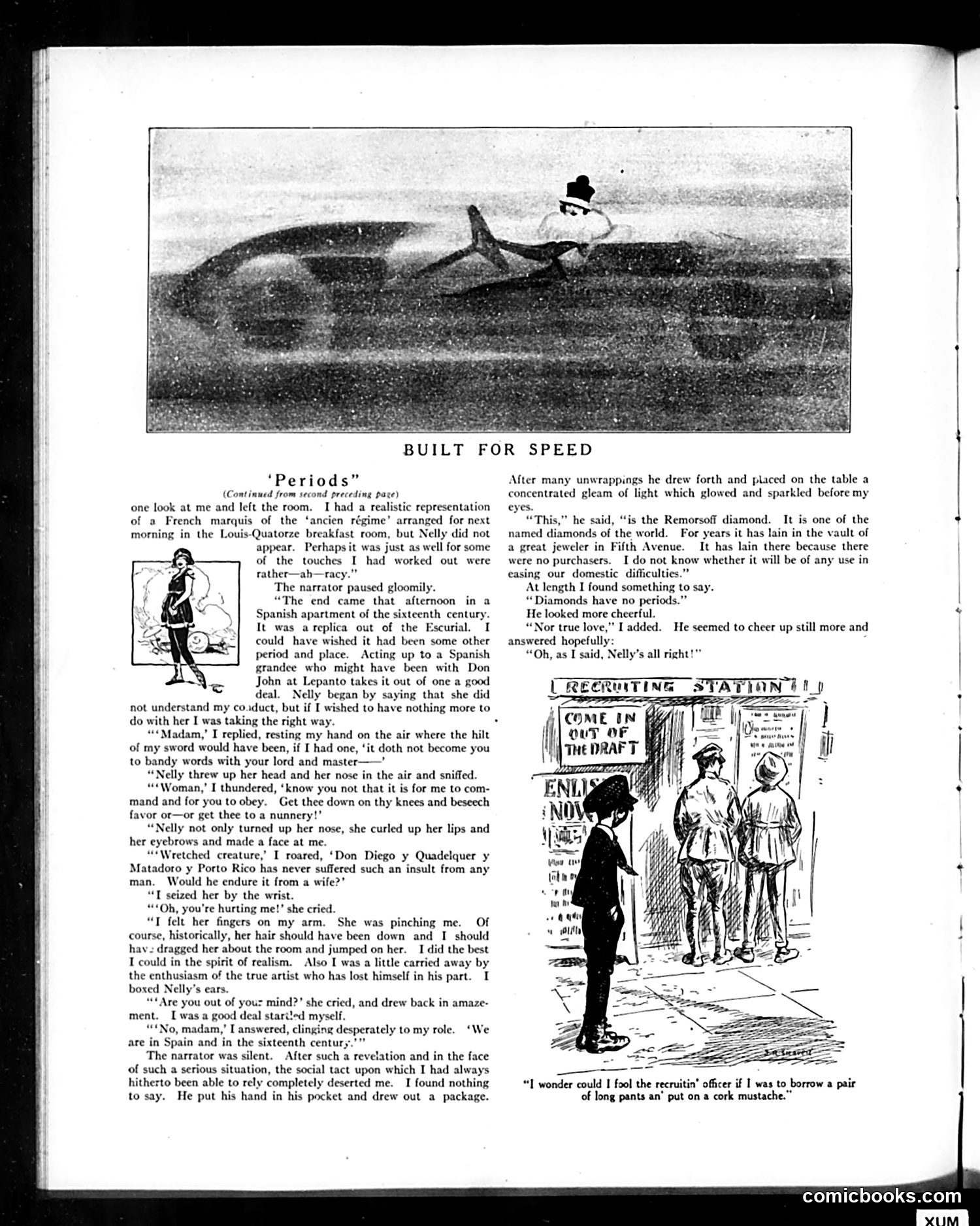
This page satirizes theatrical method acting and marital discord through a story about a man who takes historical roleplay too seriously. The narrator, attempting to impress a woman named Nelly, recreates period rooms (French marquis, Spanish grandee settings) and adopts corresponding personas with increasing commitment. The satire peaks when, playing a 16th-century Spanish nobleman, he physically disciplines Nelly—boxing her ears—in character. The joke targets both his pretentious dedication to "realism" and the absurdity of justifying domestic violence through historical authenticity. Nelly's resistance and his desperation to salvage the relationship (eventually offering the "Remorsoff diamond") underscore the comedy. The accompanying cartoon about a "Recruiting Station" appears unrelated, depicting military recruitment. Together, these pieces mock impractical idealism—whether theatrical or institutional—colliding with real-world consequences.
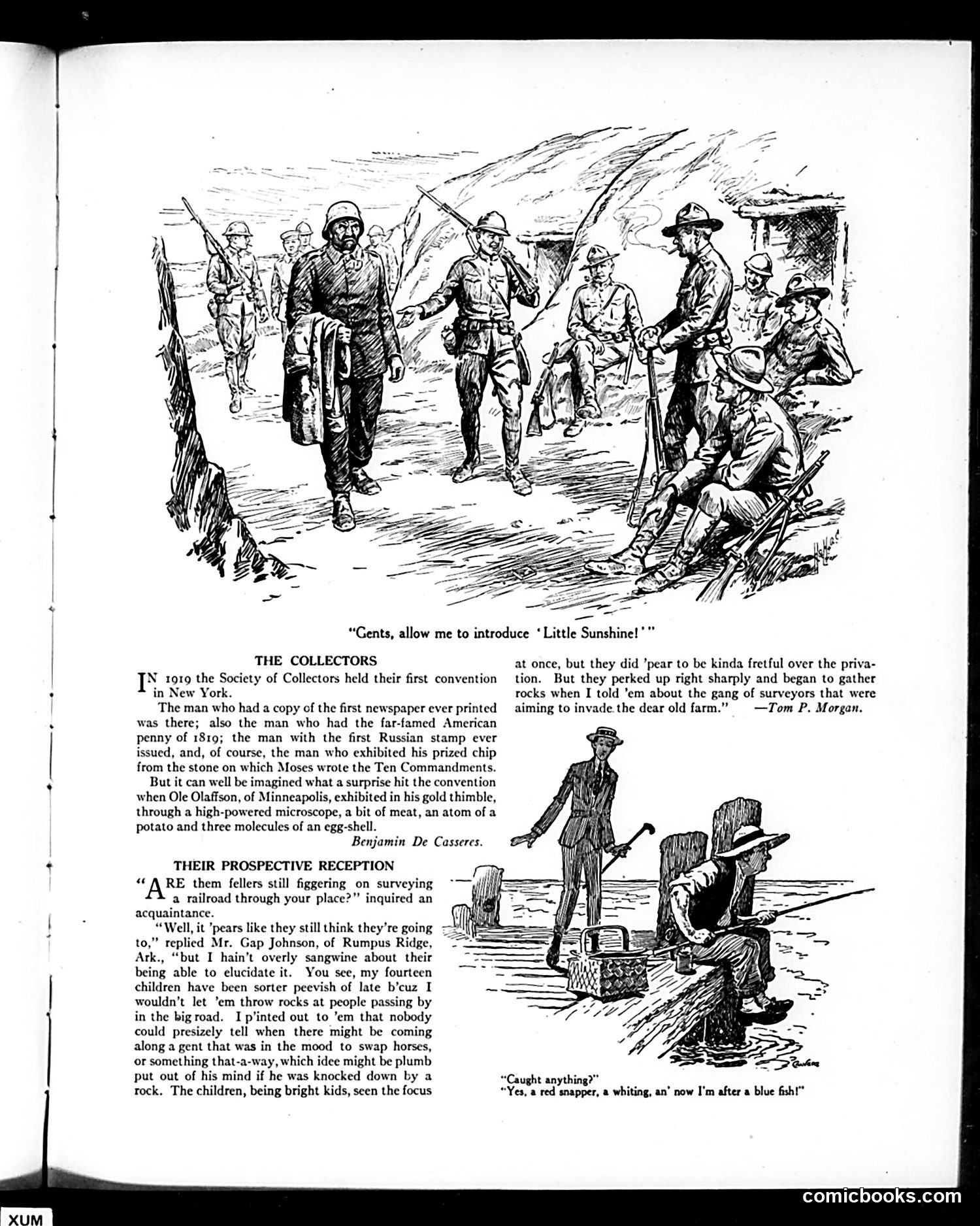
This page contains two unrelated satirical pieces typical of Judge's humor: **"The Collectors"** mocks the 1919 Society of Collectors convention in New York. The satire targets obsessive collecting culture—the article catalogs absurdly rare items (first printed newspaper, 1819 penny, Russian stamp, chip from Moses's stone tablets) before revealing the real punchline: Ole Olaffson's "prize" is a microscopic collection of everyday items (meat, potato, egg-shell) displayed in a gold thimble. The joke: even the most trivial objects become "collectible" to wealthy enthusiasts. **"Their Prospective Reception"** is rural Americana humor. A farmer (Mr. Gap Johnson of Arkansas) explains he forbade his fourteen children from throwing rocks at road travelers—not from kindness, but because a potential horse-trader might pass by. When told surveyors are coming to build a railroad through his farm, the children eagerly resume rock-throwing, viewing the surveyors as obstacles to prevent. It's gentle satire of rural suspicion toward outside development and progress. The fishing dialogue appears unrelated filler.
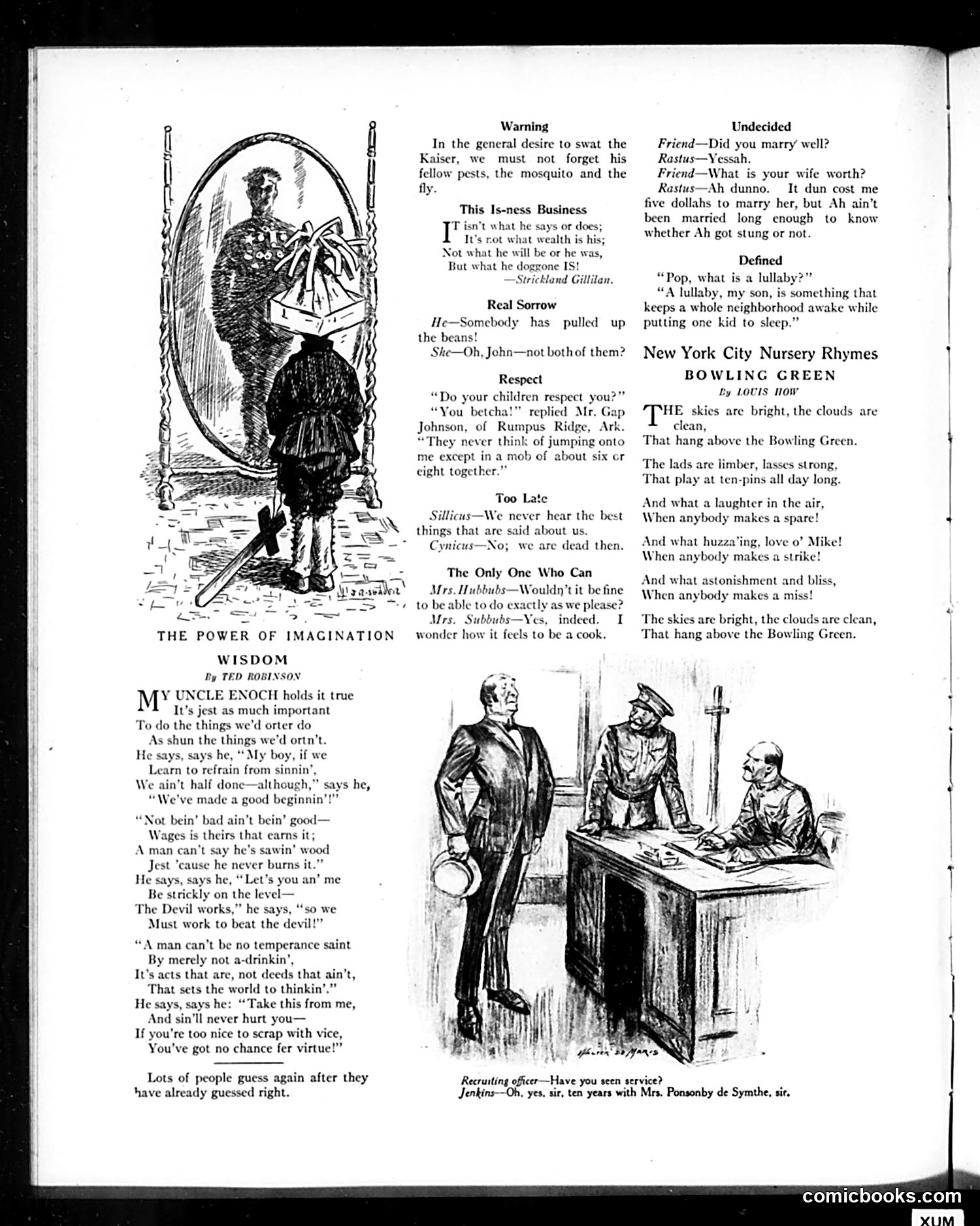
This page contains several short satirical pieces typical of early 20th-century American humor magazines: **"The Power of Imagination"** (left): An illustration shows a figure gazing at an idealized vision, satirizing human tendency to fantasize rather than face reality. **Short humor pieces** (center-right): These include racist dialect jokes featuring "Rastus" (a stereotypical Black character common in period humor), playing on themes of marriage costs and marital regret. The "Respect" joke mocks rural Arkansas life. **"Bowling Green" poem**: A nostalgic celebration of the New York City bowling alley, capturing recreational leisure culture. **"Wisdom" poem (by Ted Robinson)**: Uncle Enoch dispenses folk philosophy about virtue requiring *action*, not mere abstinence—a Progressive-era moral message emphasizing active goodness over passive avoidance of sin. **Final recruiting joke**: A serviceman's ten-year tenure with a wealthy woman (Mrs. Ponsonby de Symthe) is presented as military "service," wordplay mocking domestic servitude. The page reflects Judge's blend of sentimental Americana, period-typical racial stereotyping, and social commentary.
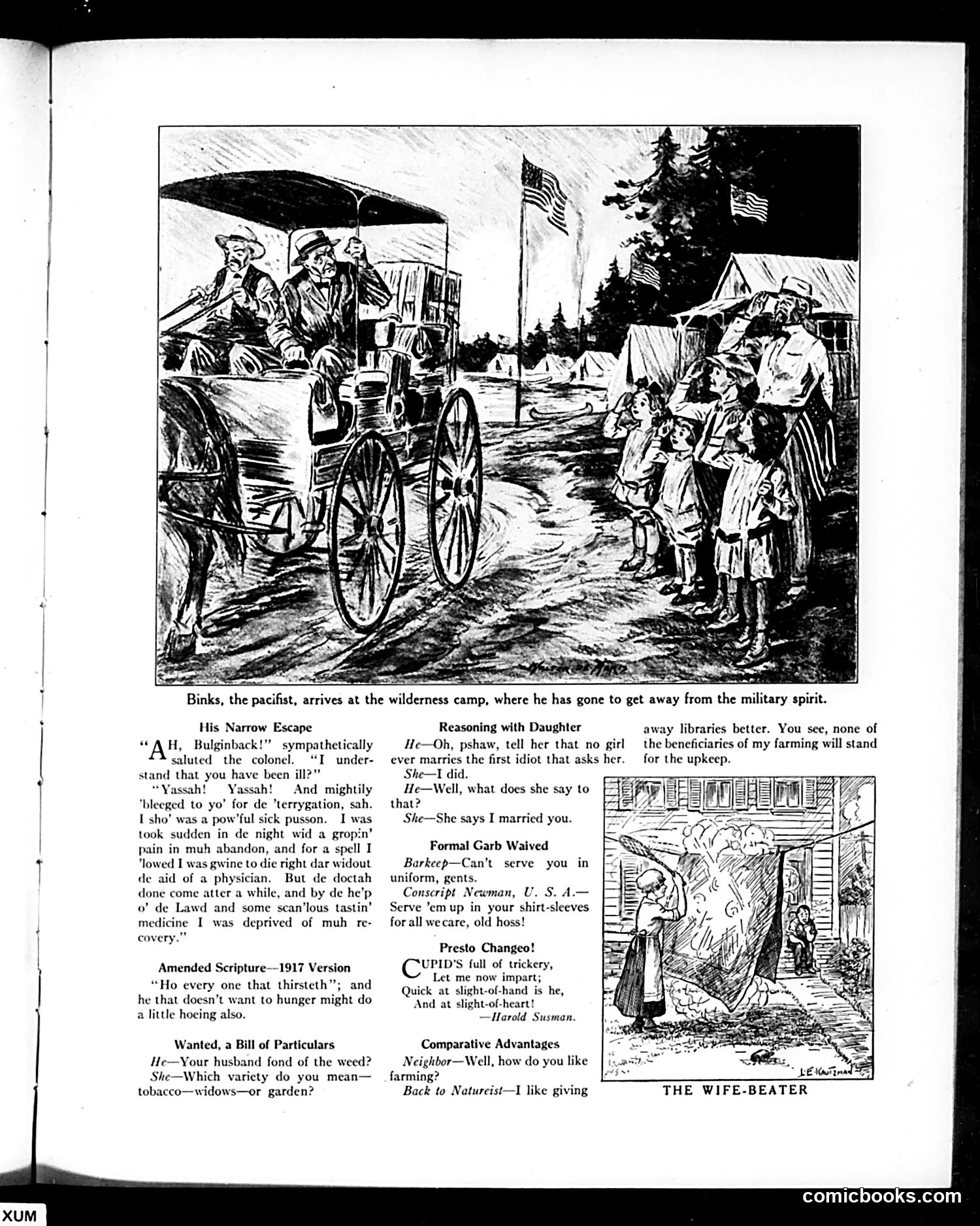
This 1917 satirical page from Judge magazine contains multiple short humor pieces mocking contemporary social issues: **"His Narrow Escape"** features dialect humor about a Black character's illness—typical of early 20th-century stereotypical portrayal. **"Amended Scripture"** satirizes wartime labor shortages by rewriting Biblical passages to encourage agricultural work during WWI. **The marriage jokes** mock domestic discord and nagging wives—common misogynistic humor of the era. **"Binks, the pacifist"** appears to ridicule anti-war sentiment during America's WWI involvement, contrasting the pacifist's wilderness retreat with patriotic military spirit. **"Formal Garb Waived"** jokes about newly conscripted soldiers, referencing WWI military conscription. **"The Wife-Beater"** cartoon's title uses period slang for an undershirt, playing on double meaning—reflecting casual attitudes toward domestic violence. The page reflects 1917 American attitudes: pro-war sentiment, racial stereotyping, and dismissive treatment of women's concerns.
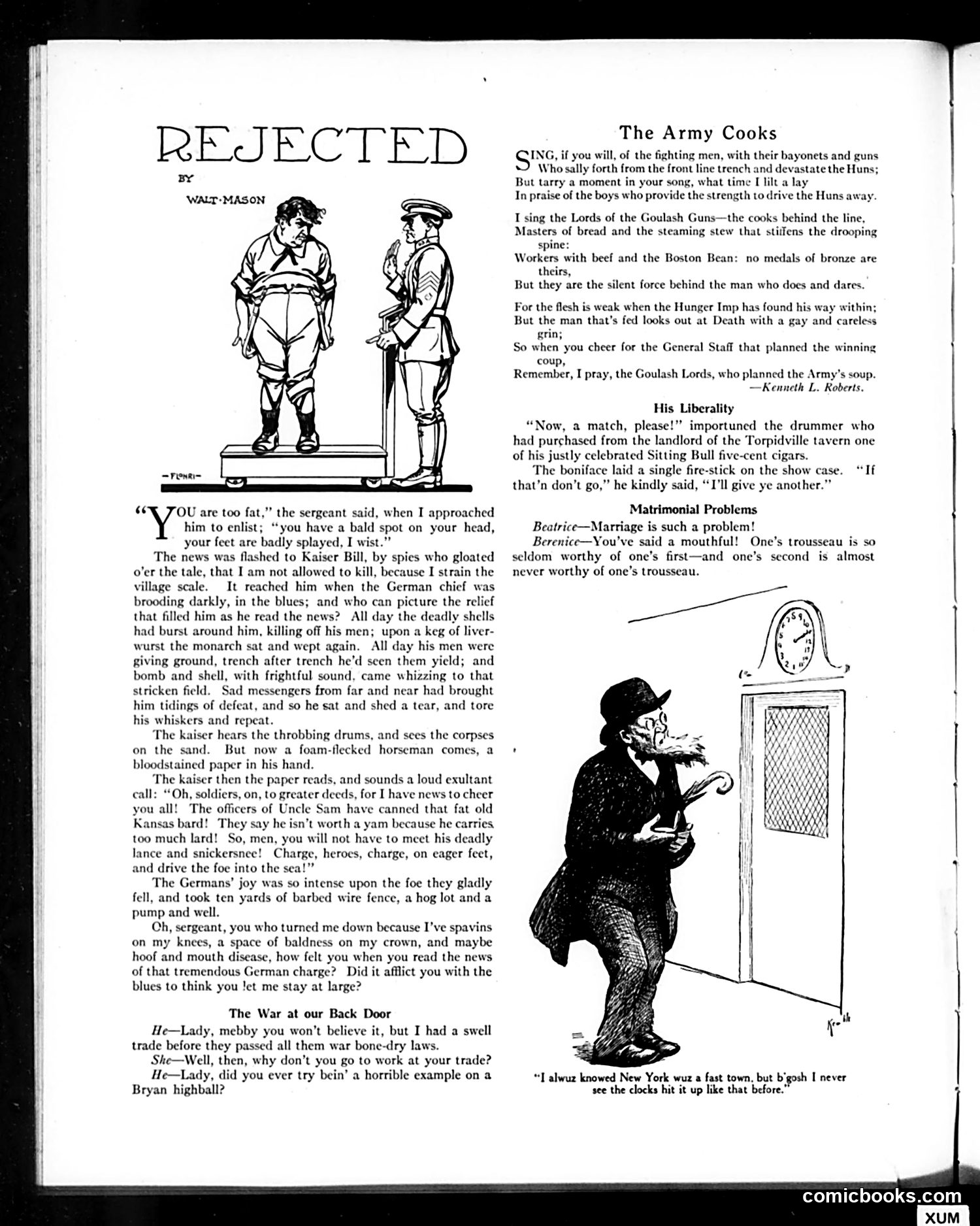
**"Rejected" (main cartoon):** This WWI-era satire mocks military recruitment standards. A sergeant rejects an overweight, bald recruit as unfit for service. The joke: Kaiser Wilhelm celebrates this news, believing America has lost a valuable soldier. The punchline is ironic—the rejected man's absence supposedly helps Germany win battles, when in reality he's worthless to either side. The satire criticizes both overly rigid recruitment rules and exaggerates German desperation. **"The Army Cooks" (poem):** Praises kitchen staff as unsung heroes, arguing that well-fed soldiers fight better than starving ones. Credits cooks' "Goulash Guns" with enabling military victories—a tongue-in-cheek elevation of typically low-status work. **Minor items:** "His Liberality" jokes about cheap cigars; "Matrimonial Problems" uses the word "trousseau" (wedding outfit) as a punchline about marriage's financial burdens; "War at our Back Door" references Prohibition's impact on a bartender's livelihood.
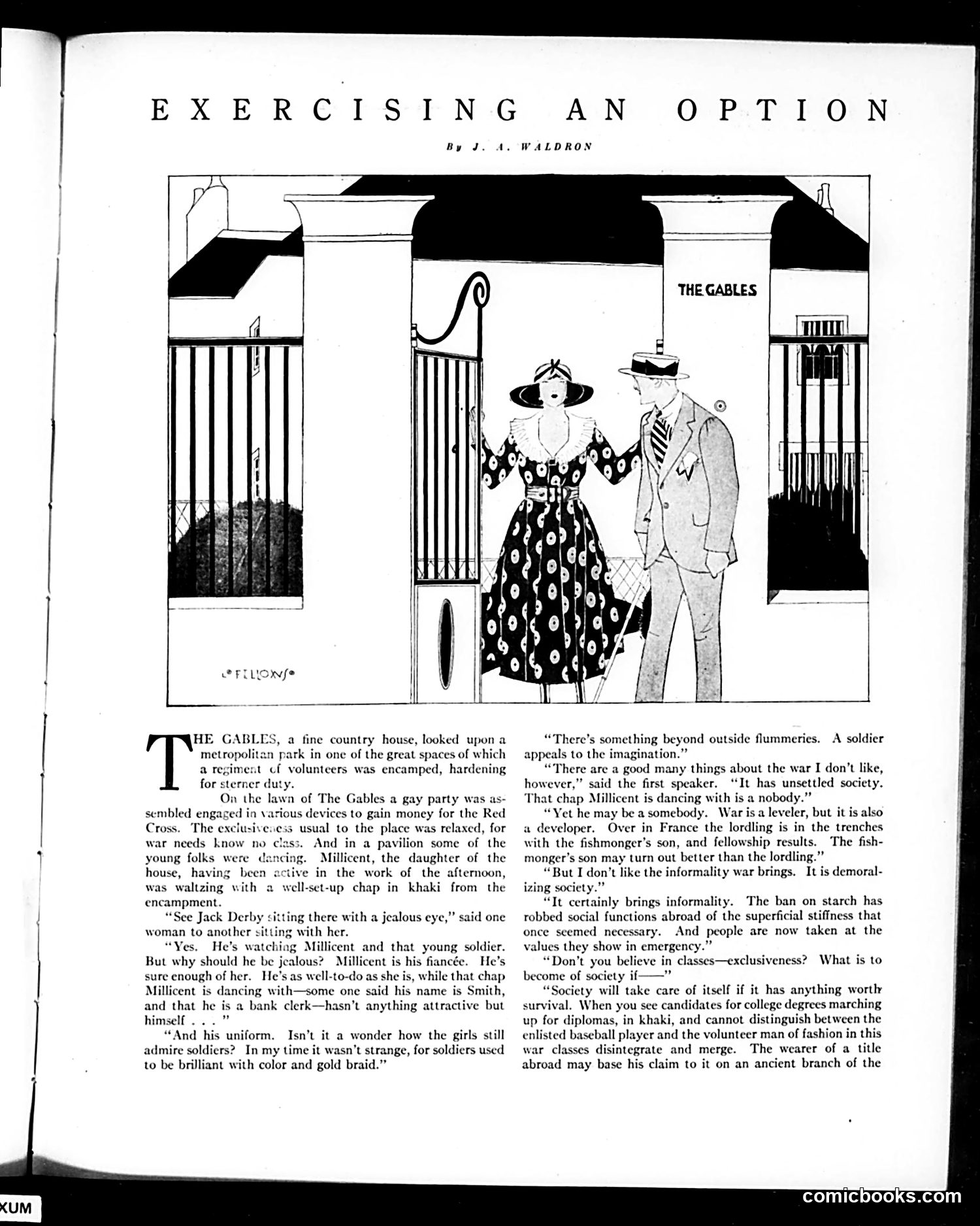
This story satirizes WWI-era anxieties about social class disruption. At "The Gables," an exclusive country house, wealthy Millicent dances with a soldier named Smith—a mere bank clerk—while her fiancé Jack Derby watches jealously. The dialogue between two society women captures the period's class panic: the war has "unsettled society" by mixing soldiers of different social standing and removing formal distinctions (starch bans, khaki uniforms replacing dress uniforms). One woman laments this "informality" as demoralizing, while the other argues war is a "leveler" where merit matters more than birth. The satire targets upper-class anxiety about social hierarchy dissolving during wartime. The bank clerk's uniform makes him appealing despite his modest status—illustrating how the war temporarily democratized attraction and social values. The "option" referenced in the title appears to be Millicent's ability to choose outside her prescribed class circle.
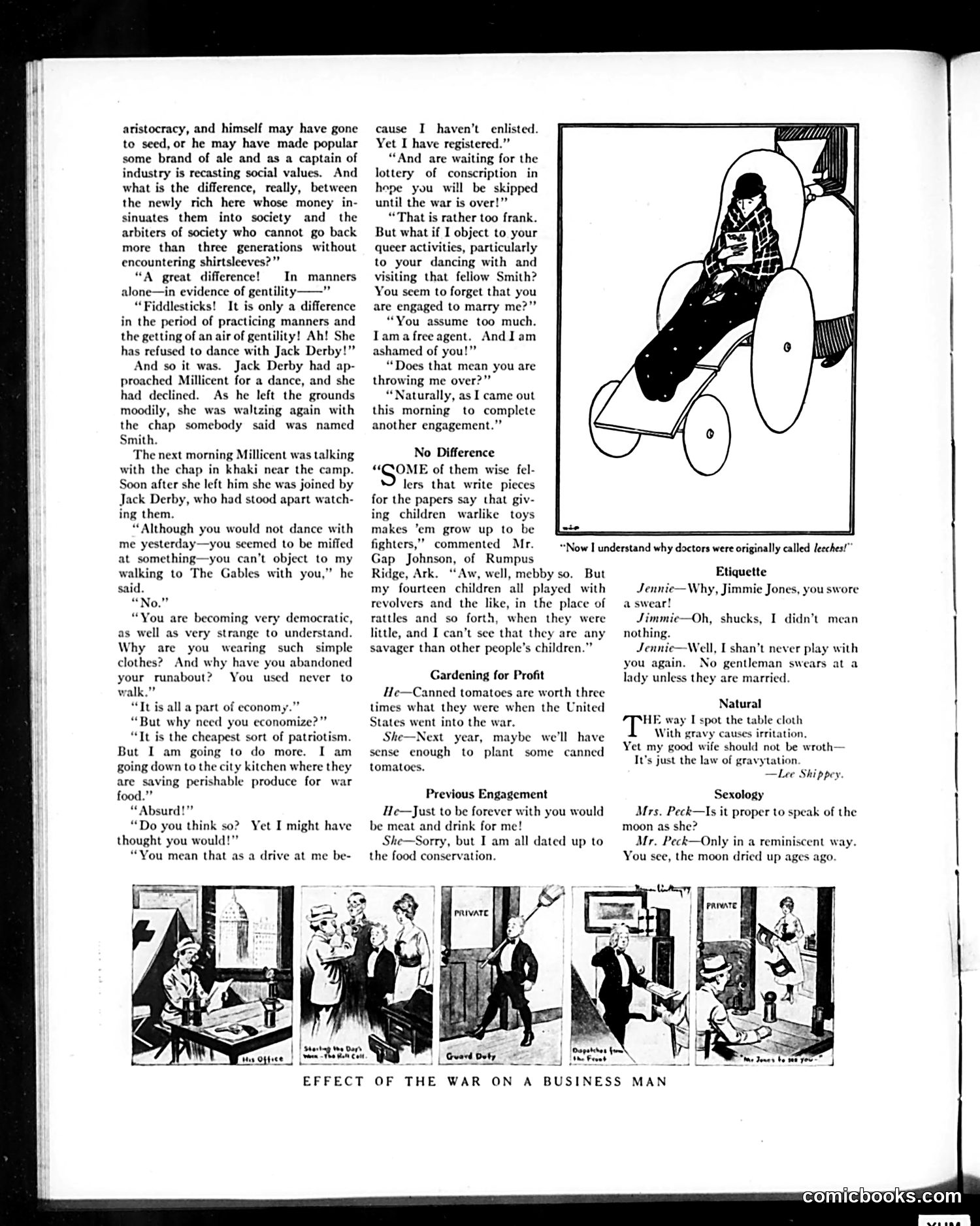
This page from Judge satirizes American social attitudes during World War I. The main narrative concerns Millicent, a wealthy woman engaged to Jack Derby, who refuses to dance with him because he hasn't enlisted—yet he registered for the draft lottery. Millicent, meanwhile, adopts wartime "economy" by abandoning her car and working in city kitchens, and breaks her engagement, declaring herself a "free agent" engaged in patriotic work instead. The satire targets the hypocrisy of both figures: Derby criticizes her activities while doing nothing himself; Millicent performs conspicuous patriotism while rejecting obligation to him. The surrounding humor pieces mock wartime rhetoric—Gap Johnson's children playing with toy guns, tomato-canning profiteering, and forced "food conservation" dating excuses. The cartoon "Effect of the War on a Business Man" (bottom) likely shows how civilian life becomes disrupted by war obligations, though details are small.
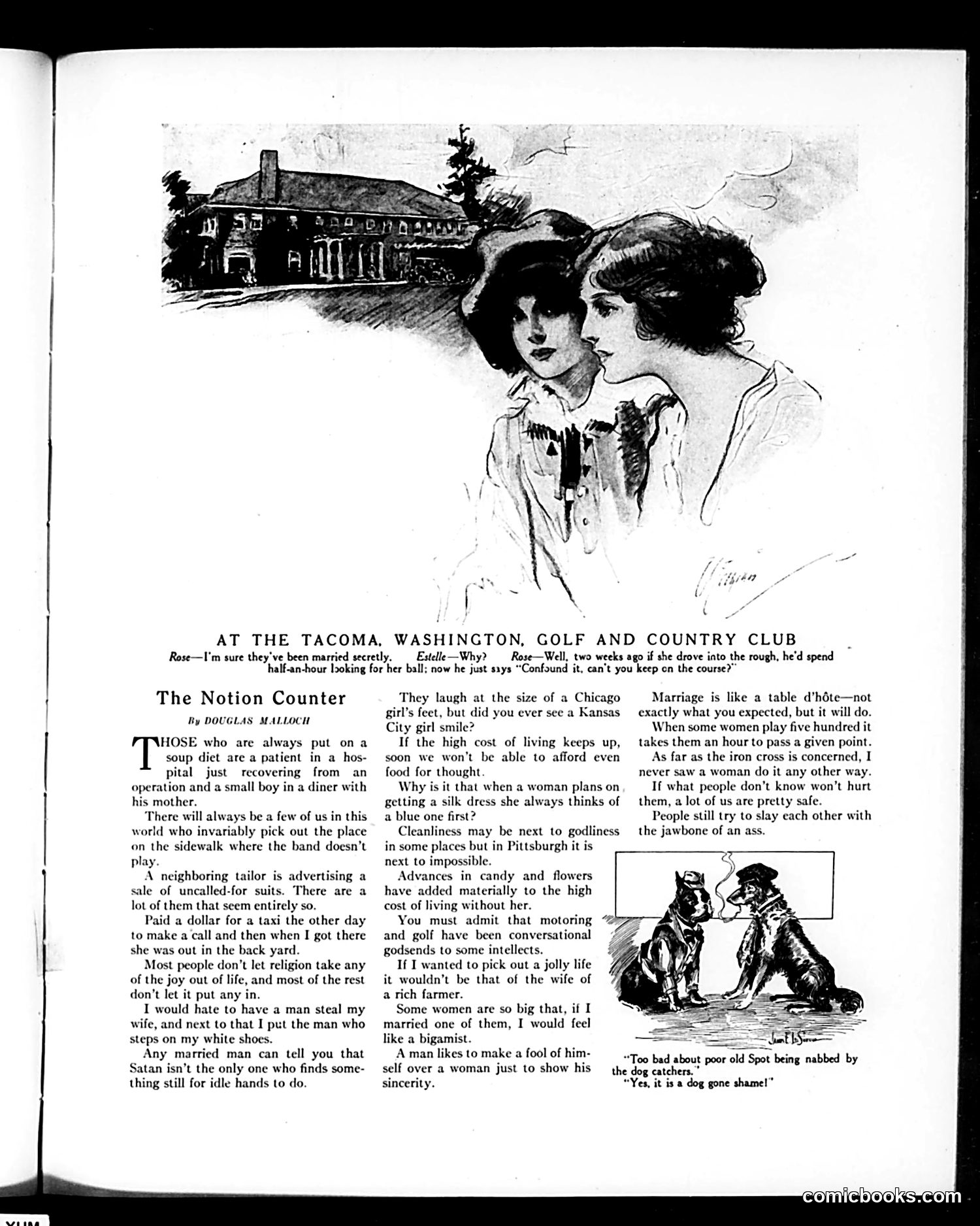
This page contains two satirical pieces from *Judge* magazine about marriage and social life circa 1910s-1920s. **"At the Tacoma, Washington, Golf and Country Club"** (top): A brief joke about how courtship differs from marriage. Two women gossip that a couple must be secretly married because the man's behavior at golf has changed—he now criticizes his wife's game rather than gallantly helping her search for lost balls. The satire: romance dies quickly after marriage; husbands stop performing. **"The Notion Counter"** (below): A collection of witty social observations about American life—observations that still land today. They mock: penny-pinching hospitals, regional differences (Kansas City girls' smiles vs. Chicago girls' feet size), the high cost of living, women's contradictory shopping habits, Pittsburgh's pollution, and marital discord. The final cartoon joke (bottom right) is a visual pun: a dog about to be caught by dog catchers—"Too bad about poor old Spot being nabbed" / "Yes, it is a dog gone shame!" The humor relies on gentle social criticism and wordplay typical of early 20th-century American magazines aimed at middle-class readers.
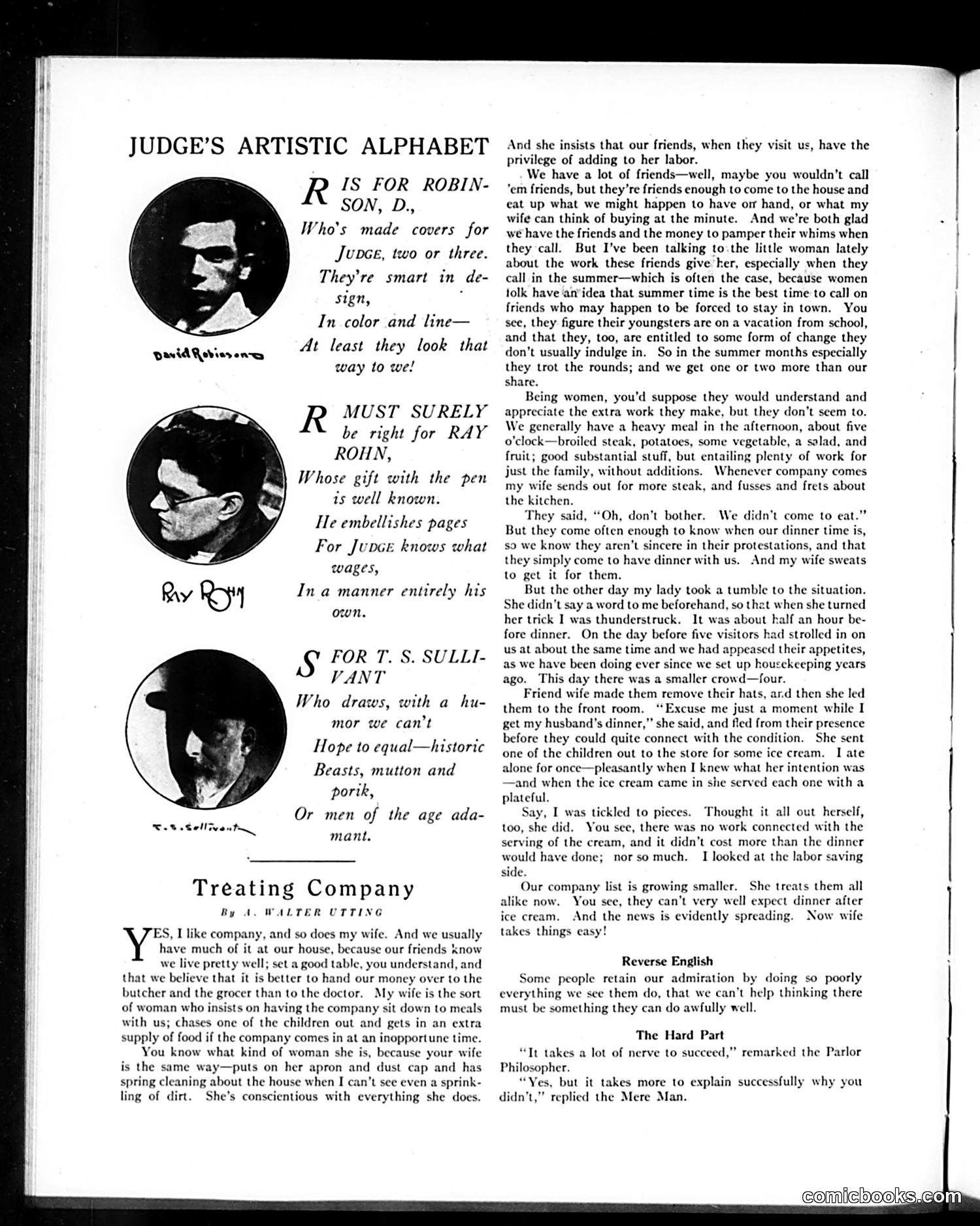
**Left side:** A section of Judge's alphabet featuring three illustrators who created covers and content for the magazine: Robinson, D.; Ray Rohn; and T.S. Sullivant. These are professional acknowledgments of the artists' work, celebrating their design skills and distinctive drawing styles in "color and line." **Right side:** "Treating Company" by A. Walter Utting is a humorous essay about uninvited dinner guests. The narrator describes how friends regularly invite themselves to his home during summer, claiming they "didn't come to eat" while clearly timing visits to meal hours. His wife accommodates them elaborately despite the extra work. The joke's climax: she finally rebels by deliberately excluding the guests from dinner, serving only her husband while they wait in the front room—a witty reversal of expected hospitality obligations. The satire mocks both the hypocrisy of guests and the social pressure on housewives to provide lavish meals.
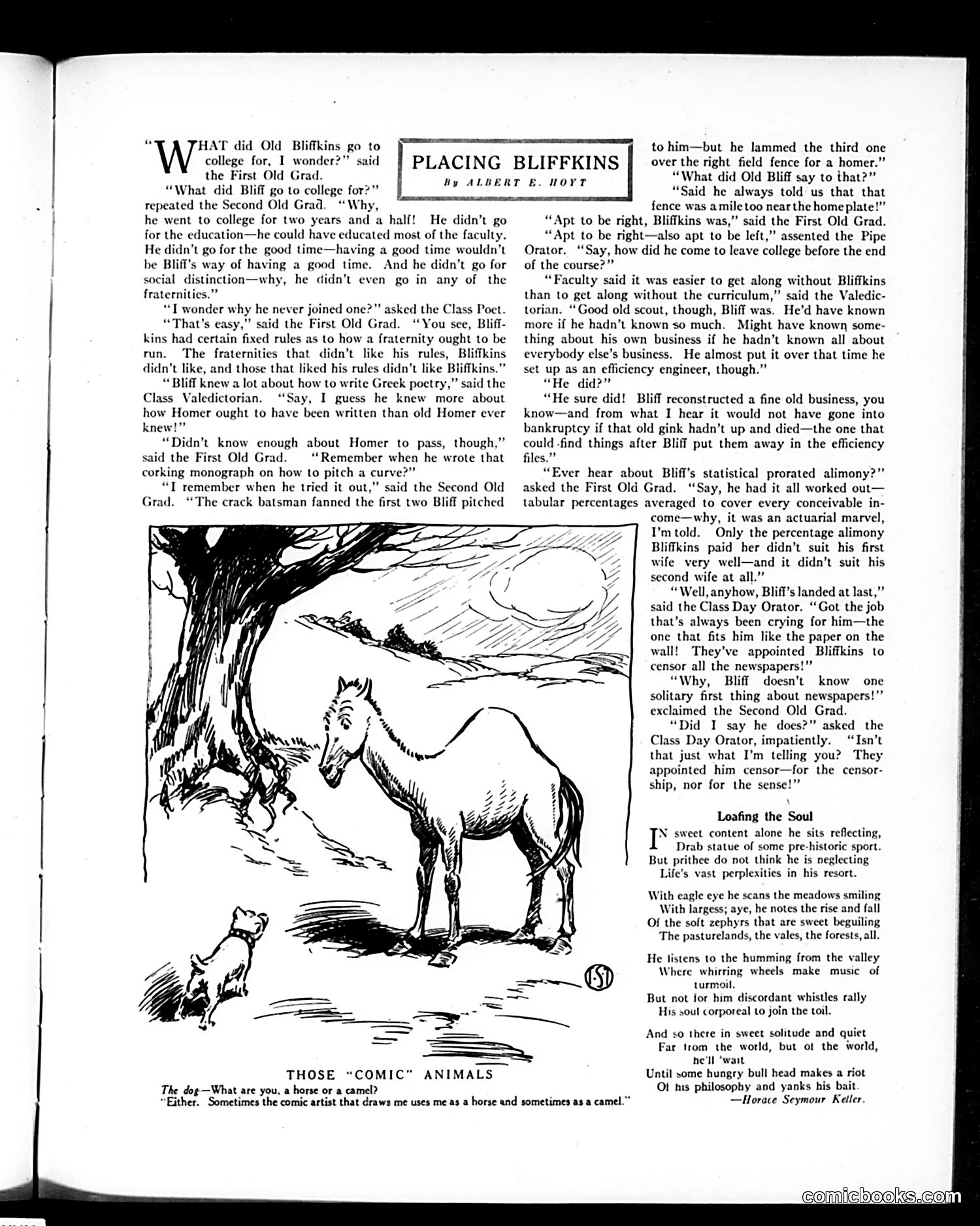
This humorous story satirizes a character type: the overeducated know-it-all who is competent at nothing practical. "Old Bliffkins" attended college without genuine purpose—not for learning, socializing, or advancement—yet accumulated knowledge on every subject while mastering none. The running joke involves his spectacular failures: his baseball pitch theory fails in practice; his efficiency engineering causes business collapse; his alimony calculations, though mathematically elaborate, satisfy no one. The satire culminates in dark irony: Bliffkins is appointed newspaper censor—not *because* he understands journalism, but *precisely because* he doesn't. The appointment mocks both Bliffkins's worthlessness and institutional incompetence that places unqualified people in positions of authority. The accompanying cartoon (showing confused animals—a camel and horse) reinforces the theme: identity confusion and misplacement. The piece critiques American society's tendency to value credentials over actual competence.
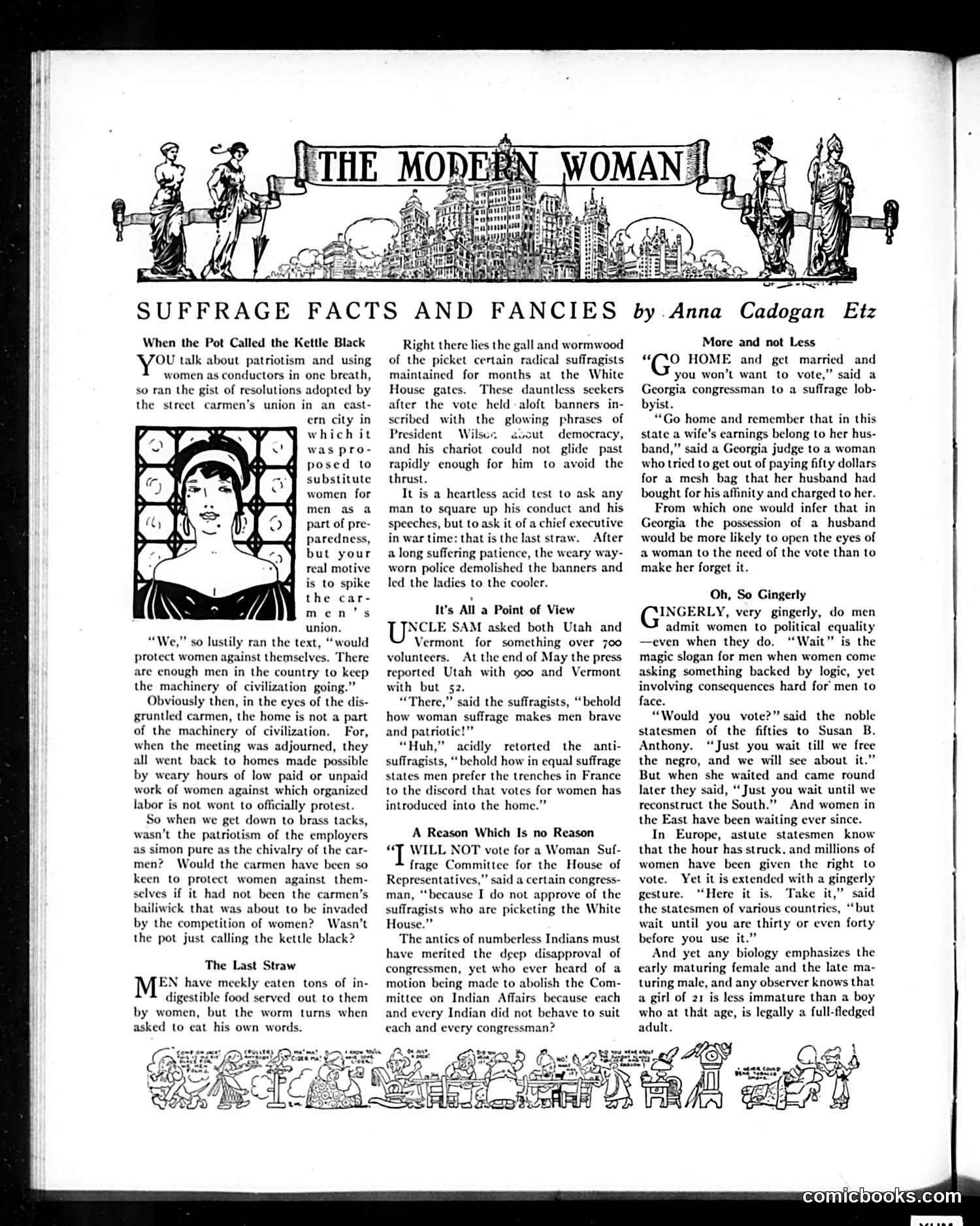
This page from *Judge* magazine presents anti-suffrage arguments through satirical rebuttals by Anna Cadogan Etz. The content mocks men's hypocrisy regarding women's rights: **"When the Pot Called the Kettle Black"** ridicules streetcar workers who oppose hiring women conductors on "patriotic" grounds while relying on women's unpaid domestic labor—calling out their contradictory logic. **"The Last Straw"** critiques male complaints about suffragists picketing the White House with pro-democracy banners, suggesting men can't handle women holding them accountable. **"It's All a Point of View"** shows how both suffragists and anti-suffragists misinterpret Utah's higher WWI volunteer rates to support opposite conclusions about women's voting. **"A Reason Which Is no Reason"** exposes a congressman rejecting a woman-suffrage committee because he dislikes suffragists' tactics—a standard he wouldn't apply elsewhere. The satire systematically dismantles men's objections to women's suffrage by exposing logical inconsistencies and double standards in their arguments.
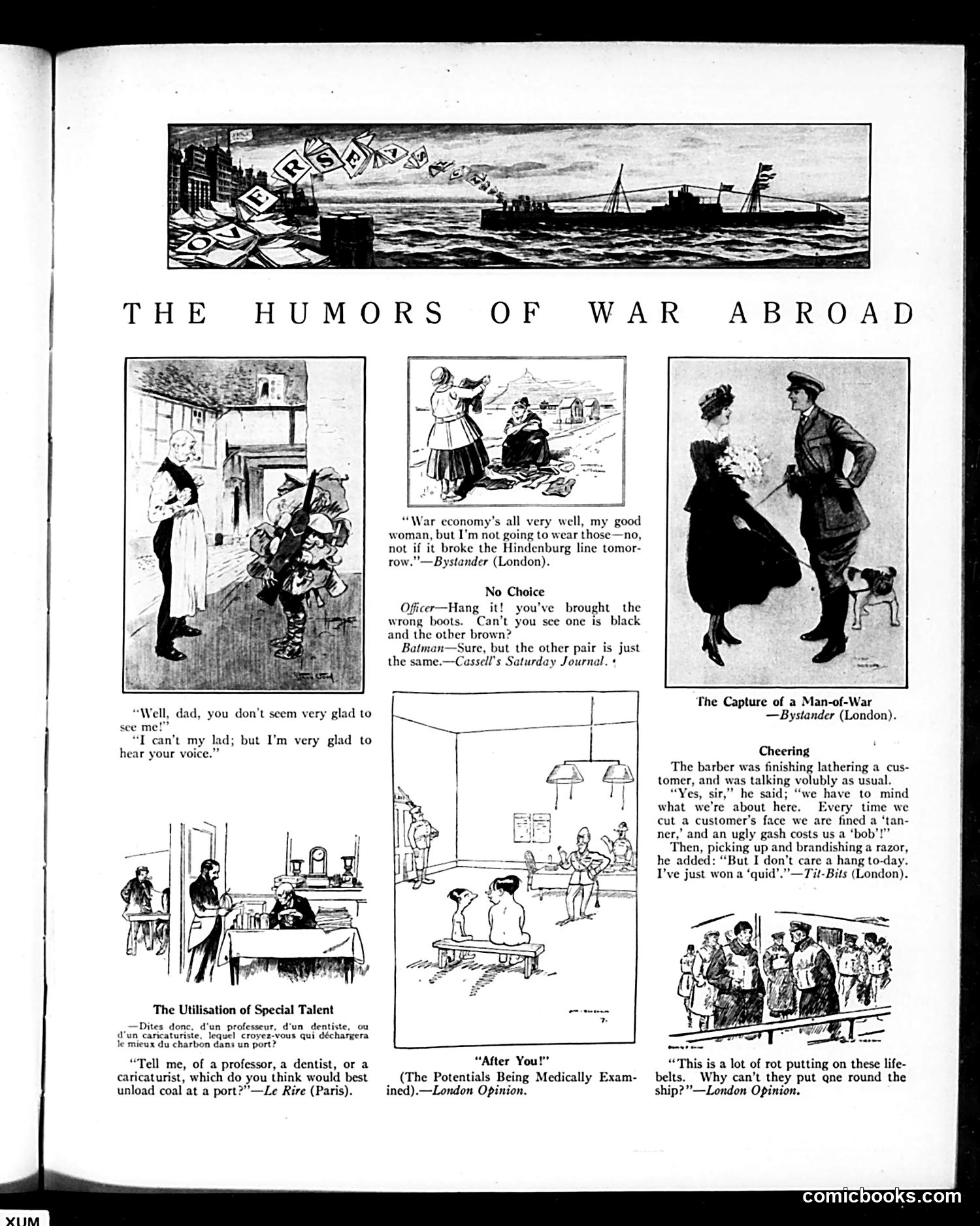
This page collects wartime satirical cartoons from WWI-era British and French publications, mocking home-front absurdities during the conflict. **Key themes:** - **"The Utilisation of Special Talent"**: A French joke questioning whether educated professionals (professors, dentists, caricaturists) would effectively unload coal—mocking the wasteful deployment of skilled workers to menial labor during wartime mobilization. - **"War economy"**: A woman resists fabric rationing even if it means breaking the German Hindenburg defensive line—satirizing civilian resistance to sacrifice. - **Boot mix-up**: Soldiers receiving mismatched boots, with the batman noting the spare pair is equally useless—poking fun at military supply incompetence. - **Medical exams & life-belts**: Jokes about military medical procedures and ships' safety equipment, questioning whether precautions actually protect soldiers. The overall satire targets wartime inefficiency, civilian selfishness, and the disconnect between leaders' rhetoric about sacrifice and actual wartime management.
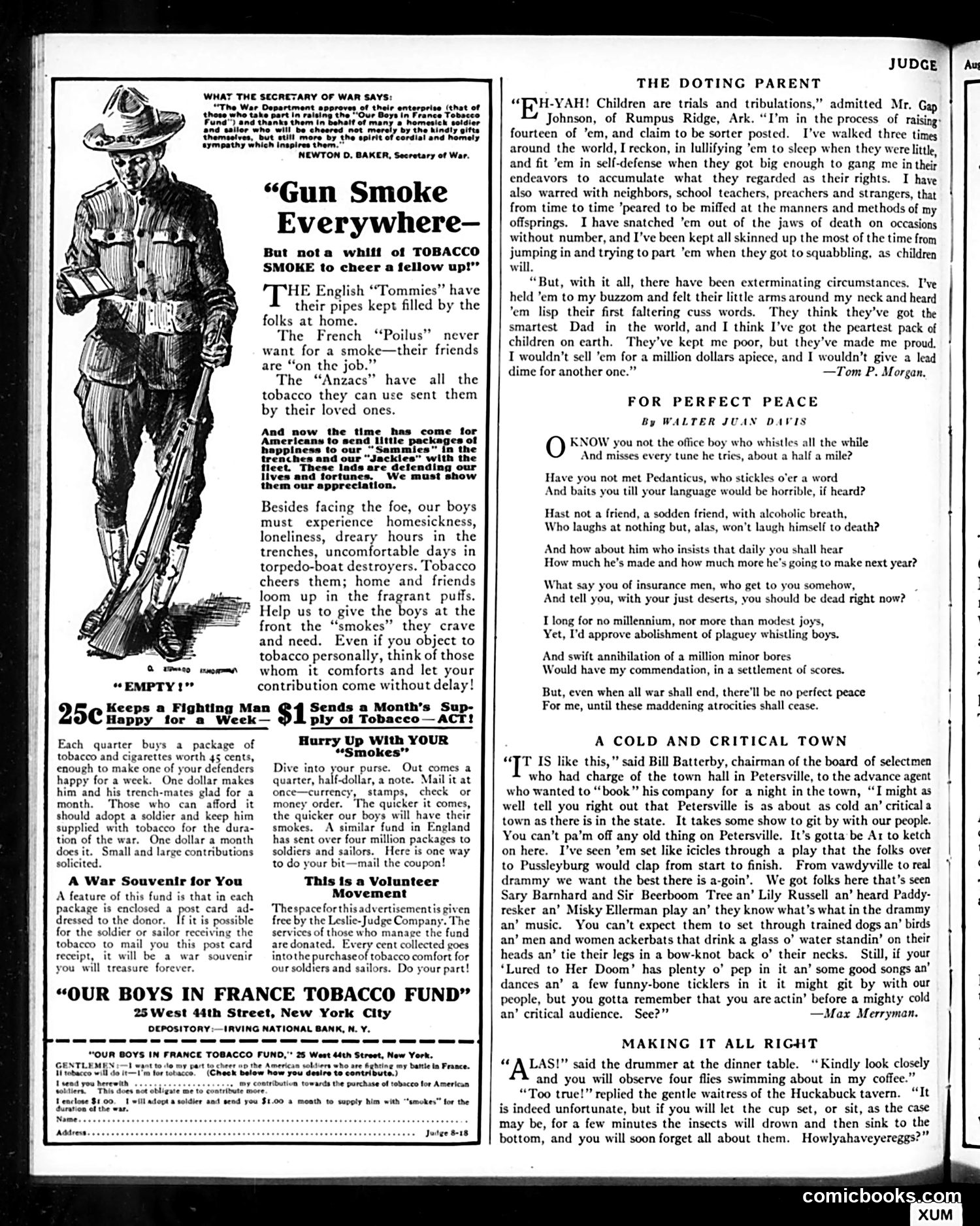
This page contains **WWI-era propaganda** promoting tobacco donations to American soldiers in France. The dominant left-side advertisement features an illustrated soldier and urges citizens to send cigarettes and tobacco packages monthly ("25 cents keeps a fighting man happy for a week"). **The satire**: The cartoon contrasts Allied soldiers' experience—British "Tommies," French "Poilus," and Australian "Anzacs" all receive tobacco from home—with American boys supposedly going without. This creates pressure on American donors through patriotic guilt. **Historical context**: During WWI, tobacco was considered morale-boosting and was actively promoted as a soldier's necessity (smoking was then socially acceptable and not yet widely recognized as harmful). The right-side articles are unrelated humor pieces about parenting and small-town life—typical Judge magazine filler content. **Modern perspective**: The page reveals how thoroughly tobacco was normalized and marketed as patriotic duty, exploiting wartime sentiment to boost consumption.
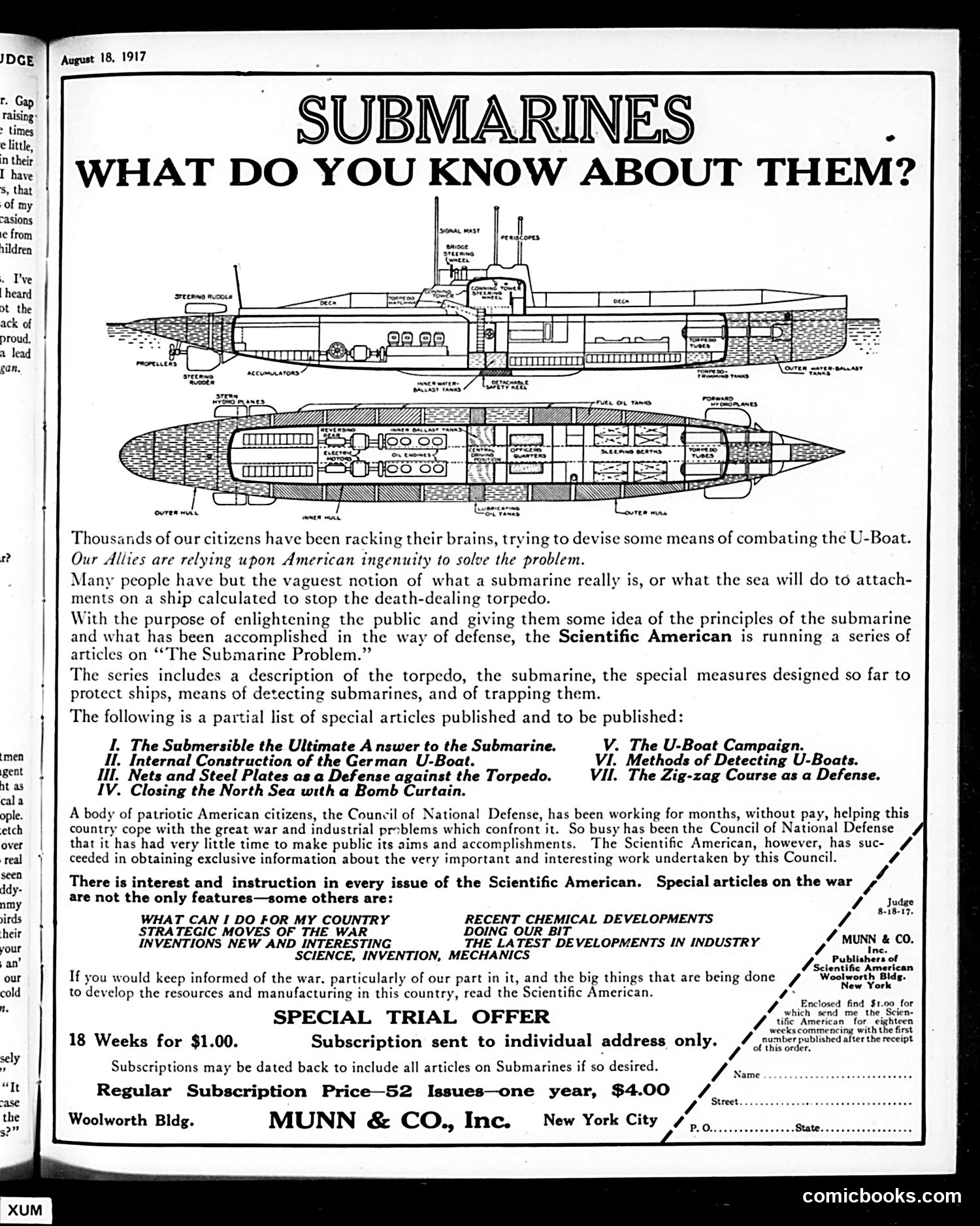
This is primarily an **advertisement/promotional page**, not satire. Dated August 18, 1917 (U.S. entered WWI in April 1917), it addresses genuine public anxiety about German U-boats, which were sinking merchant and military ships. The page features **technical cutaway diagrams** of submarine construction, designed to educate American readers about this threat. The text emphasizes that Scientific American magazine is running an educational series on submarine defense—covering torpedoes, detection methods, and protective tactics like zig-zag evasion and steel plating. The appeal to patriotism is straightforward rather than satirical: it frames the subscription offer (18 weeks for $1.00) as a civic duty, arguing readers should "keep informed" about war developments and "what I can do for my country." The Council of National Defense is cited as a credible source, lending authority to the magazine's coverage. This is wartime propaganda through information—selling magazines by positioning them as essential to understanding national defense.
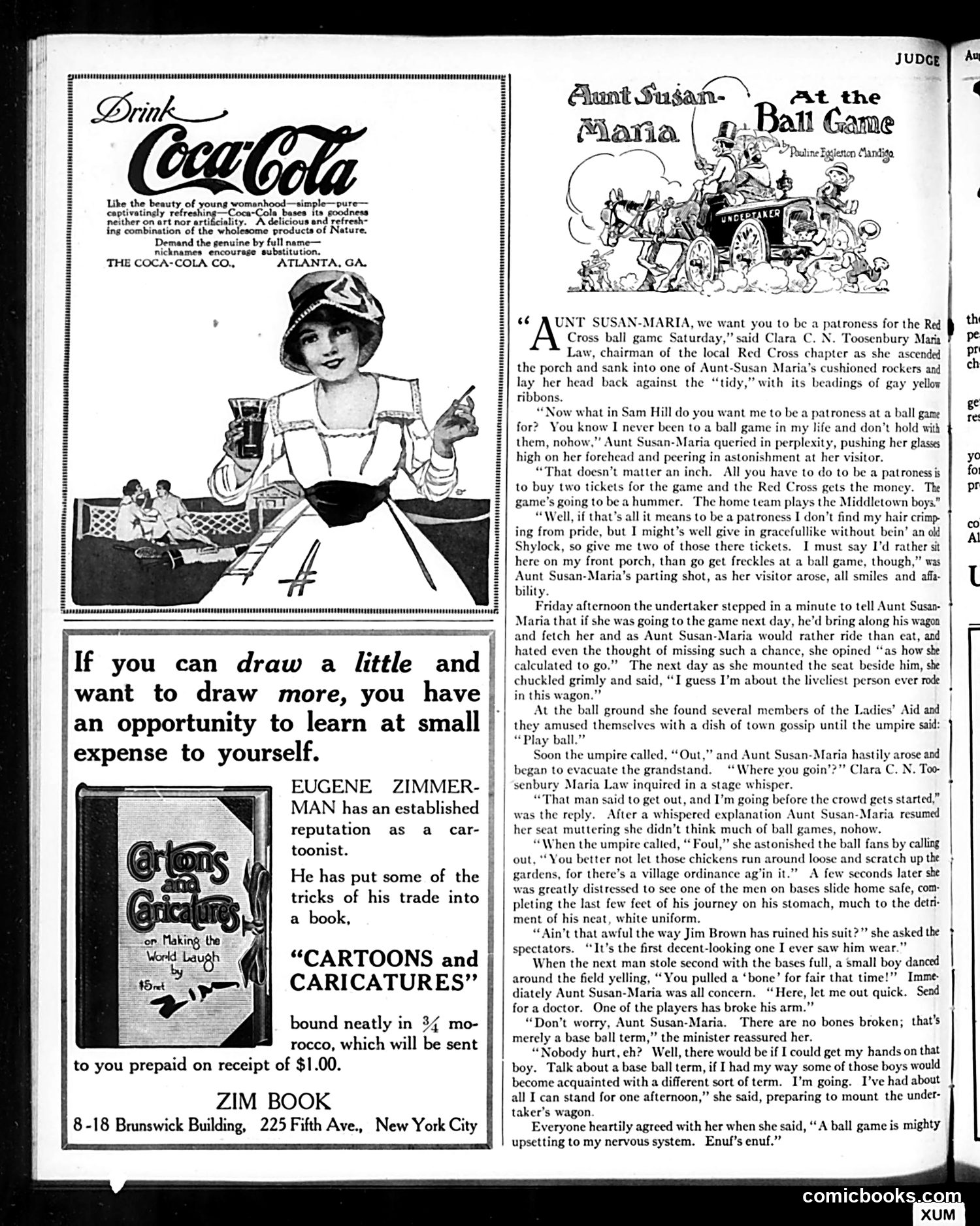
This is a humorous story about an elderly rural woman's first baseball game. Aunt Susan-Maria, a cranky small-town widow, is reluctant when asked to be a Red Cross ball game patroness (buying tickets to support charity). She agrees only to get rid of the solicitor. At the game, her unfamiliarity with baseball rules and etiquette produces comedy: she tries to leave when the umpire calls "Out," complains about stray chickens near the bases, and expresses horror at a player sliding into base because it dirties his uniform. The satire gently mocks rural Americans' bewilderment with modern urban pastimes and their practical, no-nonsense values. Aunt Susan-Maria represents the unsophisticated country person encountering unfamiliar city customs—a stock character in early 20th-century humor. The page also advertises Eugene Zimmerman's cartooning instruction book.
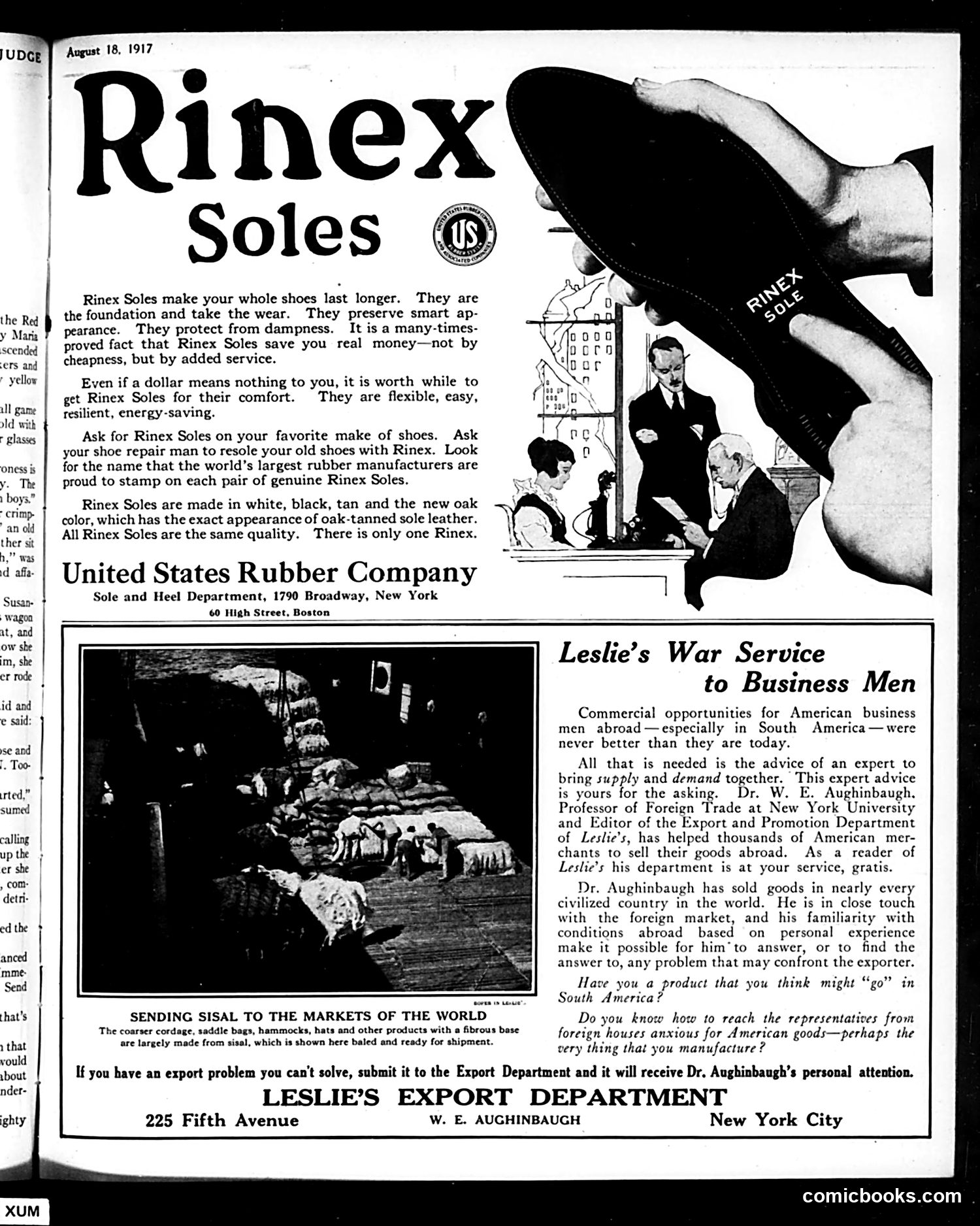
This page is primarily **advertising**, not political satire. It contains two unrelated advertisements: **Top:** A Rinex Soles advertisement from United States Rubber Company promoting replacement shoe soles as economical and durable. The accompanying illustration shows a businessman displaying a shoe sole to office workers—a straightforward product pitch with no satirical content. **Bottom:** An advertisement for Leslie's Magazine's Export Department, featuring Dr. W. E. Aughinbaugh offering free consulting advice to American businessmen seeking to export goods abroad, particularly to South America. The image shows sisal fiber products being prepared for shipment. The timing (1917, during WWI) may explain the export focus—American manufacturers were seeking international markets. However, **neither advertisement contains political cartoon elements, caricatures, or satire** that would require historical context to decode. This appears to be a standard advertising page rather than editorial content.
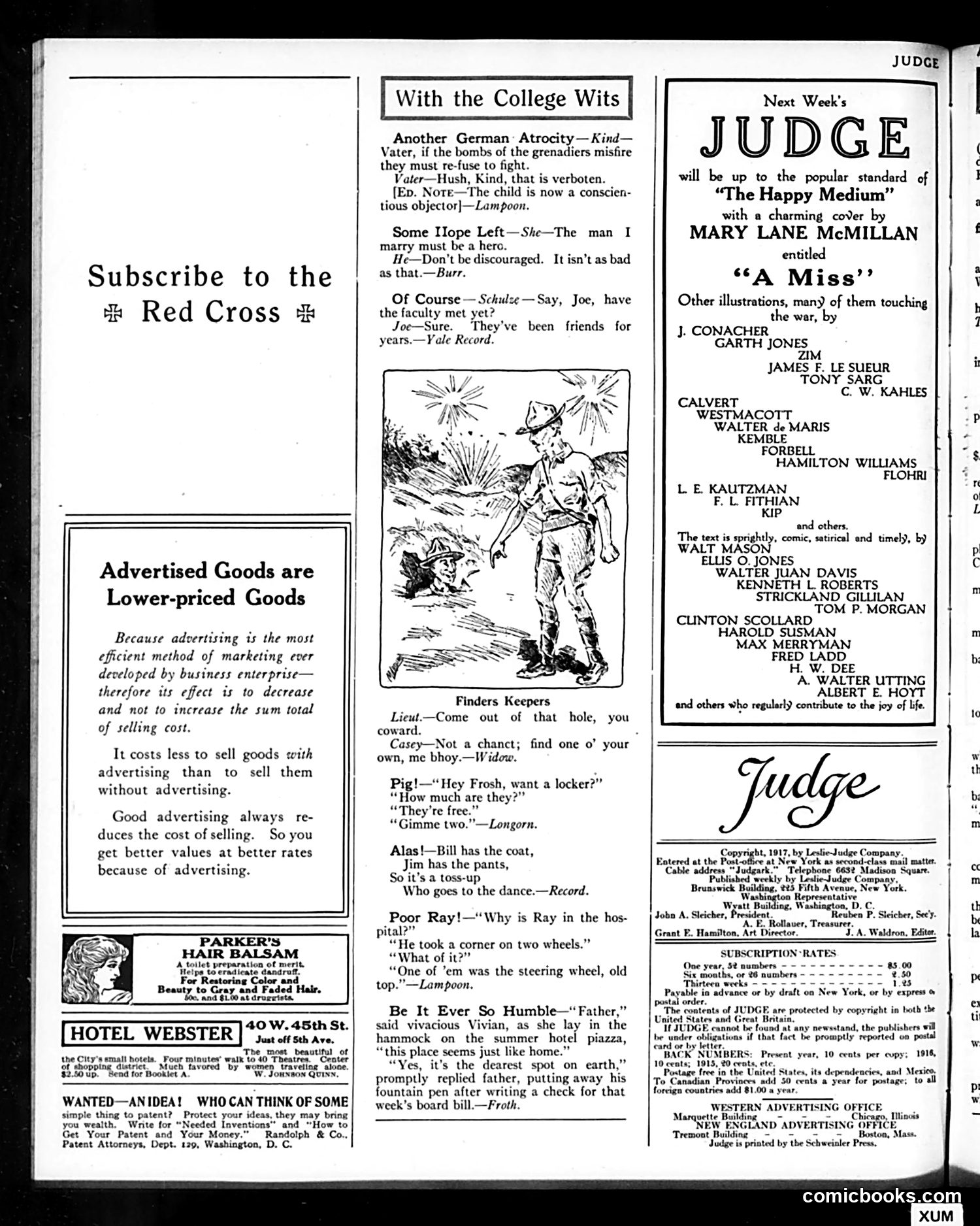
This page is primarily **advertising and editorial content** rather than political cartoons. The main elements are: **"With the College Wits"** section: A series of brief jokes from college humor magazines (Yale Record, Longhorn, etc.). These include: - A German atrocity joke mocking German militarism and a child becoming a "conscientious objector"—relevant to WWI sentiment - Campus humor about dormitory life, dating, and student finances **The satire**: The German joke reflects 1917 American anti-German propaganda during U.S. involvement in World War I, portraying German military discipline as absurdly rigid. **Advertisement section** promotes the value of advertising itself, Red Cross subscription, Parker's Hair Balsam, Hotel Webster, and patent services. The page advertises next week's Judge cover by Mary Lane McMillan, titled "A Miss," with contributions from various satirists and illustrators. This appears to be a typical editorial/promotional page from the magazine's interior.
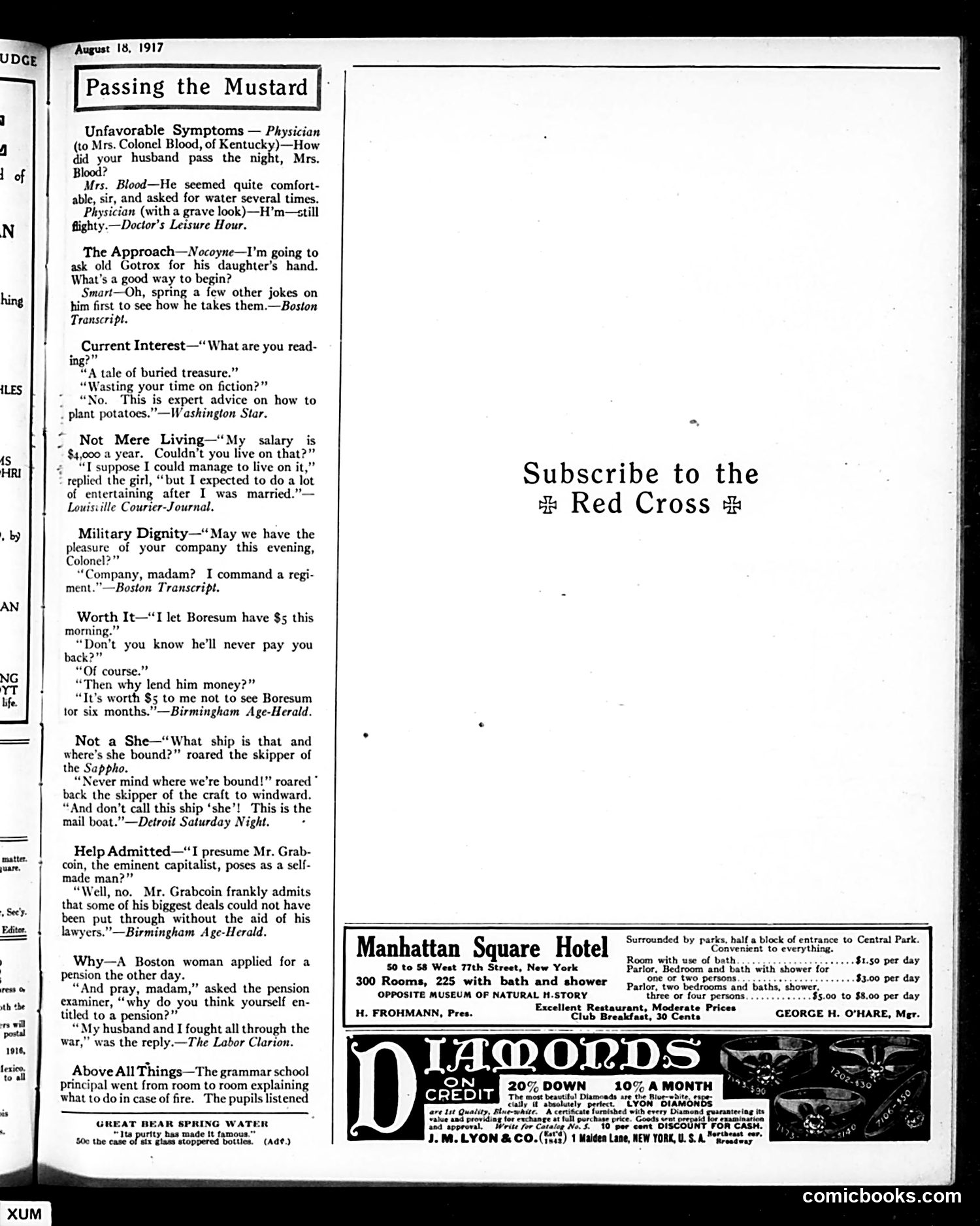
This page contains a collection of brief humorous anecdotes rather than a political cartoon. The title "Passing the Mustard" appears to be the section heading for these jokes. The humor spans domestic, social, and wartime themes typical of 1917 America: - **Military references**: One joke mocks a Colonel's vanity about rank; another involves a Boston woman claiming a pension for "fighting" with her husband during "the war"—likely satirizing pension fraud concerns during WWI. - **Social satire**: Jokes target wealthy capitalists who claim self-made status (Grabcoin), romantic courtship etiquette, and salary expectations among the working class. - **Wordplay**: Several rely on puns and double meanings ("mail boat" misidentified as a ship, "flighty" advice-seeking). The page also contains period advertisements for the Manhattan Square Hotel and a diamonds-on-credit business, plus a Red Cross subscription appeal—reflecting 1917 wartime concerns.
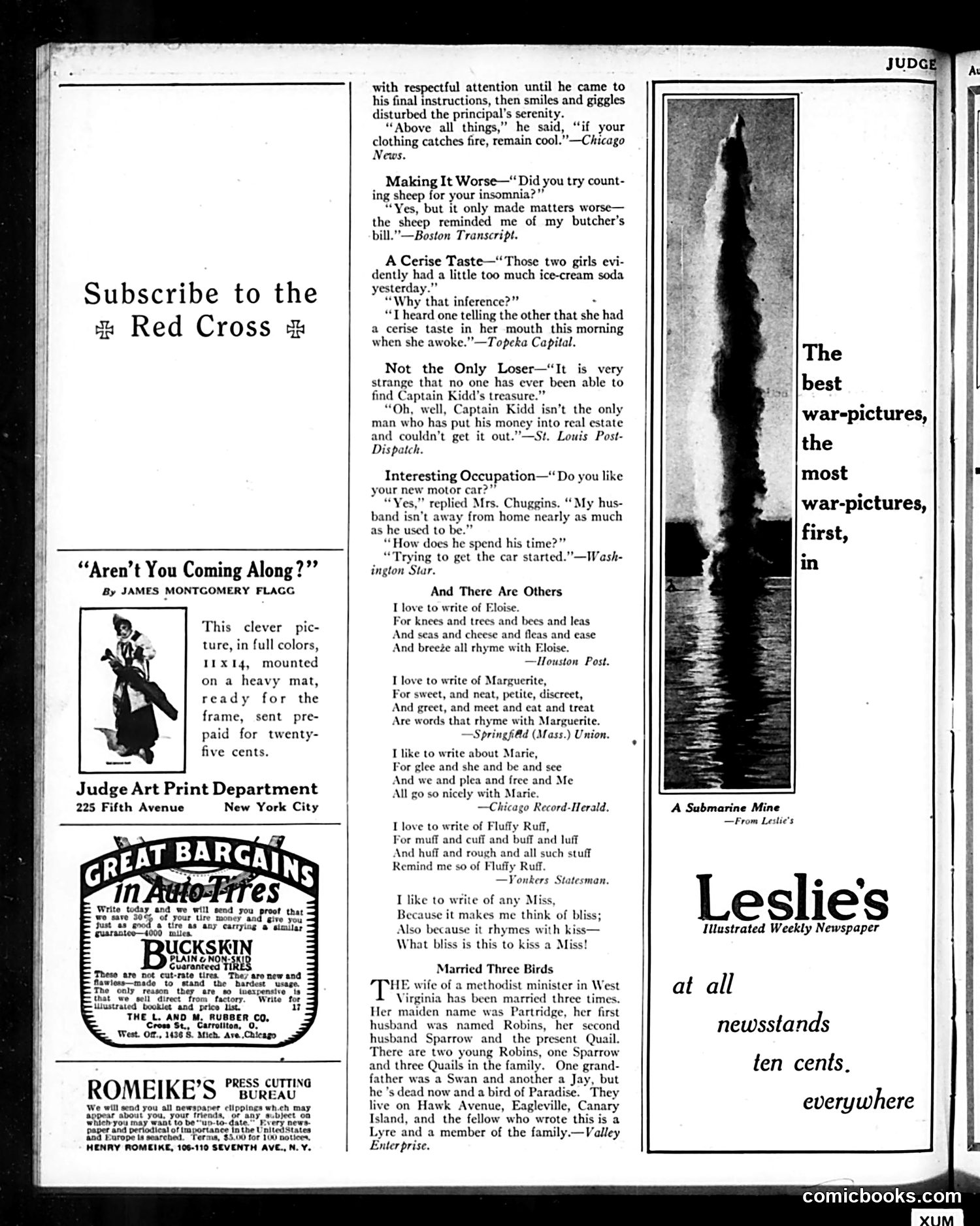
This page from *Judge* contains primarily **short humorous anecdotes and advertisements** rather than political cartoons. The main content includes: **The Featured Cartoon**: James Montgomery Flagg's "Aren't You Coming Along?" (promoting Red Cross subscriptions) depicts a patriotic appeal, likely referencing WWI-era charitable giving. **The Humor Pieces**: Several brief jokes satirize everyday American life—insomnia remedies, ice-cream-induced nausea, failed treasure hunts, automobile troubles, and romantic poetry. These are gentle social observations rather than sharp political satire. **"Married Three Birds"**: A whimsical piece playing on a woman's sequential marriages to men with bird-related surnames (Partridge, Robins, Sparrow, Quail), living on "Hawk Avenue" in "Eagleville." **The Advertisements**: Promote art prints, tires, and newspaper clipping services—typical early 20th-century magazine fare. The page reflects *Judge*'s character as a general-interest humor magazine blending light satire with commercial content, not hard-hitting political commentary.
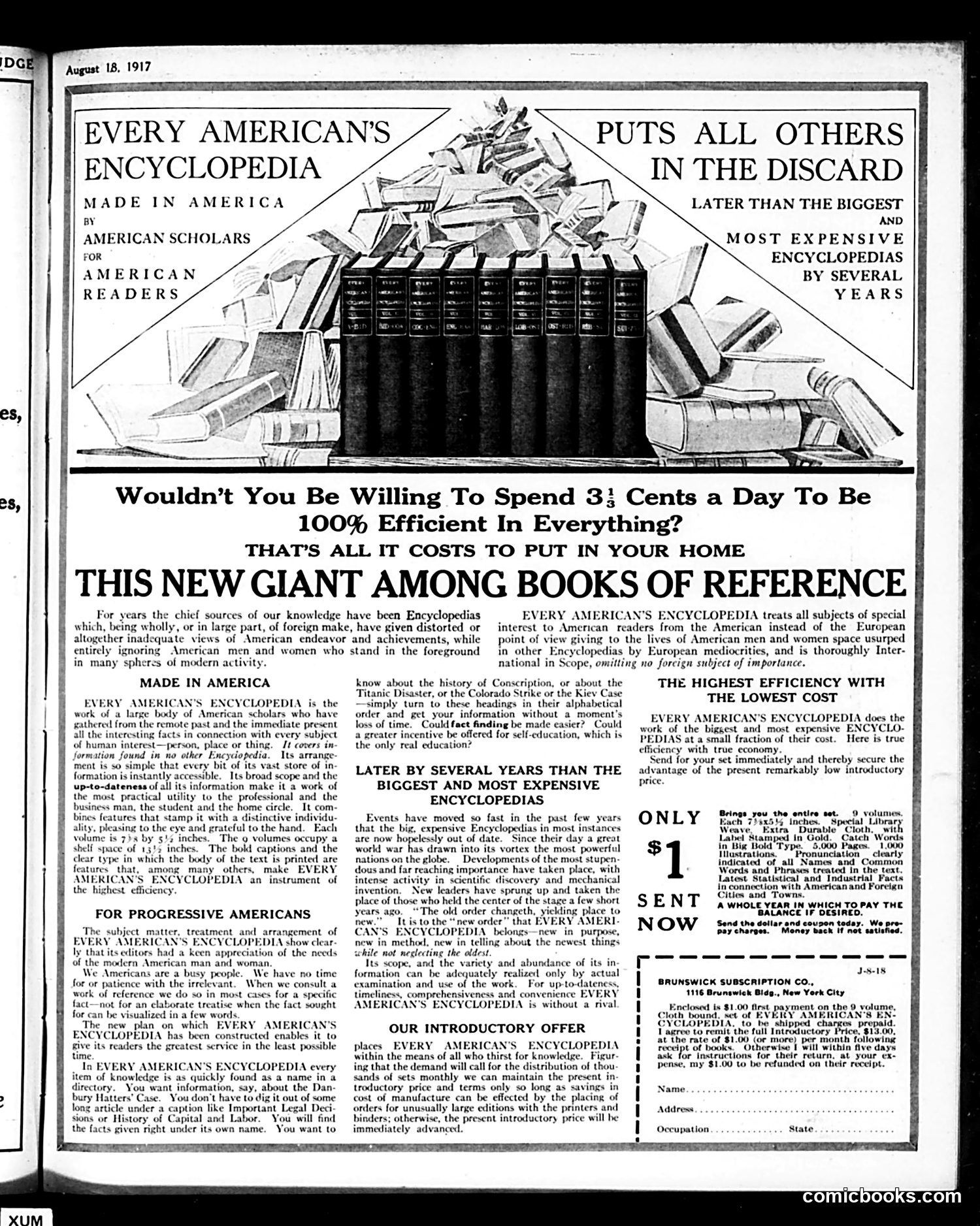
This is primarily an **advertisement**, not a satirical cartoon. It promotes "Every American's Encyclopedia," a new American-made reference work published in 1917. The sales pitch emphasizes nationalist pride—contrasting this "Made in America by American Scholars" encyclopedia against European competitors that allegedly contain "distorted or altogether inadequate" information about American achievements and events. The advertisement targets practical American readers who value efficiency, claiming the encyclopedia's alphabetical organization saves time compared to competitors' lengthy articles. It also argues that rival encyclopedias are outdated because "events have moved so fast" (likely referencing WWI's rapid developments). The pitch emphasizes affordability: only $1 "sent now" (approximately 3.3 cents daily). The visual shows the encyclopedia set towering over discarded competitor volumes, symbolizing superiority. This reflects early-20th-century American confidence in homegrown products and expertise during World War I, when "Made in America" messaging was commercially powerful.
This is a straightforward **advertisement**, not political satire. It promotes Fairy Soap by the Fairbank Company, emphasizing the product's "pure and inviting appearance" and "gentle, easy cleansing qualities." The ad highlights that the soap's "oval floating cake fits the hand" and asks, "Have you a little Fairy in your home?"—a marketing slogan playing on the product's name. The illustration features a stylized fairy figure sitting atop the soap cake. This is vintage advertising from Judge magazine, likely early 20th century, using whimsical imagery to market consumer goods. There is no political commentary or satirical content on this page—it's simply a commercial advertisement typical of the era.