
Judge, 1917-08-18 · page 14 of 28
Judge — August 18, 1917 — page 14: what you’re looking at
What you’re looking at
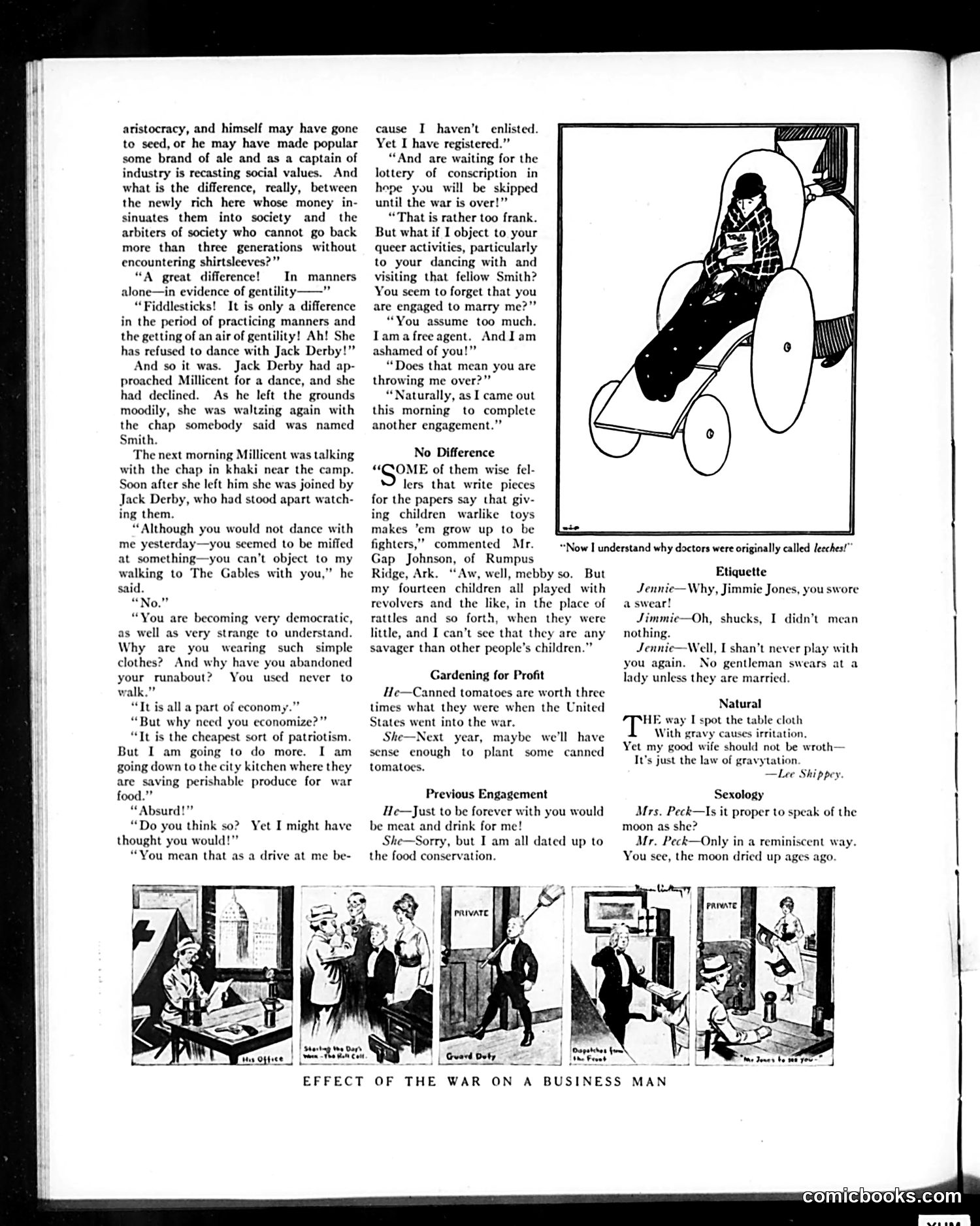
This page from Judge satirizes American social attitudes during World War I. The main narrative concerns Millicent, a wealthy woman engaged to Jack Derby, who refuses to dance with him because he hasn't enlisted—yet he registered for the draft lottery. Millicent, meanwhile, adopts wartime "economy" by abandoning her car and working in city kitchens, and breaks her engagement, declaring herself a "free agent" engaged in patriotic work instead. The satire targets the hypocrisy of both figures: Derby criticizes her activities while doing nothing himself; Millicent performs conspicuous patriotism while rejecting obligation to him. The surrounding humor pieces mock wartime rhetoric—Gap Johnson's children playing with toy guns, tomato-canning profiteering, and forced "food conservation" dating excuses. The cartoon "Effect of the War on a Business Man" (bottom) likely shows how civilian life becomes disrupted by war obligations, though details are small.
📄 Transcribed text from this page (OCR, searchable)
Machine-transcribed from the original scan — historical spelling and the odd misread are preserved.
aristocracy, and himself may have gone to seed, or he may have made popular some brand of ale and as a captain of industry is recasting social values. And what is the difference, really, between the newly rich here whose moncy in- sinuates them into society and the arbiters of society who cannot go back more than three generations without encountering shirtsleeves?”” “A great difference! alone—in evidence of gentility——' “Fiddlesticks! It is only a difference in the period of practicing manners and the getting of an air of gentility! Ah! She has refused to dance with Jack Derby!” And so it was. Jack Derby had ap- proached Millicent for a dance, and she had declined. As he left the grounds moodily, she was waltzing again with the chap somebody said was named Smith. The next morning Millicent was talking with the chap in khaki near the camp. Soon after she left him she was joined by Jack Derby, who had stood apart watch- ing them. “Although you would not dance with me yesterday—you seemed to be miffed at something—you can’t object to my walking to The Gables with you,” he said. “No.” “You are becoming very democratic, as well as very strange to understand. Why are you wearing such simple clothes? And why have you abandoned your runabout? You used never to walk.” “Tt is all a part of economy.” “But why need you economize?” “It is the cheapest sort of patriotism. But I am going to do more. I am going down to the city kitchen where they are saving perishable produce for war food. “Absurd!” “Do you think so? Yet I might have thought you would!” “You mean that a In manners a drive at me be- | | seastng t00 Dans voce The Ham Coit EFFECT cause I haven't enlisted. Yet I have registered.” “And are waiting for the lottery of conscription in hope you will be skipped until the war is over!” “That is rather too frank. But what if I object to your queer activities, particularly to your dancing with and visiting that fellow Smith? You scem to forget that you are engaged to marry me?” “You assume too much. Iamafree agent. Andlam ashamed of you!” “Does that mean you are throwing me over?” “Naturally, as I came out this morning to complete another engagement.” No Difference “COME of them wise fel- lers that write pieces for the papers say that giv- ing children warlike toys makes ’em grow up to be fighters,” commented Mr. Gap Johnson, of Rumpus Ridge, Ark. “Aw, well, mebby so. But my fourteen children all played with revolvers and the like, in the place of rattles and so forth, when they were little, and I can’t see that they are any savager than other people's children.” Gardening for Profit He—Canned tomatoes are worth three times what they were when the United States went into the war. She—Next year, maybe we'll have sense enough to plant some canned tomatoes. Previous Engagement He—Just to be forever with you would be meat and drink for me! She—Sorry, but I am all dated up to the food conservation. —} ERSSE SrA BETTE] se Fe OF THE WAR ON A BUSINESS W/L | ) “Now I understand why doctors were originally called leeches!” Etiquette Jennie—Why, Jimmie Jones, you swore a swear! Jimmie—Oh, shucks, I didn’t: mean nothing. Jennie—Well, I shan’t never play with you again. No gentleman swears at a lady unless they are married. Natural HE way I spot the table cloth With gravy causes irritation, Yet my good wife should not be wroth— It's just the law of gravytation. —Lee Shippey. Sexology Mrs. Peck—Is it proper to speak of the moon as she? Mr. Peck—Only in a reminiscent way. You see, the moon dried up ages ago.