
Judge, 1917-08-18 · page 16 of 28
Judge — August 18, 1917 — page 16: what you’re looking at
What you’re looking at
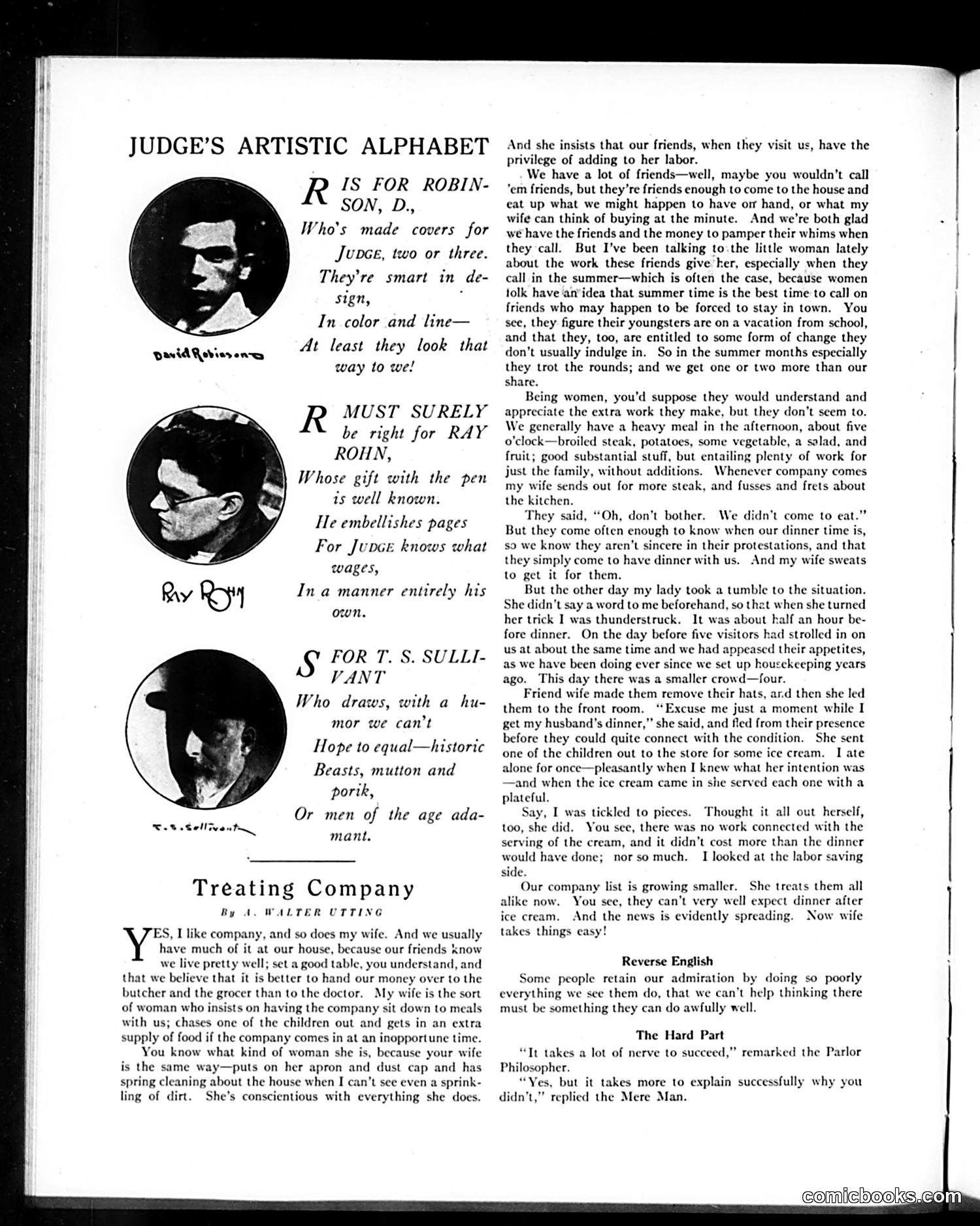
**Left side:** A section of Judge's alphabet featuring three illustrators who created covers and content for the magazine: Robinson, D.; Ray Rohn; and T.S. Sullivant. These are professional acknowledgments of the artists' work, celebrating their design skills and distinctive drawing styles in "color and line." **Right side:** "Treating Company" by A. Walter Utting is a humorous essay about uninvited dinner guests. The narrator describes how friends regularly invite themselves to his home during summer, claiming they "didn't come to eat" while clearly timing visits to meal hours. His wife accommodates them elaborately despite the extra work. The joke's climax: she finally rebels by deliberately excluding the guests from dinner, serving only her husband while they wait in the front room—a witty reversal of expected hospitality obligations. The satire mocks both the hypocrisy of guests and the social pressure on housewives to provide lavish meals.
📄 Transcribed text from this page (OCR, searchable)
Machine-transcribed from the original scan — historical spelling and the odd misread are preserved.
JUDGE’S ARTISTIC ALPHABET IS FOR ROBIN- SON, D., Who's made covers for Junce, two or three. They’re smart in de- Sign, In color and line— At least they look that way to we! DRIAR WEES R MUST SURELY be right for RAY ROHN, Whose gift with the pen is well known. He embellishes pages For Junce knows what wages, Ina manner entirely his own. FOR T. S. SULLI- VANT Who draws, with a hu- mor we can’t Hope to equal—historic Beasts, mutton and pork, Or men of the age ada- mant, TiS Selly. Treating Company By A. WALTER UTTING ES, I like company, and so does my wife. And we usually have much of it at our house, because our friends know we live pretty well; set a good table, you understand, and that we believe that it is better to hand our money over to the butcher and the grocer than to the doctor. My wife is the sort of woman who insists on having the company sit down to meals with us; chases one of the children out and gets in an extra supply of food if the company comes in at an inopportune time. You know what kind of woman she is, because your wi! is the same way—puts on her apron and dust cap and has spring cleaning about the house when I can’t even a sprink- ling of dirt. She's conscientious with everything she does. And she insists that our friends, when they visit us, have the privilege of adding to her labor. We have a lot of friends—well, maybe you wouldn’t call ‘em friends, but they’re friends enough to come to the house and eat up what we might happen to have or hand, or what my wife can think of buying at the minute. And we’re both glad we have the friends and the money to pamper their whims when they call. But I’ve been talking to.the little woman lately about the work these friends give ker, especially when they call in the summer—which is often the case, because women tolk have an’idea that summer time is the best time to call on friends who may happen to be forced to stay in town. You see, they figure their youngsters are on a vacation from school, and that they, too, are entitled to some form of change they don’t usually indulge in. So in the summer months especially they trot the rounds; and we get one or two more than our share. Being women, you’d suppose they would understand and appreciate the extra work they make, but they don’t seem to. We gencrally have a heavy meal in the afternoon, about five o’clock—broiled steak, potatoes, some vegetable, a salad, and fruit; good substantial stuff, but entailing plenty of work for just the family, without additions. Whenever company comes my wife sends out for more steak, and fusses and frets about the kitchen. They said, “Oh, don’t bother. We didn’t come to ea But they come often enough to know when our dinner time is, so we know they aren’t sincere in their protestations, and that they simply come to have dinner with us. And my wife sweats to get it for them. But the other day my lady took a tumble to the situation. She didn’t say a word to me beforehand, so that when she turned her trick I was thunderstruck. It was about kalf an hour be- fore dinner. On the day before five visitors strolled in on us at about the same time and we had appeased their appetites, as we have been doing ever since we set up housckeeping years ago. This day there was a smaller crowd—four. Friend wife made them remove their hats, and then she led them to the front room. “Excuse me just a moment while I get my husband’s dinner,” she said, and fled from their presence before they could quite connect with the condition. She sent one of the children out to the store for some ice cream. I ate alone for once—pleasantly when I knew what her intention was —and when the ice cream came in she served each one with a plateful. Say, I was tickled to pieces. Thought it all out herself, too, she did. You see, there was no work connected with the serving of the cre , and it didn’t cost more than the dinner would have done; nor so much. I looked at the labor saving side. Our company list is growing smaller. She treats them all alike now. You see, they can’t very well expect dinner after ice cream. And the news is evidently spreading. Now wife takes things easy! Reverse English Some people retain our admiration by doing so poorly everything we see them do, that we can’t help thinking there must be something they can do awfully well. The Hard Part “Tt takes a lot of nerve to succeed,” remarked the Parlor Philosopher. “Yes, but it takes more to explain successfully why you didn’t,” replied the Mere Man. comichoo!