
Judge, 1917-08-18 · page 17 of 28
Judge — August 18, 1917 — page 17: what you’re looking at
What you’re looking at
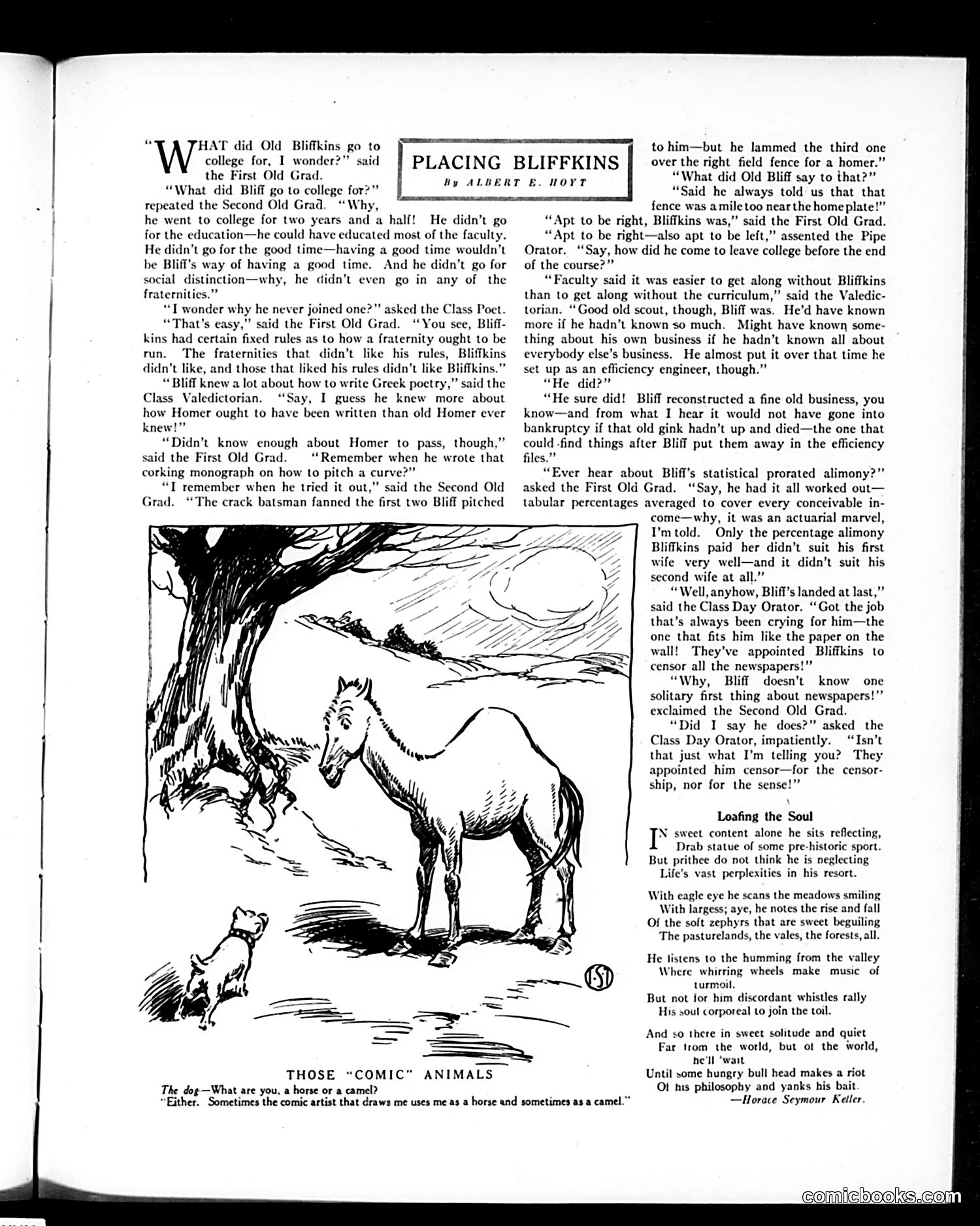
This humorous story satirizes a character type: the overeducated know-it-all who is competent at nothing practical. "Old Bliffkins" attended college without genuine purpose—not for learning, socializing, or advancement—yet accumulated knowledge on every subject while mastering none. The running joke involves his spectacular failures: his baseball pitch theory fails in practice; his efficiency engineering causes business collapse; his alimony calculations, though mathematically elaborate, satisfy no one. The satire culminates in dark irony: Bliffkins is appointed newspaper censor—not *because* he understands journalism, but *precisely because* he doesn't. The appointment mocks both Bliffkins's worthlessness and institutional incompetence that places unqualified people in positions of authority. The accompanying cartoon (showing confused animals—a camel and horse) reinforces the theme: identity confusion and misplacement. The piece critiques American society's tendency to value credentials over actual competence.
📄 Transcribed text from this page (OCR, searchable)
Machine-transcribed from the original scan — historical spelling and the odd misread are preserved.
PLACING BLIFFKINS By ALBERT E. HOYT = HAT did Old Bliffkins go to W college for, I wonder?” said the First Old Grad. “What did Bliff go to college for?” repeated the Second Old Grad. “Wh: he went to college for two years and a half! He didn’t go for the education—he could have educated most of the faculty. He didn’t go for the good time—having a good time wouldn’t be Bliff’s way of having a good time. And he didn’t go for social distinction—why, he didn’t even go in any of the fraternities.” “T wonder why he never joined one?” asked the Class Poet. “That's easy,” said the First Old Grad. ‘You see, Bliff- kins had certain fixed rules as to how a fraternity ought to be run. The fraternities that didn’t like his rules, Bliffkins didn't like, and those that liked his rules didn’t like Bliffkins.” “ Bliff knew a lot about how to write Greek poetry,” said the Class Valedictorian. “Say, I guess he knew more about how Homer ought to have been written than old Homer ever knew!” “Didn’t know enough about Homer to pass, though,” said the First Old Grad. ‘Remember when he wrote that corking monograph on how to pitch a curve?” “T remember when he tried it out,” said the Second Old 1. “The crack batsman fanned the first two Biff pitched to him—but he lammed the third one over the right field fence for a homer.” “What did Old BIiff say to that?” “Said he always told us that that fence was amiletoo nearthe home plate!” “Apt to be right, Bliffkins was,” said the First Old Grad. “Apt to be right—also apt to be left,” assented the Pipe Orator. “Say, how did he come to leave college before the end of the course?” “Faculty said it was easier to get along without Bliffkins than to get along without the curriculum,” said the Valedic- torian. “Good old scout, though, Bliff was. He'd have known more if he hadn’t known so much. Might have known some- thing about his own business if he hadn’t known all about everybody else’s business. He almost put it over that time he set up as an efliciency engineer, though.” “He did?” “He sure did! Biff reconstructed a fine old business, you know—and from what I hear it would not have gone into bankruptcy if that old gink hadn’t up and died—the one that could find things after Bliff put them away in the efficiency files.” “Ever hear about Bliff’s statistical prorated alimony?” asked the First Old Grad. “Say, he had it all worked out— tabular percentages averaged to cover every conceivable in- come—why, it was an actuarial marvel, I’'mtold. Only the percentage alimony Bliffkins paid her didn’t suit his first wife very well—and it didn’t suit his second wife at all.” “Well, anyhow, Bliff’s landed at last,” said the Class Day Orator. ‘‘Got the job that’s always been crying for him—the one that fits him like the paper on the wall! They've appointed Bliffkins to censor all the newspapers!" “Why, Biff doesn’t know one solitary first thing about newspapers!”’ exclaimed the Second Old Grad. “Did I say he docs?” asked the Class Day Orator, impatiently. “Isn’t that just what I’m telling you? They appointed him censor—for the censor- ship, nor for the sense!” Loafing the Soul 'N sweet content alone he sits reflecting, Drab statue of some pre-historic sport. But prithee do not think he is neglecting Life’s vast perplexities in his resort. With eagle eye he scans the meadows smiling With largess; aye, he notes the rise and fall Of the soft zephyrs that are sweet beguiling The pasturelands, the vales, the forests, all. He listens to the humming from the valley Where whirring wheels make music of turmoil. But not for him discordant whistles rally His soul corporeal to join the toil. And so there in sweet solitude and quiet Far trom the world, but ot the world, —z — ——— ss he'll ‘wait THOSE “COMIC” ANIMALS The dog—What are you, a horse or a camel? “Either. Sometimes the comic artist that draws me uses me as a horse and sometimes as a camel.” Until some hungry bull head makes a riot Ot hus philosophy and yanks his bait —Horace Seymour Keller.