
Judge, 1917-08-18 · page 13 of 28
Judge — August 18, 1917 — page 13: what you’re looking at
What you’re looking at
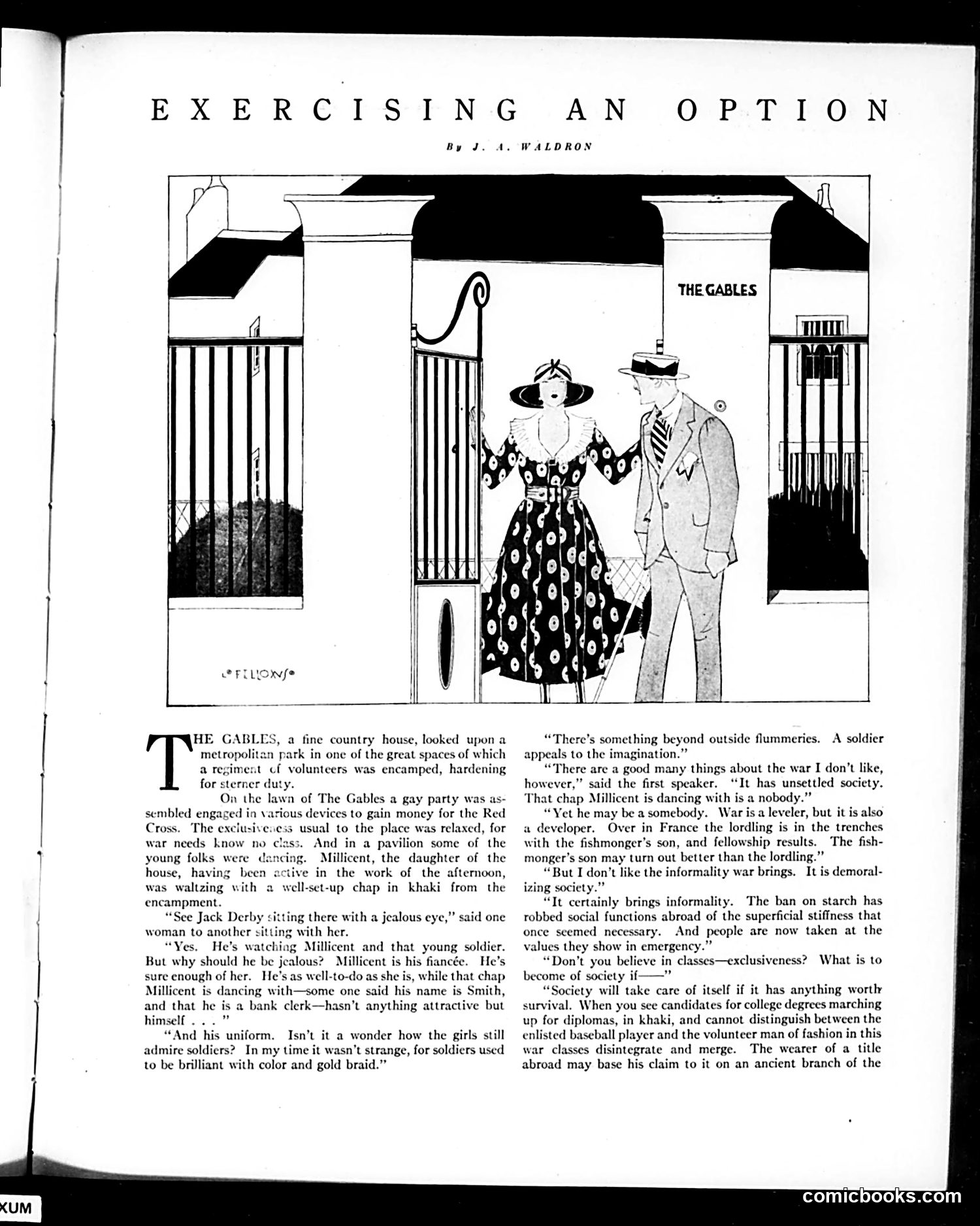
This story satirizes WWI-era anxieties about social class disruption. At "The Gables," an exclusive country house, wealthy Millicent dances with a soldier named Smith—a mere bank clerk—while her fiancé Jack Derby watches jealously. The dialogue between two society women captures the period's class panic: the war has "unsettled society" by mixing soldiers of different social standing and removing formal distinctions (starch bans, khaki uniforms replacing dress uniforms). One woman laments this "informality" as demoralizing, while the other argues war is a "leveler" where merit matters more than birth. The satire targets upper-class anxiety about social hierarchy dissolving during wartime. The bank clerk's uniform makes him appealing despite his modest status—illustrating how the war temporarily democratized attraction and social values. The "option" referenced in the title appears to be Millicent's ability to choose outside her prescribed class circle.
📄 Transcribed text from this page (OCR, searchable)
Machine-transcribed from the original scan — historical spelling and the odd misread are preserved.
KUM SING By J. A. EXERCI AN © PT l-OrN WALDRON HE GABLES, a fine country house, looked upon a metropolitan park in one of the great spaces of which a regiment cf volunteers was encamped, hardening ¢ lawn of The Gables a gay party was as- in various devices to gain money for the Red Cross. The exclusivesess usual to the place was relaxed, for war needs know no ¢ And in a pavilion some of the young folks were di Millicent, the daughter of the house, havin, in the work of the afternoon, was waltzing with a well-set-up chap in khaki from the encampment, “See Jack Derb; woman to another “Yes, He's watching Millicent and that young soldier. But why should he be jealous? Millicent is his fiancée. He's sure enough of her. He's as well-to-do as she is, while that chap Millicent is dancing with—some one said his name is Smith, and that he is a bank clerk—hasn’t anything attractive but sitting there with a jealous eye,” said one ting with her. himself . . . “And his uniform. Isn’t it a wonder how the girls still admire soldiers? In my time it wasn’t strange, for soldiers used to be brilliant with color and gold braid.” “There’s something beyond outside flummeries. A soldier appeals to the imagination.” “There are a good many things about the war I don’t like, however,” said the first speak “It has unsettled society. That chap Millicent is dancing w nobody.” “Yet he may be a somebody. War isa leveler, but it is also a developer. Over in France the lordling is in the trenches with the fishmonger’s son, and fellowship results. The fish- monger’s son may turn out better than the lordling.” “But I don’t like the informality war brings. It is demoral- izing society.” “Tt certainly brings informality. The ban on starch has robbed social functions abroad of the superficial stiffness that once seemed necessary. And people are now taken at the values they show in emergency.” “Don’t you believe in classes—exclusiveness? What is to become of society if ia “Society will take care of itself if it has anything wortlr survival. When y ¢ candidates for college degrees marching up for diplomas, in khaki, and cannot distinguish between the enlisted baseball player and the volunteer man of fashion in this war classes disintegrate and merge. The wearer of a title abroad may base his claim to it on an ancient branch of the h comicbooks.com