
Judge, 1917-08-18 · page 5 of 28
Judge — August 18, 1917 — page 5: what you’re looking at
What you’re looking at
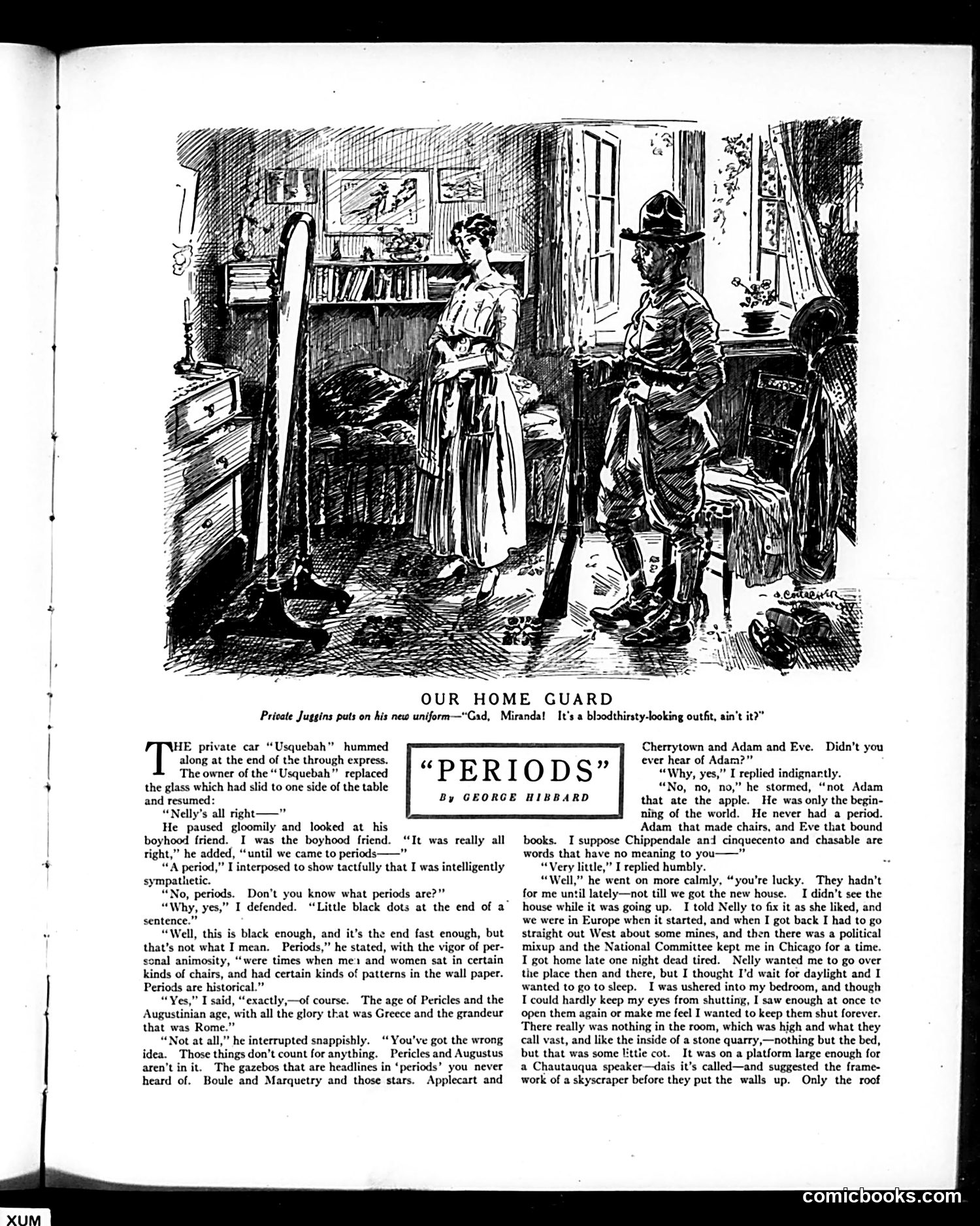
This cartoon titled "Our Home Guard" by George Hibbard depicts two figures in what appears to be early 20th-century domestic space. The illustration shows a woman in an apron confronting a man in military uniform, with the caption: "Private Justus puts on his new uniform—'Gad, Miranda! It's a bloodthirsty-looking outfit, ain't it?'" The satire targets civilian military volunteers or home defense forces ("home guard"), mocking their pretensions. The woman's reaction and the domestic setting suggest humor about ordinary citizens adopting military dress and attitudes while remaining fundamentally unchanged by their uniforms. The joke appears to be about the contrast between martial appearance and actual civilian status. The accompanying story "Periods" by George Hibbard explores historical references, though its satirical target remains unclear from the visible text.
📄 Transcribed text from this page (OCR, searchable)
Machine-transcribed from the original scan — historical spelling and the odd misread are preserved.
4 _—__—__+ XUM OUR HOME GUARD Private Juggins puts on his new uniform—"Cad, Miranda! It's a bloodthirsty-looking outfit, ain't it?” along at the end of the through express. The owner of the “Usquebah” replaced the glass which had slid to one side of the table and resumed: “Nelly’s all right——” He paused gloomily and looked at his boyhood friend. I was the boyhood friend. “It was really all right,” he added, “until we came to periods —” “A period,” I interposed to show tactfully that I was intelligently sympathetic. “No, periods. Don’t you know what periods are?” Ts private car “Usquebah” hummed “Why, yes,” I defended. “Little black dots at the end of a° sentence.” “Well, this is black enough, and it’s the end fast enough, but that’s not what I mean. Periods,” he stated, with the vigor of per- sonal animosity, “‘were times when me1 and women sat in certain kinds of chairs, and had certain kinds of patterns in the wall paper. Periods are historical.” “Yes,” I said, “exactly,—of course. The age of Pericles and the Augustinian age, with all the glory that was Greece and the grandeur that was Rome.” “Not at all,” he interrupted snappishly. “You've got the wrong idea. Those things don’t count for anything. Pericles and Augustus aren’t in it. The gazebos that are headlines in ‘periods’ you never heard of. Boule and Marquetry and those stars. Applecart and “PERIODS” By GEORGE HIBBARD Cherrytown and Adam and Eve. Didn't you ever hear of Adam?” “Why, yes,” I replied indignartly. “No, no, no,” he stormed, “not Adam that ate the apple. He was only the begin- ning of the world. He never had a period. Adam that made chairs, and Eve that bound books. I suppose Chippendale and cinquecento and chasable are words that have no meaning to you——” “Very little,” I replied humbly. “Well,” he went on more calmly, “you're lucky. They hadn’t for me until lately—not till we got the new house. I didn’t see the house while it was going up. I told Nelly to fix it as she liked, and we were in Europe when it started, and when I got back I had to go straight out West about some mines, and then there was a political mixup and the National Committee kept me in Chicago for a time. I got home late one night dead tired. Nelly wanted me to go over the place then and there, but I thought I'd wait for daylight and I wanted to go to sleep. I was ushered into my bedroom, and though I could hardly keep my eyes from shutting, I saw enough at once to open them again or make me feel I wanted to keep them shut forever. There really was nothing in the room, which was high and what they call vast, and like the inside of a stone quarry,—nothing but the bed, but that was some littie cot. It was on a platform large enough for a Chautauqua speaker—dais it’s called—and suggested the frame- work of a skyscraper before they put the walls up. Only the roof comicbooks.com