
A complete issue · 29 pages · 1917
Judge — June 30, 1917
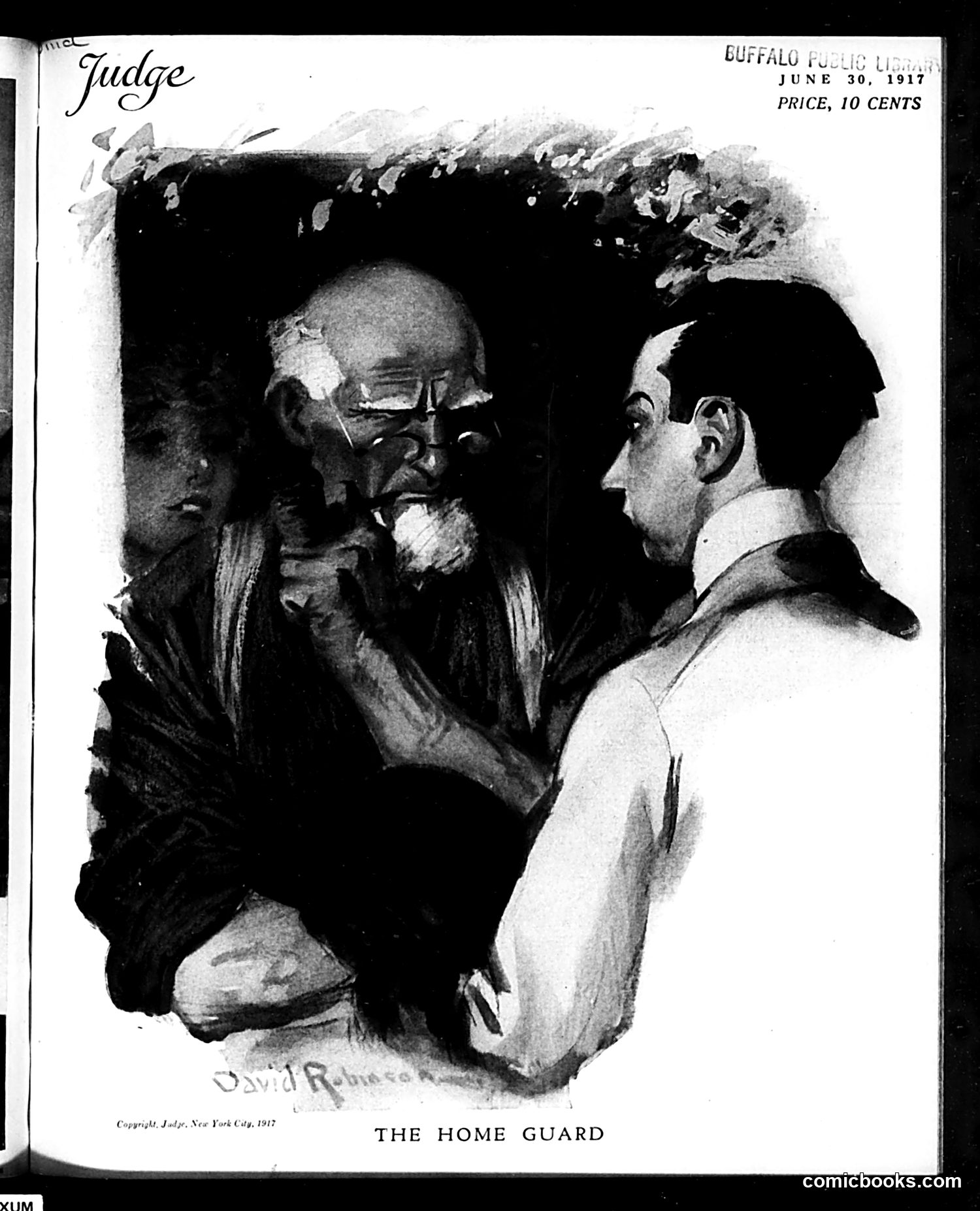
This cartoon depicts an elderly man with glasses and a beard confronting a younger man in profile. The title "The Home Guard" suggests commentary on American domestic security during World War I (the U.S. entered the war in April 1917). The satire likely mocks civilian vigilantism or overzealous "home front" enforcement during wartime—possibly referring to paranoia about spies, draft evasion, or sedition. The elderly figure appears to represent established authority or patriotic fervor, while the younger man may represent either a suspect or someone being detained. Without additional context or caption text, the specific figures remain unclear, though the cartoon critiques excessive wartime domestic policing or civilian enforcement of patriotic conformity.
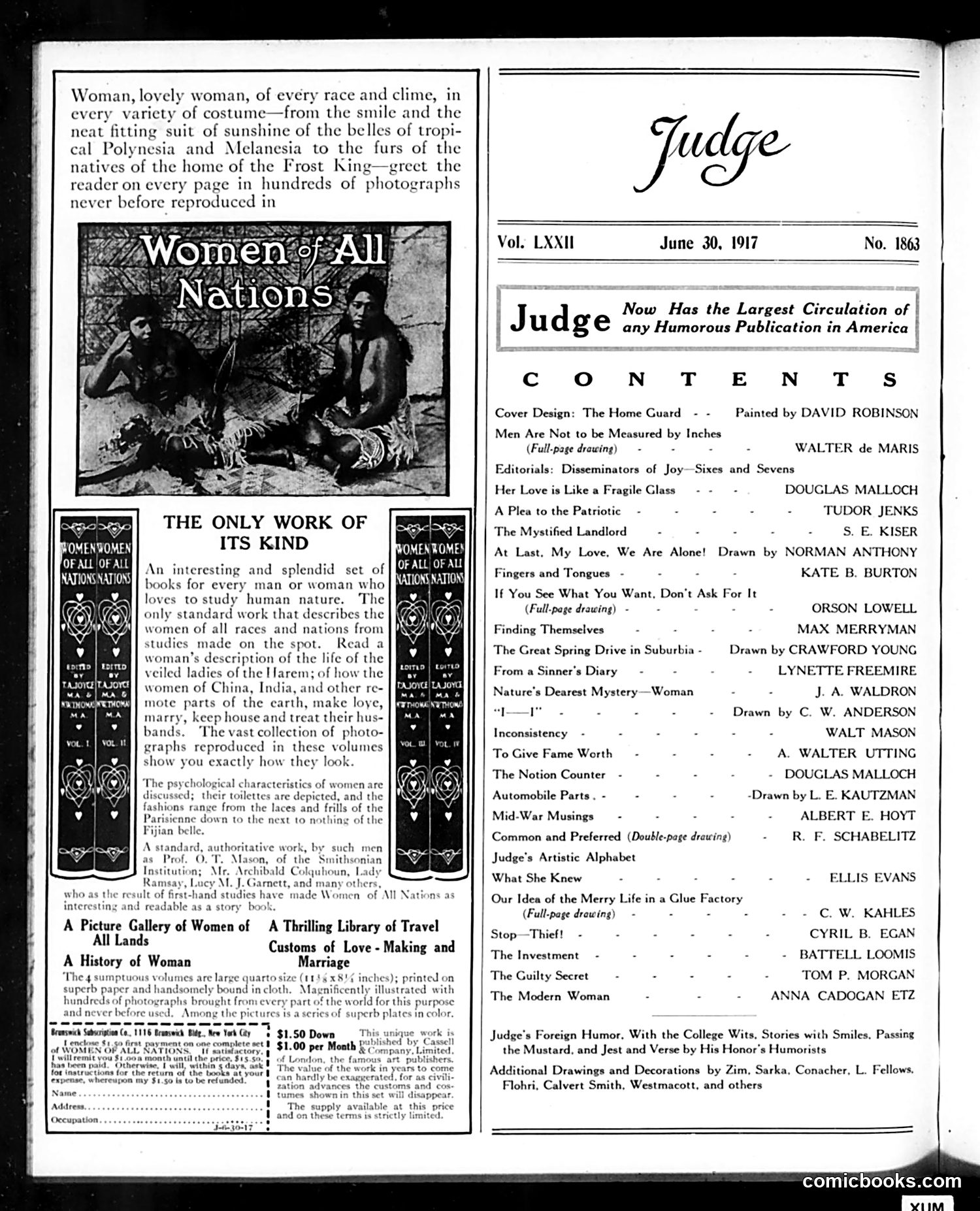
This is primarily a contents/masthead page for Judge magazine rather than a political cartoon. The left side advertises a multi-volume reference work, "Women of All Nations," describing illustrated studies of women across different cultures and climates. The right side lists editorial contents for this issue, featuring humorous articles and drawings by various contributors. Article titles suggest typical early-20th-century satirical humor: "Men Are Not to be Measured by Inches," "A Plea to the Patriotic," "Inconsistency," and "Stop—Thief!" Published June 30, 1917 (during U.S. involvement in World War I), the patriotic-themed article suggests contemporary concerns, though no specific political cartoons are visible on this particular page.
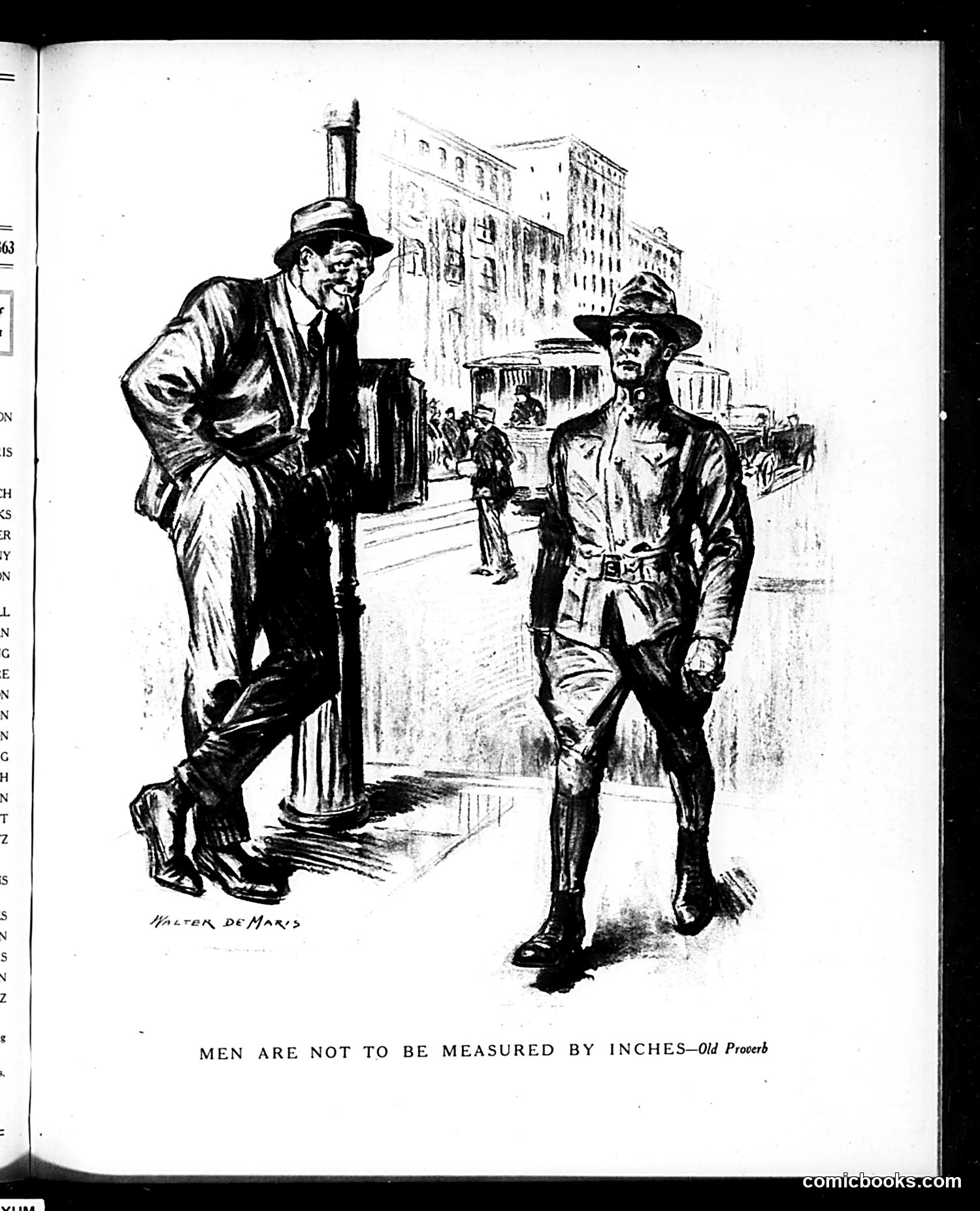
This cartoon by Halton De Maris depicts a tall, thin man in civilian clothes leaning against a lamppost confronting a uniformed soldier. The caption reads "MEN ARE NOT TO BE MEASURED BY INCHES—Old Proverb." The satire appears to critique physical stature standards, likely related to military recruitment. The civilian's exaggerated height contrasts with the soldier's more typical build, suggesting the cartoon mocks rigid height requirements for military service. The proverb's message—that worth isn't determined by physical measurements—implies criticism of policies that rejected qualified recruits based solely on height standards. This reflects early 20th-century military recruitment debates, when height minimums were common but controversial. The cartoon argues character and capability matter more than inches.
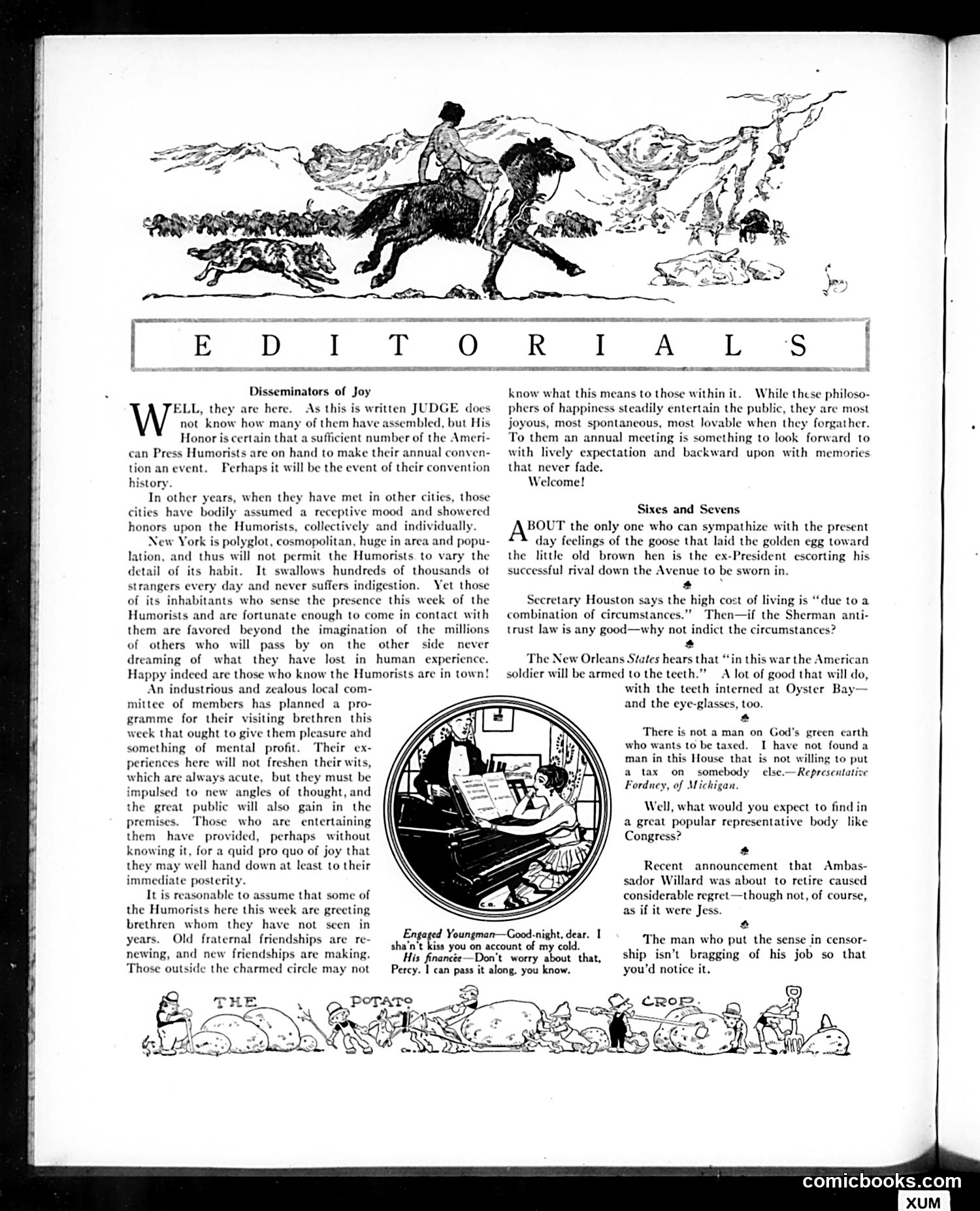
This is an editorial page from *Judge* magazine featuring satirical commentary on contemporary politics and society. **Top Section ("Disseminators of Joy"):** Celebrates the Humorists' annual convention, praising their role in bringing joy and mental refreshment to the public. It contrasts New York's cosmopolitan nature with how the convention creates fellowship among traveling humorists. **"Sixes and Sevens":** A series of brief satirical quips mocking current events, including: - Someone's regret about a rival's political success - Secretary Houston's claim about high living costs - A New Orleans newspaper's claim about arming soldiers - General complaints about taxation and Congressional representation **The Circular Illustration:** Appears to show two figures in an office or formal setting, likely commenting on bureaucratic or political interaction, though specific identities are unclear from the image alone. The page emphasizes humor as social commentary on taxation, military matters, and political representation.
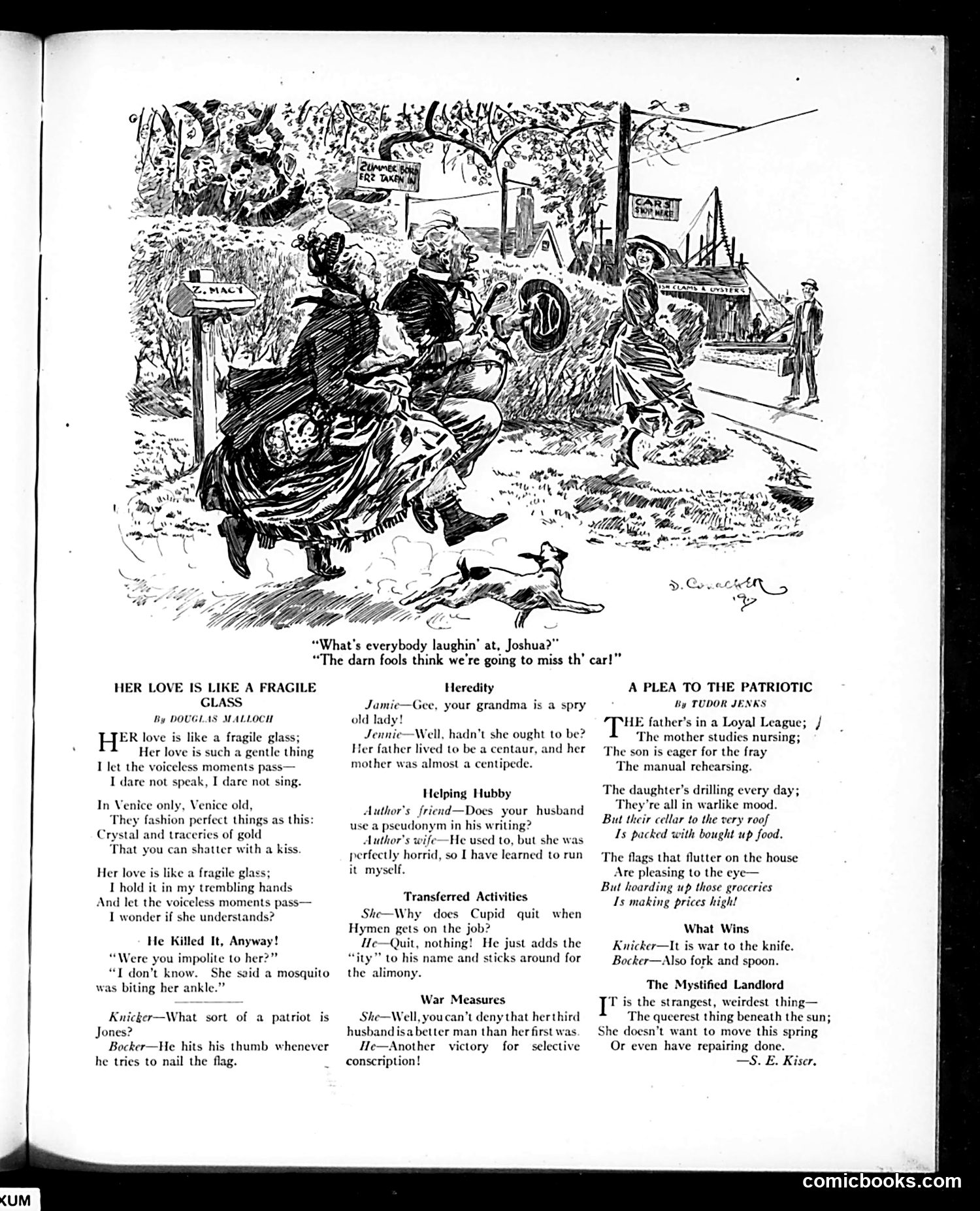
The main cartoon depicts two women in elaborate dress being chased by a small dog, with onlookers nearby. The caption reads: "What's everybody laughin' at, Joshua?" "The darn fools think we're going to miss th' car!" This appears to satirize wartime automobile shortages or rationing during World War I. The women's exaggerated fashions and the joke about "missing the car" likely mock civilians who continued conspicuous consumption and leisure activities despite wartime material restrictions. The surrounding text contains humorous short pieces with patriotic themes, including "A Plea to the Patriotic" by Tudor Jenas, which satirizes families maintaining comfortable home life while sons serve militarily. The overall page ridicules civilian hypocrisy regarding wartime sacrifice.
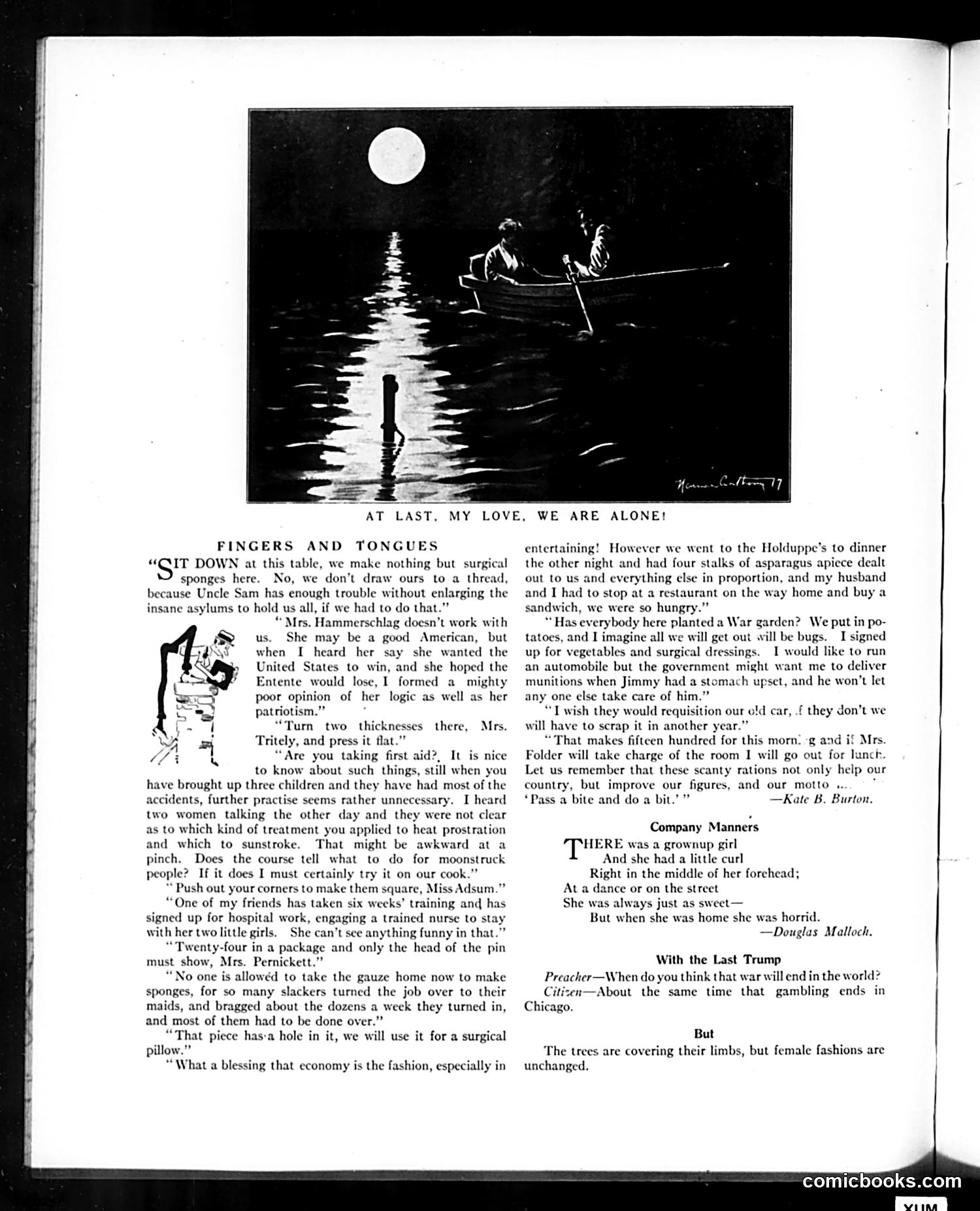
**The Illustration**: The cartoon "At Last, My Love, We Are Alone!" depicts two figures in a rowboat beneath a full moon—a romantic scene undermined by what appears to be a third figure in the water. This likely satirizes wartime intrusions on privacy or civilian life during WWI (suggested by references to "War garden" and "munitions" in the text). **The Text Sections**: "Fingers and Tongues" presents domestic complaints about servants and household management during wartime rationing. "Company Manners" is a brief poem about superficial social behavior. The final section offers cynical observations about war and fashion remaining unchanged. **The Satire**: The page mocks how civilians complain about minor domestic inconveniences while larger wartime events unfold, and satirizes society's continued focus on frivolous concerns like fashion despite national crisis.
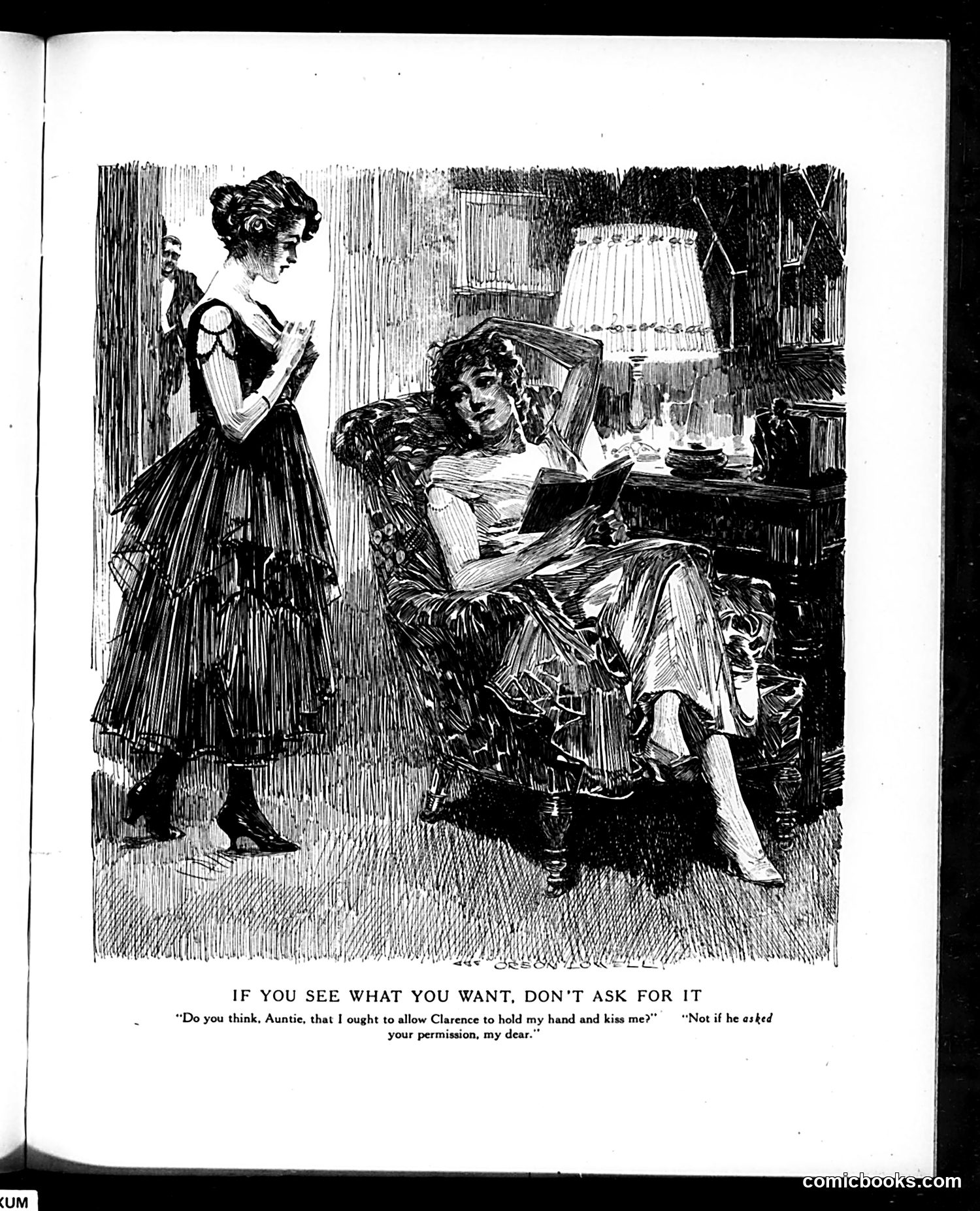
This cartoon satirizes early 20th-century courtship etiquette and female autonomy. A young woman (presumably the niece) asks her aunt for permission regarding physical affection with a suitor named Clarence. The aunt's response—that she shouldn't allow it *if he asked permission*—is paradoxical and witty social commentary. The joke critiques the era's rigid romantic conventions: the aunt implies that proper courtship requires the man to act without explicit consent, yet seeking permission would demonstrate excessive politeness that undermines masculine confidence. The cartoon mocks both the formality of the period and the contradictory expectations placed on romantic interactions—damned if you ask, damned if you don't. It presents the absurdity of these unspoken social rules governing Victorian/Edwardian courtship behavior.
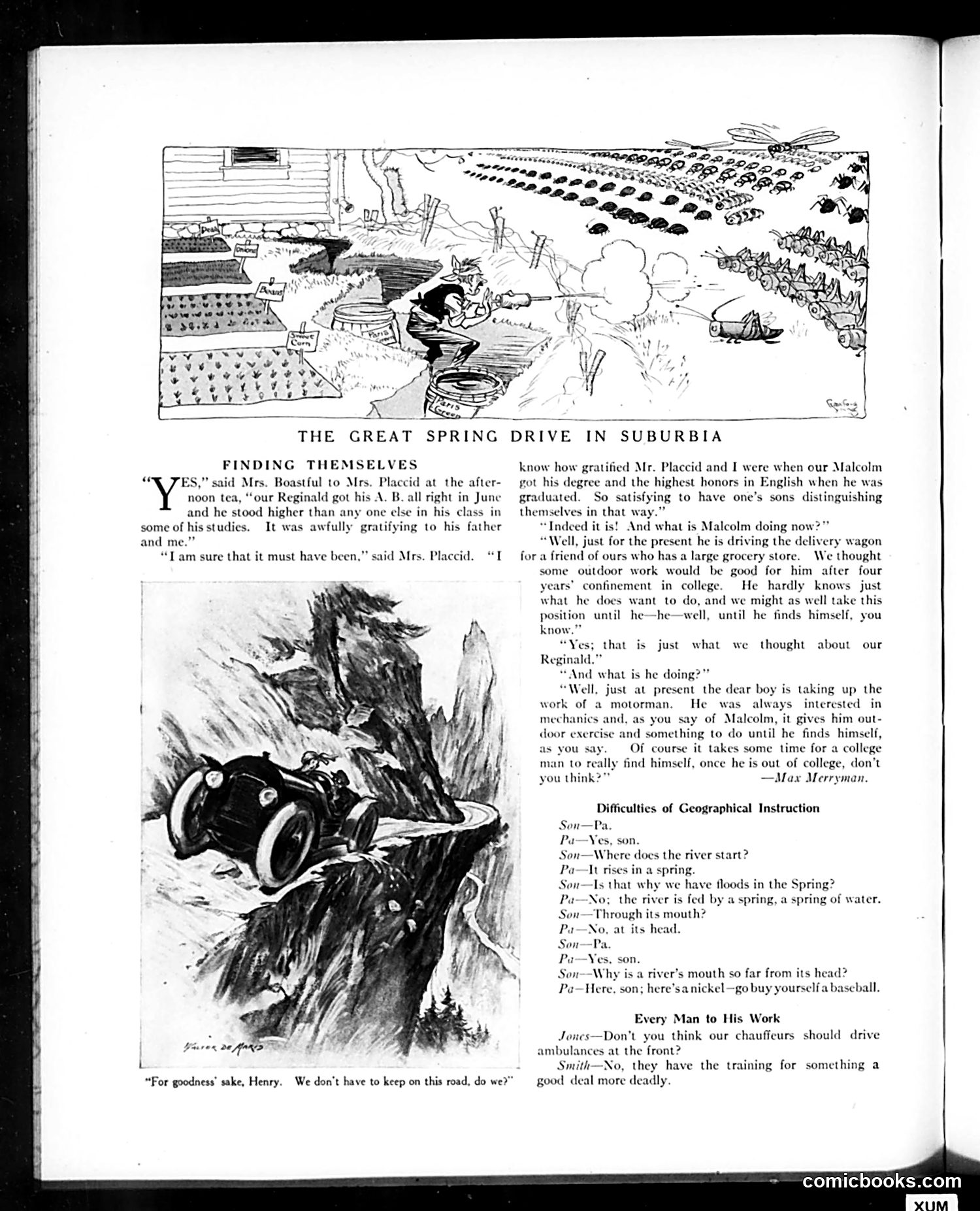
This page satirizes early 20th-century middle-class pretension about their educated sons. Two suburban matrons, Mrs. Boastful and Mrs. Placcid, compete over their sons' accomplishments at an afternoon tea. Mrs. Boastful brags that her Reginald earned top honors in his college class; Mrs. Placcid counters that her Malcolm is currently driving a delivery wagon—framing manual labor as character-building rather than failure. The satire targets parents' self-delusion: both women congratulate themselves on their sons' situations despite—or perhaps because of—the sons' apparent lack of direction. College graduates working as delivery drivers or motormen suggests economic uncertainty or aimlessness disguised as noble "finding themselves." The page's other brief sketches mock suburban life, parenting, and wartime assumptions. The caption "For goodness' sake, Henry. We don't have to keep on this road, do we?" remains unclear without additional context.
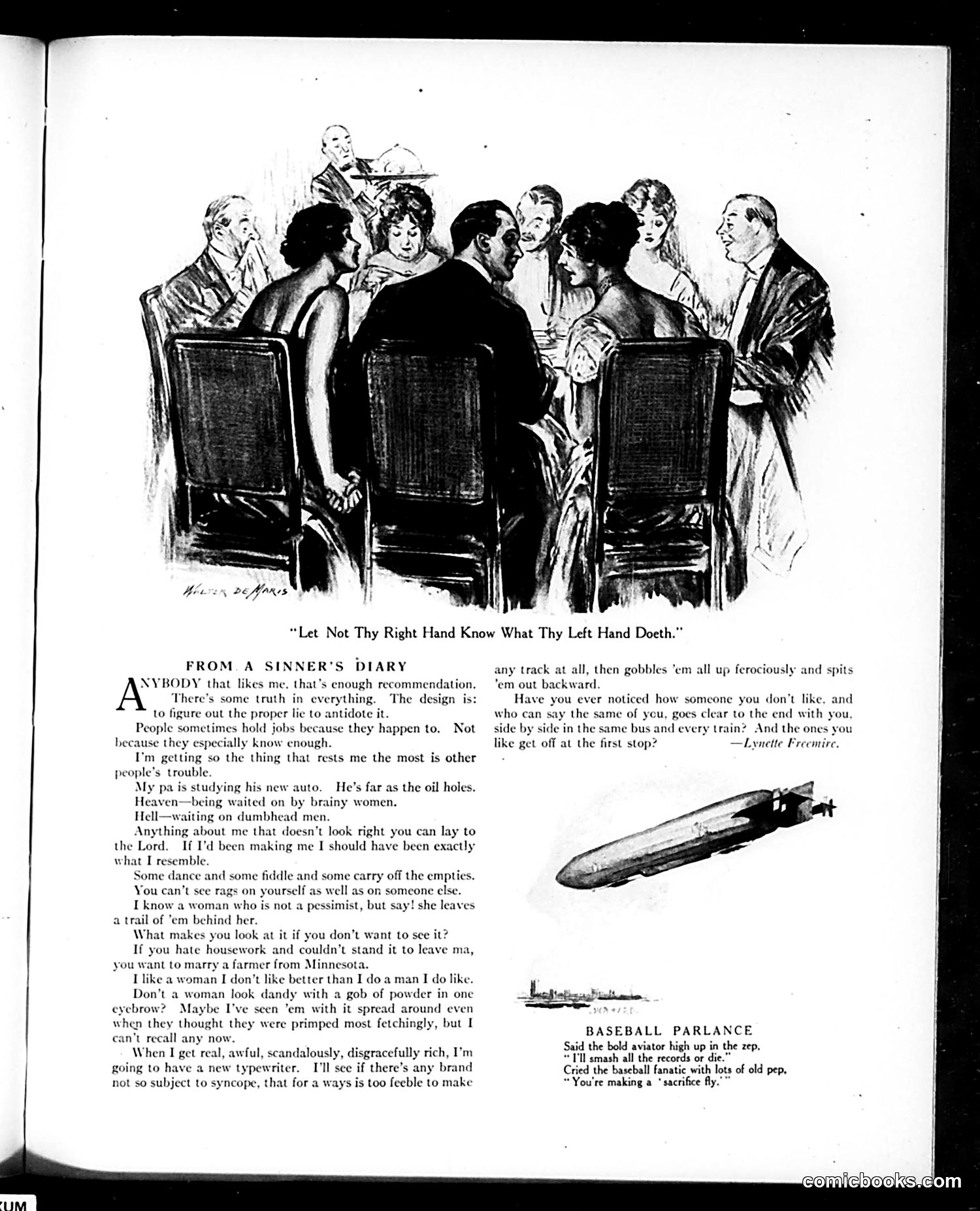
This page from *Judge* contains two distinct pieces: **"From a Sinner's Diary"** is a satirical monologue by "Lynette Freemire" offering cynical observations on human nature and society. The accompanying illustration shows a social gathering. The monologue mocks hypocrisy (the biblical title references doing good deeds secretly), incompetence in jobs, and social behaviors—particularly critiquing women's cosmetics and fashion choices. The tone is misanthropic but humorous, poking fun at universal human flaws rather than specific political targets. **"Baseball Parlance"** is a brief joke playing on double meaning: an aviator in a zeppelin boasts he'll break records or die; a baseball fan interprets this as a "sacrifice fly" (a baseball term for a specific type of out). It's simple wordplay humor, likely capitalizing on contemporary interest in aviation and baseball as popular American pastimes. The page appears to be primarily humor and social satire rather than political commentary.
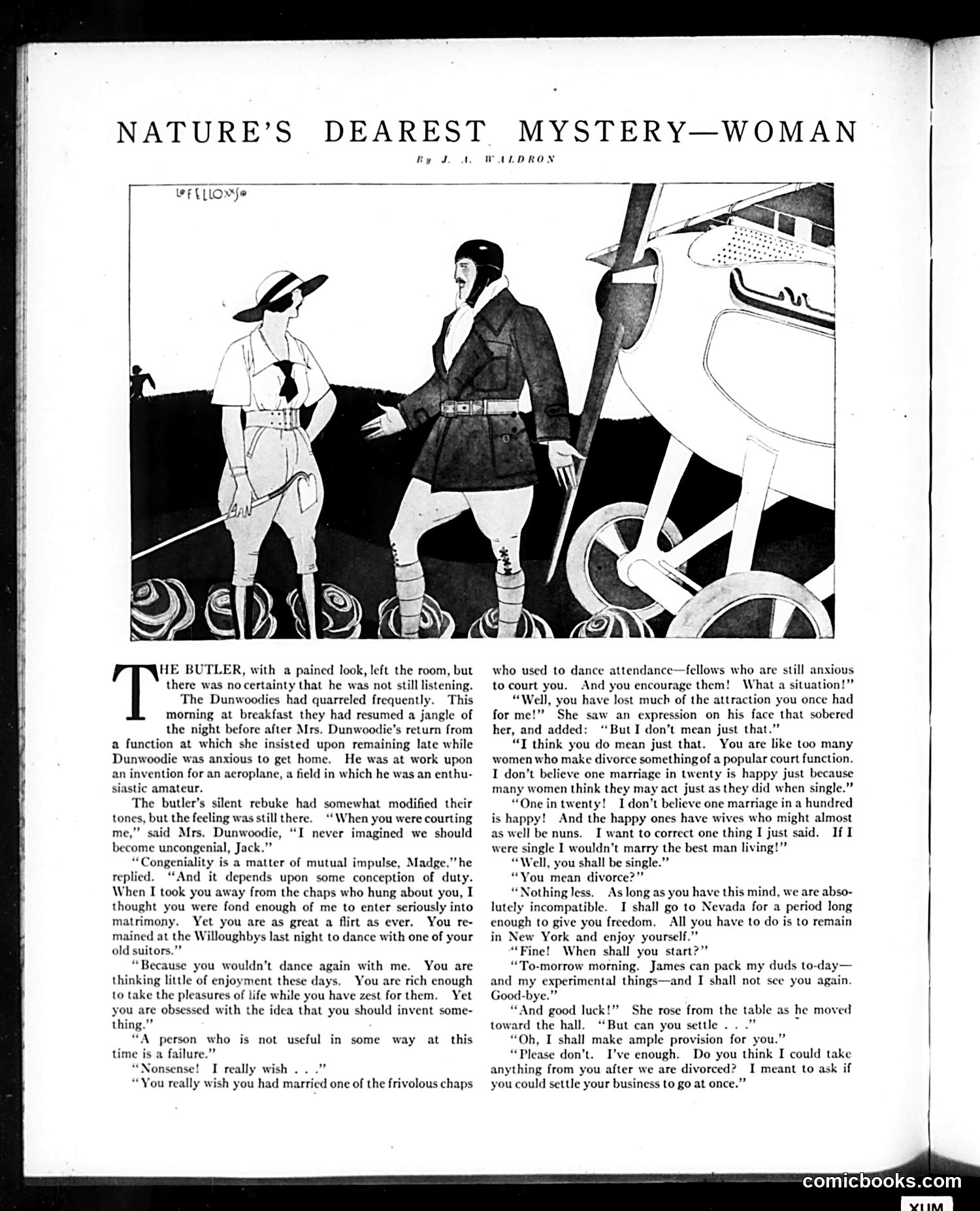
This satirical story-illustration mocks early 20th-century marriage dynamics and women's changing social roles. The cartoon depicts a quarreling couple: Jack Dunwoodie (an aviation enthusiast) and his wife Madge (depicted in fashionable attire). Their conflict centers on incompatible expectations—he wants a dutiful helpmeet supporting his inventions; she demands social pleasure and entertainment. The satire targets both parties: Madge is portrayed as a frivolous flirt unable to accept domestic sacrifice, while Jack is an obsessive workaholic indifferent to his wife's happiness. Their rapid pivot to divorce—via Nevada's famously permissive laws—satirizes how casually modern couples dissolve marriages. The title itself is ironic: the "mystery" is women's supposed emotional nature and their newfound willingness to abandon marriages for independence. The piece critiques the era's emerging divorce culture and women's demands for equality in marriage, reflecting anxieties about changing gender roles among Judge's satirical audience.
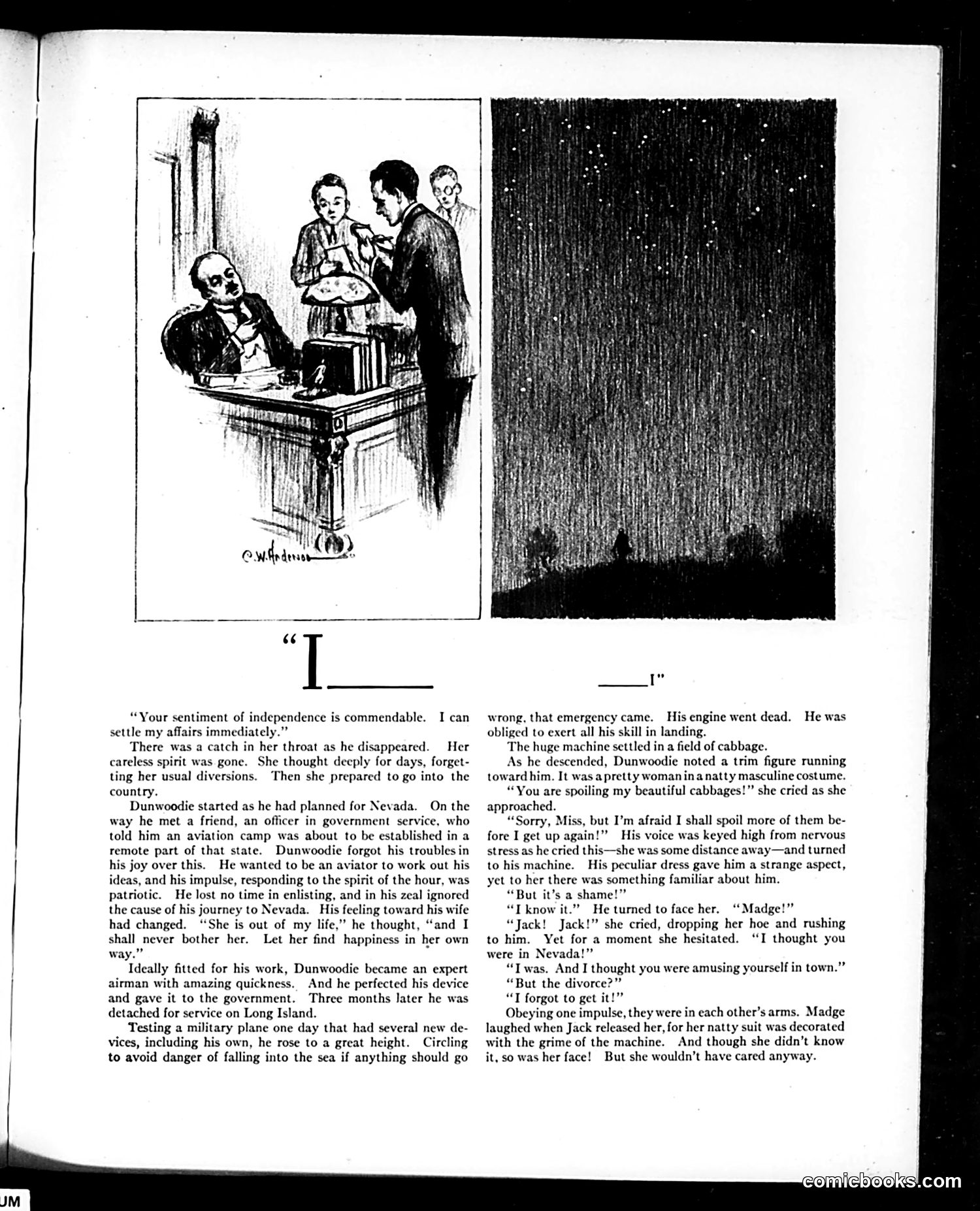
This appears to be a serialized romantic story rather than political satire. The narrative follows Dunwoodie, a man who enlists as a military aviator during what seems to be WWI era (references to "government service," aviation camps, and patriotic impulse suggest early 1900s-1910s). The cartoon illustration shows a domestic scene—likely depicting Dunwoodie's initial separation from his wife Madge. The story's plot involves marital discord (they planned a divorce), but both independently change course—he enlists instead of going to Nevada; she retreats to the country. They coincidentally reunite when his experimental military plane crashes in her vegetable field. The "satire" here is gentle comedy: the reunion occurs through chance amid cabbages, she's dressed as a working farmer, and both forget their divorce plans. It's sentimental humor about reconciliation, not political commentary. This reflects Judge magazine's mixed content of satire, fiction, and illustrations for middle-class readers.
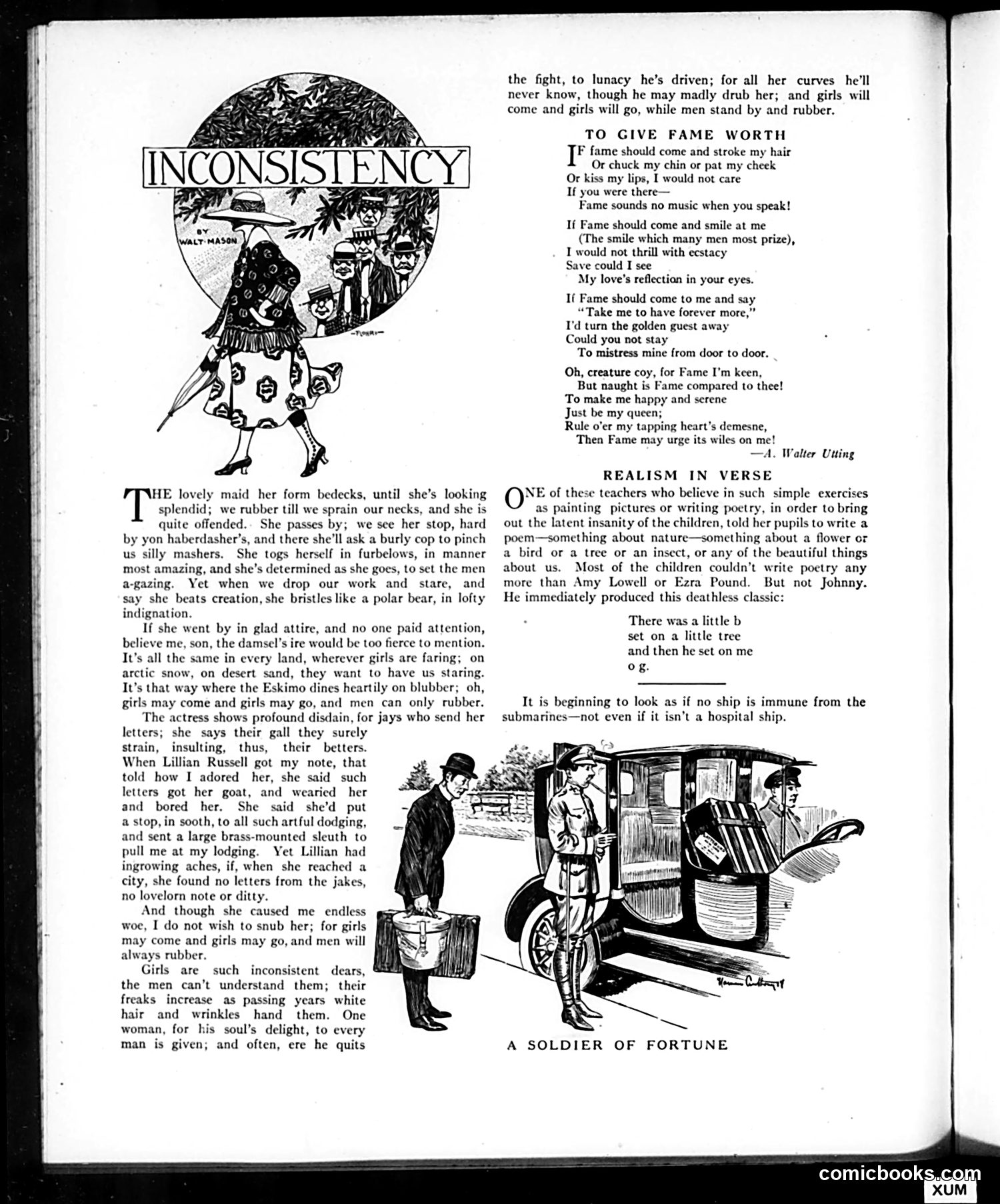
**"Inconsistency" Cartoon & Poem (Left)** This satirical piece critiques women's contradictory behavior around male attention. The illustrated woman dresses to be noticed ("set the men a-gazing") yet expresses outrage when men look ("bristles like a polar bear"). The poem mocks this paradox across all cultures and social classes, culminating in the refrain that "girls may come and girls may go, and men will always rubber" (stare). The reference to actress Lillian Russell illustrates the point: she rejected fan letters as presumptuous yet suffered when receiving none. The satire targets female inconsistency as universal and maddening to men. **"To Give Fame Worth" Poem (Center)** A sentimental romantic poem arguing love matters more than fame. The speaker would reject celebrity if his beloved weren't present to share it. **"Realism in Verse" (Right)** A humorous commentary on progressive education. A teacher assigns nature poetry; most children fail, but "Johnny" produces a crude, unintentionally obscene poem ("There was a little b...og") instead of genuine poetry. The satire mocks both the teaching method and children's inability to produce art.
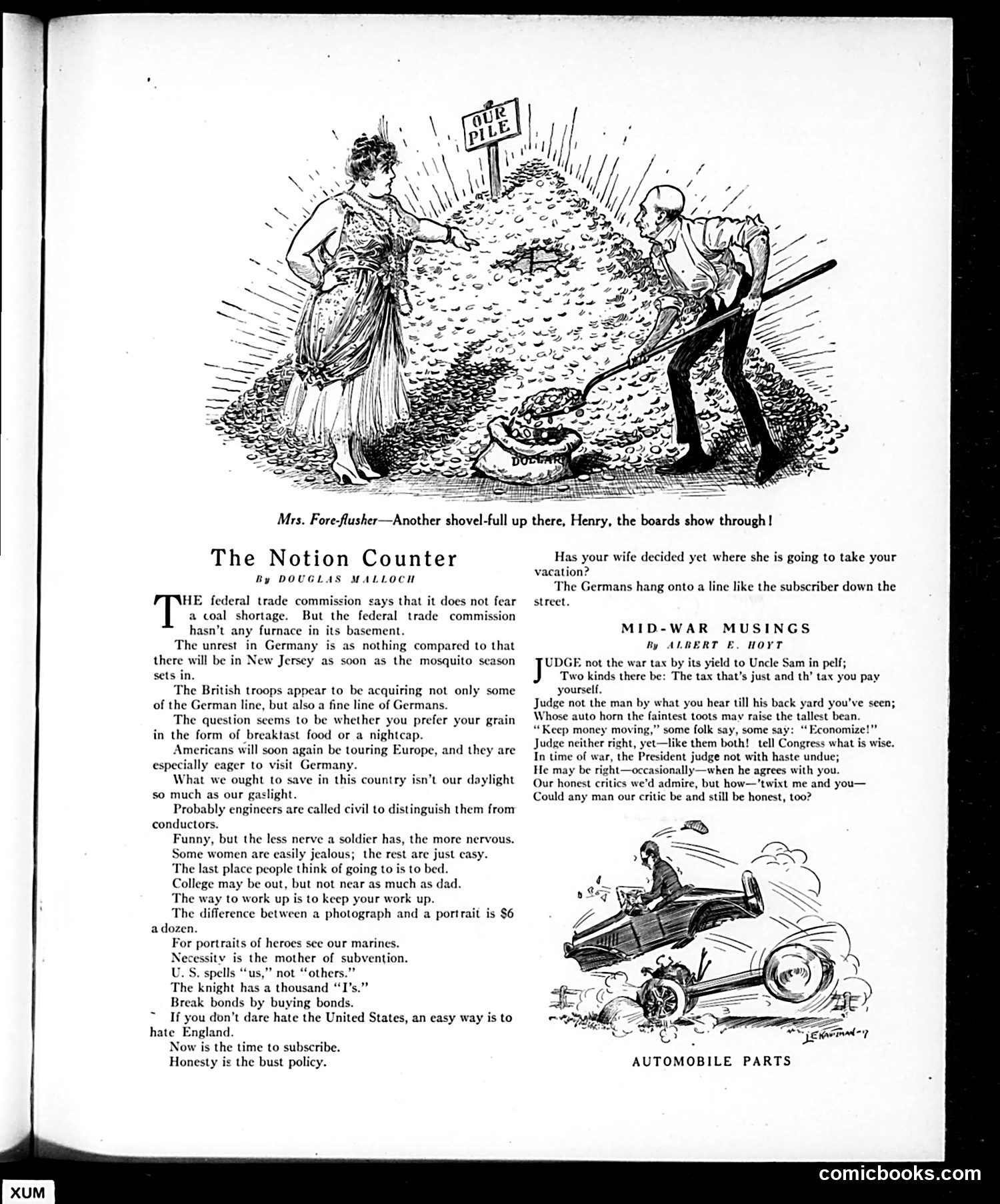
The top cartoon satirizes home-front wartime shortages. Mrs. Fore-flusher directs her husband Henry to shovel more material onto their roof ("the boards show through"), likely depicting makeshift repairs during WWI material rationing when proper supplies were scarce. "The Notion Counter" is a humor column of brief satirical observations about American life during wartime, touching on coal shortages, German military advances, tourism to Europe, daylight-saving measures, and subscription appeals. "Mid-War Musings" offers ironic verse advice about not judging the war effort, military policy, or patriotic criticism too harshly—suggesting that confident judgment about complex wartime matters is difficult. The repeated caution against hasty judgment implies many Americans held strong opinions despite limited understanding. The cartoon and text collectively reflect WWI-era American concerns: material shortages, military developments, and debate over wartime policy and patriotism.
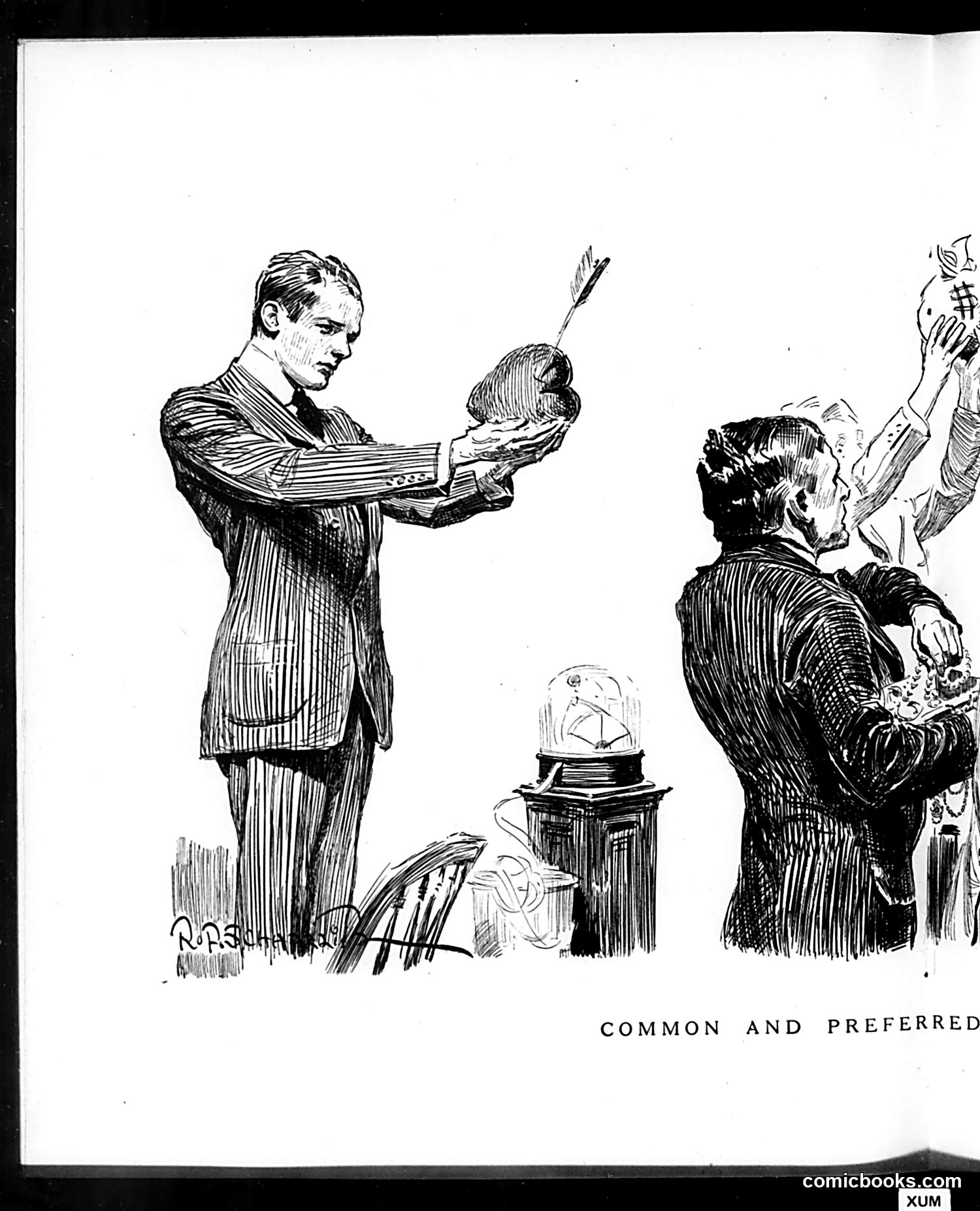
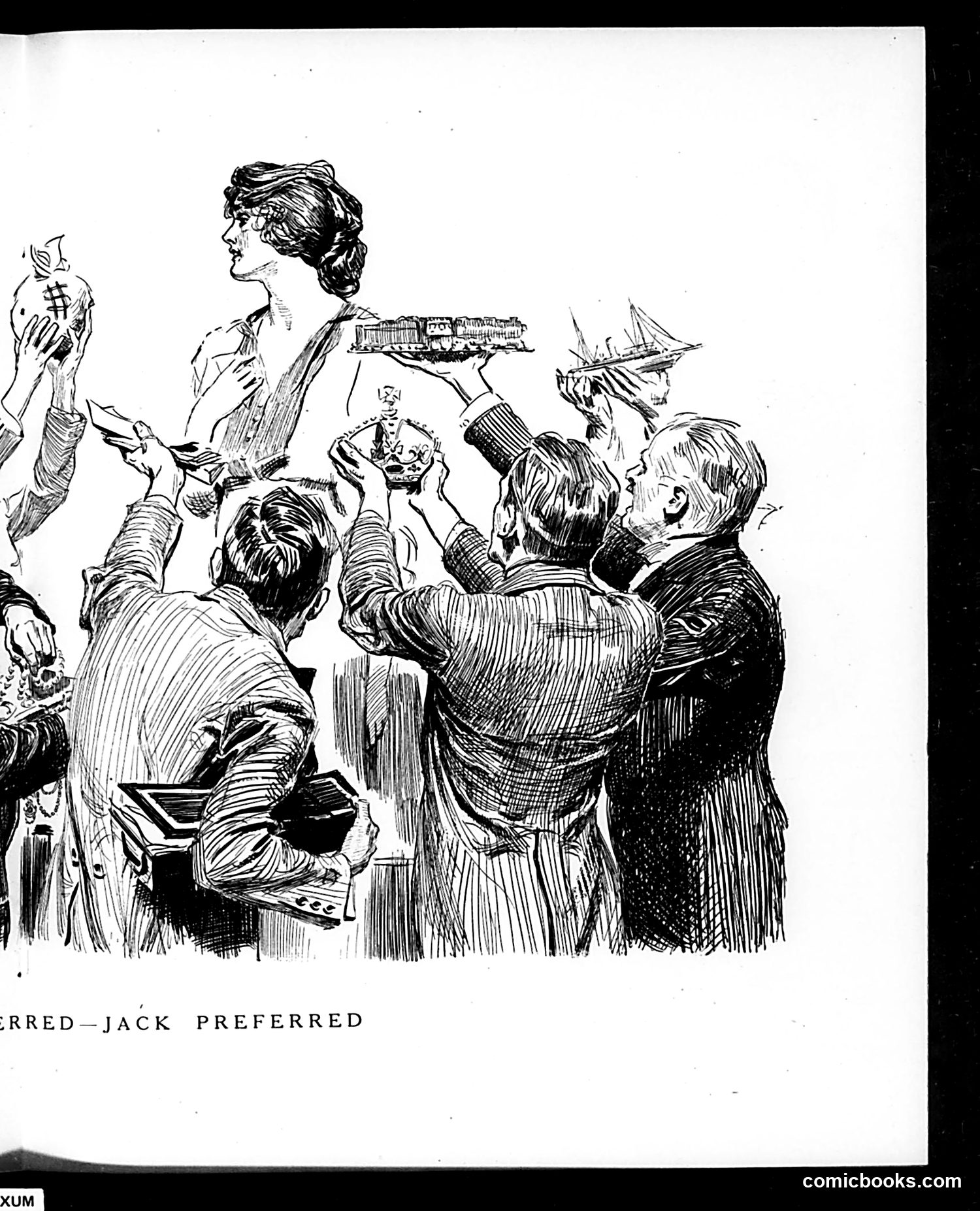
This political cartoon uses financial terminology as satire. The man on the left holds a heart with an arrow through it, displaying it to others—suggesting he's offering "common" stock (ordinary shares) to the public. The figures on the right appear to be wealthy or influential men examining this offering, presumably representing investors or the financial establishment. The satire likely critiques either: - Commercialization of human emotion or relationships - Stock market manipulation or fraudulent offerings disguised as legitimate investments - Class division between common people and financial elites The "preferred" versus "common" stock distinction suggests commentary on how different classes of people are valued differently in society or markets. The specific political/social context remains unclear without additional historical information about *Judge* magazine's publication date.
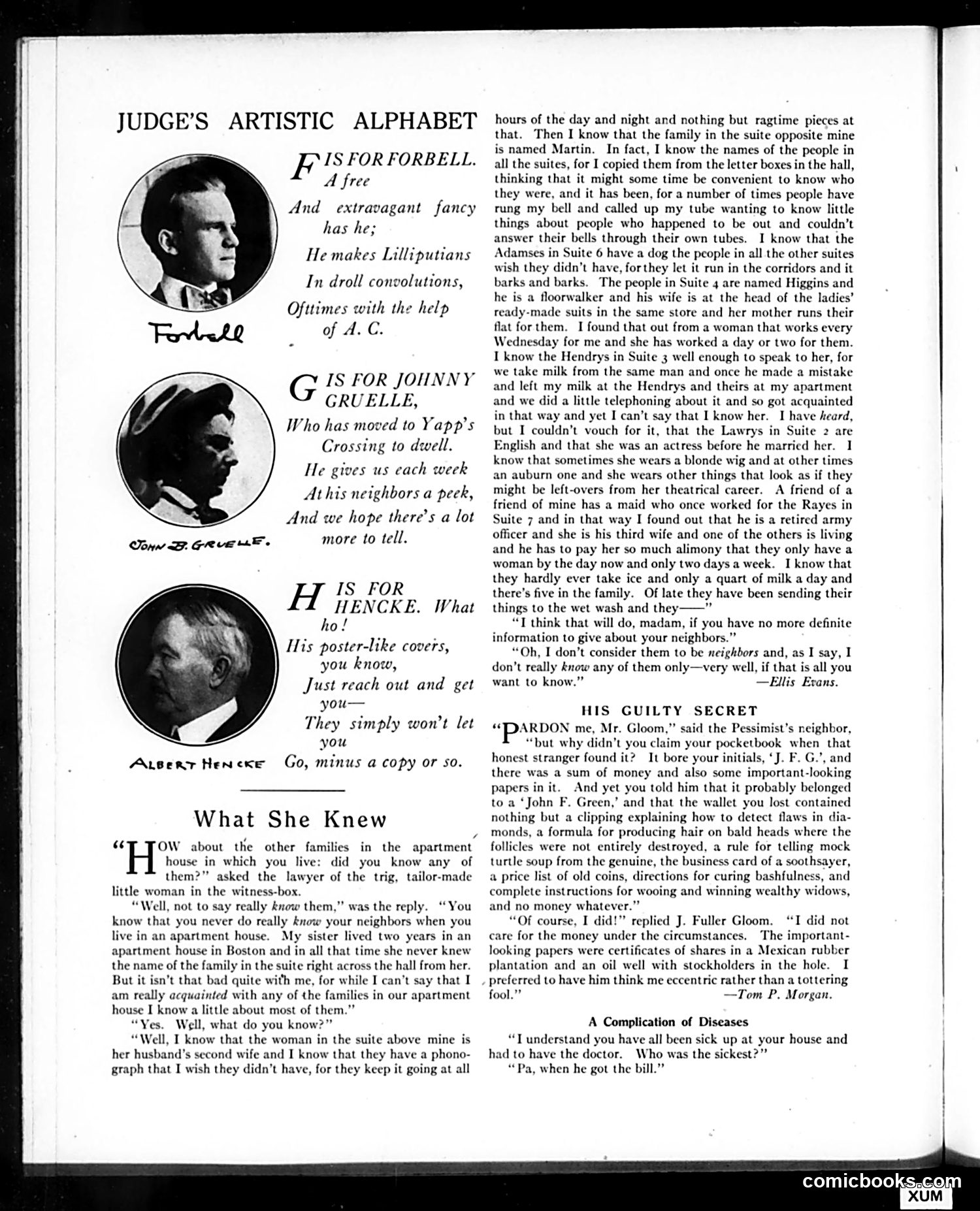
This page features Judge's "Artistic Alphabet," showcasing three cartoonists: Forbell, Johnny Gruelle, and Albert Hencke. The accompanying caricatures and verses humorously characterize their artistic styles—Forbell's intricate miniatures, Gruelle's weekly neighborhood sketches, and Hencke's commanding poster designs. The main story, "What She Knew," satirizes apartment-house gossip culture. A witness testifies about her apartment neighbors, claiming she "doesn't really know them" while proceeding to reveal extensive personal details about each suite's residents—their marital status, occupations, purchases, and financial troubles. The joke critiques both urban anonymity and hypocrisy: apartment dwellers maintain social distance yet obsessively gather and share private information about neighbors. The lawyer's interruption ("I think that will do, madam...") punctures the woman's oblivious rambling, highlighting how gossipers lack self-awareness about their invasiveness.
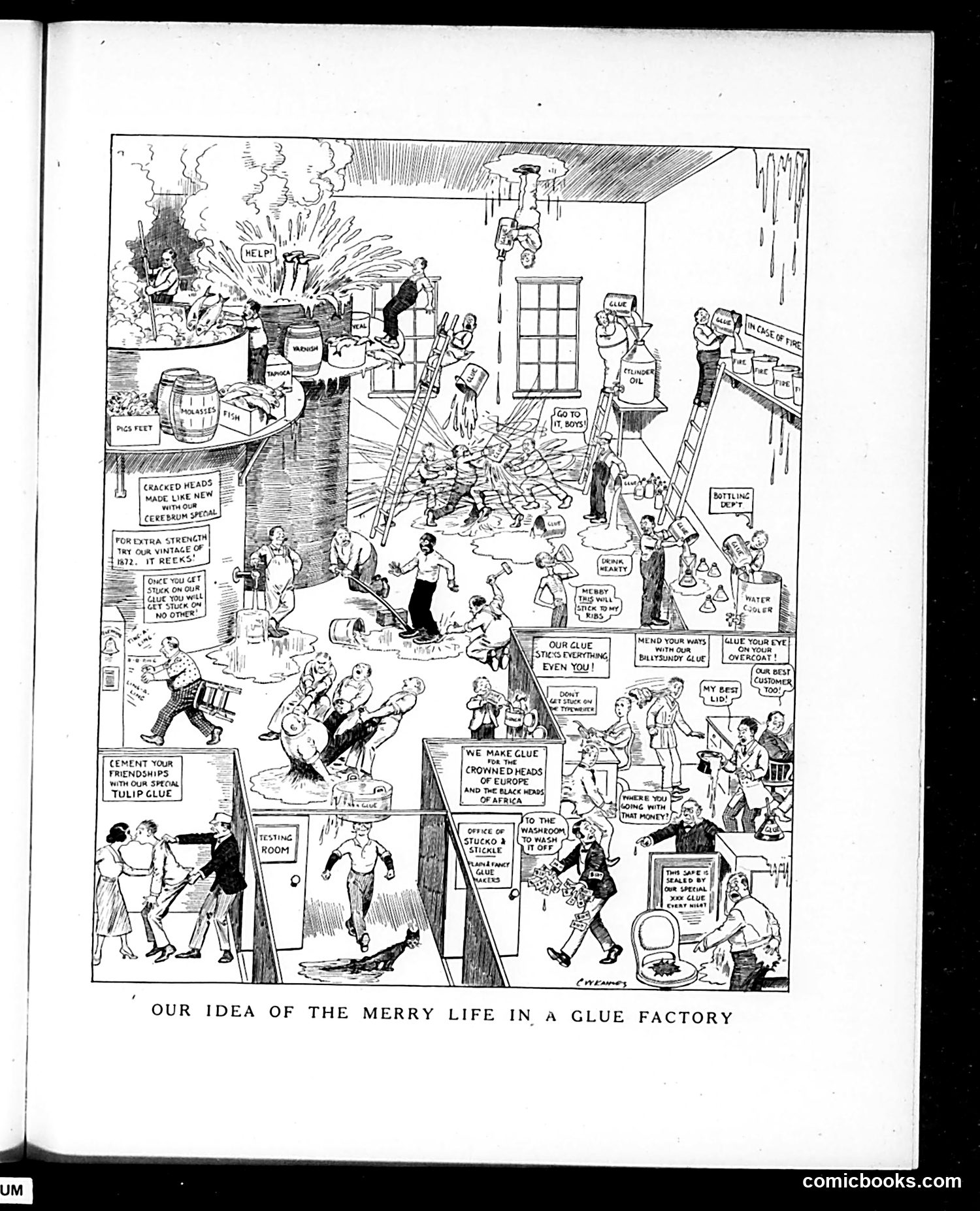
This is a satirical cartoon depicting a chaotic glue factory as absurdly "merry." The humor works through exaggerated contrast: the subtitle promises merriment, but the image shows disaster—explosions, fires, people being struck and injured, collapsing structures, and general pandemonium. The scattered text labels mock the factory's supposed products and uses: "glue for crowned heads of Europe," "cement your friendships," "mend your wars," "bottling dept," "water cooler." These labels humorously suggest that glue could solve social and political problems (mending wars, cementing friendships), which is obviously absurd. The satire targets both industrial labor conditions of the era and the pretentious marketing claims of manufacturers. By presenting catastrophic working conditions as "merry," the cartoon critiques how factories advertised themselves while workers faced genuine danger. It's a darkly comic indictment of industrial-age labor and corporate rhetoric.
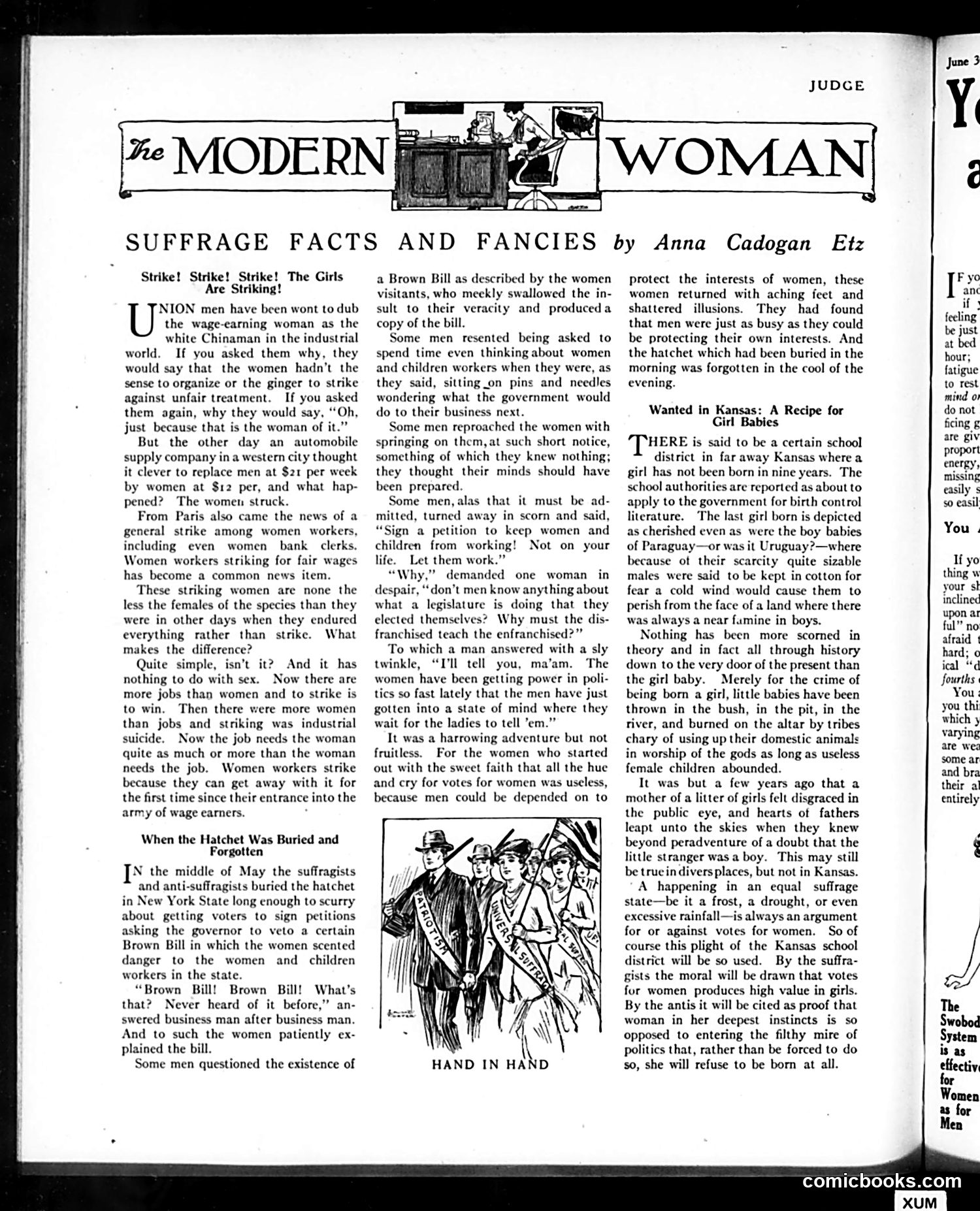
This 1910s-era satirical article by Anna Cadogan Etz addresses women's labor activism and suffrage through three connected pieces. **"Strike! Strike! The Girls Are Striking!"** mocks male dismissal of women workers as incapable of organizing. The piece argues women *have* struck successfully—contradicting claims they lack "ginger"—and explains the shift: women now strike because labor demand favors them, making strikes winnable rather than suicidal. **"When the Hatchet Was Buried and Forgotten"** satirizes male indifference to labor protections. Female suffragists and anti-suffragists temporarily unified to petition against a "Brown Bill" affecting women and child workers. Men repeatedly claimed ignorance, dismissed the issue, or refused to support women's labor rights—revealing that men only protect their *own* interests, not women's. The irony: women petitioned the very men who claim to protect them. **The cartoon "Hand in Hand"** (accompanying text) appears to visualize women's political alliance. The article's point: men's professed paternalism is hollow; women's political engagement is necessity, not choice.
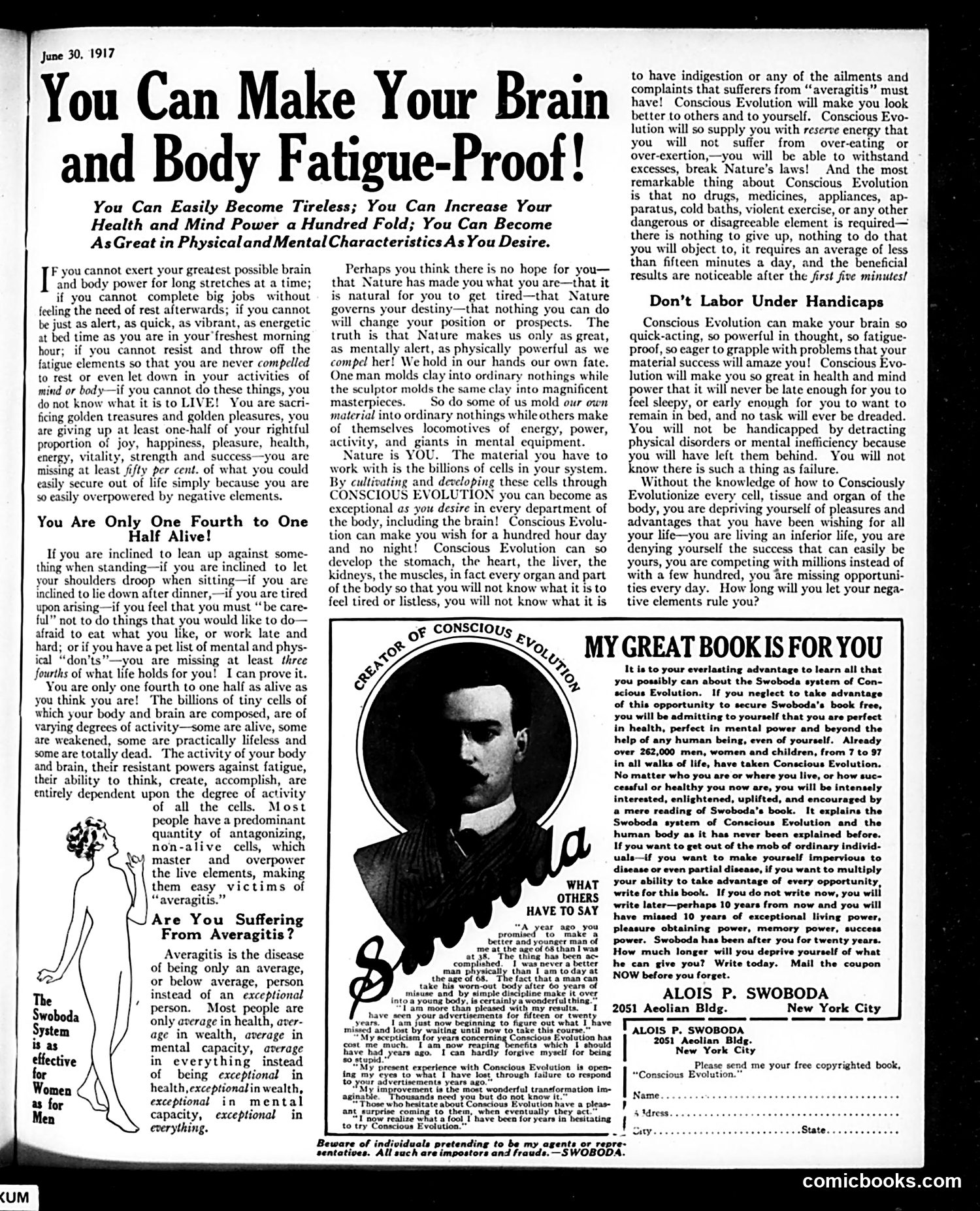
This page is primarily **advertising disguised as self-help editorial**. It promotes "Conscious Evolution," a pseudo-scientific health philosophy marketed by Alois P. Swoboda (visible in the advertisement at bottom right). The text invents a fictional disease called "averagitis"—laziness and mediocrity—claiming most people are "only one fourth to one half alive" due to "dead" cells. It promises readers can become "tireless" and achieve exceptional health through Swoboda's system. The cartoon shows a woman labeled "The Swoboda System" positioned as a miraculous cure. The accompanying testimonial (OCR'd in the text) references "worn-out body" and "simple discipline about eating." **Context**: Published June 1917, this reflects pre-FDA America's unregulated health-quack marketplace. The pseudo-scientific language about "cell activation" and "conscious evolution" was typical marketing for charlatan wellness schemes. The pitch exploits anxiety about fatigue and ordinariness—common concerns during WWI-era America—to sell an undefined self-improvement program.
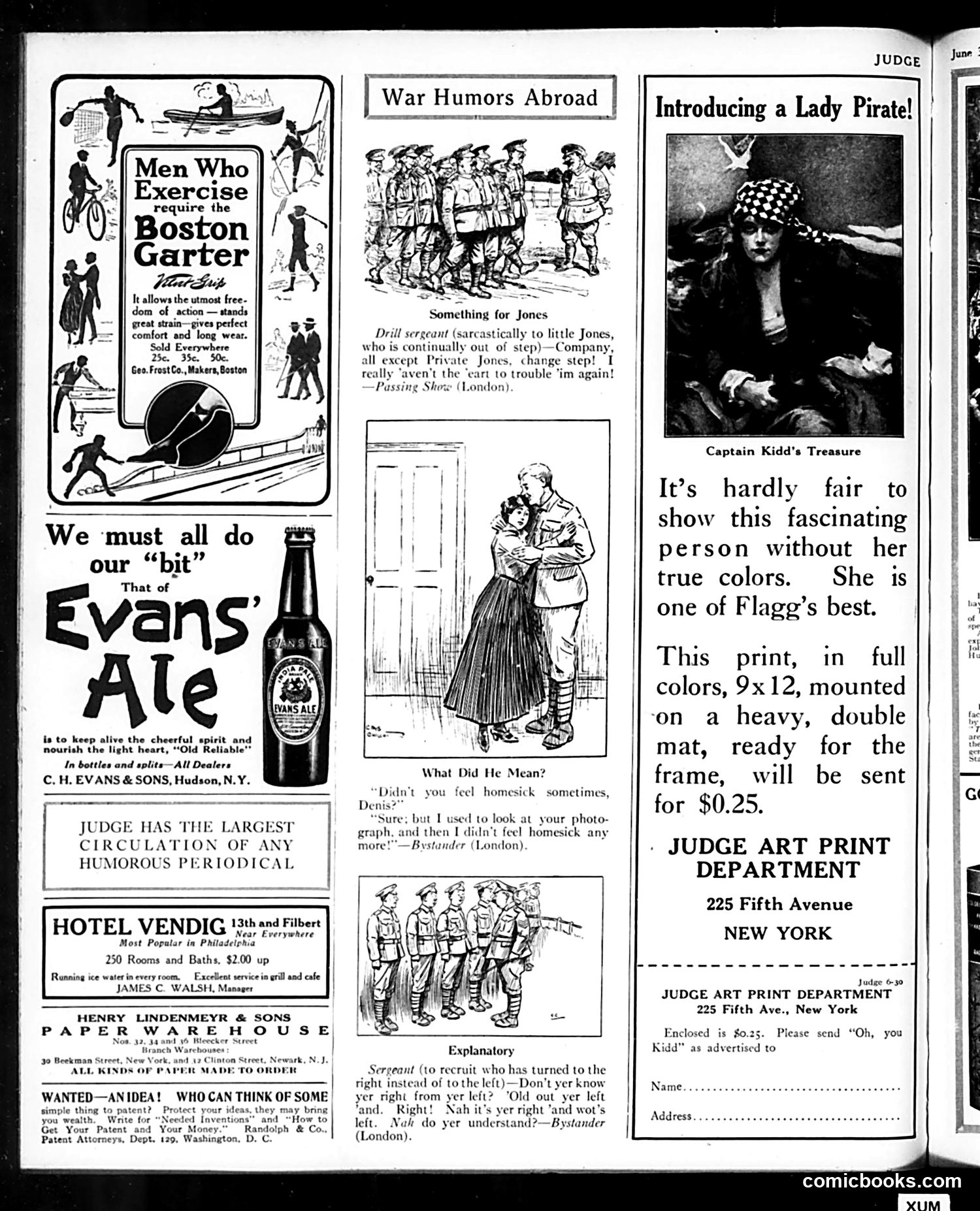
This page mixes advertisements with war-era humor cartoons, likely from WWI era (references to "doing our bit"). **War Humors Section:** Three brief jokes from British publications (*Passing Show*, *Bystander*) satirize military life and homesickness. They mock drill sergeants' exasperation with clumsy recruits (Private Jones repeatedly out of step) and a soldier who felt homesick until viewing his girlfriend's photograph—suggesting romantic distraction from duty. **Art Print Advertisement:** Promotes a colorized portrait titled "Captain Kidd's Treasure," described as "one of Flagg's best"—likely referring to illustrator James Montgomery Flagg. The image shows a woman in checkered headwrap presented as a "lady pirate." The ad acknowledges the black-and-white reproduction doesn't do justice to "true colors," advertising the full-color print for $0.25. **Other Content:** Remainder is typical period advertising (Boston Garters, Evans' Ale, hotels, patent attorneys). The page reflects American consumer culture and British wartime humor in circulation together.
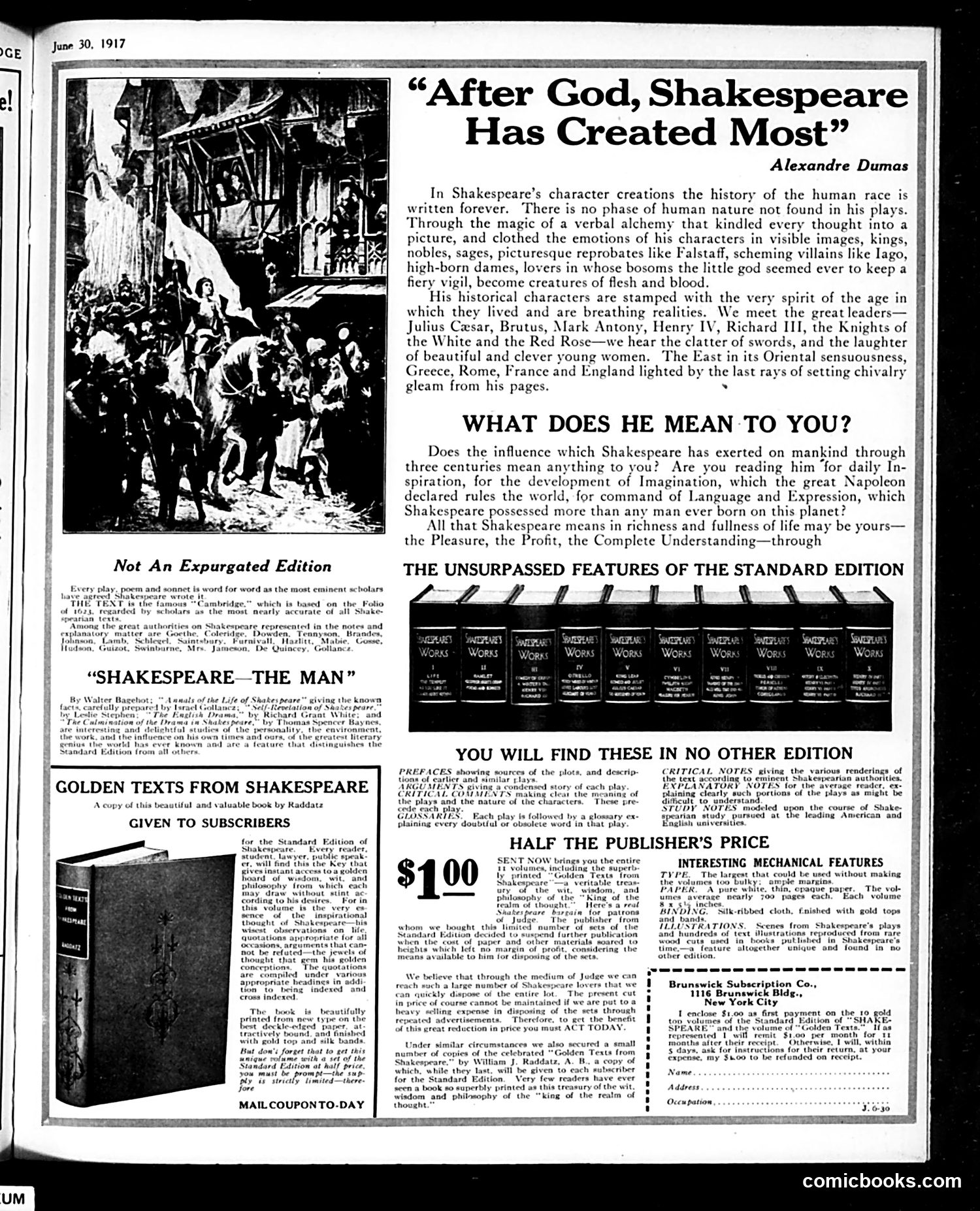
This page is primarily a **subscription advertisement** for a "Standard Edition" of Shakespeare's complete works, published by Brunswick Subscription Co. It's not a political cartoon or satire. The content opens with a quote attributed to Alexandre Dumas praising Shakespeare's character creation. The ad then uses this to pitch the edition's value to readers, asking "What Does He Mean to You?" and suggesting Shakespeare offers "Pleasure, Profit, Complete Understanding." The advertisement emphasizes the edition's unique features: critical notes, glossaries, illustrations, and high-quality binding at "half the publisher's price" ($1.00 per volume). A mail coupon at the bottom invites subscription payment. For modern readers, this reflects early 20th-century book marketing: Shakespeare was positioned as essential cultural/intellectual property, and subscription sales by mail were a standard direct marketing method before digital commerce.
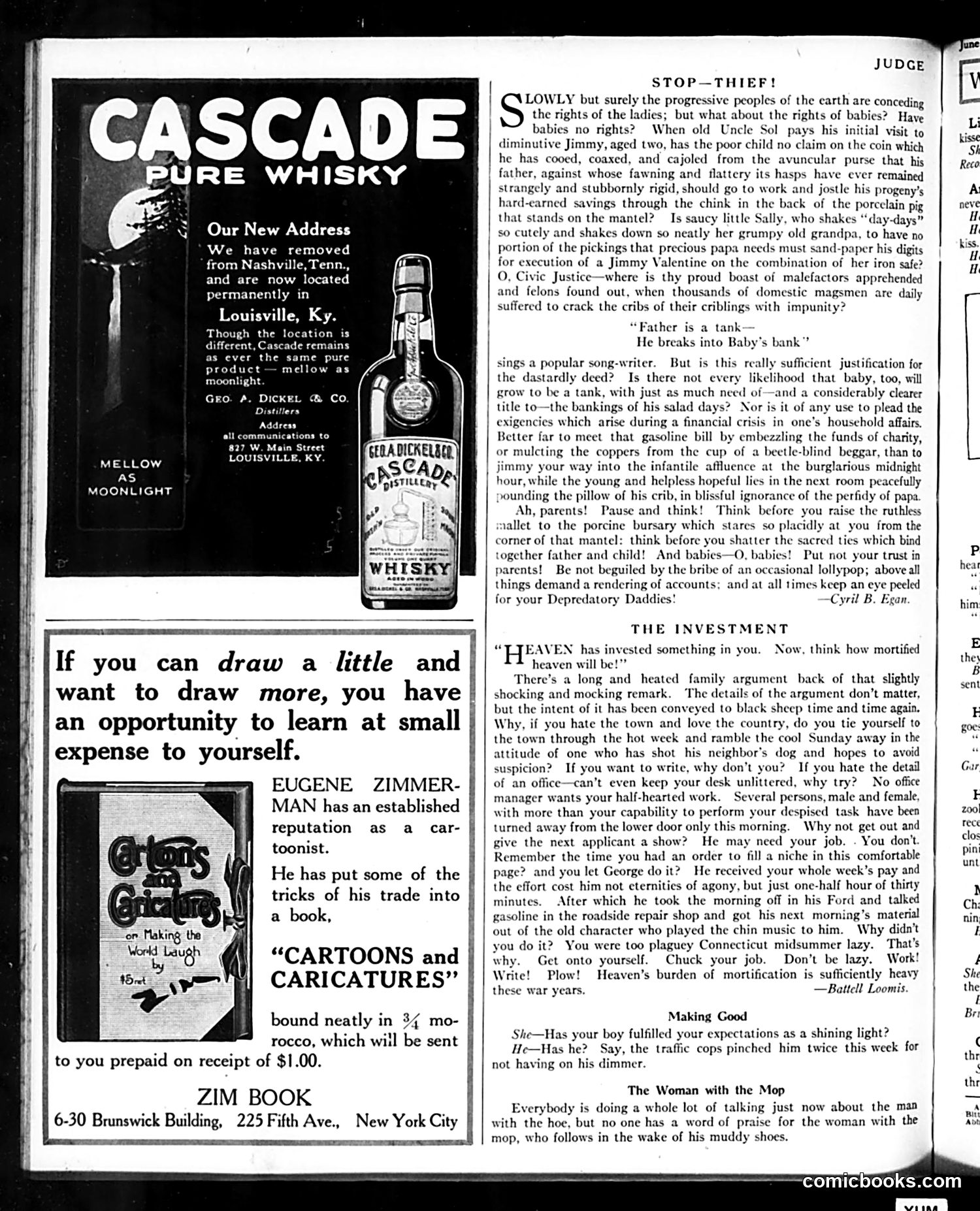
This page primarily contains **advertisements and satirical essays** rather than political cartoons. The main content is a lengthy satirical piece titled "STOP—THIEF!" by Cyril B. Egan, mocking parents who steal from their children's piggy banks and savings. Using mock-heroic language, it compares household theft from children to serious crimes, arguing that if society prosecutes criminals like "Jimmy Valentine" (a reference to O. Henry's gentleman burglar), parents who raid their kids' banks deserve equal moral condemnation. The satire critiques financial hypocrisy during economic hardship—suggesting parents justify theft through crisis, but this sets poor examples for children who will become "tanks" (thieves) themselves. Secondary content includes: - **Cascade Whisky advertisement** announcing relocation to Louisville, Kentucky - **Eugene Zimmerman cartoonist book advertisement** offering a how-to guide on cartooning for $1.00 The page reflects early 20th-century concerns about parental responsibility and financial morality during economic uncertainty.
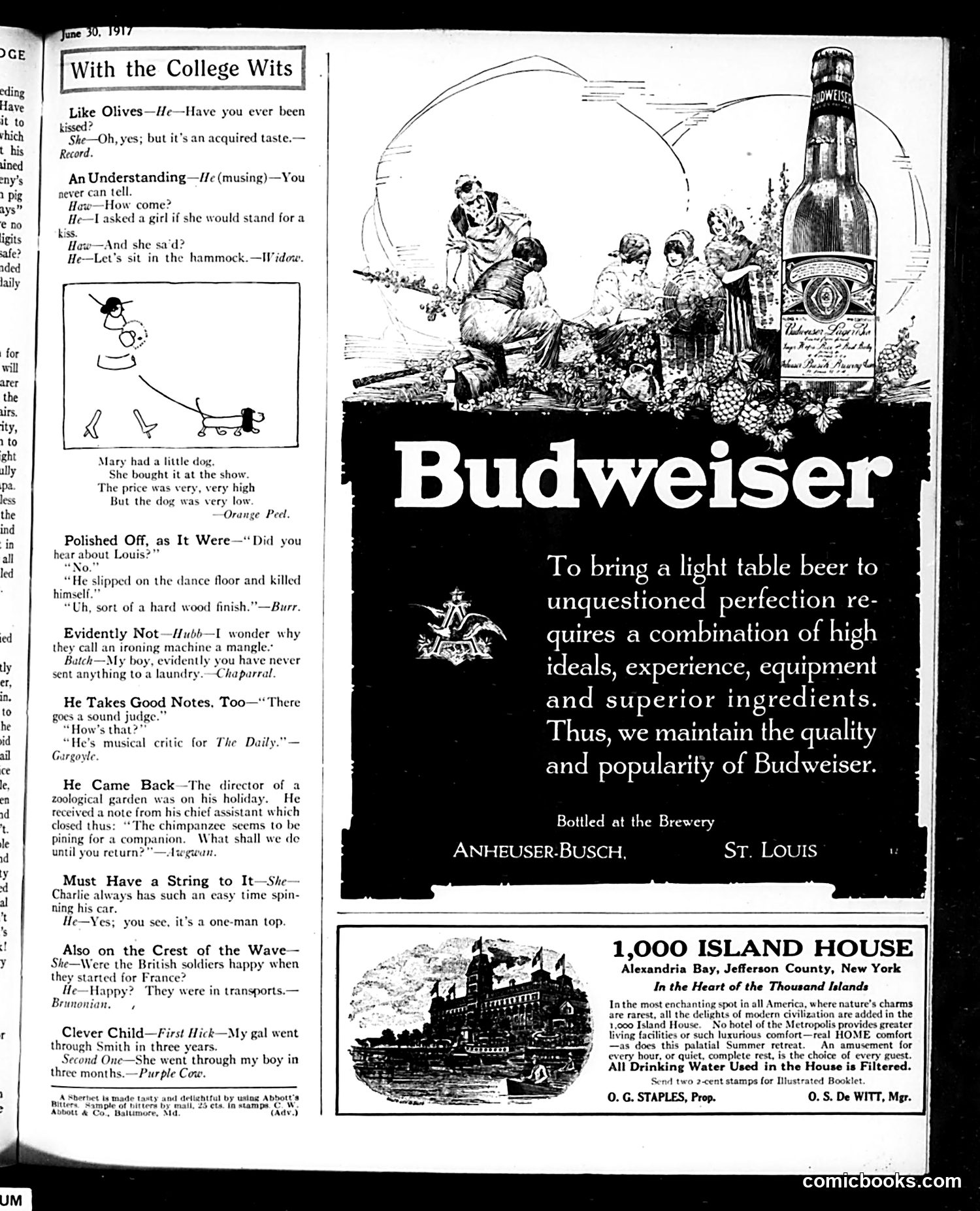
This page contains brief humorous quips typical of Judge's satirical humor column. The jokes target: **"Like Olives"**: A play on acquired taste—kissing is compared to olives, suggesting both require habituation. **"An Understanding"**: A young man asks a girl to stand for a kiss; she proposes sitting in a hammock instead—a joke about her literal interpretation and flirtation. **"Polished Off"**: A dark humor joke about someone named Louis dying from slipping on a dance floor, with wordplay on "hard wood finish." **"Evidently Not"** and others: Brief puns and observational humor about everyday situations (laundries, judges, zoos). The page is primarily **advertising**—two large ads for Budweiser beer and the 1,000 Island House resort dominate the space. These ads are notable for their period imagery and claims about quality ingredients and modern amenities. The college humor represents typical Judge content: sophisticated wordplay aimed at educated readers.
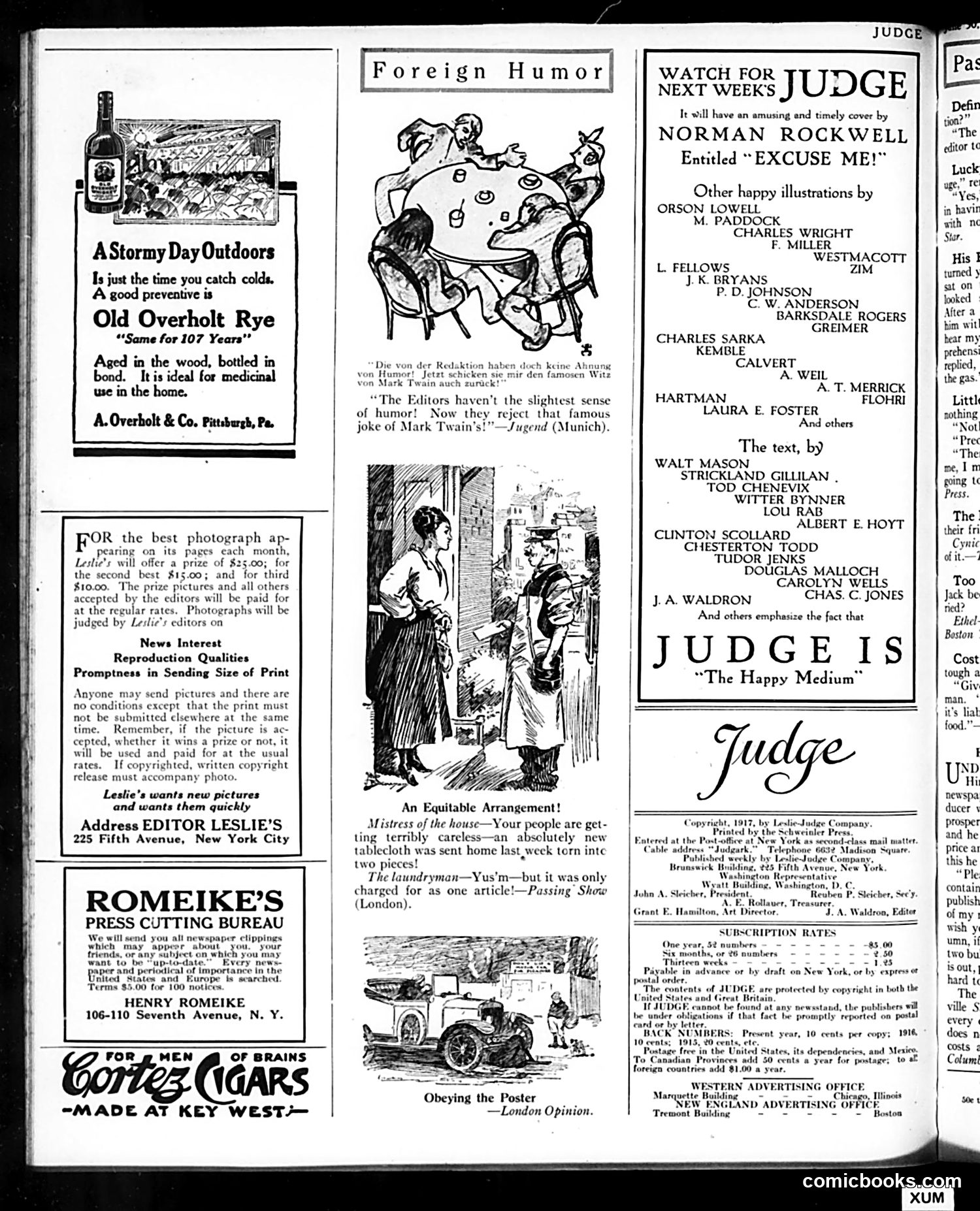
This cartoon depicts a landlady confronting a laundry service about a tablecloth damaged during washing. The laundryman's response—that he'll only charge for *one* ruined tablecloth instead of two—attempts to frame this as a fair compromise. The satire targets working-class dishonesty masked as reasonableness. The laundryman's logic is absurd: he damaged the item, yet presents charging the full price as generosity. The cartoon mocks both his transparently self-serving "arrangement" and implicitly critiques service workers who exploit their position over wealthy clients' property. This reflects early 20th-century class anxieties about domestic servants and service providers—stock characters in Judge's satirical repertoire. The joke assumes reader sympathy with the exasperated middle-class householder facing casual dishonesty from her inferiors.
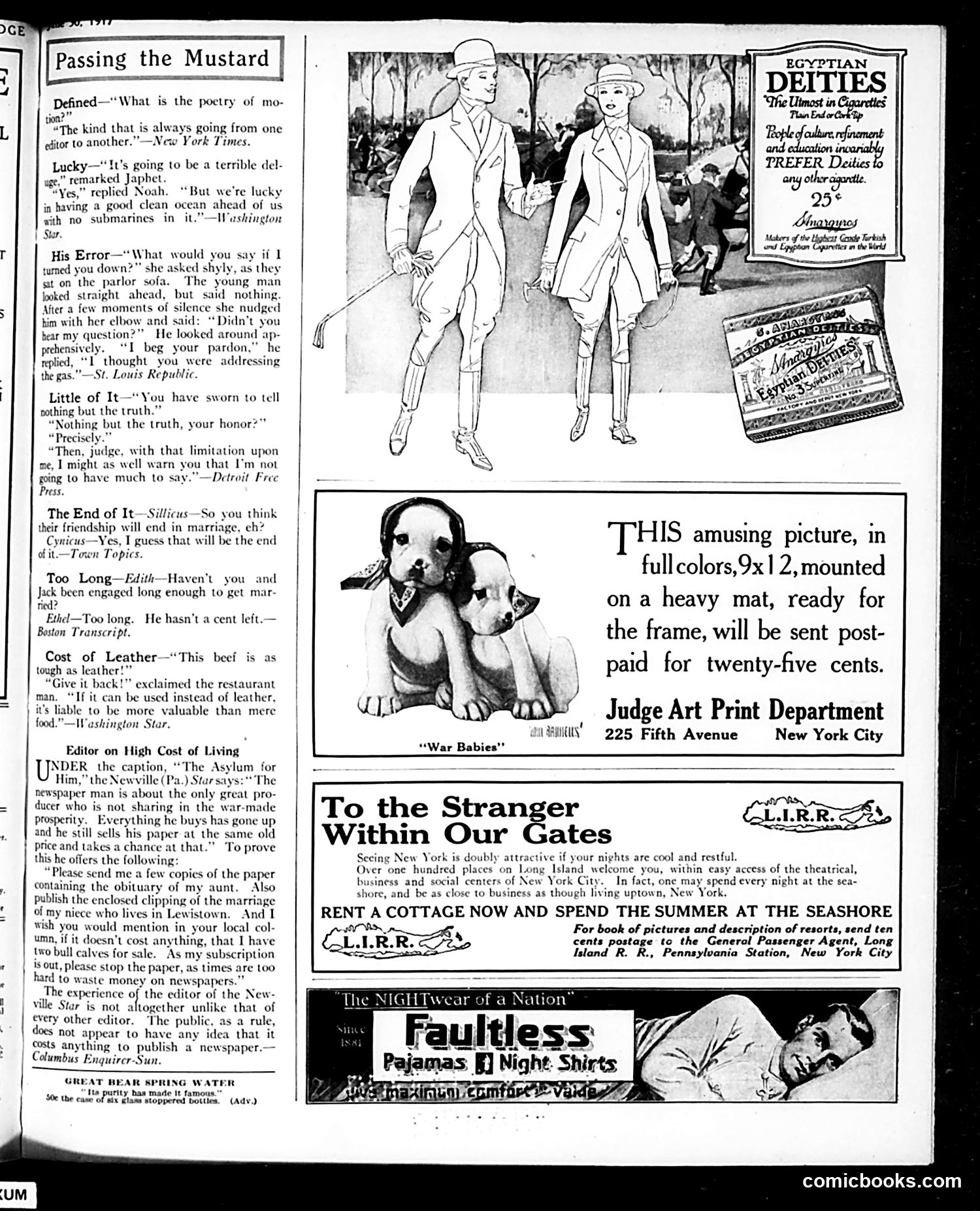
This is primarily a **humor/joke collection page** rather than political satire. The "Passing the Mustard" section features short comedic anecdotes from newspapers, playing on wordplay and misunderstandings: - **"His Error"**: A young man on a parlor sofa, asked a direct question, claims he thought the woman was addressing "the gas" (a joke about inattentiveness). - **"Little of It"**: A courtroom joke about a witness sworn to truth but warning he won't say much—playing on legal language. - **"The End of It"**: A quip that friendship "ends" in marriage (implying marriage ends friendship). The page mixes these brief satirical vignettes with **period advertisements** (Egyptian Deities cigarettes, Judge Art Prints, Faultless Pajamas, and travel promotions). An editor's commentary criticizes the newspaper industry's expectation that editors work for exposure rather than fair compensation. The humor reflects early-20th-century sensibilities about courtship, relationships, and professional grievances—nothing requiring specific historical context beyond understanding the social norms of the era.
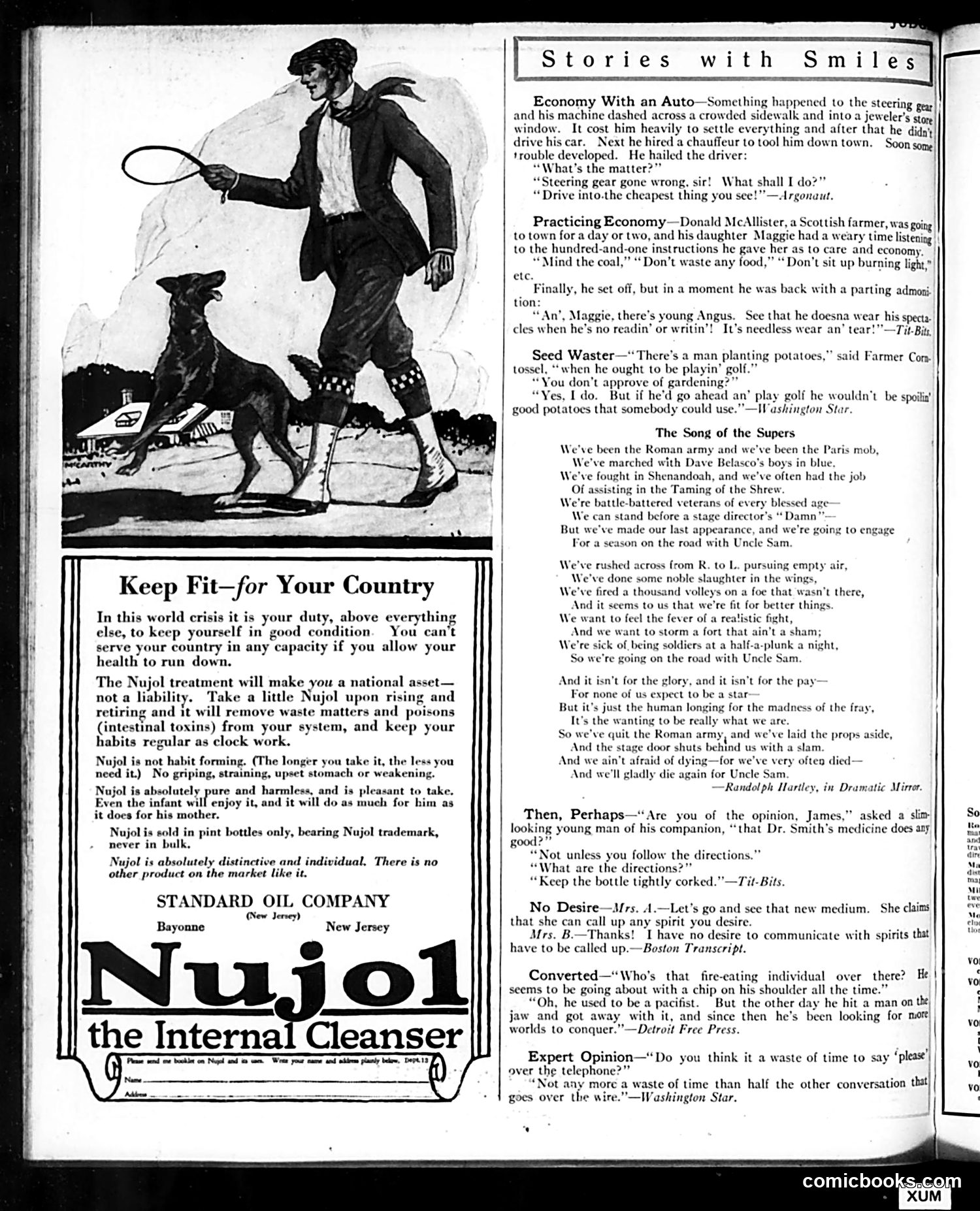
This page blends wartime propaganda with humor and advertising, likely from WWI era (references to "world crisis" and Uncle Sam recruitment). **Main Content:** The cartoon (top left) shows a man and dog in silhouette—humor content supporting the adjacent stories about economy and frugality. **The Stories with Smiles** section contains three brief jokes: one about a car crash causing financial ruin, another about a Scottish farmer's obsessive penny-pinching, and a third mocking a man gardening instead of golfing. **"The Song of the Supers"** is a patriotic poem by Randolph Hartley about theatrical extras ("supers") who've performed in productions (Dave Belasco was a famous producer) and are now volunteering for actual military service with "Uncle Sam" rather than fake stage combat. **The Nujol advertisement** uses patriotic duty language to sell laxative medicine as essential to keeping citizens healthy for national service—typical wartime marketing. The page's overall message: civic duty, frugality, and genuine sacrifice for country trump entertainment and comfort.

This is **not a political cartoon but a full-page advertisement** for the Automobile Blue Books—a commercial travel guide series published in 1917. The page uses the slogan "Re-discover America" to market these guidebooks as essential tools for automobile touring. The advertisement emphasizes safety and convenience: the Blue Books identify dangerous railroad crossings, unsafe roads, landmarks, and scenic detours, allowing drivers to travel confidently without relying on signs or directions from locals. The appeal reflects early 20th-century automobile culture—when car travel was still novel and infrastructure unreliable. By positioning these books as practical necessities (compared to a ship's compass), the publisher markets them as independence-enabling products for motorists exploring unfamiliar territory. The page includes a mail-in coupon and lists nine regional volumes covering different U.S. areas, priced at $3.00 each. There is no satire present—this is straightforward period advertising aimed at middle-class automobile owners.
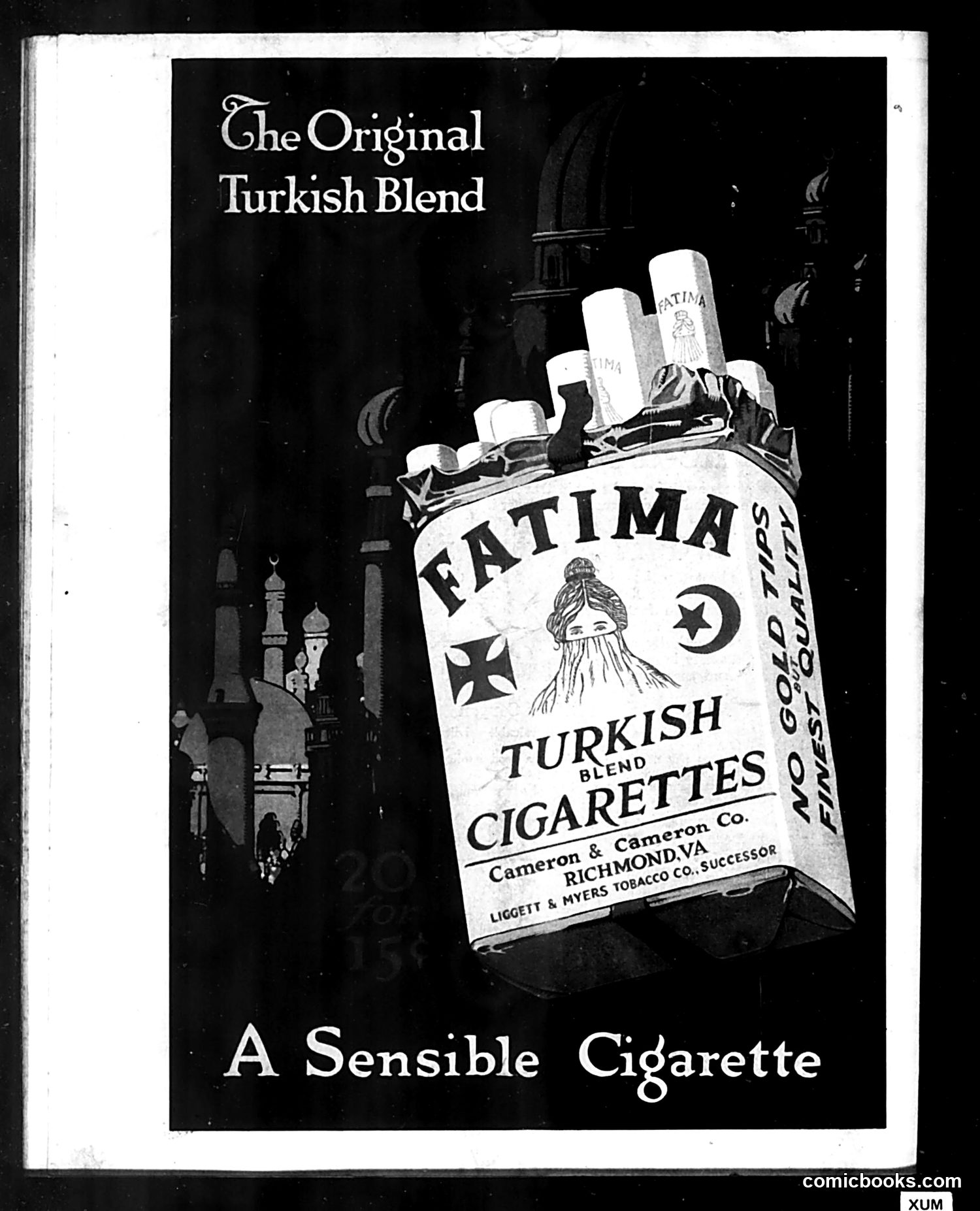
This is a vintage cigarette advertisement for Fatima brand Turkish blend cigarettes, manufactured by Cameron & Cameron (Richmond) under the Liggett & Myers Tobacco Company. The ad features the product package prominently displayed against a stylized silhouette of what appears to be a Turkish mosque or minaret, reinforcing the "Turkish" marketing angle. The package shows Ottoman imagery—a crescent moon and star symbol—designed to evoke exotic appeal. The tagline "A Sensible Cigarette" reflects early 20th-century marketing, when Turkish tobacco was marketed as a premium, refined choice compared to other blends. This advertisement exploits orientalist imagery and branding to position the product as sophisticated and desirable to American consumers. The dark, atmospheric composition emphasizes luxury and exclusivity.

This appears to be a back cover or mostly blank page from Judge magazine, with minimal visible content. The image is predominantly black with only scattered white marks and dots visible, along with a white border on the left edge and the "comicbooks.com" watermark in the bottom right corner. The OCR text provides no substantive content to analyze. Without clear cartoon imagery, legible text, or identifiable figures, I cannot reliably determine what political, social, or satirical commentary this page originally contained. The page quality or reproduction makes it impossible to discern specific caricatures, references, or jokes that would be necessary to explain the content to a modern reader.