
Judge, 1917-06-30 · page 12 of 29
Judge — June 30, 1917 — page 12: what you’re looking at
What you’re looking at
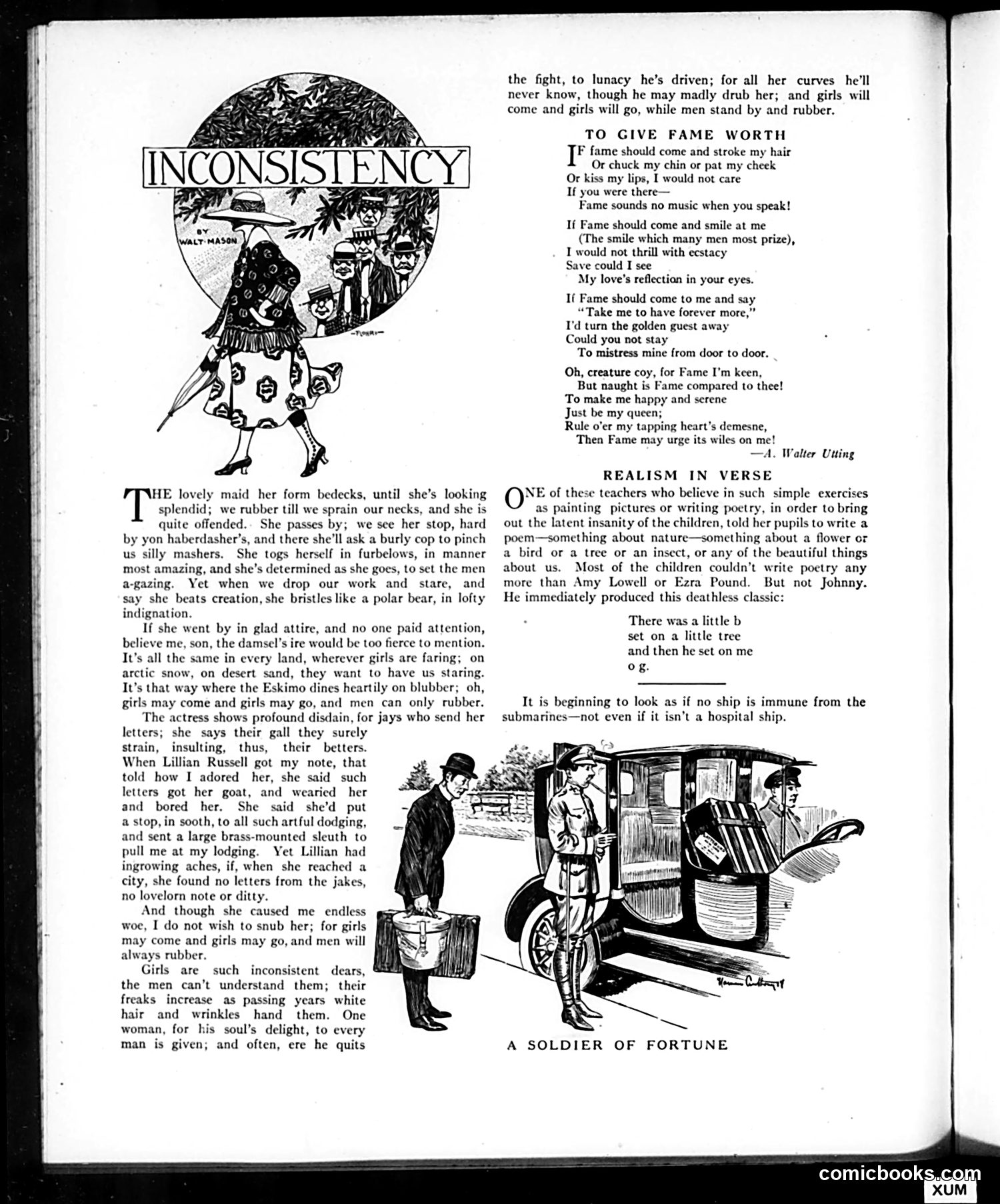
**"Inconsistency" Cartoon & Poem (Left)** This satirical piece critiques women's contradictory behavior around male attention. The illustrated woman dresses to be noticed ("set the men a-gazing") yet expresses outrage when men look ("bristles like a polar bear"). The poem mocks this paradox across all cultures and social classes, culminating in the refrain that "girls may come and girls may go, and men will always rubber" (stare). The reference to actress Lillian Russell illustrates the point: she rejected fan letters as presumptuous yet suffered when receiving none. The satire targets female inconsistency as universal and maddening to men. **"To Give Fame Worth" Poem (Center)** A sentimental romantic poem arguing love matters more than fame. The speaker would reject celebrity if his beloved weren't present to share it. **"Realism in Verse" (Right)** A humorous commentary on progressive education. A teacher assigns nature poetry; most children fail, but "Johnny" produces a crude, unintentionally obscene poem ("There was a little b...og") instead of genuine poetry. The satire mocks both the teaching method and children's inability to produce art.
📄 Transcribed text from this page (OCR, searchable)
Machine-transcribed from the original scan — historical spelling and the odd misread are preserved.
HE lovely maid her form bedecks, until she’s looking splendid; we rubber till we sprain our necks, and she is quite offended.. She passes by; we see her stop, hard by yon haberdasher’s, and there she'll ask a burly cop to pinch us silly mashers. She togs herself in furbelows, in manner most amazing, and she's determined as she goes, to set the men a-gazing. Yet when we drop our work and stare, and say she beats creation, she bristles like a polar bear, in lofty indignation. If she went by in glad attire, and no one paid attention, believe me, son, the damsel’s ire would be too fierce to mention. It’s all the same in every land, wherever girls are faring; on arctic snow, on desert sand, they want to have us staring. It’s that way where the Eskimo dines heartily on blubber; oh, girls may come and girls may go, and men can only rubber. The actress shows profound disdain, for jays who send her letters; she says their gall they surely Strain, insulting, thus, their betters. When Lillian Russell got my note, that told how I adored her, she said such letters got her goat, and wearied her and bored her. She said she’d put a stop, in sooth, to all such artful dodging, and sent a large brass-mounted sleuth to pull me at my lodging. Yet Lillian had ingrowing aches, if, when she reached a city, she found no letters from the jakes, no lovelorn note or ditty. And though she caused me endless woe, I do not wish to snub her; for girls may come and girls may go, and men will always rubber. Girls are such inconsistent dears, the men can’t understand them; their freaks increase as passing years white hair and wrinkles hand them. One woman, for his soul’s delight, to every man is given; and often, ere he quits the fight, to lunacy he’s driven; for all her curves he'll never know, though he may madly drub her; and girls will come and girls will go, while men stand by and rubber. TO GIVE FAME WORTH F fame should come and stroke my hair Or chuck my chin or pat my cheek Or kiss my lips, I would not care If you were there— Fame sounds no music when you speak! If Fame should come and smile at me (The smile which many men most prize), I would not thrill with ecstacy Save could I see My love's reflection in your eyes. If Fame should come to me and say “Take me to have forever more,” I'd turn the golden guest away Could you not stay To mistress mine from door to door. Oh, creature coy, for Fame I'm keen, But naught is Fame compared to thee! To make me happy and serene Just be my queen; Rule o'er my tapping heart’s demesne, Then Fame may urge its wiles on me! —A. Walter Utting REALISM IN VERSE NE of these teachers who believe in such simple exercises as painting pictures or writing poetry, in order to bring out the latent insanity of the children, told her pupils to write a poem—something about nature—something about a flower or a bird or a tree or an insect, or any of the beautiful things about us. Most of the children couldn’t write poetry any more than Amy Lowell or Ezra Pound. But not Johnny. He immediately produced this deathless classic: There was a little b set on a little tree and then he set on me og. It is beginning to look as if no ship is immune from the submarines—not even if it isn’t a hospital ship. AY - ~—_ A SOLDIER OF FORTUNE