
Judge, 1917-06-30 · page 16 of 29
Judge — June 30, 1917 — page 16: what you’re looking at
What you’re looking at
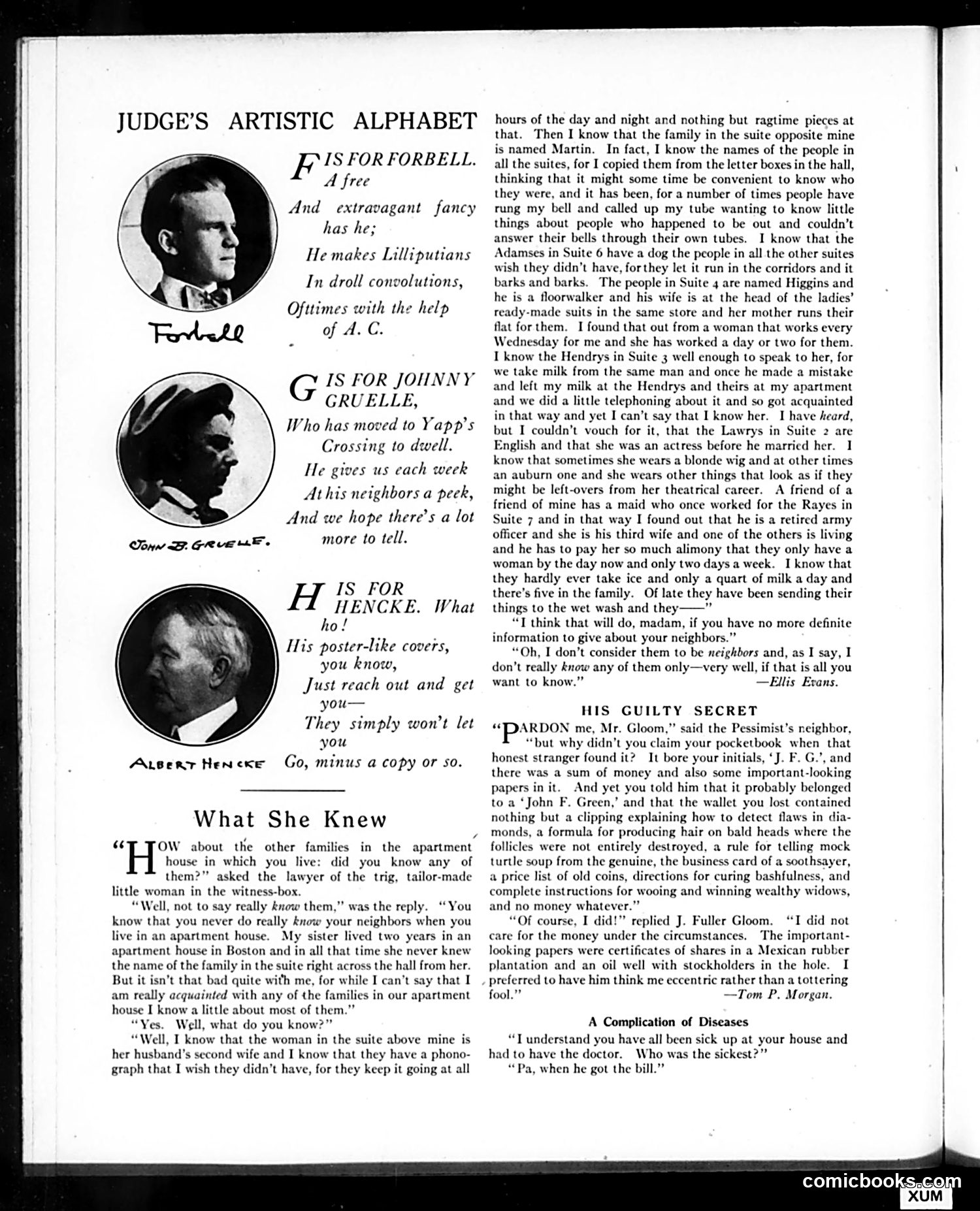
This page features Judge's "Artistic Alphabet," showcasing three cartoonists: Forbell, Johnny Gruelle, and Albert Hencke. The accompanying caricatures and verses humorously characterize their artistic styles—Forbell's intricate miniatures, Gruelle's weekly neighborhood sketches, and Hencke's commanding poster designs. The main story, "What She Knew," satirizes apartment-house gossip culture. A witness testifies about her apartment neighbors, claiming she "doesn't really know them" while proceeding to reveal extensive personal details about each suite's residents—their marital status, occupations, purchases, and financial troubles. The joke critiques both urban anonymity and hypocrisy: apartment dwellers maintain social distance yet obsessively gather and share private information about neighbors. The lawyer's interruption ("I think that will do, madam...") punctures the woman's oblivious rambling, highlighting how gossipers lack self-awareness about their invasiveness.
📄 Transcribed text from this page (OCR, searchable)
Machine-transcribed from the original scan — historical spelling and the odd misread are preserved.
JUDGE’S ARTISTIC ALPHABET IS FOR FORBELL. A free And extravagant fancy has he; He makes Lilliputians In droll convolutions, Ofttimes with the help of A.C. G IS FOR JOIN GRUELLE, Who has moved to Yapp’s Crossing to dwell. He gives us each week Athis neighbors a peek, And we hope there’s a lot more to tell. Conw BF. GRE LE IS FOR HENCKE. What ho! His poster-like covers, you know, Just reach out and get you— They simply won't let you Go, minus a copy or so. Aeert Hen cKe What She Knew ; “ OW about the other families in the apartment H house in which you 1 did you know any of them?” asked the lawyer of the trig, tailor-made little woman in the witness-box. “Well, not to say really know them,” was the reply. “You know that you never do really know your neighbors when you live in an apartment house. My sister lived two years in an apartment house in Boston and in all that time she never knew the name of the family in the suite right across the hall from her. But it isn’t that bad quite with me, for while I can’t say that I am really acquainted with any of the families in our apartment house I know a little about most of them.” “Yes. Well, what do you know?” “Well, I know that the woman in the suite above mine is her husband’s second wife and I know that they have a phono- graph that I wish they didn’t have, for they keep it going at all hours of the day and night and nothing but ragtime pieces at that. Then I know that the family in the suite opposite mine is named Martin. In fact, I know the names of the people in all the suites, for I copied them from the letter boxes in the hall, thinking that it might some time be convenient to know who they were, and it has been, for a number of times people have rung my bell and called up my tube wanting to know little things about people who happened to be out and couldn’t answer their bells through their own tubes. I know that the Adamses in Suite 6 have a dog the people in all the other suites wish they didn’t have, forthey let it run in the corridors and it barks and barks. The people in Suite 4 are named Higgins and he is a floorwalker and his wife is at the head of the ladies’ ready-made suits in the same store and her mother runs their flat for them. I found that out from a woman that works every Wednesday for me and she has worked a day or two for them. I know the Hendrys in Suite 3 well enough to speak to her, for we take milk from the same man and once he made a mistake and left my milk at the Hendrys and theirs at my apartment and we did a little telephoning about it and so got acquainted in that way and yet I can’t say that I know her. I have heard, but I couldn’t vouch for it, that the Lawrys in Suite 2 are English and that she was an actress before he married her. 1 know that sometimes she wears a blonde wig and at other times an auburn one and she wears other things that look as if they might be left-overs from her theatrical career. A friend of a friend of mine has a maid who once worked for the Rayes in Suite 7 and in that way I found out that he is a retired army officer and she is his third wife and one of the others is living and he has to pay her so much alimony that they only have a woman by the day now and only two days a week. I know that they hardly ever take ice and only a quart of milk a day and there's five in the family. Of late they have been sending their things to the wet wash and they ——” “T think that will do, madam, if you have no more definite information to give about your neighbors.” “Oh, I don’t consider them to be neighbors and, as I say, I don’t really know any of them only—very well, if that is all you want to know.” —Ellis Evans. HIS GUILTY SECRET *DARDON me, Mr. Gloom,” said the Pessimist’s neighbor, “but why didn’t you claim your pocketbook when that honest stranger found it? It bore your initials, ‘J. F. G.’, and there was a sum of money and also some important-looking papers in it. And yet you told him that it probably belonged to a ‘John F. Green,’ and that the wallet you lost contained nothing but a clipping explaining how to detect flaws in dia- monds, a formula for producing hair on bald heads where the follicles were not entirely destroyed, a rule for telling mock turtle soup from the genuine, the business card of a soothsayer, a price list of old coins, directions for curing bashfulness, and complete instructions for wooing and winning wealthy widows, and no money whatever.” “Of course, I did!” replied J. Fuller Gloom. “I did not care for the money under the circumstances. The important- looking papers were certificates of shares in a Mexican rubber plantation and an oil well with stockholders in the hole. I preferred to have him think me eccentric rather than a tottering fool.”” —Tom P. Morgan. A Complication of Diseases “T understand you have all been sick up at your house and had to have the doctor. Who was the sickest?” “Pa, when he got the bill.” comlcnoolieg