
Judge, 1917-06-30 · page 18 of 29
Judge — June 30, 1917 — page 18: what you’re looking at
What you’re looking at
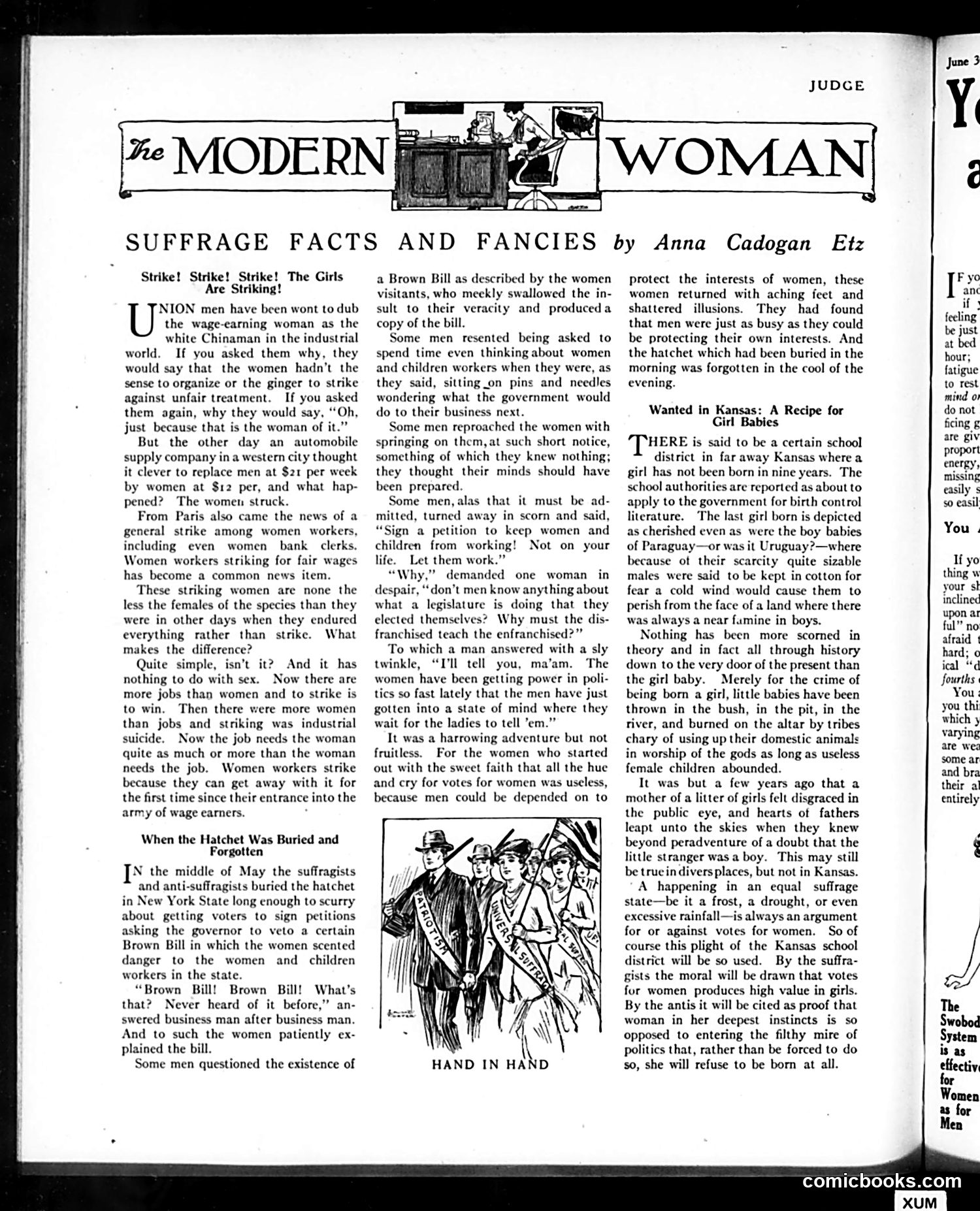
This 1910s-era satirical article by Anna Cadogan Etz addresses women's labor activism and suffrage through three connected pieces. **"Strike! Strike! The Girls Are Striking!"** mocks male dismissal of women workers as incapable of organizing. The piece argues women *have* struck successfully—contradicting claims they lack "ginger"—and explains the shift: women now strike because labor demand favors them, making strikes winnable rather than suicidal. **"When the Hatchet Was Buried and Forgotten"** satirizes male indifference to labor protections. Female suffragists and anti-suffragists temporarily unified to petition against a "Brown Bill" affecting women and child workers. Men repeatedly claimed ignorance, dismissed the issue, or refused to support women's labor rights—revealing that men only protect their *own* interests, not women's. The irony: women petitioned the very men who claim to protect them. **The cartoon "Hand in Hand"** (accompanying text) appears to visualize women's political alliance. The article's point: men's professed paternalism is hollow; women's political engagement is necessity, not choice.
📄 Transcribed text from this page (OCR, searchable)
Machine-transcribed from the original scan — historical spelling and the odd misread are preserved.
JUDGE SUFFRAGE FACTS AND FANCIES by Anna Cadogan Etz Strike! Strike! Strike! The Girls Are Striking! ON men have been wont to dub U the wage-earning woman as the white Chinaman in the industrial world. If you asked them why, they would say that the women hadn’t the sense to organize or the ginger to strike against unfair treatment. If you asked them again, why they would say, “Oh, just because that is the woman of it.” But the other day an automobile supply company in a western city thought it clever to replace men at $21 per week by women at $12 per, and what hap- pened? The women struck. From Paris also came the news of a general strike among women wor! including women bank clerks. Women workers striking for fair wages has become a common news item. These striking women are none the less the females of the species than they were in other days when they endured everything rather than strike. What makes the difference? Quite simple, isn’t it? And it has nothing to do with sex. Now there are more jobs than women and to strike is to win. Then there were more women than jobs and striking was industrial suicide. Now the job needs the woman quite as much or more than the woman needs the job. Women workers strike because they can get away with it for the first time since their entrance into the army of wage earners. . When the Hatchet Was Buried and Forgotten N the middle of May the suffragists and ant ffragists buried the hatchet in New York State long enough to scurry about getting voters to sign petitions asking the governor to veto a certain Brown Bill in which the women scented danger to the women and children workers in the state. “Brown Bill! Brown Bill! What’s that? Never heard of it before,” an- swered business man after business man. And to such the women patiently ex- plained the bill. Some men questioned the existence of a Brown Bill as described by the women visitants, who meekly swallowed the in- sult to their veracity and produceda copy of the bill. Some men resented being asked to spend time even thinking about women and children workers when they were, as they said, sitting_on pins and needles wondering what the government would do to their business next. Some men reproached the women with springing on them, at such short not something of which they knew nothing; they thought their minds should have been prepared. Some men, alas that it must be ad- ited, turned away in scorn and said, “Sign a petition to keep women and children from working! Not on your life. Let them work.” “Why,” demanded one woman in despair, “don’t men know anything about what a legislature is doing that they elected themselves? Why must the dis- franchised teach the enfranchised?” To which a man answered with a sly twinkle, “I'll tell you, ma'am. The women have been getting power in poli- tics so fast lately that the men have just gotten into a state of mind where they wait for the ladies to tell ’em.” It was a harrowing adventure but not fruitless. For the women who started out with the sweet faith that all the hue and cry for votes for women was useless, because men could be depended on to HAND IN HAND protect the interests of women, these women returned with aching feet and shattered illusions. They had found that men were just as busy as they could be protecting their own interests. And the hatchet which had been buried in the morning was forgotten in the cool of the evening. Wanted in Kansas: A Recipe for Girl Babies HERE is said to be a certain school district in far away Kansas where a girl has not been born in nine years. The school authorities are reported as about to apply to the government for birth control literature. The last girl born is depicted as cherished even as were the boy babies of Paraguay—or was it Uruguay?—where because ot their scarcity quite sizable males were said to be kept in cotton for fear a cold wind would cause them to perish from the face of a land where there was always a near famine in boys. Nothing has been more scorned in theory and in fact all through history down to the very door of the present than the girl baby. Merely for the crime of being born a girl, little babies have been thrown in the bush, in the pit, in the river, and burned on the altar by tribes chary of using up their domestic animals in worship of the gods as long as useless female children abounded. It was but a few years ago that a mother of a litter of girls felt disgraced in the public eye, and hearts of fathers leapt unto the skies when they knew beyond peradventure of a doubt that the little stranger was a boy. This may still be trucin divers places, but not in Kansas. A happening in an equal suffrage state—be it a frost, a drought, or even excessive rainfall—is always an argument for or against votes for women. So of course this plight of the Kansas school district will be so used. By the suffra- gists the moral will be drawn that votes fur women produces high value in girls. By the antis it will be cited as proof that woman in her deepest instincts is so opposed to entering the filthy mire of politics that, rather than be forced to do so, she will refuse to be born at all. mind 01 do not ficing g are giv proport energy, missing easily so easil You | If yo thing w your st inclined upon ar ful” no afraid | hard; ical “*d fourths You : you thi which y varying are wee some ar and bra their al entirely comicbooks.com