
Judge, 1917-06-30 · page 11 of 29
Judge — June 30, 1917 — page 11: what you’re looking at
What you’re looking at
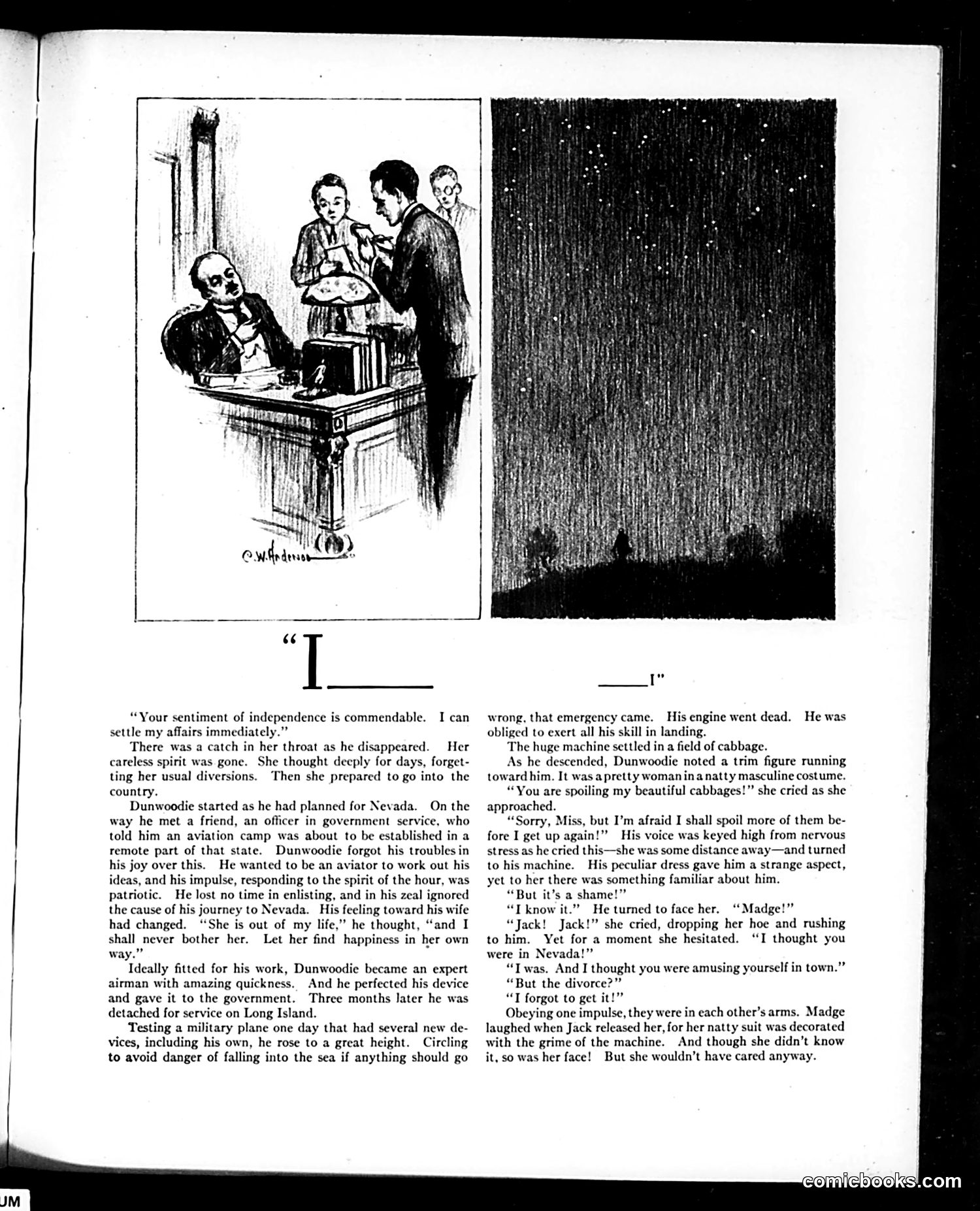
This appears to be a serialized romantic story rather than political satire. The narrative follows Dunwoodie, a man who enlists as a military aviator during what seems to be WWI era (references to "government service," aviation camps, and patriotic impulse suggest early 1900s-1910s). The cartoon illustration shows a domestic scene—likely depicting Dunwoodie's initial separation from his wife Madge. The story's plot involves marital discord (they planned a divorce), but both independently change course—he enlists instead of going to Nevada; she retreats to the country. They coincidentally reunite when his experimental military plane crashes in her vegetable field. The "satire" here is gentle comedy: the reunion occurs through chance amid cabbages, she's dressed as a working farmer, and both forget their divorce plans. It's sentimental humor about reconciliation, not political commentary. This reflects Judge magazine's mixed content of satire, fiction, and illustrations for middle-class readers.
📄 Transcribed text from this page (OCR, searchable)
Machine-transcribed from the original scan — historical spelling and the odd misread are preserved.
JM i © WApderien—e° ‘TL “Your sentiment of independence is commendable. I can settle my affairs immediately.” There was a catch in her throat as he disappeared. Her careless spirit was gone. She thought deeply for days, forget- ting her usual diversions. Then she prepared to go into the country. Dunwoodie started as he had planned for Nevada. On the way he met a friend, an officer in government service, who told him an aviation camp was about to be established in a remote part of that state. Dunwoodie forgot his troubles in his joy over this. He wanted to be an aviator to work out his ideas, and his impulse, responding to the spirit of the hour, was patriotic. He lost no time in enlisting, and in his zeal ignored the cause of his journey to Nevada. His feeling toward his wife had changed. ‘She is out of my life,” he thought, “and I shall never bother her. Let her find happiness in her own way.” Ideally fitted for his work, Dunwoodie became an expert airman with amazing quickness. And he perfected his device and gave it to the government. Three months later he was detached for service on Long Island. Testing a military plane one day that had several new de- vices, including his own, he rose to a great height. Circling to avoid danger of falling into the sea if anything should go wrong, that emergency came. His engine went dead. He was obliged to exert all his skill in landing. The huge machine settled in a field of cabbage. As he descended, Dunwoodie noted a trim figure running toward him. It was apretty woman ina natty masculine costume. “You are spoiling my beautiful cabbages!” she cried as she approached. “Sorry, Miss, but I’m afraid I shall spoil more of them be- fore I get up again!” His voice was keyed high from nervous stress as he cried this—she was some distance away—and turned to his machine. His peculiar dress gave him a strange aspect, yet to her there was something familiar about him. “But it’s a shame!” “T know it.” He turned to face her.“ Madge!” “Jack! Jack!” she cried, dropping her hoe and rushing to him. Yet for a moment she hesitated. ‘I thought you were in Nevada!” “Twas. And I thought you were amusing yourself in town.” “But the divorce?” “T forgot to get it!” Obeying one impulse, they were in each other’s arms. Madge laughed when Jack released her, for her natty suit was decorated with the grime of the machine. And though she didn’t know it, so was her face! But she wouldn’t have cared anyway.