
Judge, 1917-06-30 · page 10 of 29
Judge — June 30, 1917 — page 10: what you’re looking at
What you’re looking at
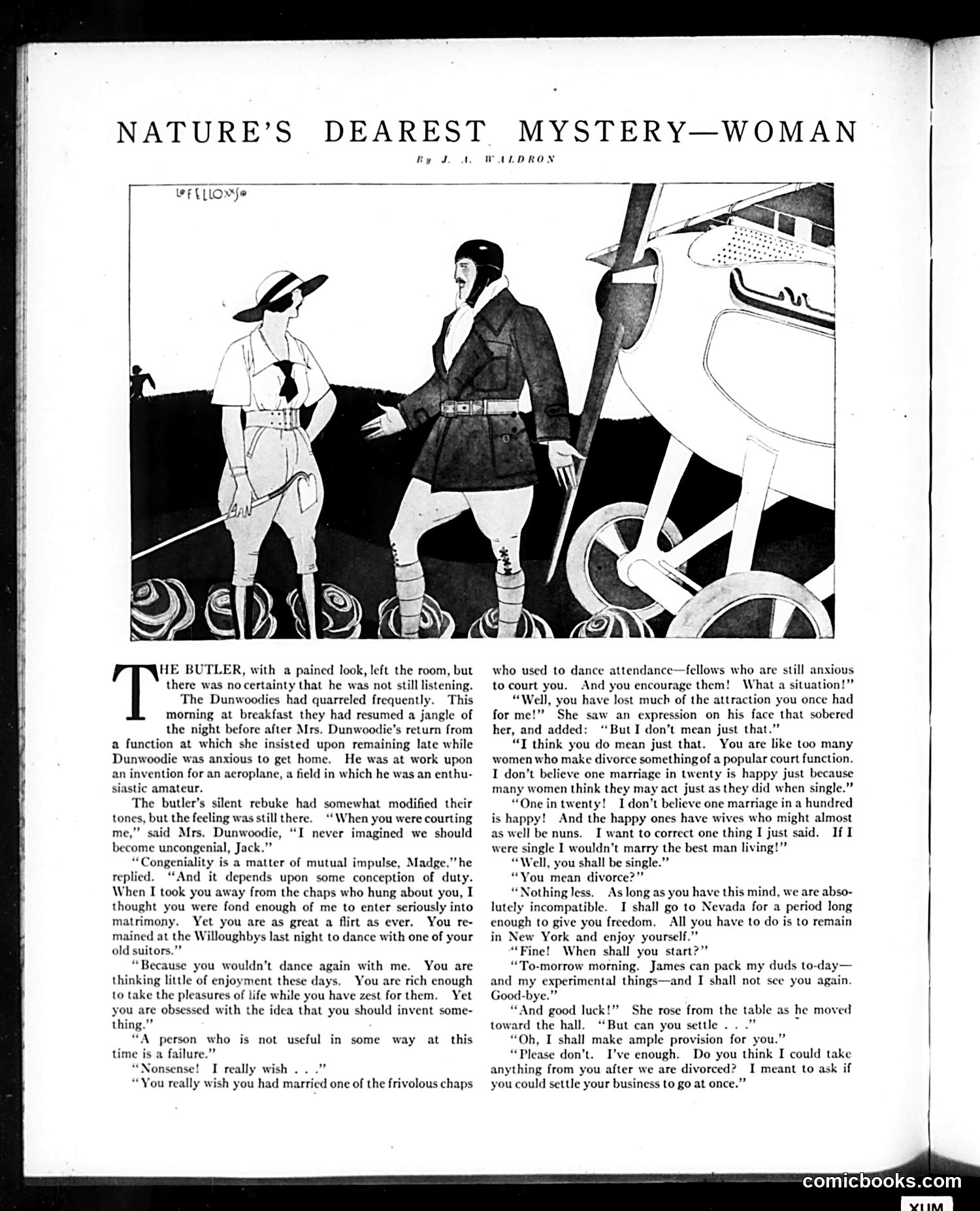
This satirical story-illustration mocks early 20th-century marriage dynamics and women's changing social roles. The cartoon depicts a quarreling couple: Jack Dunwoodie (an aviation enthusiast) and his wife Madge (depicted in fashionable attire). Their conflict centers on incompatible expectations—he wants a dutiful helpmeet supporting his inventions; she demands social pleasure and entertainment. The satire targets both parties: Madge is portrayed as a frivolous flirt unable to accept domestic sacrifice, while Jack is an obsessive workaholic indifferent to his wife's happiness. Their rapid pivot to divorce—via Nevada's famously permissive laws—satirizes how casually modern couples dissolve marriages. The title itself is ironic: the "mystery" is women's supposed emotional nature and their newfound willingness to abandon marriages for independence. The piece critiques the era's emerging divorce culture and women's demands for equality in marriage, reflecting anxieties about changing gender roles among Judge's satirical audience.
📄 Transcribed text from this page (OCR, searchable)
Machine-transcribed from the original scan — historical spelling and the odd misread are preserved.
By IA NATURE’S DEAREST MYSTERY—WOMAN WALDRON Prtioxye HE BUTLER, with a pained look, left the room, but there was no certainty that he was not still listening. The Dunwoodies had quarreled frequently. This morning at breakfast they had resumed a jangle of the night before after Mrs. Dunwoodie’s return from a function at which she insisted upon remaining late while Dunwoodie was anxious to get home. He was at work upon an invention for an aeroplane, a field in which he was an enthu- siastic amateur. The butler’s silent rebuke had somewhat modified their tones, but the feeling was still there. ‘‘ When you were courting me,” said Mrs. Dunwoodie, “I never imagined we should become uncongenial, Jack.” “Congeniality is a matter of mutual impulse, Madge,” he replied. “And it depends upon some conception of duty. When I took you away from the chaps who hung about you, I thought you were fond enough of me to enter seriously into matrimony. Yet you are as great a flirt as ever. You re- mained at the Willoughbys last night to dance with one of your old suitors.” “Because you wouldn’t dance again with me. You are thinking little of enjoyment these days. You are rich enough to take the pleasures of life while you have zest for them. Yet you are obsessed with the idea that you should invent some- thing.” “A person who is not useful in some way at this time is a failure.” Nonsense! I really wish . . .” “You really wish you had married one of the frivolous chaps NY GON A who used to dance attendance—fellows who are still anxious to court you. And you encourage them! What a situation!” “Well, you have lost much of the attraction you once had for me!” She saw an expression on his face that sobered her, and added: ‘But I don’t mean just that.” “T think you do mean just that. You are like too many women who make divorce something of a popular court function. I don’t believe one marriage in twenty is happy just because many women think they may act just as they did when single.” “One in twenty! I don’t believe one marriage in a hundred is happy! And the happy ones have wives who might almost as well be nuns. I want to correct one thing I just said. If I were single I wouldn’t marry the best man living!” “Well, you shall be single.” “You mean divorce?” “Nothing Jess. As long as you have this mind, we are abso- lutely incompatible. I shall go to Nevada for a period long enough to give you freedom. All you have to do is to remain in New York and enjoy yourself.” “Fine! When shall you start?” “To-morrow morning. James can pack my duds to-day— and my experimental things—and I shall not see you again. Good-bye.” “And good luck!” She rose from the table as he moved toward the hall. “But can you settle . . .” 7 “Oh, I shall make ample provision for you.” “Please don’t. I’ve enough. Do you think I could take anything from you after we are divorced? I meant to ask if you could settle your business to go at once.” comicbooks.com