
A complete issue · 28 pages · 1917
Judge — June 23, 1917
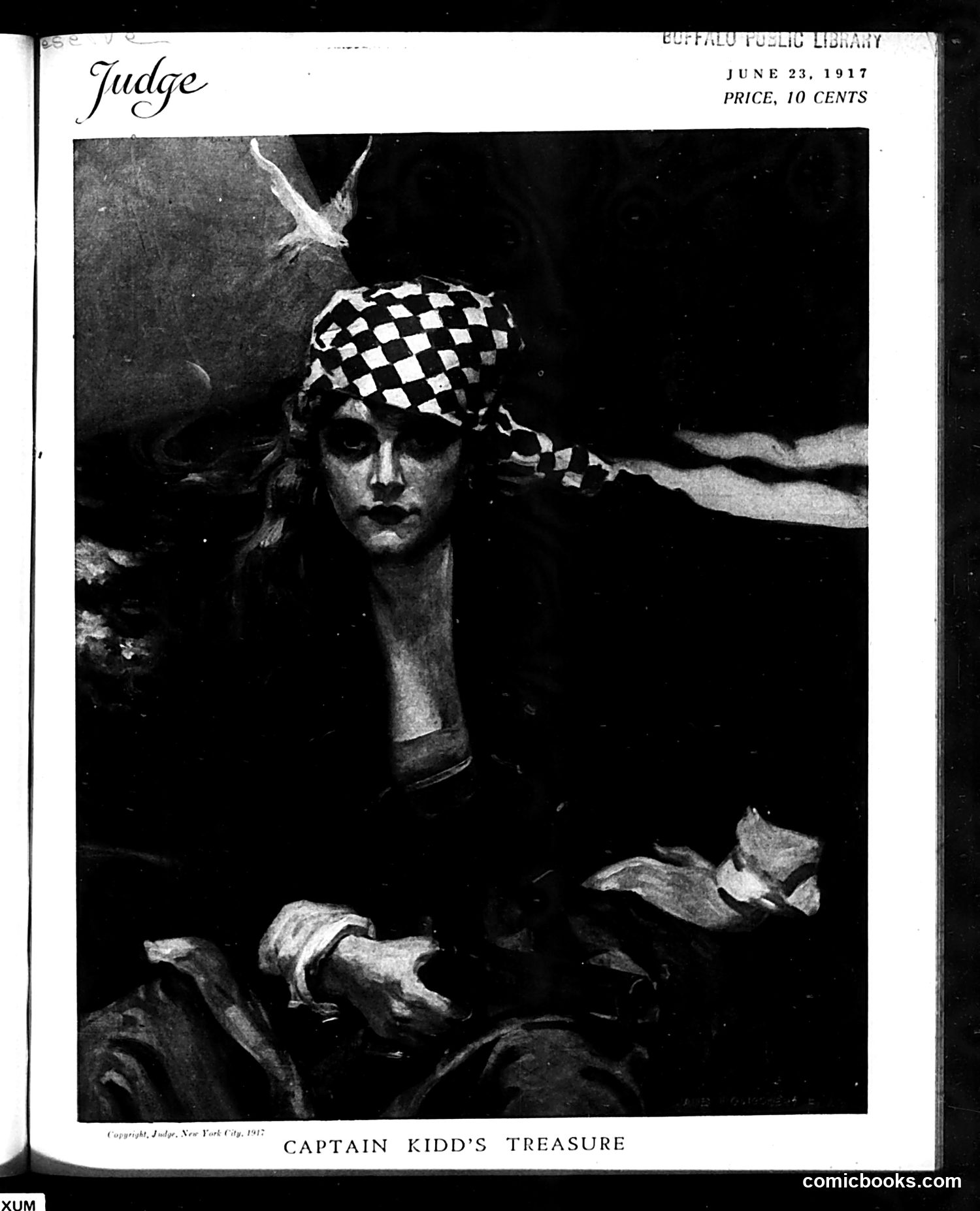
This page from Judge magazine (June 23, 1917) presents an illustration titled "Captain Kidd's Treasure" showing a figure in a checkered headscarf examining what appears to be treasure or valuables. The reference is to the legendary pirate Captain William Kidd. However, without additional context or captions visible on this page, the specific satirical point is unclear. Given the 1917 date—during World War I—this could be political satire about American wealth, war profiteering, or international relations, though I cannot definitively state the intended target or message from the image alone. The dramatic lighting and theatrical staging suggest commentary on contemporary figures or events, but more information would be needed to identify them precisely.
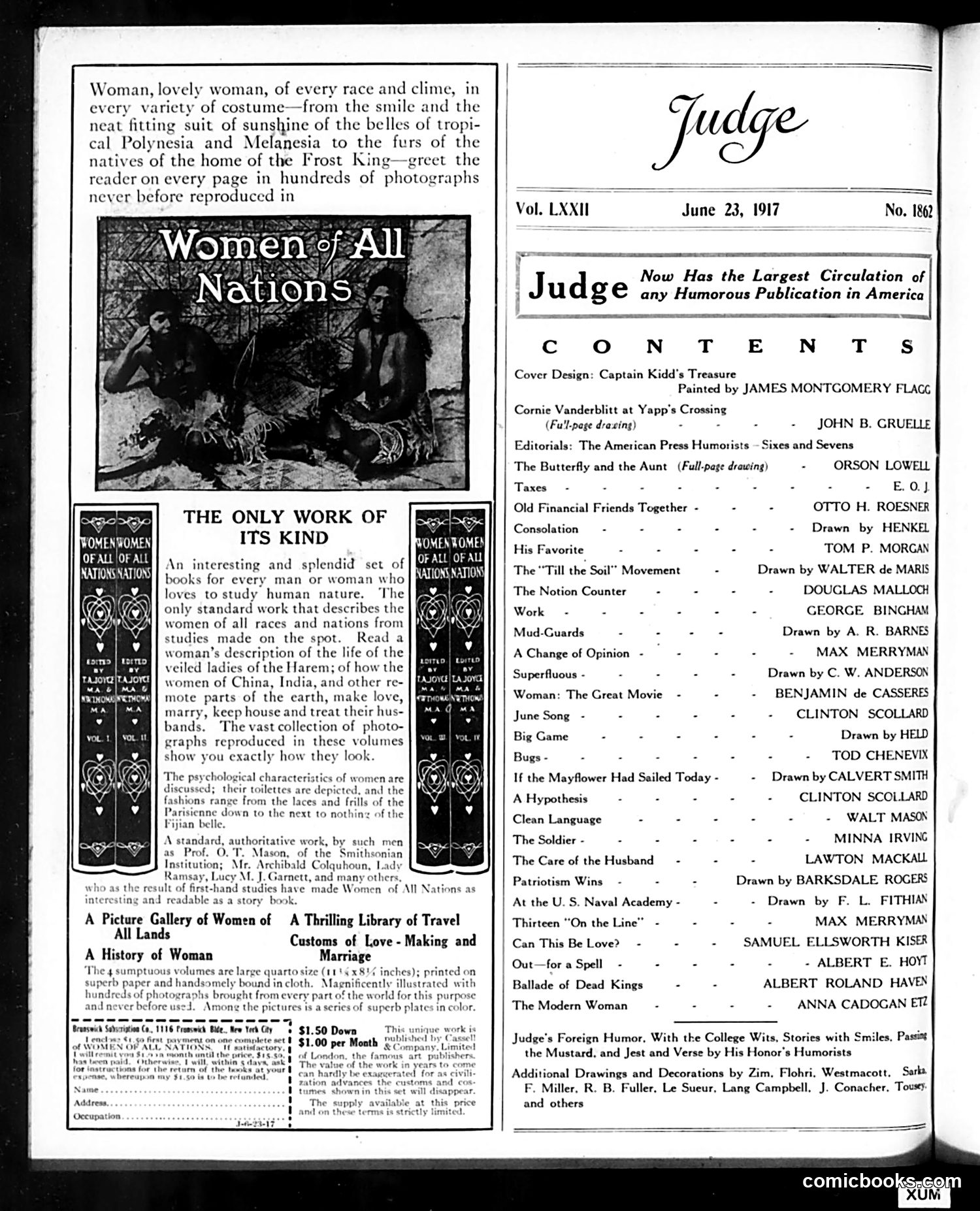
This page is primarily **advertising and table of contents** rather than political commentary. The left side promotes "Women of All Nations," a multi-volume work describing women from various races and regions—presented as ethnographic study material. The advertisement emphasizes the work's comprehensiveness and "standard, authoritative" nature. The contents listing shows this issue contains various humorous pieces, editorial cartoons, and satirical drawings typical of Judge's format. Given the **June 1917 date**, this falls during America's involvement in World War I, evident from content references like "Patriotism Wins" and "At the U.S. Naval Academy." The actual satirical cartoons themselves aren't clearly visible enough in this reproduction to identify specific political targets or jokes with confidence.
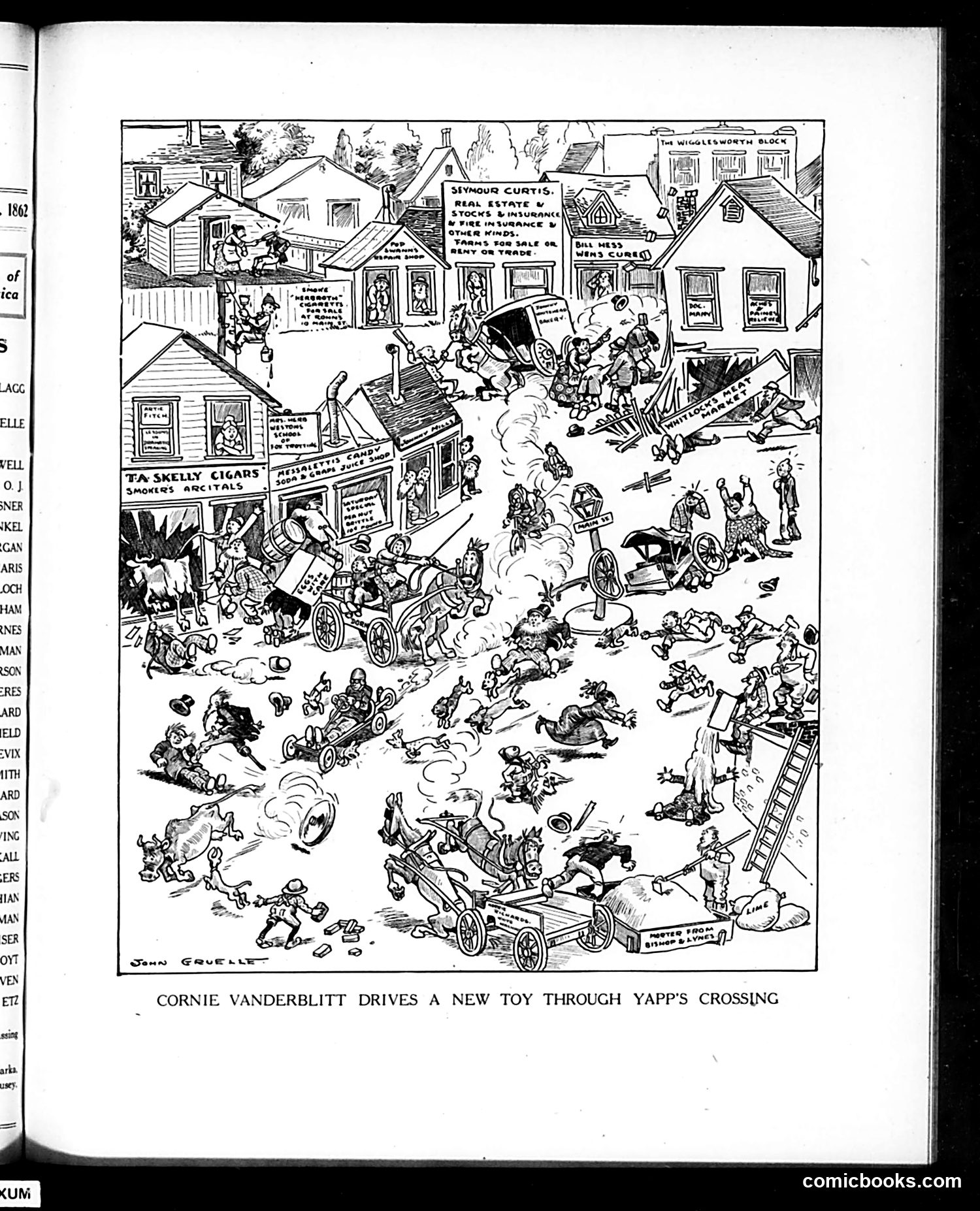
This cartoon satirizes wealth and recklessness among the Gilded Age elite. "Cornie Vanderbilt" (likely referencing the prominent Vanderbilt family) drives an elaborate toy vehicle through a crowded working-class neighborhood ("Yapp's Crossing"), causing comic chaos—figures scatter, collide, and tumble in her path. The satire targets how the wealthy, indulging in frivolous playthings, carelessly endanger ordinary people. The detailed street scene with businesses (T.A. Skelly Cigars visible) emphasizes this is a real community, not a playground. The cartoon mocks both aristocratic entitlement and the obliviousness of the rich to their destructive impact on society—a common Progressive-era critique of unchecked wealth and class inequality.
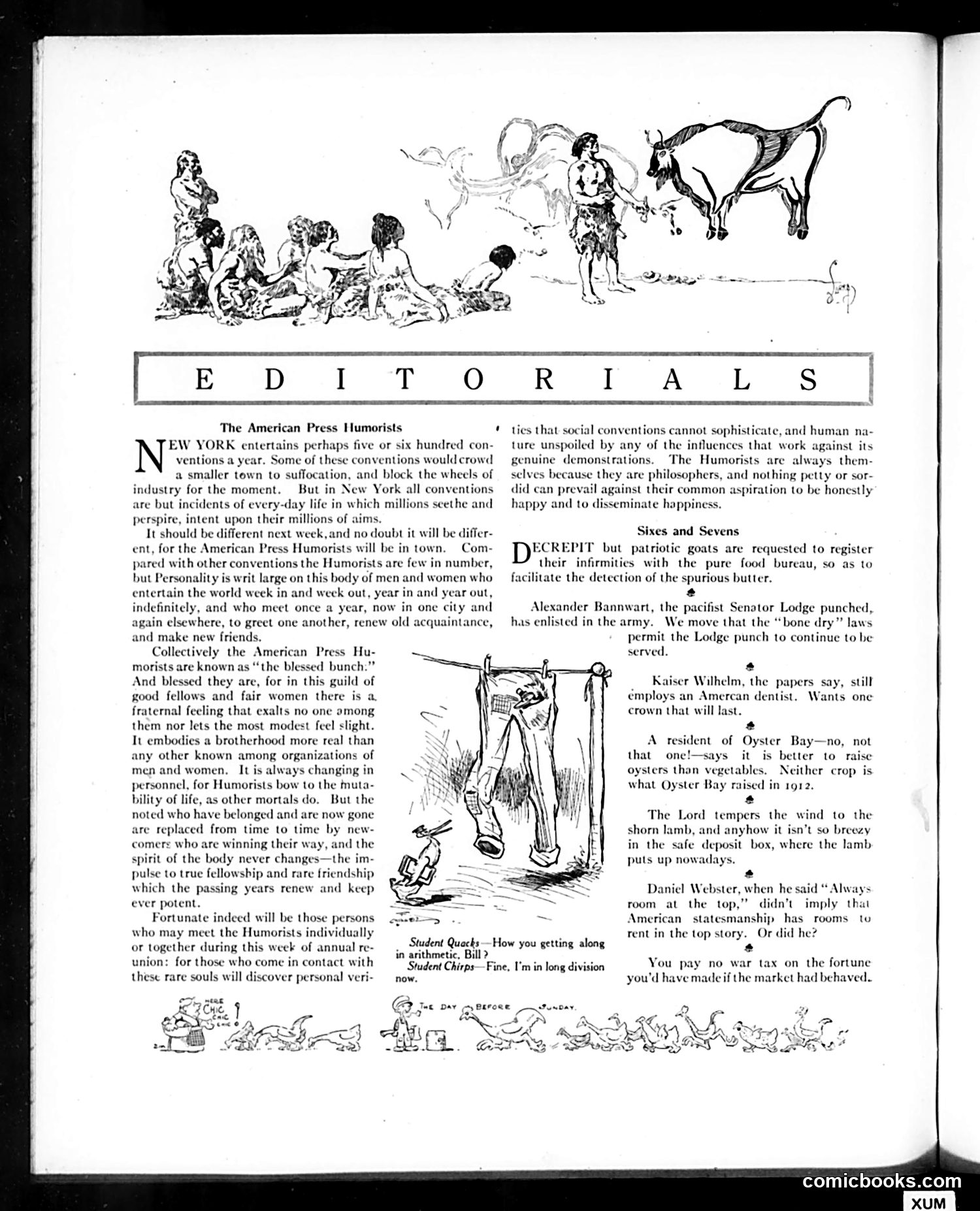
This editorial celebrates American Press Humorists, a professional organization. The top illustration depicts primitive or pastoral figures with livestock, suggesting humor's ancient roots and universal human appeal. The text praises humorists as philosophers who demonstrate truths social conventions obscure. The "Sixes and Sevens" section contains brief satirical items: - Senator Lodge's pacifism is mocked (he "punched" despite advocating non-violence) - Kaiser Wilhelm's dental vanity is ridiculed - Oyster Bay (Theodore Roosevelt's home) farming is criticized - A joke about tax-free wartime profits The cartoon below shows a student arithmetic problem with double entendre about "long division." The page blends organizational boosterism with typical wartime-era satire targeting political figures and social absurdities.
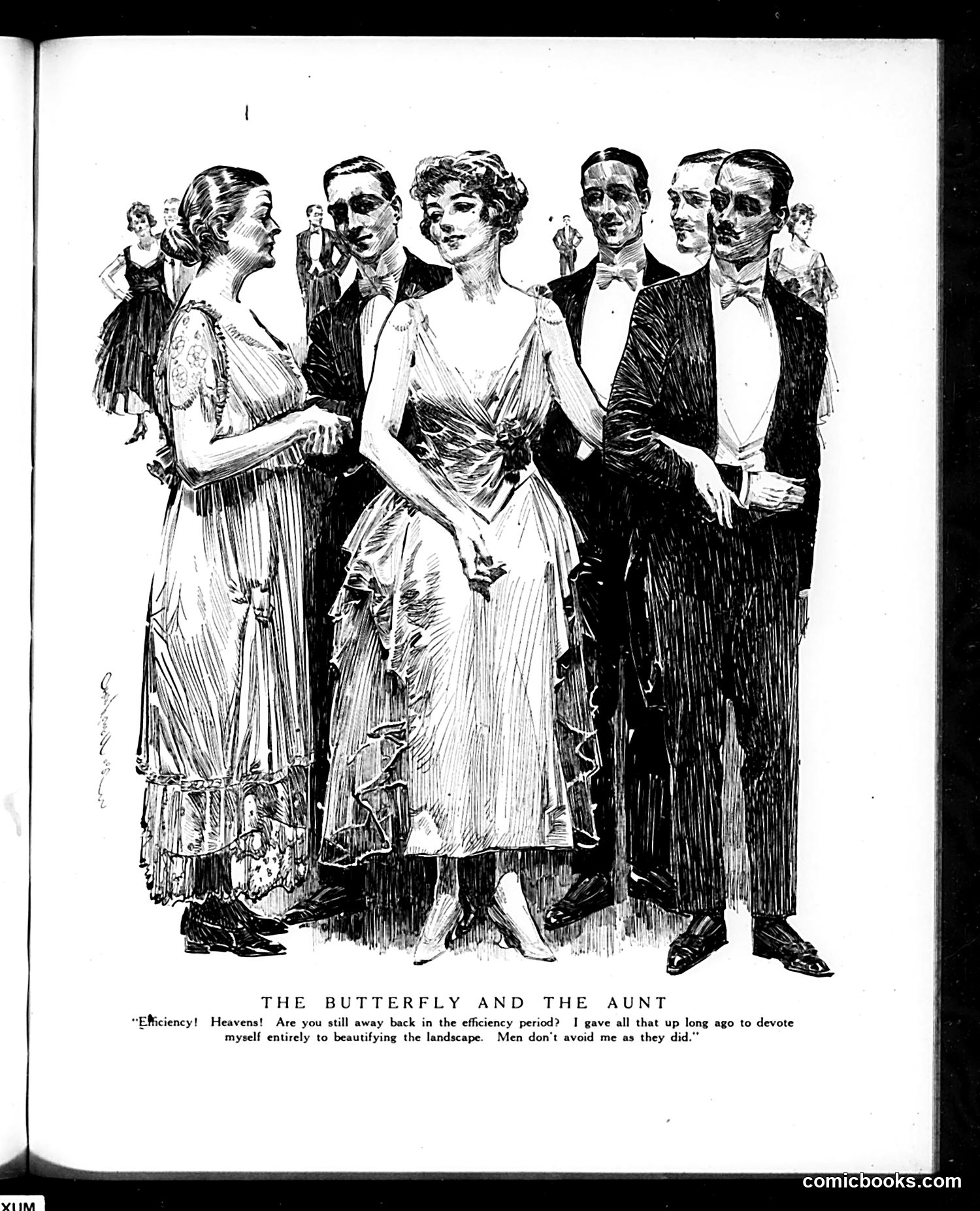
This cartoon satirizes a woman who claims to have abandoned social life ("the efficiency period") to focus on "beautifying the landscape," yet complains that men now avoid her. The joke hinges on irony: she sacrificed her social appeal for earnest, unglamorous work, then expresses surprise that her romantic prospects suffered as a result. The cartoon mocks both the "efficiency movement" (an early-20th-century trend emphasizing rational productivity) and the woman's self-deluding logic. She presents landscaping as noble work while resenting its social consequences—the implicit critique being that women cannot simultaneously pursue serious work and maintain traditional attractiveness/desirability without contradiction. The title's "butterfly" likely refers to her former frivolous social self.
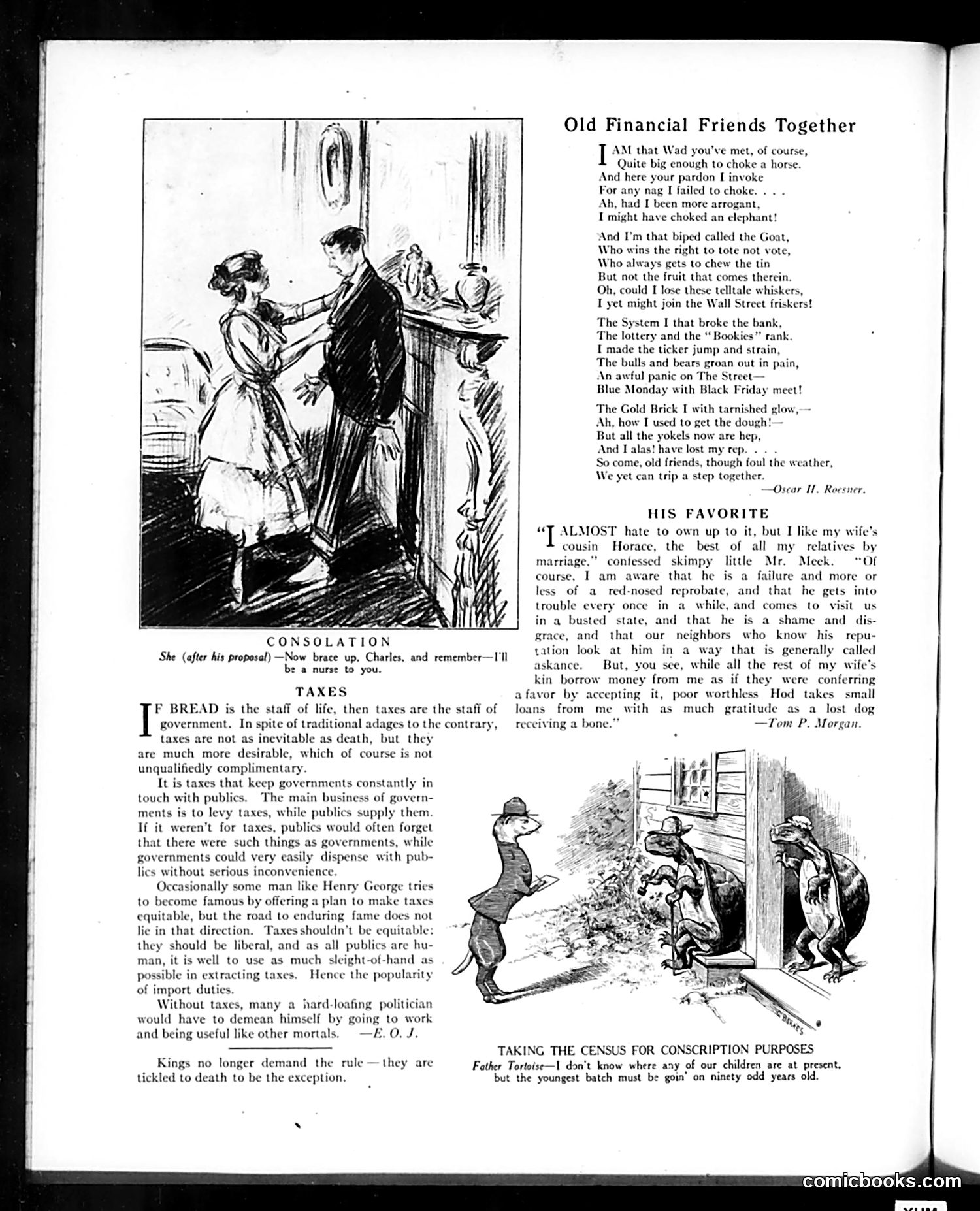
**"Old Financial Friends Together"** (poem by Oscar II. Roesner): A satirical verse mocking a character called "the Goat" who boasts of financial schemes—manipulating stock markets, causing bank failures, and profiting from crashes like "Blue Monday with Black Friday." The poem suggests this figure ruined ordinary investors while escaping consequences. **"His Favorite"** and **"Taxes"**: These pieces mock wealthy individuals who exploit their relatives and avoid civic responsibility. One confesses his cousin borrows money "with as much gratitude as a lost dog," while the tax commentary critiques how the wealthy resist taxation while governments depend on public revenue. **"Taking the Census"**: A cartoon joke about conscription dodging through age manipulation during wartime.
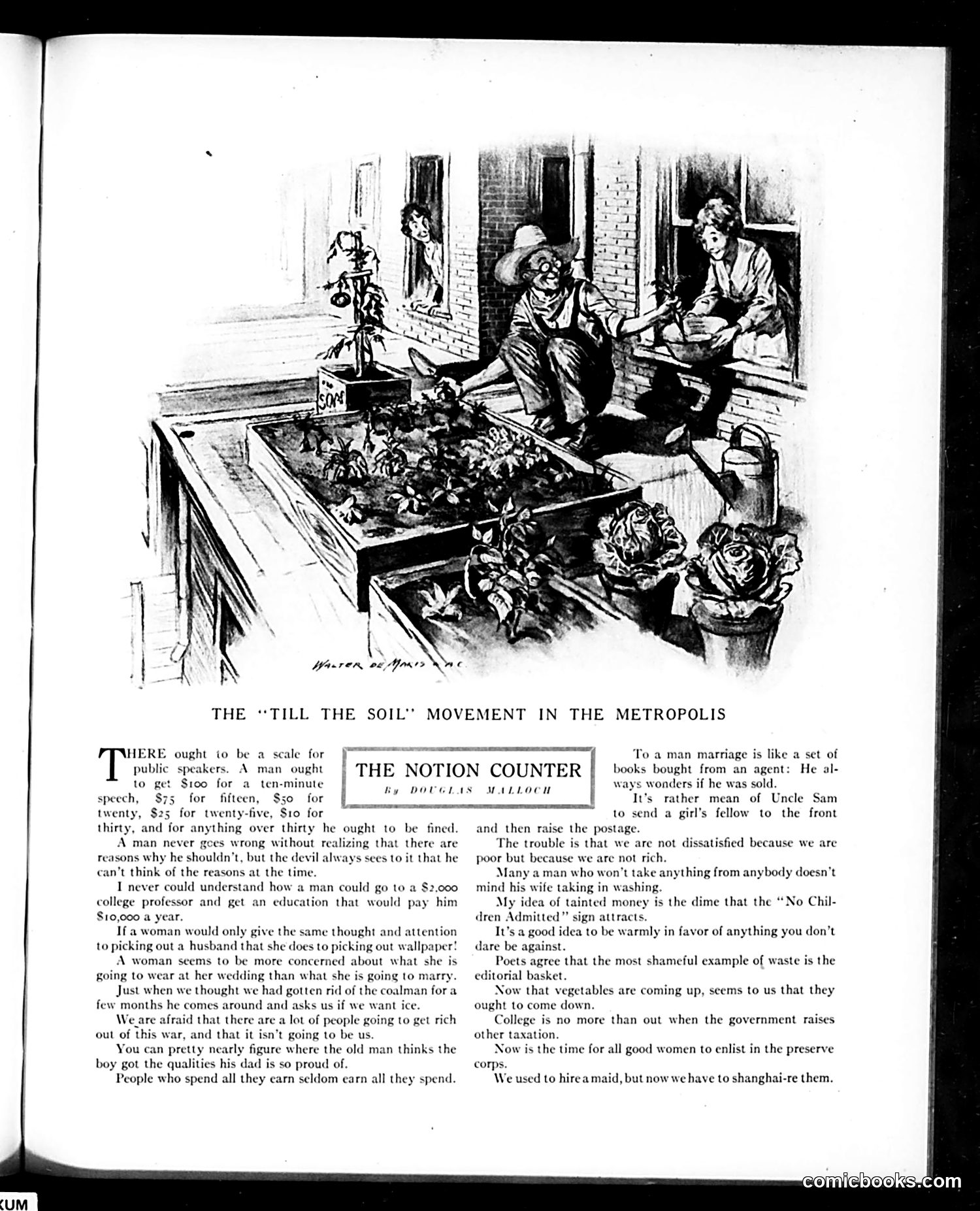
This Judge magazine page satirizes early 20th-century "back-to-the-land" and urban gardening movements, likely related to WWI-era food conservation efforts. The cartoon shows city dwellers attempting vegetable gardening on a tenement fire escape—an absurdly impractical urban setting for farming. The accompanying "Notion Counter" column by Douglas Malloch contains satirical aphorisms mocking wartime economics and social changes. Key jabs include: criticism of inflated college costs versus low wages, mockery of women prioritizing wedding clothes over marriage choice, and cynical quips about profiteering from war and rising postage rates. The "shanghai-re" maids reference alludes to labor shortages as men enlisted. Overall, the page ridicules both the impracticality of urban farming initiatives and broader wartime economic anxieties among the middle class.
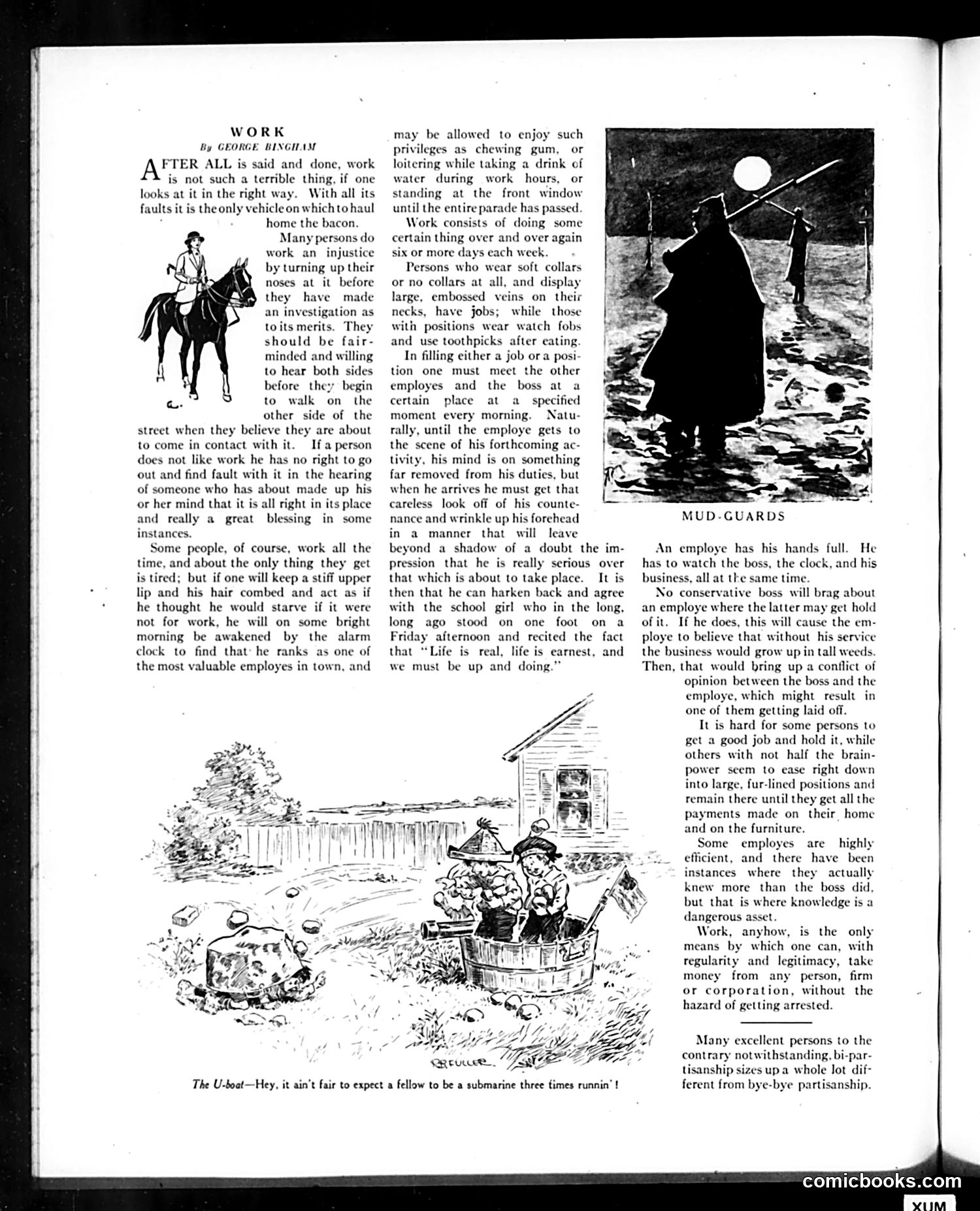
This is a satirical essay with accompanying illustrations mocking workplace culture and employment hierarchies of the early 20th century. **The Main Point:** Bingham cynically describes "work" as a necessary evil that people pretend to value while actually resenting it. The satire targets both workers and employers—workers who must feign seriousness and obedience, and bosses who exploit their labor. **Key Satirical Observations:** - Workers must adopt fake expressions of dedication ("wrinkle up his forehead") to appear serious - The "mud-guards" illustration shows employers juggling surveillance of workers, the clock, and business—implying constant tension - Blue-collar workers ("soft collars...embossed veins") get jobs while others wear status symbols like watch fobs - Knowledge itself is "dangerous" to workers **The Broader Critique:** Bingham satirizes the performative nature of employment—that honest work is the only "legitimate" way to make money (implying skepticism about this claim), yet the system demands dishonesty and self-suppression from workers navigating class divisions and power imbalances.
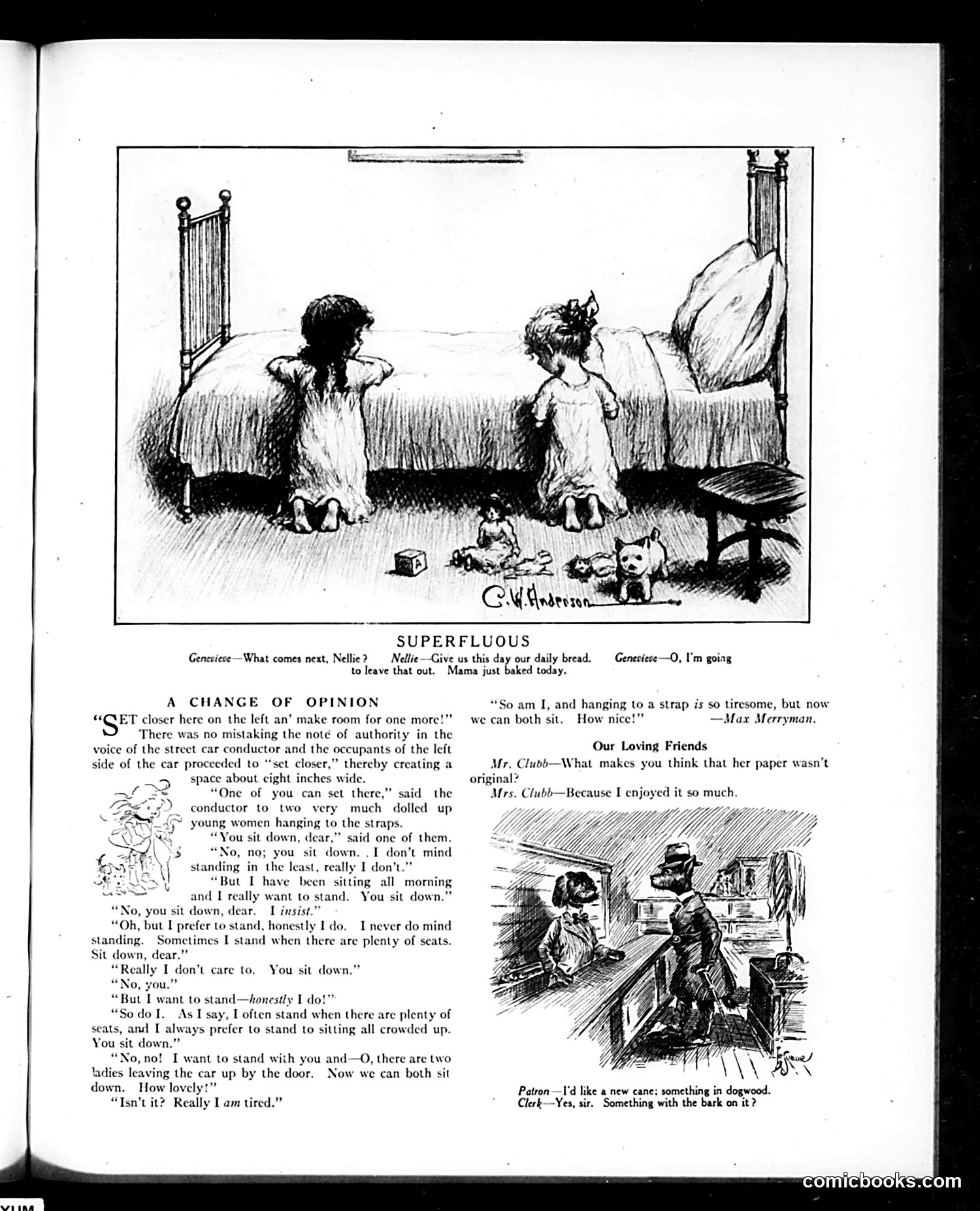
This page contains three separate humorous pieces satirizing early 20th-century social conventions: **"Superfluous"**: A cartoon showing two children at bedtime. One suggests omitting "give us our daily bread" from prayers since mother just baked fresh bread. It mocks literal-minded religiosity and childish logic. **"A Change of Opinion"**: A dialogue between two fashionable young women on a streetcar debating who should sit in a newly available space. Each insists the other sit while claiming she prefers standing—an exaggerated portrayal of performative politeness and false modesty. Both eventually drop the pretense when two more seats appear, revealing their exhaustion. It satirizes affected gentility among young women trying to appear refined. **"Our Loving Friends"**: Two brief anecdotes. The first mocks a woman who plagiarizes but enjoys her own work. The second is a pun: a patron asking for a cane "in dogwood" (the wood type) gets asked if he wants it "with the bark on it" (playing on the phrase's double meaning). The humor relies on observational satire about manners, hypocrisy, and wordplay typical of early Judge magazine.
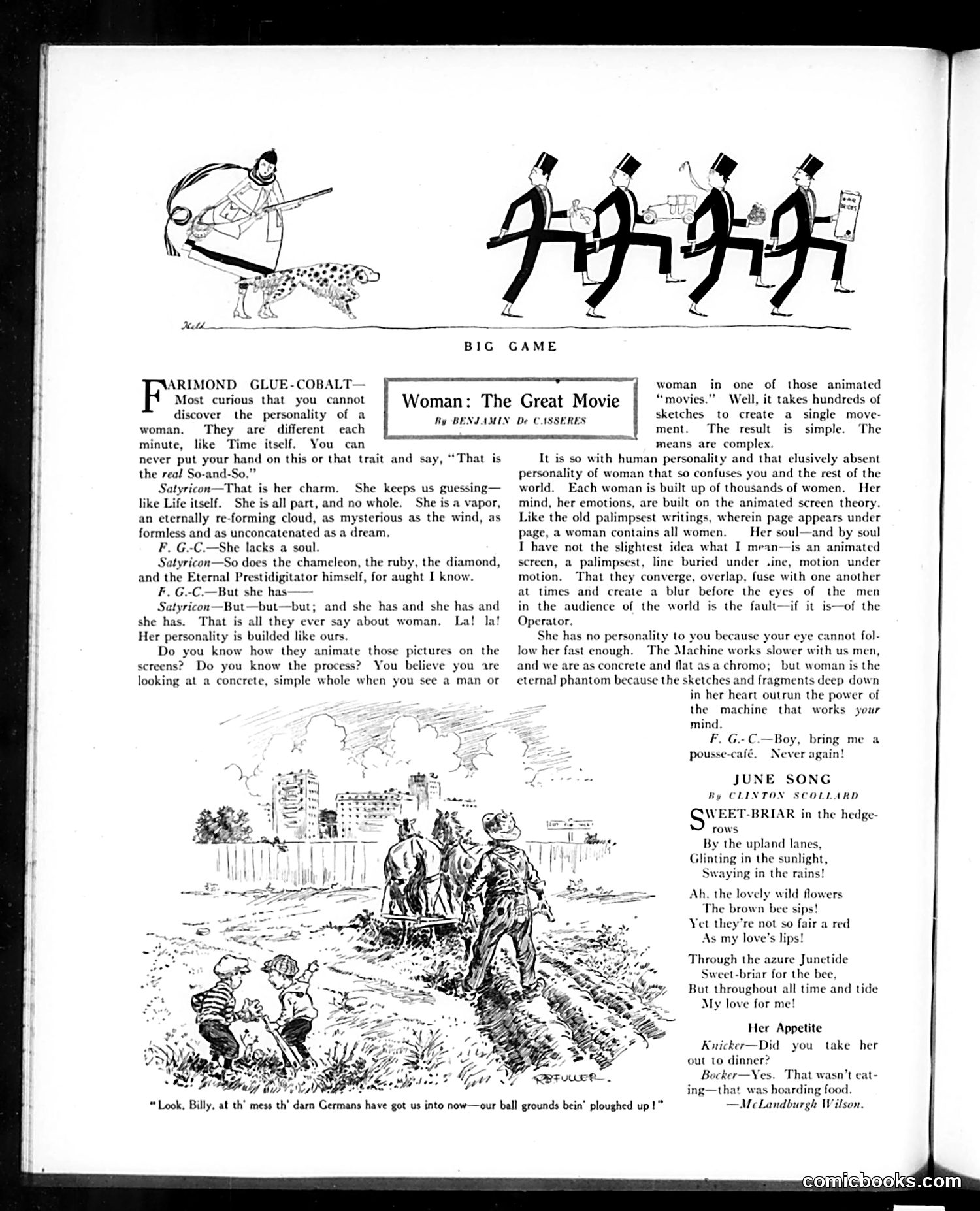
The page contains two main elements: **"Big Game" Cartoon (top):** A satirical illustration showing businessmen in top hats being chased by a hunter with a rifle and hunting dog. The "big game" being hunted is metaphorically the businessmen themselves—likely referencing labor disputes or class conflict of the era. The title suggests wealthy men are the prey being pursued. **"Woman: The Great Movie" Essay (center/right):** A philosophical piece comparing women's personalities to animated films. The author argues women are complex, built from "thousands of women" in layers (like animation frames or palimpsests), making them appear inconsistent or contradictory to men. Rather than criticism, this frames women's apparent changeability as sophisticated complexity—their "personality" moves too fast for men to comprehend, like film frames the eye cannot follow. The bottom illustration depicts soldiers and a rural battlefield, likely WWI-related, with dialogue about baseball fields being "ploughed up"—referring to how war disrupts civilian life. The "June Song" is sentimental poetry about love and nature.
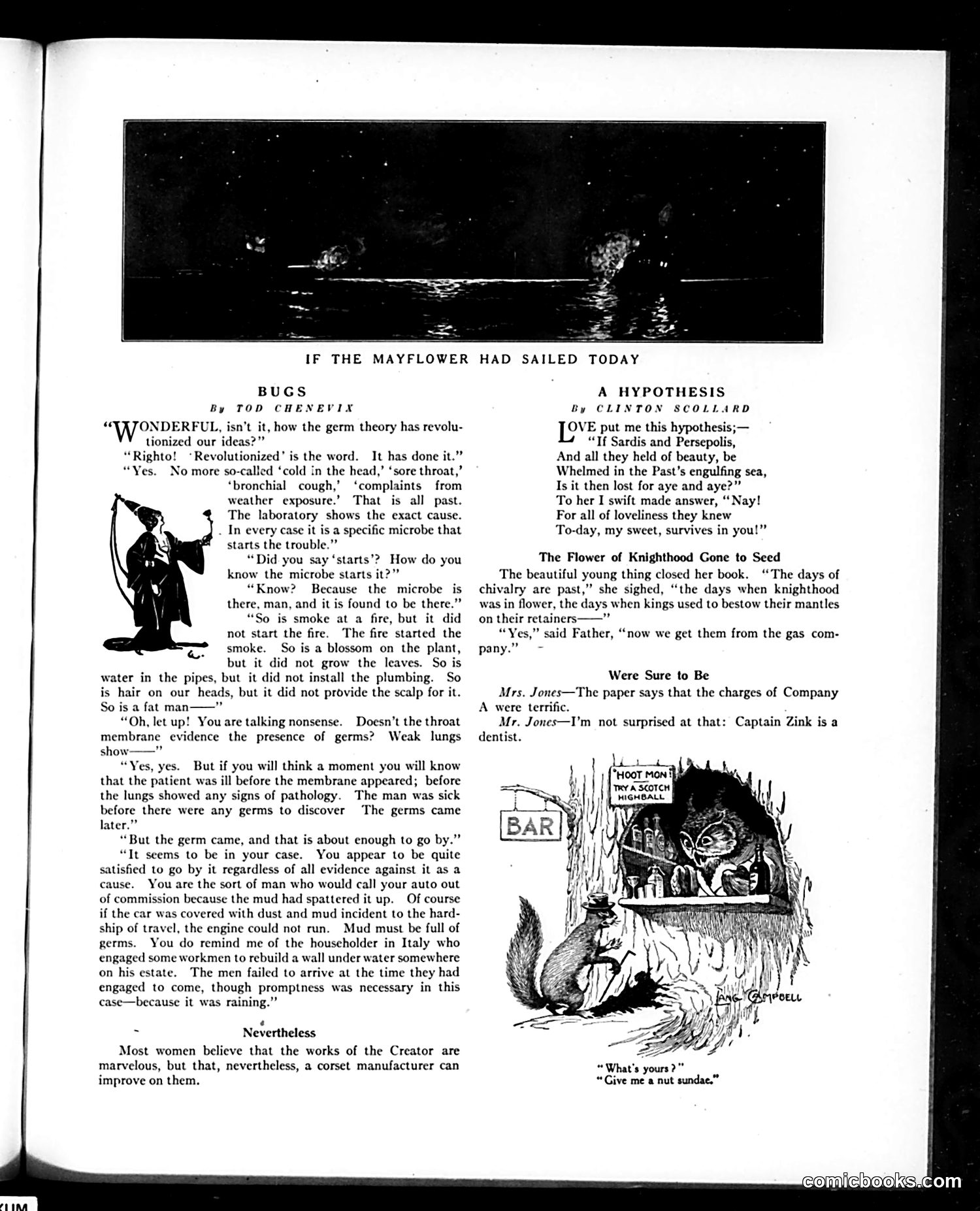
This page contains three satirical pieces mocking contemporary attitudes: **"Bugs" (left):** A dialogue ridiculing the popular "germ theory" of disease. One speaker argues germs cause illness because they're *present* at disease sites, while the other uses logical analogies (smoke doesn't start fires; blossoms don't grow leaves) to expose this faulty reasoning. The satire targets public credulity about emerging bacteriology—people accepting germ theory as absolute truth despite weak causal logic. **"A Hypothesis" (top right):** A sentimental poem about beauty persisting through time, likely written sincerely rather than satirically. **Bottom cartoons:** Two brief joke pieces. "The Flower of Knighthood Gone to Seed" mocks a young woman lamenting lost chivalry while her father cynically notes knights now come "from the gas company" (tradesmen, not nobility). The bar scene joke plays on "Captain Zink" being a dentist—making the military rank absurd. The page collectively satirizes scientific pretension, romantic nostalgia, and social pretense circa the early 20th century.
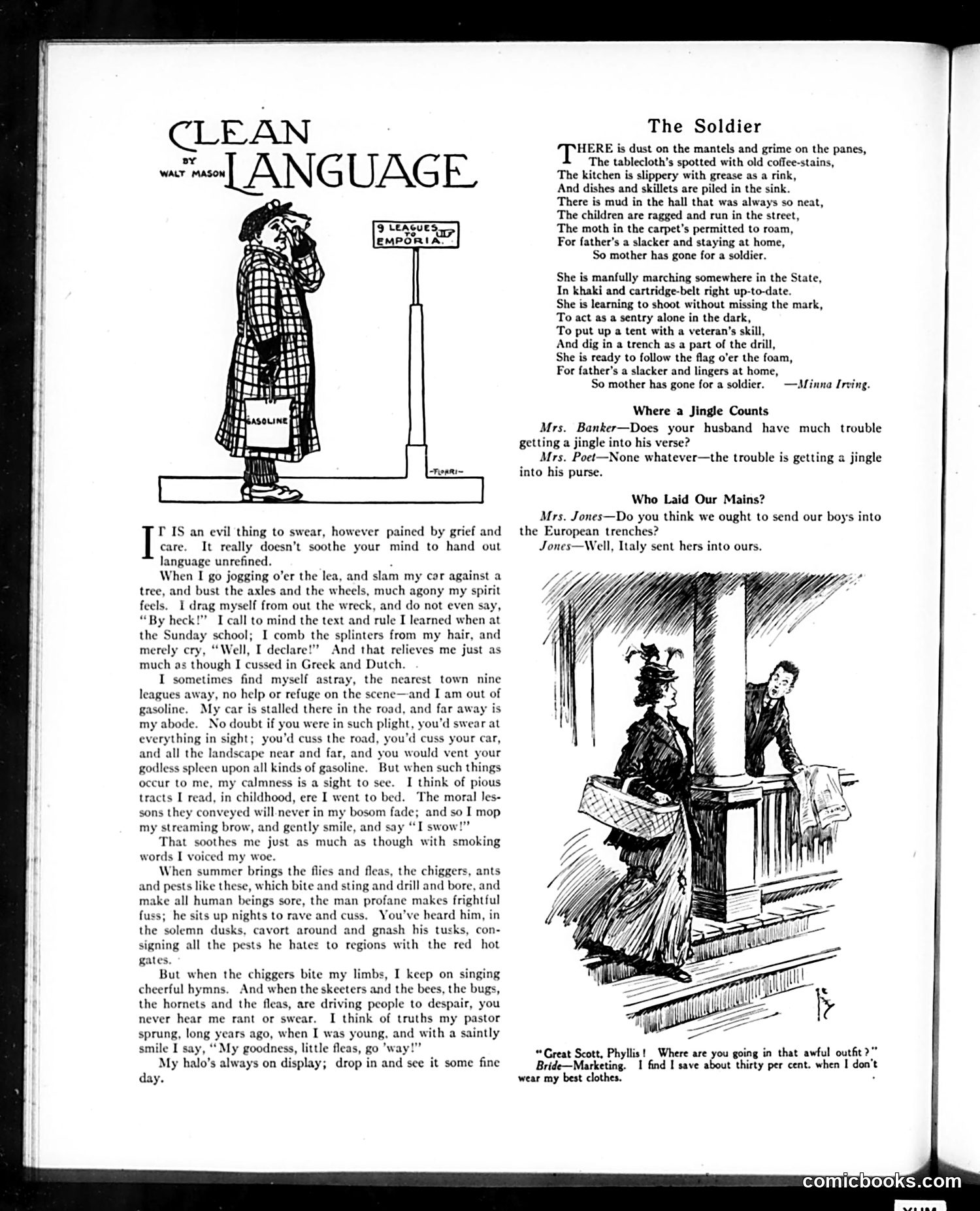
This page contains WWI-era satirical content from *Judge* magazine. The main pieces are: **"Clean Language"** (by Walt Mason): A moralistic essay mocking pious self-restraint. The author claims to avoid swearing during frustrations (car breakdowns, insect bites) by reciting childhood religious lessons and saying phrases like "My goodness, little fleas, go 'way!" The satire targets sanctimonious hypocrisy—suggesting such false virtue during genuine hardship is absurd. **"The Soldier"** (by Minna Irving): A poem criticizing fathers as "slackers" (draft evaders) while mothers enlist. It portrays domestic neglect resulting from the father's absence from war service, framing female military participation as noble compensation. **"Where a Jingle Counts"** and **"Who Laid Our Mains?"**: Brief jokes about poets' poor income and Italy's military contributions. **The illustration** shows a woman in fashionable wartime attire, captioned about saving money by not wearing her best clothes while marketing—mocking wartime economy measures among society women. The page reflects 1910s anxieties about masculinity, military duty, and social propriety during WWI.
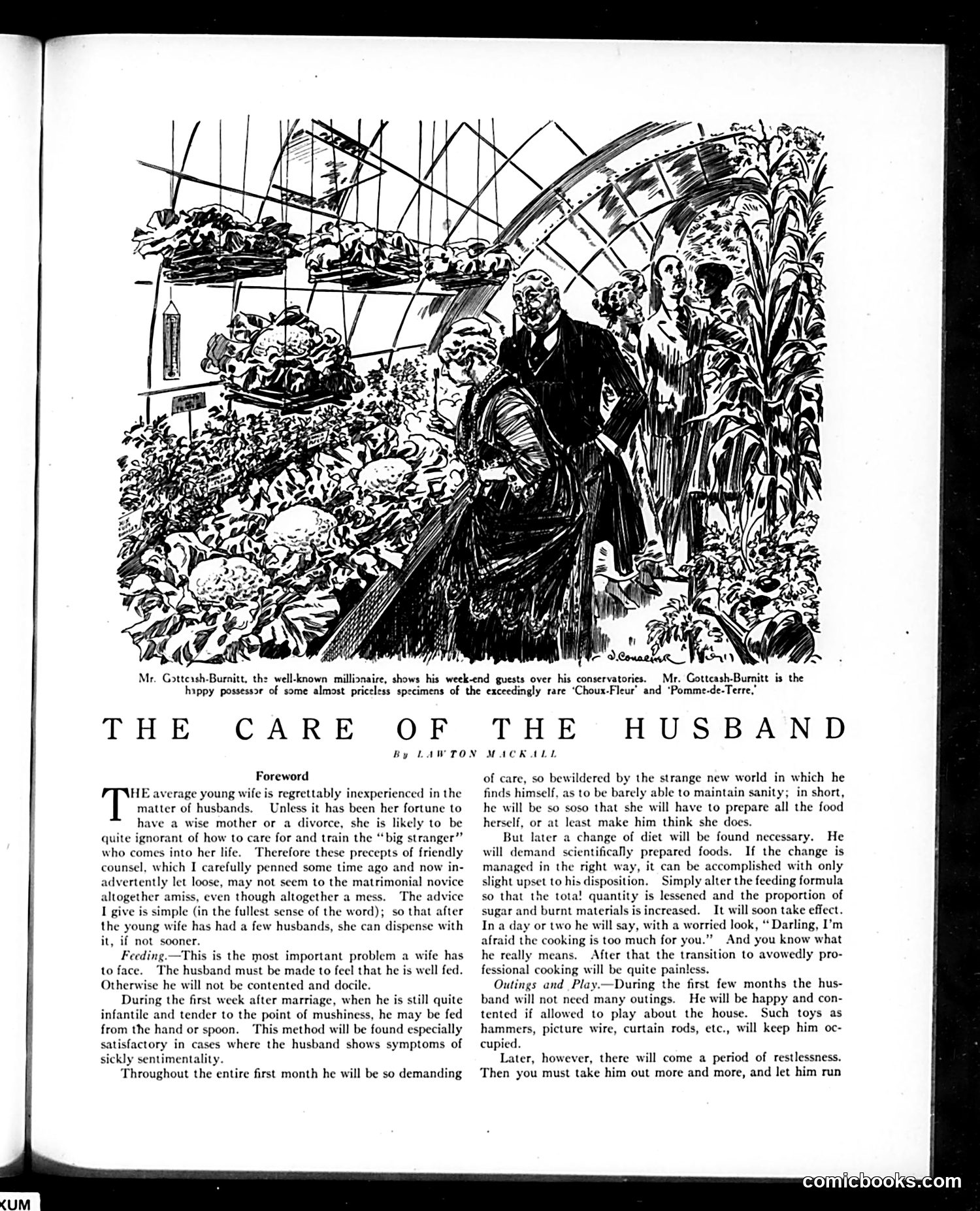
This page contains two distinct pieces from Judge magazine: **The Cartoon (top):** A wealthy millionaire named Gotteash-Burnitt shows weekend guests his conservatory, proudly displaying "priceless specimens" of cabbage (*Choux-Fleur*) and potatoes (*Pomme-de-Terre*)—vegetables with French names. The satire mocks the pretension of the ultra-rich: they're treating common vegetables as exotic rarities, suggesting their ostentatious display of wealth is ridiculous when the "precious" items are actually mundane. **The Article:** "The Care of the Husband" is satirical advice written as if husbands are children or pets requiring training. It parodies period marital advice columns by presenting husband-management as a domestic management problem. The humor derives from treating grown men as infantile beings needing careful feeding, distraction with "toys," and behavioral conditioning—a pointed commentary on contemporary gender dynamics and perhaps the intelligence of men, or the frustration wives experienced with their limited agency. Both pieces contain sharp social satire typical of Judge's approach to American society.
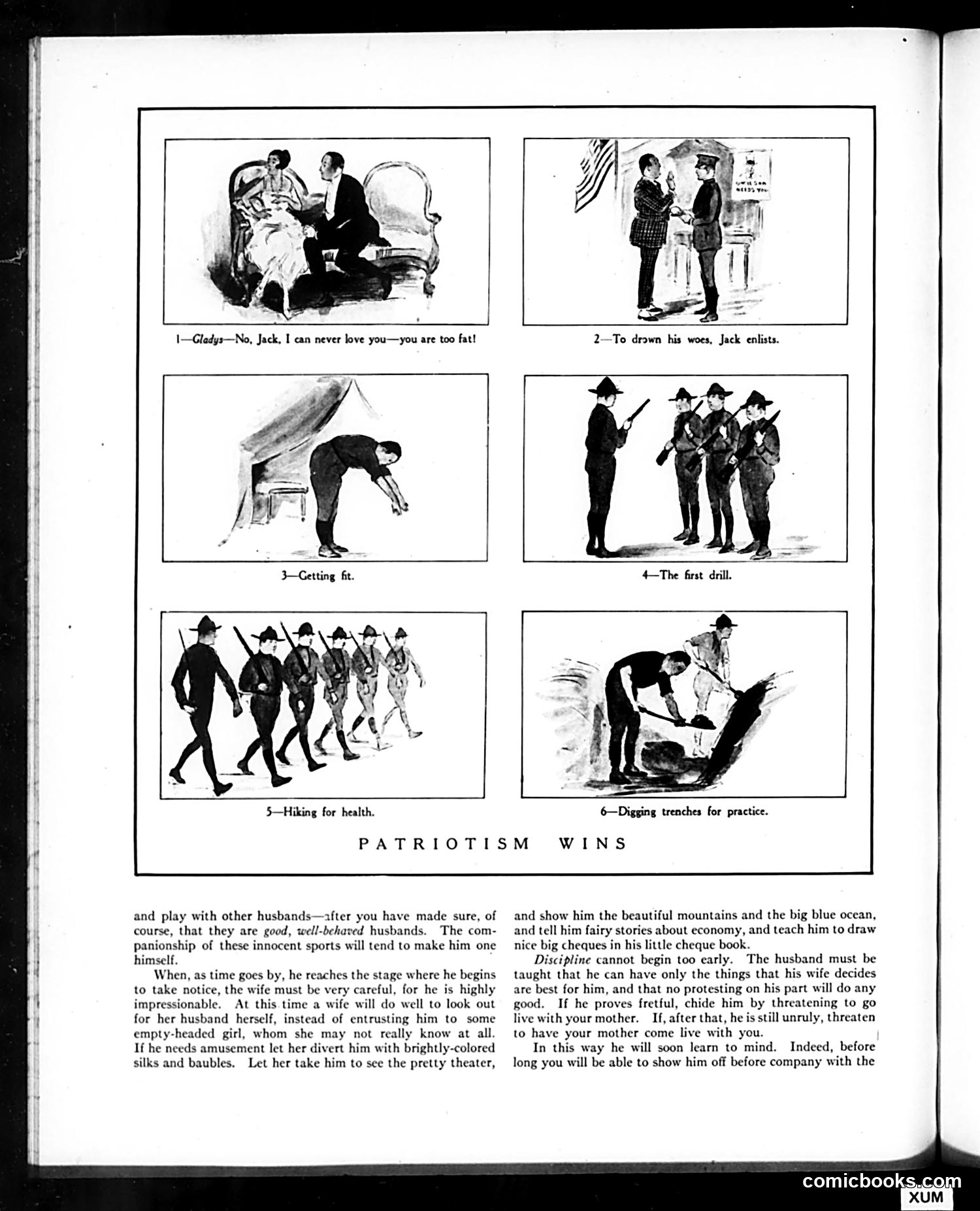
This cartoon uses humor to address anxieties about masculinity during World War I. The six panels show a man's transformation from a domestic, pampered husband into a soldier ready for military service—depicted through enlistment, uniform-fitting, drill training, and trench-digging practice. The accompanying text satirizes contemporary advice to wives about "training" husbands like children through discipline, distraction with "brightly-colored silks," and threats of maternal interference. The cartoon's point appears to be ironic: that military discipline and patriotic service will finally make men into responsible adults that civilian wives' nagging never could. The satire targets both overly controlling wives and the notion that husbands need such management—suggesting that patriotic duty and military structure accomplish what domestic life cannot.
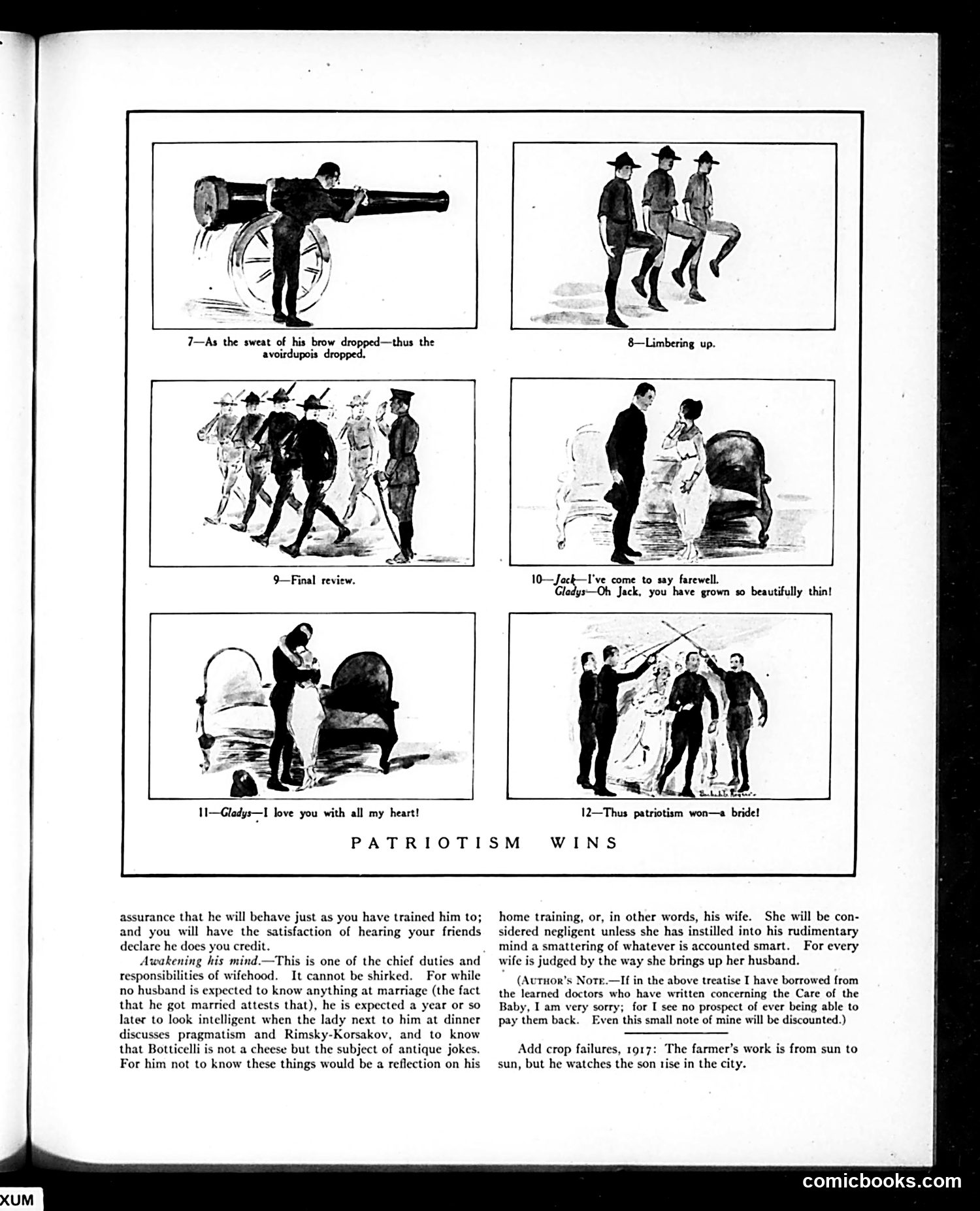
This six-panel comic strip satirizes the supposed romantic and patriotic benefits of military service during World War I. The narrative follows a soldier named Jack who, upon enlisting or deployment, becomes physically transformed—notably thinner and more disciplined through "limbering up" (panel 8) and military training. The satire's point: Gladys, Jack's sweetheart, finds him *more attractive* after he's been worn down by military service, declaring she loves his newfound thinness. The final panel presents this as a triumph of patriotism—the implication being darkly ironic that military service (which visibly diminishes men's health) is somehow beneficial and romantic. The accompanying text about wives' duties mocks domestic expectations, further emphasizing how this era weaponized patriotism and gender roles. The humor is cynical: the "bride" is won not through romance but through a man's physical degradation by war.
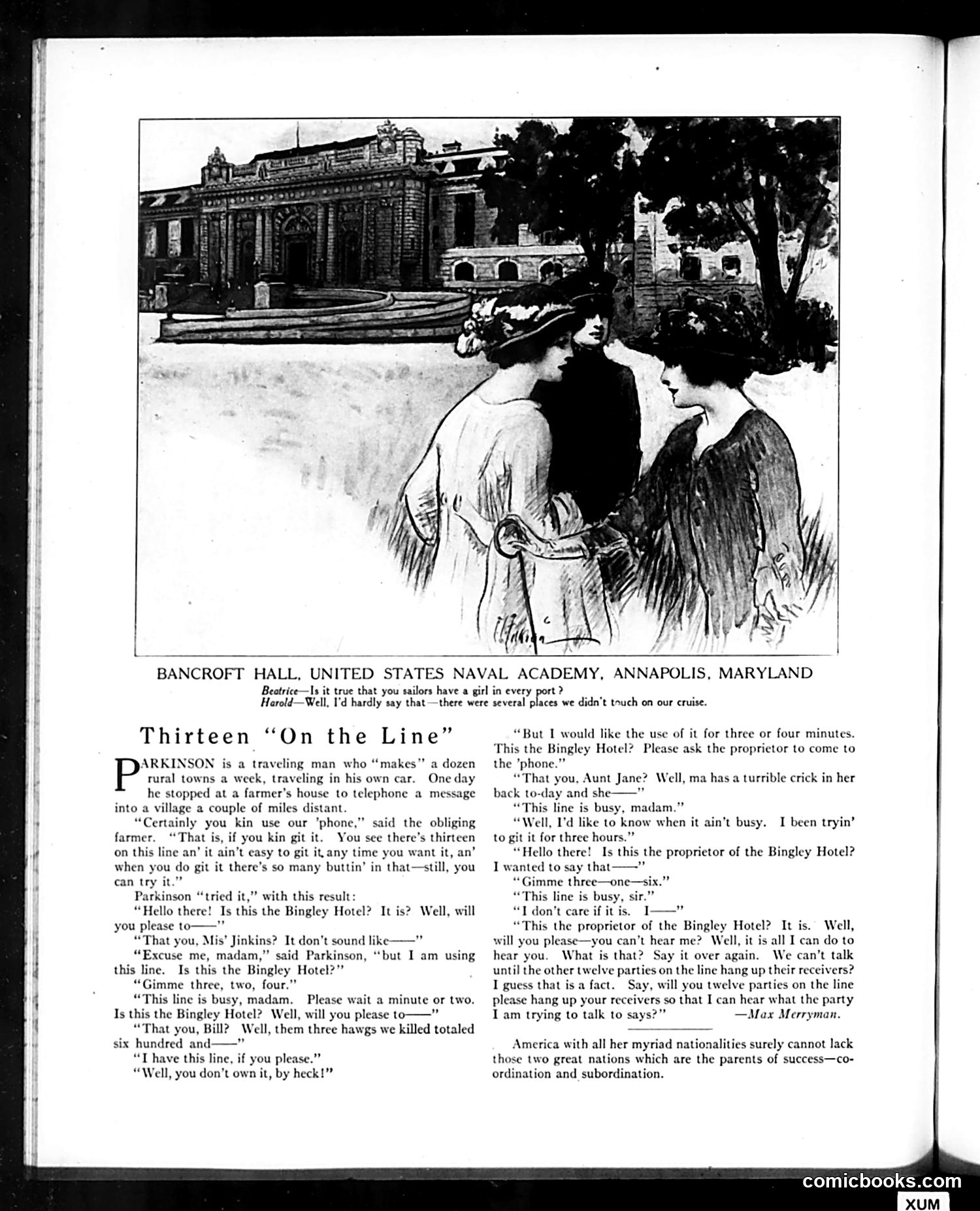
This comic satirizes the frustrations of **shared party-line telephone systems** common in rural America. A traveling salesman (Parkinson) attempts to use a farmer's phone to make a business call but encounters chaos: thirteen parties share the same line, and multiple people constantly interrupt—gossiping about sick relatives, dead hogs, and personal matters. The joke exposes the lack of privacy and coordination on rural party lines, where users had no exclusive access and anyone could pick up mid-conversation. The final ironic commentary suggests America needs better "coordination and subordination"—implying that even basic telephone etiquette requires social discipline. The upper illustration shows two women at Naval Academy grounds, humorously implying sailors have romantic interests everywhere, contrasting with the "on the line" chaos below. The satire targets rural infrastructure limitations and social disorder.
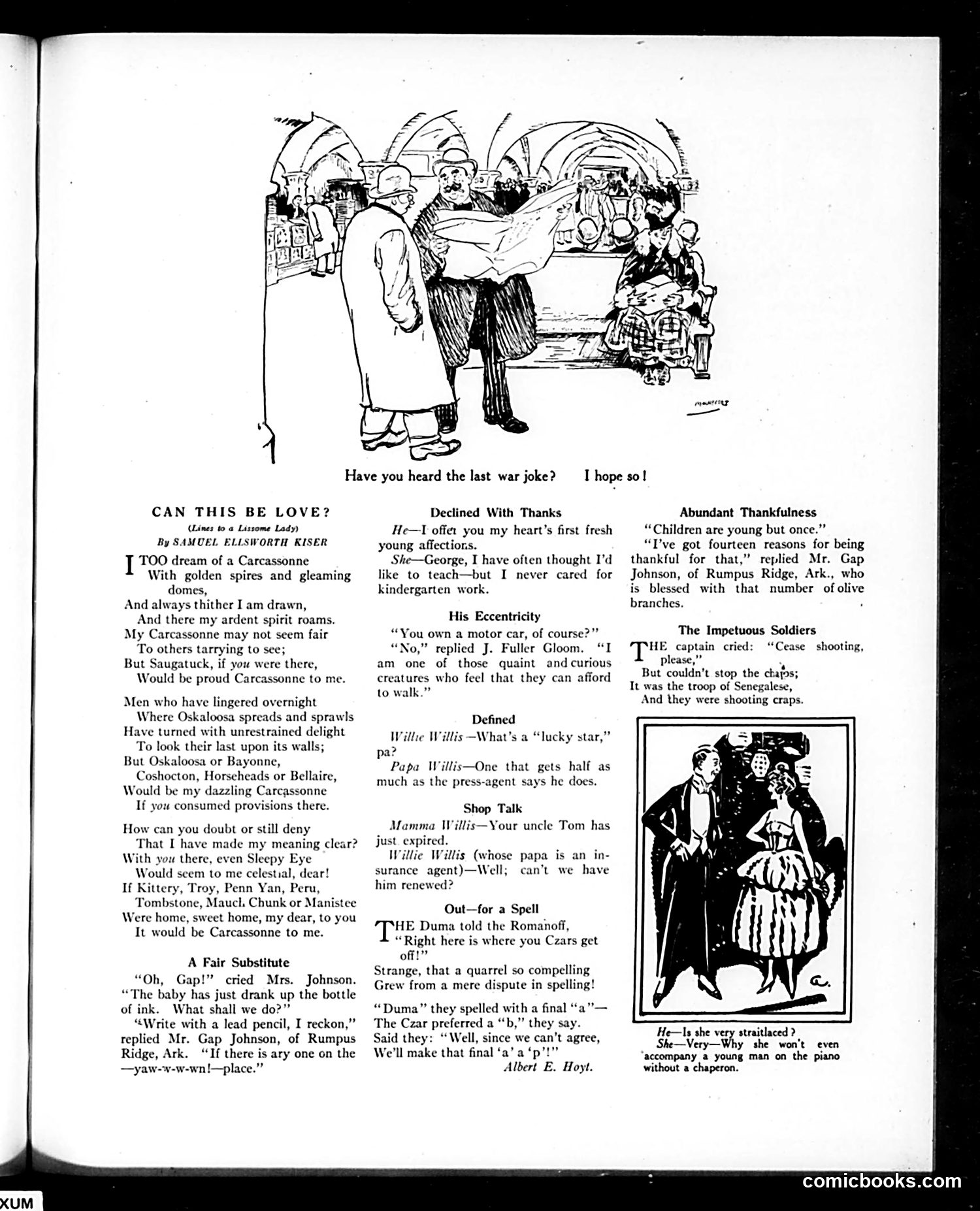
This page contains humorous prose and verse typical of Judge's satirical content, circa early-to-mid 20th century. **Main items:** The large cartoon depicts what appears to be a wartime or refugee scene with soldiers and civilians in an arched shelter, accompanying the opening joke "Have you heard the last war joke?" The poems and short humor pieces use rural American place names (Carcassonne, Saugatuck, Oskaloosa) for comedic effect—turning obscure towns into romantic ideals. Several items mock contemporary domestic life: a joke about using pencil instead of ink, and references to large families ("fourteen olive branches"). **Notable satirical pieces:** - "His Eccentricity" mocks wealthy eccentricity (refusing cars while wealthy) - "Willie Willis" jokes about insurance agents - "Out—for a Spell" appears to satirize Russian politics, referencing the Duma and Tsar in a spelling dispute (unclear historical reference) - "Impetuous Soldiers" puns on Senegalese troops shooting dice ("craps") The humor relies on wordplay, domestic absurdity, and light social observation rather than sharp political commentary.
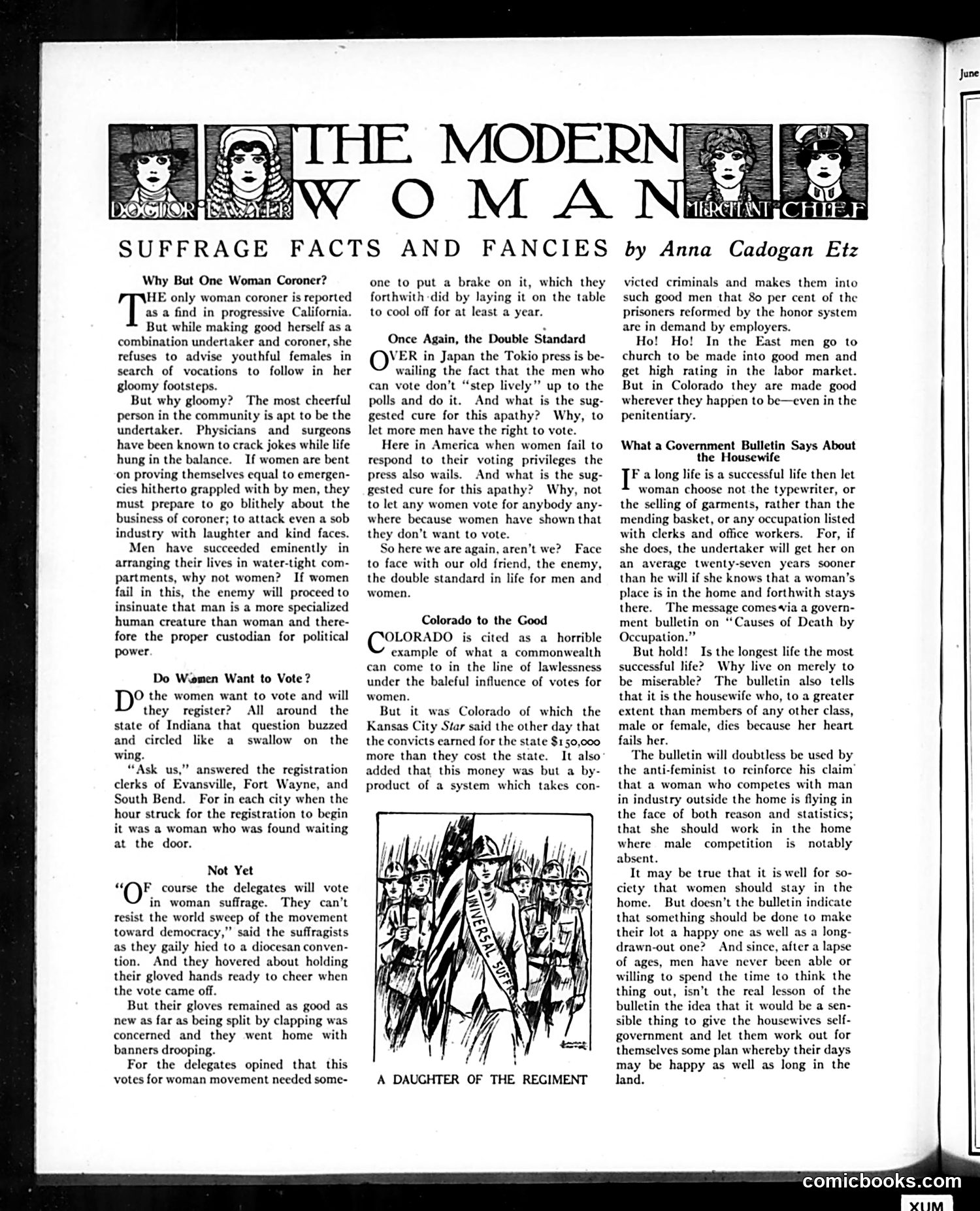
This page by Anna Cadogan Etz presents satirical arguments defending women's suffrage circa 1910s. The cartoon "A Daughter of the Regiment" (center) depicts a woman marching with soldiers, symbolizing women's civic participation and equality. Etz's sections expose anti-suffrage hypocrisy: She highlights the "double standard"—when men don't vote in Japan, authorities suggest expanding male voting rights; when women neglect voting in America, opponents claim women shouldn't vote at all. The "Colorado to the Good" section ironically praises Colorado's progressive criminal reform system while noting that the same state granted women suffrage, contradicting claims that women's votes cause social decay. Throughout, Etz employs sarcasm to challenge dismissals of women's professional capabilities (the reluctant female coroner) and exposes discriminatory logic preventing women's political participation. The overall message: suffrage opponents apply inconsistent standards and ignore evidence of women's competence.
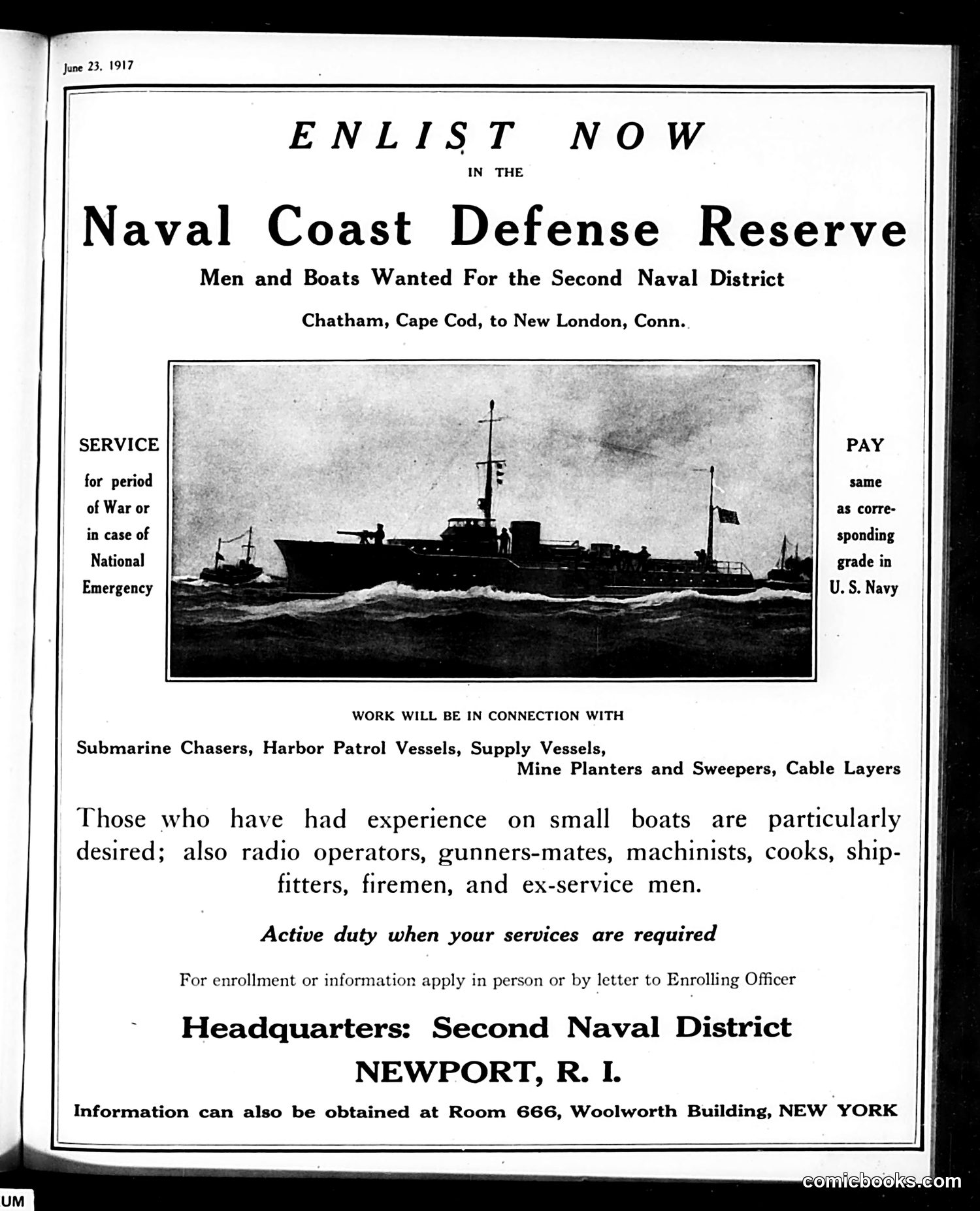
This page is primarily a **U.S. Navy recruitment advertisement** rather than satire or political cartoon. Dated June 23, 1917—shortly after America's entry into World War I—it recruits men for the Naval Coast Defense Reserve. The ad features a warship image and calls for volunteers with maritime experience for submarine-chasing, harbor patrol, and mine-sweeping operations along the New England coast (Cape Cod to Connecticut). It emphasizes that pay equals corresponding Navy grades and that service is required "when your services are required"—essentially a reserve arrangement. The recruitment targets experienced boat handlers, radio operators, gunners, machinists, cooks, and ex-military personnel. The prominent placement in *Judge* magazine indicates government advertising during wartime mobilization. There is no apparent satire here—this is straightforward wartime recruitment messaging aimed at readers who might have coastal or maritime experience.
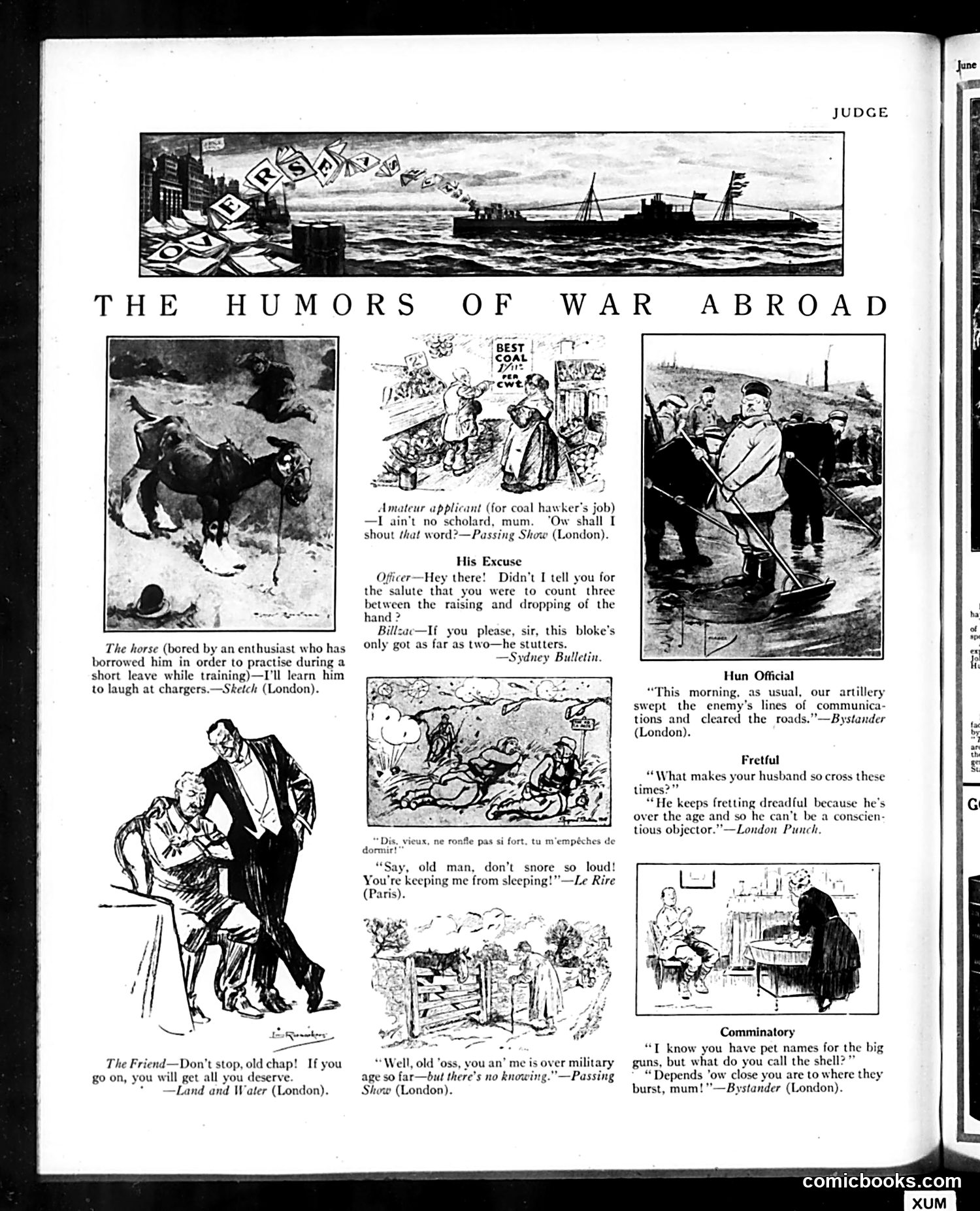
This Judge page collects wartime humor from various Allied publications, satirizing WWI absurdities. The jokes target: **Military incompetence**: A soldier can only count to two, explaining his faulty salute; an officer tries practicing cavalry charges on a borrowed, exhausted horse. **Class/education gaps**: An illiterate coal-hawker applicant struggles with formal language, highlighting working-class exclusion. **Domestic frustration**: A husband resents being "over age" for conscription—unable to serve yet unable to claim conscientious objector status, creating bureaucratic absurdity. **War's casual horror**: Soldiers casually nickname artillery shells by their impact radius ("depends 'ow close you are to where they burst, mum"). **German propaganda**: A "Hun Official" boasts of routine military operations in sterile language, mocking enemy communication. The page mixes light domestic comedy with darker observations about militarization, age restrictions, and how war permeates civilian life. The satire emphasizes chaos, incompetence, and the human cost of mechanized warfare.
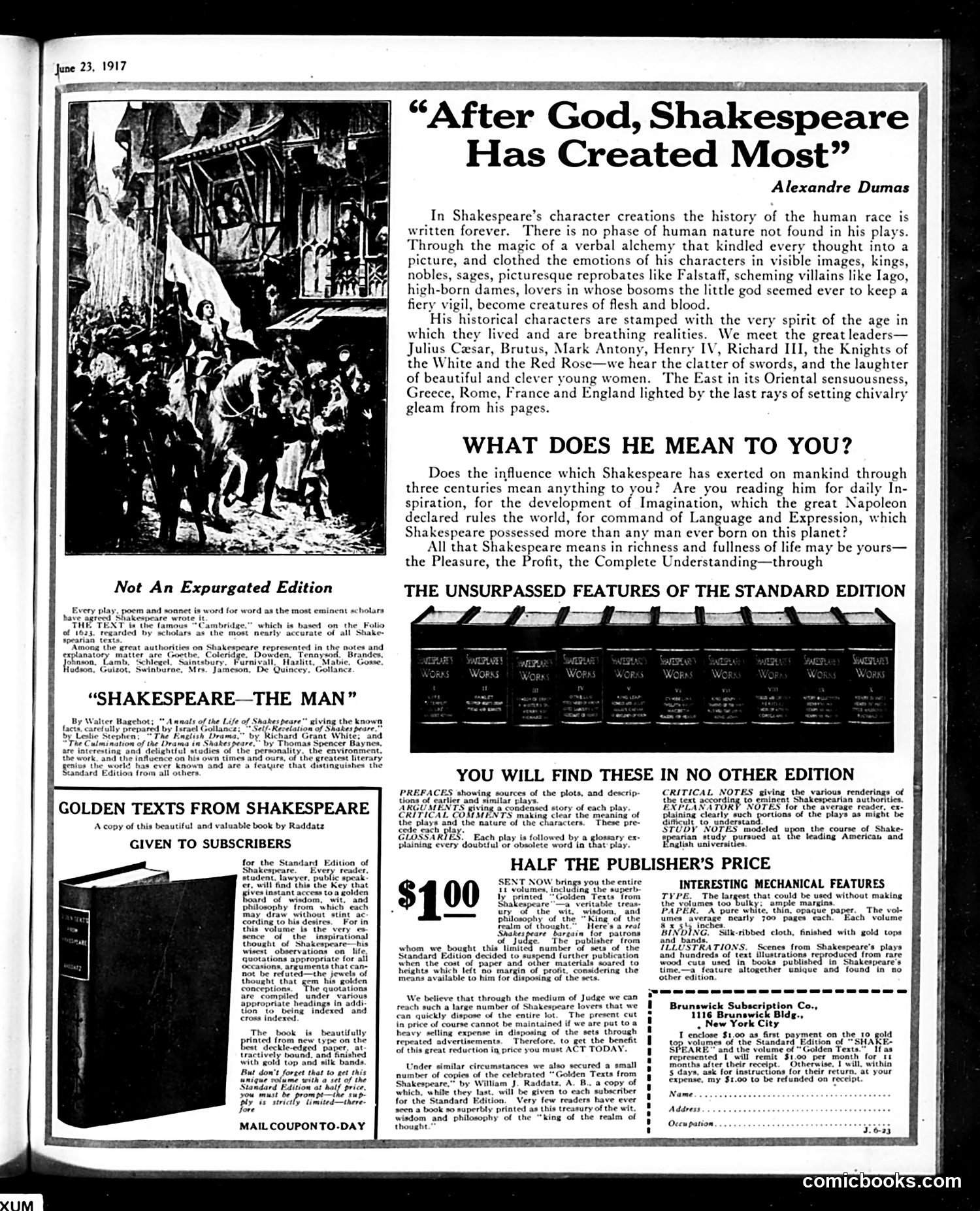
This page is primarily **advertising**, not political satire. It promotes a "Standard Edition" of Shakespeare's complete works to Judge magazine readers. The advertisement uses Alexandre Dumas's quote praising Shakespeare to argue the playwright's universal relevance—appealing to readers' aspirations for self-improvement, imagination, and eloquence. The dramatic engraving shows a theatrical scene, emphasizing Shakespeare's cultural prestige. The marketing pitch emphasizes exclusivity: this edition includes features "found in no other edition"—prefaces, critical notes, glossaries, and biographical material. The publisher claims to have bought limited remaining sets before production ceased due to wartime paper shortages and rising costs, creating artificial scarcity. At $1.00 (advertised as "half the publisher's price"), this targets middle-class readers seeking cultured self-education. The coupon at bottom solicits mail orders. This reflects 1917 America's reverence for classical literature as a marker of refinement and respectability.
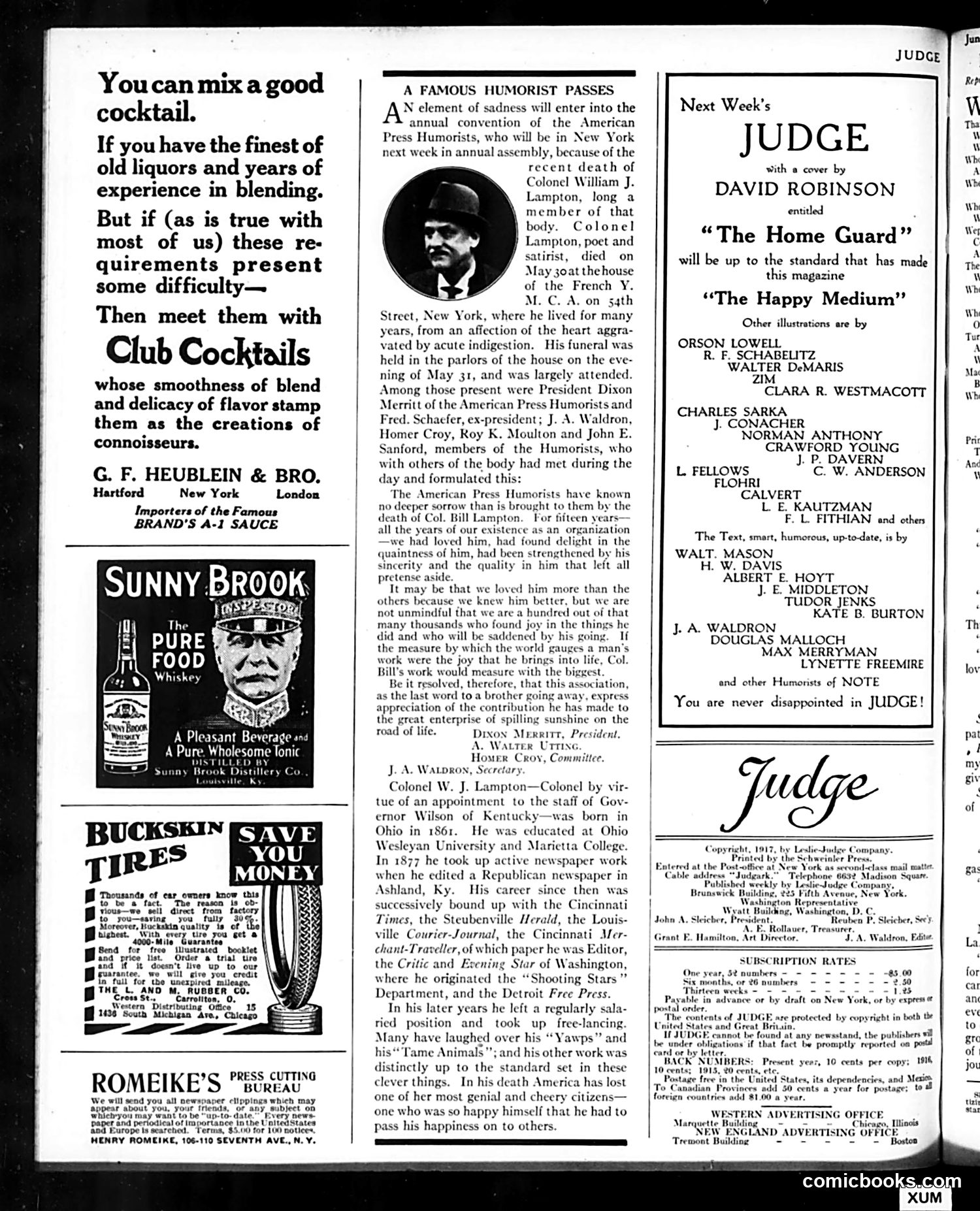
This is primarily a **memorial page** about Colonel William J. Lampton, a prominent humorist and poet who died on May 30. The text is an obituary and tribute by the American Press Humorists organization, which mourned his loss. **Who he was:** Lampton (born 1861) was an accomplished writer and editor across major newspapers including the Cincinnati Times and Detroit Free Press. He was known for creating the "Shooting Stars" newspaper column and for his genial, witty personality. **Why it mattered:** The tribute emphasizes that Lampton brought "joy" and "sunshine" to readers' lives through his humor and kindness. As the resolution states, he measured his work not by size but by "the joy that he brings into life." **The satire context:** Judge was a satirical magazine, though this particular page is unusually sincere—a genuine tribute to a respected colleague rather than satirical commentary. It shows how humor writers valued Lampton as both a craftsman and moral exemplar. The page also contains liquor and tire advertisements typical of the era.
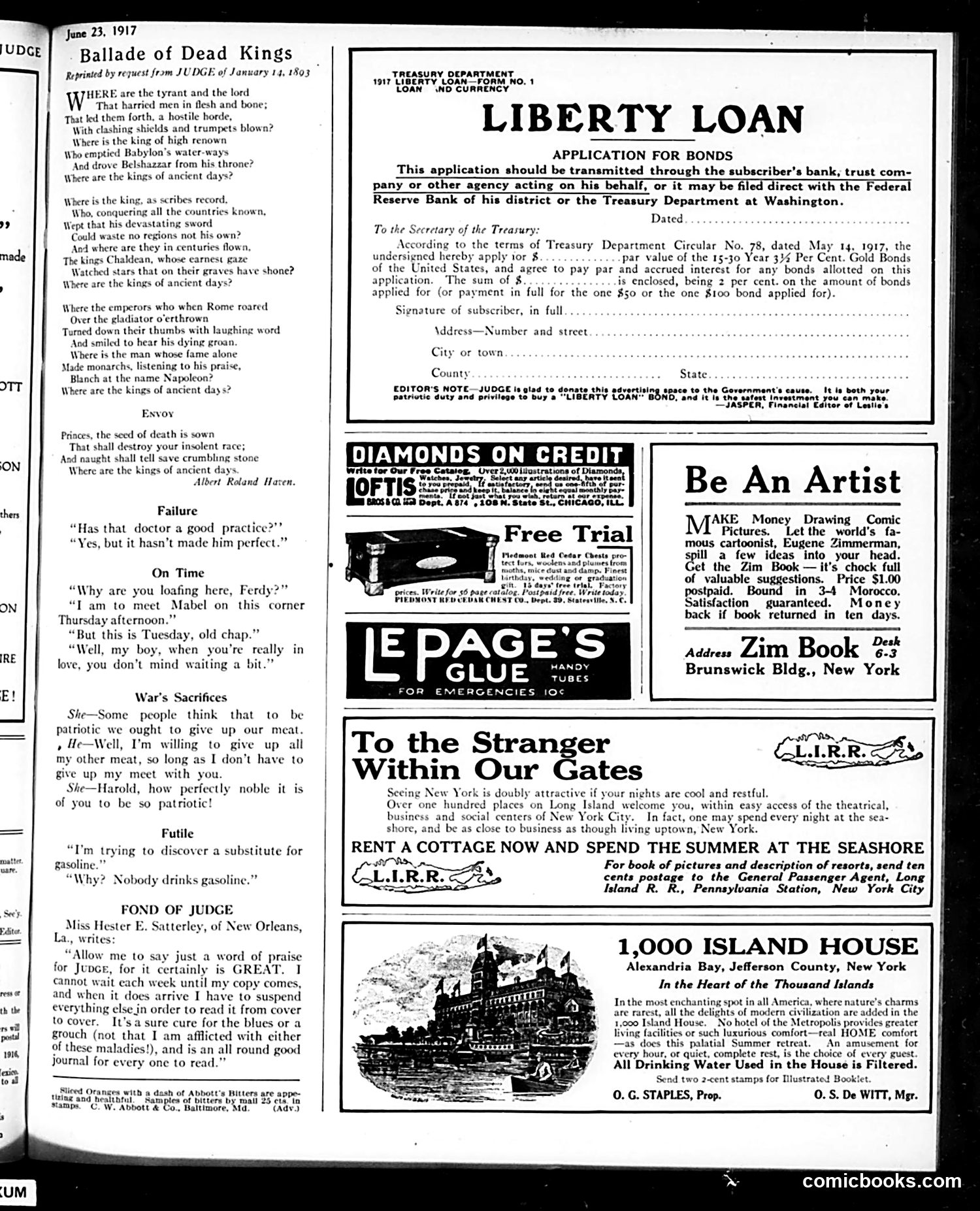
This page is dominated by wartime advertising and fundraising, reflecting America's recent entry into World War I (April 1917). The **"Ballade of Dead Kings"** poem and accompanying **Liberty Loan bond application** work together as propaganda. The poem's repeated refrain "Where are the kings of ancient days?" emphasizes the transience of power and mortality—a subtle argument that current sacrifice for the war effort ensures lasting legacy. The poem's tone suggests that empires and rulers fade, but presumably the nation that wins this war will endure. The **Liberty Loan advertisement** directly below asks readers to purchase government bonds to finance the war. This was a major wartime fundraising mechanism. The page's humor sections ("Failure," "On Time," "War's Sacrifices") are light comic relief typical of Judge's format. "War's Sacrifices" makes a mild joke about meat rationing while maintaining patriotic sentiment. The remaining ads (diamonds, art instruction, cottage rentals) are standard magazine filler unrelated to the war theme. Overall, the page demonstrates how American magazines merged patriotic messaging with commercial advertising during WWI.
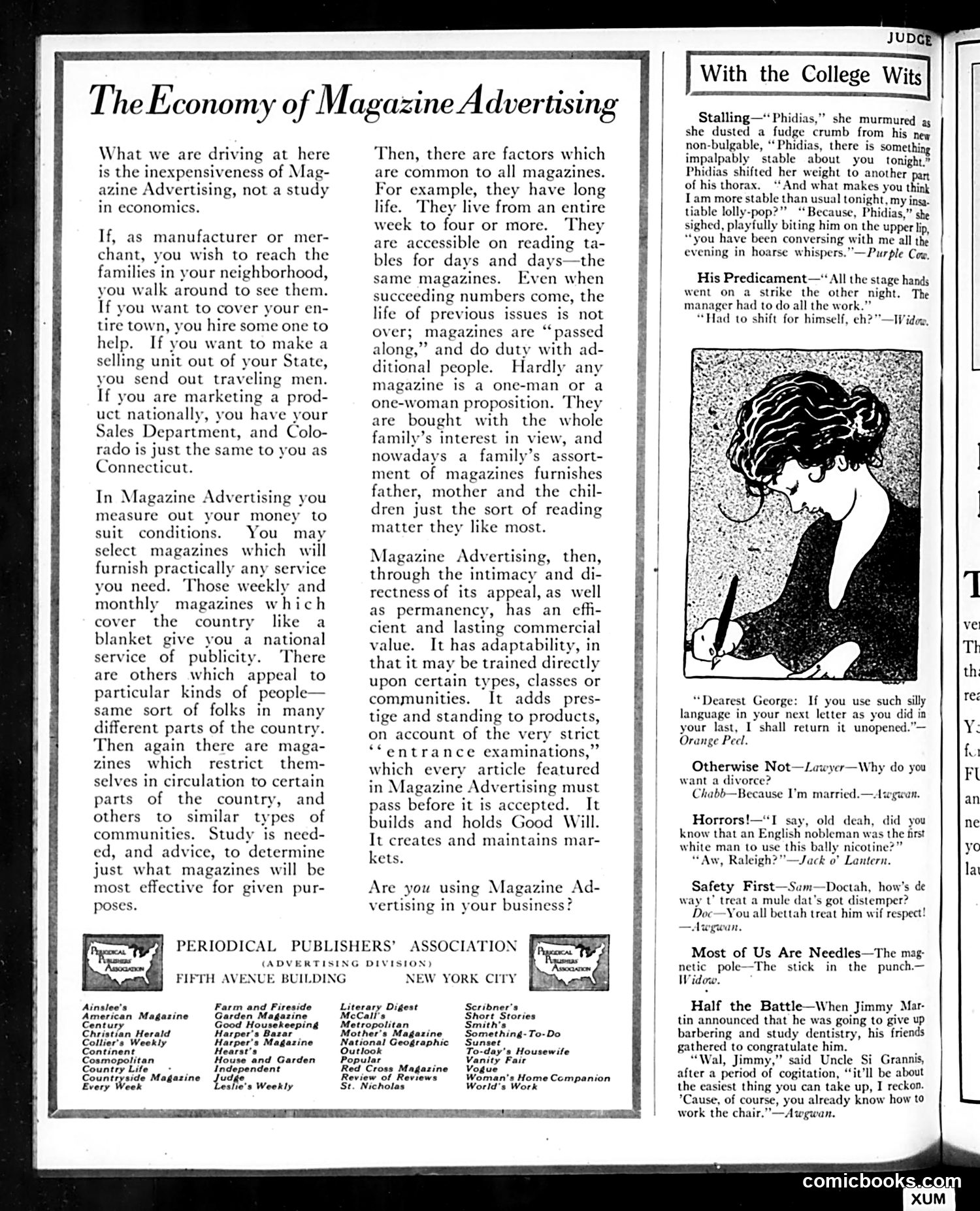
This page is primarily a **trade advertisement** for magazine advertising, published by the Periodical Publishers' Association. The left column argues that magazine advertising is cost-effective because: 1. **Broad reach with flexible targeting** — magazines cover entire nations or specific communities/demographics 2. **Long circulation life** — magazines are read repeatedly and passed between family members over weeks 3. **Family appeal** — whole households read them, providing lasting commercial value 4. **Editorial credibility** — strict "entrance examinations" for featured products build consumer trust The right side contains "College Wits" — brief romantic/comedic anecdotes satirizing college-age courtship and sophistication. These are lighthearted jokes about young people attempting wit and romance, typical of Judge's humor content from this era. The page essentially uses satire and humor content as editorial "filler" surrounding substantive advertising copy, demonstrating the very magazine advertising strategy being promoted.
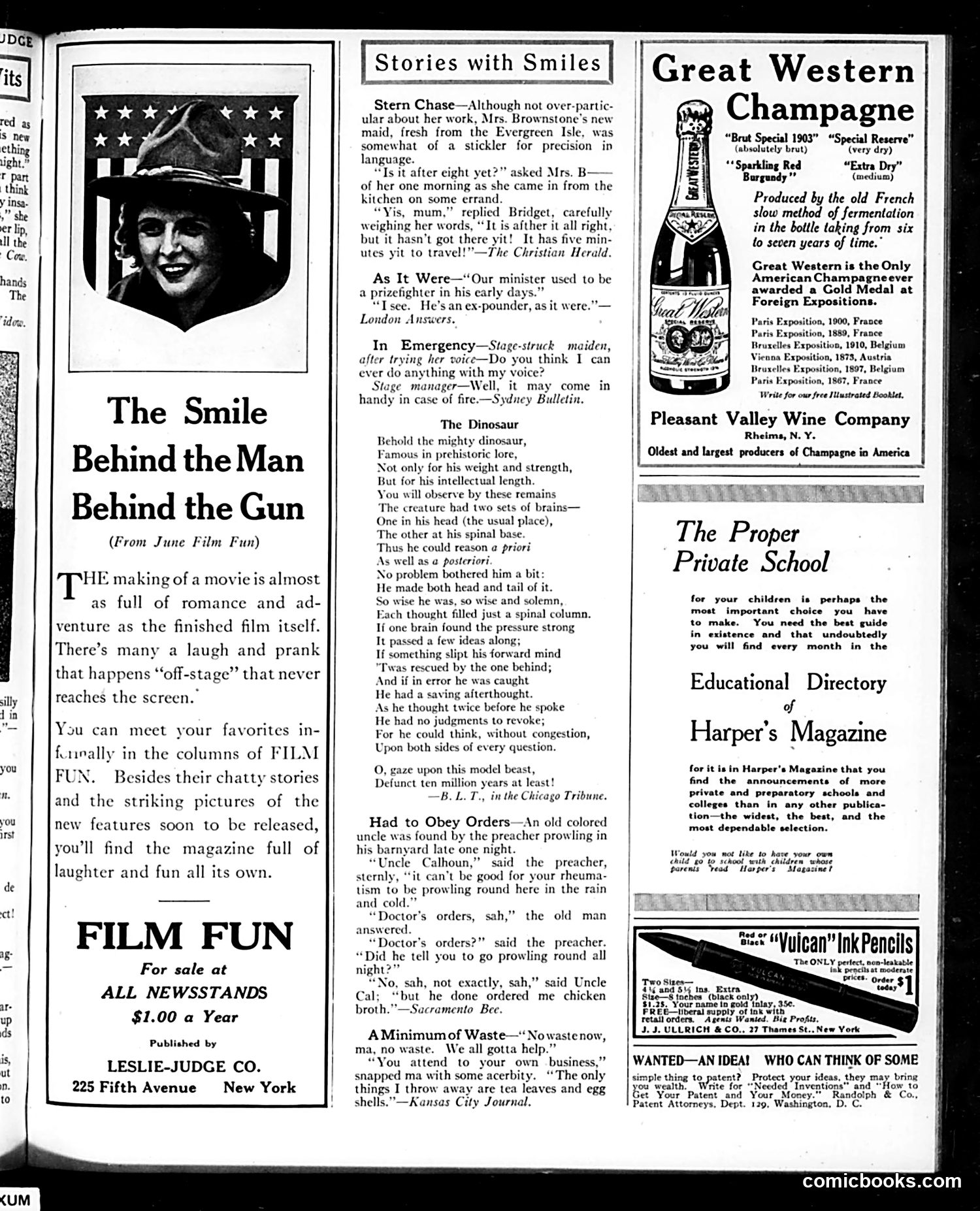
This page is primarily **advertising and promotional content** rather than political satire. The main feature is "The Smile Behind the Man Behind the Gun," promoting *Film Fun* magazine—a Leslie-Judge publication featuring movie-industry anecdotes and photos of new film releases. The article emphasizes behind-the-scenes entertainment value unavailable in finished films themselves. The "Stories with Smiles" section contains generic humorous anecdotes: an Irish maid's precise language, a minister's boxing background, a would-be actress, and an elderly Black man obeying a doctor's nonsensical orders. These are mild, non-satirical jokes typical of the era's light entertainment journalism. The page also advertises **Great Western Champagne**, boasting Gold Medal awards from international expositions, and includes educational directory information for Harper's Magazine and ink pencil promotions. There is **no discernible political cartoon or satirical commentary**—the page functions as a magazine section promoting entertainment and consumer products to Judge's readership.
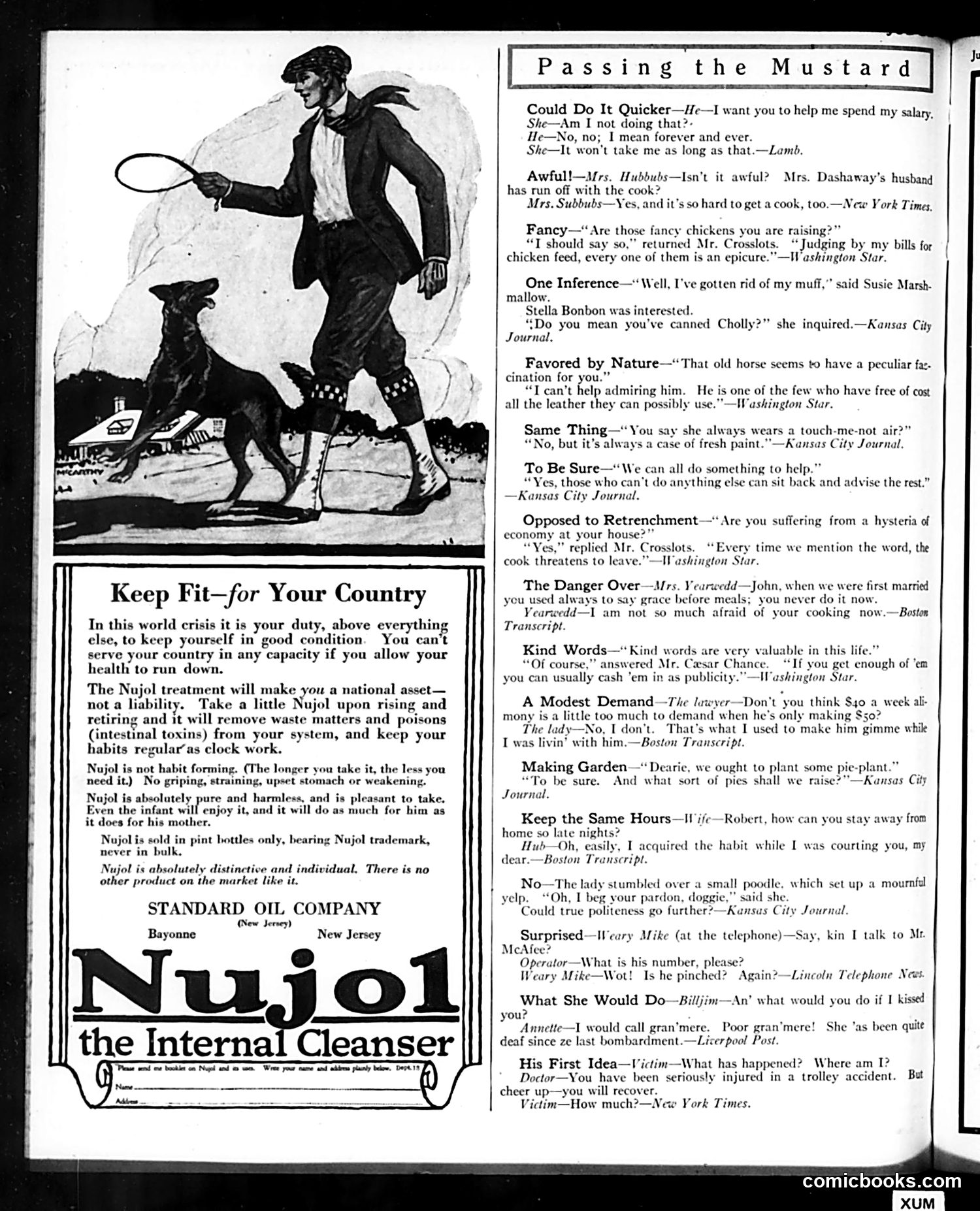
This page is primarily **humorous short jokes and quips** rather than political cartoons. The single cartoon at top-left shows a man in formal dress being confronted by a dog—likely illustrating one of the jokes below, though the specific connection is unclear. The bulk of the page consists of brief comedic dialogues sourced from newspapers (New York Times, Kansas City Journal, Boston Transcript, etc.). These jokes reflect **early 20th-century domestic and courtship humor**: - Marriage anxieties (wives spending money, husbands staying out late) - Gender dynamics (women's fashion, dating customs) - Class/servant issues (difficulty hiring cooks, references to "gran'mere") - Mild innuendo (the "muff" joke plays on double meaning) The humor is genteel and relatively innocent by modern standards. A large **Nujol laxative advertisement** dominates the lower left—typical of Judge's revenue model. The page reflects period concerns: World War I ("serve your country"), domestic economy, courtship rituals, and servant scarcity. The jokes assume a middle-to-upper-class readership familiar with these scenarios.
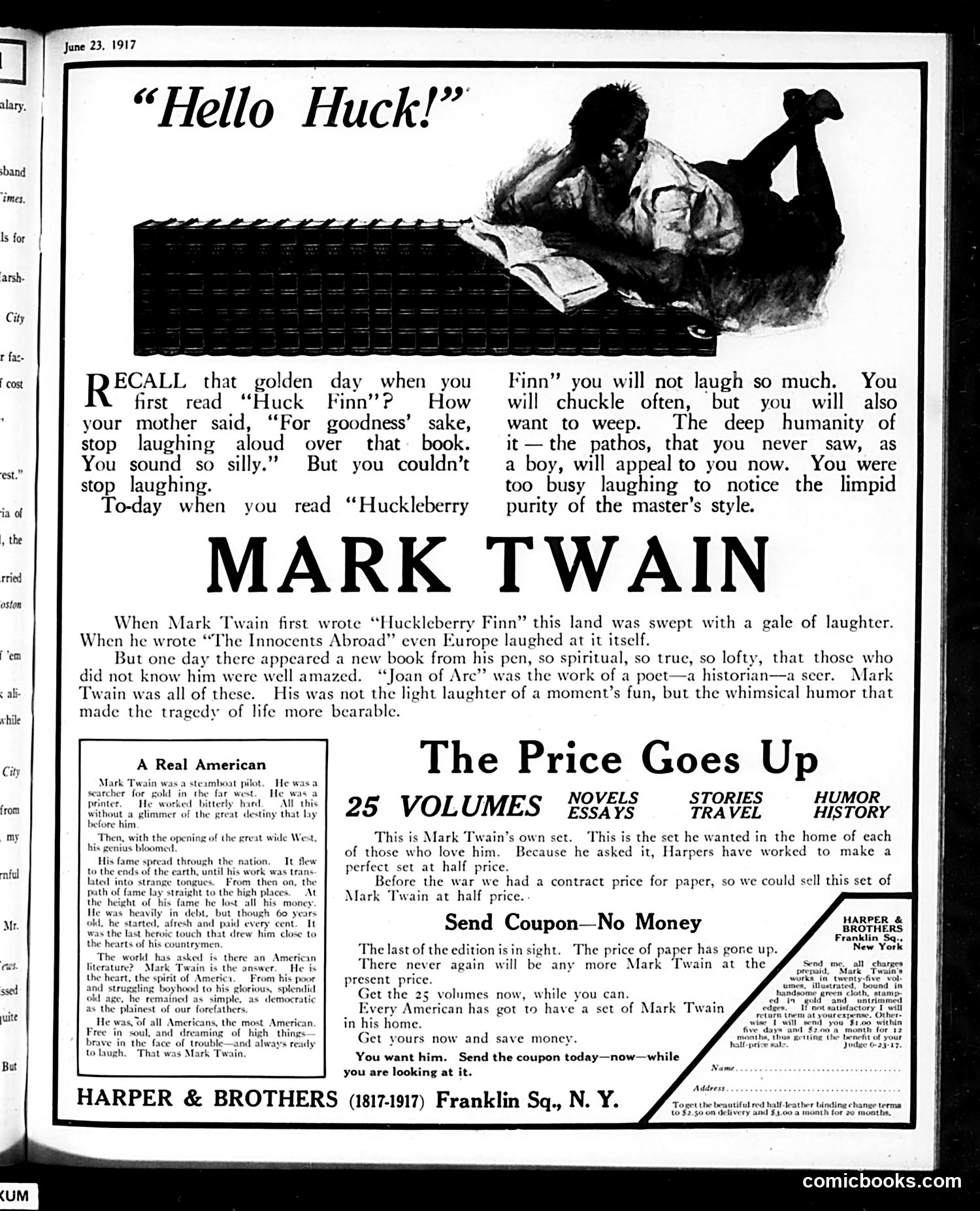
This is primarily a **publisher's advertisement** by Harper & Brothers, not a political cartoon. It promotes a 25-volume collected edition of Mark Twain's works. The page contrasts Twain's **evolution as a writer**: his early works (*Huckleberry Finn*, *The Innocents Abroad*) brought laughter, but later works like *Joan of Arc* revealed him as a serious literary artist—a "poet," "historian," and "seer" capable of addressing life's tragedies with "whimsical humor." The illustration shows a man reading contentedly, emphasizing the intimate act of engaging with Twain's work. **The sales pitch:** Wartime paper shortages have driven up costs. This "last of the edition" is being offered at the pre-war contract price—a time-sensitive deal urging readers to order immediately via coupon. The advertisement appeals to patriotic ownership ("Every American has got to have a set") while exploiting scarcity economics to drive sales.
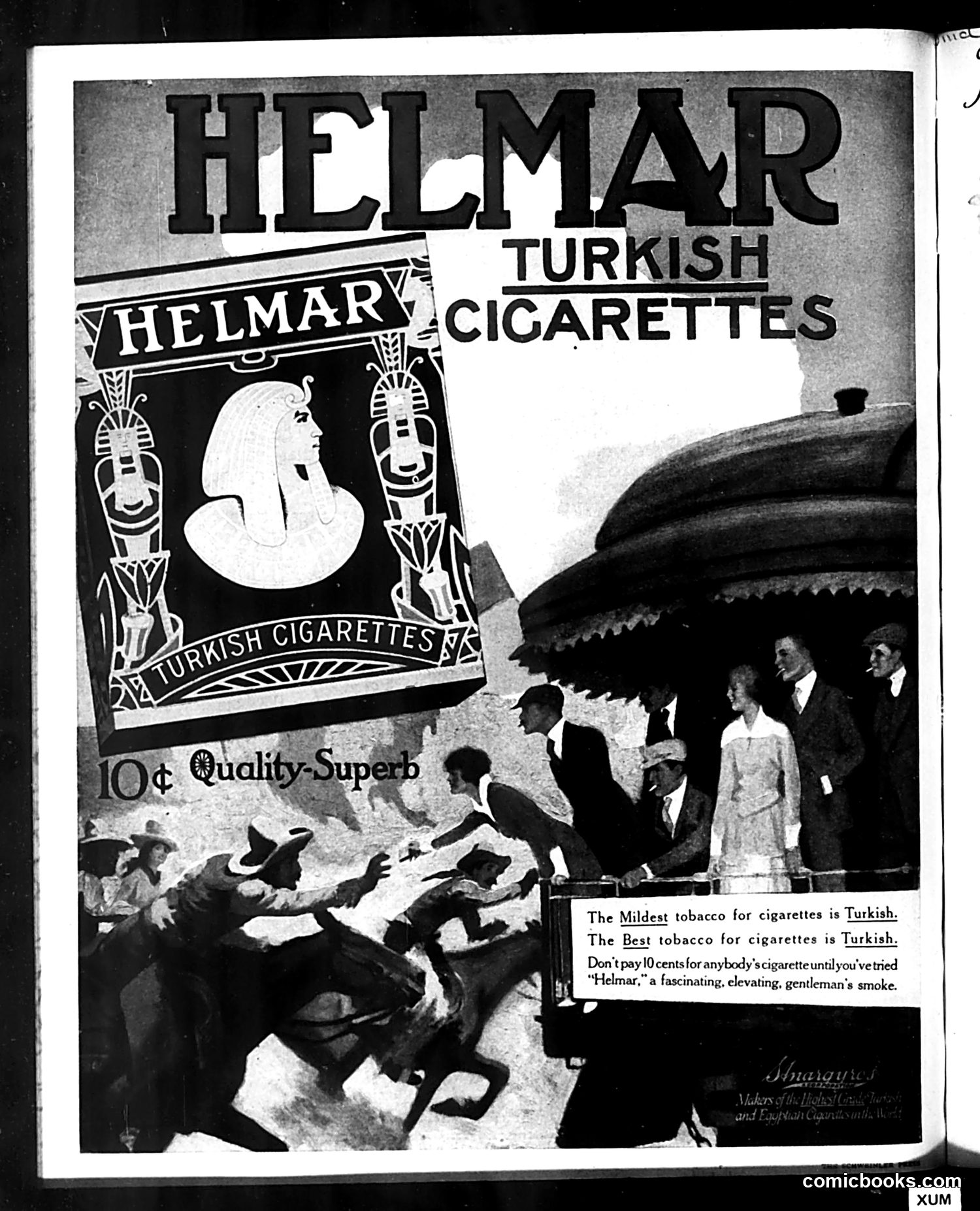
This is a cigarette advertisement for "Helmar" brand Turkish cigarettes, priced at 10 cents. The ad features a package design with an Egyptian pharaoh profile and decorative motifs, accompanied by an image of well-dressed people examining camels—likely evoking the "exotic" appeal of Turkish/Middle Eastern products. The marketing strategy employs several period tactics: claims about tobacco superiority, appeals to masculine gentility ("gentleman's smoke"), and the exotic imagery common in early 20th-century advertising. The juxtaposition of refined urbanites with camels plays on orientalist fascination and the association of Turkish tobacco with luxury and sophistication, a common selling point for tobacco products of this era before modern health warnings existed.