
Judge, 1917-06-23 · page 8 of 28
Judge — June 23, 1917 — page 8: what you’re looking at
What you’re looking at
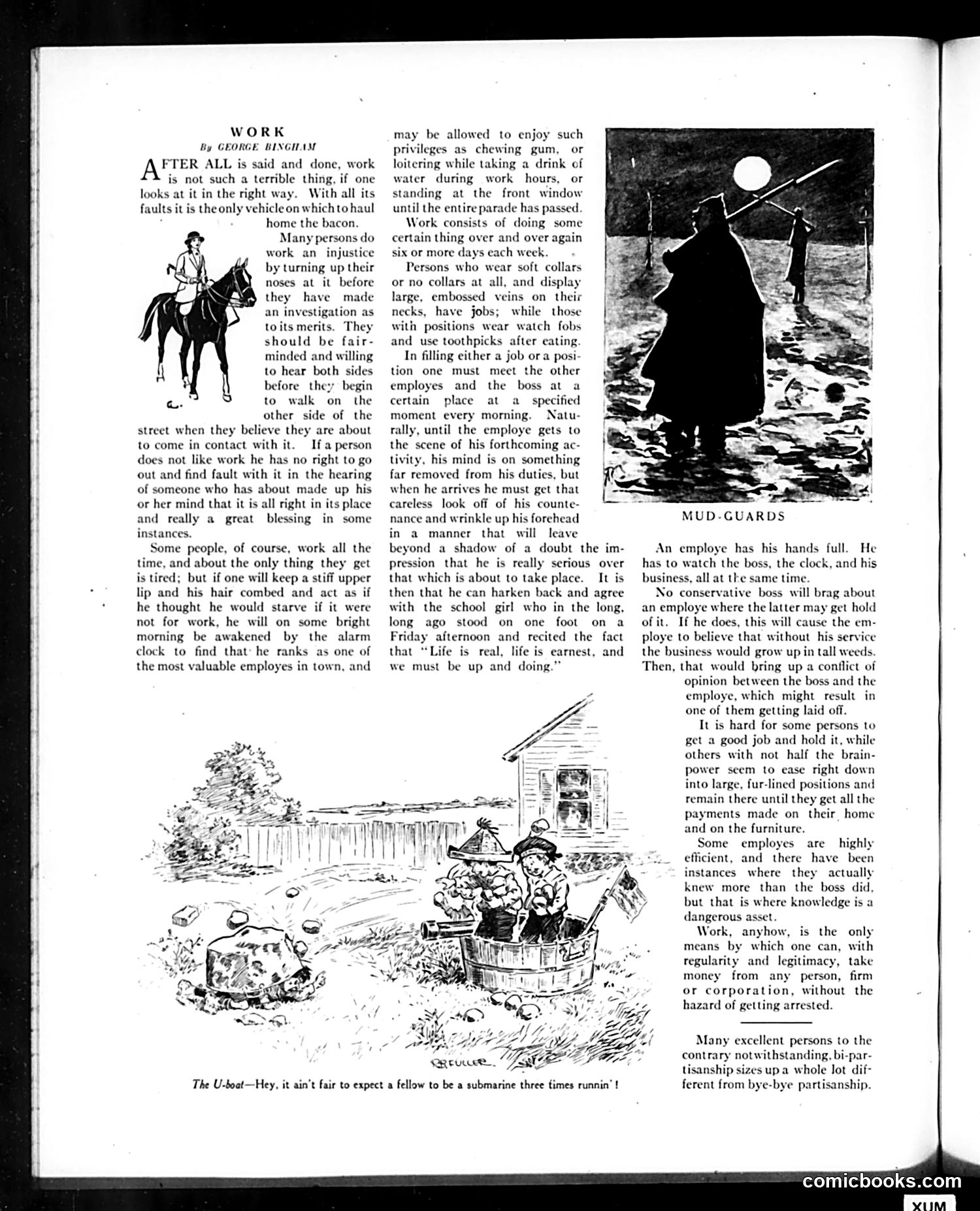
This is a satirical essay with accompanying illustrations mocking workplace culture and employment hierarchies of the early 20th century. **The Main Point:** Bingham cynically describes "work" as a necessary evil that people pretend to value while actually resenting it. The satire targets both workers and employers—workers who must feign seriousness and obedience, and bosses who exploit their labor. **Key Satirical Observations:** - Workers must adopt fake expressions of dedication ("wrinkle up his forehead") to appear serious - The "mud-guards" illustration shows employers juggling surveillance of workers, the clock, and business—implying constant tension - Blue-collar workers ("soft collars...embossed veins") get jobs while others wear status symbols like watch fobs - Knowledge itself is "dangerous" to workers **The Broader Critique:** Bingham satirizes the performative nature of employment—that honest work is the only "legitimate" way to make money (implying skepticism about this claim), yet the system demands dishonesty and self-suppression from workers navigating class divisions and power imbalances.
📄 Transcribed text from this page (OCR, searchable)
Machine-transcribed from the original scan — historical spelling and the odd misread are preserved.
WORK By GEORGE BINGHAM FTER ALL id and done, work is not such a terrible thing, if one looks at it in the right way. With all its faults it is theonly vehicleon which to haul home the bacon. Many persons do work an_ injustice by turning up their noses at it before they have made an investigation as toits merits. They should be fair- minded and willing to hear both side before they begin to walk on the other side of the street when they believe they are about to come in contact with it. Ifa person does not like work he has no right to go out and find fault with it in the hearing of someone who has about made up his or her mind that it is all right in its place and really a great blessing in some instance Some people, of course, work all the time, and about the only thing the: is tired; but if one will keep a stiff upper lip and his hair combed and act as if he thought he would starve if it were not for work, he will on some bright morning be awakened by the alarm clock to find that- he ranks as one of the most valuable employes in town, and may be allowed to enjoy such privileges as chewing gum, or loitering while taking a drink of water during work hours, or standing at the front window until the entire parade has passed. Work consists of doing some certain thing over and over again six or more days each week. Persons who wear soft collars or no collars at all, and displa: large, embossed veins on their necks, have jobs; while those tions wear watch fobs toothpicks after eating. In filling either a job ora posi tion one must meet the other employes and the boss at a certain place at a specified moment every morning. Natu- rally, until the employe gets to the scene of his forthcoming ac- tivity, his mind is on something far removed from his duties, but when he arrives he must get that careless look off of his counte- nance and wrinkle up his forehead in a manner that will leave beyond a shadow of a doubt the im- pression that he is really serious over that which is about to take place. It is then that he can harken back and agree with the school girl who in the long, long ago stood on one foot on a Friday afternoon and recited the fact that “Life is real, life is earnest, and we must be up and doing.’ The U-boat—Hey, it ain't fair to expect a fellow to be a submarine three times runnin’! aes MUD-GUARDS An employe has his hands full. He has to watch the boss, the clock, and his business, all at the same time. No conservative boss will brag about an employe where the latter may get hold of it. If he does, this will cause the em- ploye to believe that without his servi the business would grow up in tall weeds. Then, that would bring up a conflict of opinion between the boss and the employe, which might result in one of them getting laid off. It is hard for some persons to get a good job and hold it, while others with not half the brain- power seem to ease right down into large, fur-lined positions and remain there until they get all the payments made on their home and on the furniture. Some employes are highly efficient, and there have been instances where they actually knew more than the boss did, but that is where knowledge is dangerous asset. Work, anyhow, is the only means by which one can, with regularity and legitimacy, take money from any person, firm or corporation, without the hazard of getting arrested. Many excellent persons to the contrary notwithstanding, bi-par- tisanship sizes up a whole Jot di ferent from bye-bye partisanship. comicbooks.com YLIM