
Judge, 1917-06-23 · page 13 of 28
Judge — June 23, 1917 — page 13: what you’re looking at
What you’re looking at
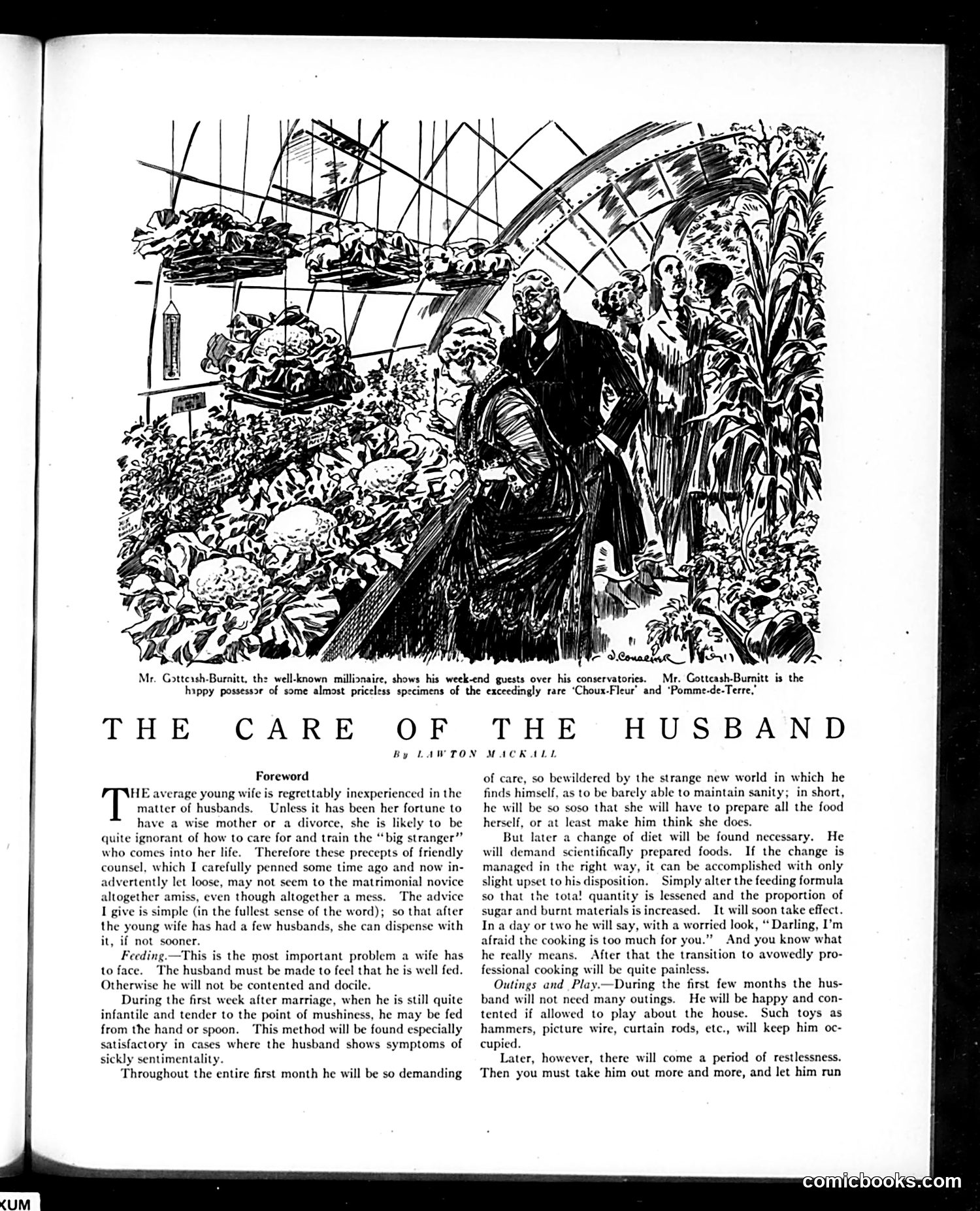
This page contains two distinct pieces from Judge magazine: **The Cartoon (top):** A wealthy millionaire named Gotteash-Burnitt shows weekend guests his conservatory, proudly displaying "priceless specimens" of cabbage (*Choux-Fleur*) and potatoes (*Pomme-de-Terre*)—vegetables with French names. The satire mocks the pretension of the ultra-rich: they're treating common vegetables as exotic rarities, suggesting their ostentatious display of wealth is ridiculous when the "precious" items are actually mundane. **The Article:** "The Care of the Husband" is satirical advice written as if husbands are children or pets requiring training. It parodies period marital advice columns by presenting husband-management as a domestic management problem. The humor derives from treating grown men as infantile beings needing careful feeding, distraction with "toys," and behavioral conditioning—a pointed commentary on contemporary gender dynamics and perhaps the intelligence of men, or the frustration wives experienced with their limited agency. Both pieces contain sharp social satire typical of Judge's approach to American society.
📄 Transcribed text from this page (OCR, searchable)
Machine-transcribed from the original scan — historical spelling and the odd misread are preserved.
Mr. Gotteash-Burnitt, th: well-known millionaire, shows his week-end guests over his conservatories. happy possessor of some almost priceless specimens of the exceedingly rare ‘Choux-Fleur’ and ‘Pomme-de-Terre,’ THE CARE OF By LAWTON Foreword HE average young wife is regrettably inexperienced in the T matter of husbands. Unless it has been her fortune to have a wise mother or a divorce, she is likely to be quite ignorant of how to care for and train the “big stranger” who comes into her life. Therefore these precepts of friendly counsel, which I carefully penned some time ago and now in- advertently let loose, may not seem to the matrimonial novice altogether amiss, even though altogether a mess. The advice I give is simple (in the fullest sense of the word); so that after the young wife has had a few husbands, she can dispense with it, if not soone Feeding.—This is the most important problem a wife has to face. The husband must be made to feel that he is well fed. Otherwise he will not be contented and docile. During the first week after marriage, when he is still quite infantile and tender to the point of mushiness, he may be fed from the hand or spoon. This method will be found especially satisfactory in cases where the husband shows symptoms of sickly sentimentality. Throughout the entire first month he will be so demanding Mr. Gottcash-Burnitt is the THE HUSBAND MACKALL of care, so bewildered by the strange new world in which he finds himself, as to be barely able to maintain sanity; in short, he will be so soso that she will have to prepare all the food herself, or at least make him think she does. But later a change of diet will be found necessary. He will demand scientifically prepared foods. If the change is managed in the right way, it can be accomplished with only slight upset to his dispositio: Simply alter the feeding formula so that the tota! quantity is lessened and the proportion of sugar and burnt materi increased. It will soon take effect. In a day or two he will say, with a worried look, “ Darling, I’m afraid the cooking is too much for you.” And you know what he really means. After that the transition to avowedly pro- fessional cooking will be quite painless. Outings and Play.—During the first few months the hus- band will not need many outings. He will be happy and con- tented if allowed to play about the house. Such toys as hammers, picture wire, curtain rods, etc., will keep him oc- cupied. Later, however, there will come a period of restlessness. Then you must take him out more and more, and let him run