
Judge, 1917-06-23 · page 16 of 28
Judge — June 23, 1917 — page 16: what you’re looking at
What you’re looking at
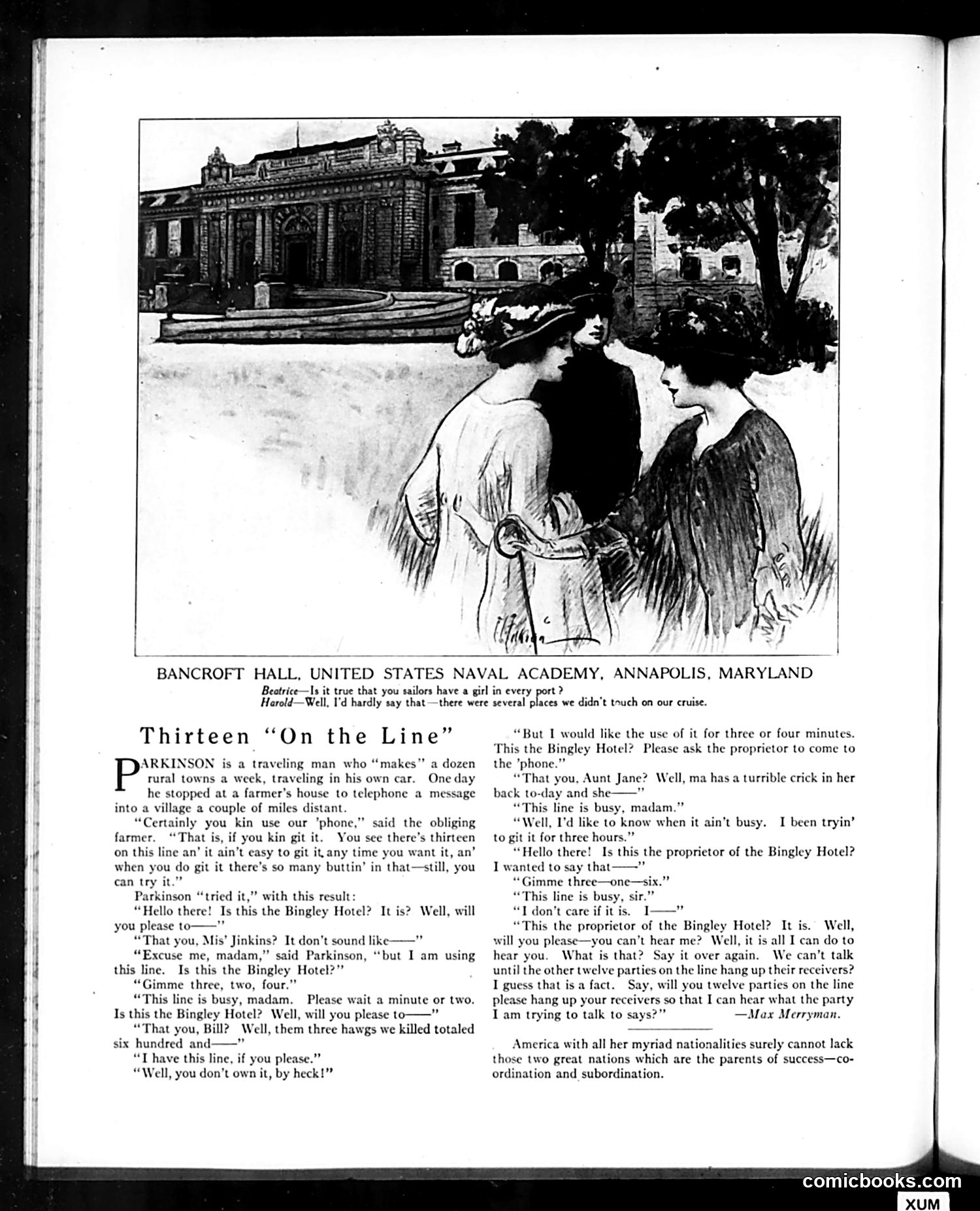
This comic satirizes the frustrations of **shared party-line telephone systems** common in rural America. A traveling salesman (Parkinson) attempts to use a farmer's phone to make a business call but encounters chaos: thirteen parties share the same line, and multiple people constantly interrupt—gossiping about sick relatives, dead hogs, and personal matters. The joke exposes the lack of privacy and coordination on rural party lines, where users had no exclusive access and anyone could pick up mid-conversation. The final ironic commentary suggests America needs better "coordination and subordination"—implying that even basic telephone etiquette requires social discipline. The upper illustration shows two women at Naval Academy grounds, humorously implying sailors have romantic interests everywhere, contrasting with the "on the line" chaos below. The satire targets rural infrastructure limitations and social disorder.
📄 Transcribed text from this page (OCR, searchable)
Machine-transcribed from the original scan — historical spelling and the odd misread are preserved.
L BANCROFT HALL, UNITED STATES NAVAL ACADEMY, ANNAPOLIS, MARYLAND Beatrice—Is it true that you sailors have a girl in every port ? Harold—Well, I'd hardly say that Thirteen “On the Line” ARKINSON traveling man who ‘‘makes” a dozen rural towns a week, traveling in his own car. One day he stopped at a farmer’s house to telephone a message a village a couple of miles distant. ly you kin use our 'phone,” said the obliging ‘That is, ii in git it. You see there's thirteen y to git it any time you want it, an’ when you do git it there’s so many buttin’ in that—still, you can try it.” Parkinson “tried it,” with this result: “Hello there! Is this the Bingley Hotel? It is? Well, will you please to ad “That you, Mis’ Jinkins? It don’t sound like—’ “Excuse me, madam,” said Parkinson, “but I am using this line. Is this the Bingley Hotel?” “Gimme three, two, four.” “This line is busy, madam. Please wait a minute or two. Is this the Bingley Hotel? Well, will you please to——”” “That you, Bill? Well, them three hawgs we killed totaled six hundred and——” “T have this line, if you pleas “Well, you don’t own it, by heck!”” there were several places we didn’t touch on our cruise. “But I would like the use of it for three or four minutes. This the Bingley Hotel? Please ask the proprietor to come to the 'phone.” “That you, Aunt Jane? Well, ma has a turrible crick in her back to-day * sy, madam.” “Well, I'd like to know when it ain't busy. I been tryin’ to git it for three hours.” “Hello there! Is this the proprietor of the Bingley Hotel? I wanted to say that——” Gimme three—one—six.”” “This line is busy, sir.” “T don’t care if it is. “This the proprietor of the Bingley Hotel? It is. Well, will you please—you can’t hear me? Well, it is all I can do to hear you. What is that? Say it over again. We can’t talk until the other twelve parties on the line hang up their receivers? I guess that isa fact. Say, will you twelve parties on the line please hang up your receivers so that I can hear what the party I am trying to talk to says? —Max Merryman. , I— America with all her myriad nationalities surely cannot lack those two great nations which are the parents of success—co- ordination and subordination. comicbooks.com