
Judge, 1917-06-23 · page 10 of 28
Judge — June 23, 1917 — page 10: what you’re looking at
What you’re looking at
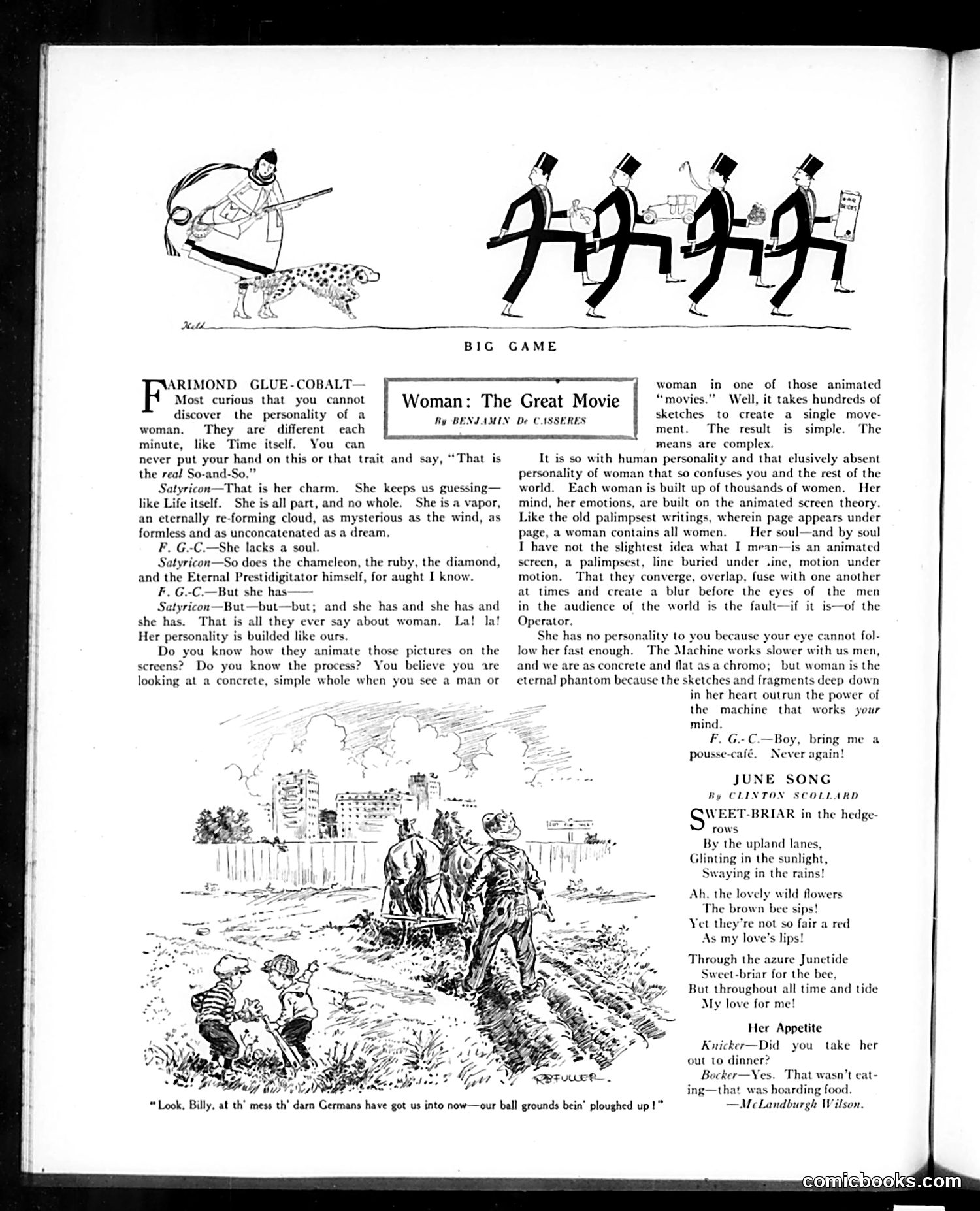
The page contains two main elements: **"Big Game" Cartoon (top):** A satirical illustration showing businessmen in top hats being chased by a hunter with a rifle and hunting dog. The "big game" being hunted is metaphorically the businessmen themselves—likely referencing labor disputes or class conflict of the era. The title suggests wealthy men are the prey being pursued. **"Woman: The Great Movie" Essay (center/right):** A philosophical piece comparing women's personalities to animated films. The author argues women are complex, built from "thousands of women" in layers (like animation frames or palimpsests), making them appear inconsistent or contradictory to men. Rather than criticism, this frames women's apparent changeability as sophisticated complexity—their "personality" moves too fast for men to comprehend, like film frames the eye cannot follow. The bottom illustration depicts soldiers and a rural battlefield, likely WWI-related, with dialogue about baseball fields being "ploughed up"—referring to how war disrupts civilian life. The "June Song" is sentimental poetry about love and nature.
📄 Transcribed text from this page (OCR, searchable)
Machine-transcribed from the original scan — historical spelling and the odd misread are preserved.
— BIG GAME Most curious that you cannot discover the personality of a woman. They are different each minute, like Time itself. You can never put your hand on this or that trait and say, “That is the real So-and-So.”” Satyricon—That is her charm. She keeps us guessing— like Life itself. She is all part, and no whole. She is a vapor, an eternally re-forming cloud mysterious as the wind, as formless and as unconcatenated as a dream, FP. —She lacks a soul. Satyricon—So does the chameleon, the ruby, the diamond, and the Eternal Prestidigitator himself, for aught I know. F. G.-C.—But she has—— Satyricon—But—but—but; and she has and she ha: she has. That is all they say about woman. La! la! Her personality is builded like ours. Do you know how they animate those pictures on the screens? Do you know the process? You believe you are looking at a concrete, simple whole when you see a man or Fs IMOND GLUE-COBALT— “Look, Billy, at th’ mess th’ darn Germans have got us into now—our ball grounds bein’ ploughed up!" Woman: The Great Movie By BENJAMIN De CASSERES woman in one of those animated “movies.” Well, it takes hundreds of sketches to create a single move- ment. The result is simple. The means are complex. It is so with human personality and that elusively absent personality of woman that so confuses you and the rest of the world. Each woman is built up of thousands of women. Her mind, her emotions, are built on the animated screen theory. Like the old palimpsest writings, wherein page appears under page, a woman contains all women. Her soul—and by soul I have not the slightest idea what I mean an animated screen, a palimpsest, line buried under .ine, motion under motion. That they converge, overlap, fuse with one another at times and create a blur before the eyes of the men in the audience of the world is the fault—if it is—of the Operator. She has no personality to you because your eye cannot fol- low her fast enough. The Machine works slower with us men, and we are as concrete and flat as a chromo; but woman is the eternal phantom because the sketches and fragments deep down in her heart outrun the power of the machine that works your mind. FL G.-C. pousse-calé. JUNE SONG Ry CLINTON SCOLLARD WEET-BRIAR in the hedge- rows By the upland lanes, Glinting in the sunlight, Ss ing in the rains! —Boy, bring me a Never again! Ah. the lovely wild flowers The brown bee sips! Yet they're not so fair a red As my love's lips! Through the azure Junetide Sweet-briar for the bee, But throughout all time and tide My love for me! Her Appetite Kuicker—Did out to dinner? Bocker—Yes. That wasn’t eat- ing—that was hoarding food. —McLandburgh Wilson. you take her