
Judge, 1917-06-23 · page 9 of 28
Judge — June 23, 1917 — page 9: what you’re looking at
What you’re looking at
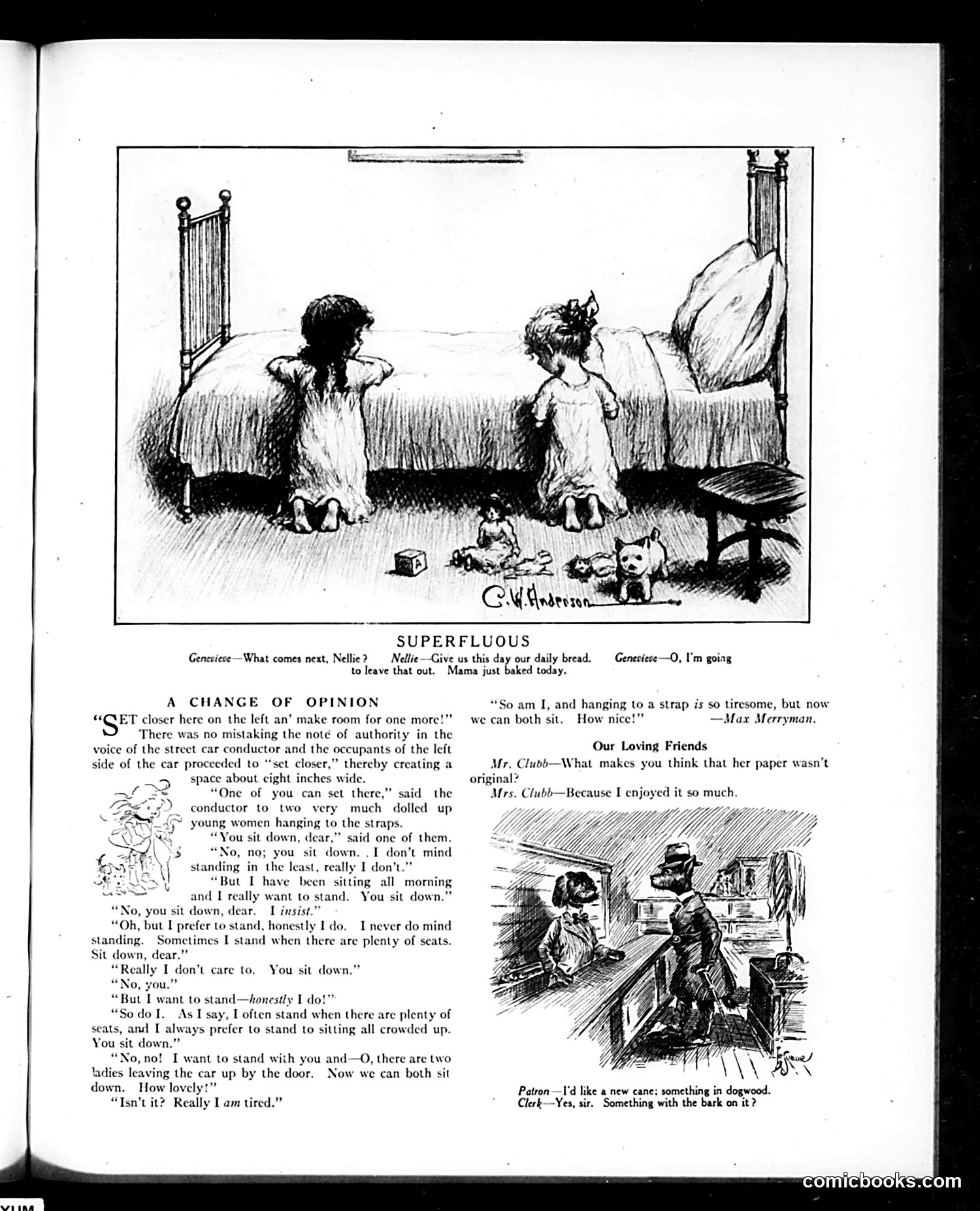
This page contains three separate humorous pieces satirizing early 20th-century social conventions: **"Superfluous"**: A cartoon showing two children at bedtime. One suggests omitting "give us our daily bread" from prayers since mother just baked fresh bread. It mocks literal-minded religiosity and childish logic. **"A Change of Opinion"**: A dialogue between two fashionable young women on a streetcar debating who should sit in a newly available space. Each insists the other sit while claiming she prefers standing—an exaggerated portrayal of performative politeness and false modesty. Both eventually drop the pretense when two more seats appear, revealing their exhaustion. It satirizes affected gentility among young women trying to appear refined. **"Our Loving Friends"**: Two brief anecdotes. The first mocks a woman who plagiarizes but enjoys her own work. The second is a pun: a patron asking for a cane "in dogwood" (the wood type) gets asked if he wants it "with the bark on it" (playing on the phrase's double meaning). The humor relies on observational satire about manners, hypocrisy, and wordplay typical of early Judge magazine.
📄 Transcribed text from this page (OCR, searchable)
Machine-transcribed from the original scan — historical spelling and the odd misread are preserved.
2 teks CN Anders Sima SUPERFLUOUS Genevieve —What comes next, Nellie? to leave that out. A CHANGE OF OPINION “Ss ET closer here on the left an’ make room for one more!” There was no mi: ing the note of authority in the voice of the street car conductor and the occupants of the left side of the car proceeded to “set closer,” thereby creating a space about cight inches wide. “One of you can set there,” said the _ conductor to two very much dolled up >’ young women hanging to the straps. You sit down, dear,” said one of them. down. . I don’t mind standing in the least, really I don’t.” “But I have been sitting all morning and I really want to stand. You sit down.” you sit down, dear. I insist.” “Oh, but I prefer to stand, honestly Ido. I never do mind standing. Sometimes I stand when there are plenty of seats. Sit down, dear.”” Ily I don’t care to. , you.” “But I want to stand—honestly I do!” “So dol. As I say, L often stand when there are plenty of and I always prefer to stand to sitting all crowded up. sit down.” “No,no! I want to stand with you and—O, there are two ladies Ieaving the car up by the door. Now we can both sit down. How lovely!” “Isn't it? Really I am tired.” r>? 5 You sit down.” Nellie—Give us this day our daily bread, Mama just baked today. Geneviece—O, I'm going “So am I, and hanging to a strap is so tiresome, but now we can both sit. How nice!” —Max Merryman. Our Loving Friends Mr. Clubb—What makes you think that her paper wasn’t origina Mrs. Clubb—Because I enjoyed it so much. Patron —I'd like a new cane; something in dogwood. Clerk—Yes, sir. Something with the bark on it ?