
A complete issue · 32 pages · 1917
Judge — May 26, 1917
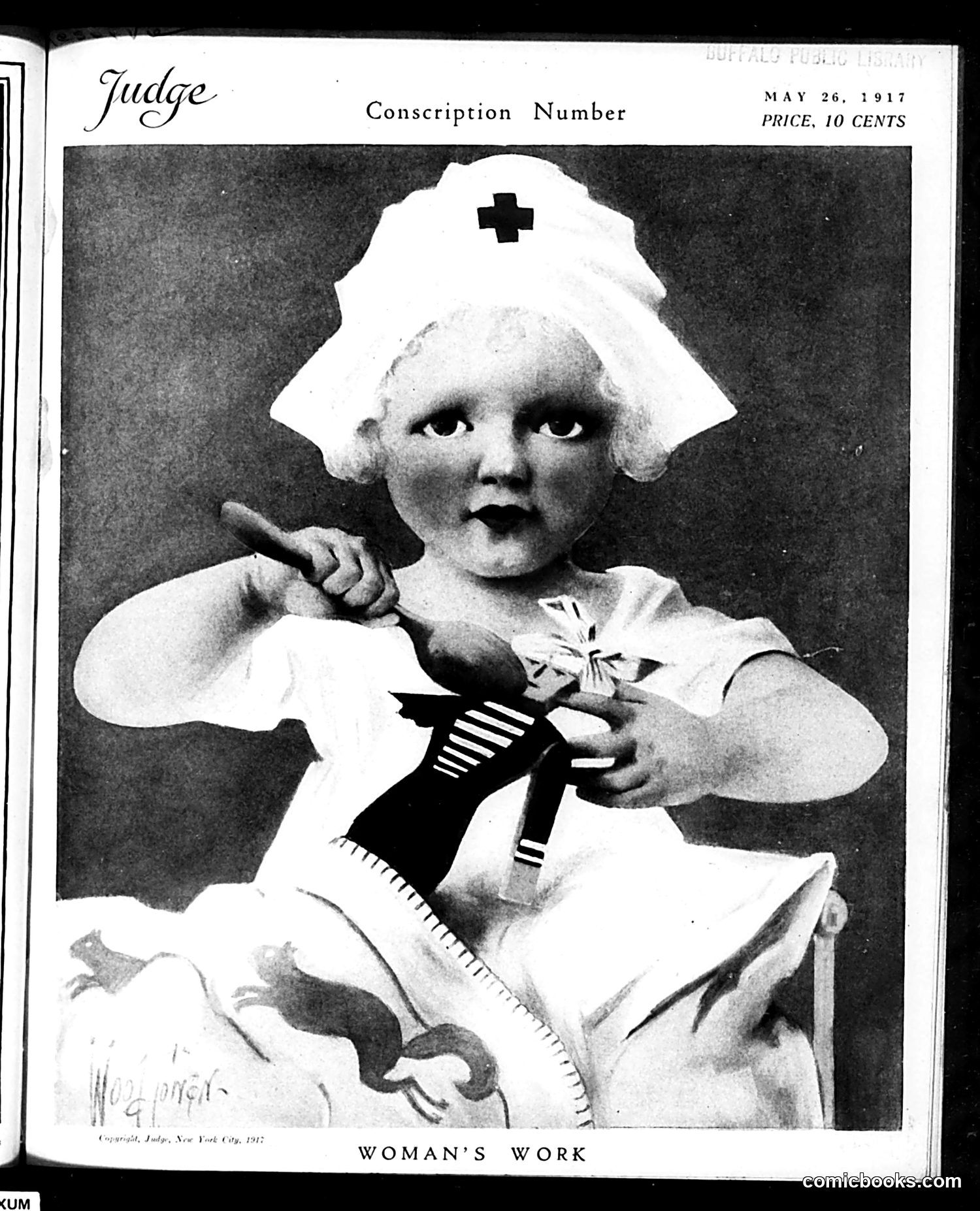
This satirical cover addresses **conscription** during World War I. The image depicts a baby dressed as a nurse (indicated by the white cap with a red cross) holding a scalpel or surgical instrument, with a determined expression. The satire appears to criticize the U.S. military draft by suggesting that conscription forces even the youngest, most unprepared citizens into service—literally depicting a baby as a medical/military worker. The caption "Woman's Work" likely sardonically comments on how conscription affects women or how women are expected to contribute to war efforts. Published May 26, 1917 (shortly after U.S. entry into WWI in April), this reflects contemporary anxieties about the draft's expansion of military obligations to previously exempt populations.
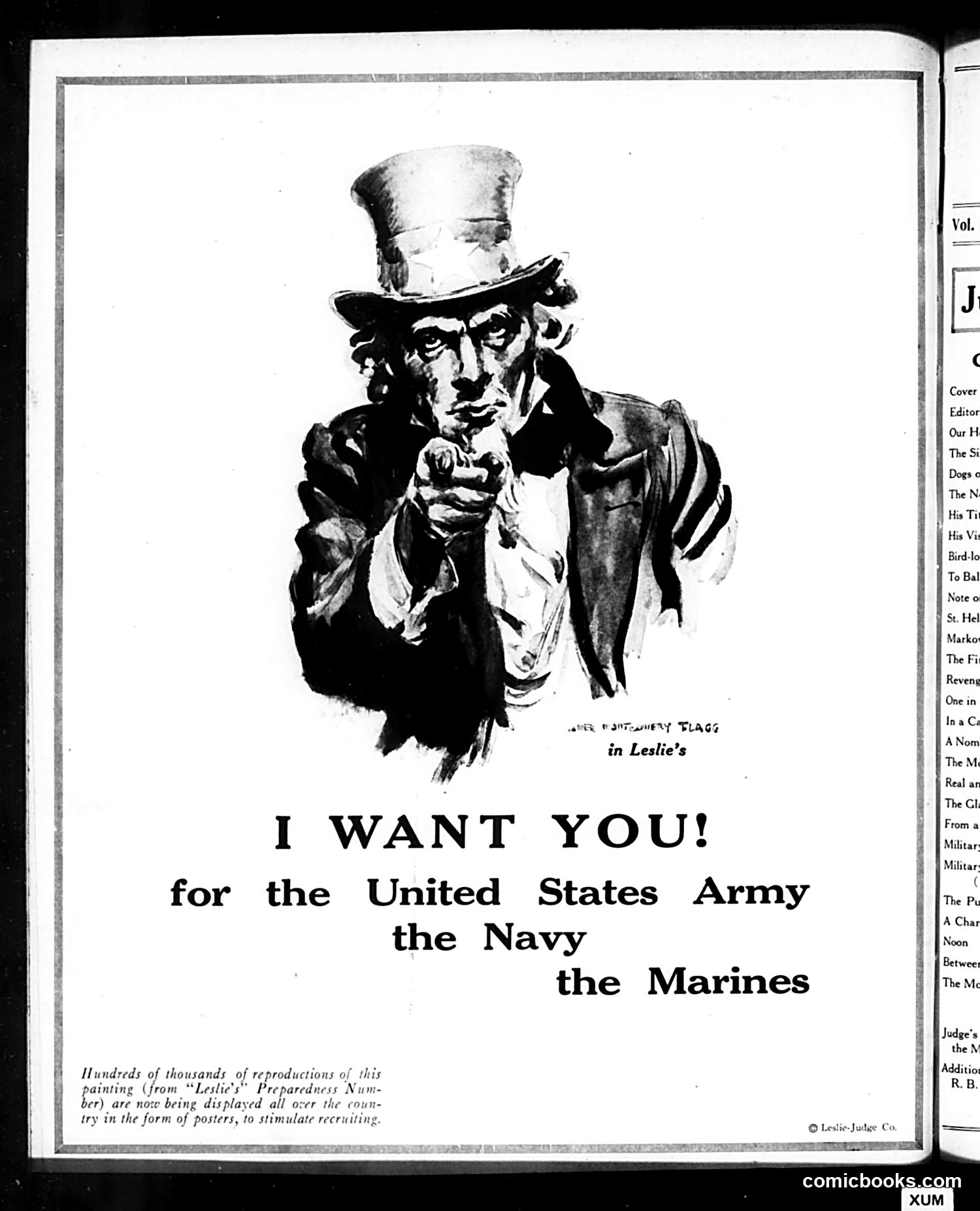
This page reproduces the famous Uncle Sam recruitment poster, one of the most iconic American images. The figure is Uncle Sam—the personification of the United States government—pointing directly at the viewer in a commanding gesture. His stern expression and formal attire (top hat, coat) convey authority. The poster recruits for "the United States Army, the Navy, the Marines," indicating this was created during a period when military service expansion was needed, likely World War I or II. The caption notes that "Leslie's" (Leslie's Illustrated Newspaper) created reproductions distributed nationwide as posters to stimulate recruitment. This demonstrates how magazines and publishers contributed to government propaganda efforts during wartime mobilization campaigns.
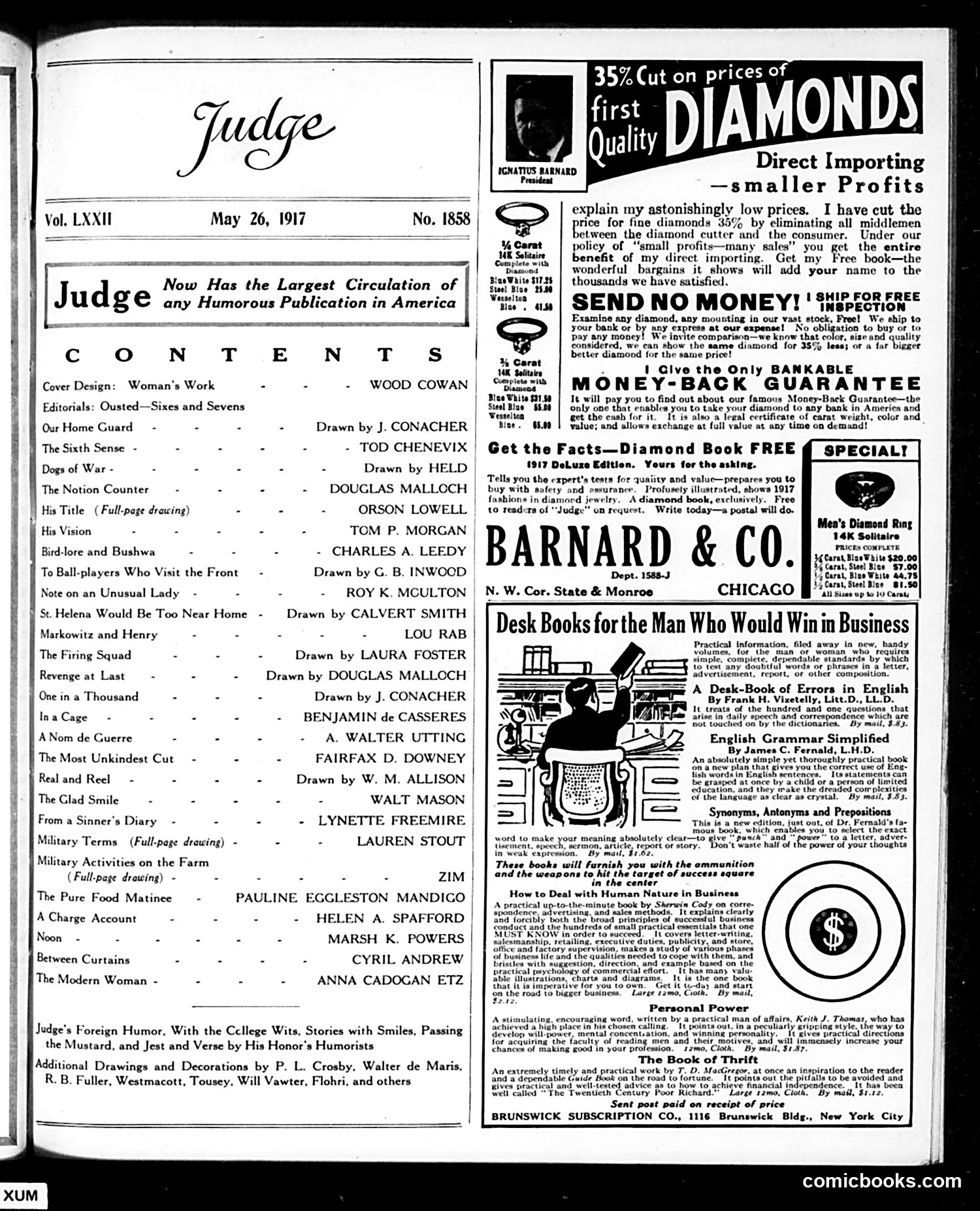
This page is primarily **advertisements** rather than political cartoons. The dominant ads promote diamonds from Barnard & Co. (emphasizing direct importing and low prices) and business self-help books (grammar, salesmanship, personal power). The left side lists the magazine's contents, including articles and drawings by various contributors. The table of contents mentions topics like "The Sixth Sense," "Dog of War," and "The Notion Counter"—suggesting satirical commentary on contemporary issues, likely related to World War I (America entered in April 1917). However, **the specific cartoons and their satirical meanings are not visible** in this particular page image. The actual editorial content and illustrations remain unclear without seeing the full article pages.
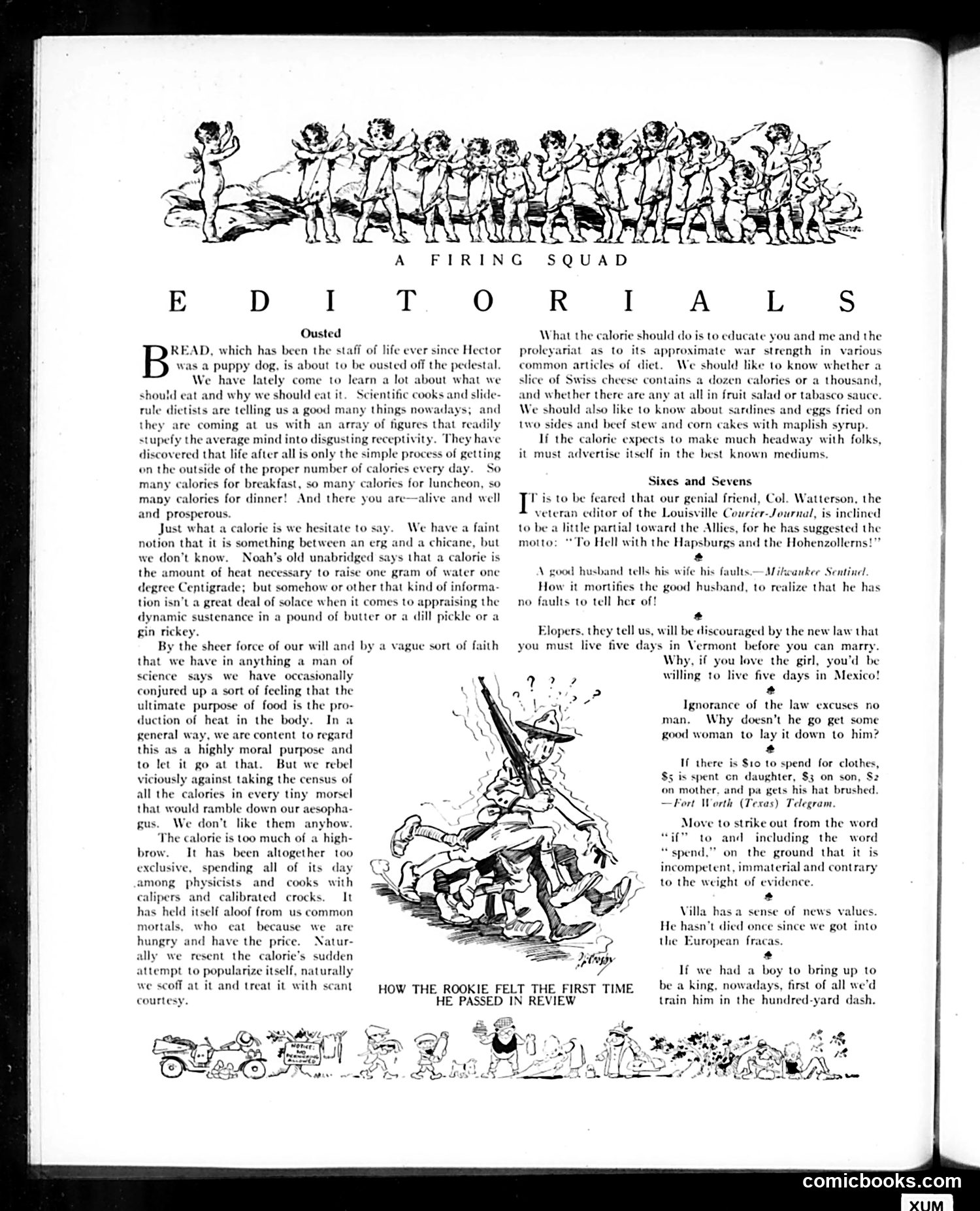
This page contains editorial commentary and humor pieces rather than political cartoons. The main illustrated piece, "How the Rookie Felt the First Time He Passed in Review," depicts a chaotic scene of military inexperience—likely referencing WWI-era military training. The humor centers on a new soldier's awkward reaction during a formal military inspection. The editorial section "Editorials" discusses calories in diet—a seemingly health-focused topic rather than political satire. The "Sixes and Sevens" section contains social commentary presented as witty observations about marriage laws, spousal behavior, and cultural attitudes. References include Vermont's marriage laws and Mexican customs. The overall tone is light satirical humor about American domestic life and social conventions rather than hard political commentary.
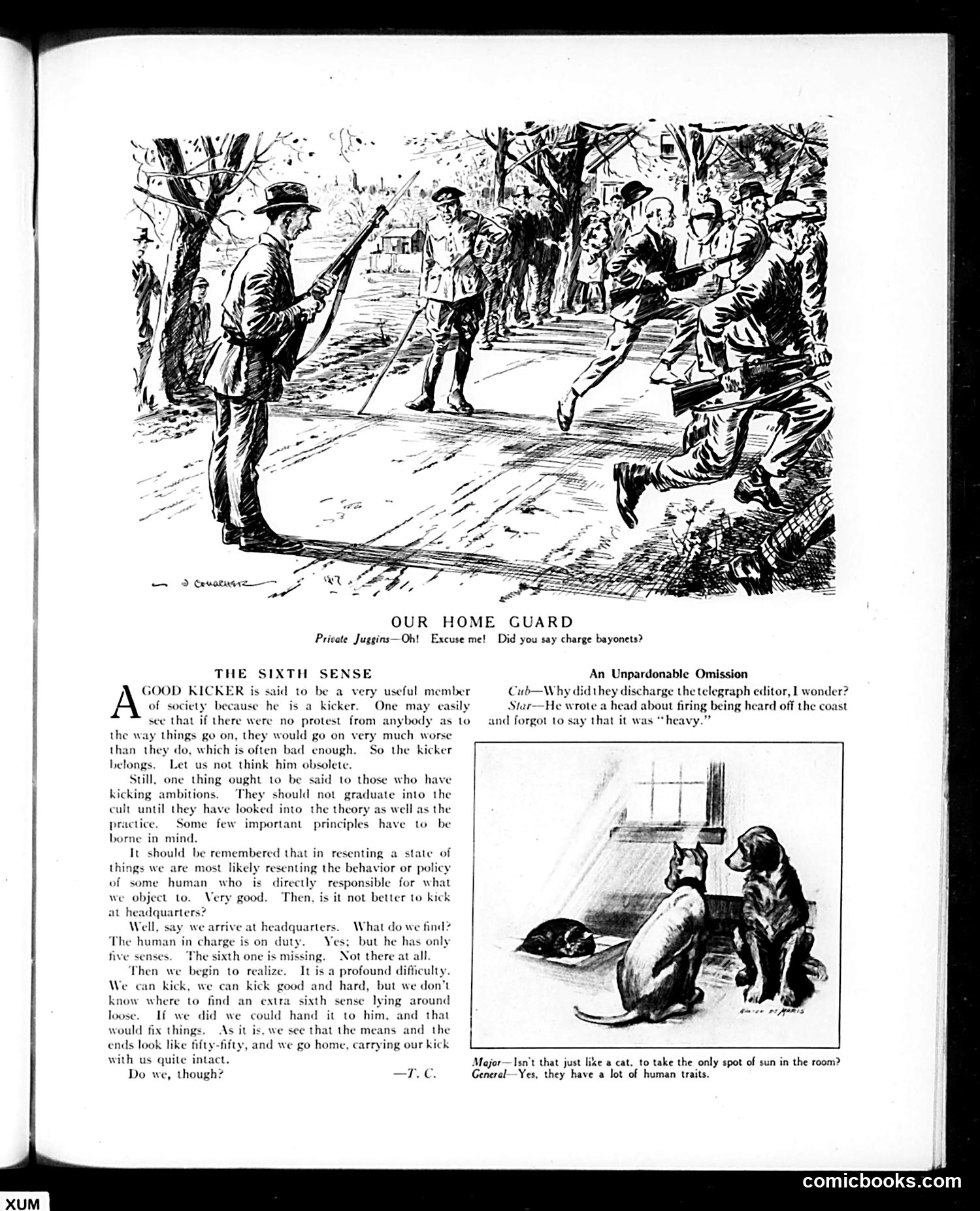
**"Our Home Guard"** (top cartoon): Shows soldiers with bayonets confronting what appears to be a civilian. The caption's joke about "charging bayonets" suggests satire about military preparedness or home defense drills, likely from WWI era when American civilians were being trained for potential combat. **"The Sixth Sense"** (article): Argues that a "kicker"—someone with kicking ambitions—is useful to society. The piece uses kicking metaphorically to discuss protest and resistance to authority, advocating that such people should study theory before acting. It concludes satirically that finding the "sixth sense" would help direct this energy productively rather than "quite intact" toward chaos. **"An Unpardonable Omission"** (right): A brief joke about a telegraph editor forgetting to mention "heavy" weather—unclear without broader context.
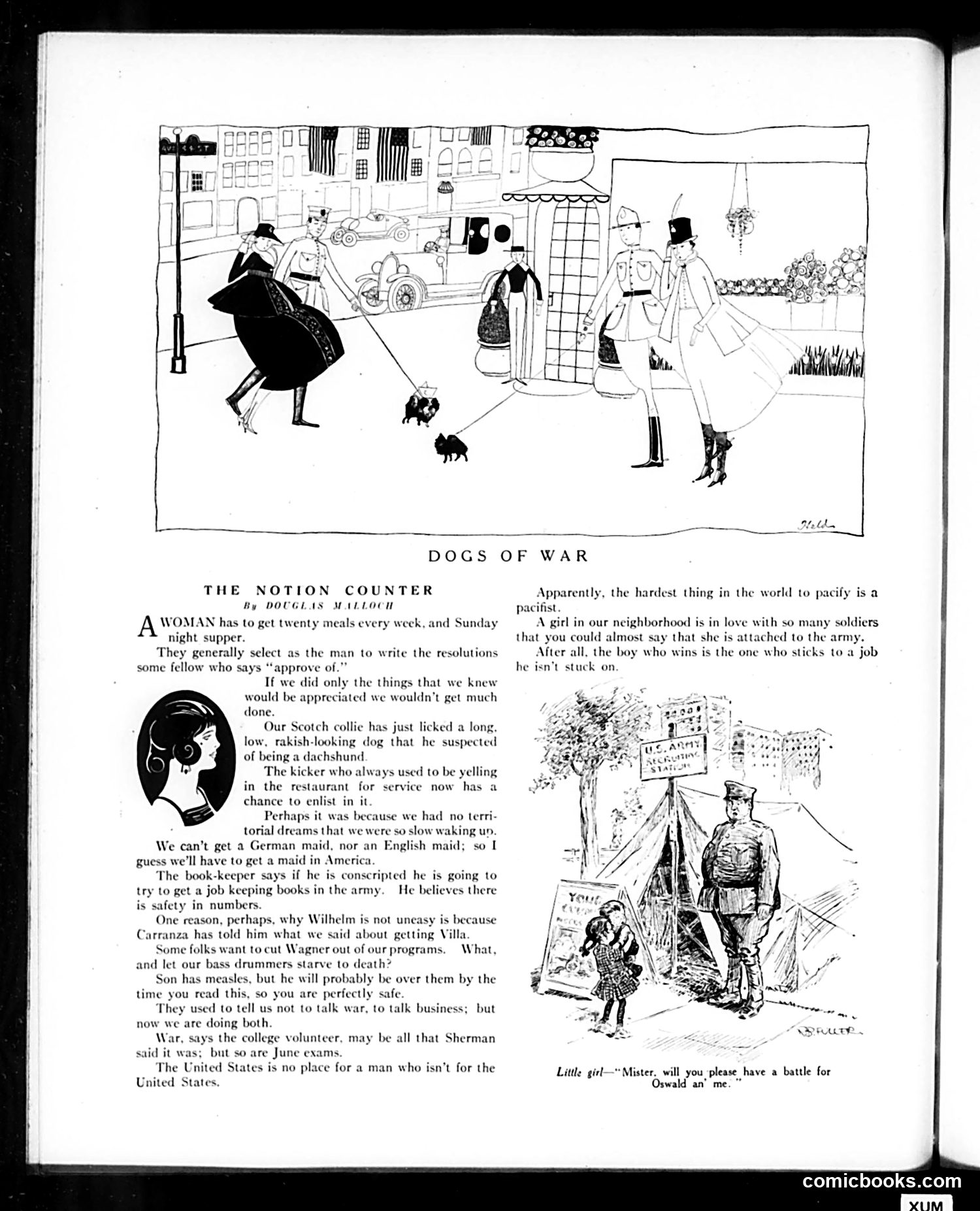
This WWI-era piece satirizes civilian attitudes toward the war through two illustrations. **Top cartoon**: Shows fashionable women with small dogs on a city street, juxtaposing domestic frivolity with warfare. The title "Dogs of War" puns on the phrase meaning instruments of conflict. **"The Notion Counter"** column below mocks various home-front behaviors: women hosting frequent meals and selecting soldiers to write resolutions, a girl pursuing multiple soldiers, society's slow mobilization efforts, and tensions between German/English maids. The final illustration shows a child requesting a soldier to "have a battle for Oswald" — satirizing how civilians, especially children, trivialize combat as entertainment. The overall message: civilians remain oblivious or frivolous while men fight, treating war as background to social life rather than grave national crisis.
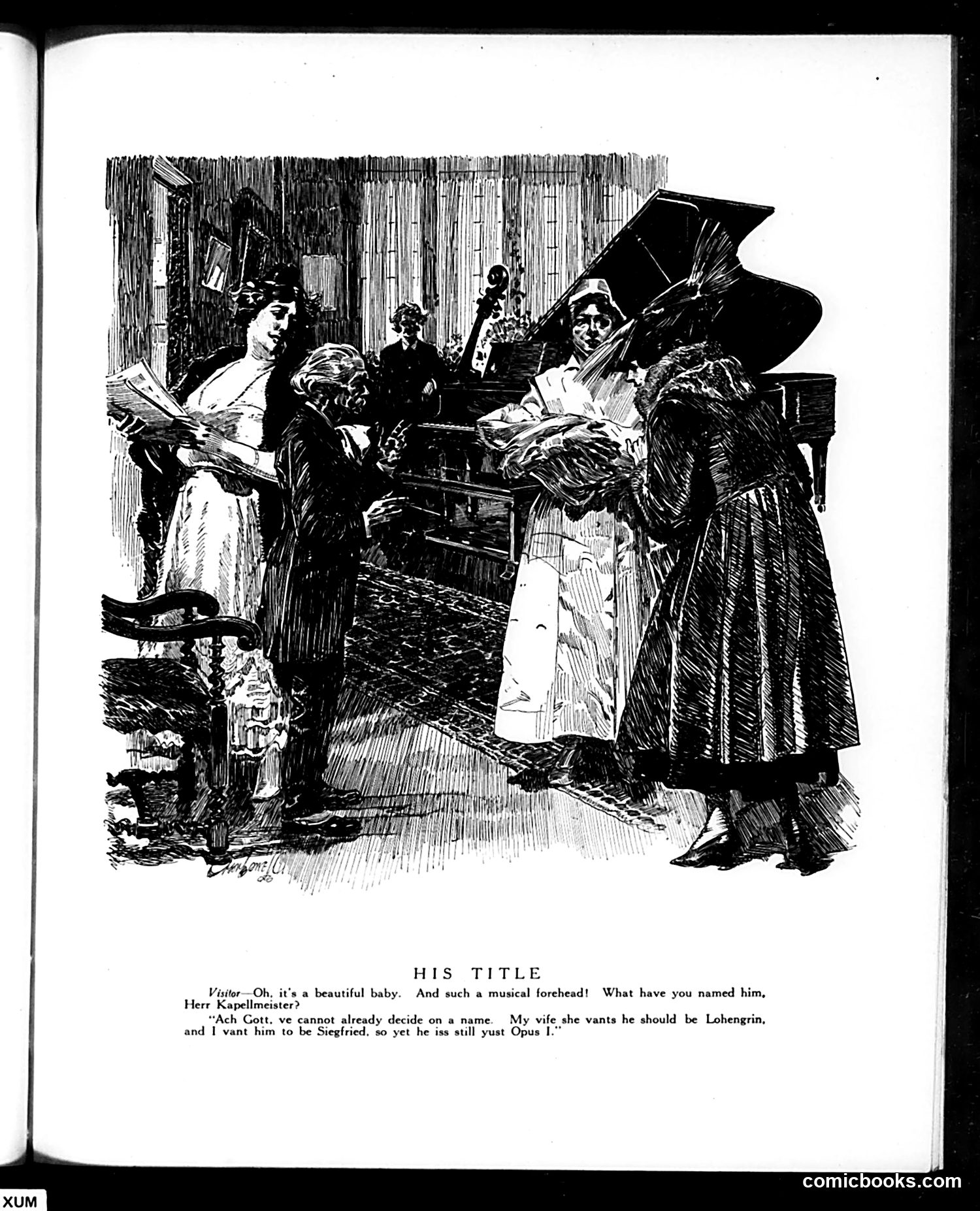
This cartoon satirizes German musical culture and naming pretensions. A visitor admires a newborn baby while addressing the father as "Herr Kapellmeister" (orchestra conductor), speaking in exaggerated German-accented English with stereotypical dialect. The joke centers on operatic ambition: the parents cannot agree whether to name their son after Wagner's *Lohengrin* or *Siegfried*—both famous operas. Unable to decide, they've temporarily named him "Opus I" (musical terminology for a composer's first work). The satire mocks Germanic musical snobbery and the pretension of naming children after grand operatic heroes rather than ordinary names. The "musical forehead" compliment plays on pseudoscientific phrenology theories popular in the era. The exaggerated German accent reinforces ethnic stereotyping common in American satirical magazines of this period.
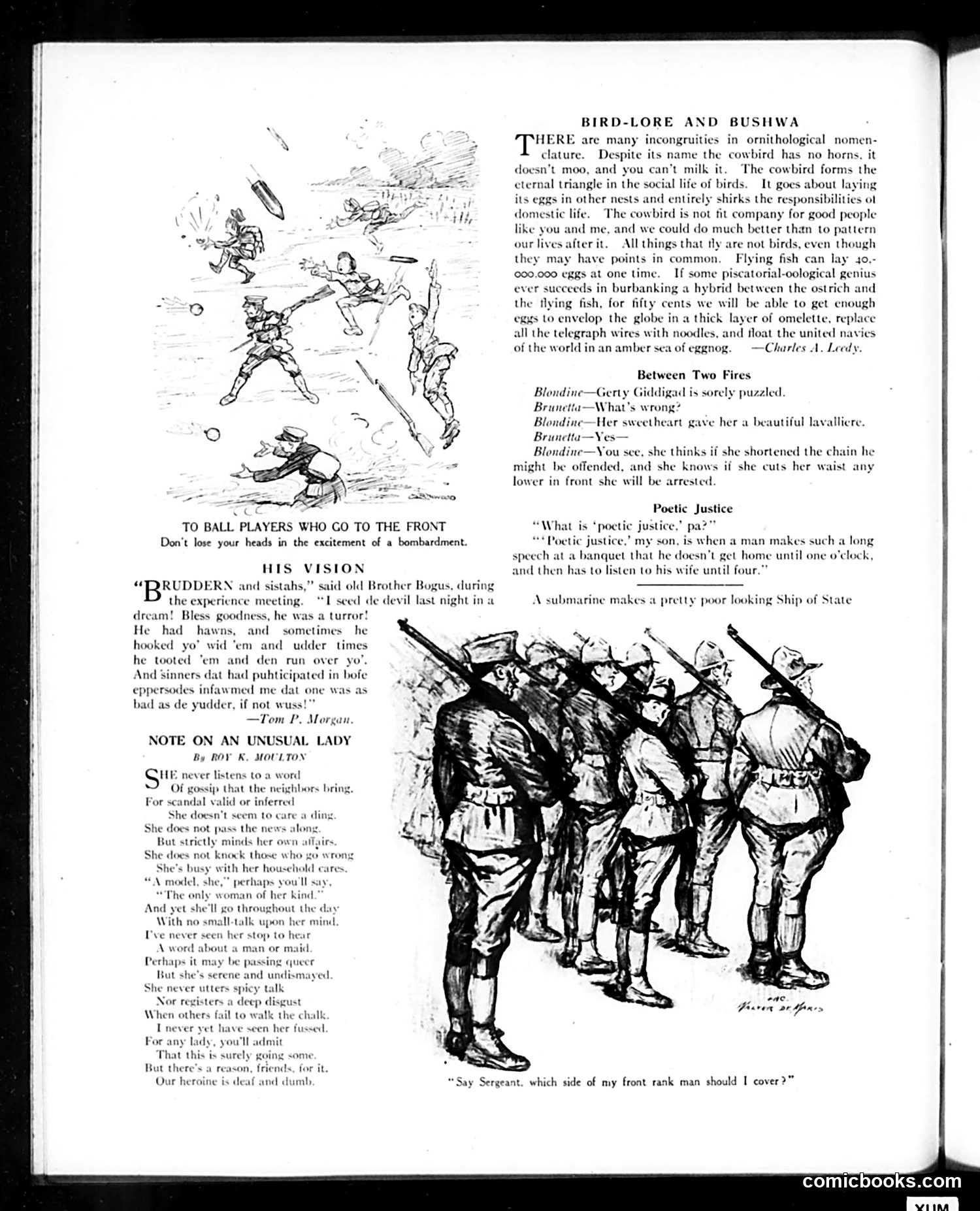
This Judge magazine page contains several satirical pieces mocking social absurdities of the era: **"Bird-Lore and Bushwa"** ridicules pseudo-scientific writing by inventing absurd hybrid scenarios (ostrich-flying fish producing enough eggs to cover the globe in omelette). **"Between Two Fires"** jokes about women's fashion constraints: a woman receives a necklace but cannot shorten its chain (fearing offense) nor lower her neckline further (risking arrest for indecency)—she's trapped by conflicting social expectations. **"Poetic Justice"** defines the term through domestic complaint: a husband makes an interminably long banquet speech, returning home too late to sleep, then endures his wife's complaints for hours—marital punishment disguised as irony. **"A Submarine Makes a Poor Ship of State"** (bottom illustration) appears to reference military/political leadership inadequacy, though context is unclear without dating the magazine. **"Note on an Unusual Lady"** reveals its punchline: the woman is praised for avoiding gossip and small-talk until the final line reveals she's "deaf and dumb"—her virtue is involuntary, not moral choice.
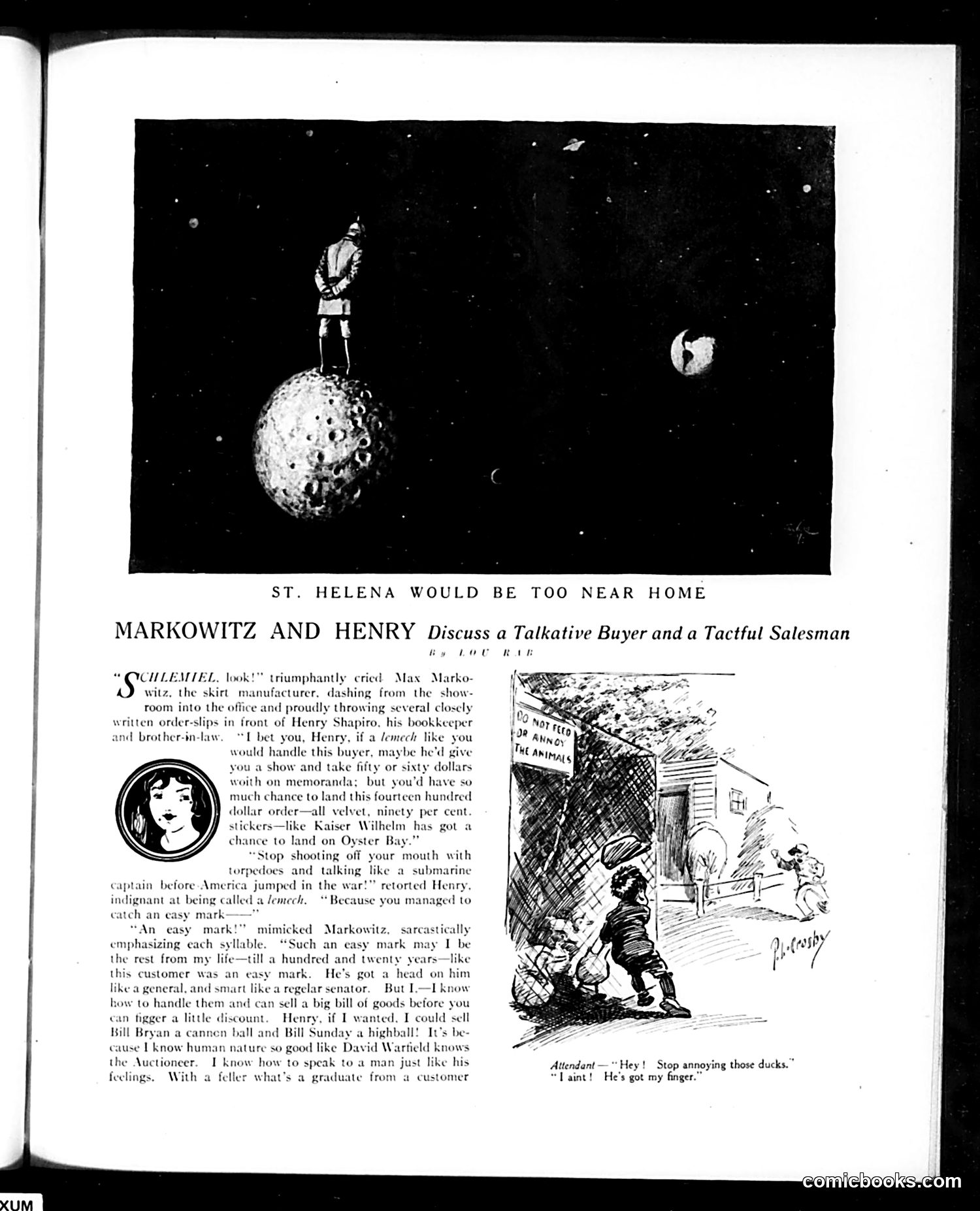
This page presents a dialogue between two Jewish businessmen—Max Markowitz (a skirt/clothing manufacturer) and Henry Shapiro (his bookkeeper and brother-in-law)—debating sales techniques. Markowitz boasts about landing a major $1,400 order through superior people skills, while Henry skeptically attributes it to luck with an "easy mark." The satire targets **Yiddish-inflected immigrant salesmanship culture** of early 20th-century America. Terms like "lemech" (fool) and "regelar" (regular) pepper their speech, emphasizing their ethnic identity. The humor relies on ethnic stereotypes: Markowitz's bombastic self-promotion, name-dropping (Bryan, Sunday, Warfield), and grandiose claims about understanding "human nature." The top illustration shows a figure standing on a cratered moon—likely referencing contemporary space exploration fantasies—captioned "St. Helena Would Be Too Near Home," suggesting their ambitions are absurdly cosmic. The page satirizes both aggressive immigrant entrepreneurship and the stereotyped Yiddish-American businessman archetype popular in period humor magazines.
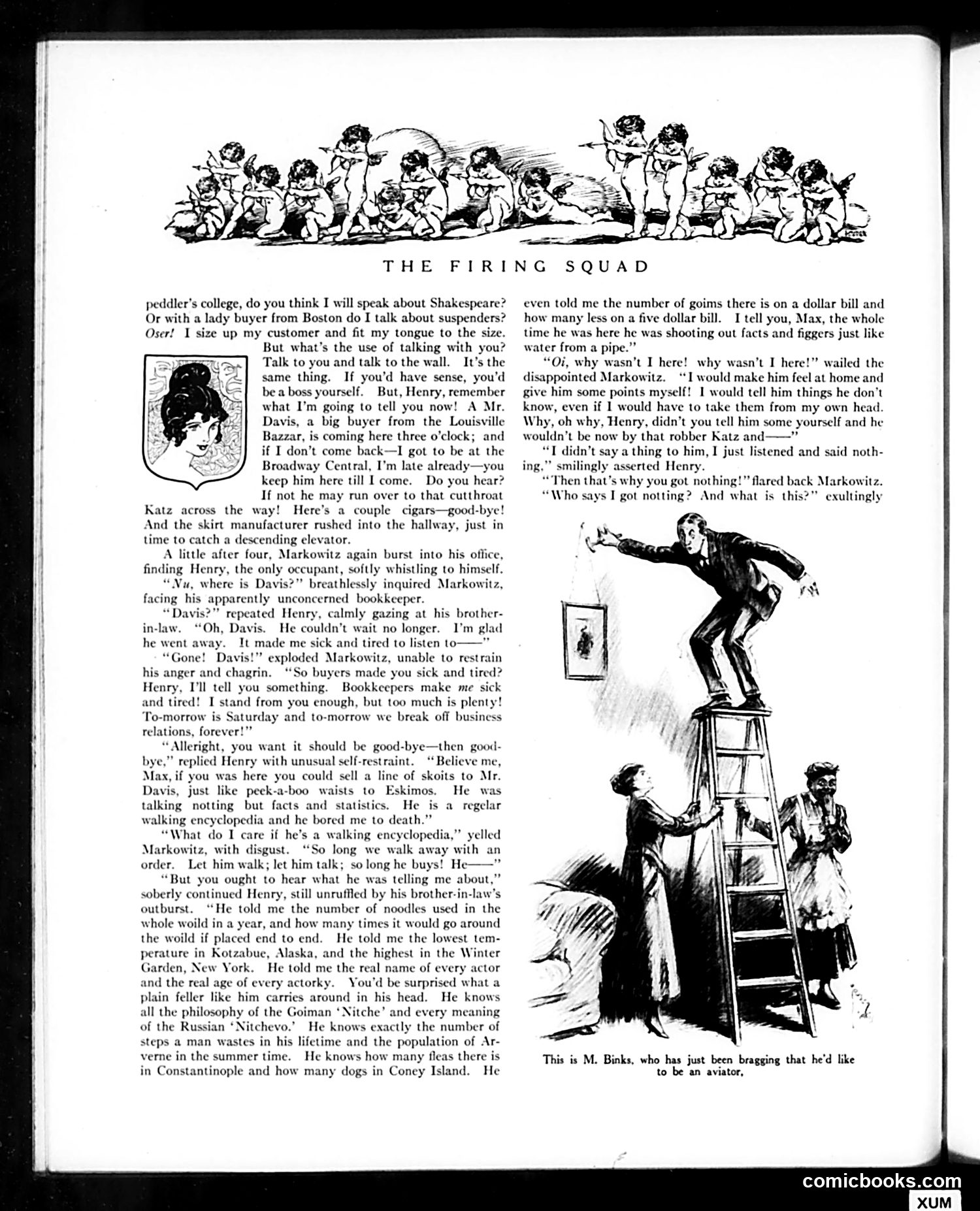
This page satirizes a common workplace dynamic in early 20th-century American business. The main story depicts a conflict between **Markowitz**, an impatient garment manufacturer, and **Henry**, his apathetic bookkeeper brother-in-law. The satire targets Henry's passivity and poor judgment: he fails to engage with an important buyer (Mr. Davis) from Louisville, instead bored by Davis's rambling monologues about useless facts—noodle consumption, temperatures in Alaska, actor ages, and obscure German/Russian philosophy. Rather than selling or entertaining the client, Henry's disinterest loses the order. Markowitz fires him in rage, but Henry responds with infuriating calm, vindicating himself by listing Davis's tedious lectures verbatim—proving Henry's point that Davis was unbearably dull, yet also demonstrating that Henry's refusal to engage cost them business. **The joke**: Henry is technically right but professionally wrong. The cartoon mocks both the verbose, fact-spouting bore and the stubborn employee who prioritizes being right over keeping his job. The title "Firing Squad" references Henry's imminent termination. The illustration shows M. Binks attempting aviation—likely another contemporary satirical reference.
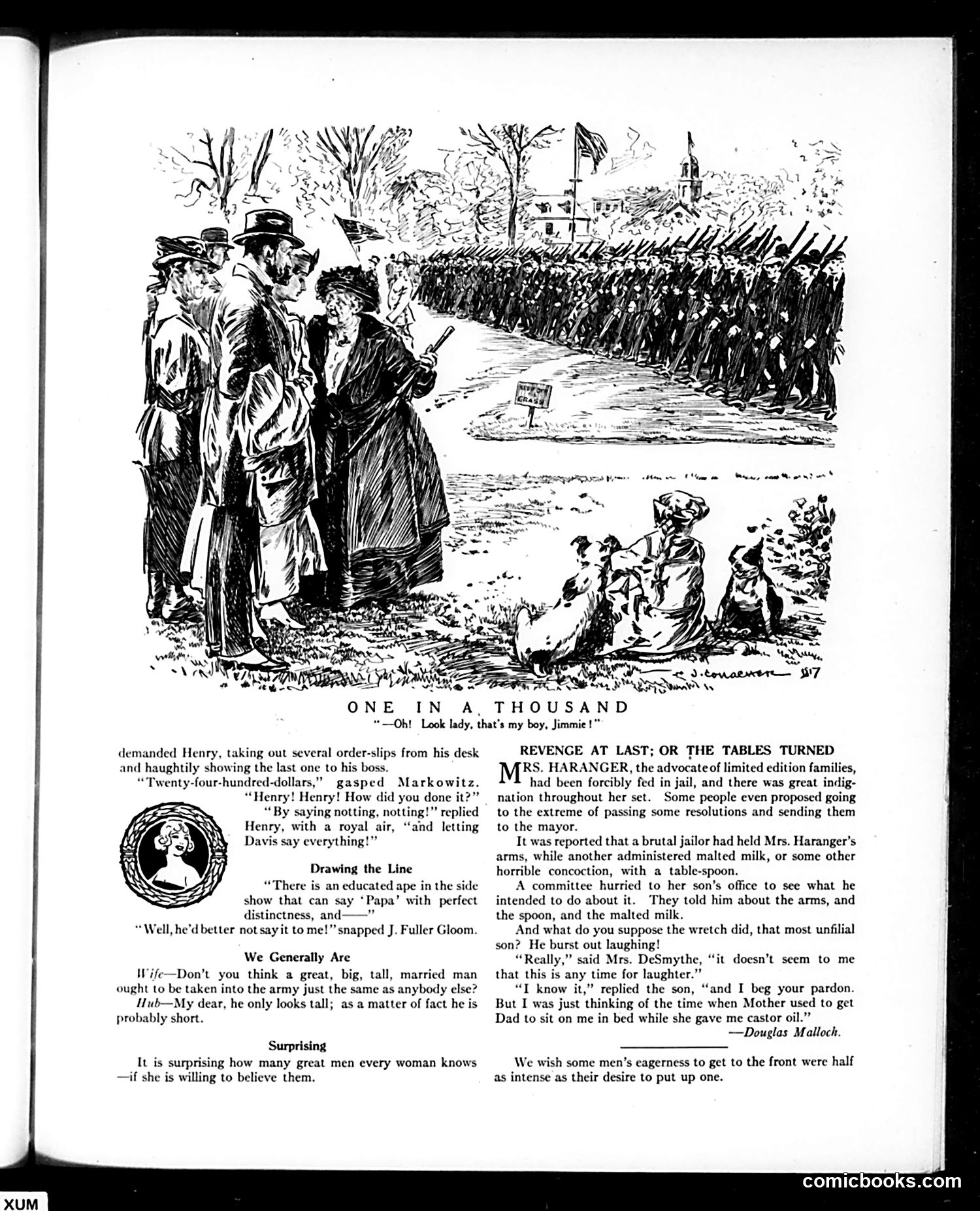
The top cartoon, "One in a Thousand," depicts an employee (Henry) successfully extracting a large payment ($2,400) from his boss by saying nothing and letting the boss talk himself into it—a satire on workplace dynamics and how silence can be strategically effective in negotiations. The main illustration shows a woman (Mrs. Haranger) at a military parade, proudly pointing out "her boy, Jimmie" among marching soldiers—likely satirizing mothers' pride during WWI era military mobilization. The story "Revenge at Last" mocks Mrs. Haranger, a birth-control advocate forcibly fed in jail (referencing Margaret Sanger's actual 1917 imprisonment). Her son laughs at her mistreatment, recalling his mother force-feeding *him* castor oil as a child. The satire suggests that those promoting "limited edition families" deserve similar coercive treatment—a hostile commentary on early birth-control activism. The shorter items are typical period humor about gender relations and military recruitment, with the final quip critiquing men's reluctance to enlist despite eagerness for other pursuits.
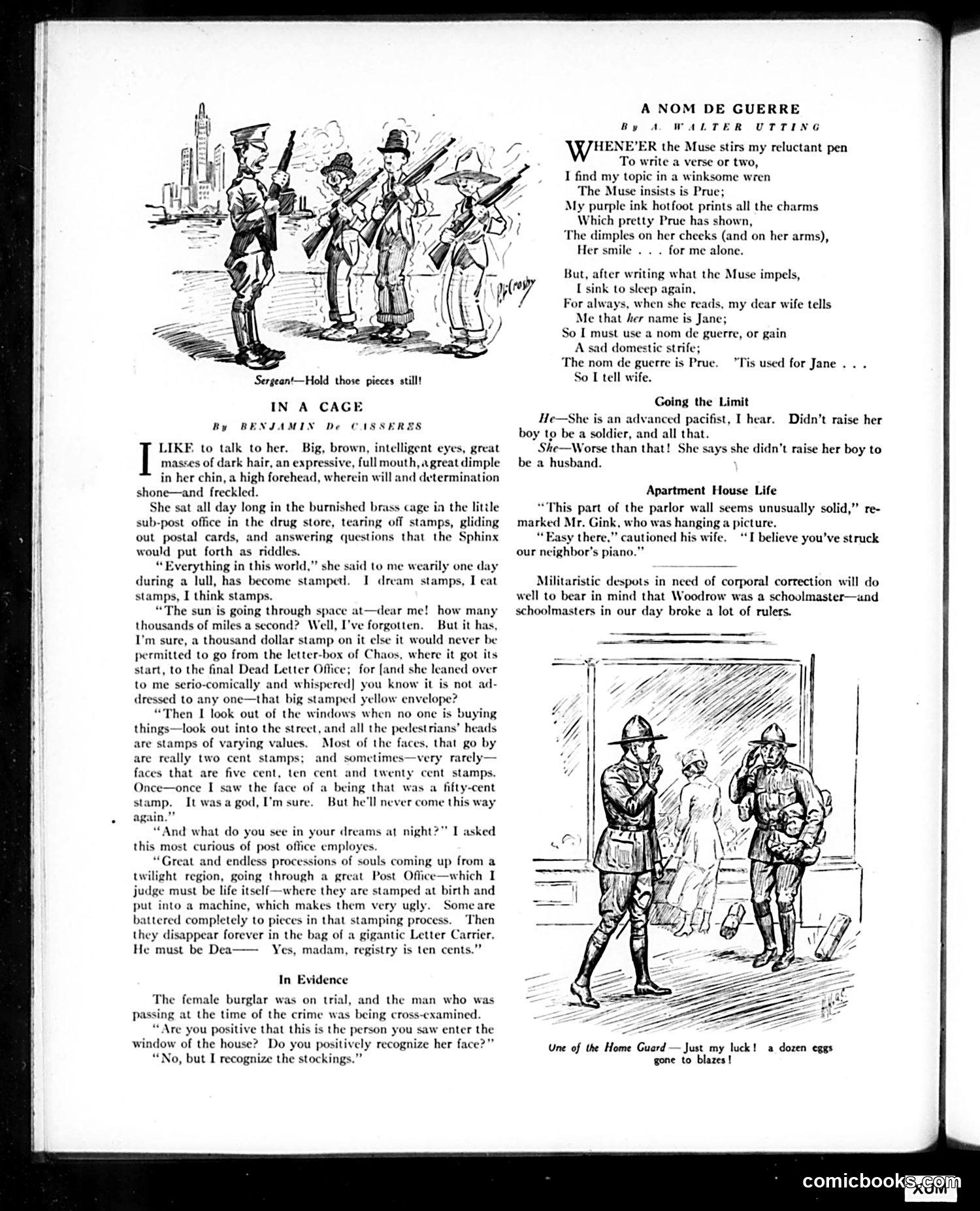
This Judge magazine page contains several satirical pieces reflective of early 20th-century American life: **"In a Cage"** depicts a post office worker exhausted by stamp-related bureaucracy, expressing existential fatigue through absurdist humor about stamps representing life's value and mortality. **"A Nom de Guerre"** jokes about a poet who dedicates verses to his muse "Prue" but must hide this from his wife "Jane"—satirizing marital tensions and poetic pretense. **"Going the Limit"** mocks pacifism and changing gender roles, referencing anti-war sentiment and women's evolving independence (the woman won't raise her son to be a soldier or husband). **"Apartment House Life"** offers domestic humor about thin apartment walls and unintended piano damage—reflecting urban living anxieties. The bottom sketch references **Woodrow Wilson** as a former schoolmaster, making a pun about "rulers" in the context of military discipline—likely WWI-era commentary on leadership and authority. The overall tone reflects wartime social anxieties, gender role shifts, and urban modern life frustrations.
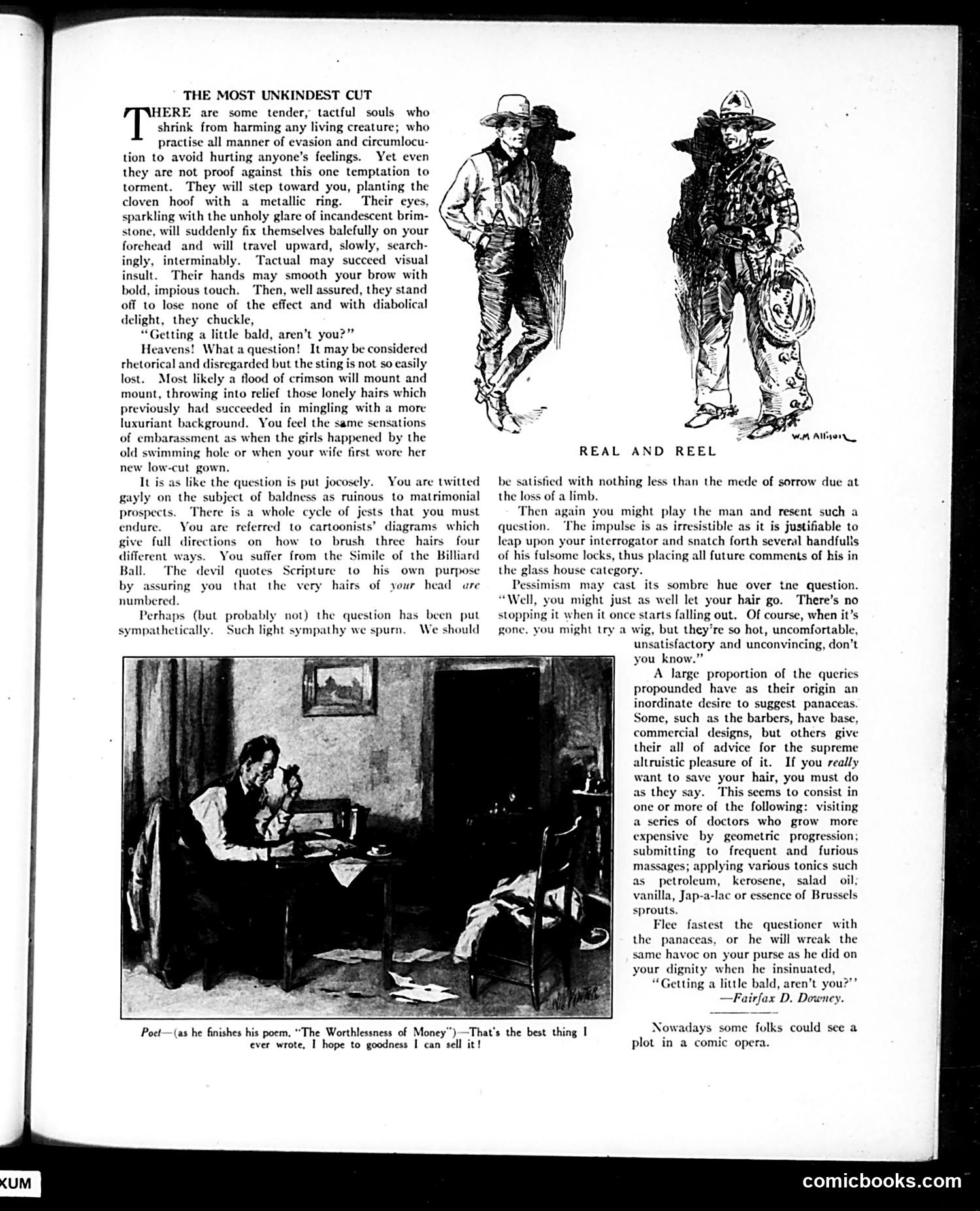
This article satirizes the social cruelty of commenting on men's hair loss. The piece describes how even "tender, tactful souls" cannot resist the temptation to mock baldness, employing exaggerated language (comparing the offender to a devil with a "cloven hoof") to emphasize how hurtful the casual question "Getting a little bald, aren't you?" truly is. The satire ridicules both the mockers and the remedies they suggest. Baldness becomes a source of acute embarrassment—compared to humiliating childhood moments—yet victims are expected to suffer silently or face ridicule for their sensitivity. The piece lambastes commercial hair-loss solutions (tonics, doctors, wigs) as expensive placebos, while mocking the "altruistic pleasure" of those dispensing unsolicited advice about treatments. The accompanying illustration of a poet shows an everyman figure, while "Real and Reel" sketches depict working-class men—likely emphasizing baldness affects all social classes equally.
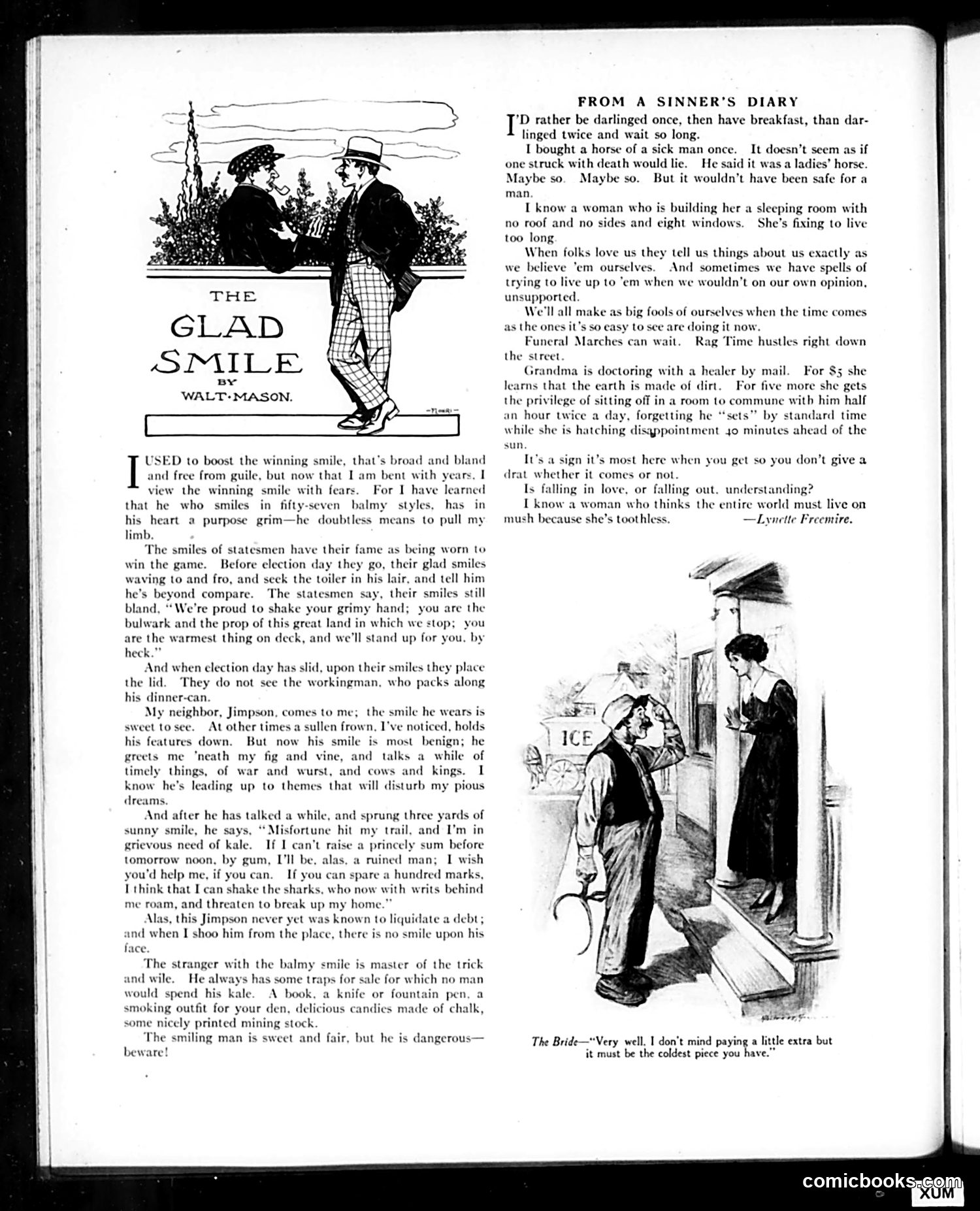
This satirical essay attacks the insincerity of political smiles and con artists' manipulation. Mason distinguishes between genuine warmth and calculated deception: politicians flash broad smiles during election campaigns to win working-class votes, praising laborers as "the bulwark and prop" of society, then ignore them afterward. He similarly critiques his neighbor Jimpson, who appears sweetly friendly while actually softening Mason up to borrow money—a debt he never repays. The piece warns that "the smiling man is sweet and fair, but he is dangerous—beware!" Mason argues such charming manipulation serves self-interest, not genuine affection. The accompanying illustration shows two men in conversation, likely depicting this duplicitous social performance. The essay reflects Progressive-era skepticism toward both political corruption and commercialized manipulation of working people.
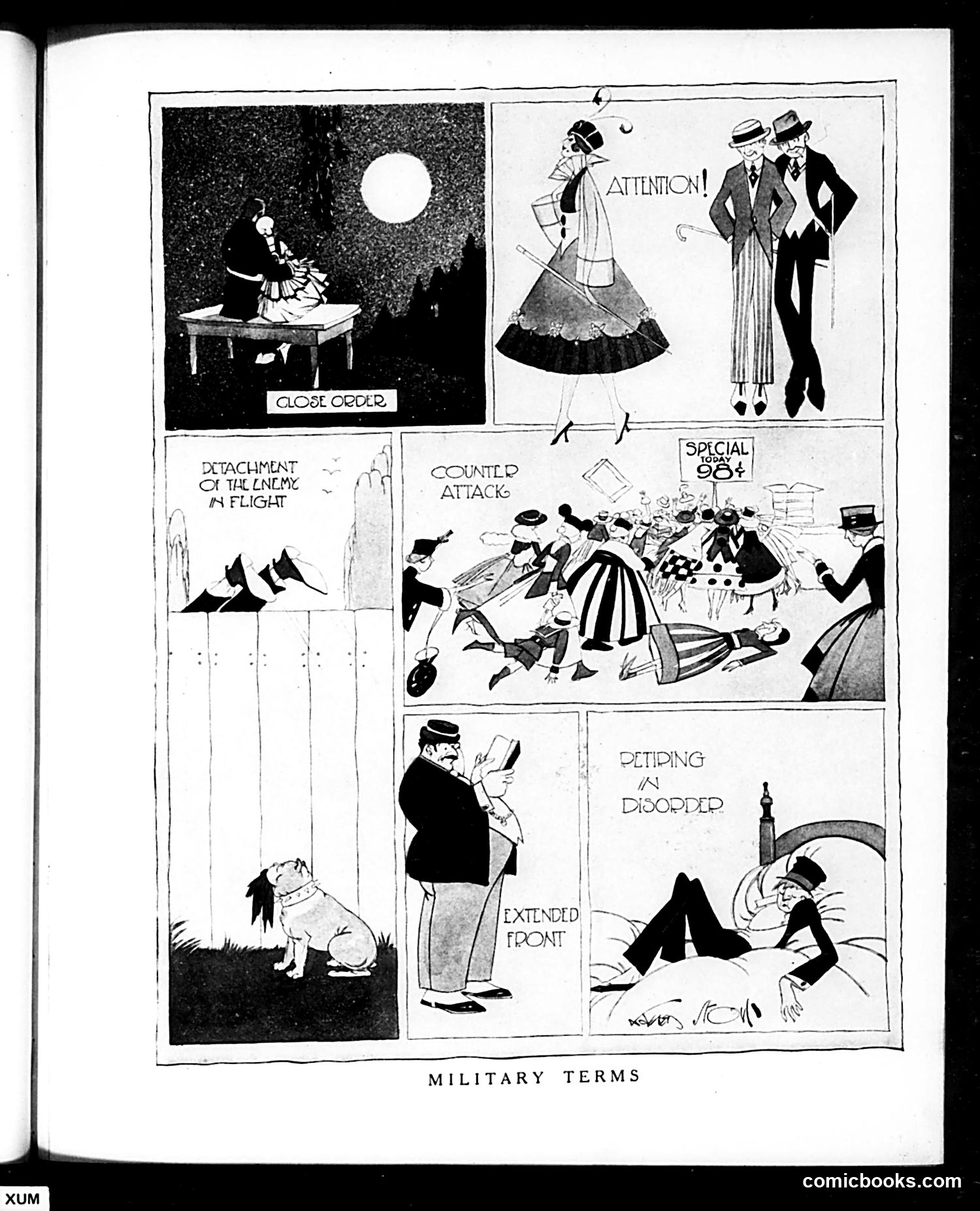
This satirical page uses humorous illustrations to redefine military terminology through domestic and social situations rather than actual warfare. "Close Order" shows a couple embracing by moonlight. "Attention" depicts a woman catching two men's gaze. "Detachment of the Enemy in Flight" shows flags retreating. "Counter Attack" illustrates a chaotic social gathering with multiple figures. "Extended Front" shows a man viewing a woman's dress hem. "Pettiping in Disorder" depicts a man falling, with a woman's petticoat visible. The satire plays on the contrast between serious military language and trivial social/romantic scenarios, suggesting that civilian life—particularly interactions between men and women—operates under "military" rules and strategies. This reflects early 20th-century humor about gender relations and courtship dynamics.
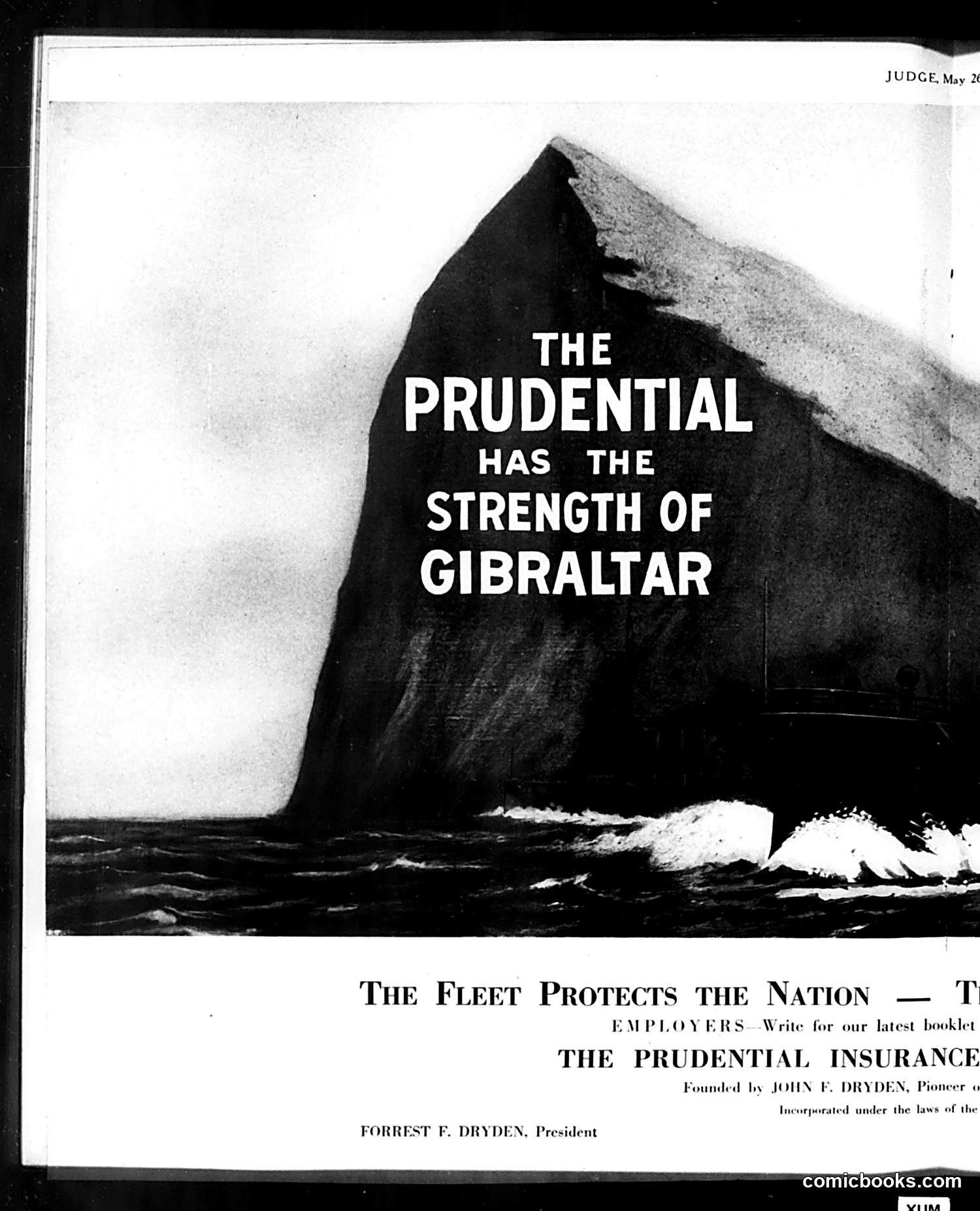
This is primarily an advertisement for Prudential Insurance rather than satirical content. The page uses patriotic imagery—the Rock of Gibraltar and reference to "The Fleet"—to promote insurance as a form of national protection. The headline "The Prudential Has the Strength of Gibraltar" compares the insurance company's stability to that famous fortification, a common advertising strategy of the era. The ad emphasizes security and strength through military metaphors, appealing to employers to contact Prudential. Founded by John F. Dryden and now led by his son Forrest F. Dryden, the company positions itself as reliably protective of the nation's interests—connecting financial security with patriotic duty. This reflects early 20th-century marketing linking corporate stability to national wellbeing.
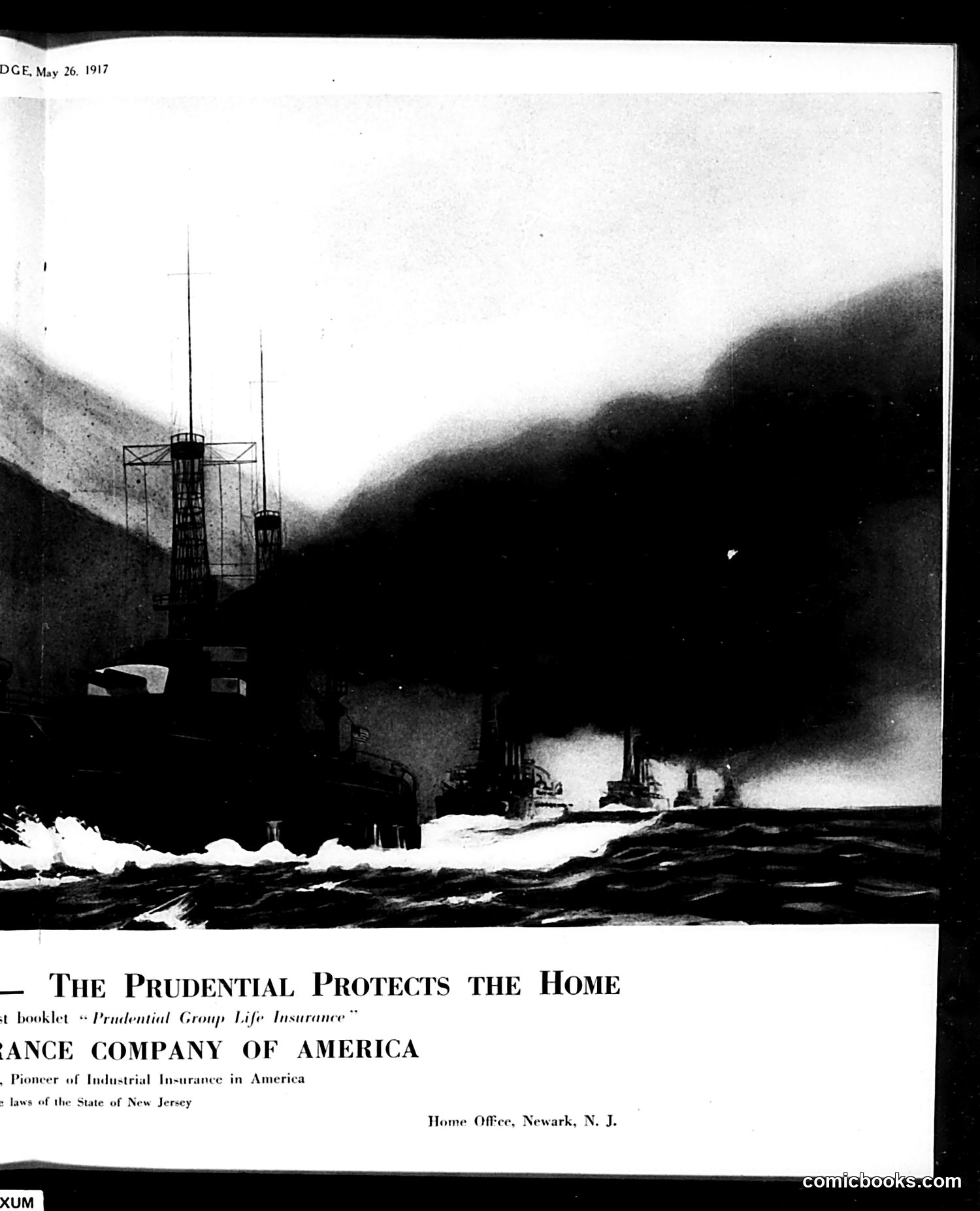
This is primarily a **full-page advertisement** for Prudential Insurance Company of America, dated May 26, 1917 (during World War I). The image shows an industrial/factory scene with tall smokestacks beside a body of water, mountains in the background, and snow on the ground—likely depicting a major American manufacturing facility. The visual communicates industrial strength and permanence. The ad's slogan, "The Prudential Protects the Home," frames insurance as protection for workers' families during uncertain times. In 1917, with America's entry into WWI imminent, this messaging resonated with anxieties about breadwinners and family security. The text emphasizes Prudential's status as "Pioneer of Industrial Insurance in America," positioning the company as trustworthy and established for working-class protection. This is **not satire or cartoon commentary**—it's straightforward insurance marketing using patriotic, industrial imagery to appeal to American workers.
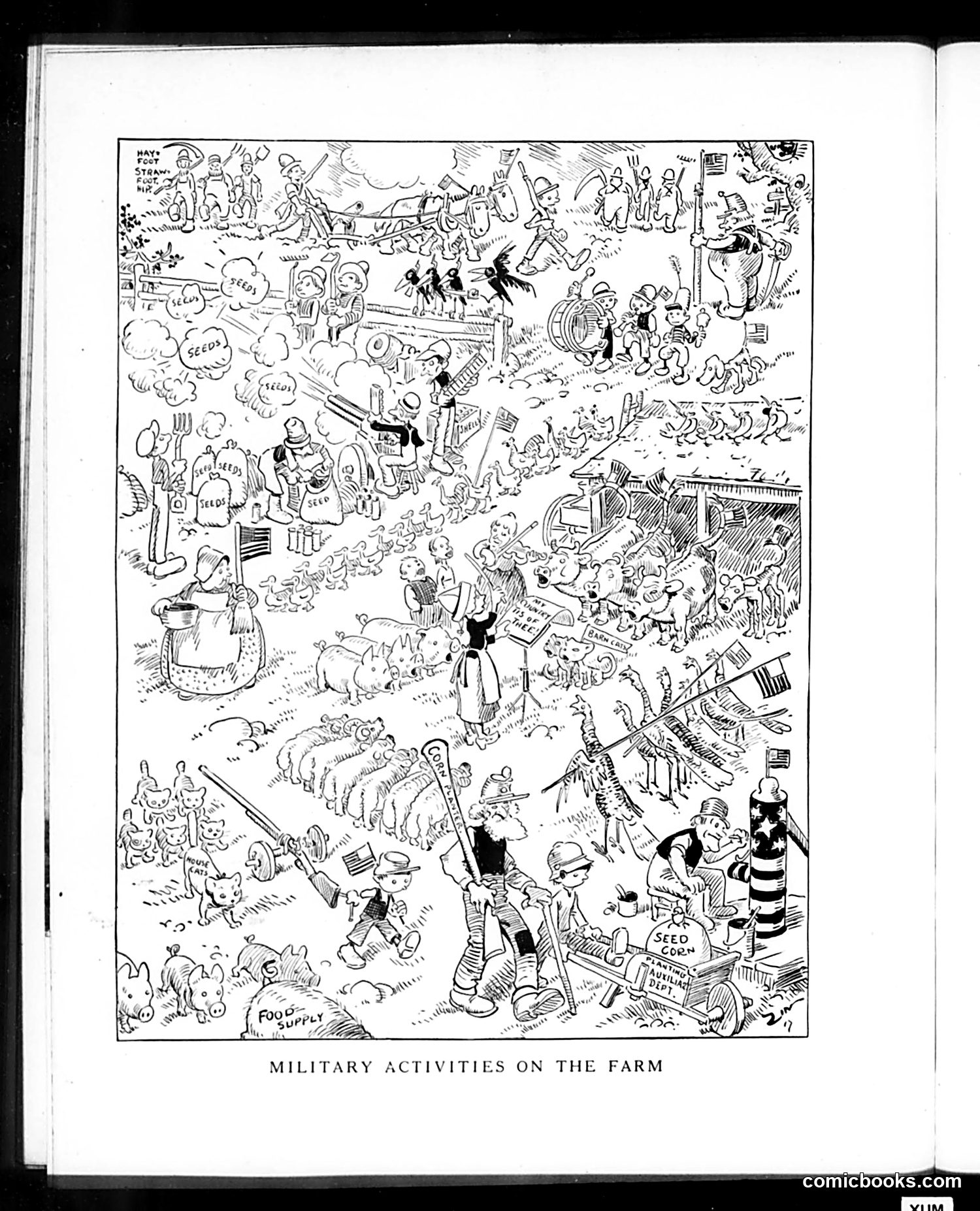
This satirical illustration depicts a farm converted into military operations during wartime (likely WWI era, based on Judge magazine's publication period). The cartoon shows soldiers and military personnel conducting various activities alongside traditional farming—soldiers drilling, equipment storage, and supply operations interspersed with livestock, crops, and farm laborers. The satire appears to critique the militarization of American agriculture and civilian life during wartime mobilization. Farmers work alongside soldiers; military structures and flags dot the landscape; supplies labeled "Seeds" and "Poultry Supply" sit next to military stores. The chaotic, densely-packed composition emphasizes how thoroughly military concerns have penetrated rural American life. The joke suggests ironic tension between civilian agricultural production and military demands on resources and personnel during national mobilization.
This is a satirical dialogue about theatrical taste and class differences. A "Tired Business Man" enthusiastically praises a play called *"The Knife,"* calling it a thrilling thriller comparable to *"Within the Law."* A pretentious Critic systematically dismantles this opinion, revealing *The Knife* as a poorly constructed melodrama about medical experimentation on criminals—mixing propaganda with entertainment in ways that undermine its dramatic impact. The Critic objects to the play's moralizing and implausible resolutions about "the unwritten law." The joke targets multiple audiences: the Businessman represents middlebrow taste (easily entertained by sensation), while the Critic embodies intellectual snobbery. Notably, the Débutante's mother nervously interrupts when the discussion threatens propriety, suggesting anxieties about women and moral messaging in theater. The humor lies in class-based assumptions about who should appreciate what art, and how critics weaponize superior taste against common enjoyment.
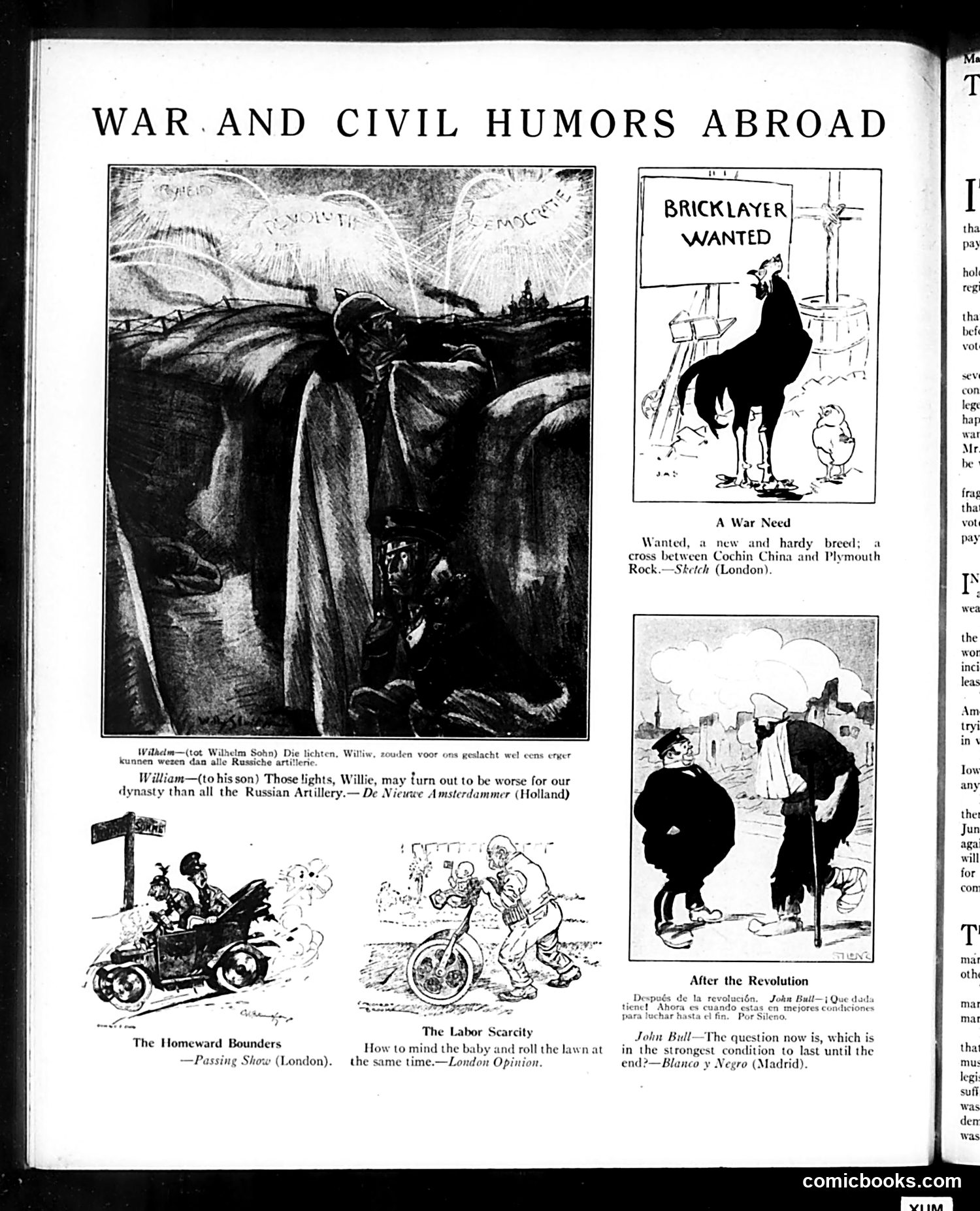
This page collects satirical cartoons from various international publications commenting on World War I and its aftermath. **Key cartoons:** 1. **"Wilhelm"** (top left): A Dutch cartoon showing Kaiser Wilhelm II warning his son that internal strife could damage their dynasty worse than Russian artillery—satirizing Germany's internal instability during the war. 2. **"A War Need"** (top right): A Sketch (London) cartoon humorously suggesting a new hybrid chicken breed (crossing Cochin China and Plymouth Rock) as a wartime necessity—likely mocking shortages or absurd wartime solutions. 3. **"The Homeward Bounders" and "The Labor Scarcity"** (bottom): Two cartoons addressing post-war labor challenges—one about soldiers returning home, the other sarcastically commenting on the impossible task of simultaneously childcare and lawn maintenance, reflecting domestic labor shortages. 4. **"After the Revolution"** (right): A Madrid cartoon questioning which nation will remain strongest after the war's conclusion. The page satirizes wartime disruptions, national anxieties, and post-war reconstruction challenges across multiple European perspectives.
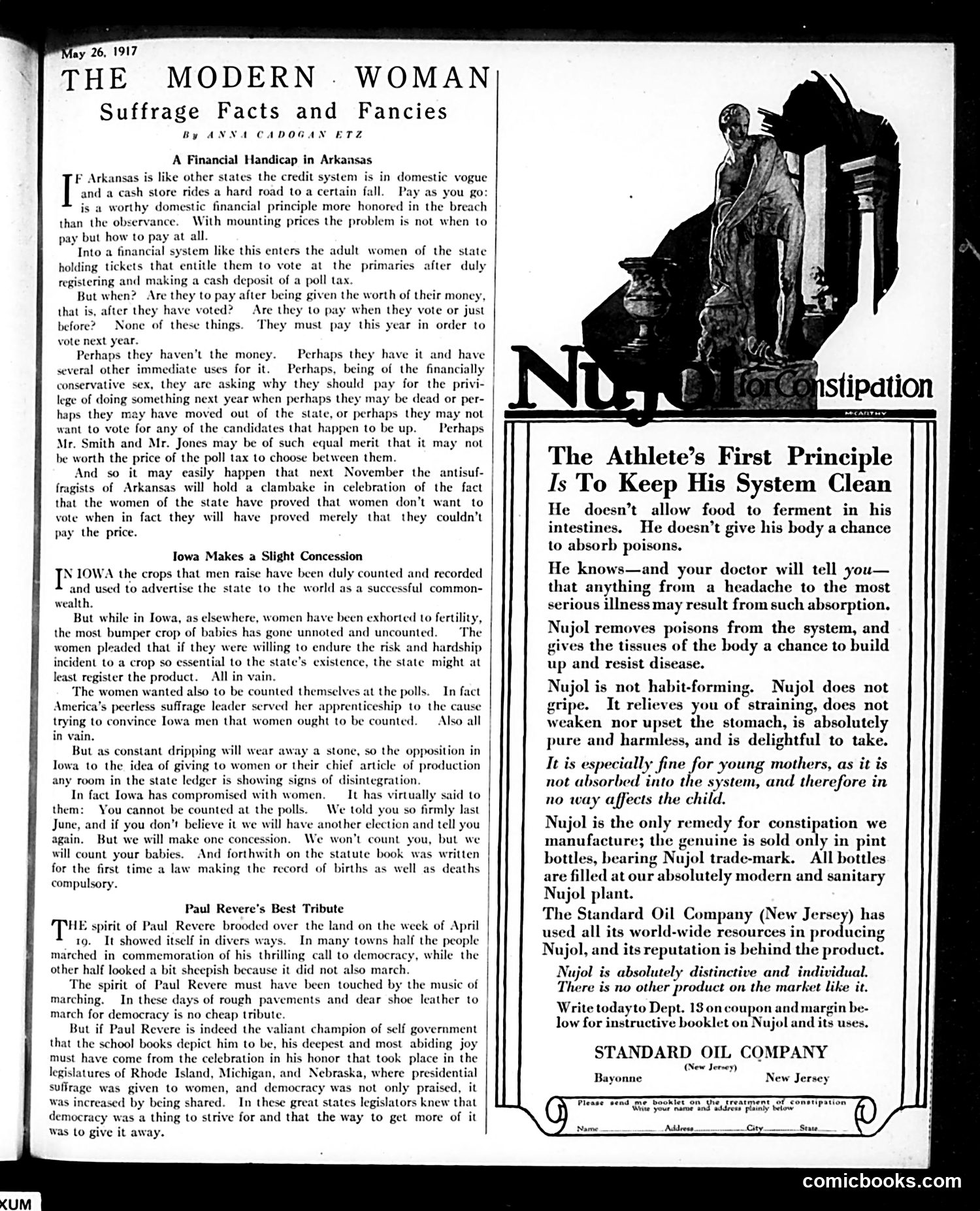
This page satirizes obstacles women faced securing voting rights. The article "A Financial Handicap in Arkansas" mocks a catch-22: women must pay poll taxes *before* voting, yet may lack funds or question whether voting is worth the cost. The satire suggests anti-suffragists will claim women "don't want to vote" when they simply can't afford the requirement. "Iowa Makes a Slight Concession" ridicules Iowa's refusal to count women at polls while grudgingly recording births—treating women's reproductive role as the only state-worthy contribution. The tone is sharply sarcastic: Iowa won't count women as citizens, but will document their babies. "Paul Revere's Best Tribute" begins discussing suffrage marches commemorating Revolutionary ideals, contrasting those who marched for democracy with those too embarrassed to participate. The *Nujol* laxative advertisement on the right is unrelated commercial content.
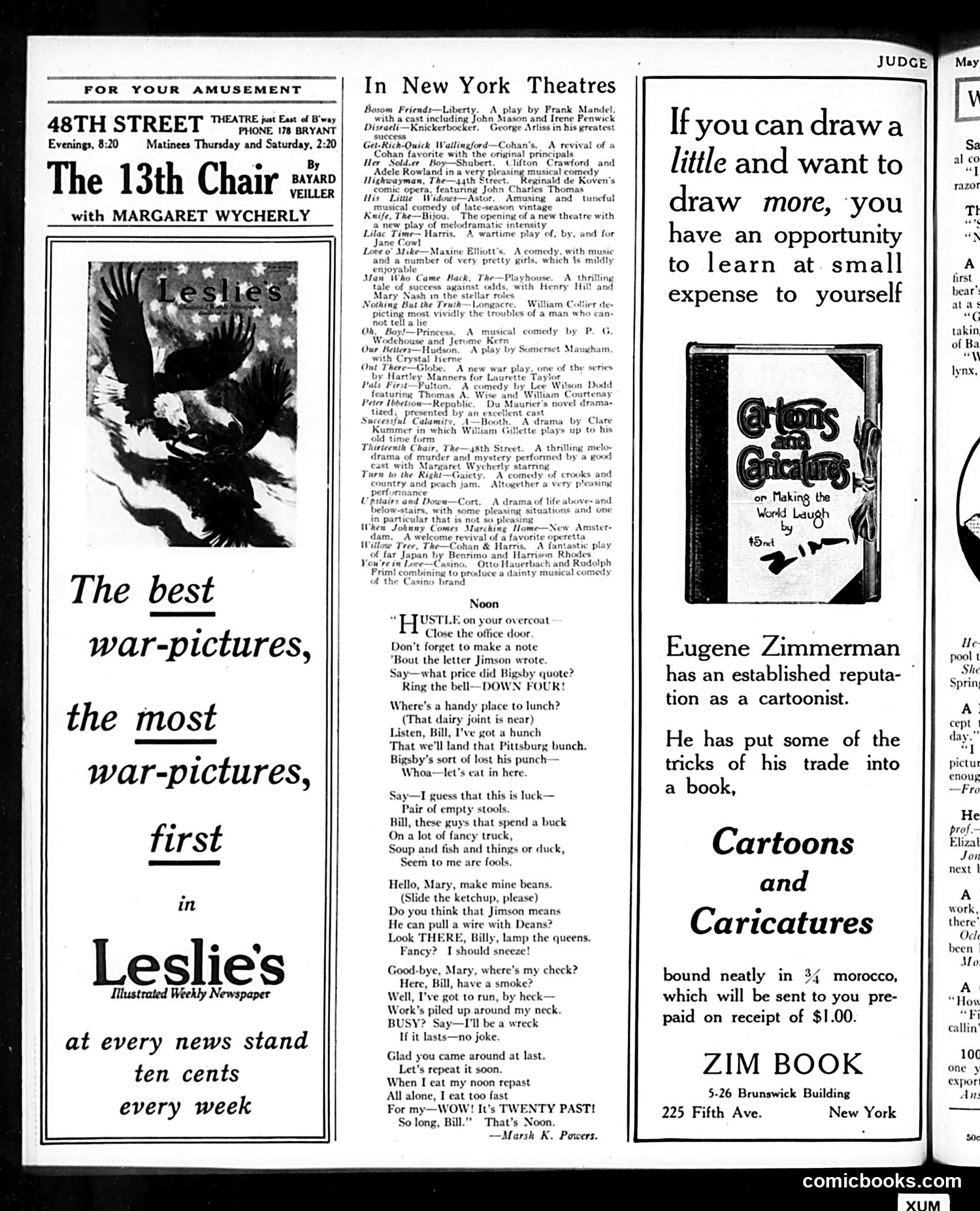
This page is primarily **advertising and theater listings** with minimal satirical content. **Left side:** Advertisement for the play *The 13th Chair* at the 48th Street Theatre, featuring Margaret Wycherly. The copy claims it contains "the best war-pictures...first in Leslie's." **Center:** Theater reviews for New York productions (brief mentions of various plays) followed by "Noon," a humorous dialogue sketch by Marsh K. Powers about office workers discussing a lunch meeting. The sketch depicts working-class banter about business ("Bigsby," "Pittsburg bunch"), with casual restaurant dialogue. It's gentle workplace humor rather than political satire. **Right side:** Advertisement for Eugene Zimmerman's instructional book *Cartoons and Caricatures*, promoting cartooning lessons for $1.00. The page reflects early 20th-century concerns (war references, office culture) but contains no identifiable political figures or sharp satirical commentary—it's primarily commercial content typical of Judge magazine's revenue model.
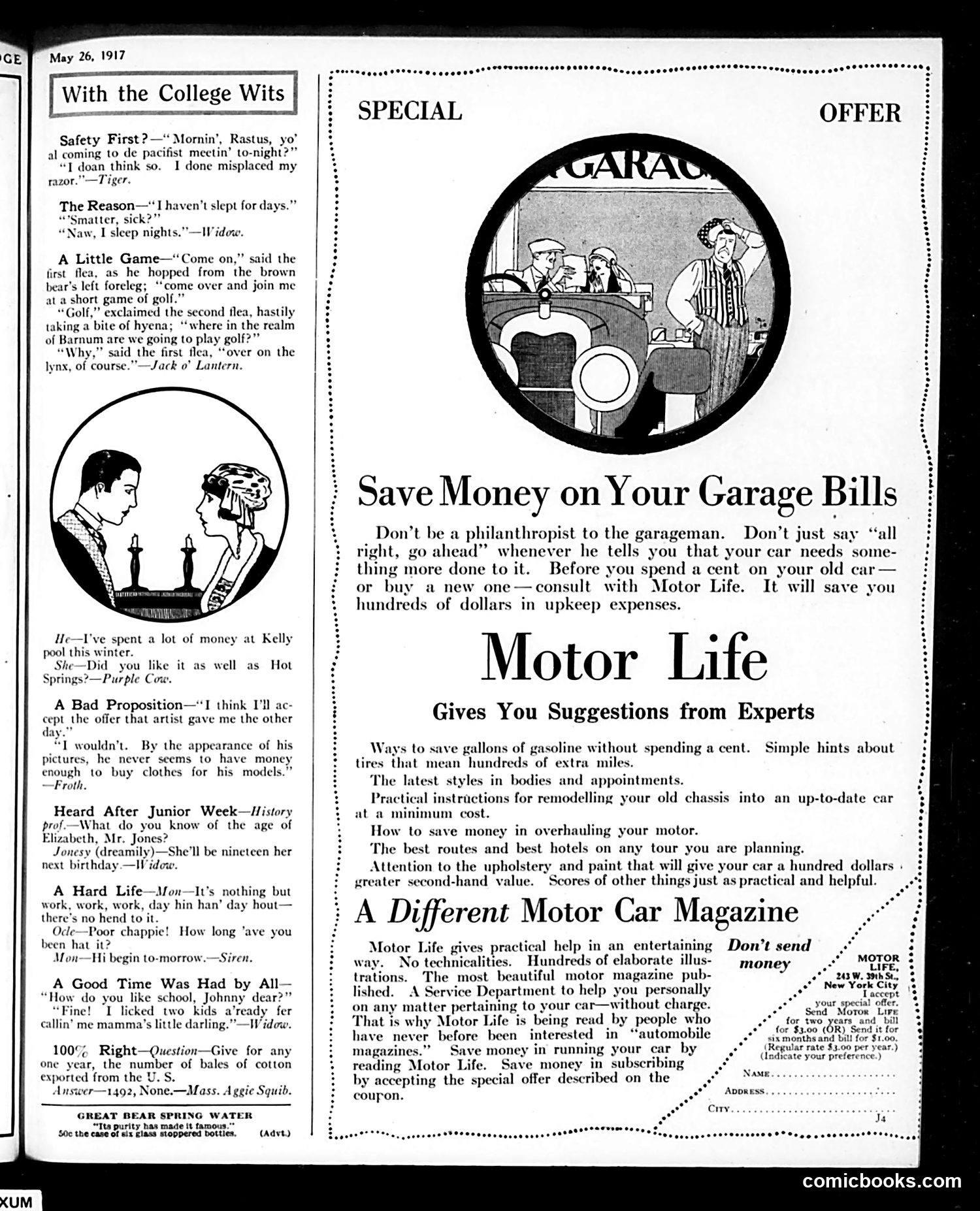
This page from Judge (May 26, 1917) contains two distinct sections: **Left side—Humor column:** A collection of brief jokes targeting college students and young people. The humor relies on wordplay and mild absurdism—fleas playing golf on a lynx, a student claiming to have misplaced his razor (implying ineptitude), confusion about historical dates. References like "Pacifist meetin'" allude to WWI-era draft debates. The jokes appear designed for a college-educated, cosmopolitan audience. **Right side—Advertisement:** A full-page Motor Life magazine promotion, capitalizing on growing automobile ownership. The ad promises readers practical advice on car maintenance and fuel economy—concerns for early automotive owners unfamiliar with upkeep costs. The garage illustration depicts a mechanic potentially overcharging customers, reflecting widespread suspicion of repair shops in this era. The juxtaposition is typical for Judge: sophisticated satire paired with consumer advertising targeting the same educated readership.
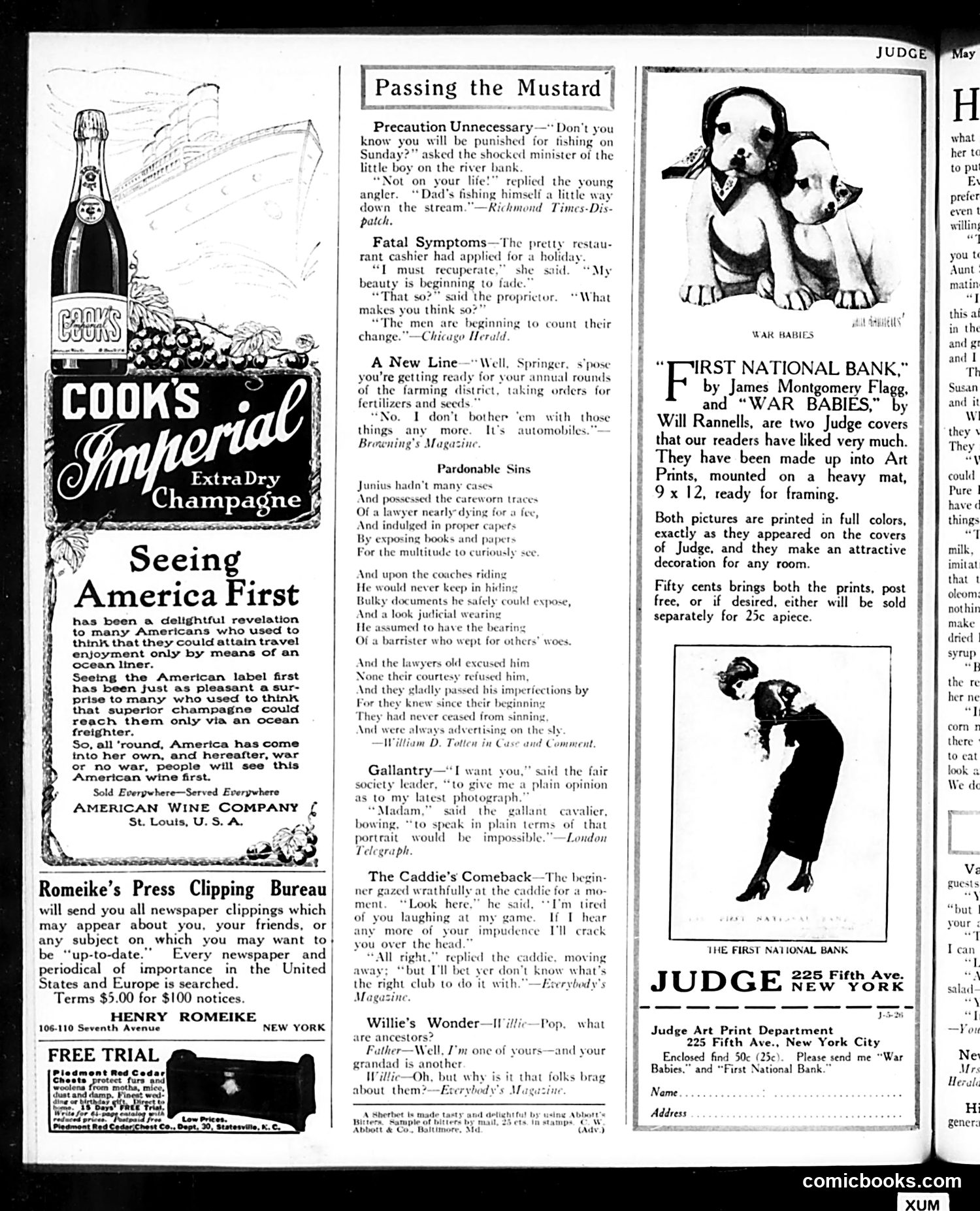
This page is primarily **advertising and humor content**, typical of Judge magazine's format. The main satirical pieces are short jokes: - **"Precaution Unnecessary"**: A boy fishing on Sunday deflects the minister's concern by noting his father fishes nearby—humor based on hypocrisy and parental example. - **"Fatal Symptoms"**: A restaurant cashier claims her beauty is fading; the owner's response that "men are beginning to count their change" jokes that her loss of beauty means she's no longer distracting customers from noticing theft. - **"Pardonable Sins"**: A poem about a lawyer (Junius) who violates professional ethics by exposing clients' secrets, yet escapes consequences because other lawyers protect him—satirizing legal profession corruption and mutual cover-ups. - **"The Caddie's Comeback"**: A golfer threatens violence; the caddie's retort that the golfer doesn't know which club to use mocks his incompetence. The **Cook's Champagne ad** emphasizes American-made luxury goods, playing on post-WWI American confidence. The **War Babies art prints** advertisement references Judge covers by notable illustrators.
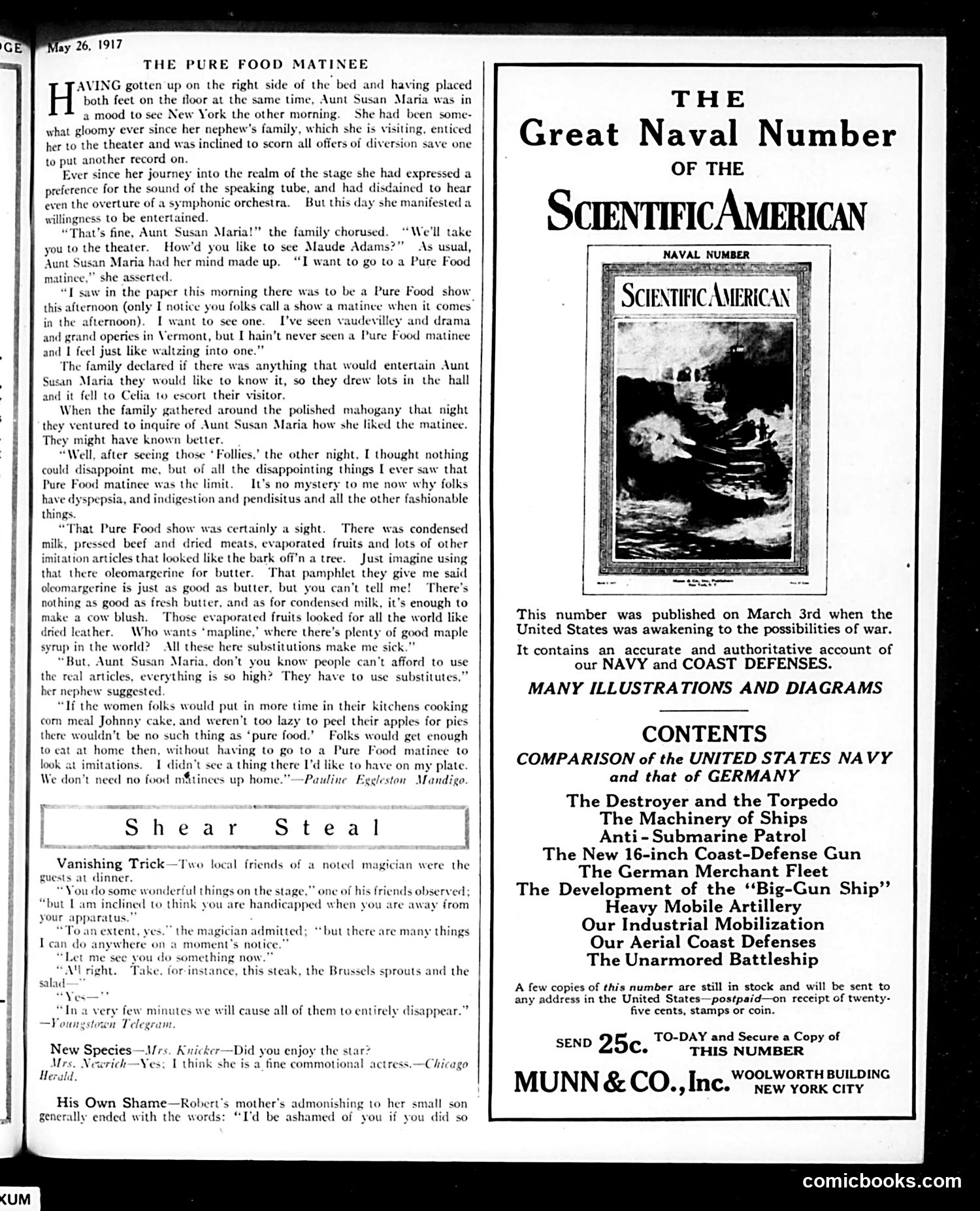
This satirical article mocks *Pure Food exhibitions*—educational displays about food safety and synthetic food products that were popular in early 20th-century America. The protagonist, Aunt Susan Maria, attends such a matinee expecting entertainment like theater, but instead views displays of condensed milk, oleomargarine, evaporated fruits, and other processed "imitation" foods. The satire targets her old-fashioned nostalgia: she complains these substitutes are inferior to "real" homemade food and blames women for laziness in the kitchen rather than acknowledging economic necessity. The joke exposes how food substitutes—driven by poverty and rising costs—were culturally controversial. Progressive reformers championed Pure Food regulations (following the 1906 Act), while traditionalists like Aunt Susan Maria scorned modern convenience foods as inauthentic and morally inferior, revealing class anxieties about industrialization and changing domestic life.
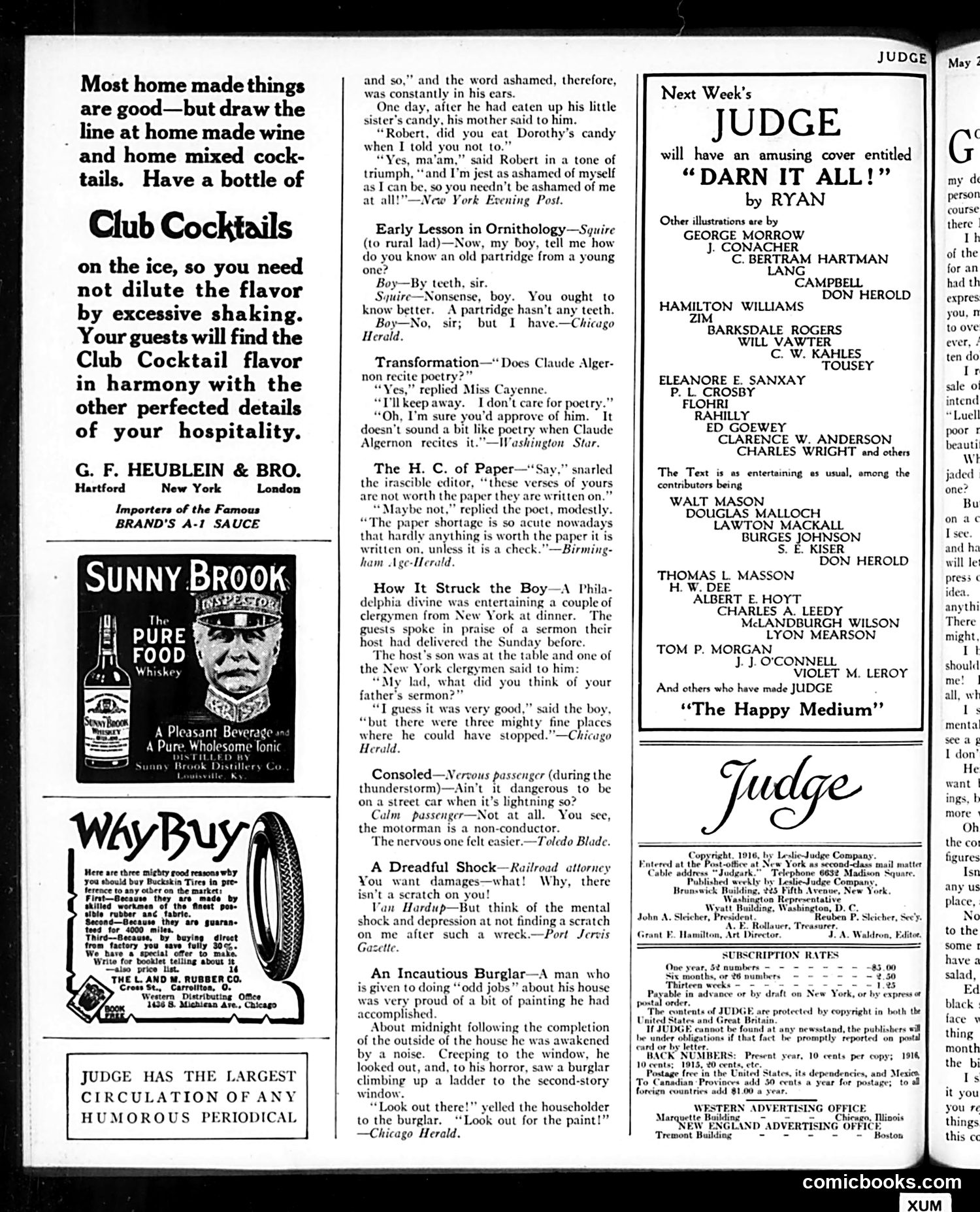
This is a page from Judge magazine containing advertisements, humorous short jokes, and a list of contributor credits for next week's issue. Rather than a political cartoon, it features multiple small comic anecdotes—jokes about children, rural wisdom, poetry appreciation, and clergymen—typical of the magazine's satirical humor style. The page demonstrates Judge's early 20th-century sensibility: gentle, domestic humor (a boy caught eating candy, a parson's sermon critique) and class-conscious comedy (city clergymen visiting from New York). Advertisements for Club Cocktails and Sunny Brook whiskey reflect the pre-Prohibition era when the magazine could freely advertise alcohol. The contributor list indicates Judge employed prominent illustrators and humorists of the period. Overall, this is a standard editorial/advertising page rather than a focused political or social satire.
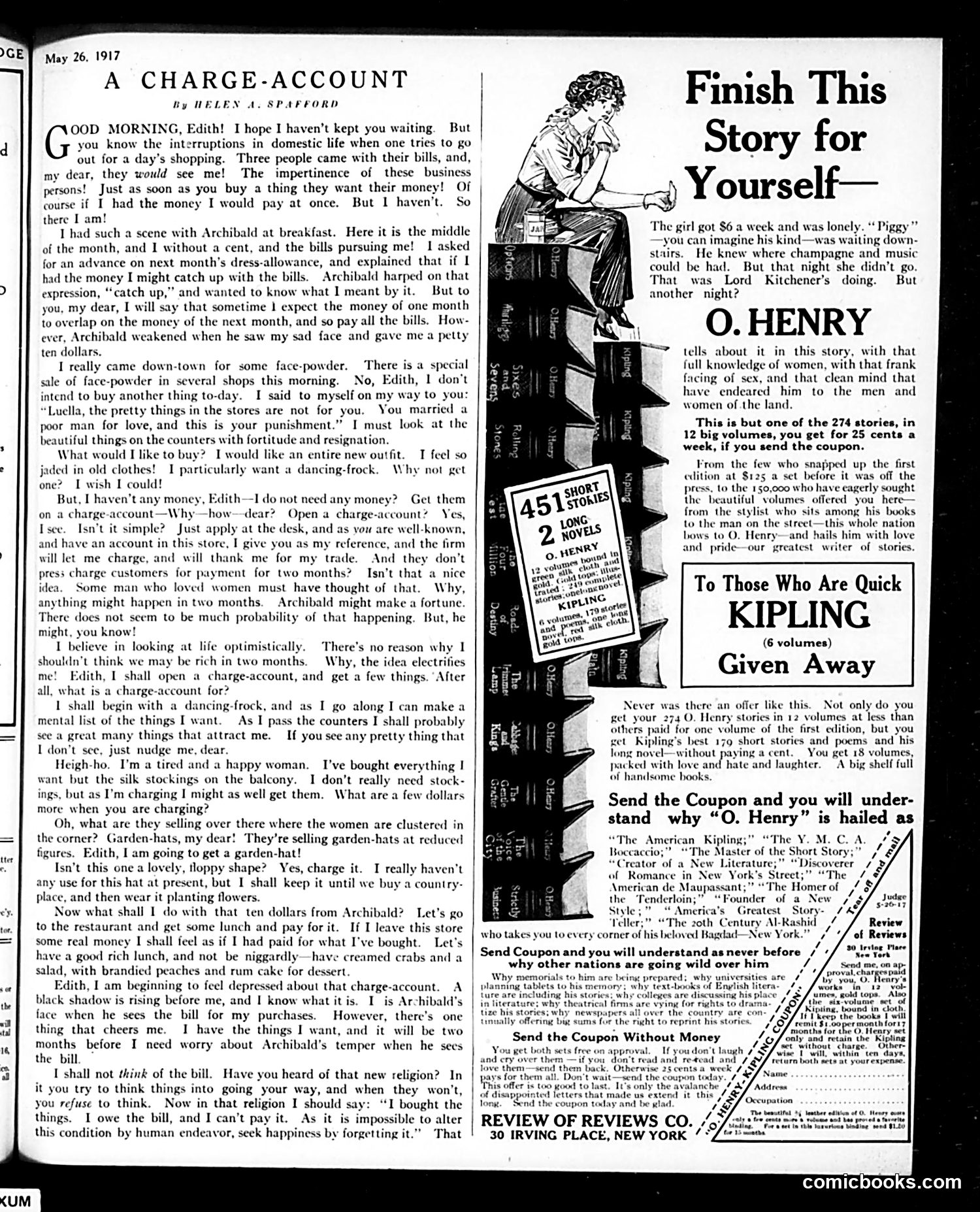
This story satirizes early 20th-century women's consumer spending habits and marital dynamics. A woman named Luella describes her shopping excursion to her friend Edith, revealing how charge accounts enable frivolous purchasing. The satire targets several points: her husband Archibald's frustration with unpaid bills; her rationalization that buying on credit is acceptable because "something might happen"—perhaps he'll get rich; and her compulsive purchases of unnecessary items (garden hats, silk stockings) justified by "I'm charging anyway." The humor lies in her contradictions: she married "a poor man for love" as self-imposed "punishment," yet feels entitled to luxuries. She claims to avoid spending, then systematically accumulates debt across multiple departments. This reflects anxieties about consumer culture, credit systems, and women's economic power in households, presented as comedy rather than serious critique.
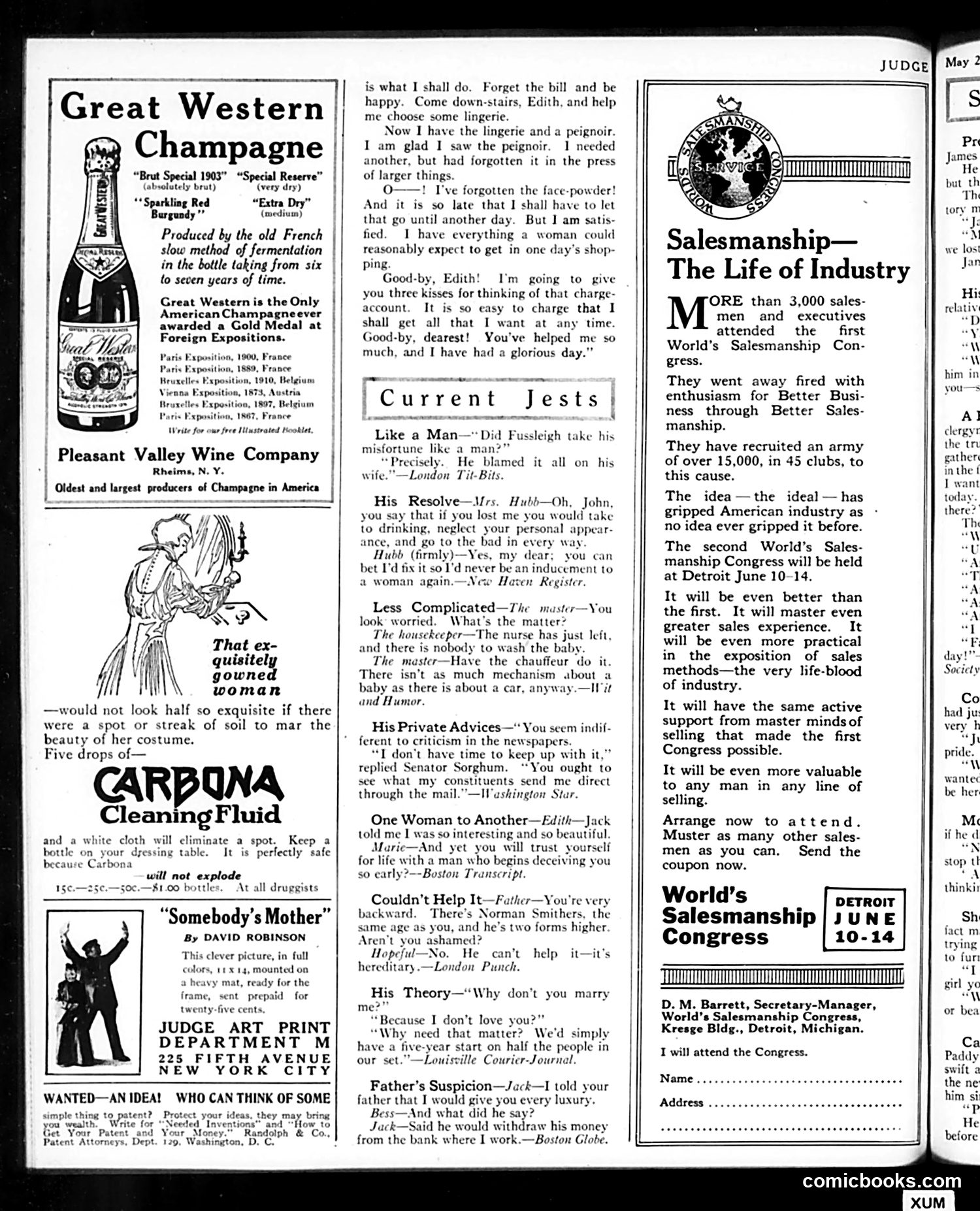
This page is primarily **advertising and humor columns**, not political cartoons. The content reflects early 1900s American consumer culture and gender dynamics. **Key Elements:** The advertisements (champagne, cleaning fluid, art prints) target affluent households. The "Current Jests" humor section contains lightweight jokes about marriage, domestic life, and class relations—typical period fare. **Notable Social Context:** The lengthy dialogue about a woman shopping and using a charge account satirizes emerging consumer culture and women's expanding economic independence. The joke hinges on her casually accumulating purchases through credit, suggesting both the novelty and mild social anxiety around female spending power at the time. Other jokes reflect contemporary attitudes: men's superiority in adversity, servants' incompetence, marital deception as normal. The humor assumes a leisured, upper-class audience with household staff. **No clear political satire** appears on this page—it's entertainment for Judge's wealthy readership.
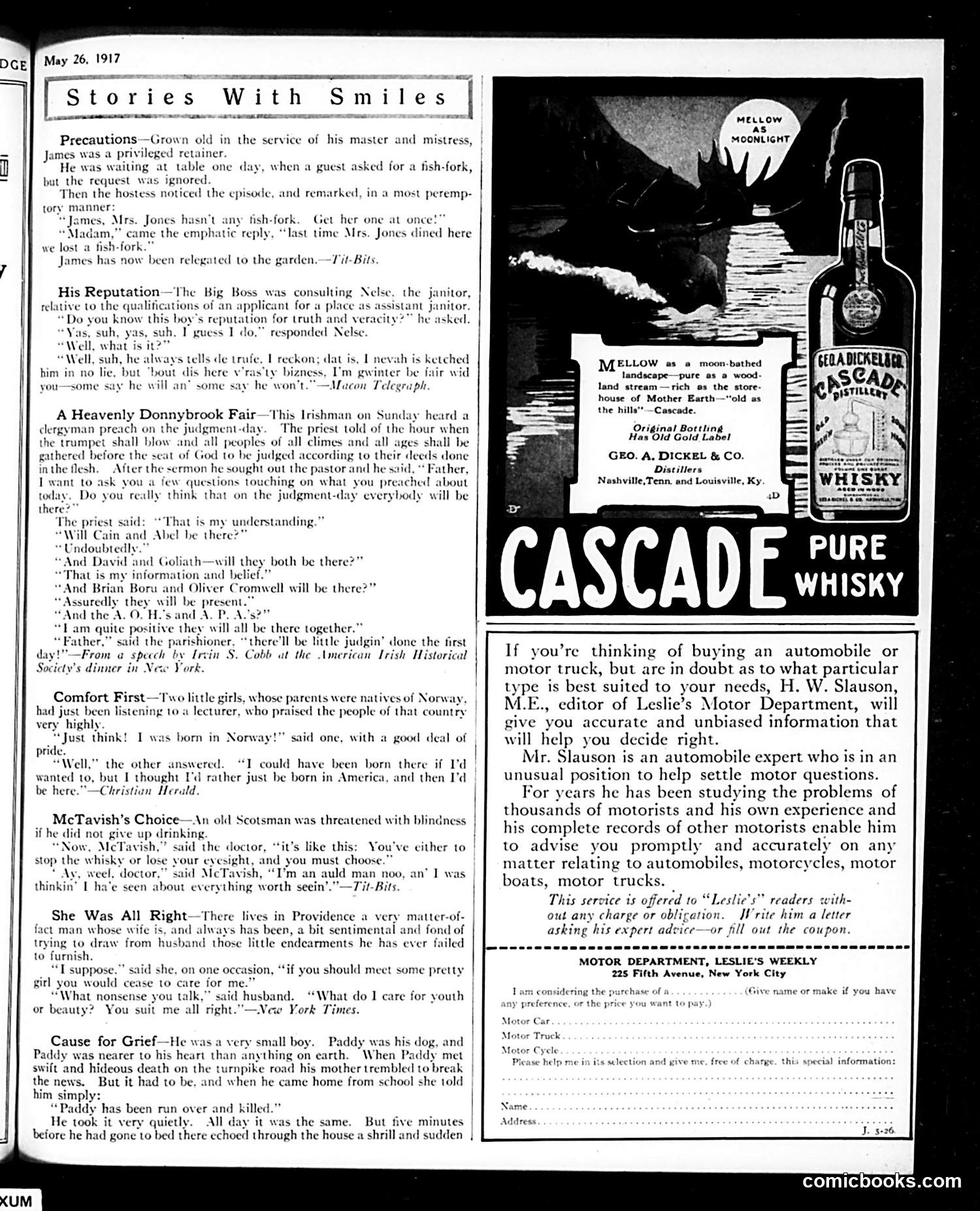
This page contains **short humorous stories** rather than political cartoons. The content reflects early 20th-century American attitudes and social hierarchies. The stories satirize class dynamics and ethnic stereotypes common to the period: - "Precautions" mocks an elderly servant's dismissal over a minor oversight - "His Reputation" features a dialect-heavy exchange with a Black janitor character, reflecting contemporary racial caricature - "A Heavenly Donnybrook Fair" uses Irish brogue to joke about Irish-American organizations (A.O.H., A.P.A.) overcrowding heaven - "Comfort First" plays on Norwegian immigrant pride - "McTavish's Choice" stereotypes Scottish drinking habits The right page contains a **Cascade Whisky advertisement** and a motor vehicle advice column. The humor relies on period stereotypes about immigrants, servants, and ethnic groups—attitudes modern readers would recognize as offensive. The magazine's satirical approach targets social pretension and working-class characters.
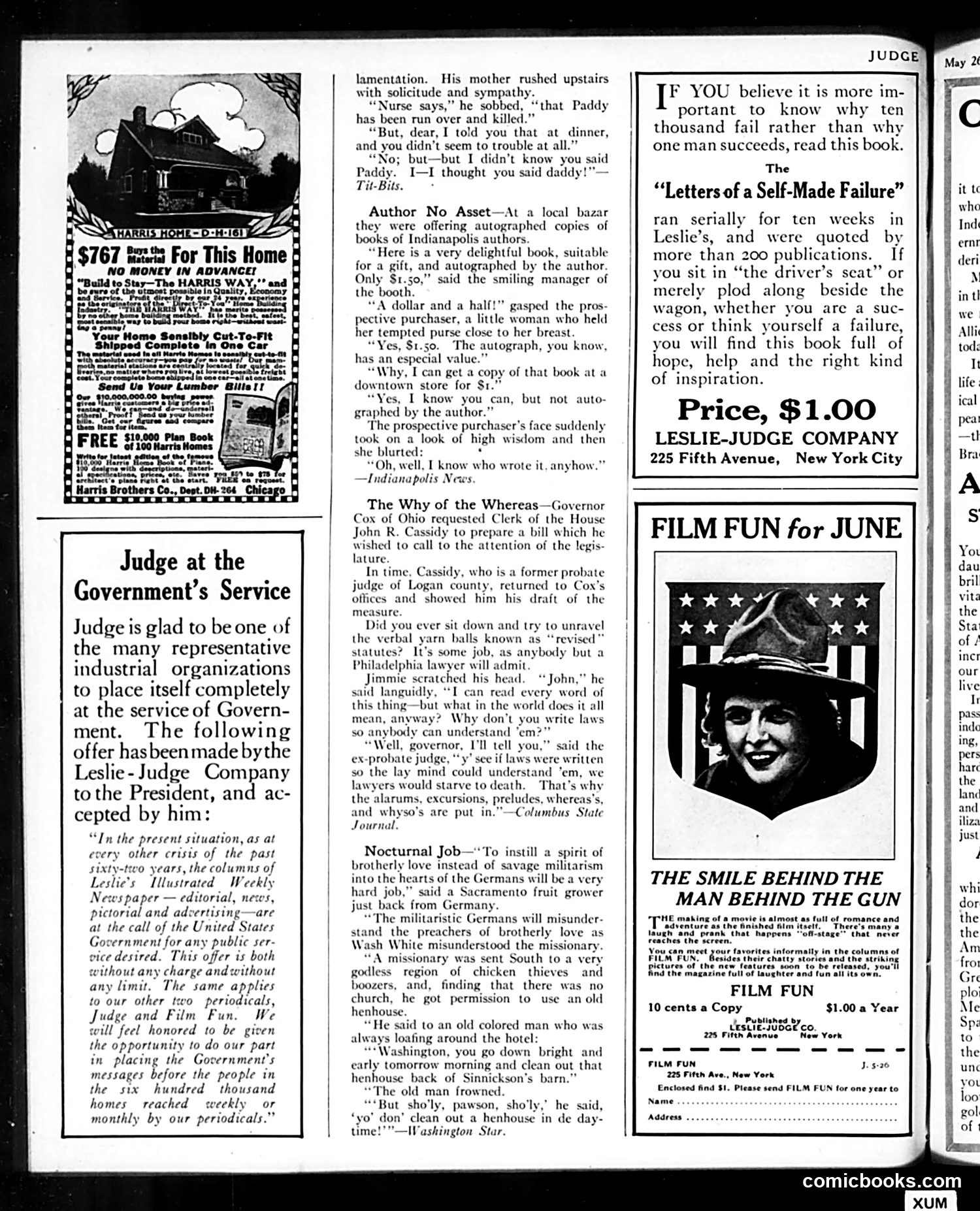
This page mixes advertisements and satirical short humor pieces typical of Judge magazine: **Main Content:** The page features three brief comic anecdotes poking fun at American life: 1. "Author No Asset" mocks the inflated vanity of authors—a woman refuses to pay extra for an autographed book, quipping she already knows who wrote it anyway. 2. "The Why of the Whereas" satirizes legal bureaucracy. A lawyer explains to his boss why bills are intentionally written in incomprehensible language ("whereas," "wherefore") instead of plain English: if legislators could actually *understand* laws, lawyers would lose their lucrative business as the middlemen who interpret legalese. 3. A brief anecdote where a child's delayed grief confuses his mother—he seems unmoved at dinner when told his father died, then cries later because he didn't realize the father mentioned at dinner was *his* dad. The humor targets American institutions—the literary establishment, legal complexity, and upper-class parenting norms—through everyday situations.
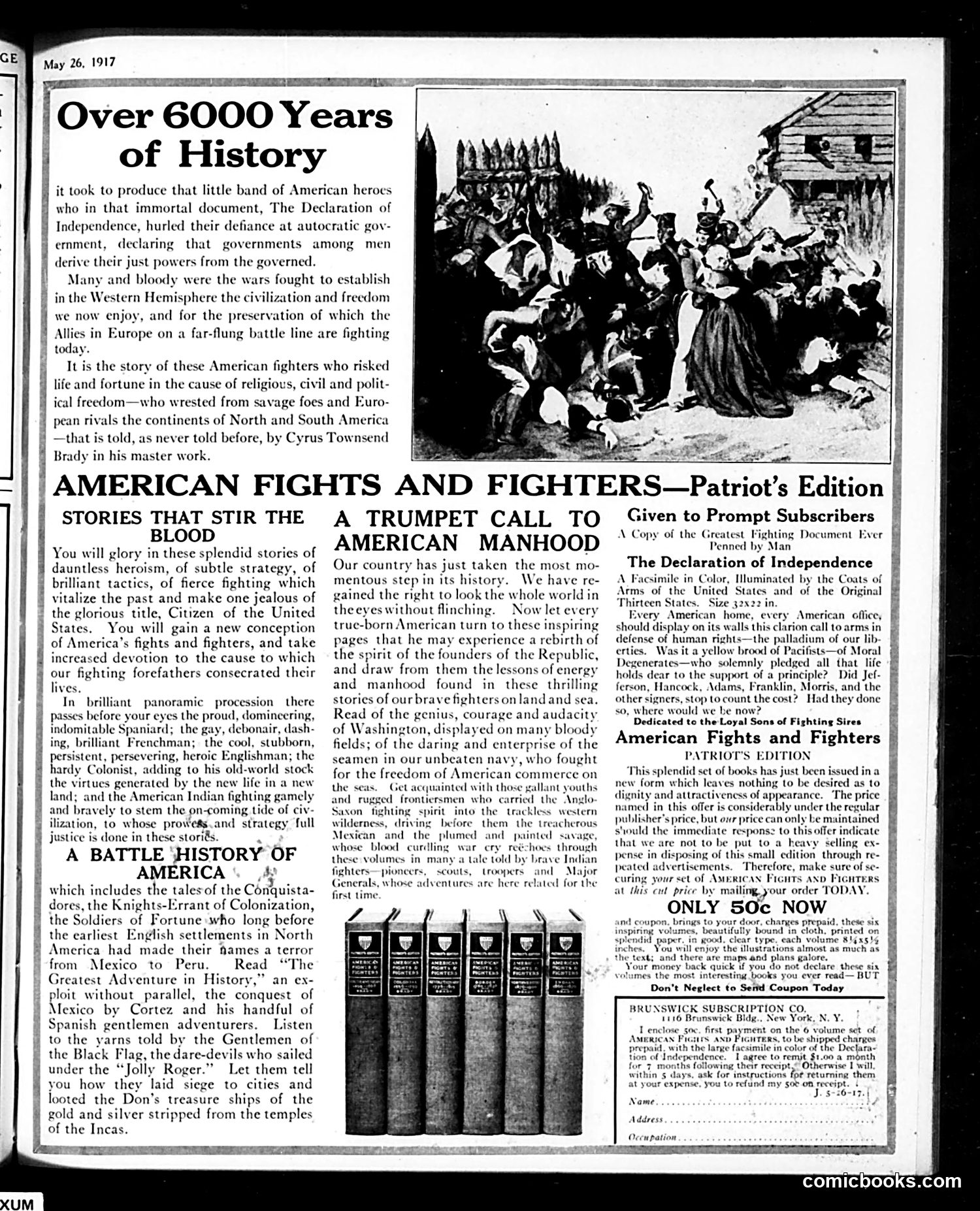
This is primarily **advertising content**, not satire. The page promotes "American Fights and Fighters—Patriot's Edition," a book series by Cyrus Townsend Brady published during America's 1917 entry into World War I. The appeal is nakedly propagandistic: it frames American history as a continuous struggle for freedom against "autocratic government" and "savage foes," positioning WWI as the latest chapter. The language—"Trumpet Call to American Manhood," "true-born American"—seeks to inspire patriotic fervor and recruit readers/soldiers. The imagery depicts colonial-era conflict, but the *context* is contemporary: "Our country has just taken the most momentous step in its history." This equates Revolutionary ideals with current war participation, suggesting that buying this book series is itself a patriotic act. Rather than satirizing, Judge here functions as a propaganda vehicle, using historical nostalgia to justify present military engagement.
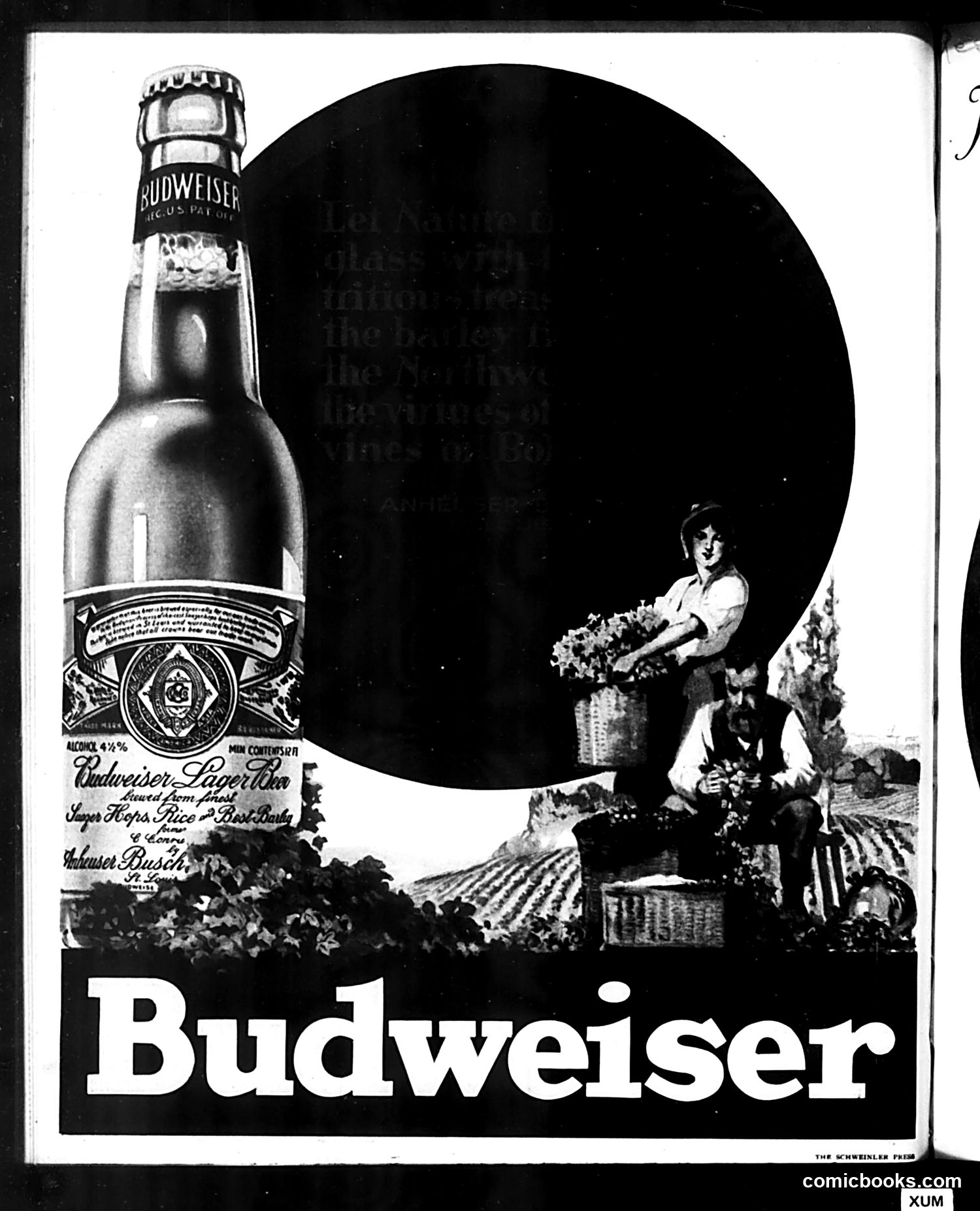
This is a Budweiser beer advertisement from Judge magazine. The image shows a large Budweiser bottle on the left alongside a pastoral scene with farmers harvesting crops in a field. A figure holds up fresh produce, suggesting agricultural abundance and harvest bounty. The advertisement associates Budweiser beer with American agricultural prosperity and rural values—common marketing strategies of the early 20th century. The composition emphasizes the beer's connection to natural ingredients and traditional farming, positioning it as an authentically American product rooted in the nation's agricultural heritage. The "Alcohol 4.7%" notation and brewery information (Anheuser-Busch, St. Louis) are visible on the label. This appears to be a straightforward product advertisement rather than political satire or social commentary.