
Judge, 1917-05-26 · page 27 of 32
Judge — May 26, 1917 — page 27: what you’re looking at
What you’re looking at
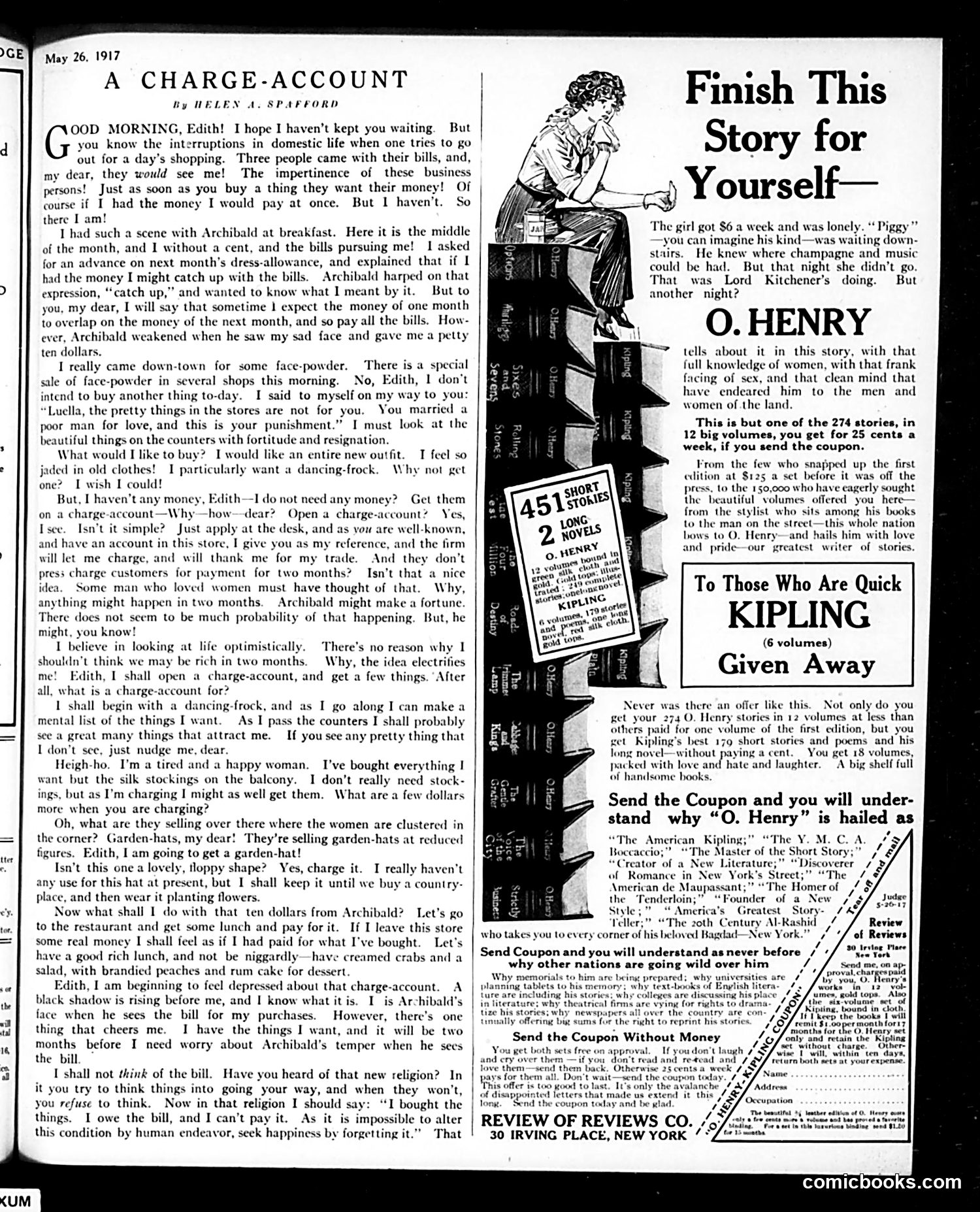
This story satirizes early 20th-century women's consumer spending habits and marital dynamics. A woman named Luella describes her shopping excursion to her friend Edith, revealing how charge accounts enable frivolous purchasing. The satire targets several points: her husband Archibald's frustration with unpaid bills; her rationalization that buying on credit is acceptable because "something might happen"—perhaps he'll get rich; and her compulsive purchases of unnecessary items (garden hats, silk stockings) justified by "I'm charging anyway." The humor lies in her contradictions: she married "a poor man for love" as self-imposed "punishment," yet feels entitled to luxuries. She claims to avoid spending, then systematically accumulates debt across multiple departments. This reflects anxieties about consumer culture, credit systems, and women's economic power in households, presented as comedy rather than serious critique.
📄 Transcribed text from this page (OCR, searchable)
Machine-transcribed from the original scan — historical spelling and the odd misread are preserved.
May 26, 1917 A CHARGE-ACCOUNT By HELEN A. SPAFPORD OOD MORNING, Edith! I hope I haven't kept you waiting. But you know the interruptions in domestic life when one tries to go and, ness out for a day’s shopping. Three people came with their bill my dear, they would see me! The impertinence of these bu Just as soon as you buy a thing they want their money! Of persons! ‘y! But 1 haven't. So course if I had the money I would pay at once. there I am! I had such a scene with Archibald at breakfast. Here it is the middle of the month, and I without a cent, and the bills pursuing me! I asked for an advance on next month’s dress-allowance, and explained that if 1 had the money I might catch up with the bills. Archibald harped on that expression, “‘catch up,” and wanted to know what I meant by it. But to you, my dear, I will say that sometime 1 expect the money of one month io overlap on the money of the next month, and so pay all the bills. How- ever, Archibald weakened when he saw my sad face and ga ten dollars. ly came down-town for some face-powder. There is a special sale of face-powder in several shops this morning. No, Edith, 1 don’t intend to buy another thing to-day. I said to myself on my way to you: “Luella, the pretty things in the stores are not for you. You married a poor man for love, and this is your punishment.” I must look at the beautiful things on the counters with fortitude and r ion. What would I like to buy? I would like an entire new outfit. T feel so jaded in old clothes! I particularly want a dancing-frock. Why not get one? I wish I could! But, I haven't any money, Edith—I do not need any money? on a charge-account—Why—how—dear? Open a charge-account? Isee. Isn't it simple? Just apply at the desk, and as vou are well-known, and have an account in this store, I give you as my reference, and the firm will let me charge, and will thank me for my trade. And they don’t press charge customers for payment for two months? Isn't that a nice idea me man who loved women must have thought of that. Why, anything might happen in two months. Archibald might make a fortune. There does not seem to be much probability of that happening. But, he might, you know! I believe in looking There’s no reason why I shouldn't think we may be rich in two months. Why, the idea electrifies me! Edith, I shall open a charge-account, and get a few things. After all, what is a charge-account for? I shall begin with a dancing-frock, and as I go along I can make a mental list of the things I want. As I pass the counters I shall probably see a great many things that attract me. If you see any pretty thing that I don’t see, just nudge me, dear. Heigh-ho. I’m a tired and a happy woman. I’ve bought everything | want but the silk stockings on the balcony. I don’t really need stock- ings, but as I'm charging I might as well get them. What are a few dollars more when you are charging? Oh, what are they selling over there where the women are clustered in the corner? Garden-hats, my dear! They’re selling garden-hats at reduced figure Zdith, I am going to get a garden-hat! Isn’t this one a lovely, floppy shape? Y any use for this hat at present, but I shall k place, and then wear it planting flowers. Now what shall I do with that ten dollars from Archibald? Let's go to the restaurant and get some lunch and pay for it. If I leave this store some real money I shall feel as if I had paid for what I've bought. Let's have a good rich lunch, and not be niggardly—have creamed crabs and a salad, with brandied peaches and rum cake for dessert. Edith, I am beginning to feel depressed about that charge-account. A black shadow is rising before me, and I know what it is. I is Archibald’s face when he sees the bill for my purchases. However, there’s one thing that cheers me. I have the things I want, and it will be two months before I need worry about Archibald’s temper when he sees the bill. I shall not think of the bill. Have you heard of that new religion? In it you try to think things into going your way, and when they won't, you refuse to think. Now in that religion I should say: “I bought the things. I owe the bill, and I can’t pay it. As it is impossible to alter this condition by human endeavor, seek happiness by forgetting it Get them Yes, life optimistically. , charge it. T really haven't p it until we buy a country- Finish This Story for ~ Yourself— The girl got $6 a week and wa “Piggy” “an imagine his kind—was waiting down- stairs. He knew where champagne and music could be had. But that night she didn’t go. That was Lord Kitchener’s doing. But another night? O. HENRY tells about it in this story, with that full knowledge of women, with that frank facing of sex, and that clean mind tha have endeared him to the men and women of the land. This is but one of the 274 storie: 12 big volumes, you get for 25 cents a week, if you send the coupon. From the few who snapped up the first edition at $125 a set before it was off the press, to the 150,000 who have eagerly sought the beautiful volumes offered you here— from the stylist who sits among his books to the man on the street—this whole nation ws to O. Henry—and hails him with love and pride—our greatest writer of stories. To Those Who Are Quick KIPLING (6 volumes) Given Away RY 0. Ew vanes Noth mc ver was there an offer like this. Not only do you get your 274 O. Henry stories in 12 volumes at less than others paid for one volume of the first edition, but you 's best 179 short stories and poems and his without Faying acent. You get 18 volumes, ( long novel hate and laughter. A big shelf full packed with lov of handsome books. Send the Coupon and you will under- stand why “O. Henry” is hailed as “The American Kipling; “The Y. M. C. A Boccaccio; Phe Master of the Short Story;” “Creator of a New Li “Discoverer / 2, of Romance in New Ye Sh Tht es: ©, American de Maupassant,” he Homer of the Tenderloin;” “Founder of a New * “ America’s Greatest ‘Veller he 20th Century Al-Rashid who takes you to every corner of his beloved Bagdad—New York.” Send Coupon and you will understand as never before / why other nations are going wild over him / Why memorial are being prepared; why universities: planning tablets to his memory; why text-books of Engl ture are including his stories; why colleges are discuss! in literature; why theatrical firms are vying for rights why newspapers all over the country Hy offering big sums for the right to reprint his stories. Send the Coupon Without Money t both If you don’t Is Aah a tpt arn both ets at your expense Styh proval.chares by. you, O. Henry's works on approval tread and re —send the cou} I's only the ava disap Je us extend it this ¢. Send the coupon t and be lad. | REVIEW OF REVIEWS CO. oy 30 IRVING PLACE, NEW YORK /*Z comicbooks.com