
Judge, 1917-05-26 · page 12 of 32
Judge — May 26, 1917 — page 12: what you’re looking at
What you’re looking at
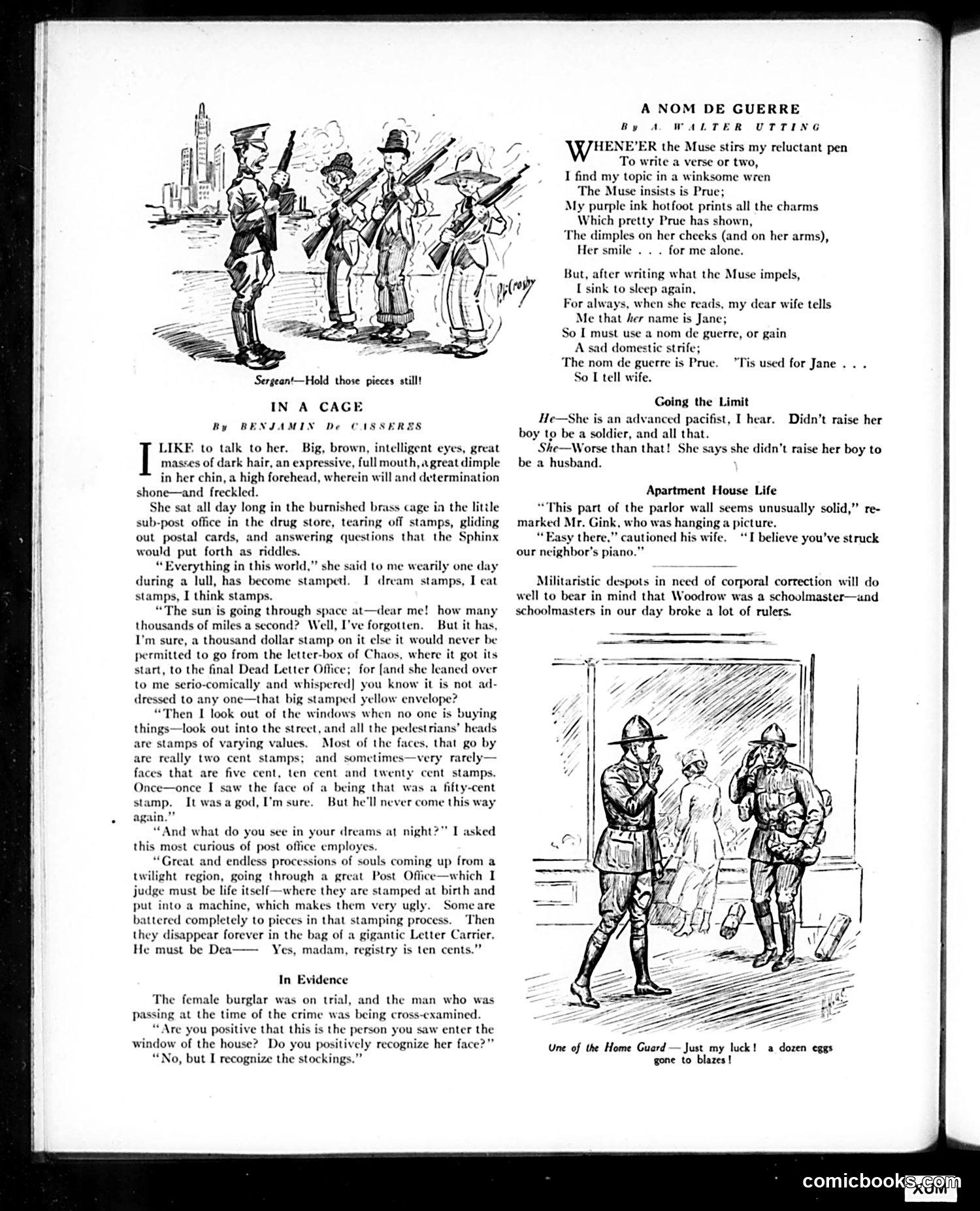
This Judge magazine page contains several satirical pieces reflective of early 20th-century American life: **"In a Cage"** depicts a post office worker exhausted by stamp-related bureaucracy, expressing existential fatigue through absurdist humor about stamps representing life's value and mortality. **"A Nom de Guerre"** jokes about a poet who dedicates verses to his muse "Prue" but must hide this from his wife "Jane"—satirizing marital tensions and poetic pretense. **"Going the Limit"** mocks pacifism and changing gender roles, referencing anti-war sentiment and women's evolving independence (the woman won't raise her son to be a soldier or husband). **"Apartment House Life"** offers domestic humor about thin apartment walls and unintended piano damage—reflecting urban living anxieties. The bottom sketch references **Woodrow Wilson** as a former schoolmaster, making a pun about "rulers" in the context of military discipline—likely WWI-era commentary on leadership and authority. The overall tone reflects wartime social anxieties, gender role shifts, and urban modern life frustrations.
📄 Transcribed text from this page (OCR, searchable)
Machine-transcribed from the original scan — historical spelling and the odd misread are preserved.
Sergean'—Hold those pieces still! IN A CAGE By BENJAMIN De CASSER LIKF. to talk to her. Big, brown, intelligent eyes, great I masses of dark hair, an expressive, full mouth, agreat dimple in her chin, a high forehead, wherein will and determination shone—and freckled. She sat all day long in the burnished brass cage in the litile sub-post office in the drug store, tearing off stamps, gliding out postal cards, and answering questions that the Sphinx would put forth as riddles. “Everything in this world,” she said to me wearily one day during a lull, has become stamped. I dream stamps, I eat stamps, I think stamps. “The sun is going through space at—dear me! how many thousands of miles a second? Well, I've forgotten. But it has, I'm sure, a thousand dollar stamp on it else it would never be permitted to go from the letter-box of Chaos, where i start, to the final Dead Letter Office; for [and she le to me serio-comically and whispered] you know it is not ad- dressed to any one—that big stamped yellow envelope? “Then I look out of the windows when no one is buying things—look out into the street, and all the pedestrians’ heads are stamps of varying values. Most of the faces, that go by are really two cent stamps; and sometime: ery rarely— faces that are five cent, ten cent and twenty cent stamps. Once—once I saw the face of a being that was a fifty-cent stamp. It was a god, I’m sure. But he'll never come this way in.” “And what do you see in your dreams at night?” I asked this most curious of post office emplo: “Great and endless processions of souls coming up from a twilight region, going through a great Post Office—which I judge must be life itself—where they are stamped at birth and put into a machine, which makes them very ugly. Some are battered completely to picces in that stamping proc Then they disappear forever in the bag of a gigantic Letter Carrier. He must be Dea—— Yes, madam, registry is ten cents.” In Evidence The female burglar was on trial, and the man who was passing at the time of the crime was being cro: amined. “Are you positive that this is the person you saw enter the window of the house? Do you positively recognize her face?” “No, but I recognize the stockings.” A NOM DE GUERRE By A WALTER UTTING HENE’ER the Muse stirs my reluctant pen To write a verse or two, I find my topi a winksome wren The Muse insists is Prue; My purple ink hotfoot prints all the charms Which pretty Prue has shown, The dimples on her cheeks (and on her arms), Her smile . . . for me alone. But, after writing what the Muse impels, [ sink to sleep again, For always, when she reads, my dear wife tells Me that her name is Jane: So I must use a nom de guerre, or gain A sad domestic strife; The nom de guerre is Prue. So L tell wife. "Tis used for Jane . . Going the Limit He—She is an advanced pacifist, I hear. boy to be a soldier, and all that. She—Worse than that! She says she didn’t raise her boy to be a husband. Didn’t raise her Apartment House Life is part of the parlor wall seems unusually solid,” re- marked Mr. Gink, who was hanging a picture. “Easy there,” cautioned his wife. ‘I believe you’ve struck our neighbor's piano.” Militaristic despots in need of corporal correction will do well to bear in mind that Woodrow was a schoolmaster—and schoolmasters in our day broke a lot of rulers. Une of the Home Guard — Just my luck! a doz gone to blazes! comicbooksseem