
A complete issue · 32 pages · 1917
Judge — April 21, 1917
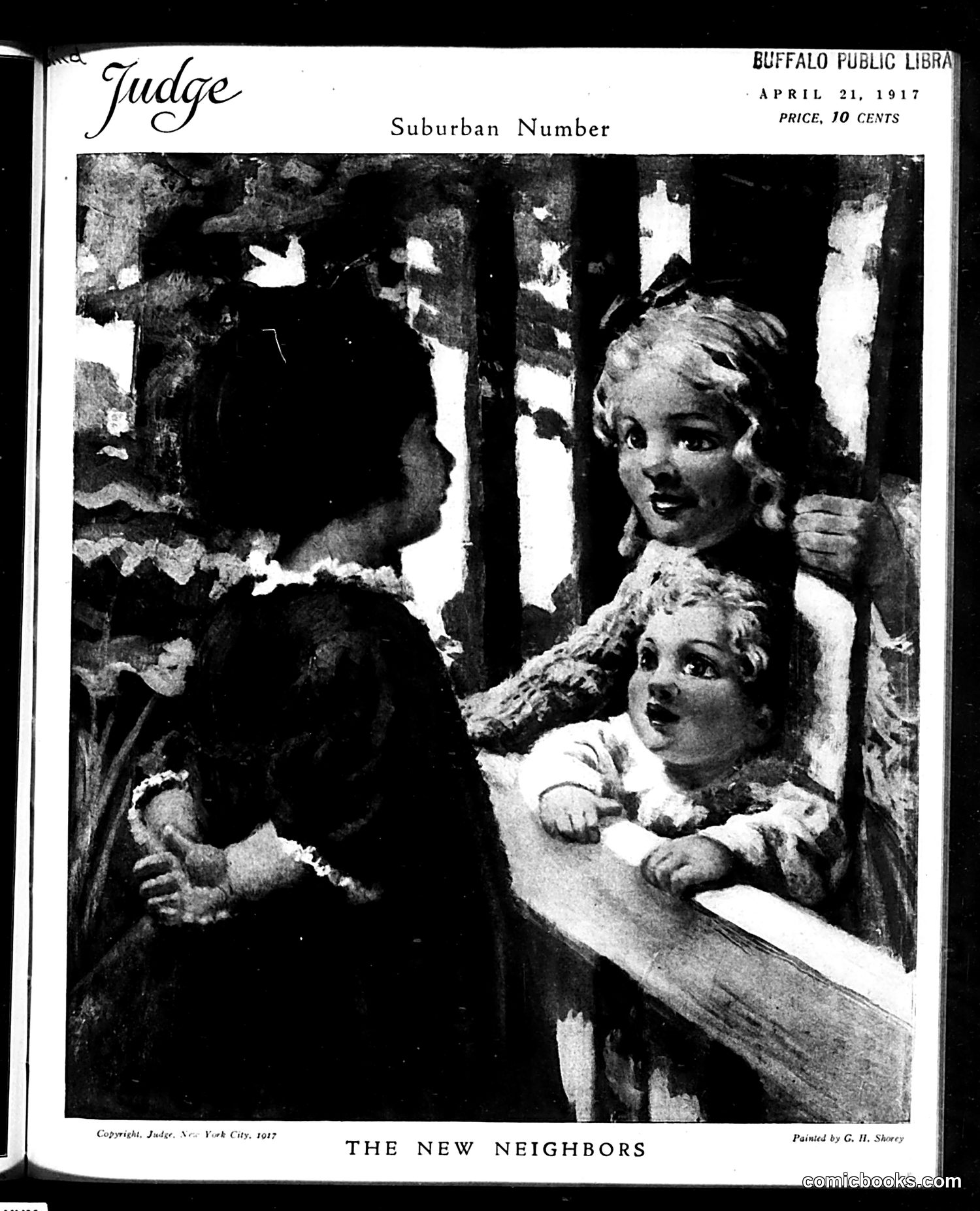
This is a Judge magazine cover from April 21, 1917, titled "The New Neighbors," painted by G. H. Sherry. The image depicts what appears to be a suburban domestic scene with figures at a fence or gate, suggesting new residents moving into a neighborhood. Given the 1917 date and "Suburban Number" designation, this likely satirizes early 20th-century American anxieties about suburban expansion and changing neighborhood demographics. The composition—with figures observing newcomers—suggests commentary on social attitudes toward outsiders or different classes entering established communities. Without identifying specific individuals, the scene captures period concerns about suburban growth, social integration, and community boundaries that Judge's readership would have recognized as contemporary satire.
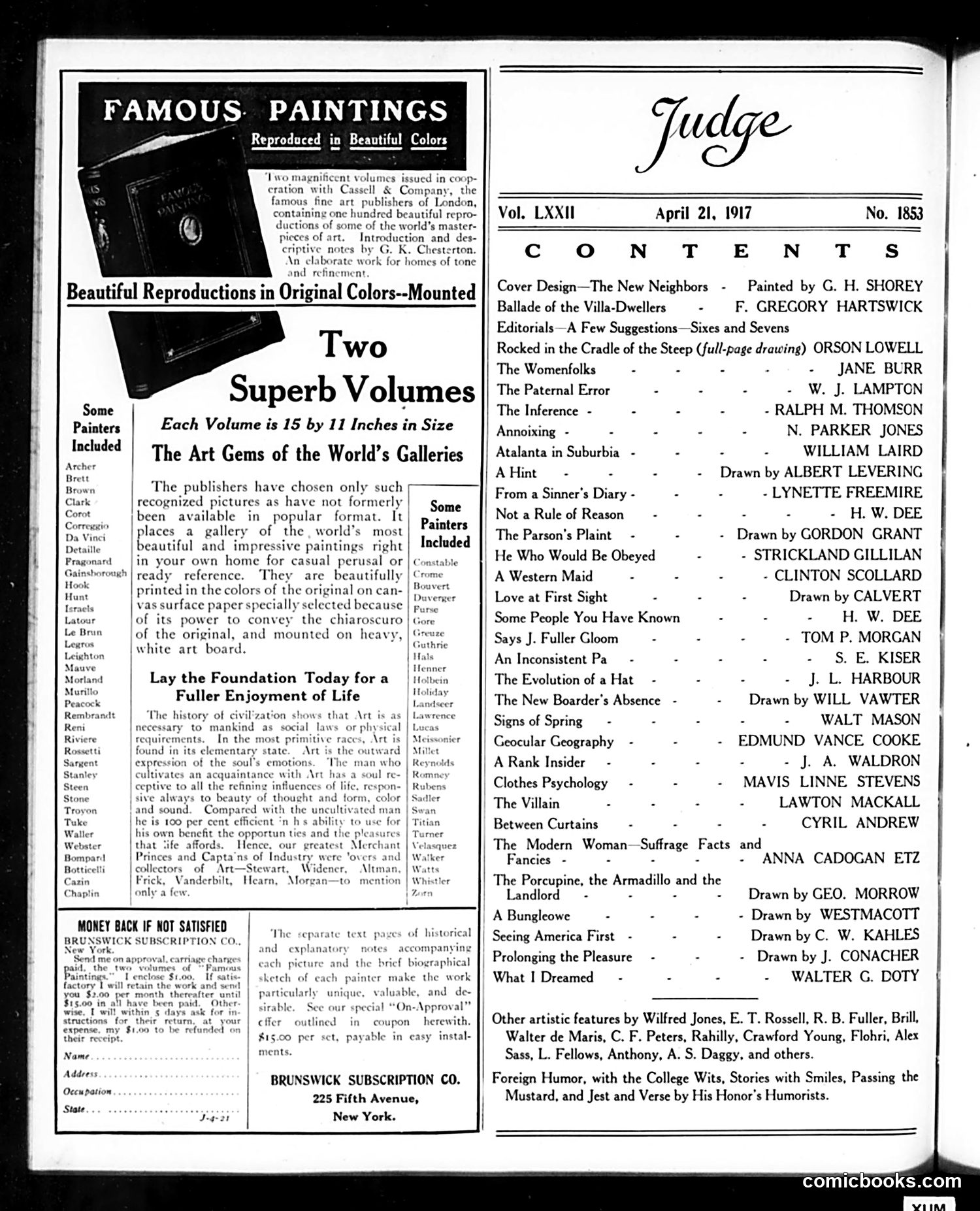
This is primarily a **contents and advertising page** rather than a cartoon page. It lists articles and illustrations for this issue of *Judge*, a satirical weekly magazine. The left side advertises a subscription offer for two volumes of reproduced famous paintings from world galleries—a common premium offer in early 20th-century magazines. The right side lists the issue's contents, including short stories, drawings, and editorial pieces by various authors. The April 1917 date places this during **America's entry into World War I** (April 6, 1917), though this particular page contains no obvious war-related content visible in the text or layout shown. The contents appear to focus on general humor, social commentary, and lighter entertainment typical of *Judge* magazine's satirical approach.
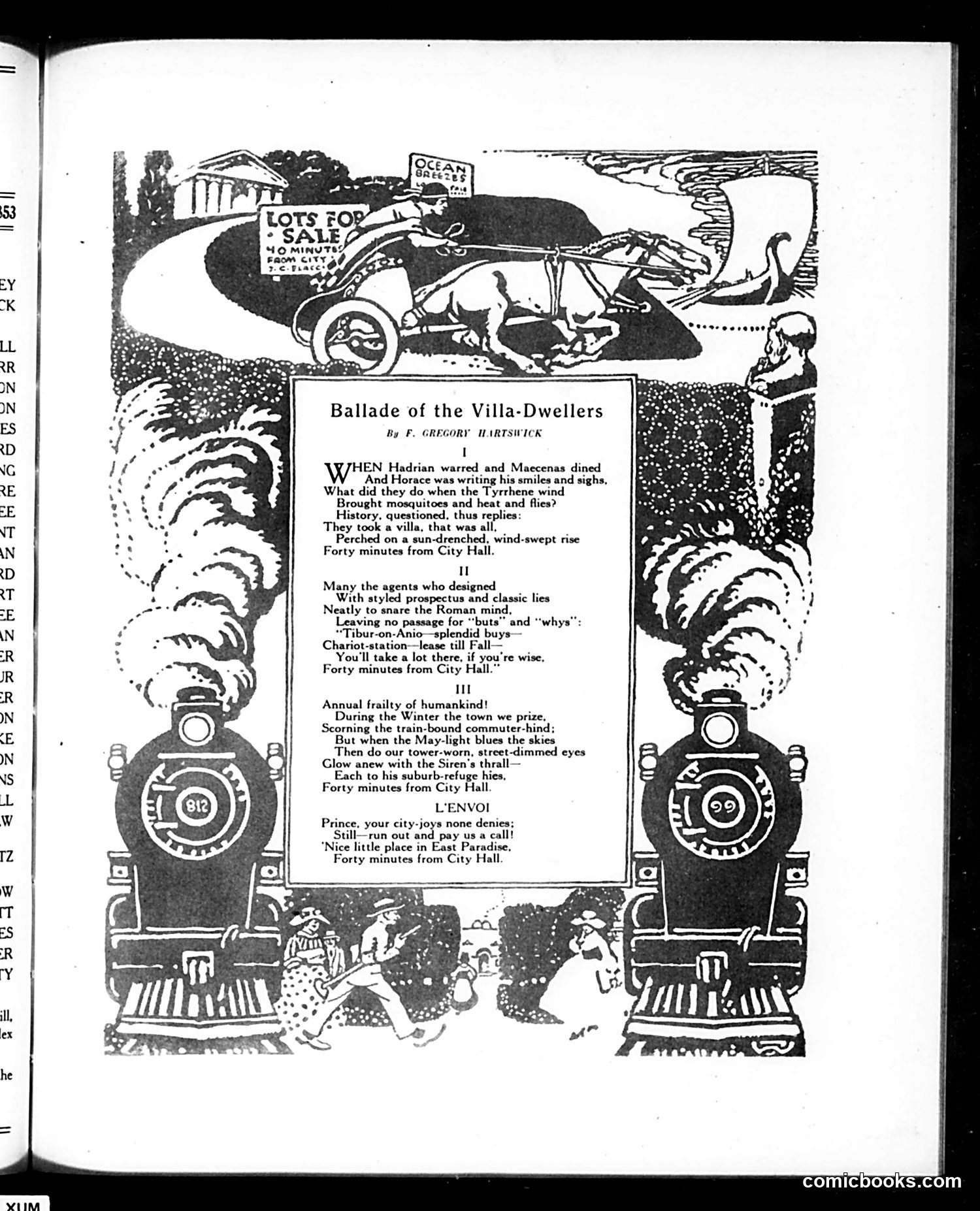
This poem satirizes wealthy suburbanites who commute to the city. The decorative border features trains and automobiles—the era's modern transportation. The satire targets the contradiction of suburban villa life: residents fled the city's "heat and fleas" for a peaceful rural retreat, yet now complain about the commute. Lines like "Forty minutes from City Hall" emphasize their paradox—they want both escape AND urban convenience. The poem mocks their pretensions: they possess "styled prospectus and classic lies," suggesting false advertising about suburban living. References to "train-bound commuter-hind" and seasonal hardships ("During the Winter the town we prize / Glow anew with the Siren's thrall") ridicule their seasonal migrations and romantic delusions about country life. Essentially: early 20th-century suburban commuters are exposed as hypocrites seeking impossible contradictions.
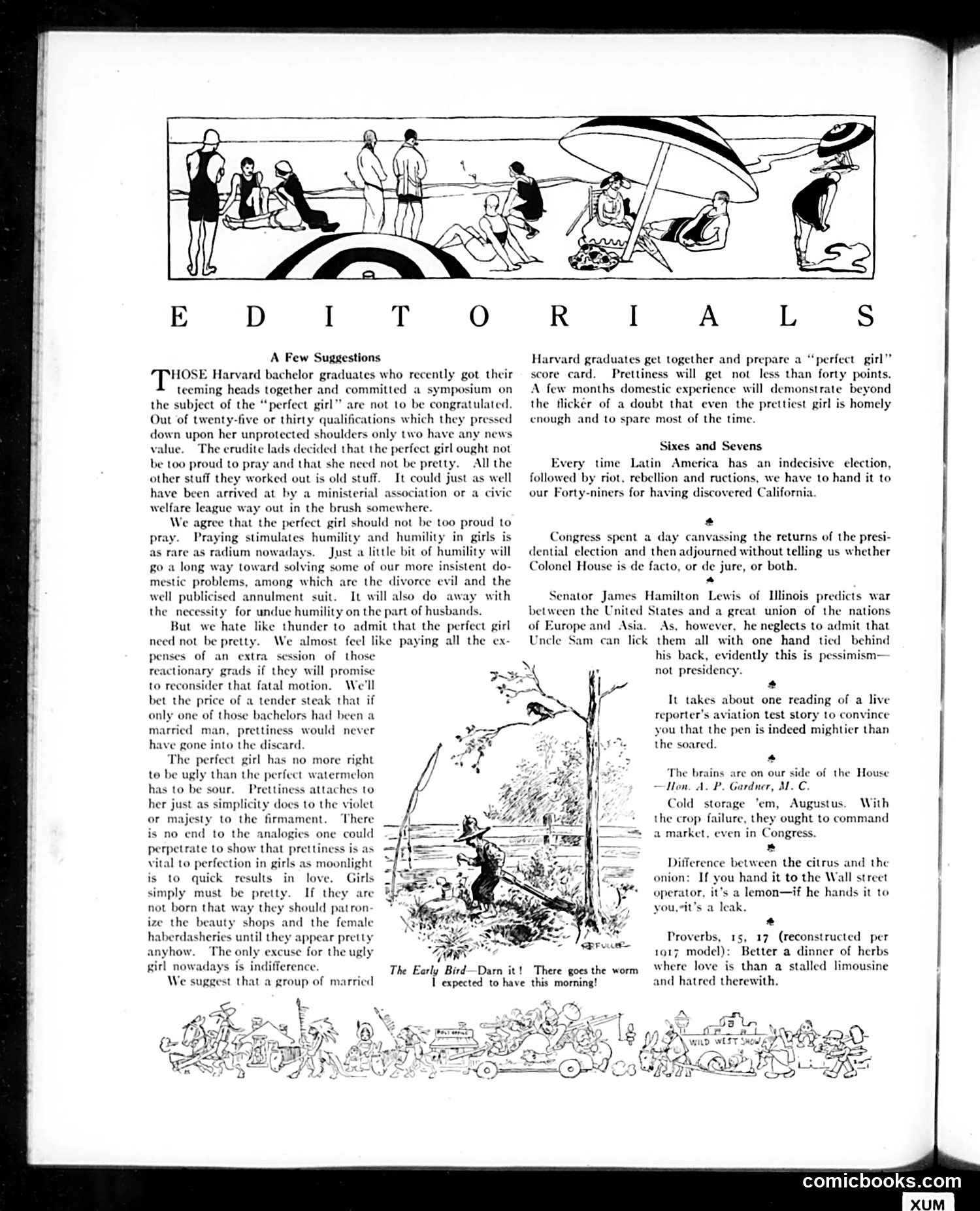
This Judge magazine page contains satirical commentary on early 20th-century American politics and social issues. The "Editorials" section mocks Harvard graduates' symposium on the "perfect girl," arguing that prettiness and humility matter less than character. The subsequent short political items critique Congress and Senator James Hamilton Lewis of Illinois. One piece sarcastically suggests that despite Lewis's predictions about international conflict, "Uncle Sam can lick [sic] the world," dismissing his pessimism as mere political posturing rather than genuine foresight. The cartoons and quips target contemporary political figures' incompetence, particularly regarding economic matters ("Cold storage 'em, Augustus") and suggest political solutions require market-like efficiency even in government. The overall tone is mocking, anti-feminist regarding marriage ideals, and critical of establishment political rhetoric.
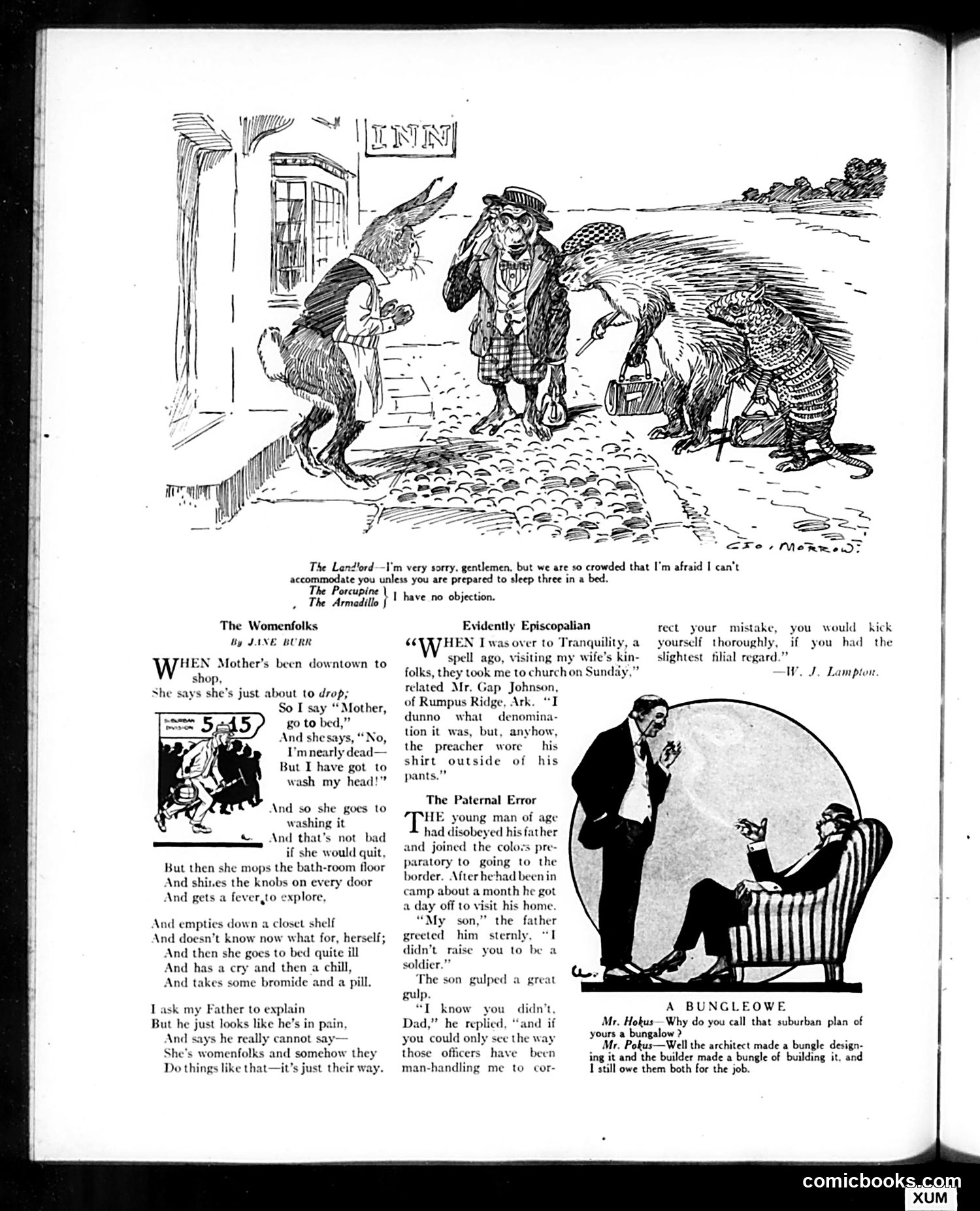
The top cartoon depicts anthropomorphic animals (appearing to be hedgehogs or porcupines) at an inn, where the landlord cannot accommodate guests unless they're willing to sleep in a bed together—a joke about overcrowding and wartime/postwar housing shortages. Below that, "The Womenfolks" is a poem by Jane Burr about a mother's domestic frustrations—cleaning, laundry, and the endless chaos of household management. It's a sympathetic portrayal of women's unpaid labor. "Evidently Episcopalian" presents an anecdote about rural religious practices, likely mocking either backwoods Christianity or city assumptions about it. "The Paternal Error" depicts a father sternly rejecting his son's military service choice, then regretting his harsh response when the son actually enlists. "A Bungalowe" is a brief comic exchange about suburban architecture terminology.
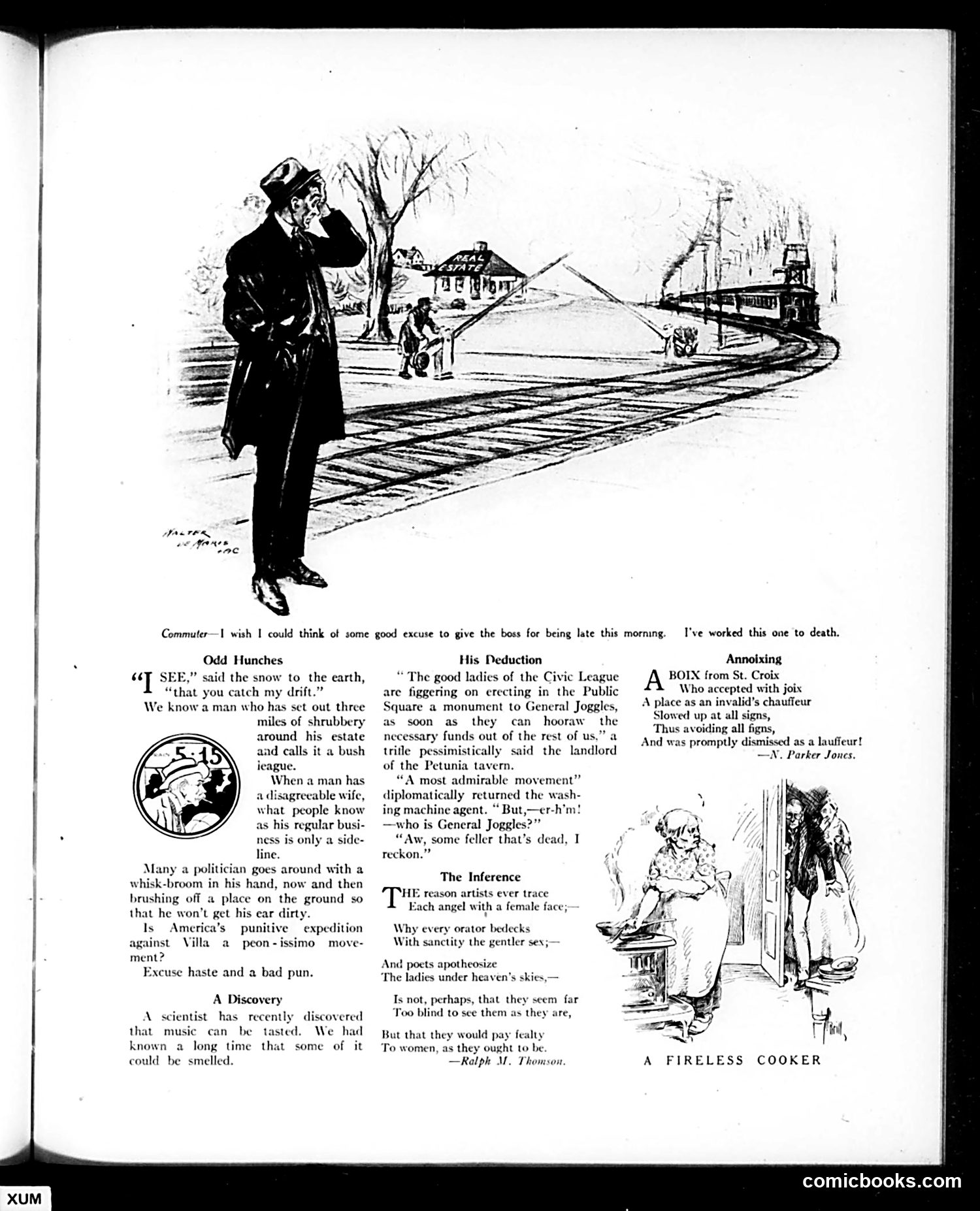
This page contains several humorous short pieces typical of early 20th-century American satire: **Main Cartoon (top):** A well-dressed commuter at a train station seeks an excuse for tardiness, having "worked this one to death"—satirizing how workers repeatedly use the same alibis with bosses. **"Odd Hunches":** Brief jokes about human nature—a man with shrubbery calling it a "bush league," politicians being hypocrites, and a scientist discovering music can be "tasted" (implying bad music "stinks"). **"His Deduction":** A tavern landlord and washing-machine salesman discuss a civic monument to "General Joggles"—likely satirizing how communities erect statues to obscure or forgotten figures without questioning their significance. **"The Inference":** A poem explaining why artists and poets idealize women—suggesting men portray women not as they are, but as they "ought to be." **Right-side illustrations:** Small comic vignettes including a "fireless cooker" joke, likely referencing early 1900s cooking technology and domestic life. The page blends social commentary with light humor typical of Judge's editorial approach.
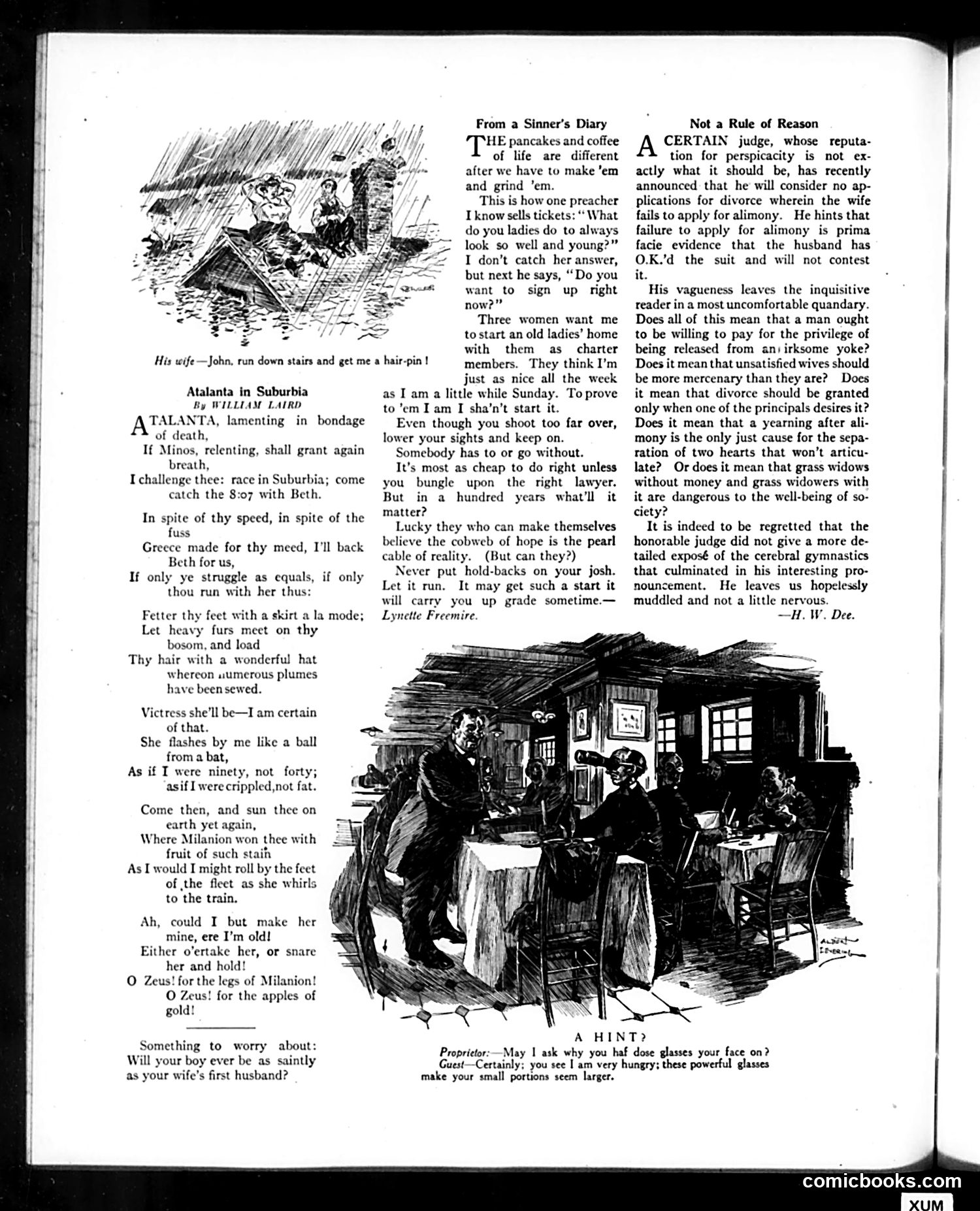
This page contains three satirical pieces mocking contemporary social attitudes: **"Atalanta in Suburbia"** parodies Greek mythology, reimagining the swift maiden Atalanta as a modern suburban wife rushing to catch the 8:07 train. The joke: she's so encumbered by fashionable clothing (heavy furs, elaborate plumed hat, restrictive skirt) that despite her legendary speed, she'd still outrun a middle-aged man. It satirizes how women's fashion constrains mobility while husbands admire their wives' vitality—an ironic commentary on period gender dynamics. **"From a Sinner's Diary"** mocks hypocritical clergy who present idealized personas on Sundays while being ordinary (implicitly flawed) weekdays. The preacher uses charm to sell memberships to an old ladies' home; the diarist admits he won't prove his virtue by starting it. **"Not a Rule of Reason"** attacks judicial absurdity: a judge declares he won't hear divorce cases unless wives demand alimony—implying husbands must pay for freedom. The author sarcastically questions this logic: Does it require mercenary wives? Punish poor women? The piece ridicules the judge's muddled reasoning. All three pieces target hypocrisy and illogical social conventions.
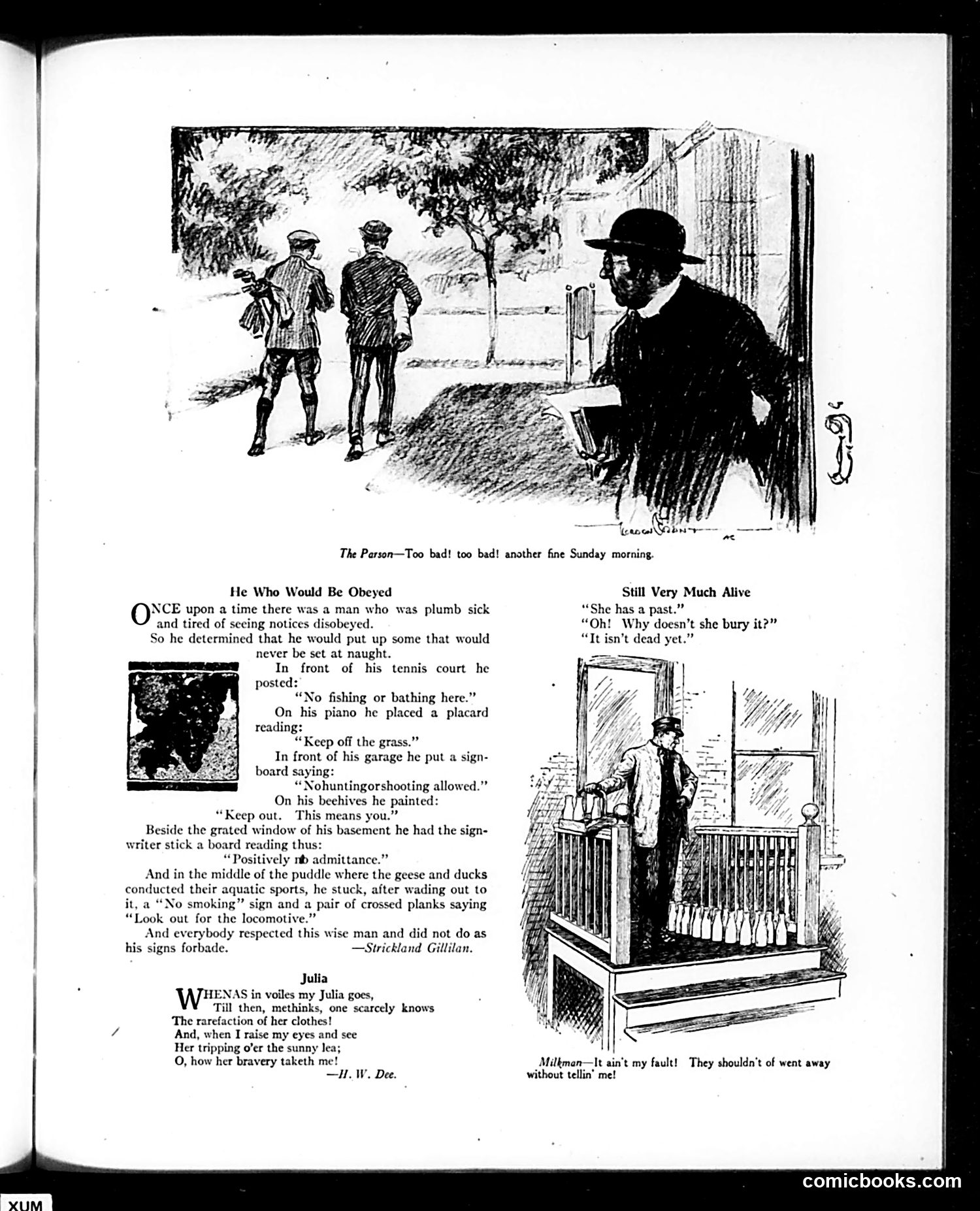
**Top Cartoon**: A parson (clergyman) comments on another "fine Sunday morning" while observing two men departing—likely parishioners who skipped church. The satire mocks habitual church absenteeism and the parson's resigned acceptance of it. **"He Who Would Be Obeyed"**: This humorous story satirizes attempts at control through signage. A man posts numerous "No" signs (no fishing, keep off grass, no hunting, no smoking, etc.) throughout his property, expecting obedience. The ironic twist: everyone respects his wishes *precisely because* of the signs' absurdity and his obvious desperation—the opposite of his intent. The satire targets ineffective authority and the absurdity of over-regulation. **"Still Very Much Alive"**: A brief joke about a woman with a disreputable past. When asked why she doesn't "bury it," the response is "It isn't dead yet"—meaning her past continues to haunt her actively. **"Julia"**: A poetic piece (attributed to H.W. Dee) praising a woman's appearance in fashionable sheer fabrics, paired with a cartoon of a milkman complaining that the household left without informing him—likely implying the woman's scandalous departure.
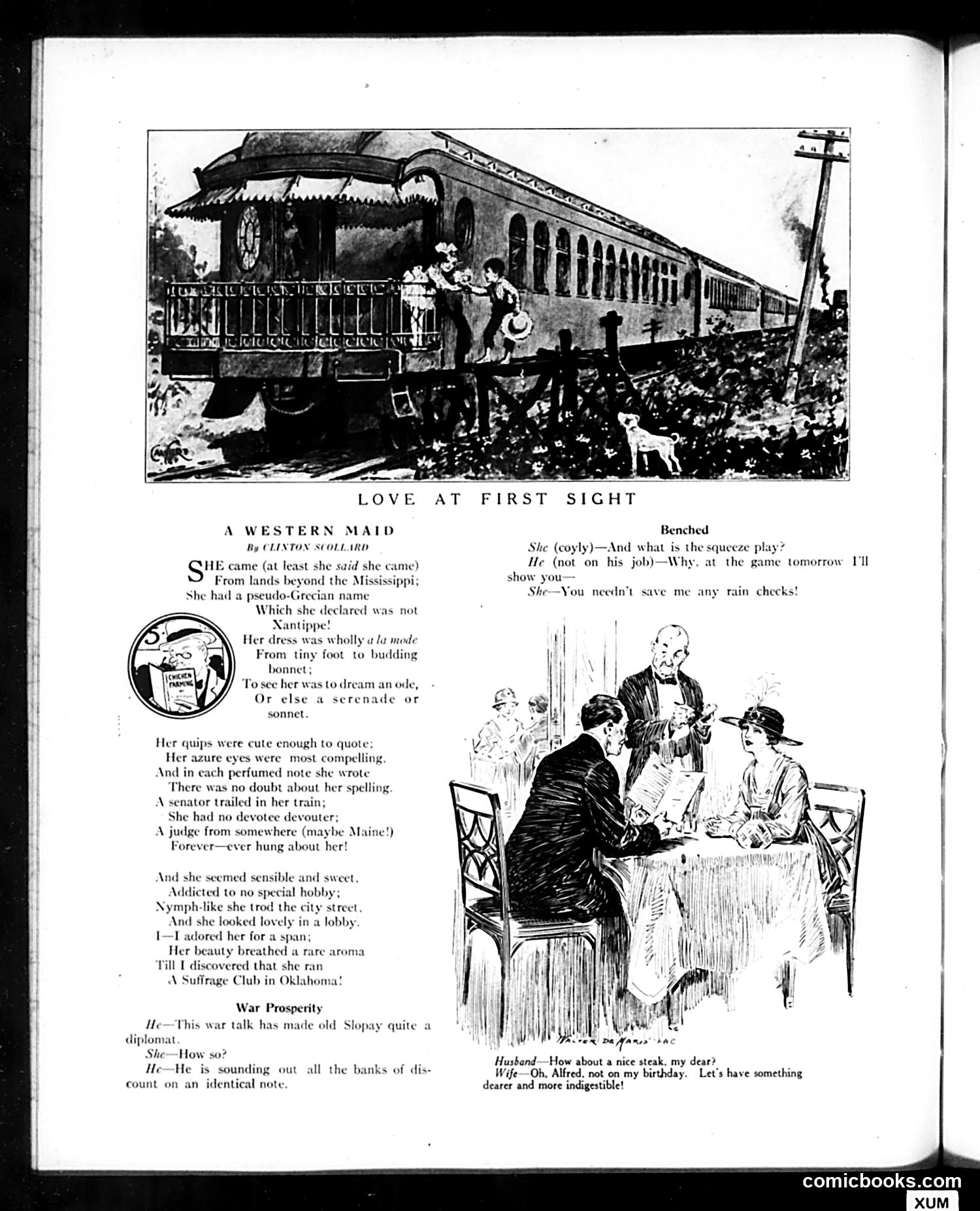
This page from *Judge* magazine contains satirical poetry and comic dialogues mocking social attitudes of the early 20th century. **"A Western Maid"** ridicules a beautiful woman from the West who seems perfect—elegant, witty, refined—until the narrator discovers she runs a **suffrage club in Oklahoma**. The joke relies on anti-suffrage sentiment: the poem suggests women's rights activism is absurd or unattractive, undermining an otherwise "ideal" woman. **"War Prosperity"** jokes about banks during wartime, suggesting financial institutions are all adopting identical loan policies—treating lending mechanically rather than individually. **"Benched"** depicts a baseball date where the woman flirts about the "squeeze play" (a baseball move), but the man admits he's not paying attention to the game. **The bottom cartoon** shows a wife rejecting steak on her birthday, demanding something "dearer and more indigestible"—satirizing wives as difficult and unreasonable consumers. Throughout, the satire targets women's autonomy, suffrage, and marital dynamics as sources of humor, reflecting attitudes of that era.
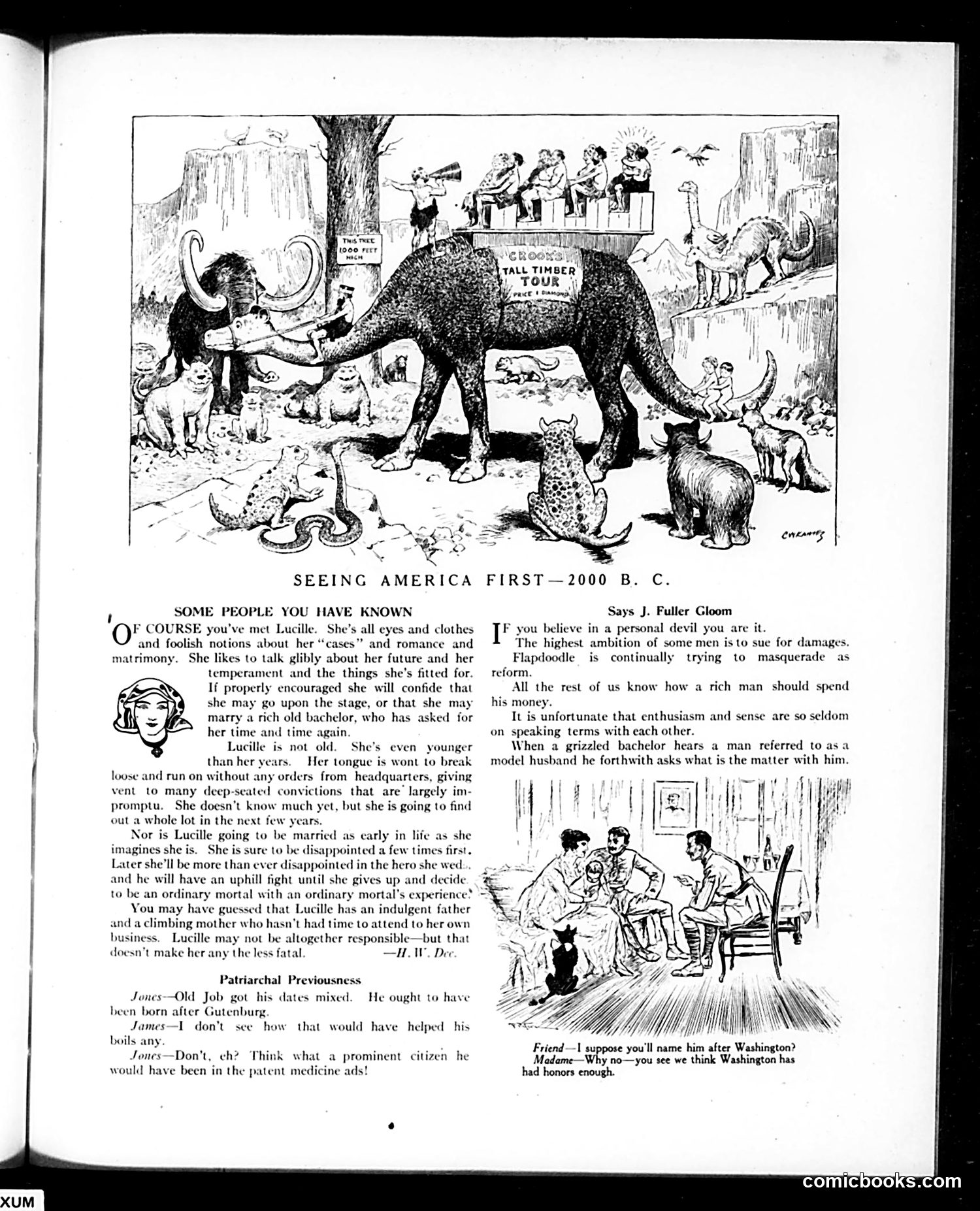
This page from Judge magazine satirizes early 20th-century American social types and attitudes through multiple pieces. **Top Cartoon**: "Seeing America First—2000 B.C." depicts a dinosaur-themed "Groomer's Tall Timber Tour," mocking the popular "See America First" tourism movement. The satire suggests that touring America's natural wonders attracts pretentious sightseers. **Main Article**: J. Fuller Gloom's "Some People You Have Known" targets a character named Lucille—a shallow, talkative young woman from an indulgent family who romanticizes about marrying wealth or becoming an actress, yet lacks real ambition or self-awareness. The author mocks her inevitable disappointment in life and love. **Brief Jokes**: Side commentary ridicules old-fashioned attitudes ("patriarchal previousness"), divine retribution beliefs, wealth, and insincere reform efforts. **Lower Cartoon**: A domestic scene where friends debate naming a newborn "Washington," with the punch line that Washington has already received sufficient honors—a mild jab at American hero-worship. Overall, the page reflects Jazz Age cynicism toward American optimism, class pretensions, and social conventions.
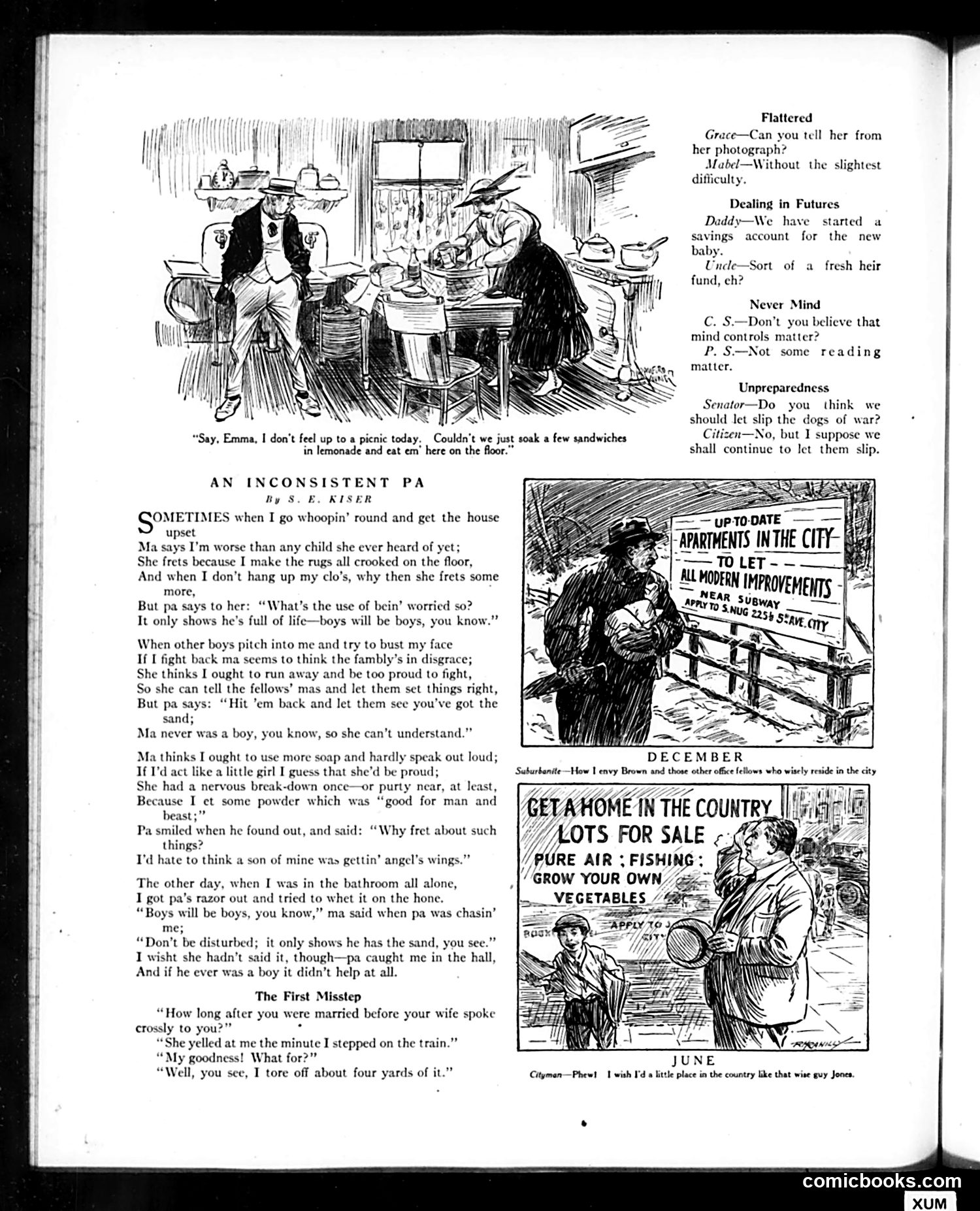
This poem satirizes parental hypocrisy through a boy's perspective. The father encourages roughish, "boyish" behavior—fighting back, being energetic, even dangerous pranks—while the mother worries about propriety and safety. The satire is that the father's philosophy ("boys will be boys") contradicts his actual response: when the boy uses his razor, the father chases him despite having just defended boyish misbehavior moments before. The humor lies in exposing the father's inconsistency: he celebrates masculine wildness in principle but punishes it in practice, particularly when it threatens *his* possessions or safety. The page also contains brief joke exchanges mocking marriage, parental savings accounts, and urban/suburban life—common Judge fare. The advertisements reference wartime concerns (housing, country living) typical of the WWI era.
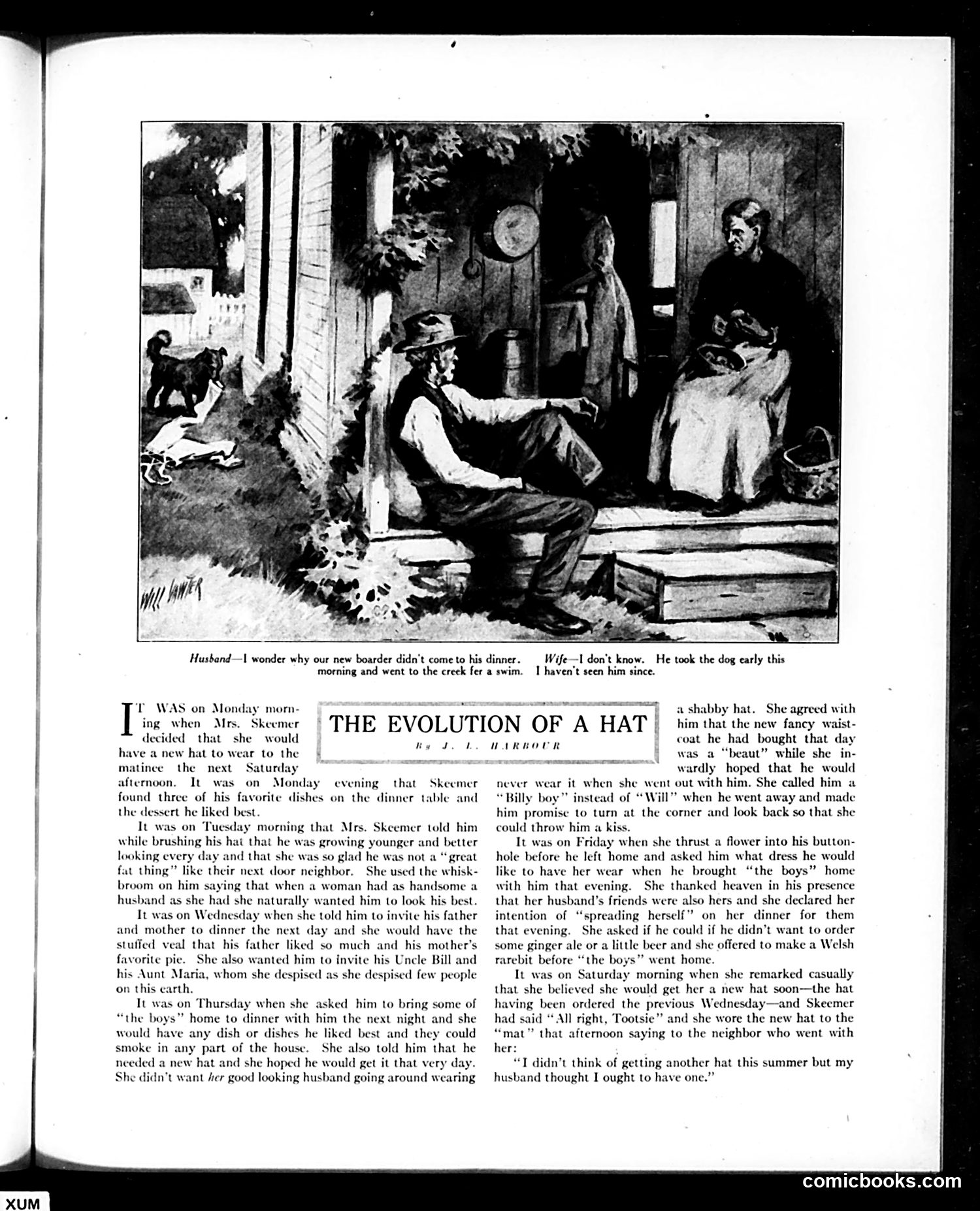
This is a domestic satire about marital manipulation. Mrs. Skeemer wants a new hat, so over the course of a week she systematically flatters and indulges her husband: serving his favorite meals, complimenting his appearance, inviting his relatives and friends, allowing smoking in the house, and suggesting he needs a new hat himself. By Saturday, she casually mentions wanting a hat—which she'd actually ordered days earlier—and her husband readily agrees. She then tells a neighbor that *her husband* thought she should have one, inverting the reality. The joke exposes how wives strategically manipulate husbands through calculated affection and ego-stroking to get what they want, while allowing husbands to believe they're making independent decisions. It satirizes both feminine cunning and masculine obliviousness in early 20th-century marriage dynamics.
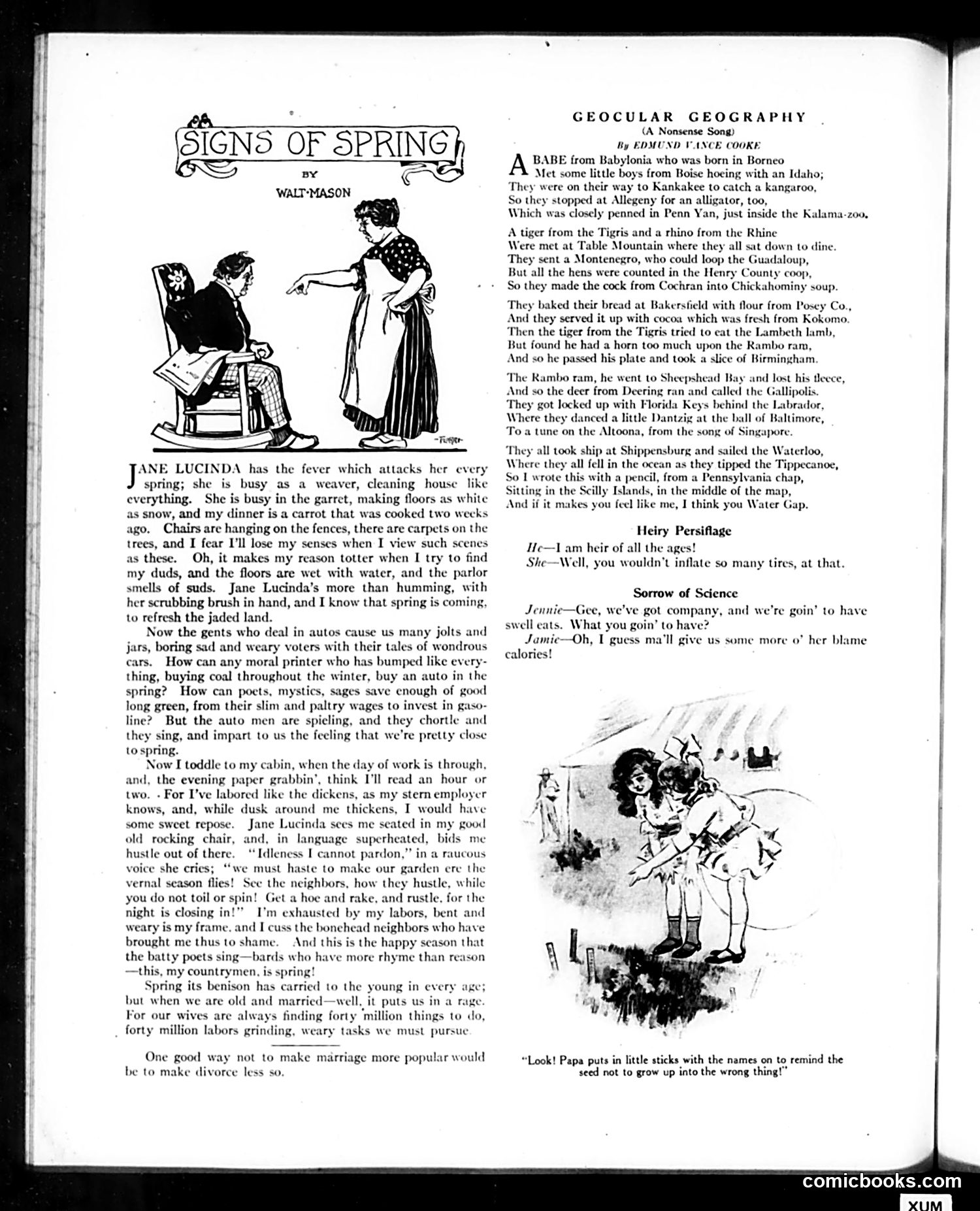
**Left side ("Signs of Spring" by Walt Mason):** A humorous complaint about spring's arrival disrupting domestic life. The cartoon shows a husband in a rocking chair while his wife (Jane Lucinda) points him toward work. The text satirizes spring fever: wives become obsessed with spring cleaning (carpets on fences, floors scrubbed), while husbands—exhausted from winter labor and auto salesmen's pitches—desperately want rest. The satire critiques both the relentless spring cleaning tradition and aggressive automobile marketing. The final joke suggests making divorce easier would help marriage's popularity, given the marital discord spring cleaning causes. **Right side ("Geocular Geography"):** A nonsense poem by Edmund Vance Cooke playing with geographical names as puns—mixing place names with animals and objects (a "babe from Babylonia," "kangaroo," "alligator," recipes made from locations). It's absurdist wordplay exploiting how place-name homonyms can create ridiculous scenarios. No political satire intended—purely comedic linguistic gymnastics.
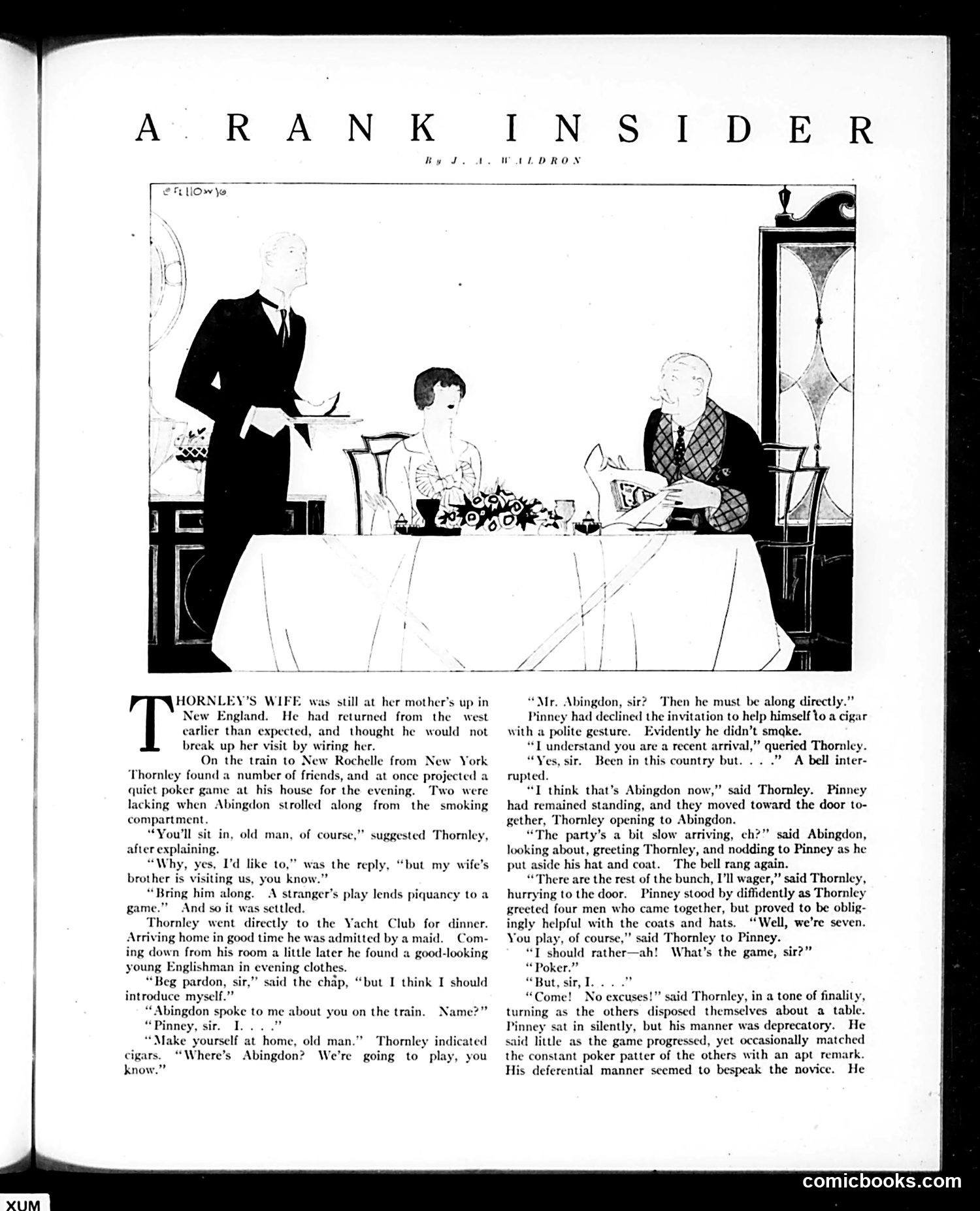
This story illustrates class tensions and social anxiety in early 20th-century America. Thornley, a wealthy American, invites an unexpected English stranger named Pinney to a poker game at his home. The satire centers on Pinney's conspicuous deference and "rank" (obvious) outsider status: he doesn't smoke, demurs at playing cards, stands diffidently, and maintains an apologetically modest demeanor throughout. The joke appears to be that Pinney's exaggerated politeness and social caution—his reluctance to participate in the casual masculinity of poker and cigars—marks him as either a social climber or con artist attempting to ingratiate himself. His overly respectful manner ("bespeak the novice") suggests either genuine naïveté or calculated manipulation. The title's irony is that his attempt to behave properly actually reveals his "rank" (obvious/glaring) status as an outsider trying to penetrate Thornley's social circle.
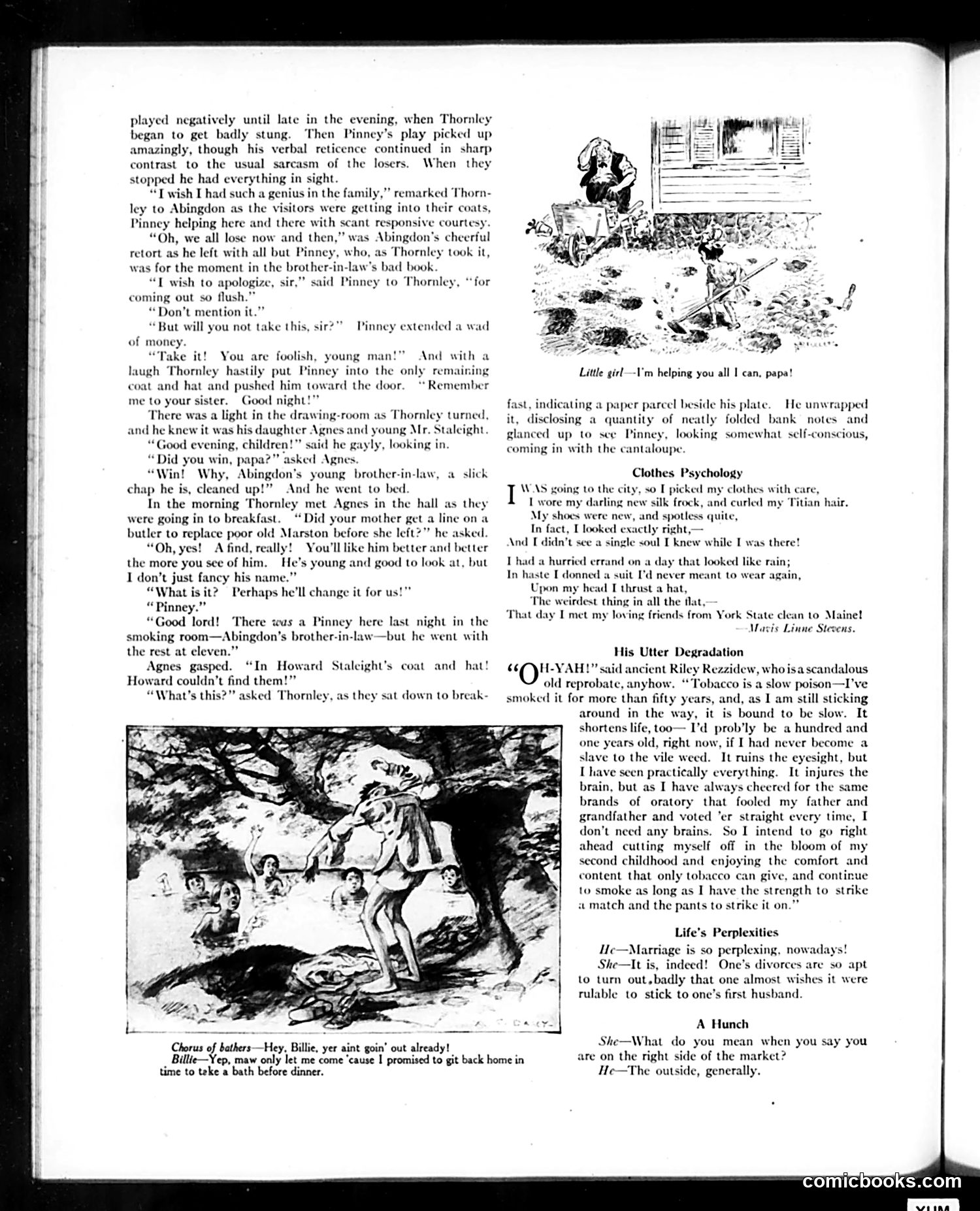
This page contains a short story about a card game and its unexpected consequences. **Thornley**, a gentleman, plays cards with visitors including a man named **Pinney**. Initially losing, Thornley wins heavily by evening. When leaving, Pinney—embarrassed by his losses—apologizes and offers money, which Thornley refuses. The twist: Pinney accidentally departs in **Howard Staleight's coat**, leaving his own behind. The next morning, Thornley discovers "Pinney" is actually the new butler he hired, having unknowingly employed the man who lost at cards the night before. The page also includes humorous poems on unrelated topics: "Clothes Psychology" (ironic observations about when you encounter acquaintances), and "His Utter Degradation" (an old man's rambling defense of his tobacco habit despite its health warnings). The cartoons illustrate these narrative moments with period-appropriate sketches, typical of Judge's satirical humor mixing social embarrassment with working-class irony.
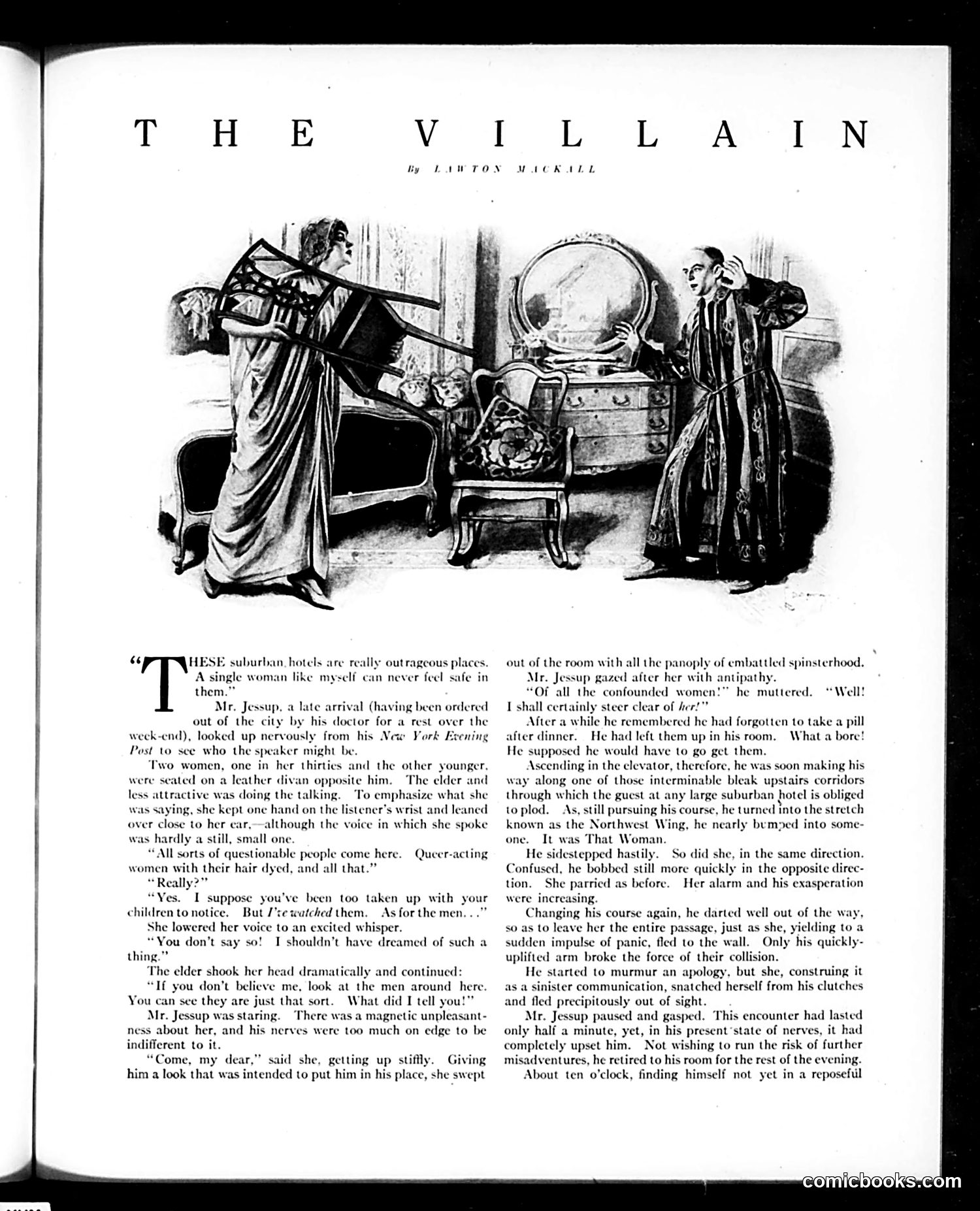
This story-illustration satirizes the power of gossip and unfounded suspicion in confined social spaces. Mr. Jessup, a nervous man seeking rest at a suburban hotel, encounters an older woman spreading malicious rumors about "questionable people" and "queer-acting women with dyed hair" frequenting the establishment. The satire's target becomes clear when Jessup later encounters the same woman in a corridor. An innocent, awkward mutual dodge is misinterpreted by both parties—she construes his polite apology as sinister advances and flees in panic, while he becomes convinced she is indeed the "villain" she portrayed herself as. The joke: the gossiping woman has created the very dangerous, disreputable atmosphere she complained about, through her own suspicious mind and wild accusations. Her unfounded warnings about others' impropriety poison the innocent interactions around her. The satire critiques how baseless gossip and moral panic can corrupt respectable spaces.
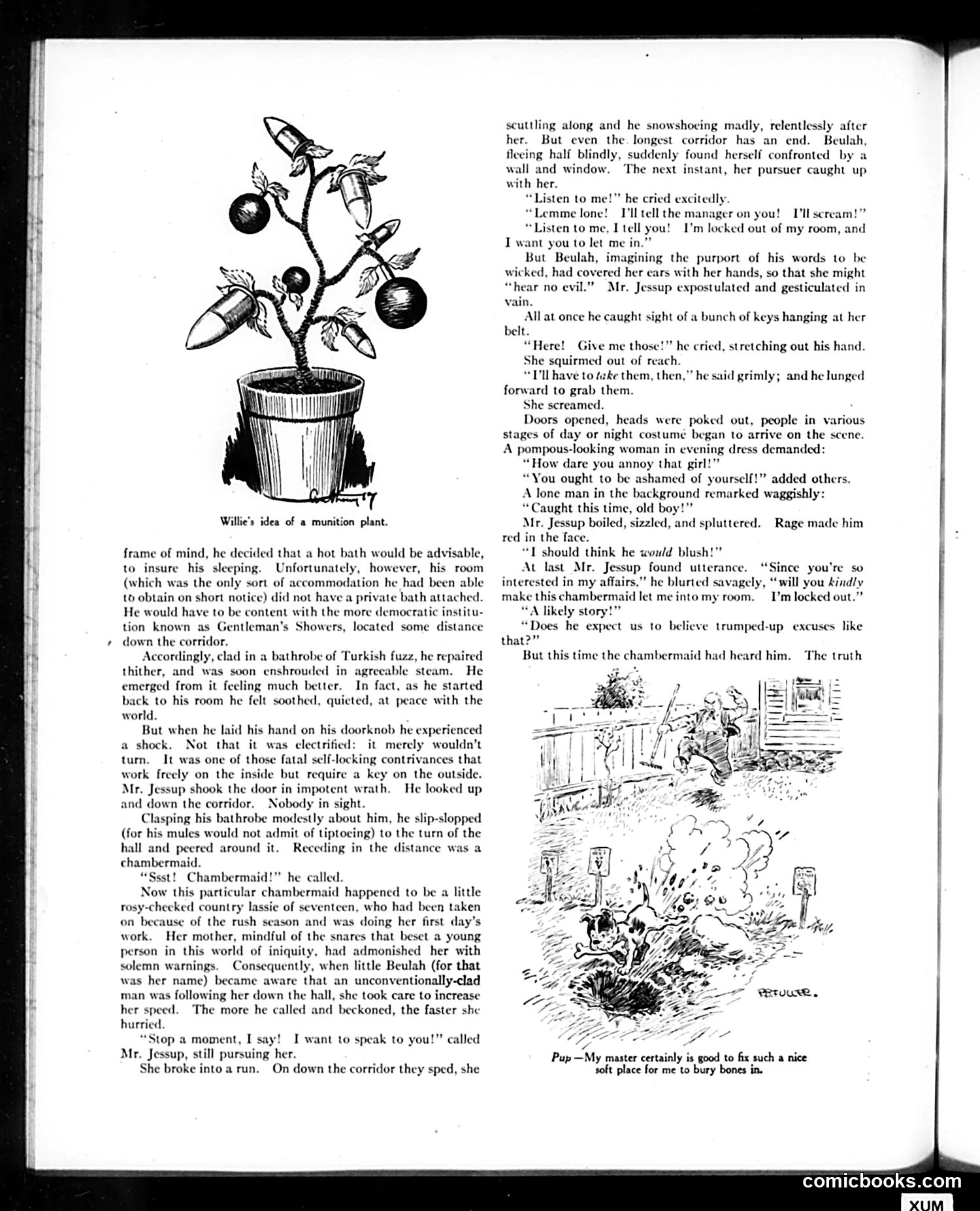
This humorous narrative concerns a man (Mr. Jessup) locked out of his hotel room while in a bathrobe. Pursuing a young chambermaid named Beulah down the corridor to obtain keys, he appears to onlookers as if he's chasing her inappropriately. The satire targets both the **prudish morality of the era** and the **misunderstandings it creates**. Beulah, coached by her mother about "snares" facing young women, defensively interprets his innocent pleas as predatory. The gathered crowd—including a disapproving woman in evening dress—immediately condemns him without hearing his explanation, reflecting contemporary social anxieties about young women's safety and the readiness to assume the worst. **"Willie's idea of a munition plant"** (the top illustration) appears unrelated—likely a separate joke about weaponry disguised as something benign, possibly commentary on wartime production or concealment. The humor derives from the gap between innocent reality and how appearances can trigger mass moral panic.
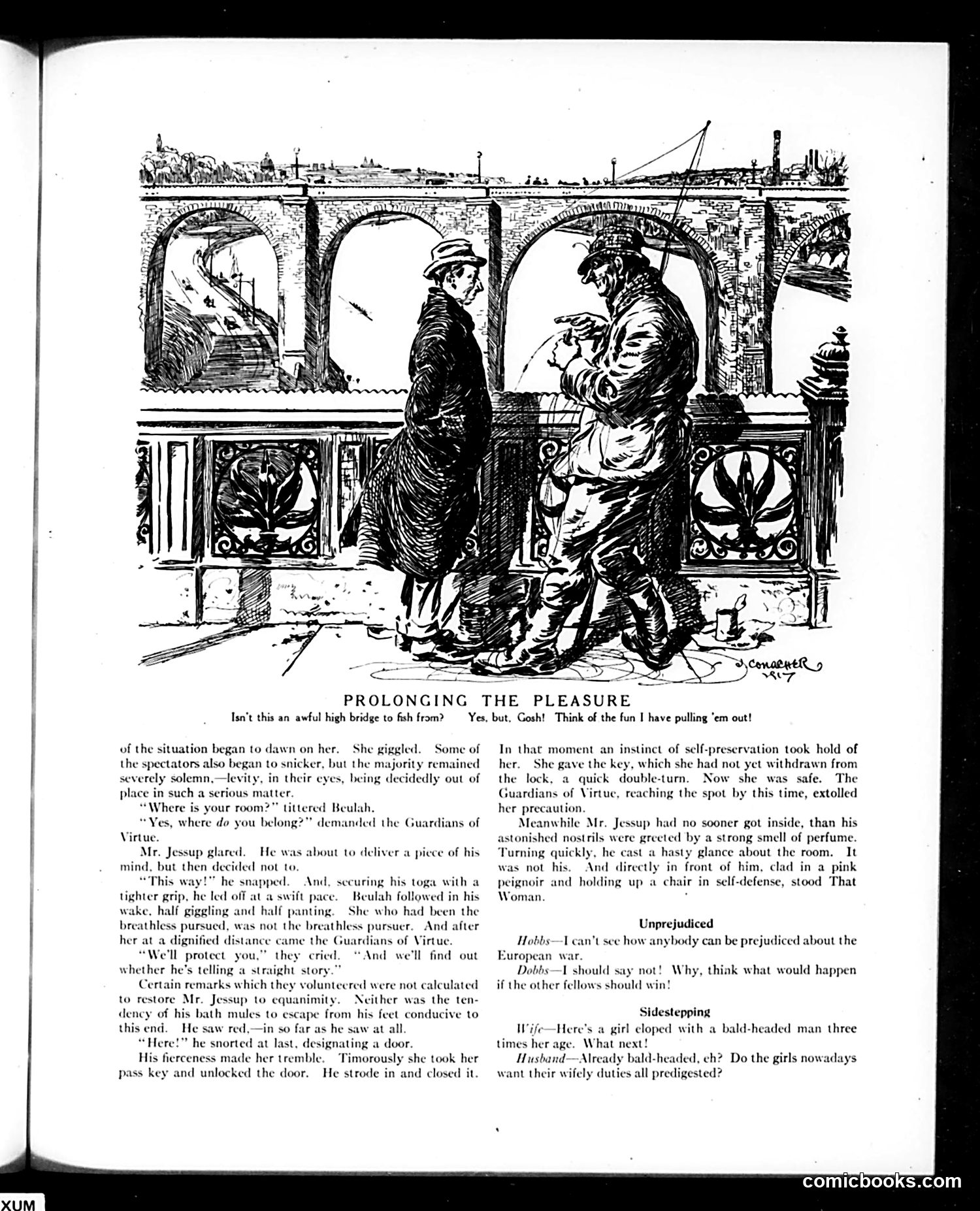
The main cartoon depicts a risqué hotel scenario playing on the tension between sexual impropriety and moral guardianship. A man (Mr. Jessup) pursues a woman (Beulah) up a high bridge/viaduct toward what appears to be a hotel. "Guardians of Virtue"—self-appointed moral enforcers—chase after them, intent on preventing scandal. The joke's payoff: Beulah deliberately leads Jessup to the wrong hotel room, where "That Woman" (likely a sex worker, suggested by the perfume and pink peignoir) awaits. She locks him in, thwarting both his seduction *and* the Guardians' interference. The title's double meaning—"prolonging the pleasure"—refers to extending the fishing metaphor from the opening caption about dangling bait. The satire targets Victorian-era moral crusaders as both sanctimonious and ineffectual, while celebrating female cunning and self-preservation over either male desire or moral policing. The page's smaller jokes mock war-related prejudice and changing gender expectations.
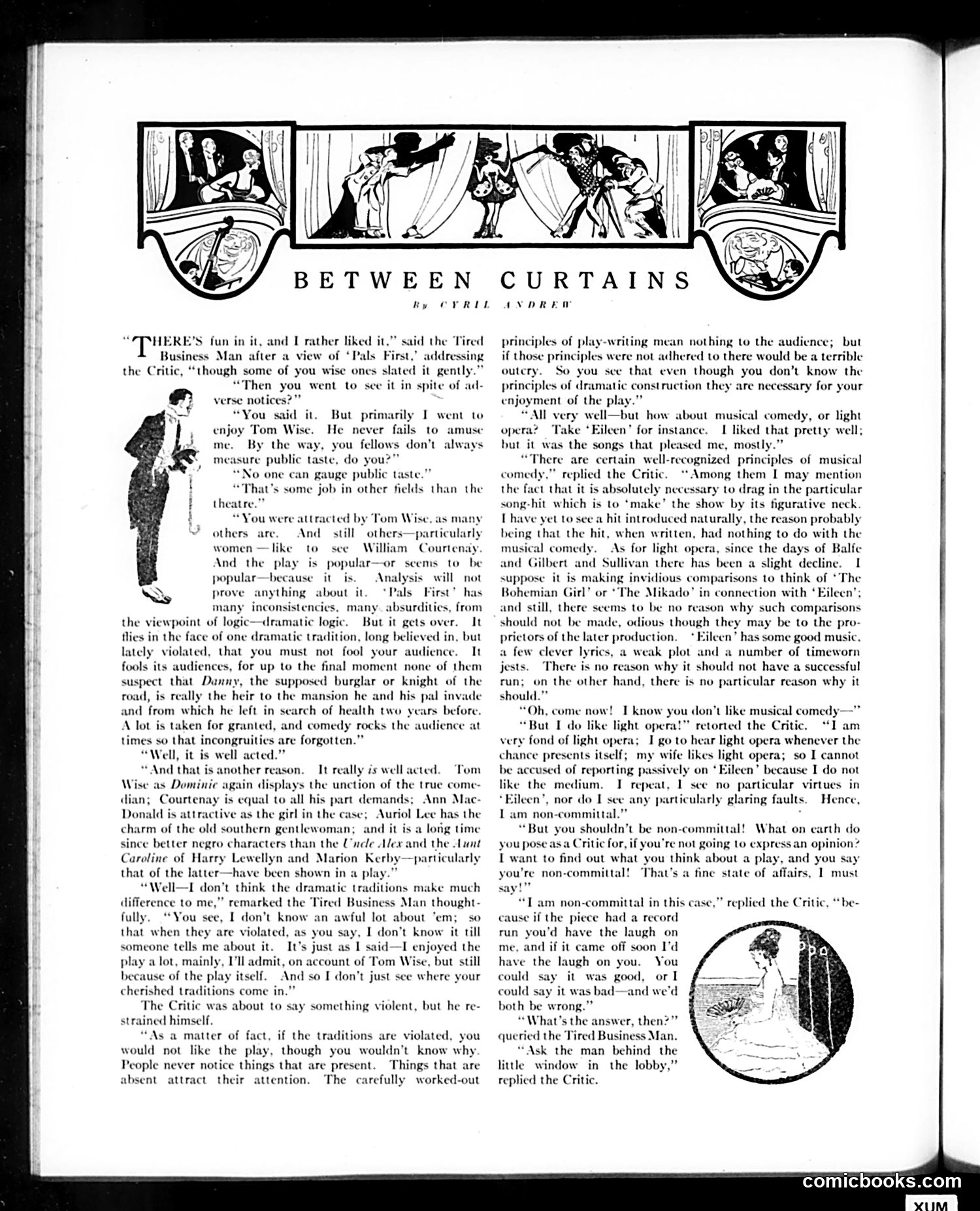
This article presents a dialogue between a theater Critic and a Tired Business Man discussing theatrical principles and recent Broadway productions. **The Setup:** The Tired Business Man attended a play called "Pals First" featuring actor Tom Wise. He enjoyed it despite admitting ignorance of dramatic theory. **The Satire's Point:** The Critic argues that theatrical traditions—like not fooling the audience about plot twists—are essential, even when audiences don't consciously notice violations. The Business Man counters that he simply enjoyed the performance without understanding these "rules," suggesting that technical principles matter less than entertainment value and good acting. **Social Commentary:** This reflects a common early-20th-century tension: educated critics valued formal artistic principles, while average theatergoers prioritized entertainment. The Tired Business Man represents the ordinary audience member whose instinctive enjoyment trumps theoretical knowledge, mildly satirizing both the Critic's pedantry and the audience's obliviousness to craft. The debate extends to musical comedy and light opera, with similar themes about artistic integrity versus popular appeal.
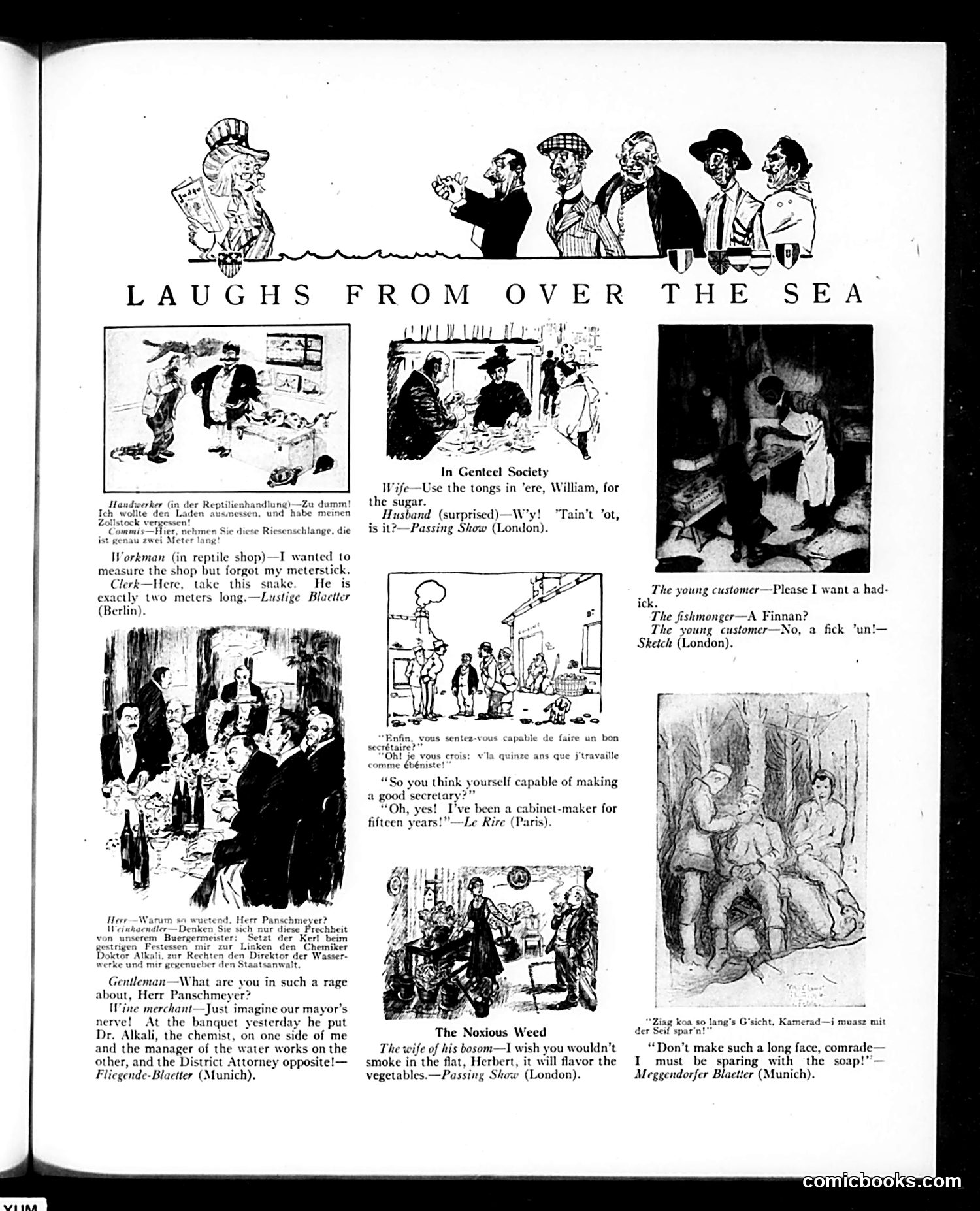
This page collects humorous cartoons and jokes from European satirical magazines, reprinted for American Judge readers. The content spans working-class and genteel humor: **Key jokes include:** A clerk solving a measurement problem with a snake (absurdist humor), a wine merchant outraged that the mayor seated him between a chemist and water-works manager—implying he'd be positioned between unpleasant odors. A husband confused why his wife uses tongs for room-temperature sugar. A fishmonger misunderstanding a customer's cockney accent requesting a "haddock" versus a "fick 'un." **The satire targets:** Class anxiety (the wine merchant), marital dynamics (nagging wives), working-class speech patterns, and the inconveniences of urban life (smoking in flats, soap rationing). The cartoons are credited to German and French publications (*Lustige Blaetter*, *Le Rire*, *Passing Show*), suggesting Judge showcased international humor to demonstrate cosmopolitan sophistication.
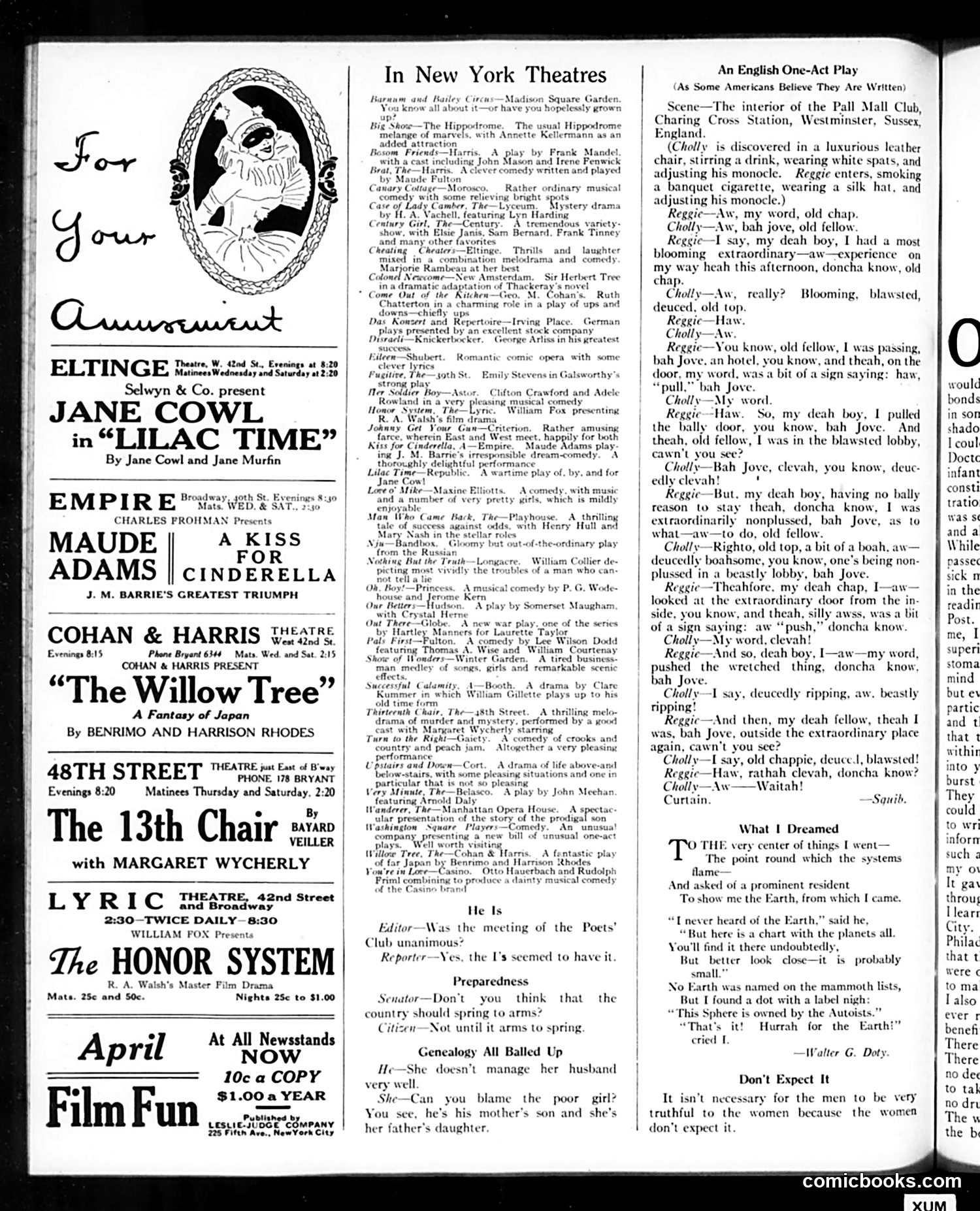
This is primarily a **theater and entertainment advertising page** from Judge magazine, not a political cartoon page. The bulk consists of Broadway theater advertisements (plays like "Lilac Time," "The Willow Tree," "The Honor System"). The only satirical content is a brief **English one-act play parody** mocking how Americans imagine British comedies are written. The sketch features two absurdly stereotypical upper-class British characters—"Cholly" and "Reggie"—who speak in exaggerated Britishisms ("bah Jove," "deah boy," "blawsted," "doncha know"). The joke satirizes American perceptions of British dialogue as consisting mainly of affected aristocratic exclamations and monocle-adjusting. The humor relies on the ridiculous overuse of these verbal tics and the trivial plot (someone saw a "push" door sign at a hotel). This mocks both British comedy conventions *and* American stereotyping of British speech patterns—suggesting Americans imagine all British plays feature this level of affected nonsense.
This is **not a cartoon** but rather a **health advertisement disguised as editorial content** — a common early 20th-century magazine practice. The piece promotes "Swoboda's System of Conscious Evolution," a now-defunct wellness program. The author (W.W. Washburn) describes personal illness and depression, then claims miraculous recovery after following Swoboda's method, which required no exercise, diet, cold baths, or apparatus—just mental discipline. **The appeal:** This targets vulnerable readers with vague promises of physical and mental transformation without effort or sacrifice. The "guarantee of satisfaction" and claim of 262,000 followers worldwide were standard marketing tactics to build credibility. **For modern readers:** This represents pre-FDA regulation "wellness" culture—making extraordinary health claims without evidence. The psychological manipulation (testimonial format, emphasizing the author's initial skepticism to seem credible) remains recognizable today. Judge magazine published such ads for revenue alongside satire, revealing period attitudes toward health, mental illness, and gullibility.
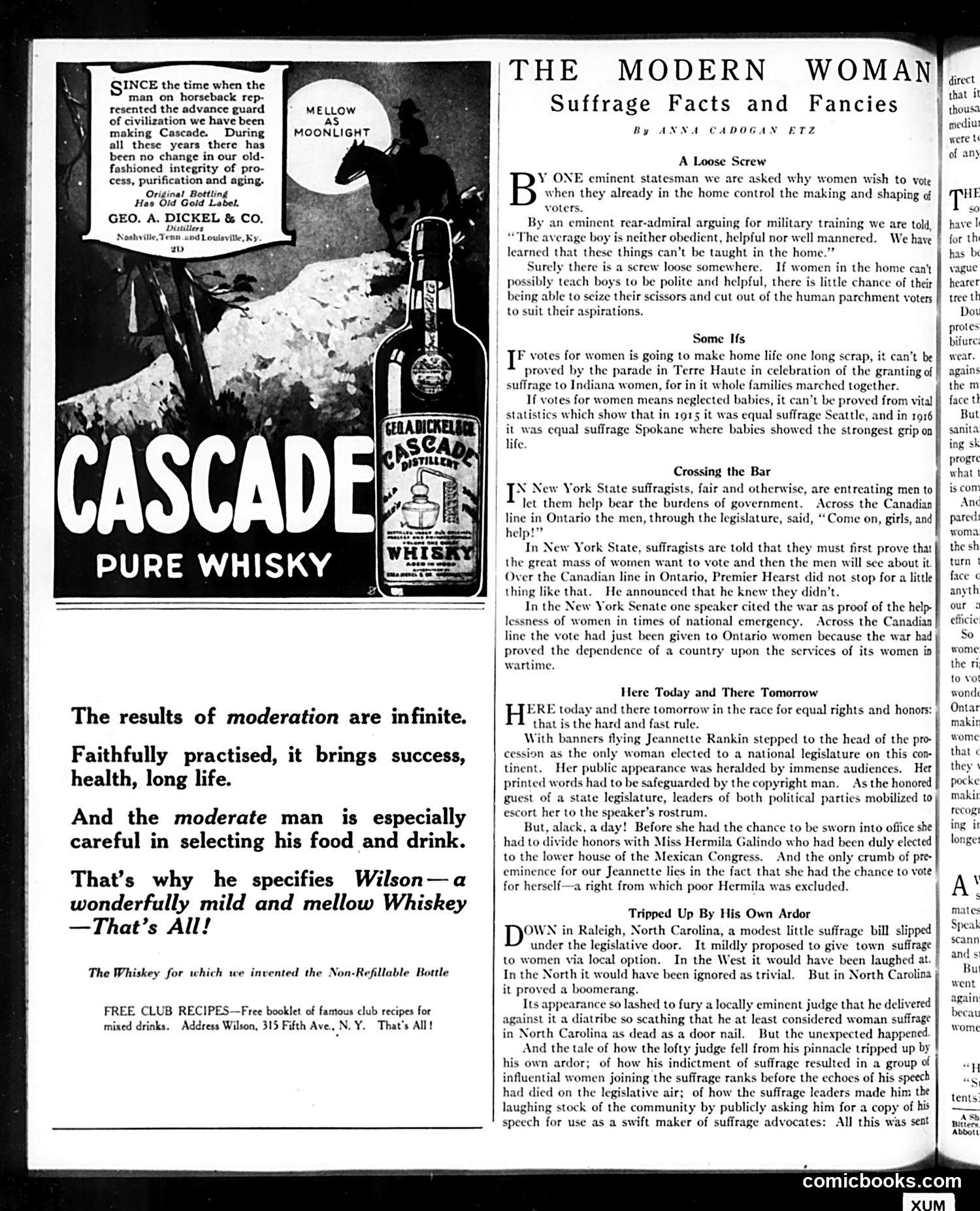
This Judge magazine page contains two distinct elements: **Left Side - Whiskey Advertisements:** Two liquor ads (Cascade and Wilson whiskey) use rhetoric about "moderation" and traditional values to sell products. These are straightforward period advertising. **Right Side - Suffrage Satire:** Anna Cadogan Etz's article critiques anti-suffrage arguments through ironic juxtaposition. The piece exposes logical inconsistencies in opponents' claims—particularly the contradiction that women allegedly lack the competence to vote yet somehow successfully raise and shape children at home. Etz uses comparative examples (Terre Haute parades, Seattle/Spokane birth statistics, Ontario vs. New York legislative approaches) to demonstrate suffragists' actual positive impact. She also references Jeannette Rankin, recently elected to Congress, and Mexican legislator Hermila Galindo as proof women *can* hold political office effectively. The satire's point: anti-suffrage arguments are logically "loose screws"—contradictory and unsupported by evidence.
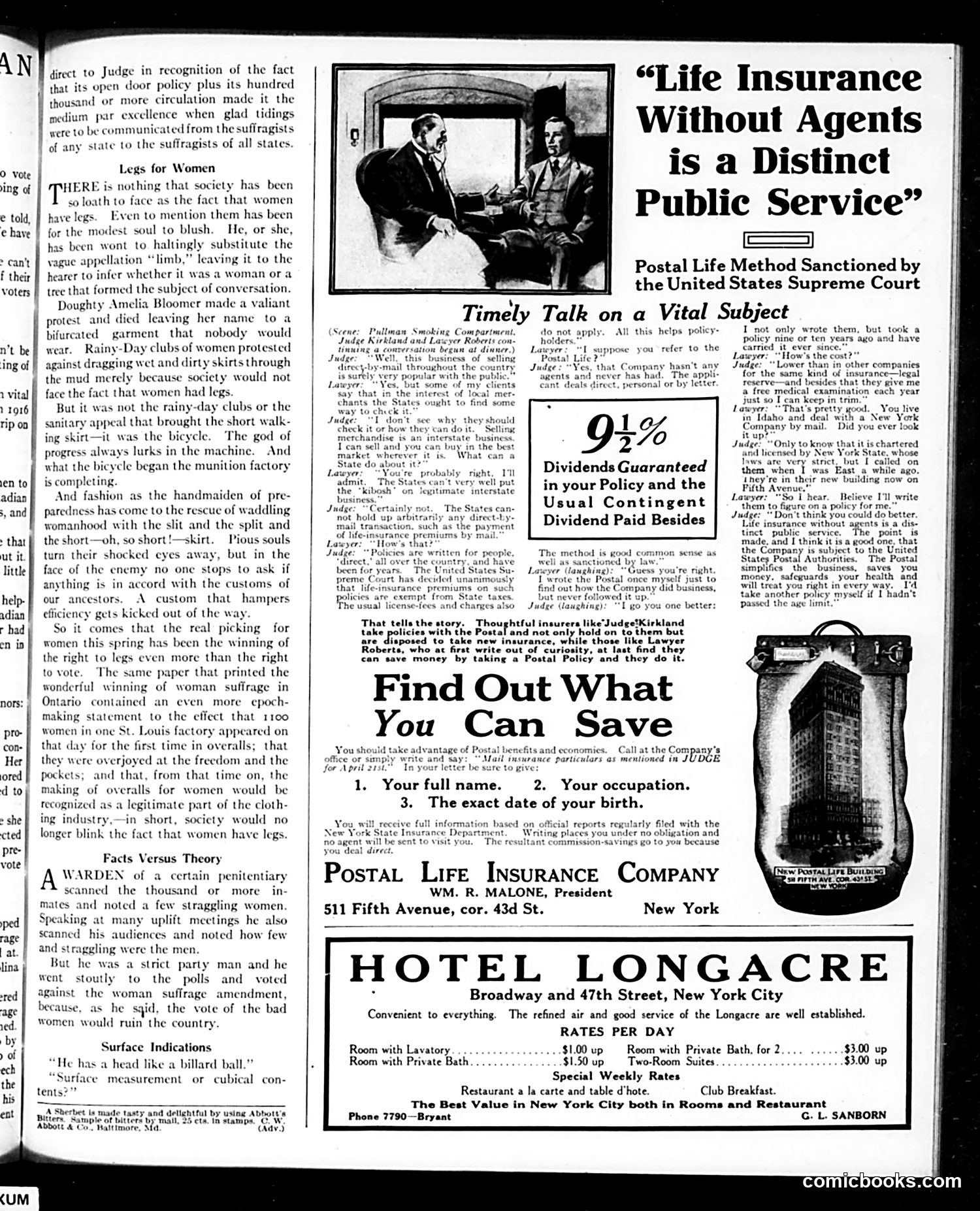
This page from *Judge* magazine combines editorial commentary with advertising. The main content addresses social progress, particularly women's rights and practical changes in dress and workplace participation. The "Legs for Women" essay celebrates how wartime necessity (munitions factories) and the bicycle have liberated women from restrictive long skirts, allowing shorter skirts and overalls. The author presents this as progress driven by pragmatism over social convention—efficiency trumps propriety when national defense demands it. The "Facts Versus Theory" section satirizes hypocrisy: a penitentiary warden observes that few men attend uplift meetings, yet votes against women's suffrage, fearing "bad women" will ruin the country. The satire exposes the contradiction between observable reality (women's responsible participation in society) and reactionary voting based on unfounded theory. The "Timely Talk" dialogue between Judge Kirkland and Lawyer Roberts advertises Postal Life Insurance's direct-mail approach, positioning it as democratic service avoiding agents' commissions. This reflects Progressive Era consumer advocacy rhetoric.
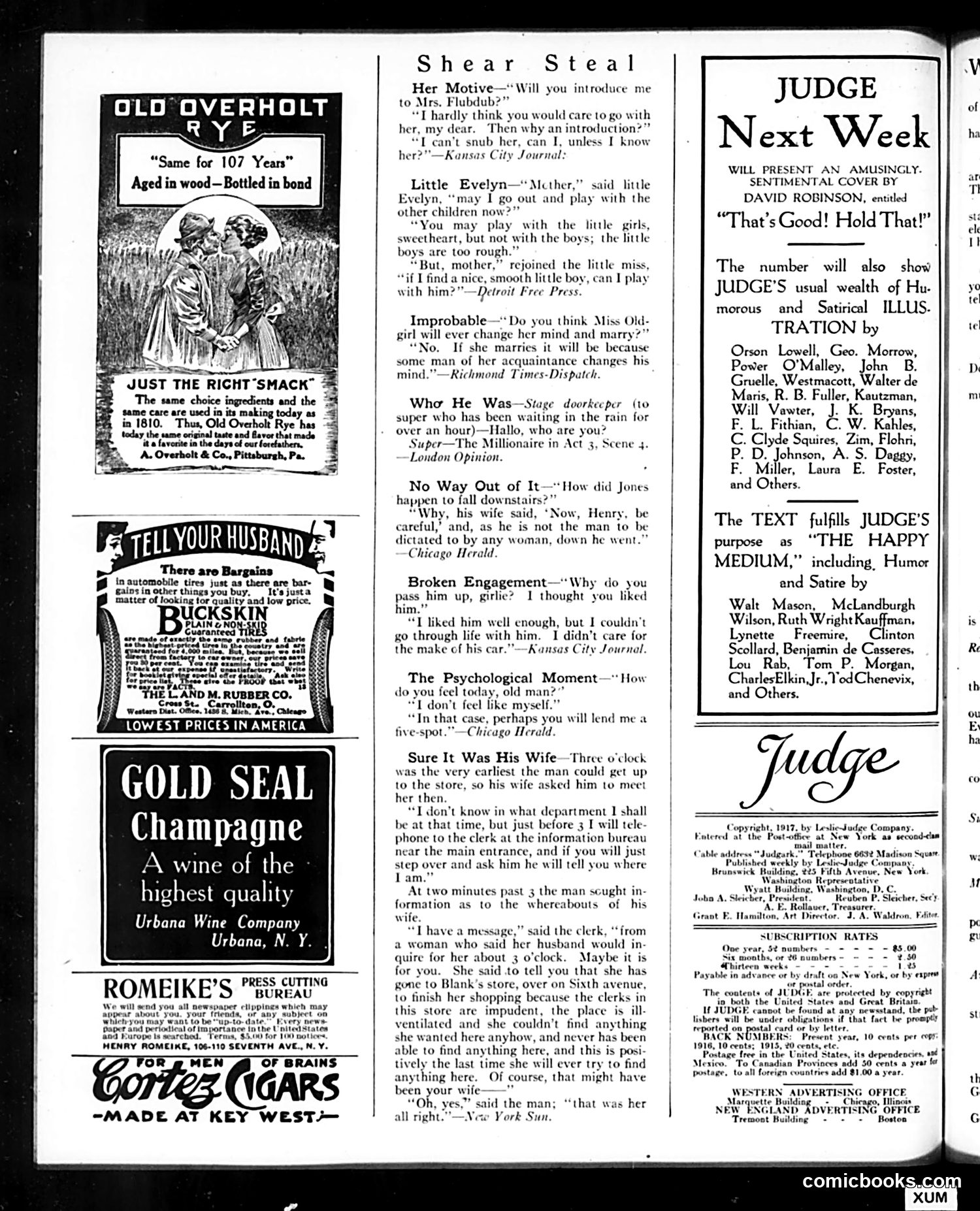
This page is primarily **advertising and humor content** with no discernible political cartoon. The left side features advertisements for liquor (Old Overholt Rye, Gold Seal Champagne) and automobile tires—common early 20th-century commercial pitches. The central section presents a series of short **joke vignettes** on domestic and social themes: - "Shear Steal" jokes about social awkwardness and snubbing - "Little Evelyn" exploits the period's gender stereotypes (boys are rough, girls are proper) for mild humor - "Broken Engagement" satirizes materialism—a woman rejecting a suitor based on his car rather than character - "Sure It Was His Wife" stereotypes wives as nagging shoppers who complain about store service These jokes reflect **early 20th-century social attitudes**: rigid gender roles, class consciousness, and consumer culture anxieties. The humor relies on recognizable domestic conflicts that Judge's middle-class readers would find relatable or amusing—typical light satire of the era without specific political content. The page announces next week's cover by artist David Robinson.
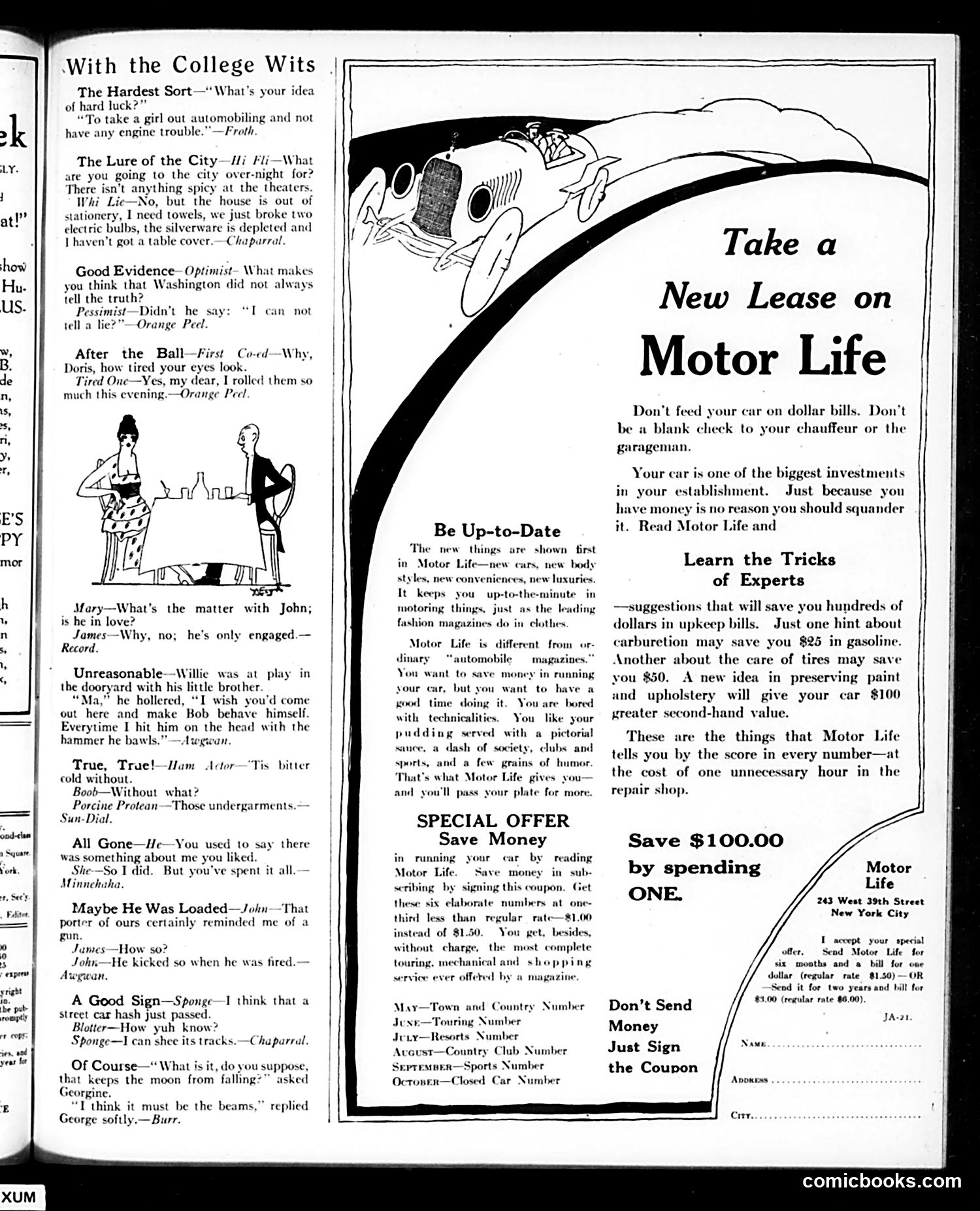
This page mixes humorous college-oriented jokes with a magazine advertisement. The left column contains brief comedic exchanges attributed to various college publications (Orange Peel, Froth, Chapparral, etc.). The jokes reflect early 20th-century college humor: dating anxieties, domestic frustrations, wordplay, and observations about engagement versus love. The right side advertises *Motor Life* magazine, targeting wealthy automobile owners. The pitch emphasizes that car ownership—presented as a major investment—requires expert knowledge to maintain. The advertisement promises readers can save hundreds of dollars through maintenance tips while enjoying "society, clubs and sports" content alongside technical advice. A special coupon offers six issues for $1.00 instead of $1.50, positioning the magazine as both practical and entertaining for the affluent motoring class.
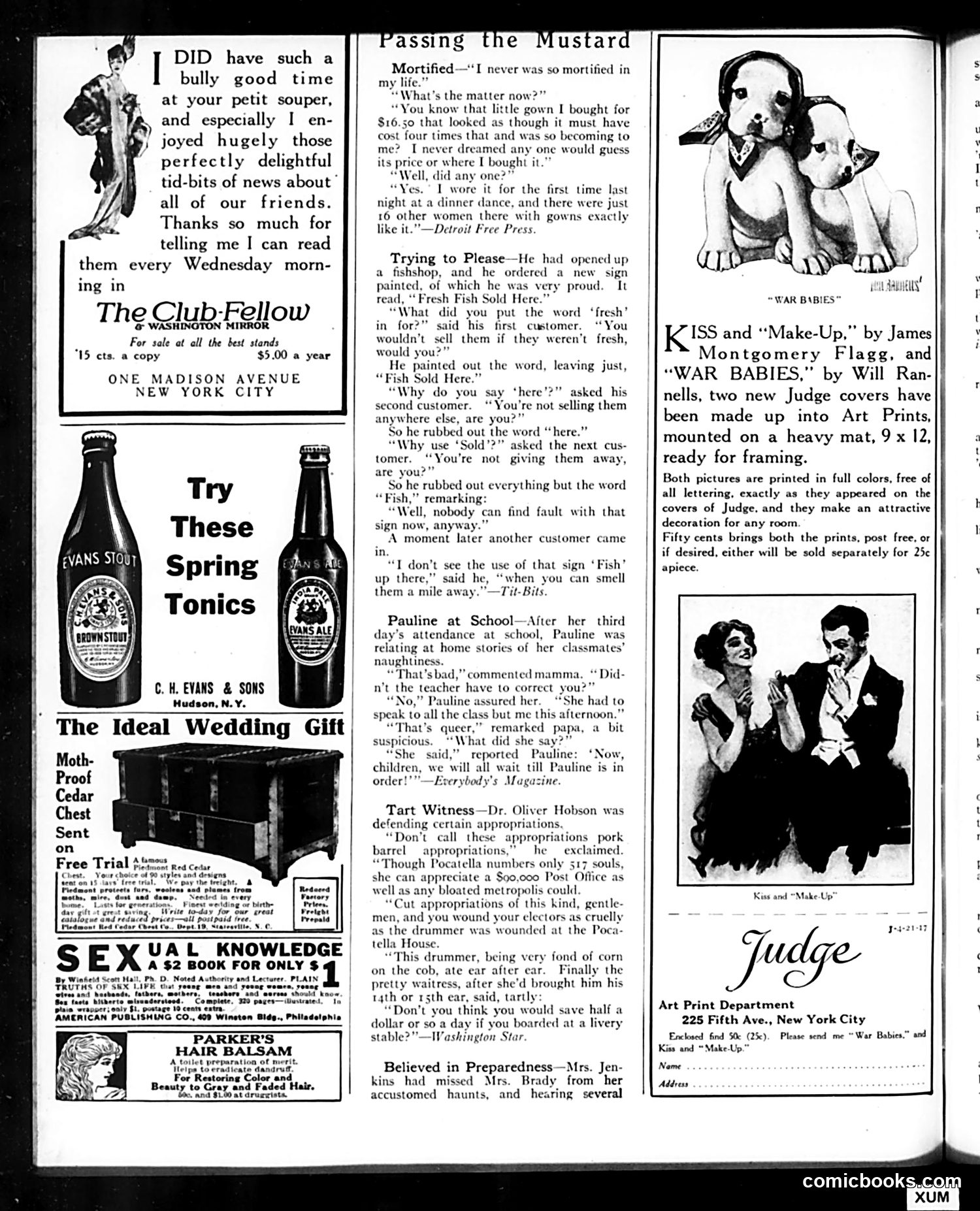
This page from *Judge* (a major American satirical weekly) consists primarily of **humorous anecdotes** rather than political cartoons. The content includes several short jokes: **"Passing the Mustard"** presents three brief comedic stories: a woman mortified that sixteen other women wore identical dresses; a fishmonger repeatedly removing words from his sign until only "Fish" remains (mocking overthinking); and a schoolgirl noting her teacher corrected only her, implying she was uniquely misbehaved. **"Tart Witness"** satirizes a politician defending wasteful "pork barrel" spending on a post office for a tiny town (Pocatella, 517 souls), using an absurd anecdote about a drummer eating excessive corn to argue against fiscal responsibility—mocking the disconnect between local politics and sensible budgeting. The page also advertises Judge art prints of "War Babies" illustrations, suggesting this is wartime-era *Judge* (likely WWI period). These are genteel, domestic humor typical of the era—no sharp political edge, mostly social observation.
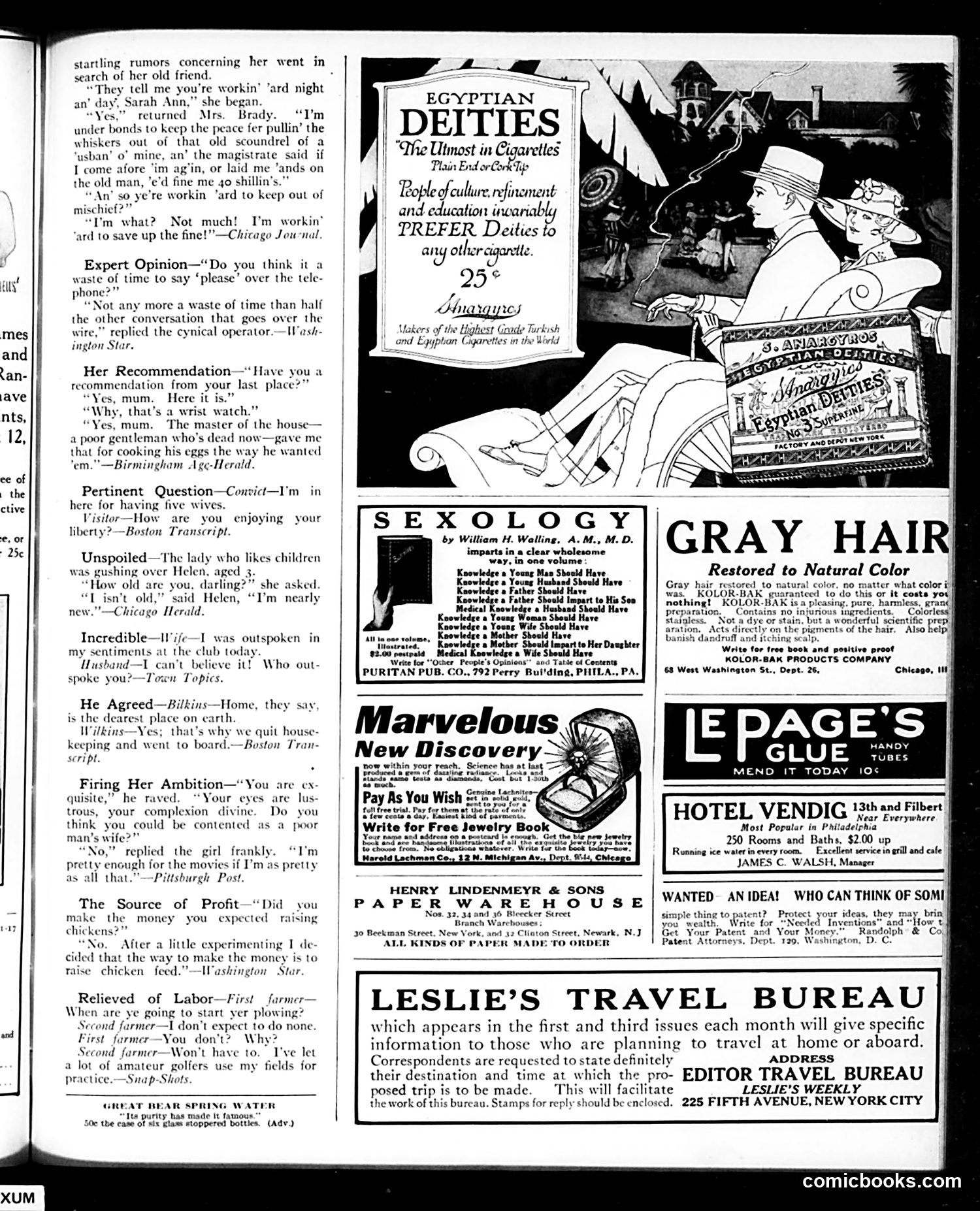
This page is primarily **advertising and humor shorts**, not political cartoons. The content includes: **Humor Pieces:** Brief jokes about working-class life—a woman working to pay a magistrate's fine, telephone etiquette, servant recommendations, and marital discord. These reflect early 20th-century domestic situations and class tensions (servants, poor gentlemen, houseekeeping). **Advertisements:** The dominant visual is an **Egyptian Deities cigarette ad** featuring illustrated figures and ornate packaging, targeting consumers seeking "culture" and "refinement." Other ads include hair restoration (Kolor-Bak), glue, hotels, and patent services. **Cultural Context:** The humor relies on Irish/working-class dialect ("'ard," "'usban'"), suggesting period class stereotyping. References to bonds and magistrates indicate concern with law and respectability among lower classes. The page reflects early 20th-century American attitudes: class consciousness, gender roles (wives, servants), and marketing luxury goods through appeals to aspiration and sophistication.
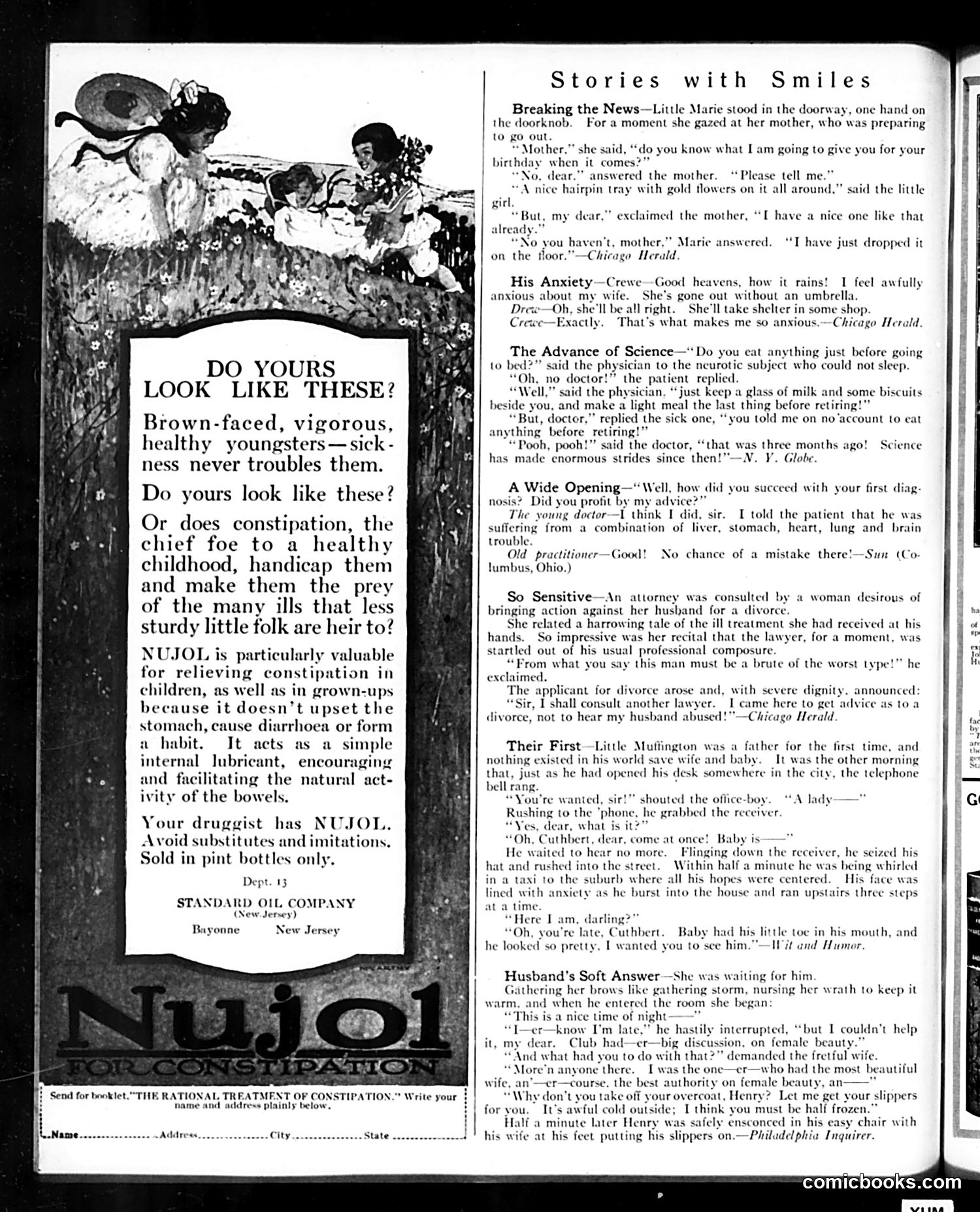
This page combines **advertising and humor content** typical of early 20th-century magazines. ## Advertisement (Left Side) A Standard Oil Company ad for **Nujol**, a laxative product. It uses comparative imagery of healthy vs. sickly children to market constipation relief, positioning the product as essential to child health. This reflects period anxieties about childhood wellness and the era's widespread promotion of patent medicines. ## Humor Stories (Right Side) Six brief comedic anecdotes addressing everyday social situations: - A child's naive gift promise - A husband's worry about his wife's shelter-seeking during rain (implying infidelity anxiety) - Medical advice contradicting itself as "science advances" - A young doctor's overly broad diagnosis - A divorce attorney offended by criticism of a client's husband - A new father's panic at being called home These stories reflect **common domestic anxieties and social humor** of the period: marriage tensions, medical uncertainty, professional dignity, and modern fatherhood. The humor targets middle-class concerns and gender dynamics typical of Judge's satirical approach.
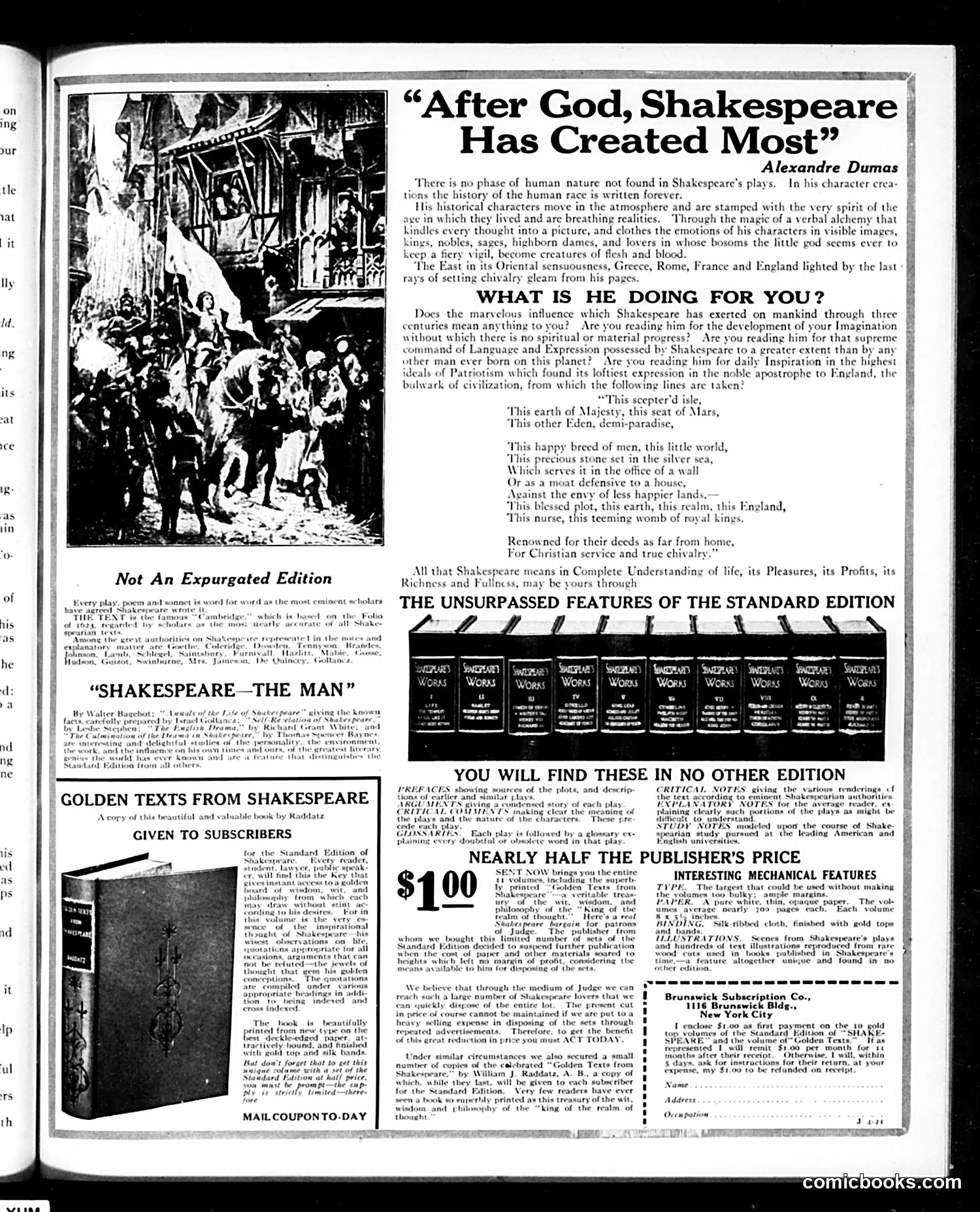
This is primarily **advertising copy**, not political satire. The page promotes a subscription edition of Shakespeare's complete works. The layout uses Alexandre Dumas's endorsement (a famous 19th-century author) and a dramatic illustration (likely from a Shakespeare play) to sell the Standard Edition of Shakespeare. The marketing pitch emphasizes Shakespeare's relevance to American readers: his exploration of human nature, language mastery, and patriotic ideals—particularly a quoted passage celebrating England as a national treasure. The "Golden Texts" sidebar and the coupon at bottom are standard mail-order advertising tactics of the era. The claim of "nearly half the publisher's price" and emphasis on "unsurpassed features" (prefaces, critical notes, illustrations) reflect competitive publishing of the early 20th century. There's no political satire here—it's a straightforward subscription promotion in Judge magazine, leveraging classical literature to appeal to educated, patriotic American readers.
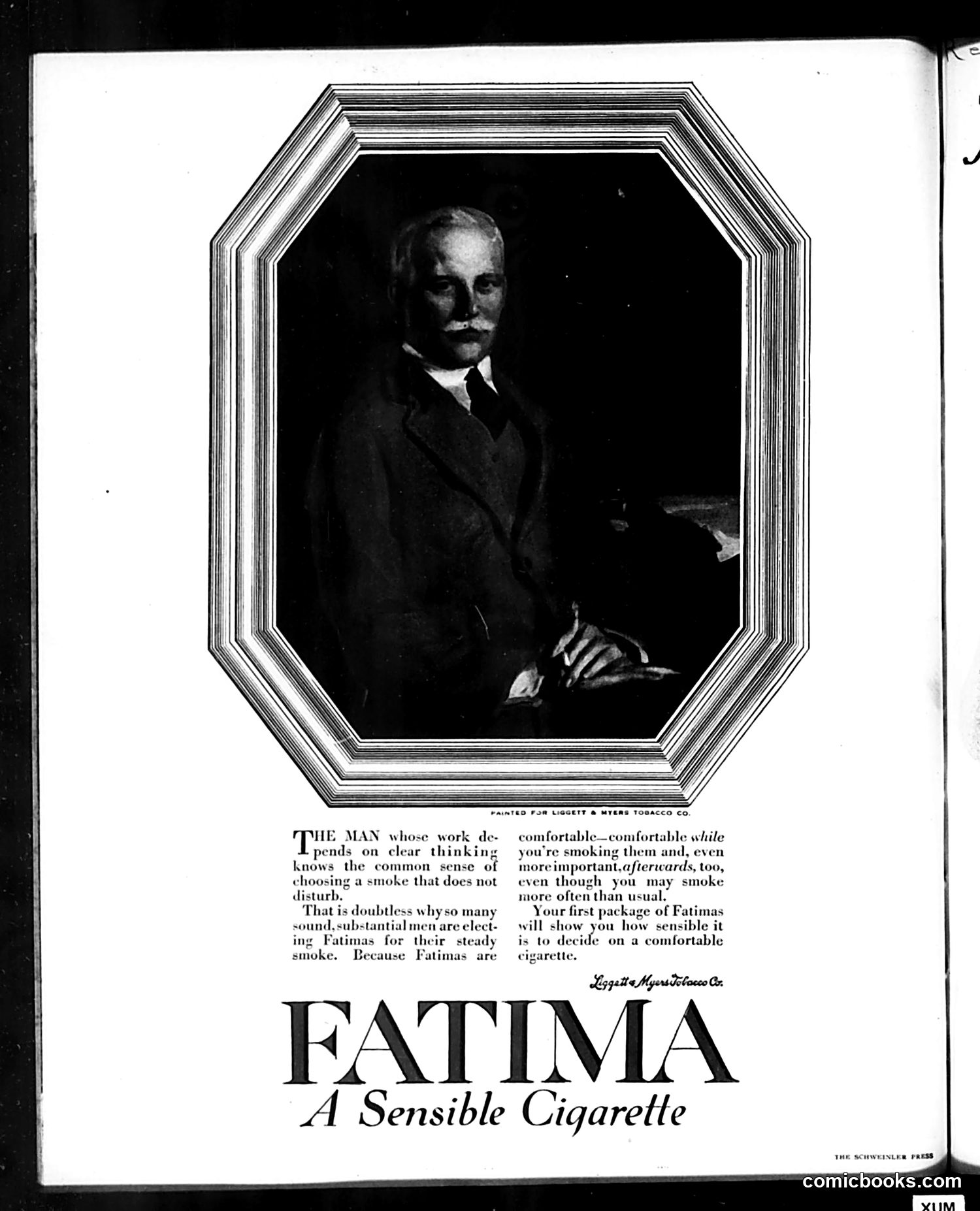
This is **not a cartoon or satire** — it's a straightforward cigarette advertisement for Fatima brand cigarettes, placed in Judge magazine. The page features a formal portrait photograph of a distinguished gentleman in business attire, presented as the ideal consumer. The ad's pitch appeals to professional men ("whose work depends on clear thinking"), positioning Fatimas as the sensible choice for serious, productive individuals. The marketing language emphasizes comfort and non-disturbance during work — suggesting the cigarette won't interfere with concentration or "afterwards" cause regret or physical discomfort. This reflects early 20th-century advertising strategies that linked smoking to sophistication, rationality, and business success. The copy specifically notes men are "electing" Fatimas, using language that frames cigarette choice as a deliberate, intelligent decision. There is no satire present — Judge's pages frequently mixed editorial cartoons with straightforward advertising revenue.