
Judge, 1917-04-21 · page 15 of 32
Judge — April 21, 1917 — page 15: what you’re looking at
What you’re looking at
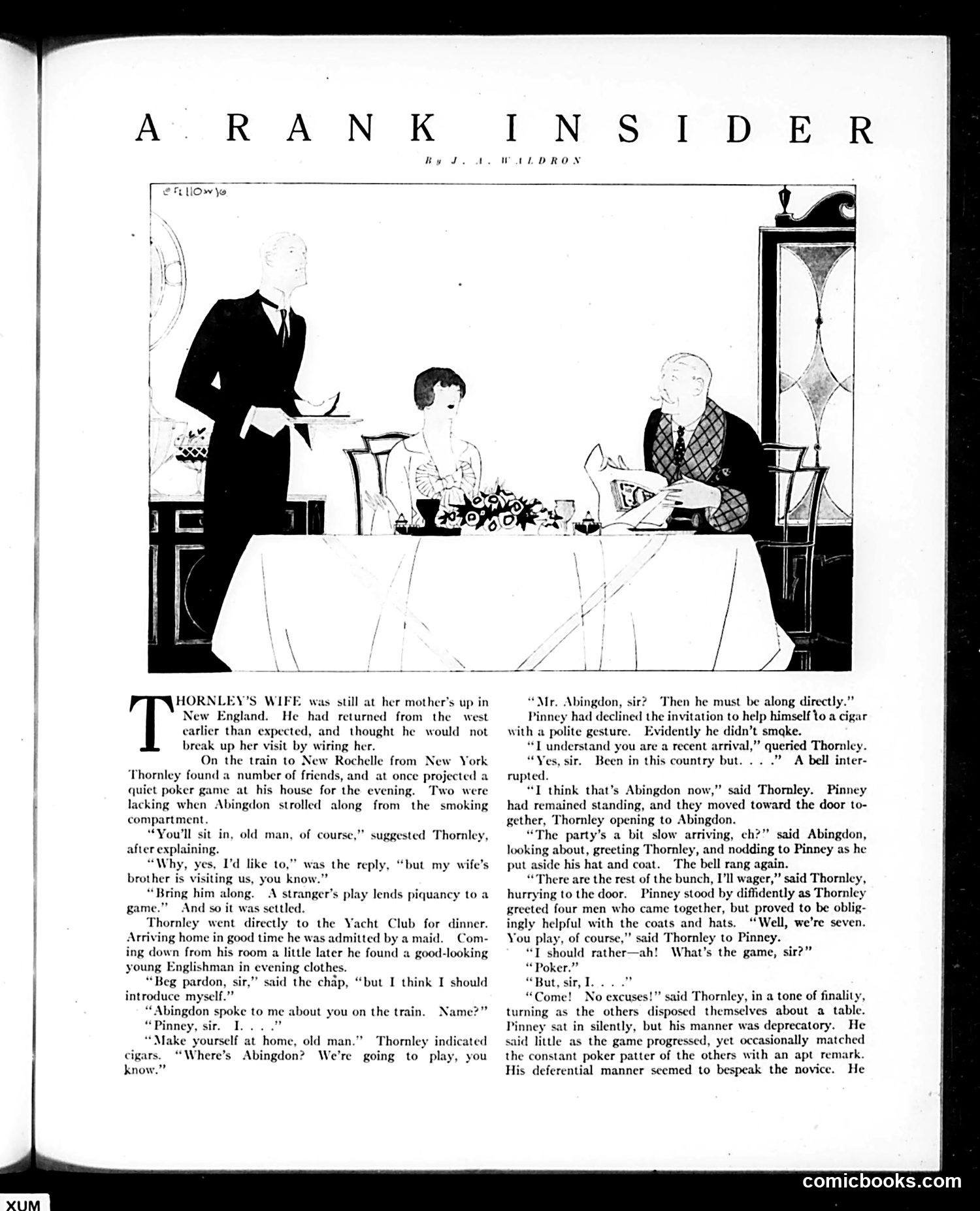
This story illustrates class tensions and social anxiety in early 20th-century America. Thornley, a wealthy American, invites an unexpected English stranger named Pinney to a poker game at his home. The satire centers on Pinney's conspicuous deference and "rank" (obvious) outsider status: he doesn't smoke, demurs at playing cards, stands diffidently, and maintains an apologetically modest demeanor throughout. The joke appears to be that Pinney's exaggerated politeness and social caution—his reluctance to participate in the casual masculinity of poker and cigars—marks him as either a social climber or con artist attempting to ingratiate himself. His overly respectful manner ("bespeak the novice") suggests either genuine naïveté or calculated manipulation. The title's irony is that his attempt to behave properly actually reveals his "rank" (obvious/glaring) status as an outsider trying to penetrate Thornley's social circle.
📄 Transcribed text from this page (OCR, searchable)
Machine-transcribed from the original scan — historical spelling and the odd misread are preserved.
| A. RAN K By Joa. INS IDER " 1LDRON HORNLE was still at her mother’s up in New England. He had returned from the west earlier than expected, and thought he would not break up her visit by On the train to Ni once projected a at his house for the evening. Two were king when Abingdon strolled along from the smoking compartment | “You'll in, old man, of course,” suggested Thornley, A stranger’s play lends piquancy to a | game And so it was settled. ornley went directly to the Yacht Club for dinner. | Arriving home in good time he was admitted by a maid. Com- ing down from his room a little later he found a good-looking young Englishman in evening clothes. “Beg pardon, sir,” said the chap, “but I think I should introduce myself.” “Abingdon spoke to me about you on the train. Name?” “Pinney, sir. Ts os." “Make yourself at home, old man.’ Thornley indicated cigars. “Where’s Abingdon? We're going to play, you know.” XUM “Mr. Abingdon, si Then he must be along directly.” Pinney had declined the invitation to help himself to a cigar with a polite gesture. Evidently he didn’t smake. “T understand you are a recent arrival,” queried Thornle: . sir, Been in this country but... .” A bell inter- rupted. “1 think that’s Abingdon now,” said Thornley. Pinney had remained standing, and they moved toward the door to- gether, Thornley opening to Abingdon. “The party’s a bit slow arriving, ch?” said Abingdon, looking about, greeting Thornley, and nodding to Pinney as he put aside his hat and coat. The bell rang again. here are the rest of the bunch, I'll wager,” said Thornley, hurrying to the door. Pinney stood by diffidently as Thornley greeted four men who came together, but proved to be oblig- ingly helpful with the coats and hats. “Well, we're seven. You play, of course,” said Thornley to Pinney. “T should rather—ah! What’s the game, sir?” “Poker.” “But, sir, I... “Come! No excu: id Thornley, in a tone of finality, turning as the others disposed themselves about a table. Pinney in silently, but his manner was deprecatory. He said little as the game progressed, yet occasionally matched the constant poker patter of the others with an apt remark. His deferential manner seemed to bespeak the novice. He comicbooks.com