
Judge, 1917-04-21 · page 20 of 32
Judge — April 21, 1917 — page 20: what you’re looking at
What you’re looking at
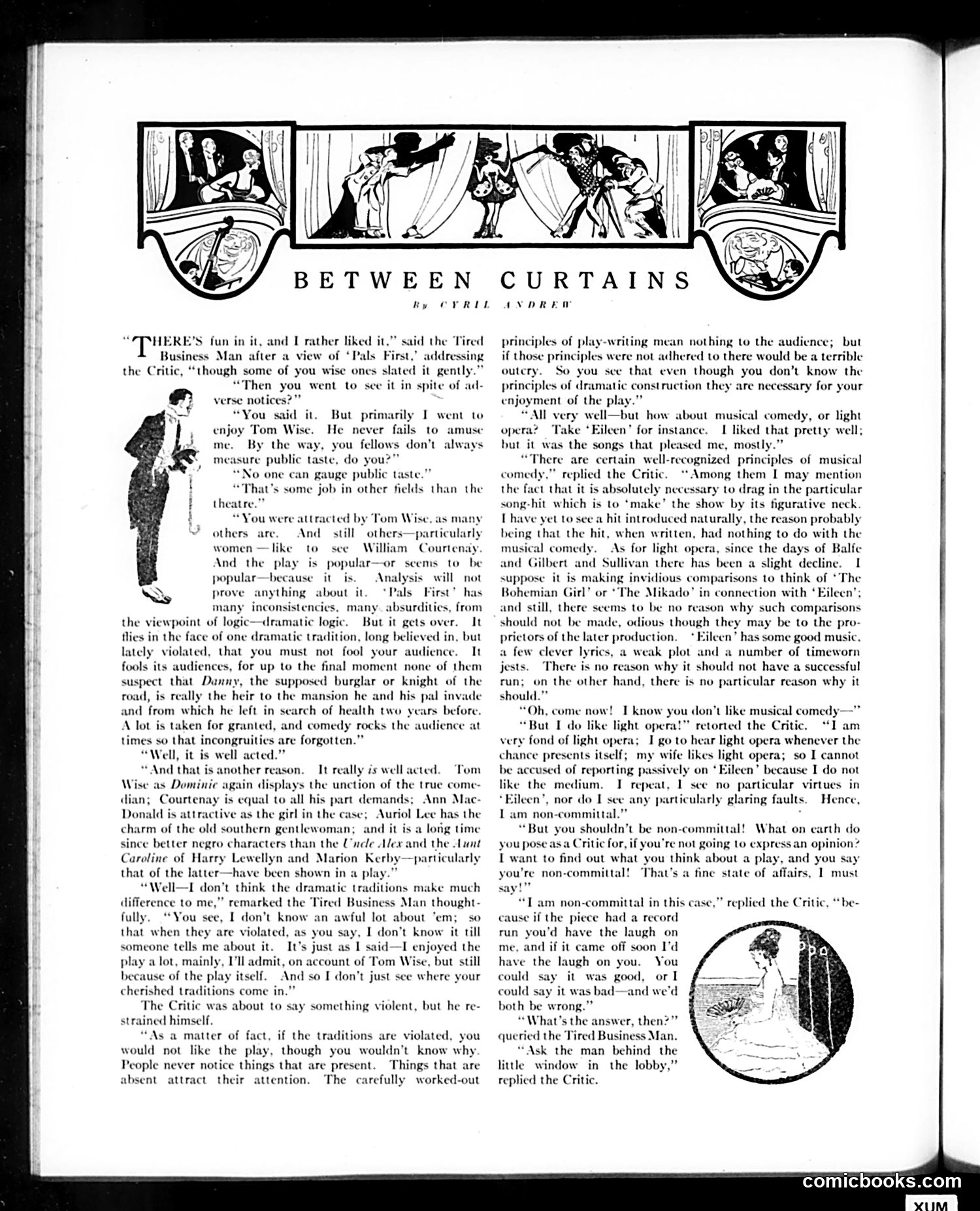
This article presents a dialogue between a theater Critic and a Tired Business Man discussing theatrical principles and recent Broadway productions. **The Setup:** The Tired Business Man attended a play called "Pals First" featuring actor Tom Wise. He enjoyed it despite admitting ignorance of dramatic theory. **The Satire's Point:** The Critic argues that theatrical traditions—like not fooling the audience about plot twists—are essential, even when audiences don't consciously notice violations. The Business Man counters that he simply enjoyed the performance without understanding these "rules," suggesting that technical principles matter less than entertainment value and good acting. **Social Commentary:** This reflects a common early-20th-century tension: educated critics valued formal artistic principles, while average theatergoers prioritized entertainment. The Tired Business Man represents the ordinary audience member whose instinctive enjoyment trumps theoretical knowledge, mildly satirizing both the Critic's pedantry and the audience's obliviousness to craft. The debate extends to musical comedy and light opera, with similar themes about artistic integrity versus popular appeal.
📄 Transcribed text from this page (OCR, searchable)
Machine-transcribed from the original scan — historical spelling and the odd misread are preserved.
BETWEEN Ry CYRIL * said the Tired addressi ently, it in spite of « and I rather liked it ew of ‘Pals “7RHER Busin ’S fun in it s Man after a vi the Critic, “though some of you wise on # “Then you went to s verse notices?” “You said But primarily I went to enjoy Tom W He never fails to amuse me. By the u fellows don’t alway: measure public taste, do you?” No one can gauge public taste.” That's some job in other fields than the theatr “You were attracted by Tom Wise, as many others are. And still others—particularly women —like to sce William Courtenay. And the play is popular—or scems to be popular—because it is. Analysis will QX>s prove anything about it. ‘Pals First’ has many inconsistencies, many. absurdities, from the viewpoint of logic—dramatic logi But it gets o It flies in the face of one d ic tradition, long believed in, but lately violated, that you must not fool your audience. It fools its audiences, for up to the final moment none of them suspect that Danny, the supposed burglar or knight of the road, is really the heir to the mansion he and his pal invade and from which he left in search of health two years before. A lot is taken for granted, and comedy rocks the audience at times so that incongruities are forgotten.” “Well, it is well acted.” “And that is another reason. It really is well acted. Tom Wise as Dominie again displays the unction of the true come- dian; Courtenay is equal to all his part demands; Ann Mac- Donald is attractive as the girl in the case; Auriol Lee has the charm of the old southern gentlewoman; and it is a long time since better negro characters than the Uncle Alex and the Aunt Caroline of Harry Lewellyn and Marion Kerby—particularly that of the latter—have been shown in a play. “Well—I don’t think the dramatic traditions make much difference to me,” remarked the Tired Business Man thought- fully. “You see, I don’t know an awful lot about ‘em; so that when they are violated, as you say, I don’t know it till someone tells me about it. It’s just as I said—I enjoyed the play a lot, mainly, I'll admit, on account of Tom Wise, but still because of the play itself. And so I don’t just see where your cherished traditions come in.” The Critic was about to say something violent, but he re- strained himself. “As a matter of fact, if the traditions are violated, you would not like the play, though you wouldn't know why People never notice things that are present. Things that are absent attract their attention, The carefully worked-out not CURTAINS (VDREN principles of play-writing mean nothing to the audience; but if those principles were not adhered to there would be a terrible outcry. So you sce that even though you don’t know the principles of dramatic construction they are necessary for your enjoyment of the play.” “All very well—but ho opera? Take ‘Eileen’ for instance. but it was the songs that pleased me, mostly “There are certain well-recognized principles of musical comedy.” replied the Critic. “Among them I may mention the fact that it is absolutely necessary to drag in the particular song-hit which is to ‘make’ the show by its figurative neck T have yet to see a hit introduced naturally, the reason probably being that the hit, when written, had nothing to do with the musical comedy. As for light opera, since the days of Balfe and Gilbert and Sullivan there has been a slight declin I suppose it is making in us comparisons to think of *The Bohemian Girl’ or *The Mikado’ in connection with ‘Eileen’; and still, there seems to be no reason why such comparisons should not be made, odious though they y be to the pro- prictors of the later production. tileen some good music, a few clever lyrics, a weak plot and a number of timeworn jests. There is no reason why it should not have a successful run; on the other hand, there is no particular reason why it should.” “Oh, come now! I know you don’t like musical comedy “But 1 like light opera!” retorted the Critic. “1 am very fond of light opera; I go to hear light opera whenever the chance presents itself; my wife likes light opera; so I cannot be accused of reporting passively on ‘Eileen’ because I do not like the medium. I repeat, 1 see no particular virtues in ‘Eileen’, nor do I see any particularly glaring faults. Hence, Tam non-committal.” “But you shouldn’t be non-committal!, What on earth do 1 Critic for, if you're not going to express an opinion? u think about a play, and you say hat’s a fine state of affairs, 1 must about musical comedy, or light I liked that pretty well; you pose as IT want to find out what you're non-committal! say!" “Tam non-committal in this case,” replied the Critic, * be- cause if the piece had a record run you'd have the laugh on me, and if it came off soon I'd have the laugh on you. You could say it | was good, orl could say it was bad—and we'd both be wrong. “What's the answer, then?” queried the Tired Business Man. Ask the man behind the little window in the lobby,” replied the Critic. comicbooks.com