
Judge, 1917-04-21 · page 16 of 32
Judge — April 21, 1917 — page 16: what you’re looking at
What you’re looking at
This page contains a short story about a card game and its unexpected consequences. **Thornley**, a gentleman, plays cards with visitors including a man named **Pinney**. Initially losing, Thornley wins heavily by evening. When leaving, Pinney—embarrassed by his losses—apologizes and offers money, which Thornley refuses. The twist: Pinney accidentally departs in **Howard Staleight's coat**, leaving his own behind. The next morning, Thornley discovers "Pinney" is actually the new butler he hired, having unknowingly employed the man who lost at cards the night before. The page also includes humorous poems on unrelated topics: "Clothes Psychology" (ironic observations about when you encounter acquaintances), and "His Utter Degradation" (an old man's rambling defense of his tobacco habit despite its health warnings). The cartoons illustrate these narrative moments with period-appropriate sketches, typical of Judge's satirical humor mixing social embarrassment with working-class irony.
📄 Transcribed text from this page (OCR, searchable)
Machine-transcribed from the original scan — historical spelling and the odd misread are preserved.
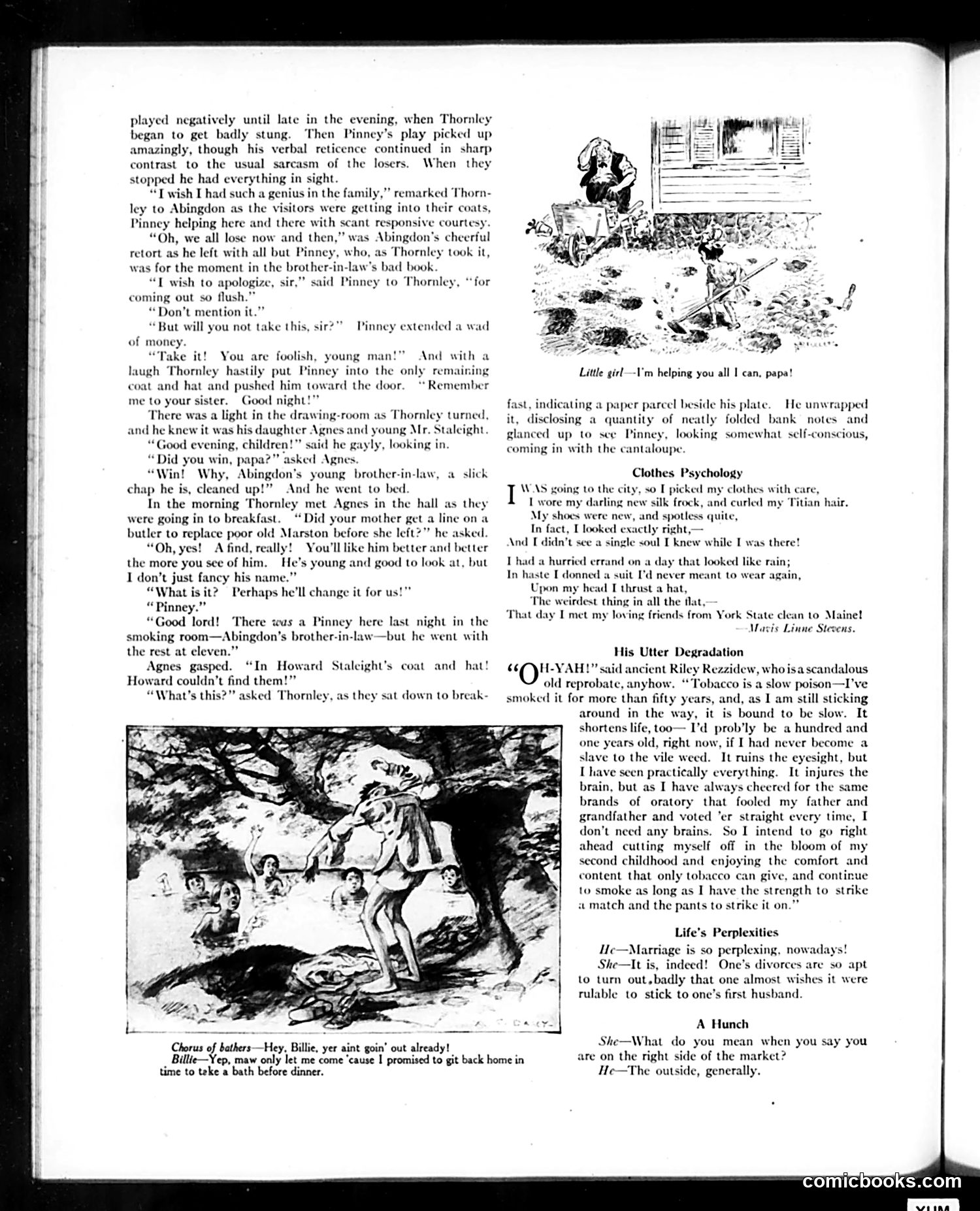
played negatively until late in the evening, when Thornley began to get badly stung. Then Pinney’s play picked up amazingly, though his verbal reticence continued in sharp contrast to the usual sarcasm of the losers. When they stopped he had everything in sight. “T wish I had such a genius in the family,” remarked Thorn- ley to Abingdon as the visitors were getting into their coats, Pinney helping here and there with nt responsive courtesy “Oh, we all lose now and then,” was Abingdon’s cheerful retort as he left with all but Pinney, who, as Thornley took it, w’s bad book said Pinney to Thornley, “for was for the moment in the brother-in “I wish to apologize, sir,” coming out so flush. “Don’t mention it. “But will you not take this, sir?” of mor Pinney extended a wad ake it! laugh Thornley hastily put Pinn coat and hat and pushed him toward the door me to your sister. Good night! There a light in the drawing-room as Thornley turned, and he knew it was his daughter Agnes and young Mr. Staleight. sood evening, children!” said he gayly, looking in. “Did you win, papa?” asked Agnes. “Win! Why, Abingdon’s young brother-in-law, a slick chap he is, cleaned up!” And he went to bed. In the morning Thornley met Agnes in the hall as they were going in to breakfast. “Did your mother get a line on a butler to replace poor old Marston before she left?” he asked. “Oh, yes!) A find, really! You'll like him better and better the more you sce of him. He's young and good to look at, but I don’t just fancy his name.” “What is it? Perhaps he'll change it for us!” “Pinney.” “Good lord! There was a Pinney here last night in the smoking room—Abingdon’s brother-in-law—but he went with the rest at eleven.” Agnes gasped. “In Howard Staleight’s coat and hat! Howard couldn’t find them!” “What's this?” asked Thornley You are foolish, young man!” And with a into the only remaining “Remember as they sat down to break- Chorus of bathers—Hey. Billie, yer aint goin’ out already! Billie—Yep, maw only let me come ‘cause | promised to git back home in time to teke a bath before dinner. Little girl—I'm helping you all | can, papa! fast, indicating a paper parcel beside his plate. He unwrapped it, disclosing a quantity of nea folded bank glanced up to see Pinney, looking somewhat self-conscious, coming in with the cantaloupe. notes and Clothes Psychology WAS going to the city, so [ picked my clothes with care, I wore my darling new silk frock, and curled my Titian hair. My shoes were new, and spotless quite, In fact, I looked exactly right, — And [ didn’t see a single soul I knew while I was there! T had a hurried errand on a day that looked like rain; In haste I donned a suit I'd never meant to wear again, Upon my head [thrust a hat, The weirdest thing in all the flat, ‘That day I met my loving friends from York State cl Mavis His Utter Degradation 66C)H-YAHL!” said ancient Riley Rezzidew, who isa scandalous old reprobate, anyhow. “Tobacco is a slow poison—I’ve smoked it for more than fifty years, and, as I am still sticking around in the way, it is bound to be slow. shortens life, too— I'd prob'ly be a hundred and one years old, right now, if I had never become a slave to the vile weed. It ruins the eyesight, but ven practically everything. It injures the brain, but as I have a s cheered for the same brands of oratory that fooled my father and grandfather and voted ‘er straight every time, I don’t need any brains. So I intend to go right ahead cutting myself off in the bloom of my second childhood and enjoying the comfort and content that only tobacco to smok long as I have the strength to strike st match and the pants to strike it on.” Life's Perplexities He—Marriage is so perplexing, nowad She—It is, indeed! One’s divorces are so apt to turn out,badly that one almost wishes it were tulable to stick to one’s first husband. A Hunch She—What do you mean when you say you are on the right side of the market? He—The outside, generally.