
A complete issue · 28 pages · 1917
Judge — March 31, 1917
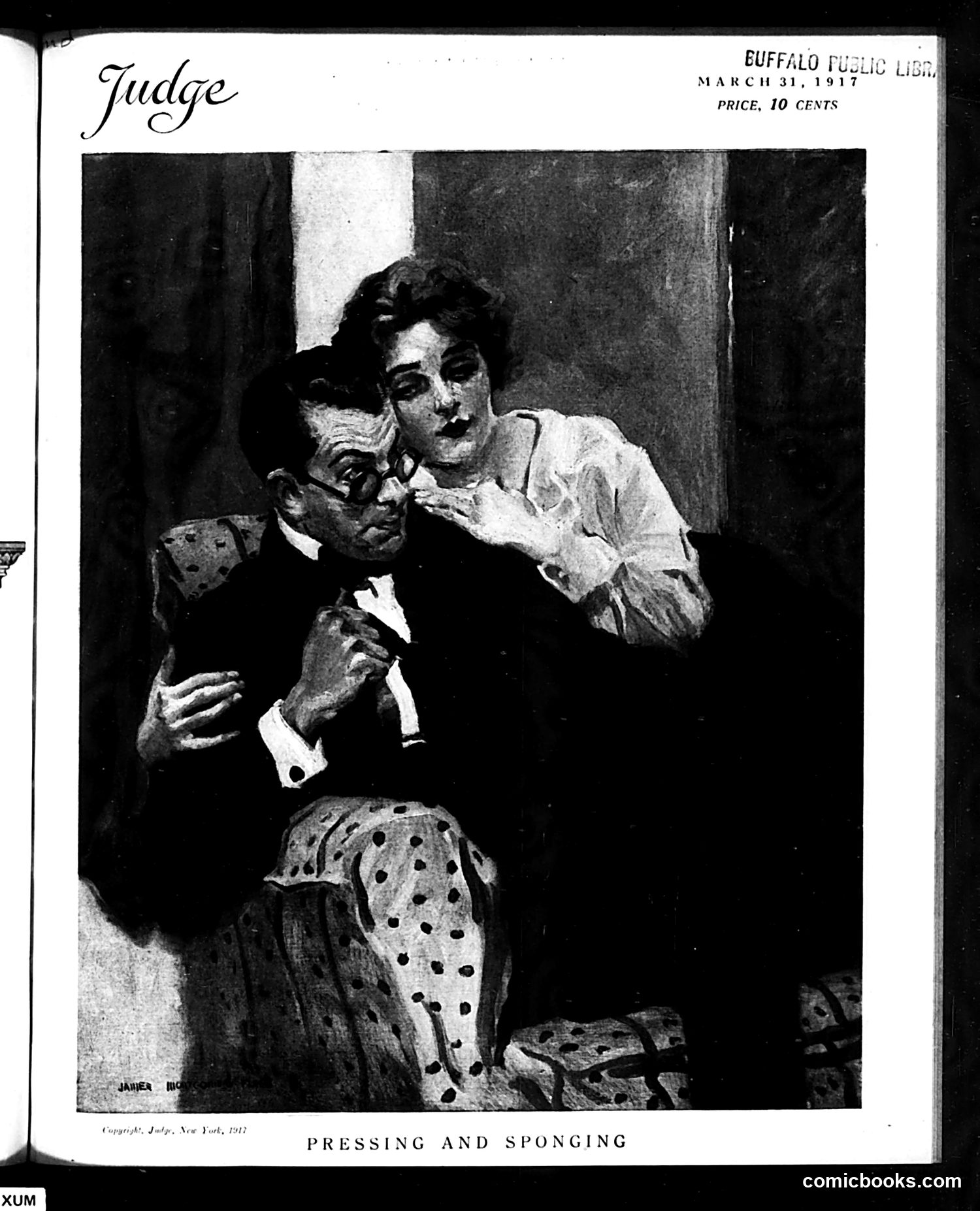
This cartoon satirizes domestic life, specifically the uncomfortable dynamics of financial dependence or debt. The title "Pressing and Sponging" uses double meaning: "pressing" refers to ironing clothes, while "sponging" means borrowing money without repaying it. The image shows a woman attending to a man's clothing while he appears distressed or evasive—likely depicting a wife managing household tasks while dealing with a husband who is a financial "sponger" (freeloader or chronic debtor). The polka-dotted fabric and intimate domestic setting underscore the personal nature of financial strain within marriage. This reflects early-20th-century anxieties about masculine responsibility and economic instability in working-class households.
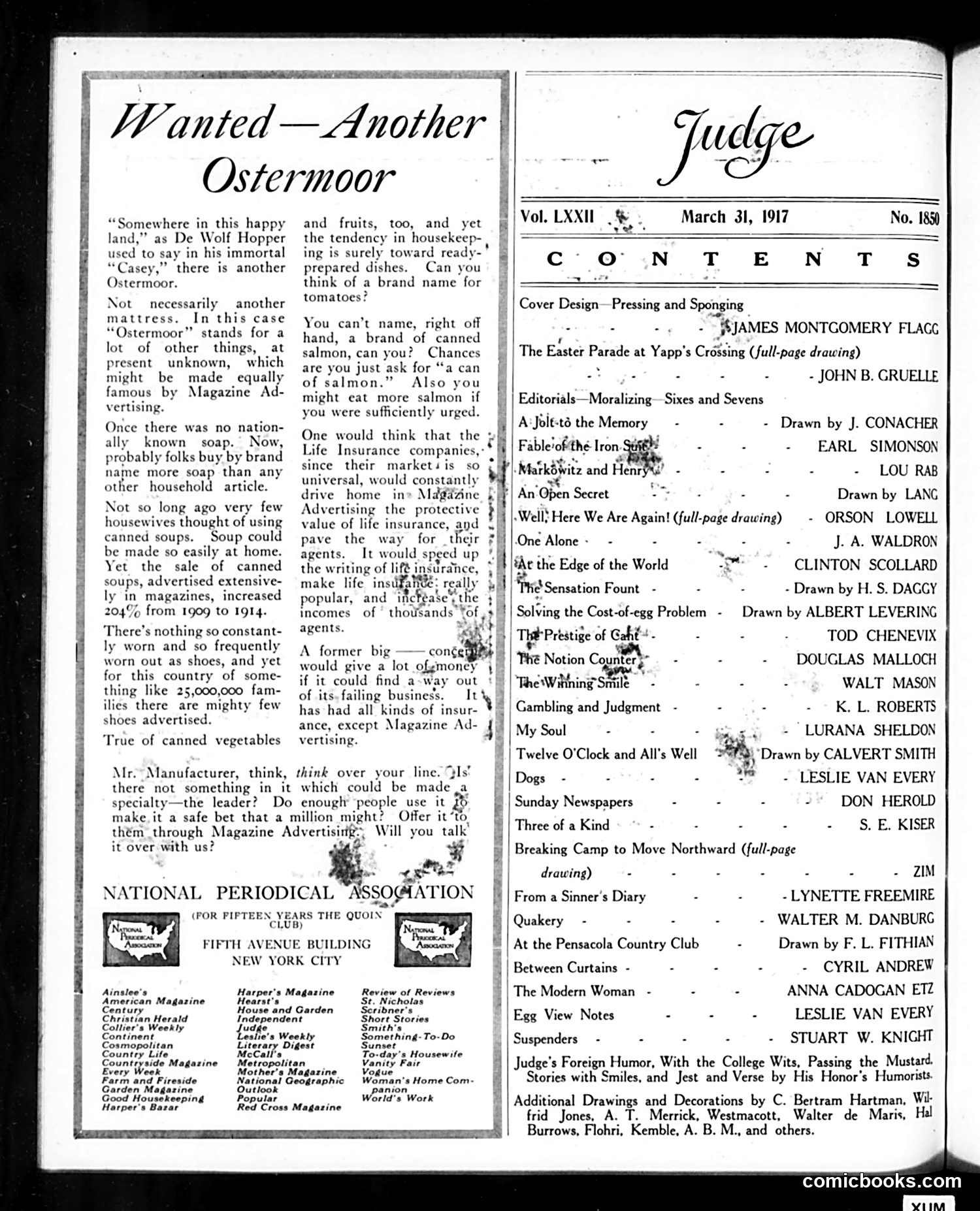
This page is primarily a **table of contents** for the issue, with a small advertisement on the left titled "Wanted—Another Ostermoor" (a mattress brand). The advertisement discusses canned goods and brand names in a humorous way, suggesting that just as "Ostermoor" became synonymous with mattresses through advertising, other products need similarly memorable brand names. It mentions canned salmon and tomatoes as examples, and jokes that Life Insurance companies should advertise more to promote their value. The contents list shows this issue features full-page drawings, editorials on "Moralizing" and other topics, and various satirical pieces typical of Judge's style—political commentary mixed with humor and illustrations about American life and culture.
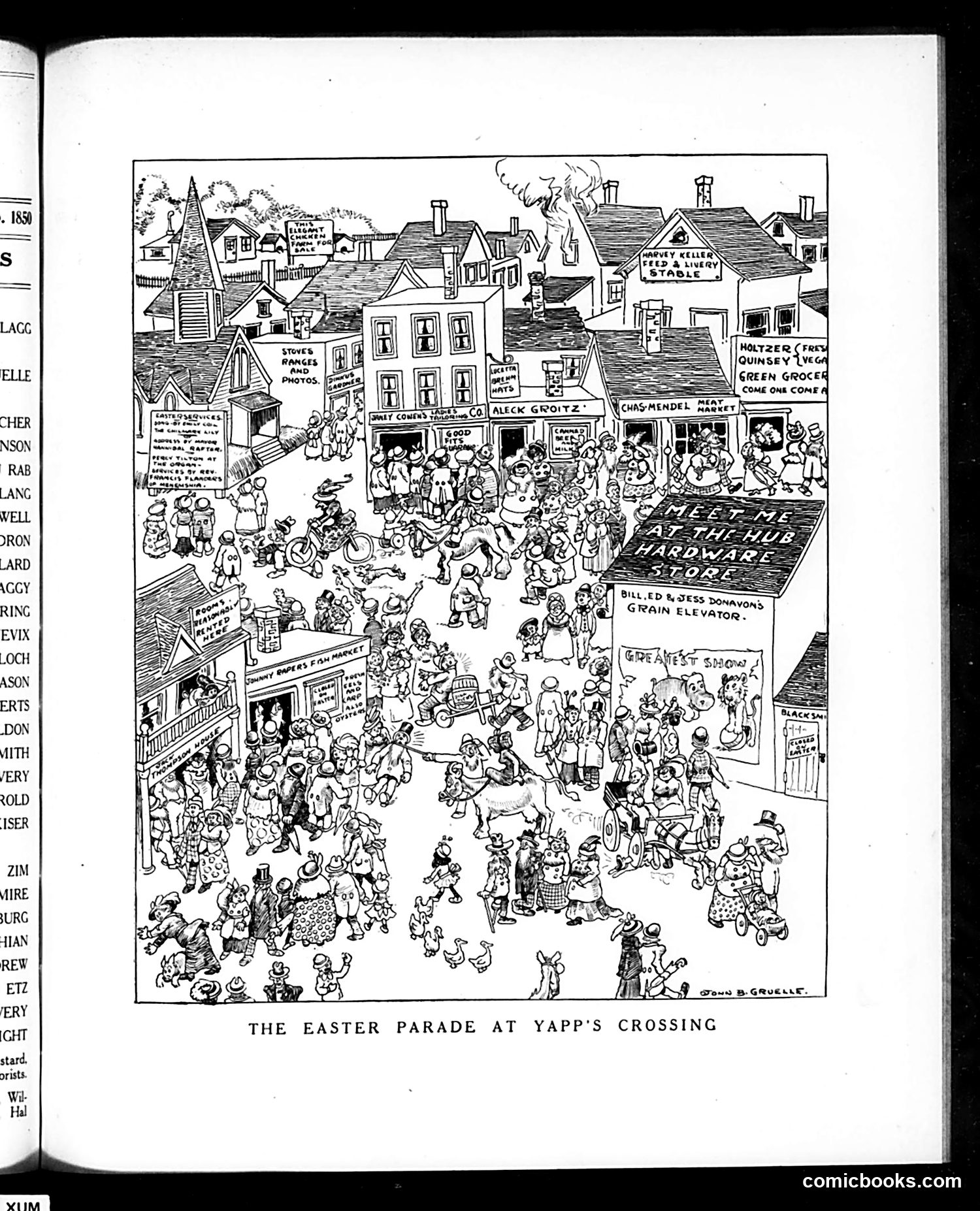
This illustration depicts a crowded, bustling small-town scene during Easter celebrations. The detailed street view shows numerous townspeople, children, and animals (including dogs and chickens) gathered around various local businesses: a grocery store, a meat market, a grain elevator, and other shops with visible signage. The satire appears to target small-town American life and commercialism. The dense, chaotic crowd and the prominent display of business names suggest mockery of how rural communities turn holiday celebrations into commercial shopping events. Store owners compete for attention, while ordinary citizens mill about in what seems like purposeless activity. The cartoon uses detailed character work and architectural specificity to humorously document quintessential small-town American culture circa early 20th century.
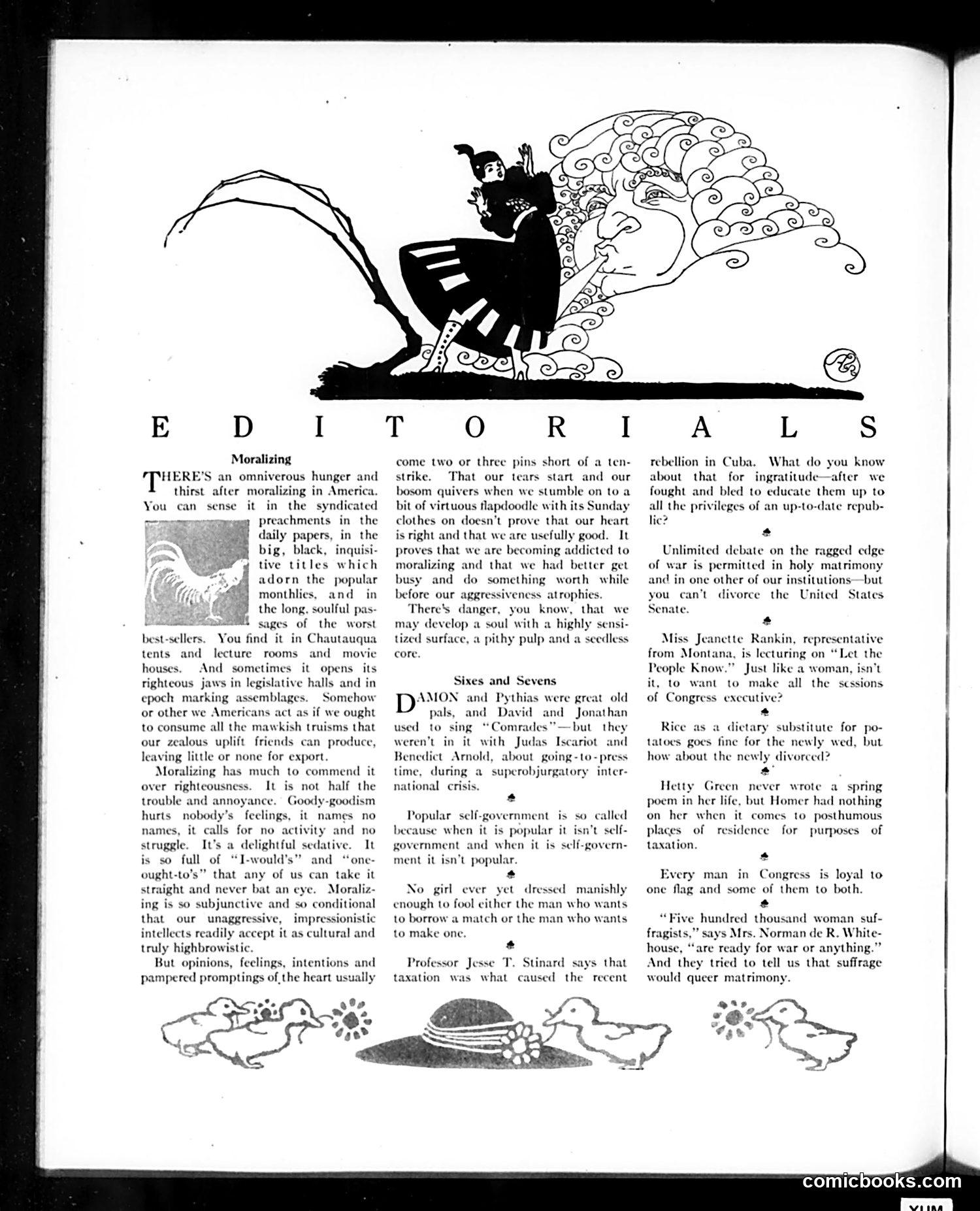
The main cartoon depicts a figure riding what appears to be a large rooster or bird, with elaborate decorative plumage. This likely represents American political boasting or aggressive posturing, given the prominent decorative display—a visual metaphor for puffed-up national pride. The editorial text below addresses American moralizing and self-righteousness. It critiques the nation's tendency to lecture others (particularly referencing Cuba's rebellion) while ignoring domestic problems. The piece mocks American moral superiority and calls out hypocrisy regarding taxation, divorce law, and women's suffrage debates. The satirical commentary suggests Judge was challenging American exceptionalism and the gap between stated values and actual conduct—a common Progressive Era critique of national policy.
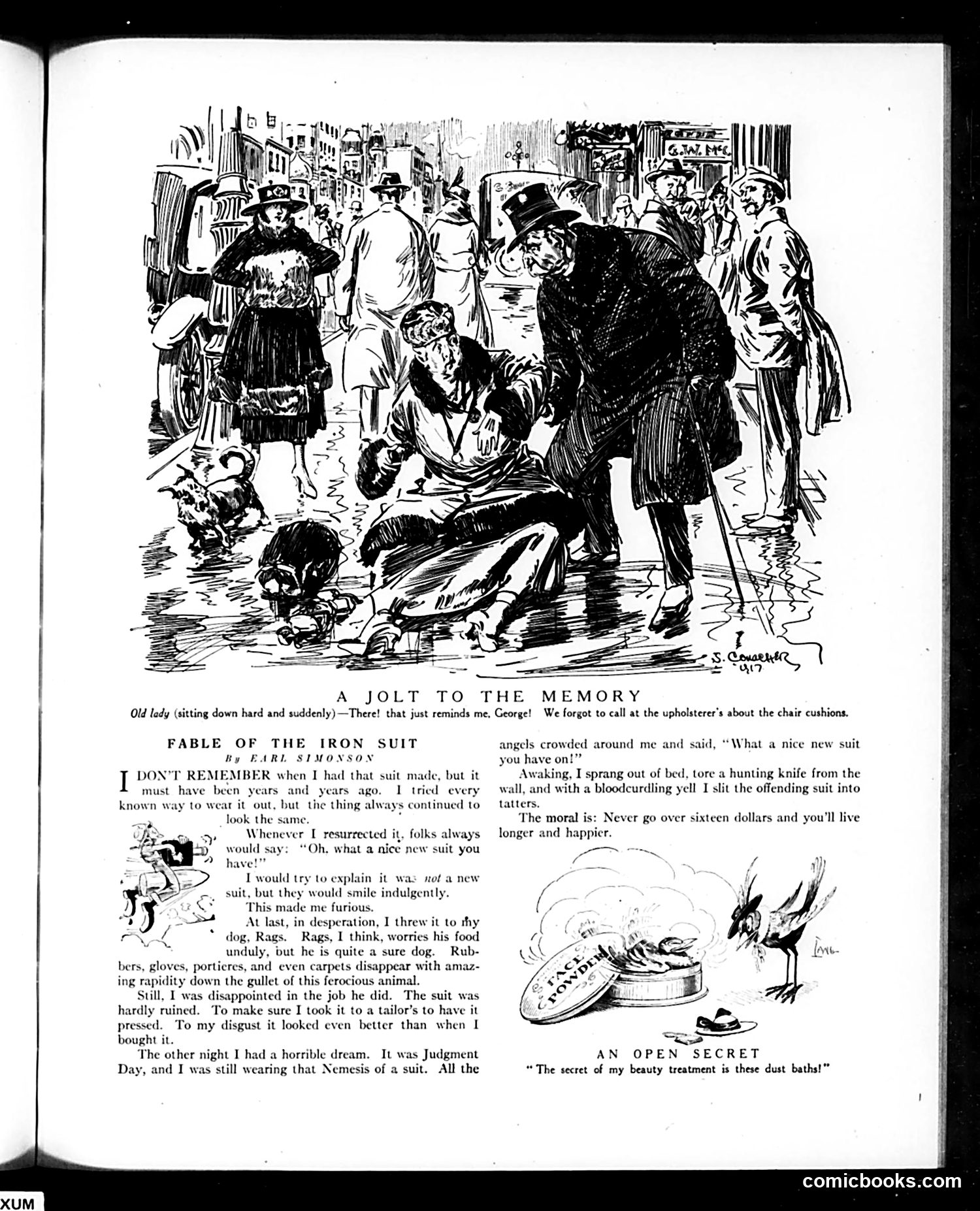
**Top Cartoon - "A Jolt to the Memory":** This depicts a street scene where an elderly woman has fallen or collapsed. A well-dressed man bends toward her while bystanders gather. The caption indicates she's reminding "George" about unpaid debts to an upholsterer. The satire targets social embarrassment—the gentleman's public humiliation when confronted about forgotten financial obligations by someone of lower social standing. **Bottom Story - "Fable of the Iron Suit":** A humorous first-person narrative mocks the endless cycle of purchasing new clothing. The author describes repeatedly buying suits hoping they'll stay new-looking, but they always deteriorate. The moral lesson—never spend more than sixteen dollars—satirizes both consumer vanity and middle-class financial anxiety. The accompanying illustrations show the suit's deterioration and a comical advertisement for "beauty treatment" bath salts.
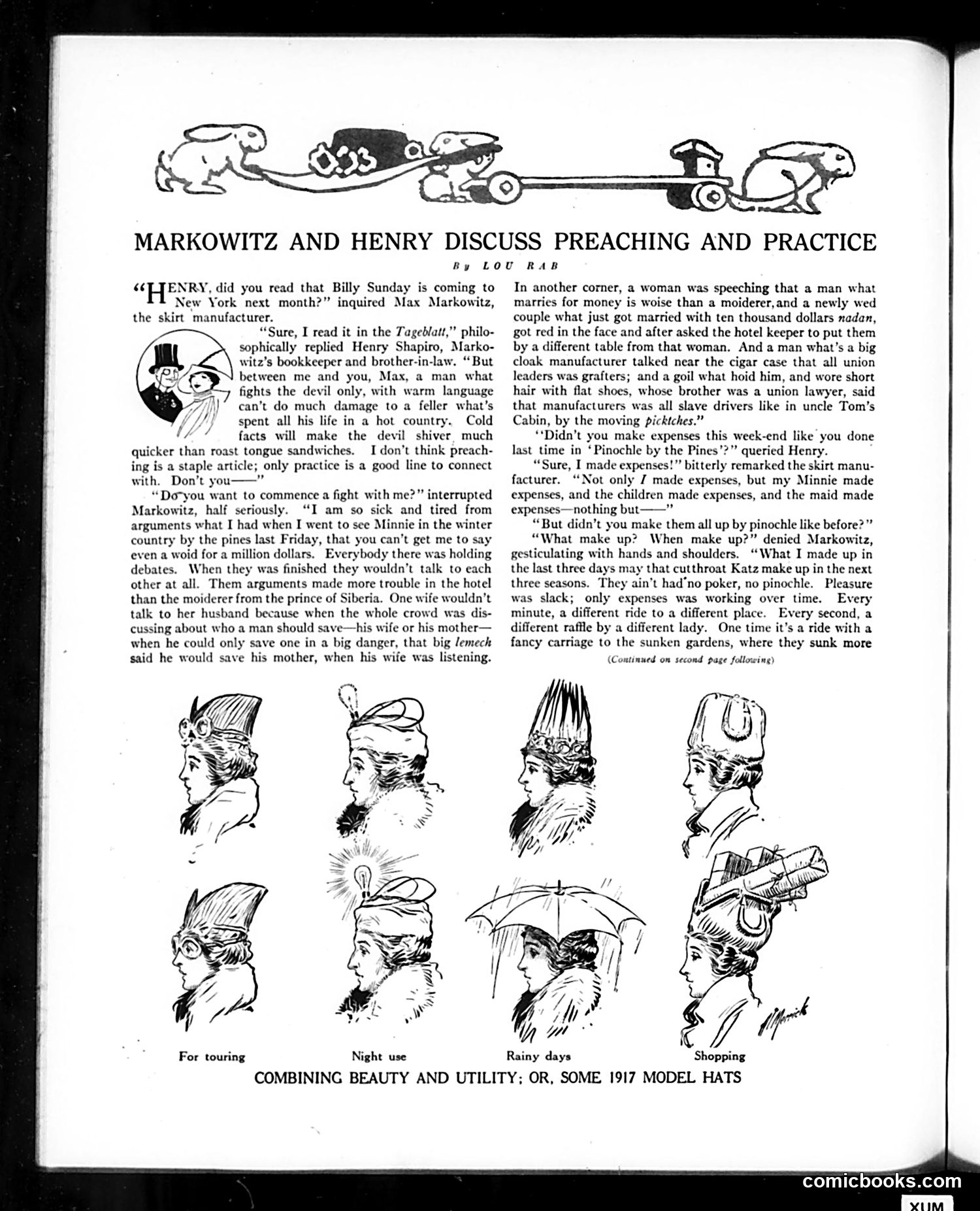
This 1917 Judge magazine page contains two distinct sections: **Top article:** A humorous dialogue between "Markowitz" and "Henry Shapiro" debating whether preaching (morality sermons) or practical experience teaches better lessons. They discuss Billy Sunday, a famous evangelist of that era, using examples of labor disputes and manufacturing mishaps to argue that real-world consequences educate more effectively than rhetoric. The satire targets both preachy moralism and labor unrest common in WWI-era America. **Bottom illustration:** Eight women's hats labeled for different 1917 occasions (touring, night use, rainy days, shopping). This satirizes contemporary fashion's impracticality—women supposedly needed specialized headwear for each activity. The joke mocks both consumer culture and women's fashion industry marketing of the period.
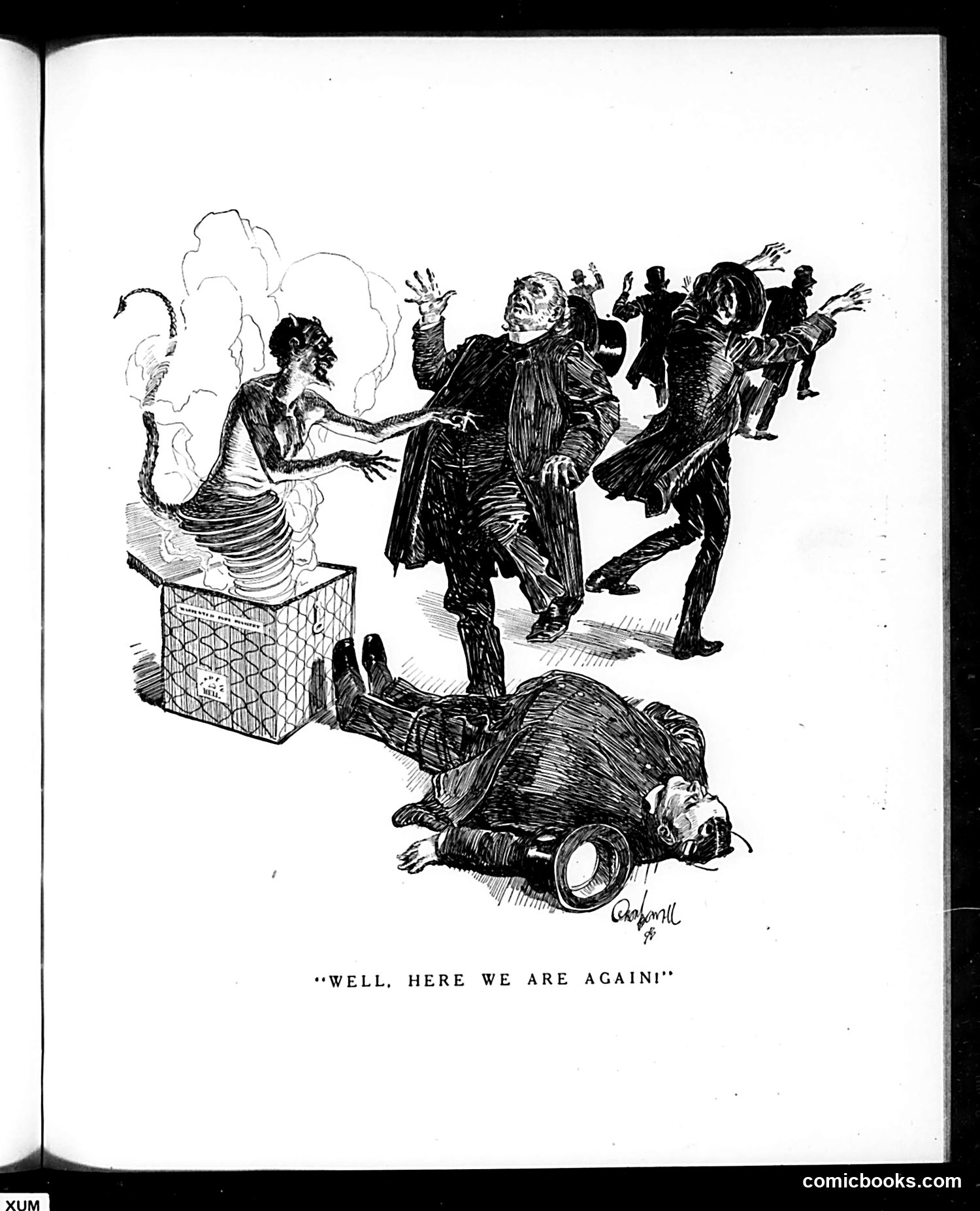
This cartoon depicts a chaotic scene with the caption "Well, Here We Are Again!" A central figure in dark clothing appears distressed while being pulled or restrained by figures on the left, with a woman emerging from what looks like a cage or basket. A man lies prone on the ground in the foreground, wearing a monocle. Without clearer OCR text or additional context, the specific historical reference is uncertain. However, the composition suggests commentary on **cyclical political turmoil or repeated scandal**—the "again" implying this is a recurring situation. The prone figure and apparent violence suggest either a satirical commentary on political misadventure or social upheaval, likely from the late 19th or early 20th century. The style and *Judge* magazine context suggest American political satire, but identifying the specific figures and event would require additional documentation.
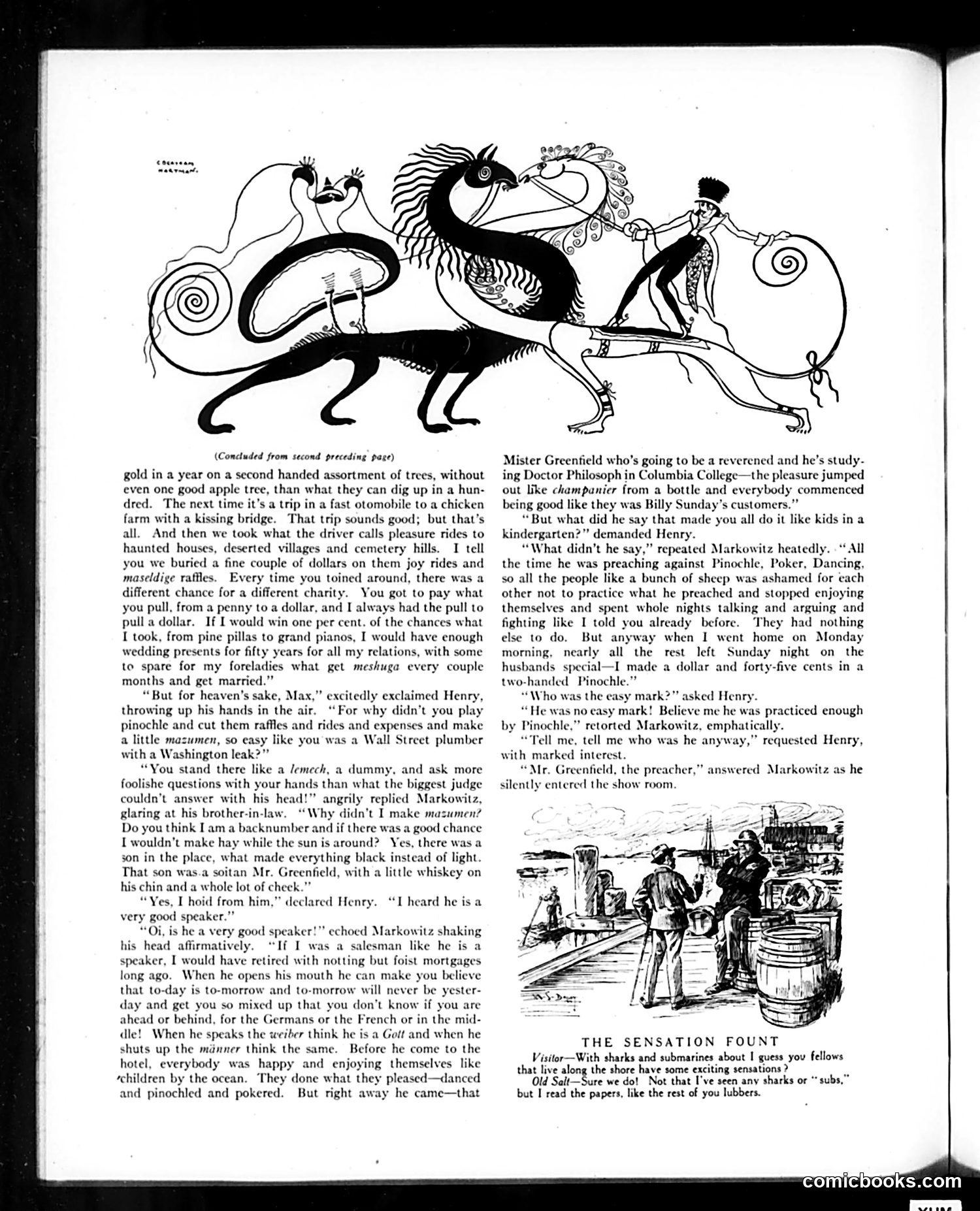
This page contains a continuation of a Yiddish-inflected comedic monologue by a character named Markowitz, complaining about a hotel guest named Mr. Greenfield who disrupted the establishment. **The satire targets:** - A self-righteous religious figure (Greenfield, studying to become a reverend/doctor of philosophy at Columbia College) whose moral preaching against gambling and dancing causes temporary reform among guests - The hypocrisy of sudden moral transformation: guests stop enjoying themselves out of shame, yet Markowitz ironically profits from a two-handed pinochle game once the reformer leaves - The absurdity of charismatic preaching that temporarily manipulates people's behavior through guilt rather than genuine conviction **The cartoon above** (showing fantastical creatures) appears decorative and unrelated to the text. **At bottom:** "The Sensation Fount" illustration depicts a seaside scene, likely setting up another story. The satire mocks religious reformers whose influence is superficial and temporary—people revert to their true natures once the preacher departs.
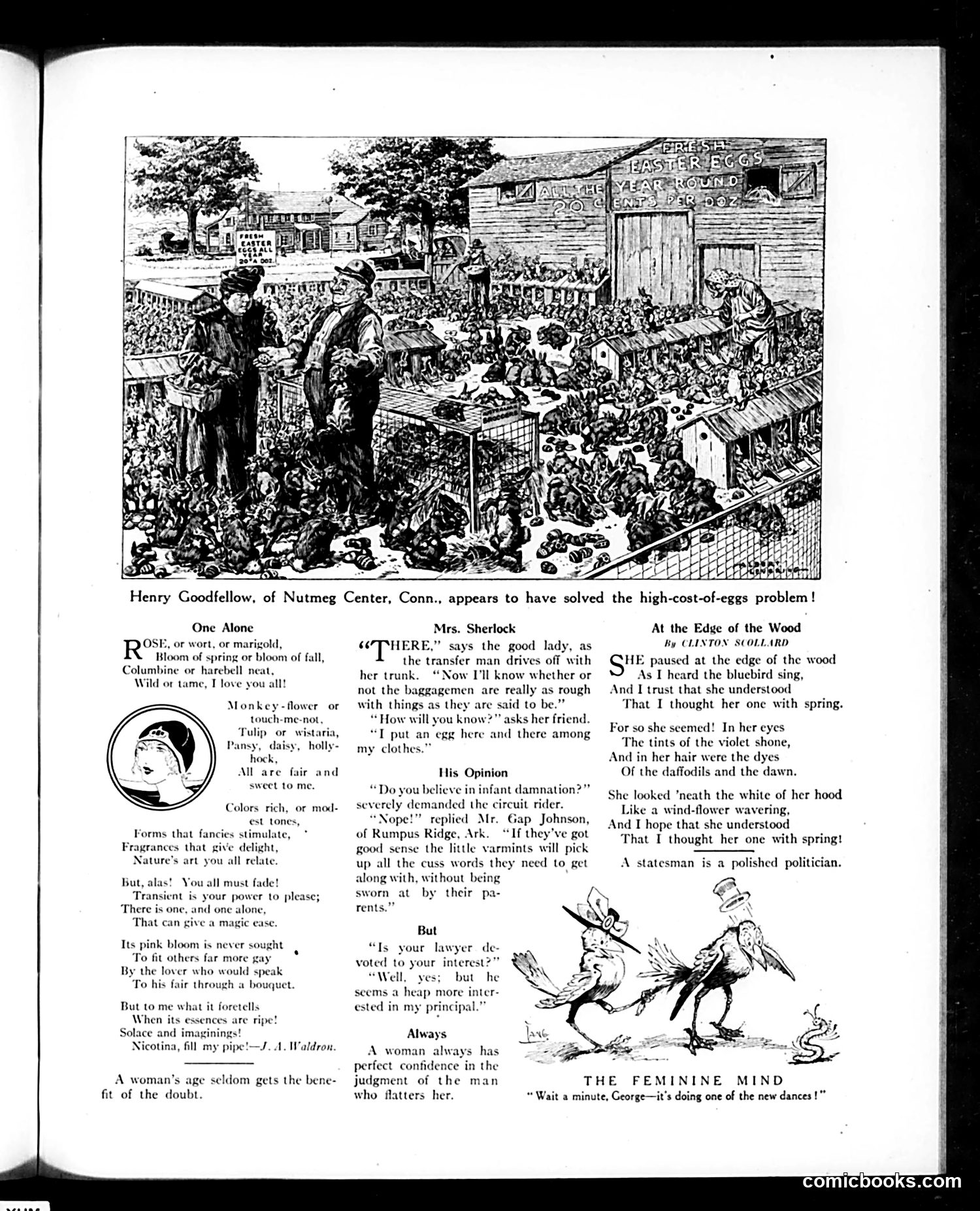
The main cartoon satirizes the rising cost of eggs (a contemporary economic concern) through Henry Goodfellow's solution: using eggs as fragile indicators to test baggage handlers' gentleness. The joke is that eggs serve a dual purpose—both practical and revealing of worker behavior. The page includes various satirical pieces typical of Judge magazine: - **"One Alone"** humorously contrasts appreciation for flowers with tobacco's superior appeal - **"Mrs. Sherlock"** depicts a woman using eggs to test whether baggage handlers truly are rough (a social commentary on labor and suspicion) - **"His Opinion"** mocks rural attitudes toward child-rearing through crude dialect humor - **"The Feminine Mind"** stereotypes women as easily pleased by flattery and distracted by trivial novelties (the "new dances") The poetry and social commentary reflect early 20th-century preoccupations: economic inflation, worker treatment, rural/urban class differences, and conventional gender stereotypes presented as humorous observations about human nature.
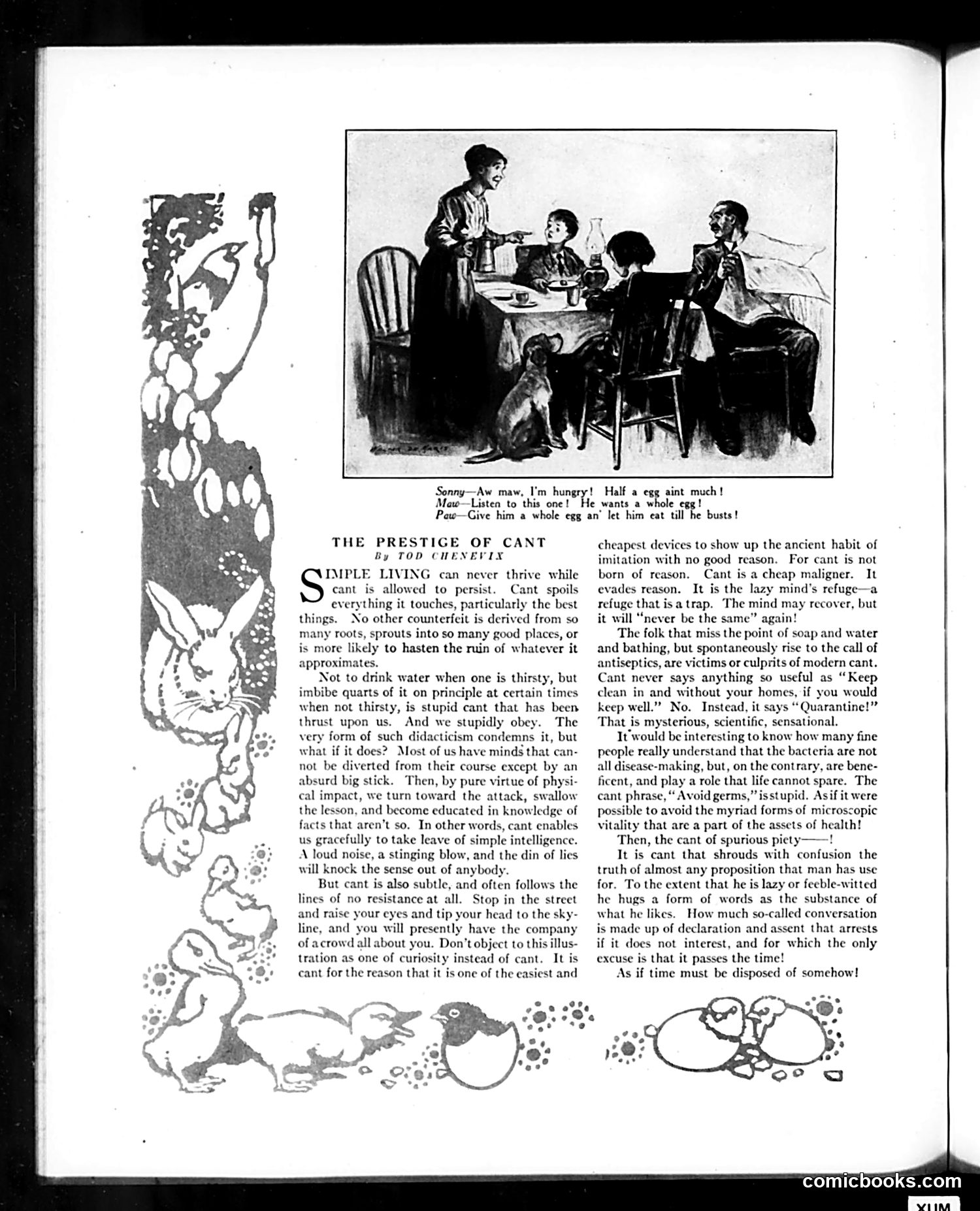
This page combines a domestic cartoon with a social commentary essay by Tod Chenevix attacking "cant"—hypocritical, thoughtless adherence to conventional ideas without reason. **The cartoon** depicts a family dinner scene where the mother dismisses the hungry child's request for a whole egg as excessive, but the father indulgently overrules her, telling him to eat until he bursts. The joke satirizes parental contradiction and inconsistency. **The essay** criticizes how people mindlessly follow social conventions: drinking water by principle when not thirsty, following fads through imitation, obsessing over "antiseptics" and "germs" without understanding bacteria's actual role, or using pious platitudes instead of genuine reasoning. Chenevix argues cant is the "lazy mind's refuge"—people adopt fashionable ideas to avoid actual thought, creating a trap they cannot escape. The satire targets early 20th-century American bourgeois pretentiousness and pseudoscientific health crazes.
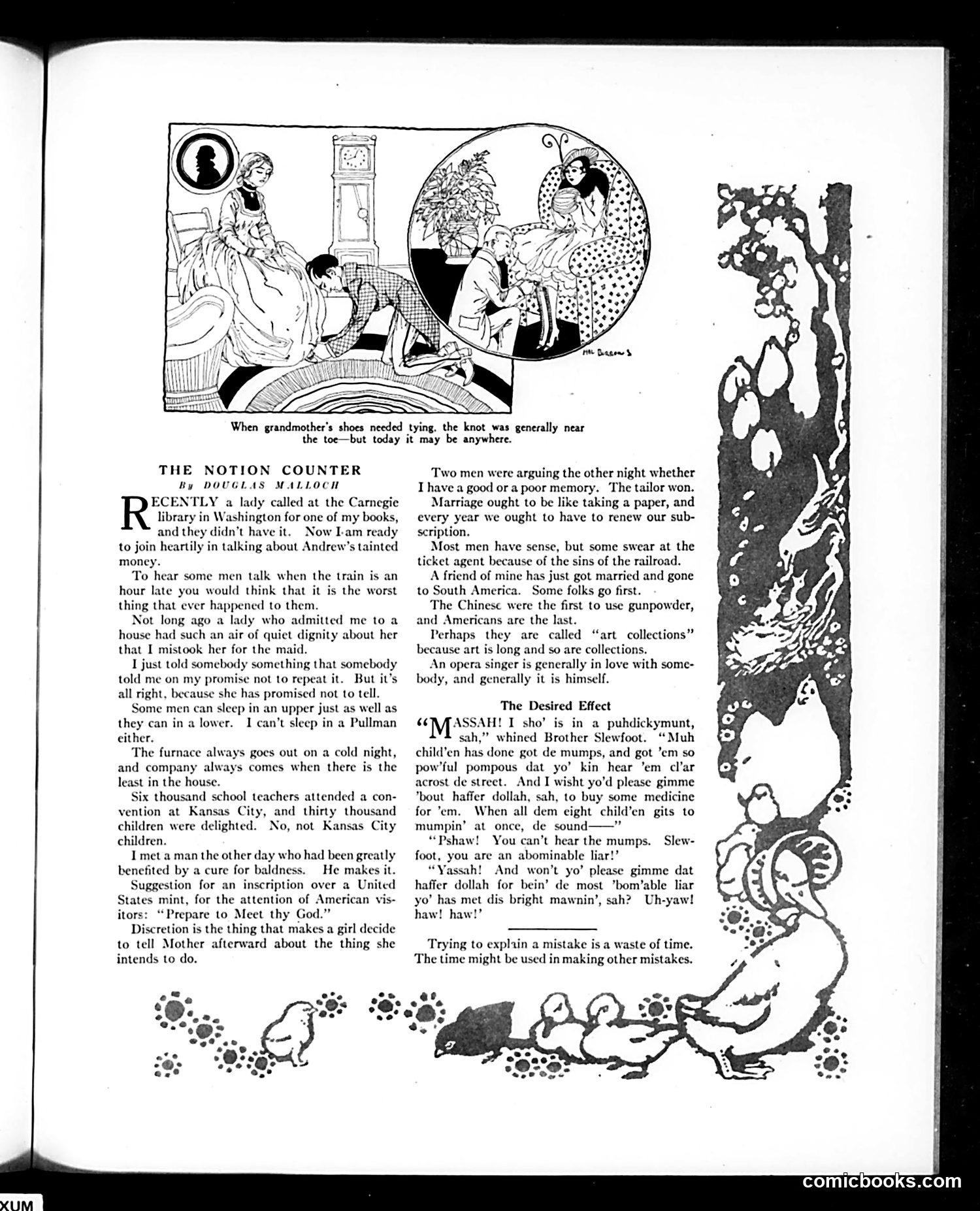
This page contains two distinct pieces: **"The Notion Counter"** by Douglas Malloch is a humorous essay collection—brief, observational anecdotes about everyday life quirks. Examples include complaints about train delays, furnace failures, and the irony of a baldness-cure salesman who benefits from his own product. One quip mocks Andrew Carnegie's philanthropic "tainted money" donation to the Washington library. These are lighthearted social commentary on human nature and modern inconveniences, requiring no specific historical context beyond early 20th-century American life. **"The Desired Effect"** is a dialect comedy sketch featuring "Brother Slewfoot," a Black character speaking in exaggerated African-American vernacular. He requests money for medicine for his children's mumps, claiming they're so loud you can hear them across the street. When challenged as a liar, he cleverly asks for payment *for being* the best liar—inverting the insult into profit. The humor relies on period stereotypes and trickster-tale traditions.
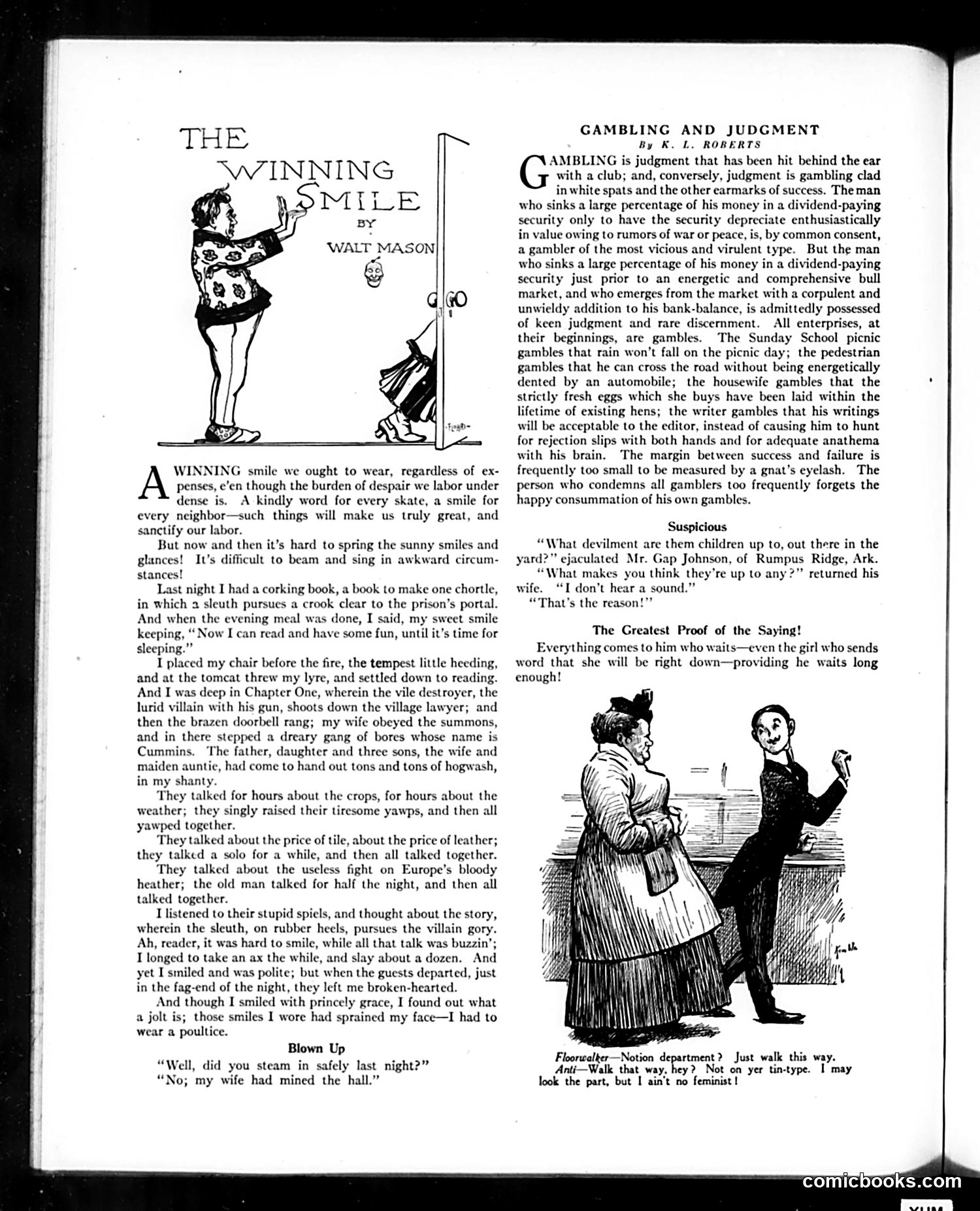
This page contains two distinct pieces of social satire typical of Judge magazine's humor: **"The Winning Smile"** (left) is a humorous poem by Walt Mason mocking the difficulty of maintaining cheerfulness during tedious social obligations. The narrator attempts to read a thrilling mystery novel but is interrupted by the Cummins family—described as boring visitors who talk incessantly about crops, weather, tile prices, and European affairs. Despite his effort to smile politely, the forced geniality literally strains his face, requiring a medical poultice afterward. The satire targets the social expectation that one must appear perpetually pleasant regardless of circumstance. **"Gambling and Judgment"** (right) is an essay by K.L. Roberts arguing that the distinction between gambling and sound investment is largely semantic—both involve risk. The accompanying cartoon depicts two figures in conversation about "walking" and "tin-type," likely illustrating how appearance and presentation mask underlying reality, reinforcing the essay's point about judging situations by outcomes rather than intent.
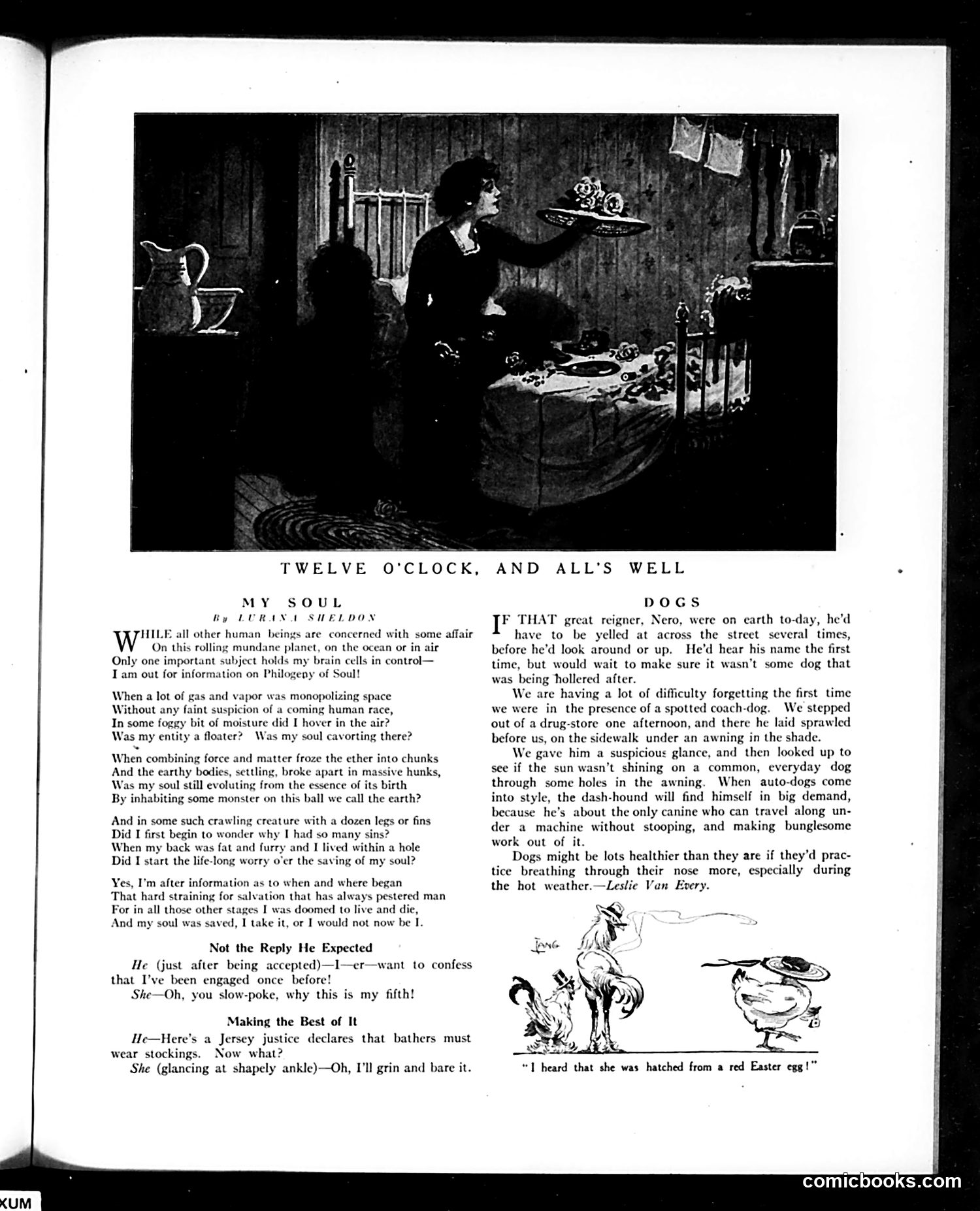
This page contains three unrelated humor pieces typical of early 20th-century satirical magazines: **"My Soul"** is a philosophical poem by Lurana Sheldon pondering the transmigration of souls through evolutionary stages—from primordial matter through animal forms to humanity. It's satirizing contemporary interest in spiritualism and pseudo-scientific theories of soul evolution popular in that era. **"Not the Reply He Expected"** and **"Making the Best of It"** are brief comedic dialogues playing on gender role reversals and social conventions—a man embarrassed about prior engagements versus a woman claiming five, and a woman making light of an absurd legal requirement for bathing attire. **"Dogs"** is a humorous essay by Leslie Van Every offering observations about urban dogs, including references to "coach-dogs" (spotted dalmatians) and emerging "auto-dogs" (dogs adapted to automobiles). The accompanying cartoon appears to show dogs discussing human behavior, with the caption poking fun at selective breeding or odd dog origins. The page reflects Judge's typical mix of philosophical satire, romantic humor, and everyday social observation.
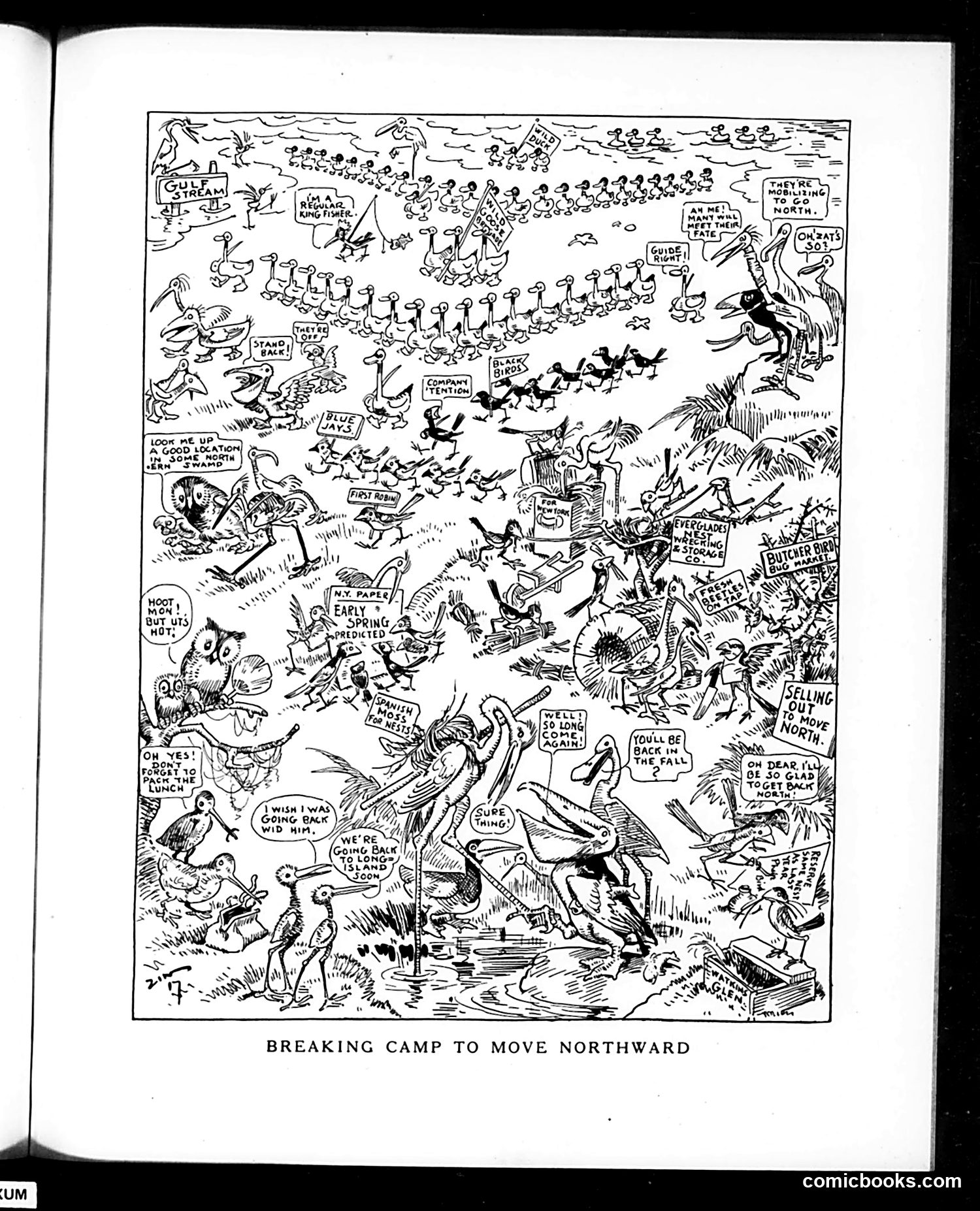
This satirical cartoon depicts a chaotic bird migration, with various avian characters anthropomorphized to represent human society during migration season. The birds are organized in formation heading north, complete with signage, supplies, and conflicting instructions ("go north," "back in fall," etc.). The satire appears to mock the disorganization and confusion of large group movements or mobilizations—possibly referencing a military campaign, labor movement, or seasonal migration of populations. Characters debate logistics ("look me up a good location," "my papers early"), and some resist or question the northward journey. The humor relies on treating birds' natural migration as a human institutional endeavor complete with bureaucratic complications, supplies, and disagreements about direction and timing. Without specific historical dating, the exact political reference remains unclear, though the emphasis on "mobilizing" and "moving northward" suggests commentary on organized mass movement during an unspecified period.
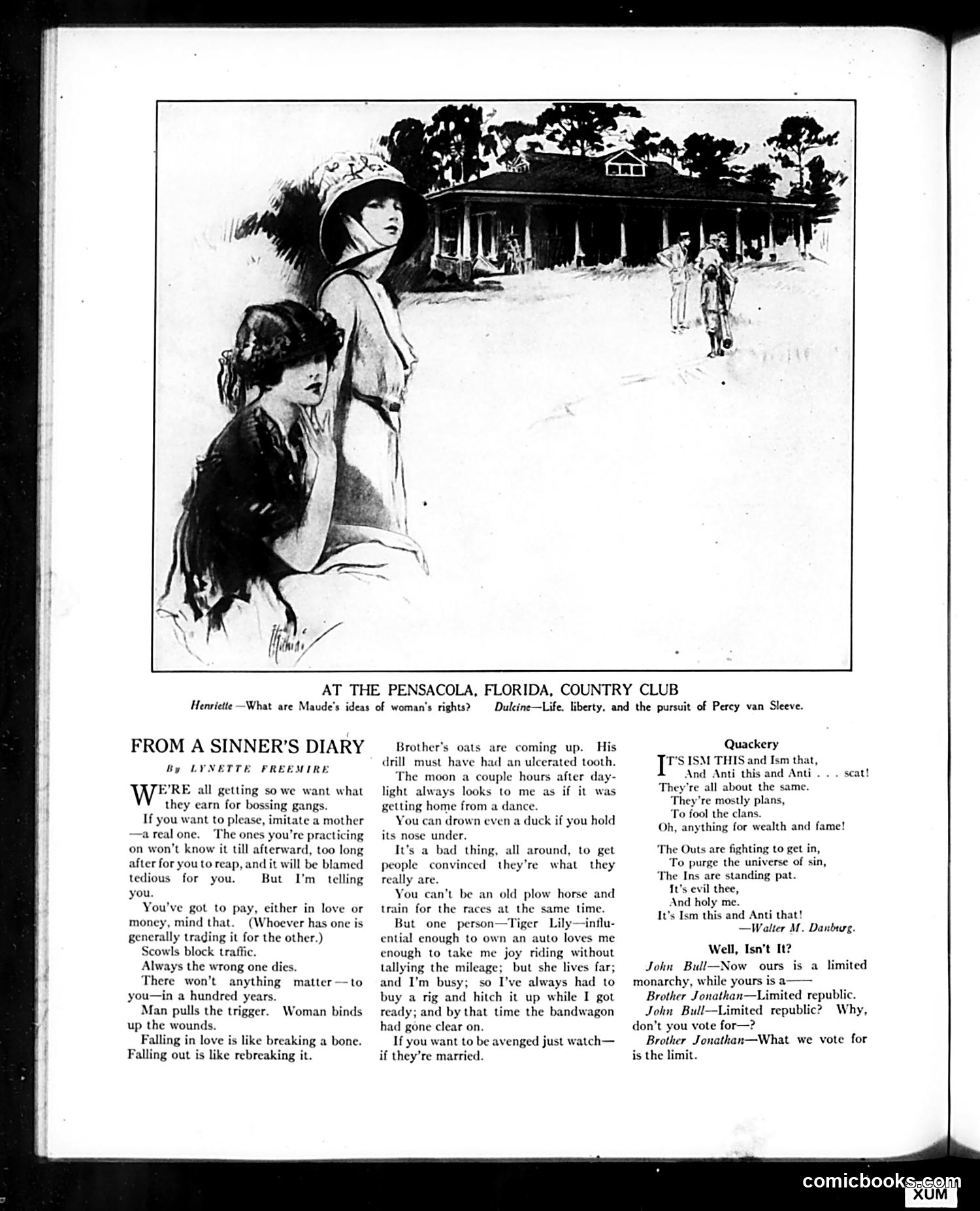
This page contains two distinct pieces: an illustrated short story and a political dialogue. **The illustration** shows two women at a Pensacola country club, likely depicting a romantic or scandalous encounter. The caption references "woman's rights" and "the pursuit of Percy van Sleeves," suggesting commentary on women's independence and romantic freedom. **"From a Sinner's Diary"** is cynical social commentary on relationships and human nature—observations that "falling in love is like breaking a bone" and cynical observations about desire and deception. The tone reflects 1920s-era skepticism about romance and social conventions. **"Well, Isn't It?"** is a political dialogue between "John Bull" (Britain) and "Brother Jonathan" (America). It satirizes American democracy, with Jonathan claiming Americans "vote for the limit"—suggesting that voting rights themselves are the extent of American political power, perhaps implying limited actual democratic influence or that citizens merely choose between constrained options. The piece mocks both monarchies and republics as equally compromised systems.
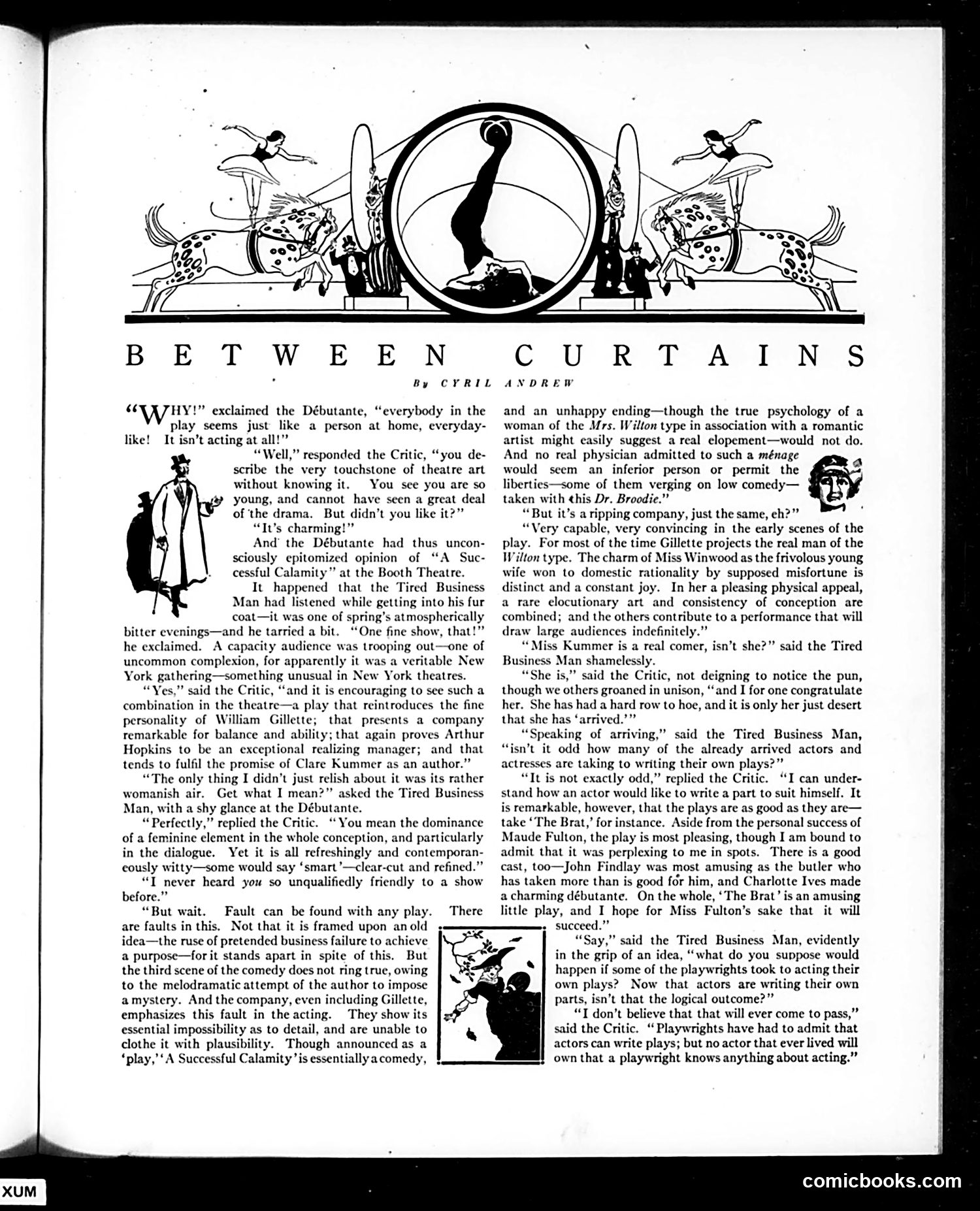
This theater criticism column by Cyril Andrew reviews "A Successful Calamity" at the Booth Theatre, featuring actor William Gillette. The piece uses dialogue between a Débutante (young society woman), a Critic, and a Tired Business Man to discuss the play's merits and flaws. The satire targets theatrical pretension: the Débutante unknowingly defines great theater by saying actors seem like "everyday" people—praised as profound insight. The Critic praises the production's contemporary wit and Gillette's performance, but faults a melodramatic third-act mystery scene as implausible. The humor relies on the Tired Business Man's vernacular contrasting with the Critic's refined vocabulary, and his shameless compliment of actress "Miss Kummer" (likely Clare Kummer, the playwright). The piece satirizes both theater criticism's pomposity and ordinary theatergoers' perspectives on "realism" in drama.
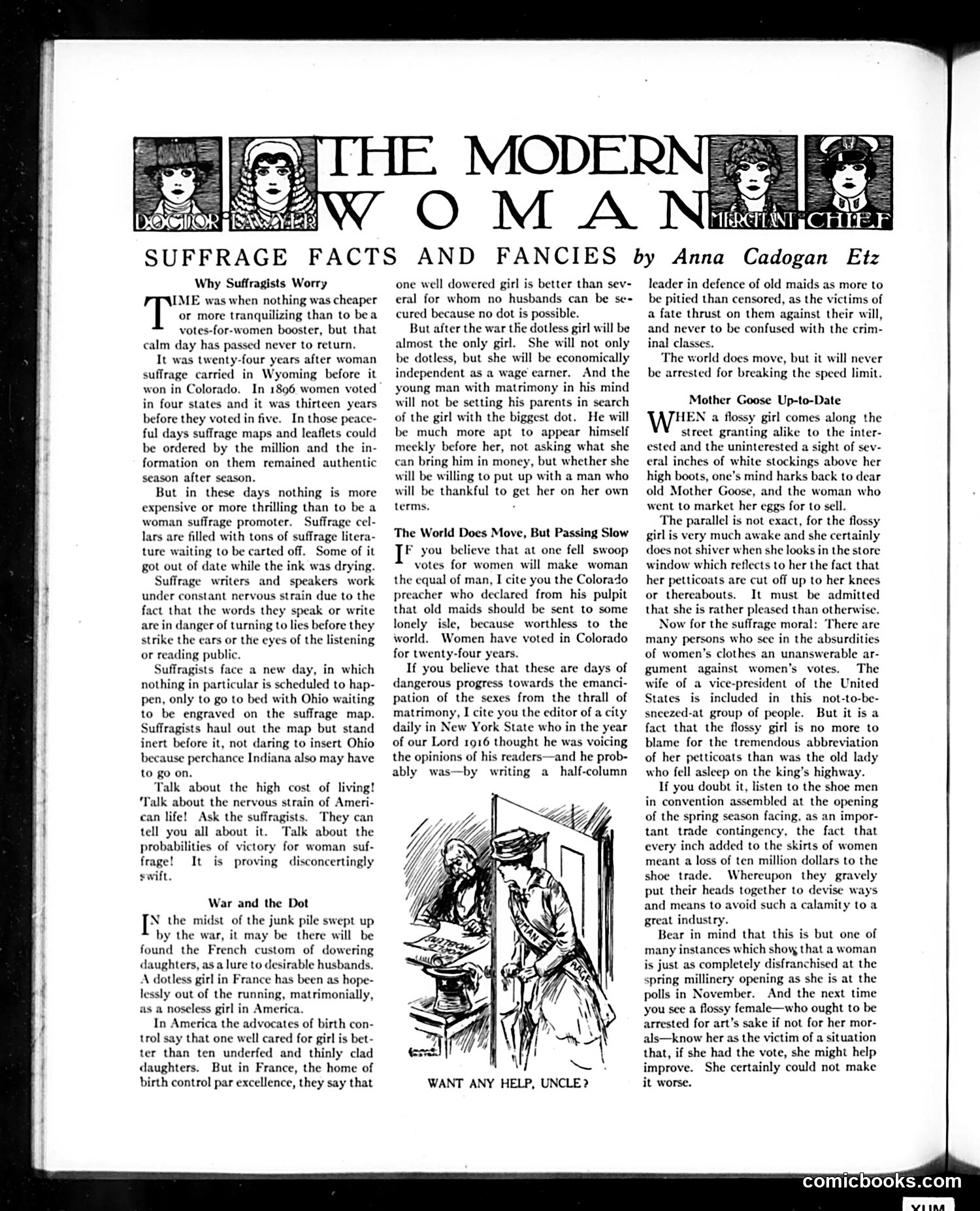
This is a satirical essay by Anna Cadogan Etz criticizing women's suffrage opponents and commenting on women's evolving roles. The article's main argument is that while suffragists celebrate incremental voting victories (Wyoming 1869, Colorado 1893, etc.), actual social progress toward gender equality remains frustratingly slow. The cartoon depicts a woman asking an elderly man "Want any help, Uncle?"—illustrating the essay's central irony: women have gained the vote, yet outdated attitudes about female worth persist. A Colorado preacher still condemns unmarried women as "worthless" despite 24 years of female suffrage. Etz mocks suffragists' exhaustion managing constantly-outdated literature and maps while states slowly adopt voting rights. She also satirizes how women's economic independence is upending traditional marriage customs (like French dowries), yet misogynist editors still publish pity-pieces about "old maids." The piece suggests voting rights alone haven't transformed underlying sexism—social change, she argues, moves glacially despite legal reform.
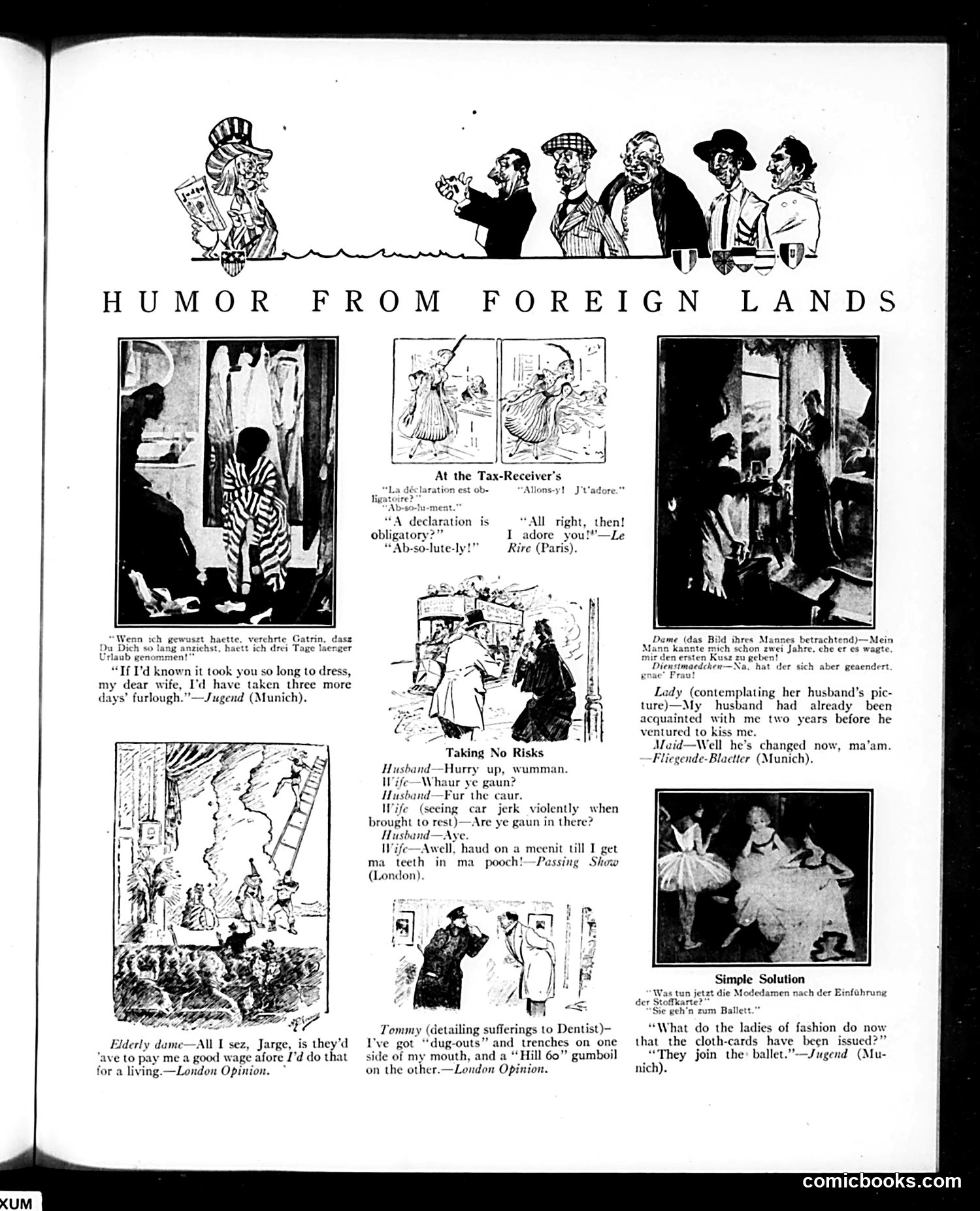
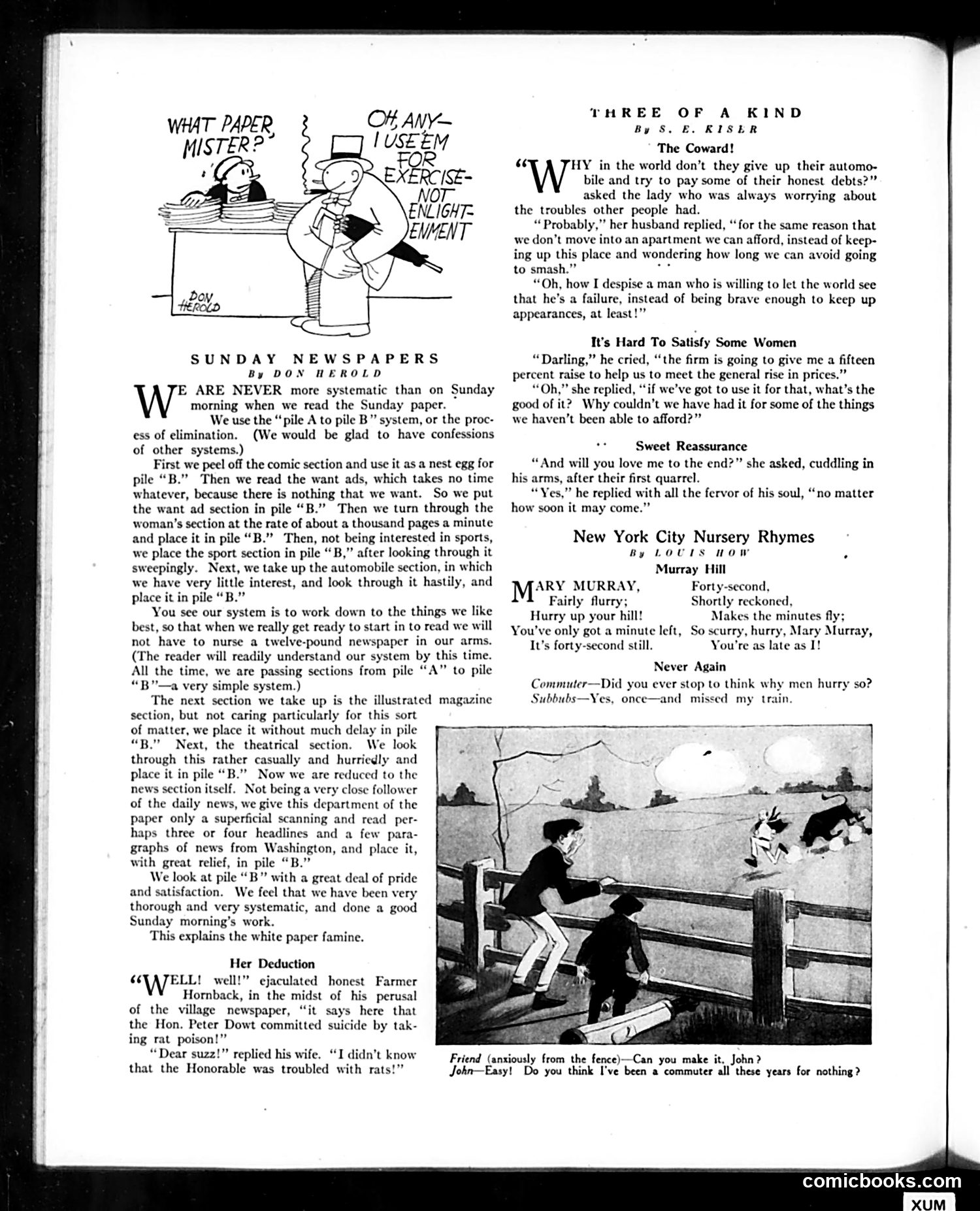
This page collects satirical comics from European publications (Munich's *Jugend*, Paris's *Le Rire*, London's *Opinion* and *Passing Show*), likely from WWI era based on references to military furloughs, trenches, and "Hill 60" (a famous WWI battle site). The jokes exploit cultural/linguistic differences and wartime conditions: a soldier complaining his wife took too long dressing during his leave; a Scottish couple's marital banter about a rickety car; a boy describing dental pain using war terminology; a wife removing her teeth before riding in a dangerous vehicle. One German cartoon references rationing ("cloth-cards"), joking that fashionable women join ballet troupes to solve wardrobe shortages. The satire targets domestic life disrupted by war, marital dynamics, and civilian adaptation to wartime restrictions—presented as amusingly quaint foreign perspectives for American readers.
This page is primarily **theatrical advertising and reviews**, not political satire. It consists of: 1. **Broadway theater advertisements** (left column): Listings for plays like "Maude Adams in Cinderella," "Jane Cowl in Lilac Time," and "The Willow Tree," typical commercial promotion for New York theaters. 2. **"In New York Theatres" review section** (right): Critical summaries of current Broadway and film productions, including live theater and motion pictures. 3. **One small cartoon** (upper left): Appears to show a figure in an oval frame, but lacks clear political or social commentary visible in this reproduction. The page reflects early 20th-century entertainment culture—note references to both stage productions and films ("motion pictures"), including titles like "The Honor System" and "Joan the Woman" with silent film star Geraldine Farrar. This is fundamentally an **entertainment/advertising page** rather than satirical political content typical of Judge magazine's core mission.
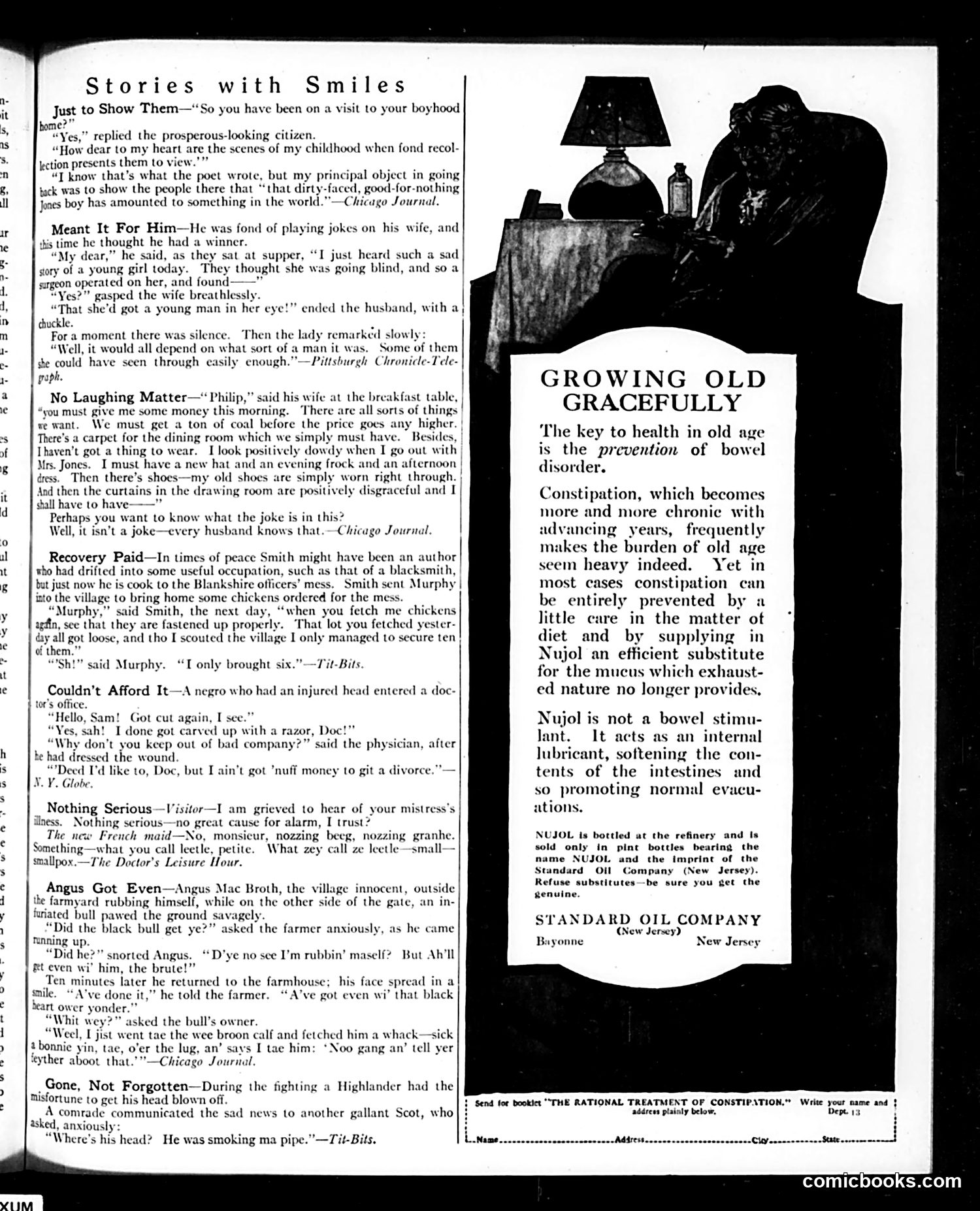
This page from Judge contains a collection of short humorous anecdotes rather than political cartoons. The jokes satirize everyday domestic and social situations: **Key sketches include:** - A man revisiting his hometown specifically to show off his success to people who knew him as a failure - A husband's joke about a girl with "a young man in her eye" backfiring when his wife delivers a cutting retort about worthless men - A wife's endless list of financial demands to her bewildered husband - Racial stereotypes in a joke about a Black man's injuries and poverty - A Scottish village simpleton getting revenge on a bull by rubbing himself with something unpleasant **The satire targets:** marital dynamics (nagging wives, henpecked husbands), class anxiety, and crude ethnic humor typical of early 20th-century American magazines. The right page advertises Nujol laxative oil, a common patent medicine cure for constipation—reflecting the era's obsession with digestive health remedies.
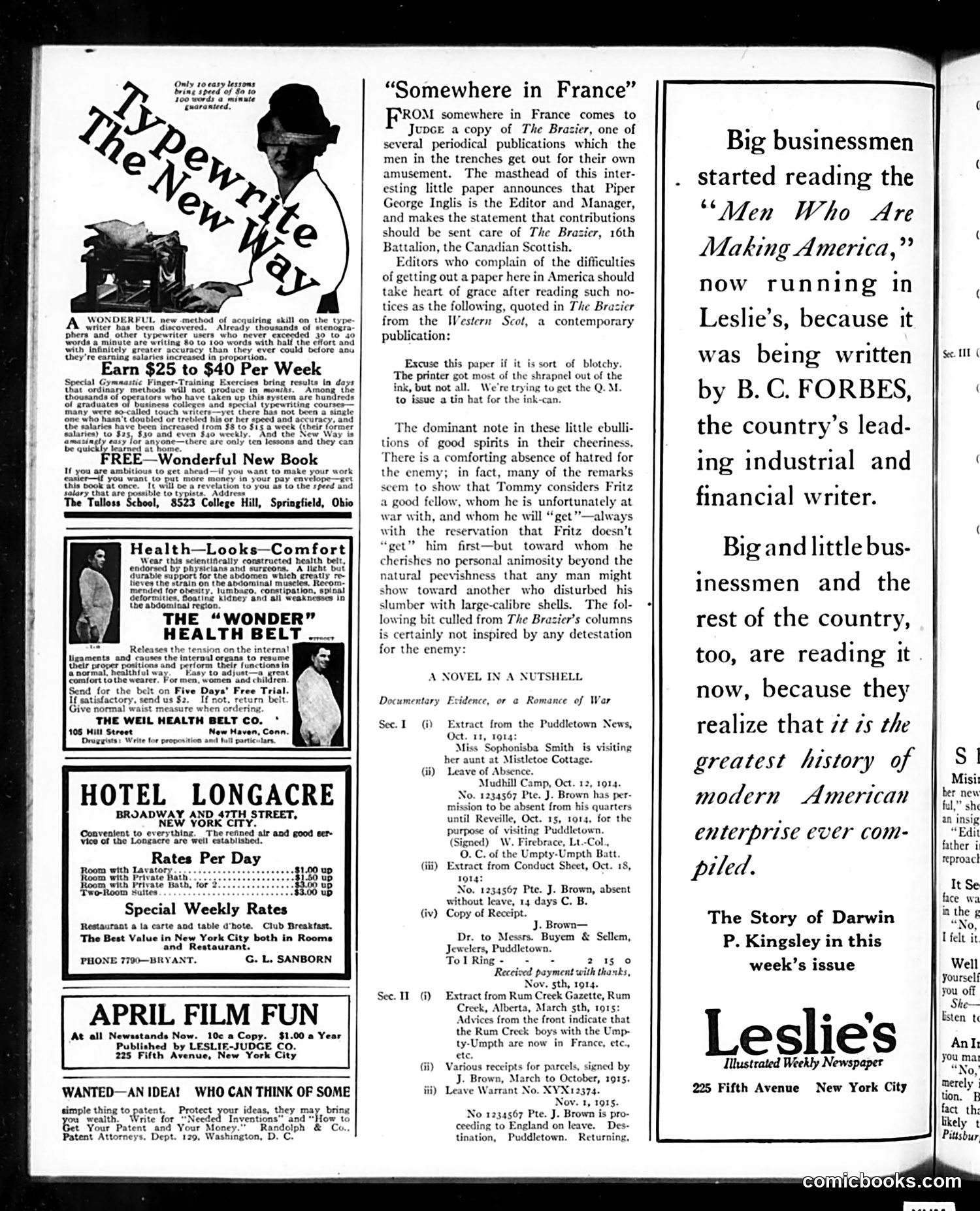
This page is primarily **advertisements and publishing news** rather than political satire or editorial cartoon content. The main editorial content discusses **The Brazier**, a trench newspaper produced by Canadian soldiers (16th Battalion, Canadian Scottish) fighting in France during World War I. The piece humorously quotes the publication's excuse for poor print quality—that shrapnel got into the printer's ink—and jokes about requesting a "tin hat" (military helmet) to protect the ink-can. The satire here is **gentle wartime humor**: it contrasts the real hardships of producing a newspaper under combat conditions with American editors' complaints about difficulties in peacetime publishing. The implicit message is that American publishers should stop complaining about trivial problems. The rest of the page consists of period advertisements for typing courses, health belts, a hotel, and patent services—typical of early-20th-century magazine advertising.
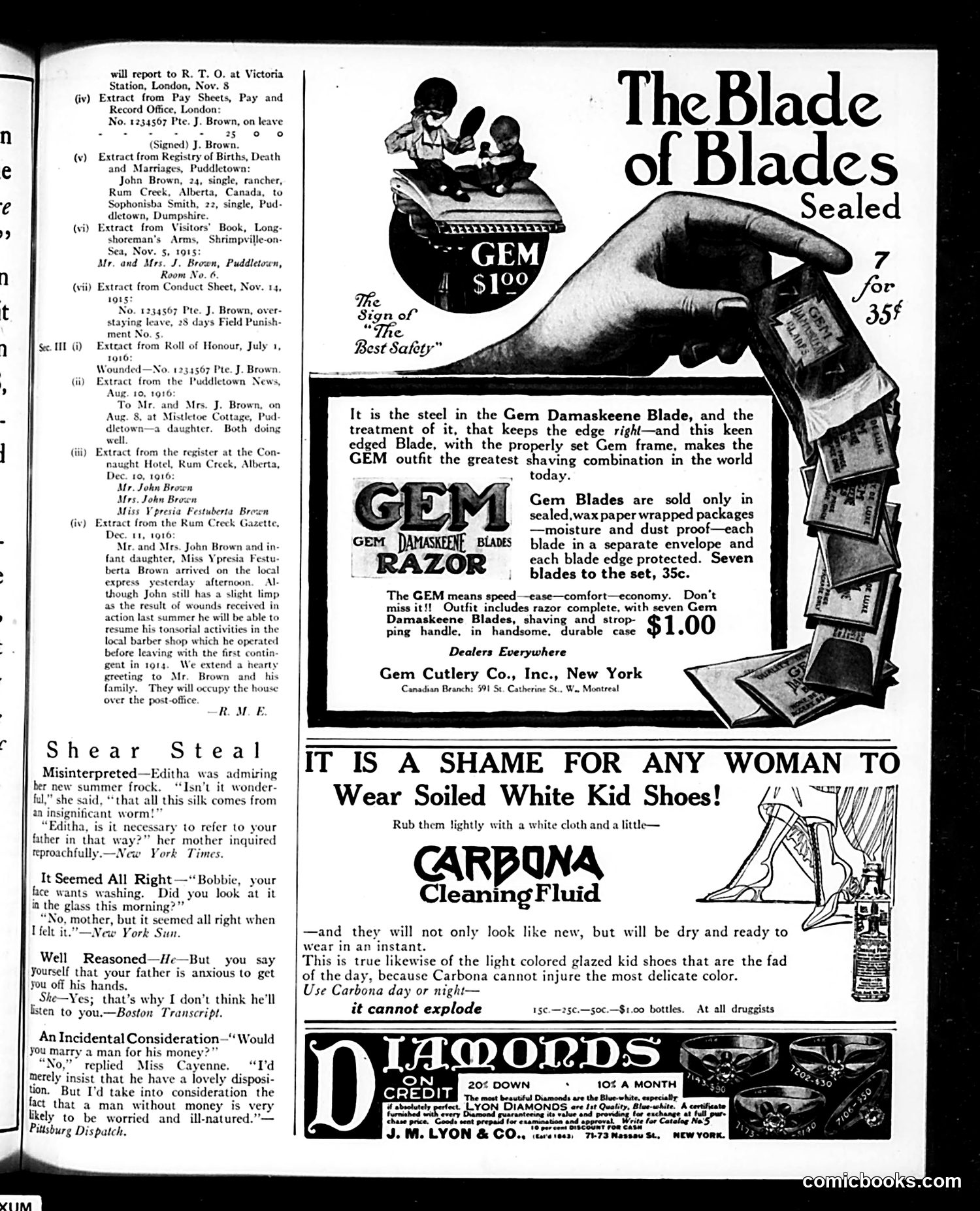
This page is primarily **advertising**, featuring three major commercial campaigns typical of the 1910s era. **Main advertisements:** 1. **Gem Damaskeene Razor Blades** (top half) — promotes sealed, individually-wrapped razor blades as superior to competitors, emphasizing hygiene and durability. The price point ($1.00 for a complete outfit, 35¢ for blades) and marketing language ("speed—ease—comfort—economy") reflects early 20th-century consumer culture. 2. **Carbona Cleaning Fluid** (center) — addressing women directly, the ad claims the product safely cleans white kid shoes without damage or explosion risk. The phrasing "It is a shame for any woman" to wear soiled shoes reflects period attitudes about feminine appearance standards and household management. 3. **Diamonds on Credit** (bottom) — J.M. Lyon & Co. offers jewelry purchase plans ($0.20 down, $0.10 monthly). **Editorial content** includes brief humor columns ("Shear Steal," "It Seemed All Right") and what appears to be military service documentation for a soldier named J. Brown—likely satirizing bureaucratic record-keeping during WWI. The page reflects 1910s consumer aspirations and gender roles.
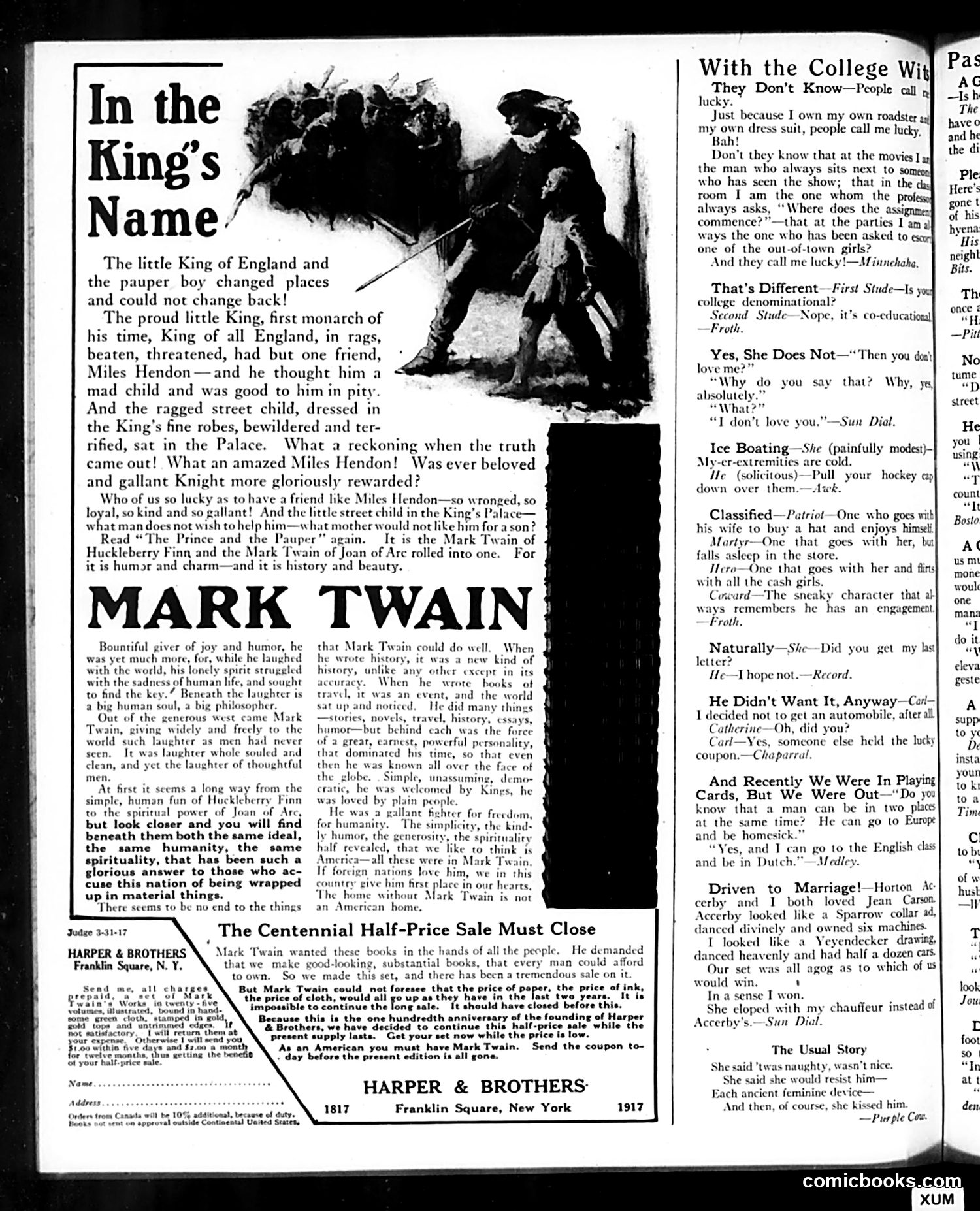
This page celebrates Mark Twain through text and illustration, commemorating the centennial of Harper & Brothers' founding. The main cartoon (top left) depicts a scene from Twain's famous novel "The Prince and the Pauper"—showing a ragged street child and a young king who have exchanged places and cannot switch back. The image illustrates the story's central premise of social role-reversal. The accompanying essay praises Twain as a writer who combined humor with serious moral purpose. It emphasizes that beneath his comedy lay profound insights into human nature, spirituality, and social justice. The piece contrasts Twain's "laughter" with his deeper purpose: he "wrote history" and championed freedom and democracy. The advertisement below announces a half-price sale on Twain's collected works, framed as a centennial promotion. Harper & Brothers argues that making quality literature affordable serves democracy—"every man could afford" complete sets. For modern readers: this reflects how 1917 America venerated Twain as both entertainer and moral philosopher, using his work to promote literacy and democratic values.
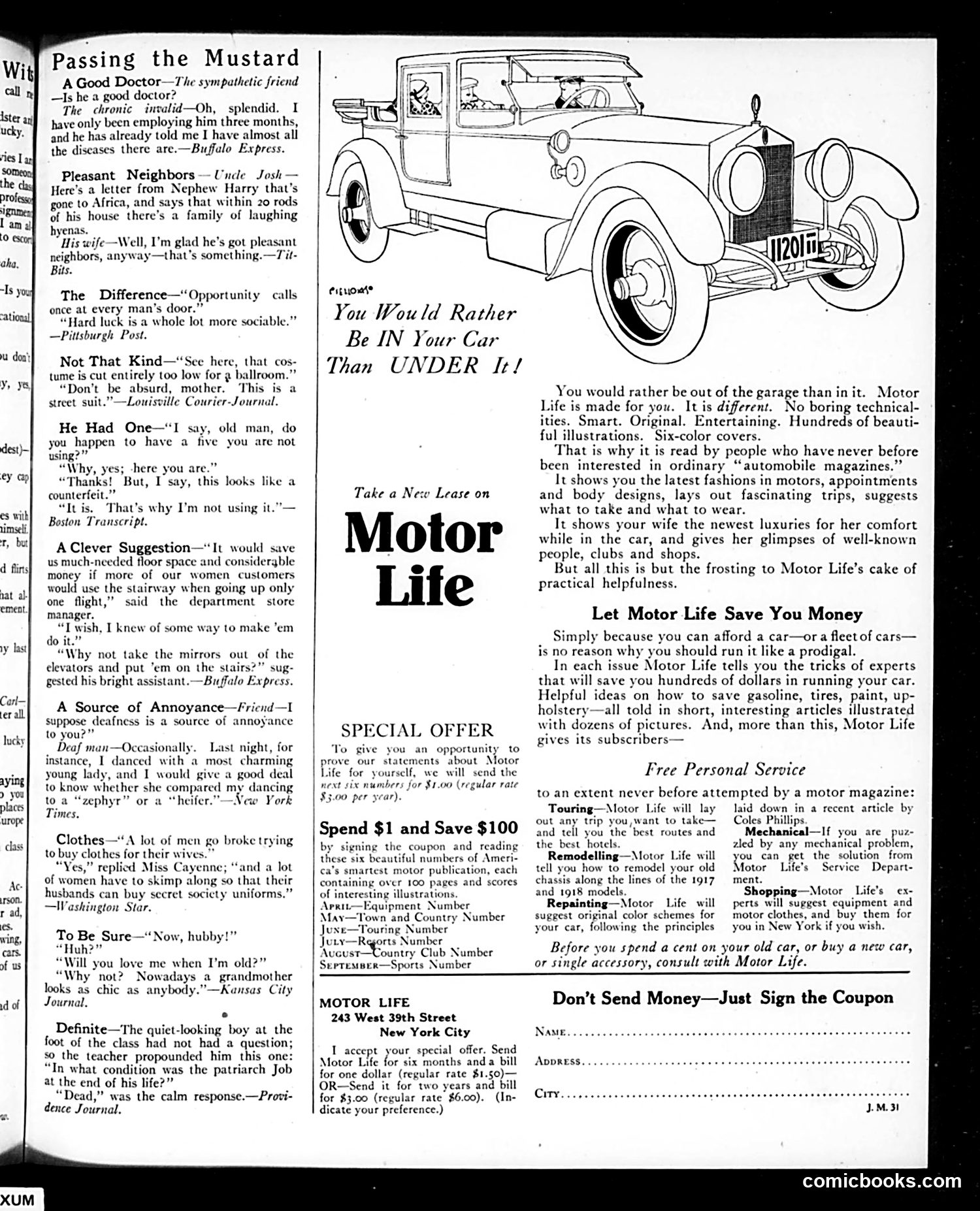
This page is primarily **advertising for Motor Life magazine**, with small humorous anecdotes ("Passing the Mustard" section) filling the left column. The main cartoon shows two automobiles—a modest family car and a sleek racing vehicle—with the tagline "You Would Rather Be IN Your Car Than UNDER It!" This references the early 1900s danger of automobile ownership: mechanical failures, accidents, and breakdowns were common hazards. The joke contrasts enjoying a car's features versus being trapped beneath a broken-down vehicle for repairs. The Motor Life advertisement positions itself as a non-technical, entertaining publication for general readers—particularly women—rather than mechanical enthusiasts. This reflects a cultural shift when automobiles were transitioning from novelty to consumer product. The brief anecdotes are genteel period humor: a hypochondriac praising a doctor for confirming diseases, marital exchanges about aging and spending, and workplace observations. They're typical Judge magazine "filler" content—wholesome, middle-class oriented satire with no particular political message.
This is primarily a magazine title page and advertising section from Judge, dated 1917, rather than a political cartoon. The content includes advertisements for alcohol-related products (Club Cocktails, Sunny Brook Whiskey, Abbott's Bitters)—notable given this was published during Prohibition's approach. It announces Judge's next issue will emphasize being "The Happy Medium" with a cover titled "Kiss and Make-up" by illustrator James Montgomery Flagg, featuring contributions from named cartoonists and writers. The right side advertises Film Fun magazine, promoting access to actresses "behind the smile" through informal stories and photographs. This appears to be a cross-promotion between sister publications. No specific political figures or satire are evident on this page. It's primarily a house advertisement showcasing the magazine's upcoming content and related products.
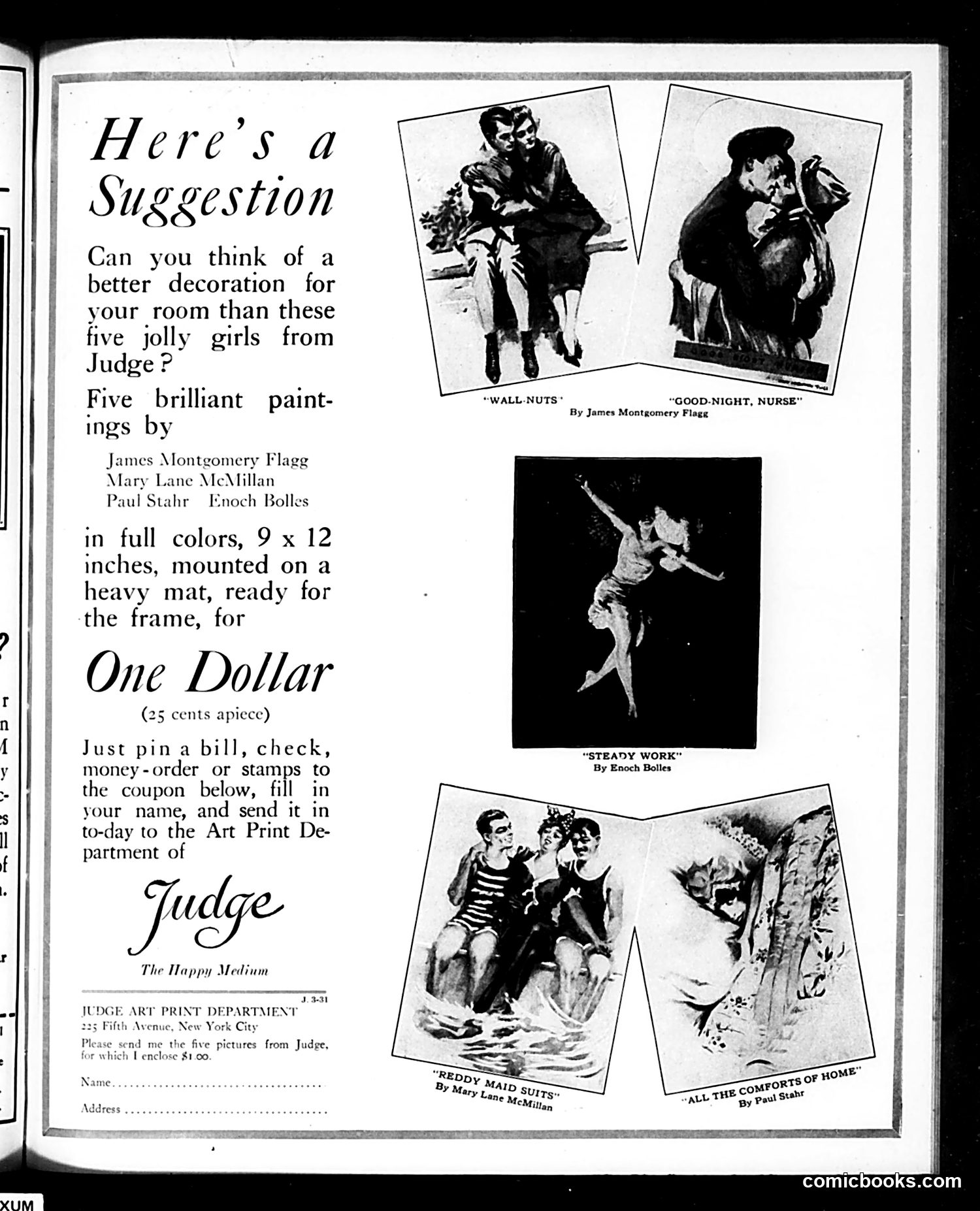
This page is primarily a **commercial advertisement** for framed art prints, not satire. Judge magazine is selling five paintings by prominent illustrators (Flagg, McMillan, Stahr, and Bolles) featuring young women in various poses and scenarios—"Wall-Nuts," "Good-Night, Nurse," "Steady Work," "Reddy Maid Suits," and "All the Comforts of Home." The paintings depict conventionally attractive women in domestic, flirtatious, or leisure situations typical of 1920s-era pin-up style illustration. The "joke" in the headline—asking if readers can imagine better room decoration—is a light sales pitch suggesting these images would appeal to male consumers as wall art. This reflects the era's entertainment marketing rather than political satire; it's essentially vintage merchandise advertising.
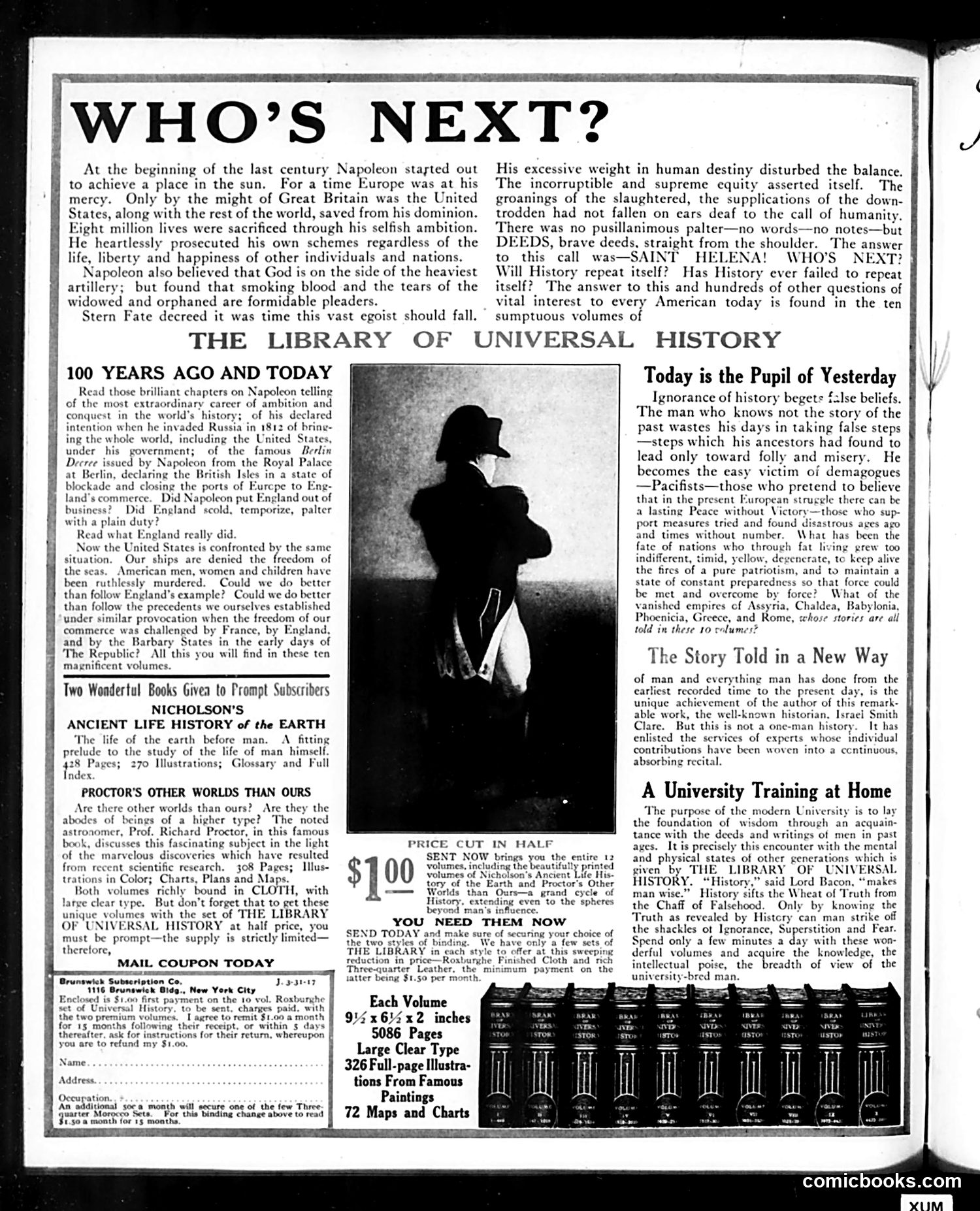
This page uses Napoleon's fall as a historical warning relevant to contemporary (likely WWI-era) politics. The silhouette image depicts Napoleon in exile—his defeat presented as inevitable justice for imperial ambition that cost eight million lives. The text draws a direct parallel: just as Napoleon threatened global dominance and Britain stopped him, a modern power (context suggests Germany, given references to commerce blockades and attacks on American ships) now threatens similar domination. The rhetorical question "Who's Next?" implies America faces a choice: follow Britain's precedent of forceful resistance or risk repeating history's mistakes through pacifism. The advertisement for "The Library of Universal History" frames this as educational urgency—Americans must study history to avoid repeating it. The piece argues that ignorance of history breeds false beliefs and folly, positioning the encyclopedia set as essential knowledge for citizens facing contemporary decisions about military intervention.