
Judge, 1917-03-31 · page 4 of 28
Judge — March 31, 1917 — page 4: what you’re looking at
What you’re looking at
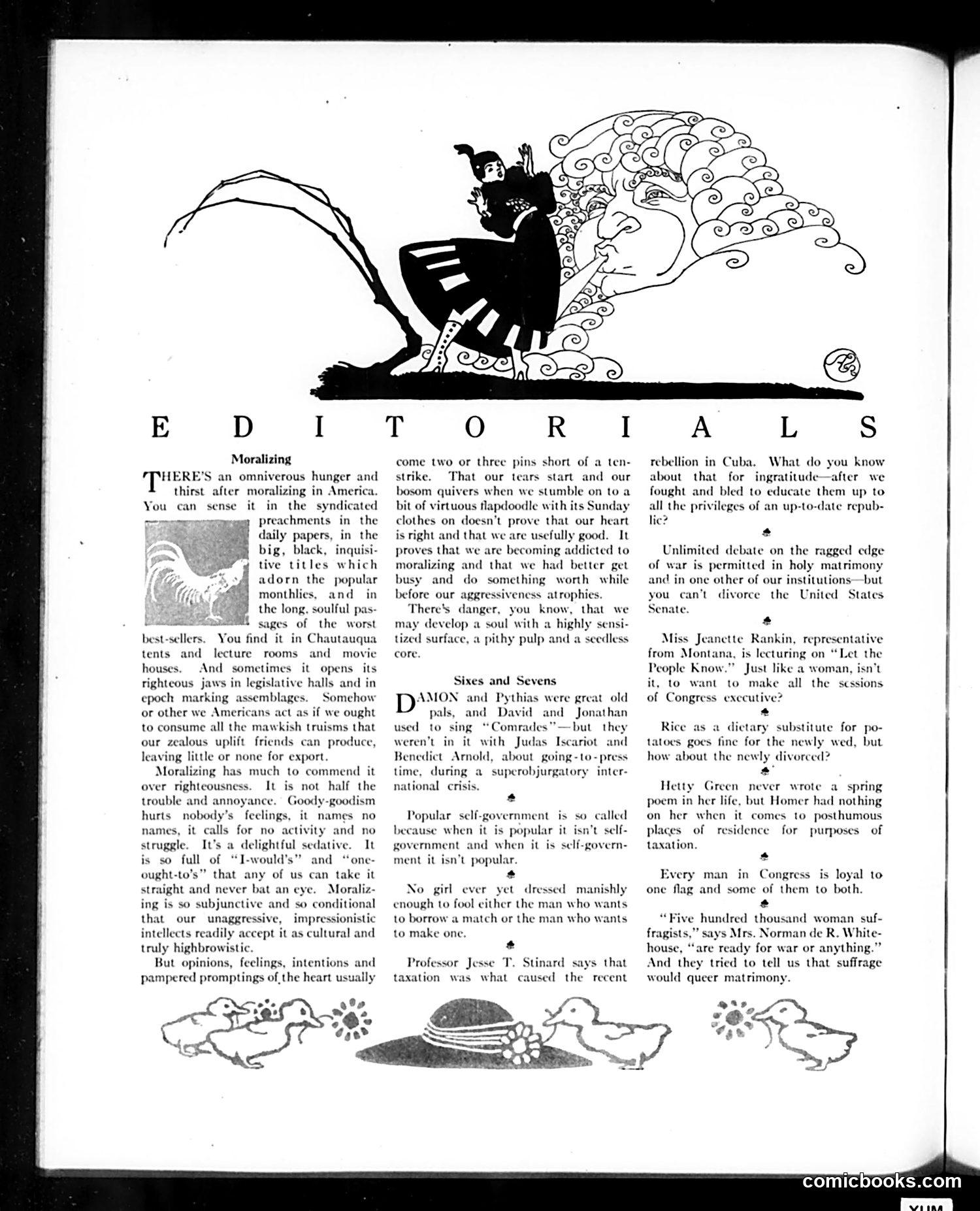
The main cartoon depicts a figure riding what appears to be a large rooster or bird, with elaborate decorative plumage. This likely represents American political boasting or aggressive posturing, given the prominent decorative display—a visual metaphor for puffed-up national pride. The editorial text below addresses American moralizing and self-righteousness. It critiques the nation's tendency to lecture others (particularly referencing Cuba's rebellion) while ignoring domestic problems. The piece mocks American moral superiority and calls out hypocrisy regarding taxation, divorce law, and women's suffrage debates. The satirical commentary suggests Judge was challenging American exceptionalism and the gap between stated values and actual conduct—a common Progressive Era critique of national policy.
📄 Transcribed text from this page (OCR, searchable)
Machine-transcribed from the original scan — historical spelling and the odd misread are preserved.
E D Moralizing HHERE’S an omniverous hunger and thirst after moralizing in America. You can sense it in the syndicated preachments in the daily papers, in the big, black, inquisi- tive titles which adorn the popular monthlies, and in the long, soulful pas- sages of the worst best-sellers. You find it in Chautauqua tents and lecture rooms and movie houses. And sometimes it opens its righteous jaws in legislative halls and in epoch marking assemblages. Somehow or other we Americans act as if we ought to consume all the mawkish truisms that our zealous uplift friends can produce, leaving little or none for export. Moralizing has much to commend it over righteousness. It is not half the trouble and annoyance. Goody-goodism hurts nobody’s feelings, it names no names, it calls for no activity and no struggle. It’s a delightful sedative. It is so full of “I-would’s” and ‘“‘one- ought-to’s” that any of us can take it straight and never bat an eye. Moraliz- ing is so subjunctive and so conditional that our unaggressive, impressionistic intellects readily accept it as cultural and truly highbrowistic. But opinions, feelings, intentions and pampered promptings of the heart usually — Sas a 7 oq a ri | a 4 o I come two or three pins short of a ten- strike. That our tears start and our bosom quivers when we stumble on to a bit of virtuous flapdoodle with its Sunday clothes on doesn’t prove that our heart is right and that we are usefully good. It proves that we are becoming addicted to moralizing and that we had better get busy and do something worth while before our aggressiveness at rophies. There's danger, you know, that we may develop a soul with a highly sensi- tized surface, a pithy pulp and a seedles core, Sixes and Sevens D*0*8 and Pythias were great old pal nd David and Jonathan used to sing “Comrades”—but they weren't in it with Judas Iscariot and Benedict Arnold, about going-to-press time, during a superobjurgatory inter- national crisis. * Popular self-government is so called because when it is popular it isn’t self- government and when it is self-govern- ment it isn’t popular. 2 No girl ever yet dressed) manishly enough to fool either the man who wants. to borrow a match or the man who wants to make one. ¢ Professor Jesse T. taxation what Stinard says that was caused the recent L rebellion in Cuba. What do you know about that for ingratitude—after we fought and bled to educate them up to all the privileges of an up-to-date repub- lic? s Unlimited debate on the ragged edge of war is permitted in holy matrimony and in one other of our institutions—but you can’t divorce the United States Senate. s Miss Jeanette Rankin, representative from Montana, is lecturing on “Let the People Know.” Just like a woman, isn’t it, to want to make all the of Congress executive? * Rice as a dietary substitute for po- tatoes goes fine for the newly wed, but how about the newly divorced? - Hetty Green never wrote a spring poem in her life, but Homer had nothing on her when it comes to posthumous places of residence for purposes of taxation. sessions Every man in Congress is loyal to one flag and some of them to both. ¢ ‘¢ hundred thousand woman suf- fragists,” says Mrs. Norman de R. White- house, “are ready for war or anything.” And they tried to tell us that suffrage would queer matrimony. comicbooks.com