
Judge, 1917-03-31 · page 17 of 28
Judge — March 31, 1917 — page 17: what you’re looking at
What you’re looking at
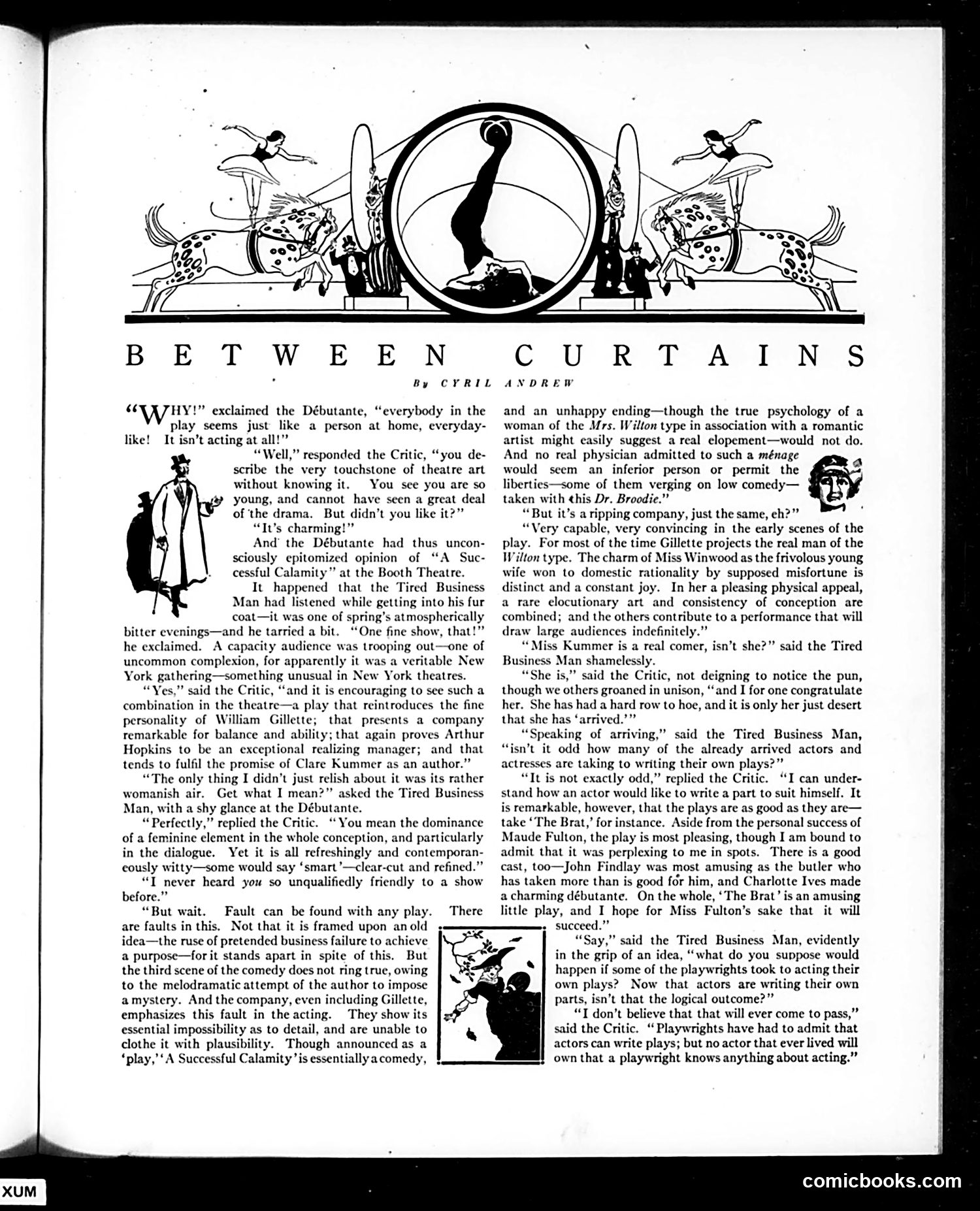
This theater criticism column by Cyril Andrew reviews "A Successful Calamity" at the Booth Theatre, featuring actor William Gillette. The piece uses dialogue between a Débutante (young society woman), a Critic, and a Tired Business Man to discuss the play's merits and flaws. The satire targets theatrical pretension: the Débutante unknowingly defines great theater by saying actors seem like "everyday" people—praised as profound insight. The Critic praises the production's contemporary wit and Gillette's performance, but faults a melodramatic third-act mystery scene as implausible. The humor relies on the Tired Business Man's vernacular contrasting with the Critic's refined vocabulary, and his shameless compliment of actress "Miss Kummer" (likely Clare Kummer, the playwright). The piece satirizes both theater criticism's pomposity and ordinary theatergoers' perspectives on "realism" in drama.
📄 Transcribed text from this page (OCR, searchable)
Machine-transcribed from the original scan — historical spelling and the odd misread are preserved.
BETWEEN By CYRIL “ HY!” exclaimed the Débutante, “everybody in the play seems just like a person at home, everyday- It isn’t acting at all!” “Well,” responded the Critic, “you de- scribe the very touchstone of theatre art without knowing it. You see you are so young, and cannot have seen a great deal of ‘the drama. But didn’t you like it?” “It’s charming!” And’ the Débutante had thus uncon- sciously epitomized opinion of “A Suc- cessful Calamity” at the Booth Theatre. It happened that the Tired Business Man had listened while getting into hi coat—it was one of spring’s atmospherically bitter evenings—and he tarried a bit. ‘One fine show, that!”” he exclaimed. A capacity audience was trooping out—one of uncommon complexion, for apparently it was a veritable New York gathering—something unusual in New York theatres. “Yes,” said the Critic, “and it is encouraging to see such a combination in the theatre—a play that reintroduces the fine personality of William Gillette; that presents a company remarkable for balance and ability; that again proves Arthur Hopkins to be an exceptional realizing manager; and that tends to fulfil the promise of Clare Kumme an author.” “The only thing I didn’t just relish about it was its rather womanish air. Get what I mean?” asked the Tired Business Man, with a shy glance at the Débutante. “Perfectly,” replied the Critic. ‘You mean the dominance of a feminine element in the whole conception, and particularly in the dialogue. Yet it is all refreshingly and contemporan- cously witty—some would say ‘smart’—clear-cut and refined.” “TI never heard you so unqualifiedly friendly to a show before.” “But wait. Fault can be found with any play. are faults in this. Not that it is framed upon an old idea—the ruse of pretended business failure to achieve a purpose—for it stands apart in spite of this. But the third scene of the comedy does not ring true, owing to the melodramatic attempt of the author to impose amystery. And the company, even including Gillette, emphasizes this fault in the acting. They show its essential impossibility as to detail, and are unable to clothe it with plausibility. Though announced as a ‘play,’‘A Successful Calamity’ is essentiallyacomedy, §, like! There CU ®R © AMY Nes ANDREW and an unhappy ending—though the true psychology of a woman of the Mrs. Wilton type in association with a romantic artist might easily suggest a real elopement—would not do. And no real physician admitted to such a ménage would seem an inferior person or permit the $ liberties—some of them verging on low comedy— taken with this Dr. Broodie.” “But it’s a ripping company, just the same, ch?” “Very capable, very convincing in the early scenes of the play. For most of the time Gillette projects the real man of the Wilton type. The charm of Miss Winwood as the frivolous young wife won to domestic rationality by supposed misfortune is distinct and a constant joy. In her a pleasing physical appeal, a rare elocutionary art and consistency of conception are combined; and the others contribute to a performance that will draw large audiences indefinitely.” “Miss Kummer is a real comer, isn’t she?” said the Tired Business Man shamelessly. “She is,” said the Critic, not deigning to notice the pun, though we others groaned in unison, “and I for one congratulate her. She has had a hard row to hoe, and it is only her just desert that she has ‘arrived.’” “Speaking of arriving,” said the Tired Business Man, “isn’t it odd how many of the already arrived actors and actresses are taking to writing their own plays?” “It is not exactly odd,” replied the Critic. “I can under- stand how an actor would like to write a part to suit himself. It is remarkable, however, that the plays are as good as they are— take ‘The Brat,’ for instance. Aside from the personal success of Maude Fulton, the play is most pleasing, though I am bound to admit that it was perplexing to me in spots. There is a good cast, too—John Findlay was most amusing as the butler who has taken more than is good for him, and Charlotte Ives made a charming débutante. On the whole, ‘The Brat’ is an amusing little play, and I hope for Miss Fulton’s sake that it will - succeed.” “Say,” said the Tired Business Man, evidently in the grip of an idea, “what do you suppose would happen if some of the playwrights took to acting their own plays? Now that actors are writing their own parts, isn’t that the logical outcome?” “T don’t believe that that will ever come to pass,” said the Critic. “Playwrights have had to admit that actors can write plays; but no actor that ever lived will own that a playwright knows anything about acting.” comicbooks.com