
A complete issue · 36 pages · 1916
Judge — December 2, 1916
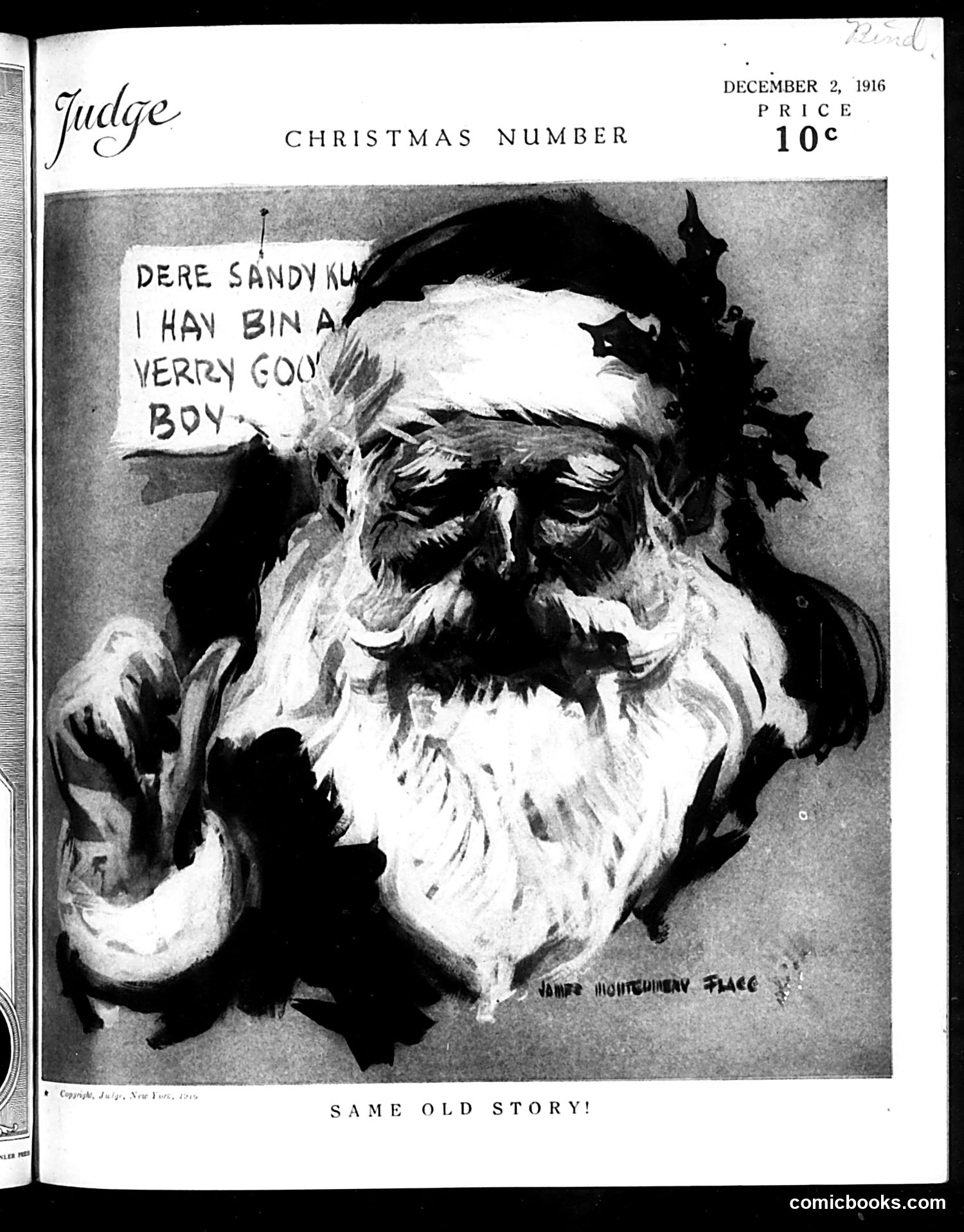
This is the cover of Judge's Christmas 1916 issue, featuring Santa Claus with a speech bubble reading "DERE SANDY KLAUS I HAV BIN A VERRY GOOD BOY." The caption reads "SAME OLD STORY!" The cartoon presents a cynical take on Christmas wishes and childhood innocence. The intentionally misspelled, childlike text in the speech bubble contrasts with what appears to be a somewhat weary or skeptical Santa figure. The "Same Old Story" caption suggests this is a recurring theme—children making claims of good behavior they may not fully deserve, or perhaps the predictable nature of Christmas appeals. The artwork is credited to James Montgomery Flagg, a prominent American illustrator of the era. The satire likely reflects period attitudes toward commercialism and childhood behavior around the holidays.
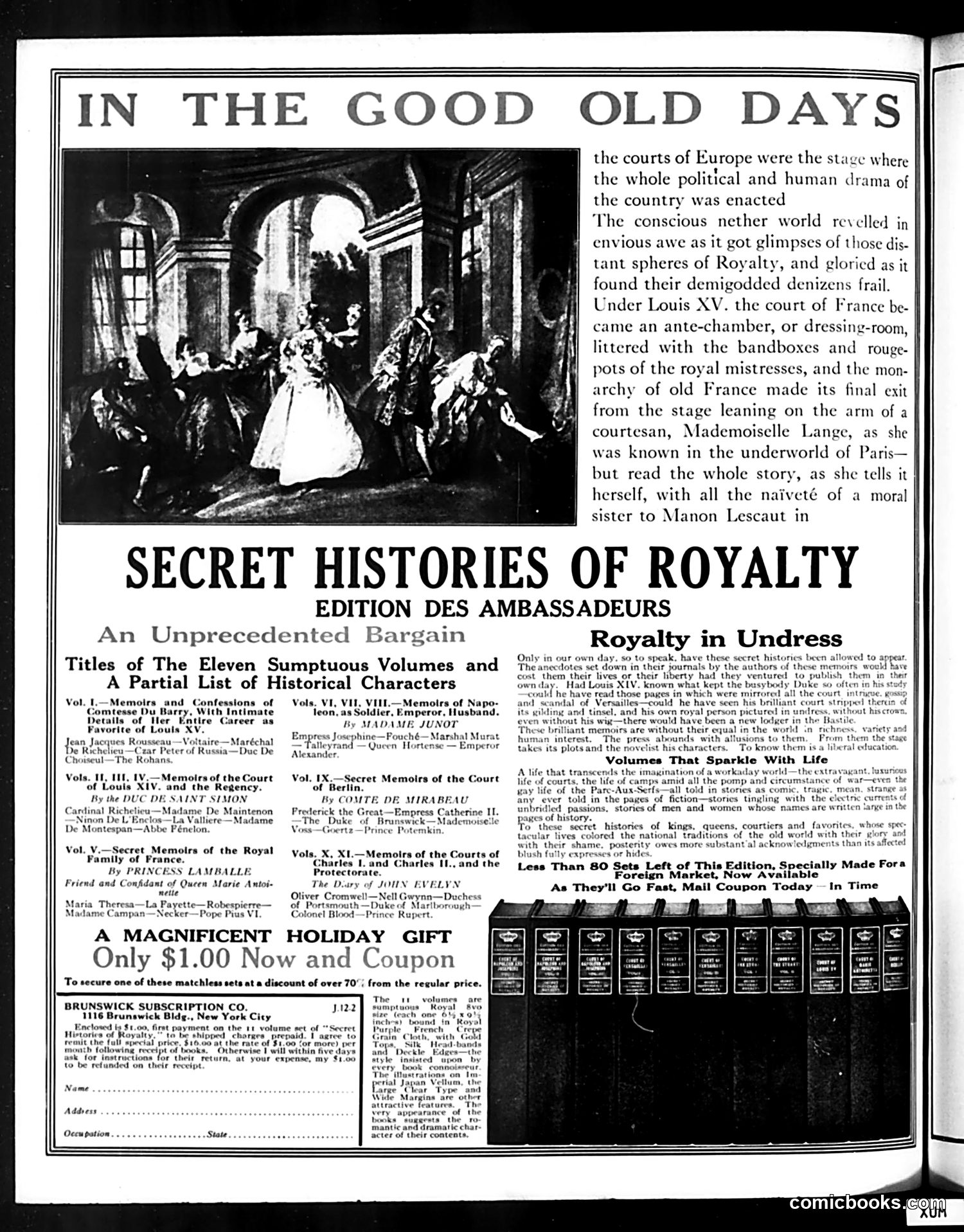
This page is primarily **advertising, not satire or political commentary**. The dominant content is a multi-volume book set advertisement for "Secret Histories of Royalty: Edition des Ambassadeurs," marketed as exposés of European court scandals and royal misdeeds. The engraving shows an 18th-century court scene, likely depicting the decadence being promised in the books. The text explicitly mentions **Mademoiselle Lange** and references **Louis XV's court in France**, positioning these volumes as revealing "secret" accounts of royal scandals, affairs, and corruption. The advertisement emphasizes these are "without equal in the world of romance and historic incident." The offer—$1.00 for eleven volumes—is presented as an exceptional bargain, targeting readers interested in sensational historical gossip about European royalty. This is essentially a mail-order book club pitch, not political satire.
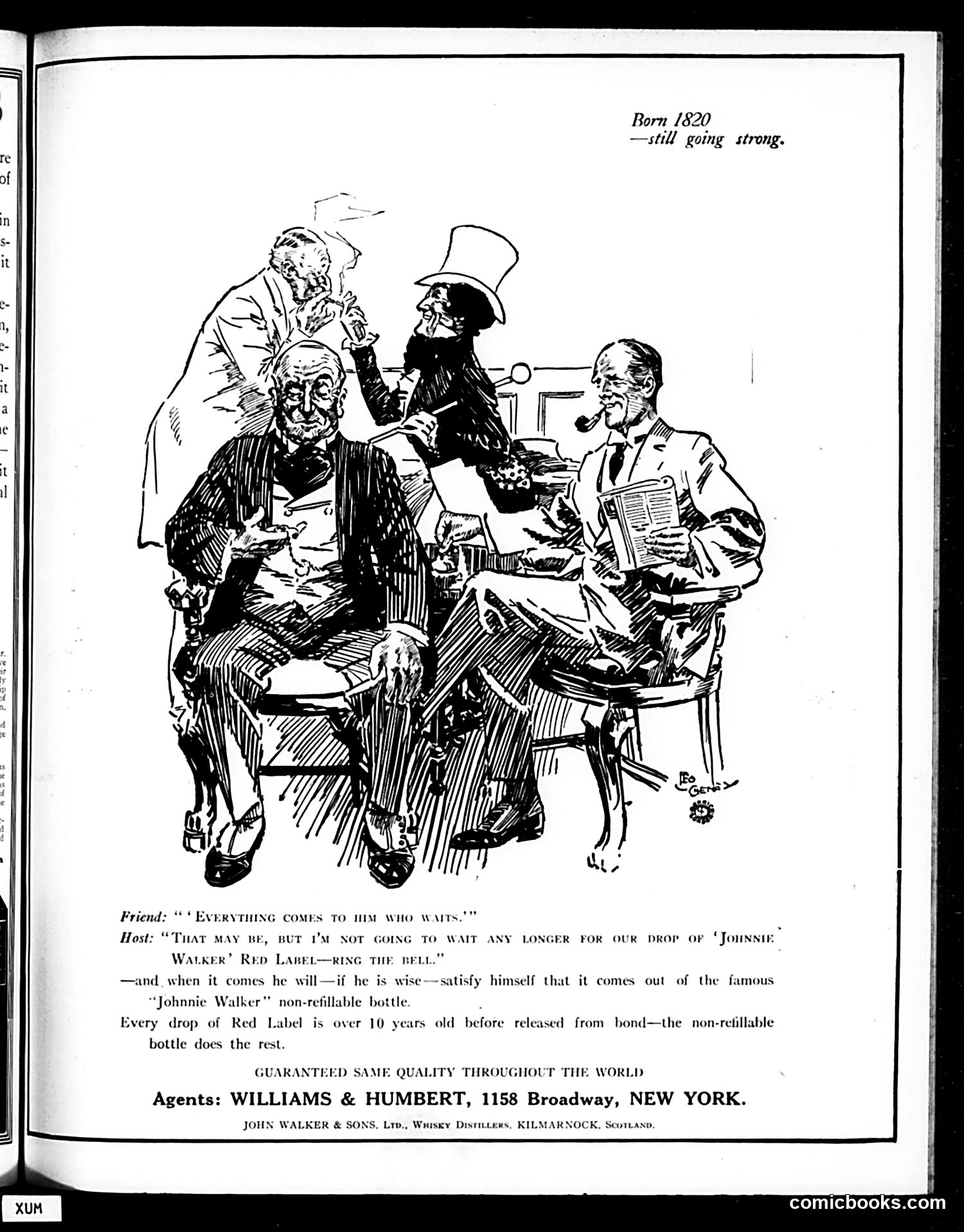
This is primarily a **whiskey advertisement**, not political satire. The 1820 birth date and "still going strong" header suggest this ad celebrates Johnnie Walker's longevity as a brand. The cartoon depicts four men in conversation. A host dismisses a friend's patience-related proverb ("Everything comes to him who waits"), insisting he won't wait for Johnnie Walker Red Label whisky—he'll "ring the bell" immediately for it instead. The advertisement emphasizes that every bottle of Red Label ages over 10 years before release, suggesting quality through patience and time. The copy stresses "guaranteed same quality throughout the world," with agents listed as Williams & Humbert in New York. This is straightforward product marketing using humor and social situations to promote the whiskey's established reputation.
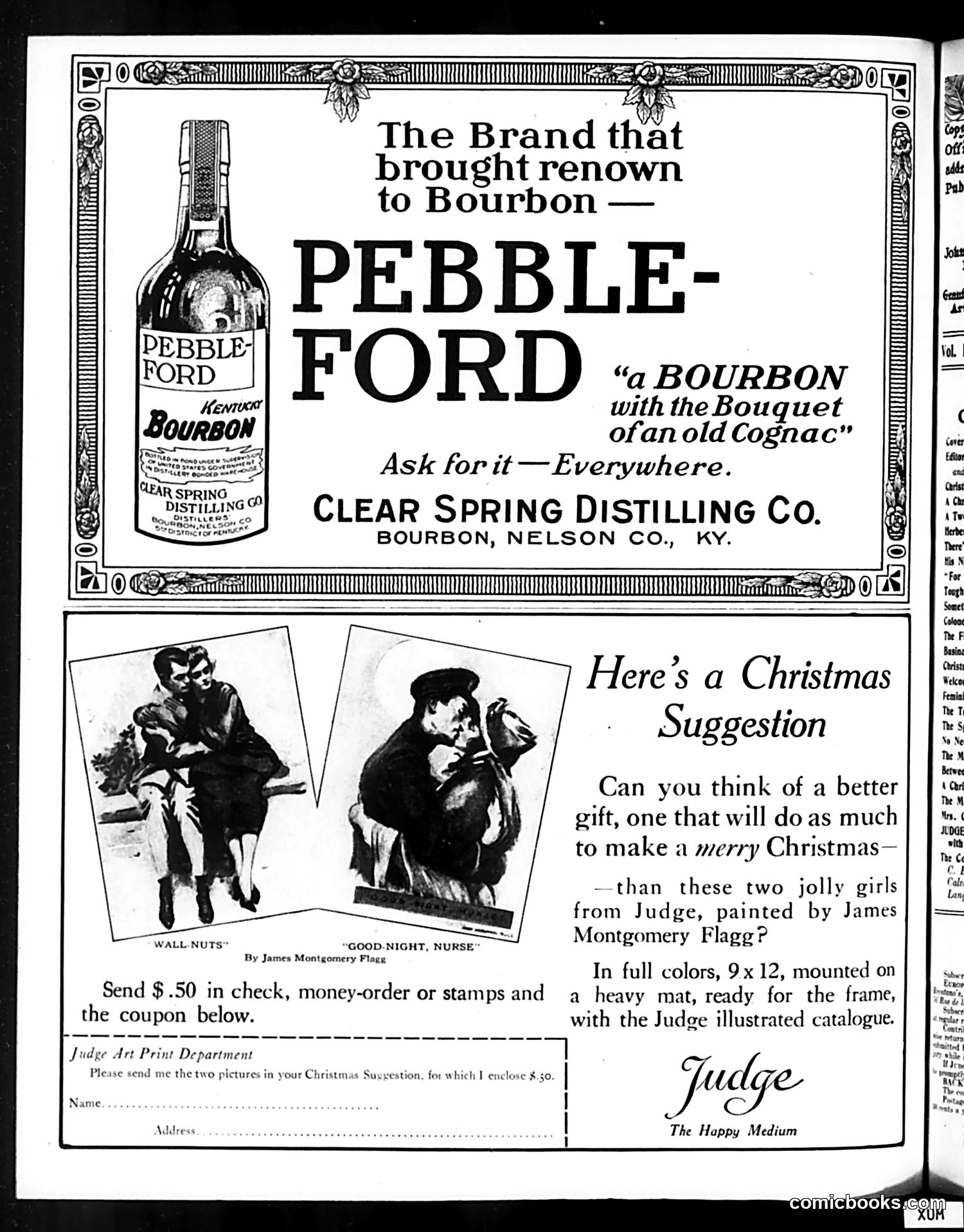
This page is primarily **advertising**, not satire. The top half features a Pebbleford Kentucky Bourbon ad from Clear Spring Distilling Co. in Nelson County, Kentucky—marketing their product as "a bourbon with the bouquet of an old Cognac." The bottom half advertises Judge magazine's art print department, offering two Christmas gift prints by artist James Montgomery Flagg: "Wall-Nuts" and "Good Night, Nurse." Both appear to depict women in domestic or caretaking scenarios. Customers could purchase these 9x12 mounted prints for 50 cents. There is **no political satire** on this page—just period commercial advertising typical of early 20th-century magazine content.
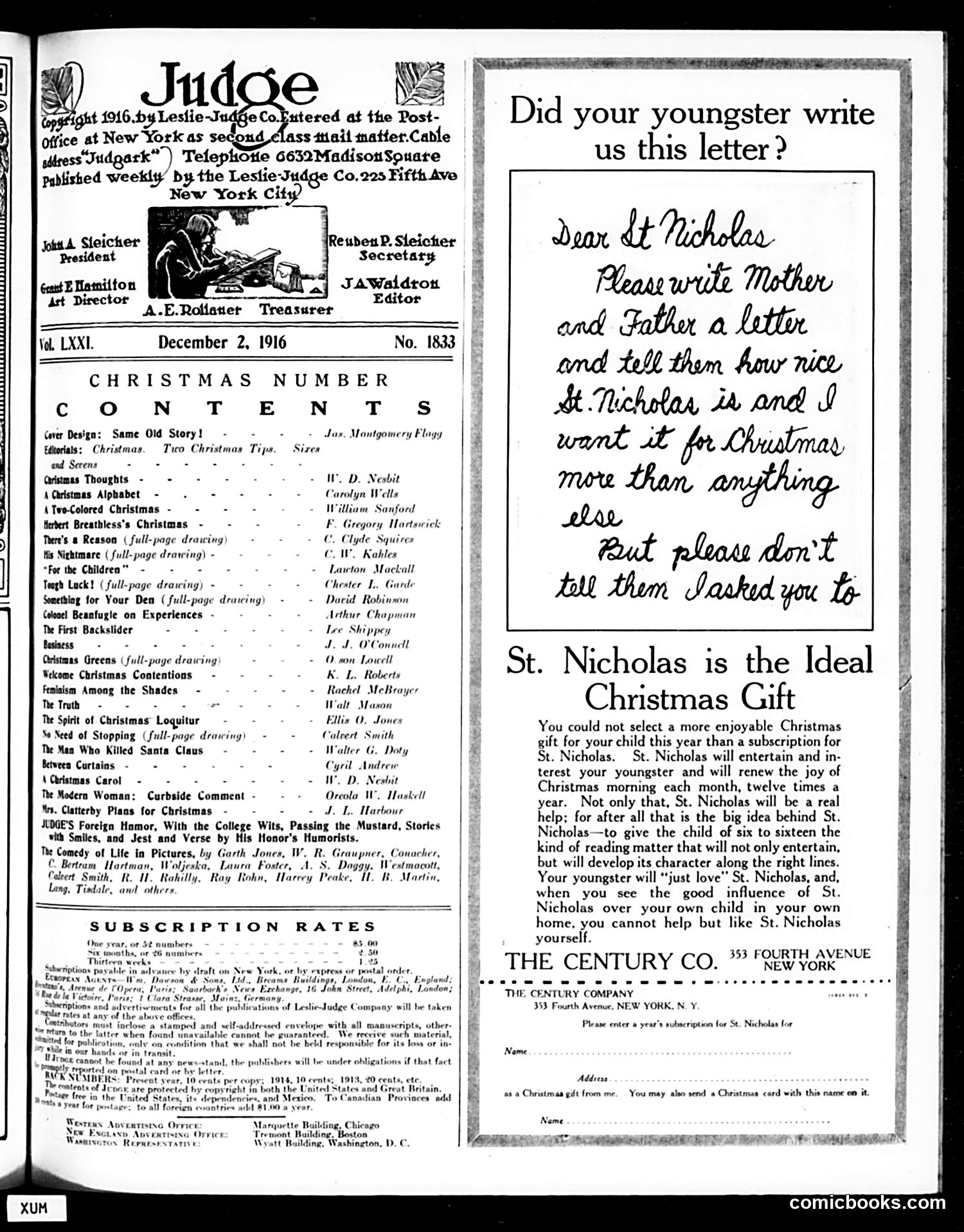
This page is primarily **advertising and editorial content** rather than political satire. The left side shows Judge magazine's masthead and table of contents for a Christmas number (December 2, 1916), listing various holiday-themed articles and illustrations. The right side features a **St. Nicholas subscription advertisement** by The Century Co. It includes a handwritten letter from a child asking parents to give a St. Nicholas magazine subscription as a Christmas gift, claiming "St. Nicholas is the Ideal Christmas Gift." The ad emphasizes the magazine's educational and character-building value for children. There is **no political cartoon or satire present** on this visible page—it consists of routine magazine promotion typical of early 20th-century publications.
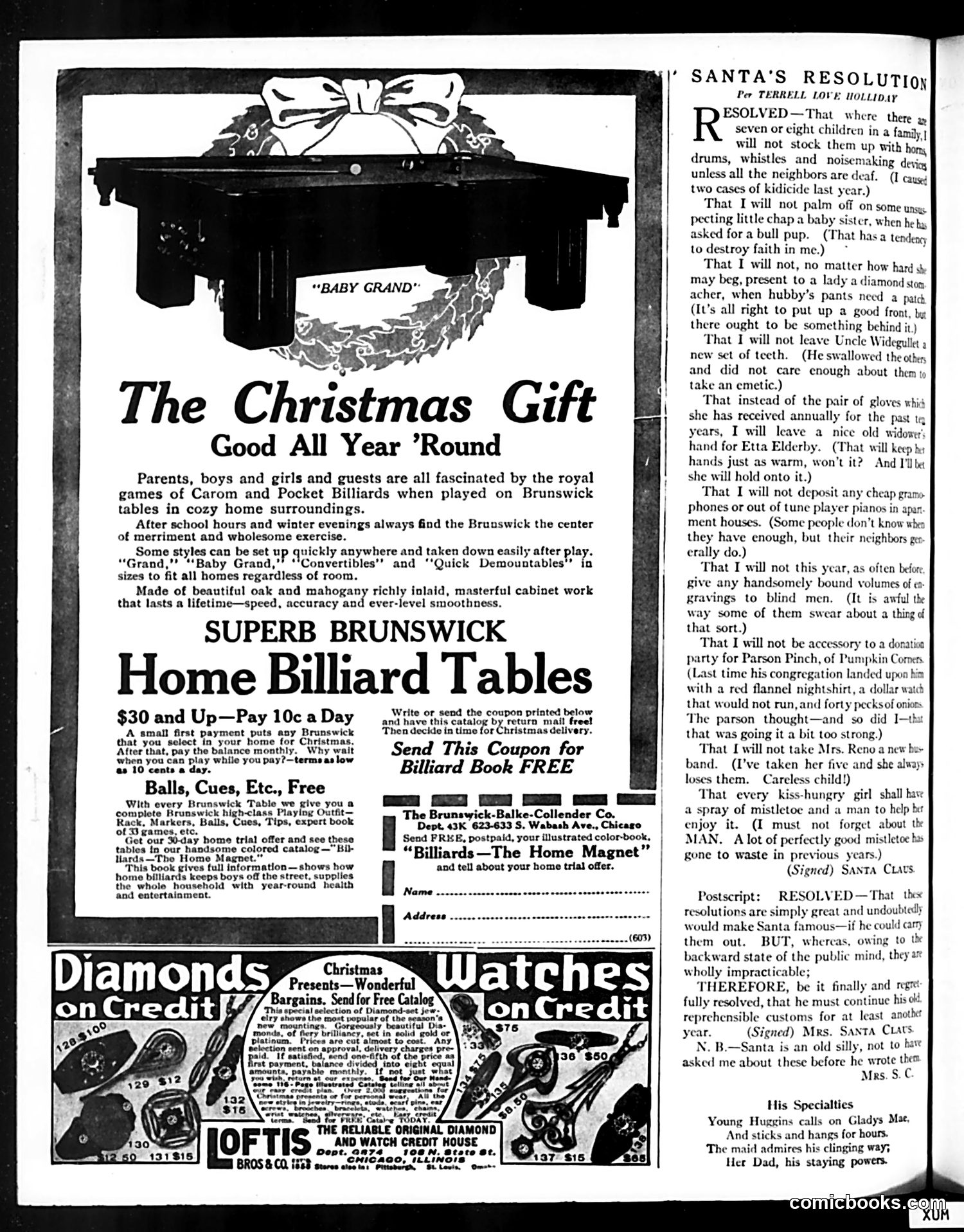
This is a humorous column by Terrell Love Holiday presenting "Santa's Resolutions"—a critique of thoughtless Christmas gift-giving practices among the wealthy. The satire targets: **Social absurdities mocked:** - Giving noisy toys to families with many children (implying neighbors will suffer) - Gifting unwanted siblings instead of requested pets - Presenting diamond jewelry to wives whose husbands need basic clothing repairs - Donating false teeth to relatives (playing on class assumptions) - Re-gifting worn gloves annually instead of meaningful presents - Installing cheap, out-of-tune pianos in apartment buildings where neighbors will hear them - Gifting expensive books nobody reads The column ridicules upper-class gift-givers for thoughtlessness disguised as generosity—prioritizing appearances over actual utility or consideration for recipients and their communities. The tone is satirical moral instruction wrapped in humorous "resolutions."
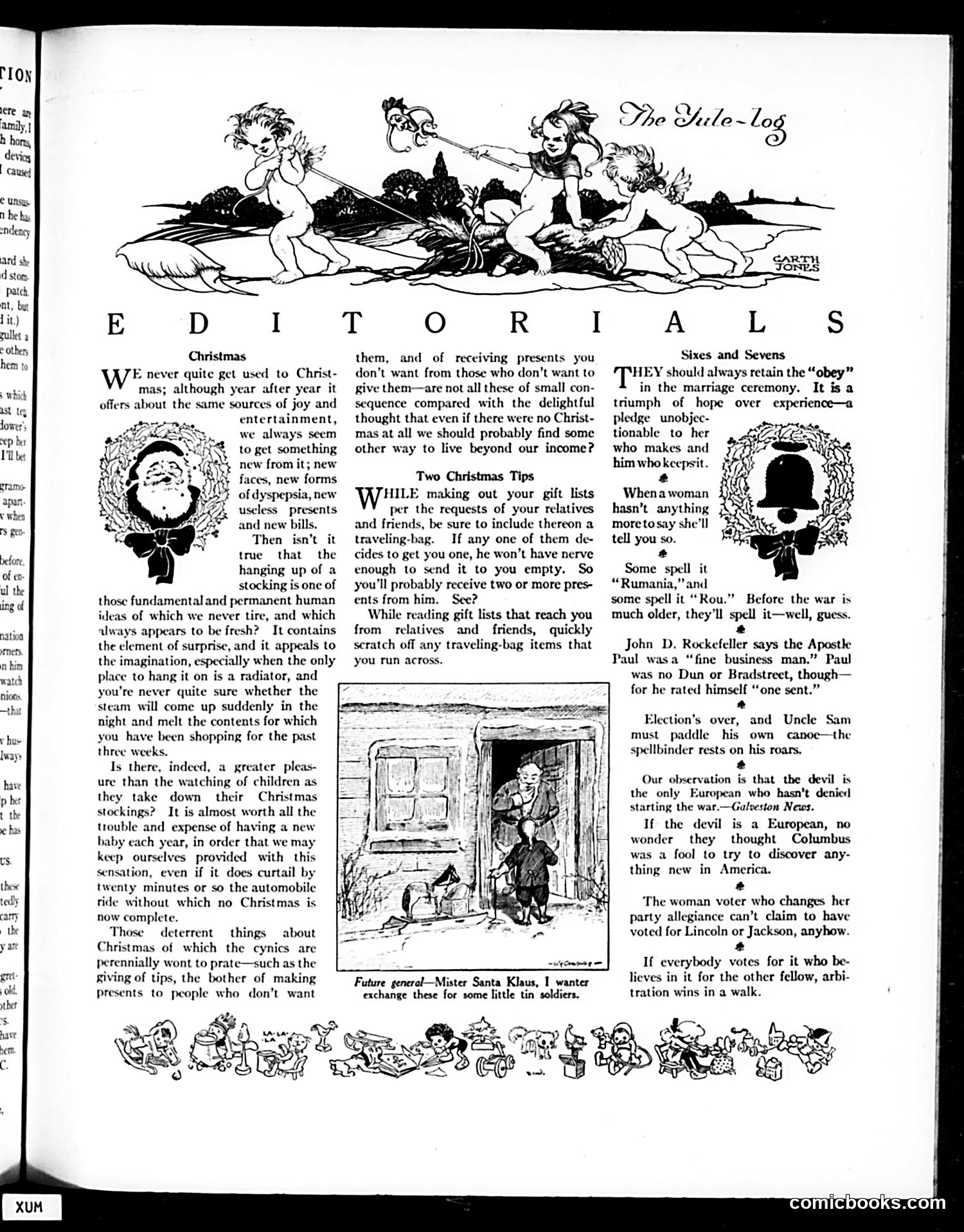
This is a Christmas-themed editorial page mixing holiday commentary with political and social satire typical of early 20th-century Judge magazine. **Main Content:** The lead essay humorously discusses Christmas traditions—particularly children's stockings and gift-giving—while satirizing American consumer culture and debt ("live beyond our income"). Two practical "tips" mock gift-giving etiquette around traveling bags. **Cartoons & References:** The illustration captioned "Future general—Mister Santa Klaus, I wanter exchange these for some little tin soldiers" appears to reference militarism or war preparation, likely World War I-era anxiety about children being raised for military service. **"Sixes and Sevens" Section:** Brief satirical quips touching on marriage obedience, women voters, European involvement in WWI ("the devil...starting the war"), and Rockefeller's business ethics. The reference to "Rumania/Rou" spelling reflects contemporary geopolitical upheaval. The page reflects Judge's characteristic blend of consumer-culture critique with conservative social commentary and pre-WWI tensions.
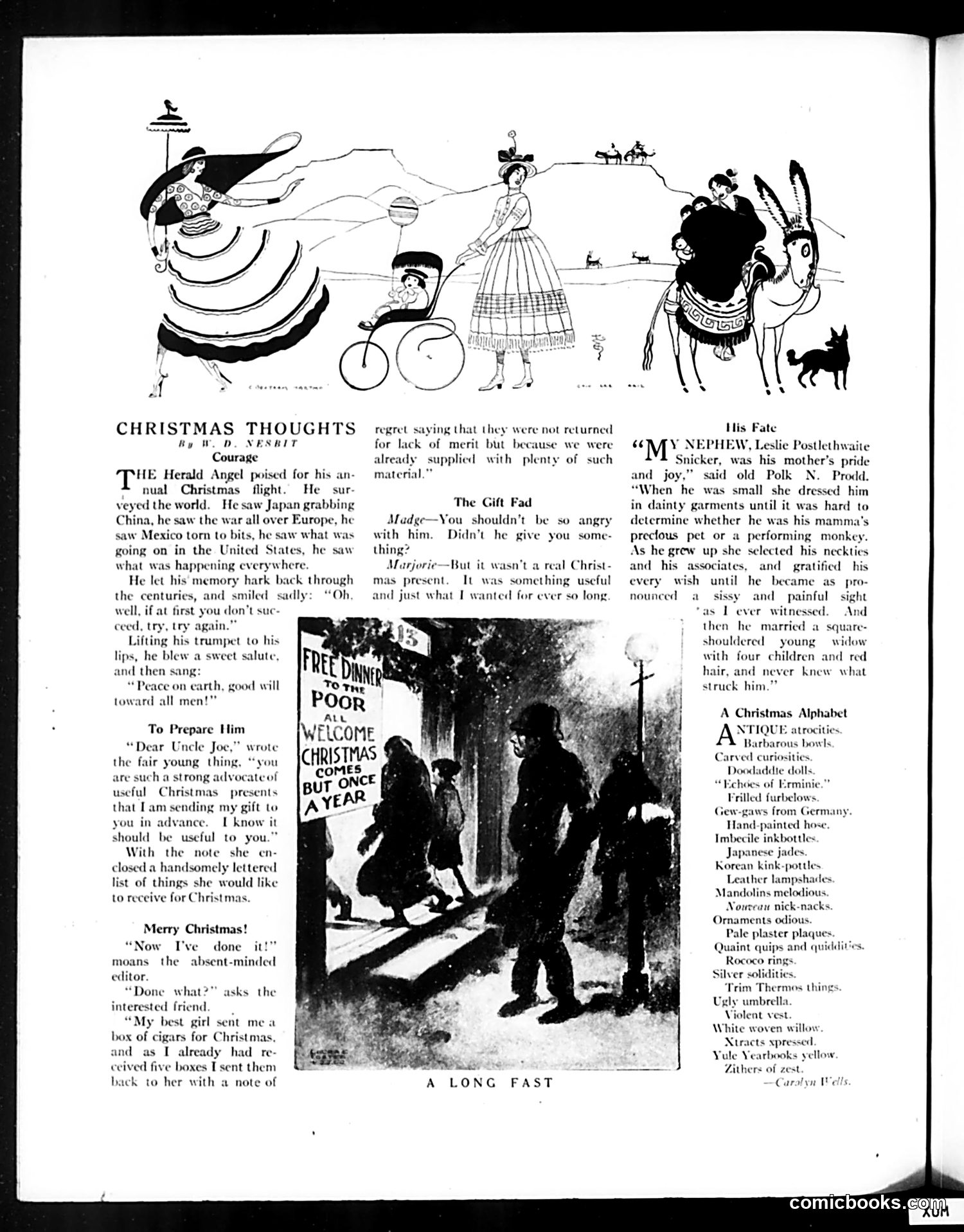
This 1917 page satirizes Christmas gift-giving customs and contemporary world events. The opening cartoon references actual conflicts: Japan's invasion of China, ongoing European warfare (World War I), and Mexican instability—suggesting humanity hasn't learned peace despite centuries of angelic exhortation. The "Gift Fad" and related humor mock the era's tension between *useful* versus *ornamental* gifts. A woman complains her suitor gave something practical she'd wanted—violating Christmas's expectation of frivolous luxury. This satirizes both consumer excess and gender role expectations (women should receive decorative, impractical items). "His Fate" ridicules overindulgent mothering of a "sissy" boy who becomes dependent, ultimately dominated by a strong-willed widow—social anxiety about masculine weakness. The "Christmas Alphabet" is pure consumer satire, cataloging imported ornaments and gadgets ("Nouveau nick-nacks," "Rococo rings") as meaningless status purchases, mocking the commercialization of the holiday.
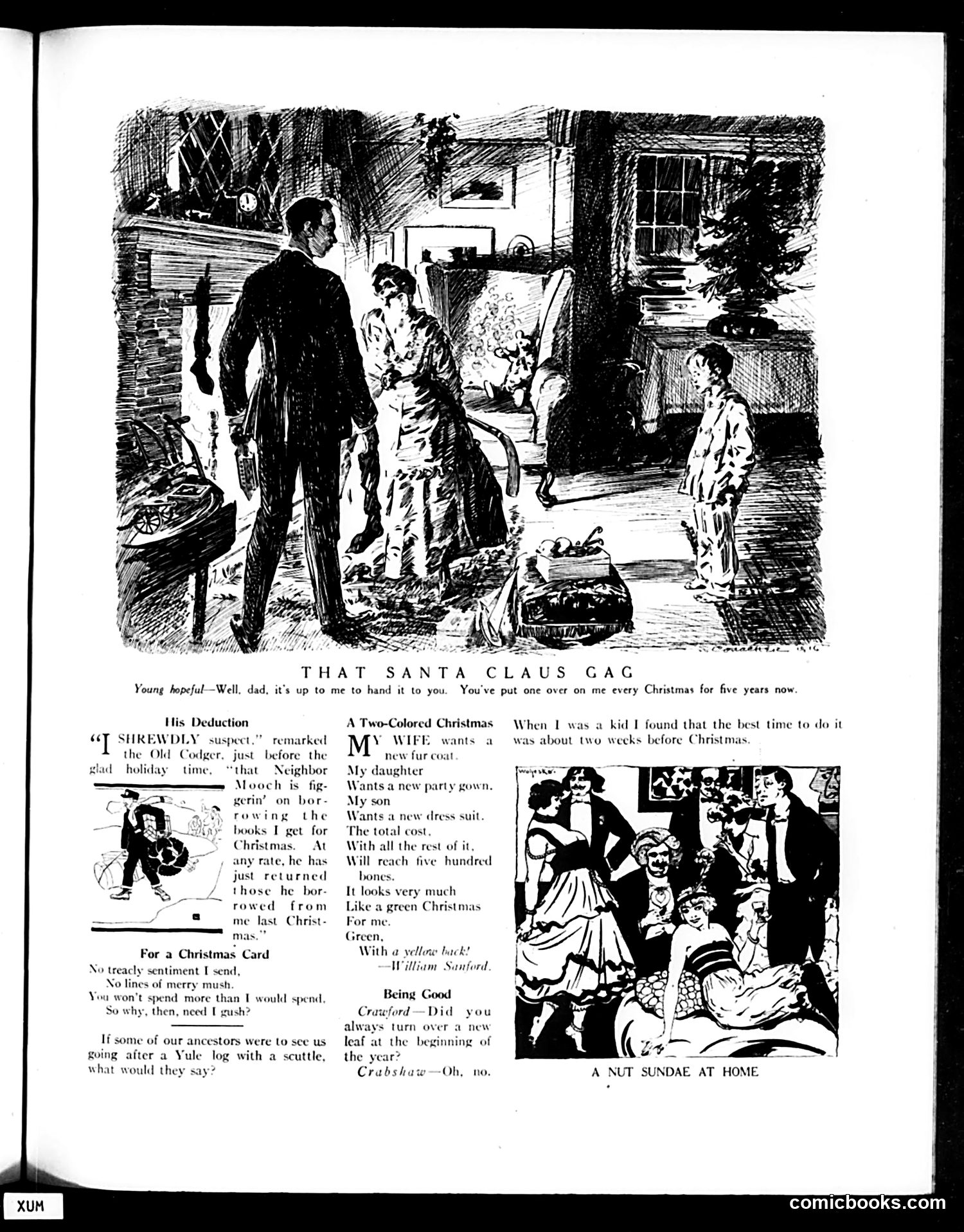
This page contains multiple unrelated satirical pieces typical of early 20th-century humor magazines. **"That Santa Claus Gag"** shows a father admitting his son has caught onto the Santa Claus deception—a common domestic comedy theme reflecting changing attitudes about childhood innocence. **"His Deduction"** satirizes a miserly neighbor who borrows books at Christmas, implying he won't return them, and the Old Codger's shrewd anticipation of this behavior. **"A Two-Colored Christmas"** uses a pun: the narrator's wife demands expensive gifts (fur coat, party gown, dress suit) totaling "five hundred bones" (dollars), leaving him financially "green"—but the "yellow back" (slang for money) he must provide makes it green in a different sense. **"Being Good"** jokes about New Year's resolutions. **"A Nut Sundae at Home"** appears to show a family gathering. The overall theme is Christmas spending and family dynamics among the middle class, with gentle mockery of domestic greed and self-deception.
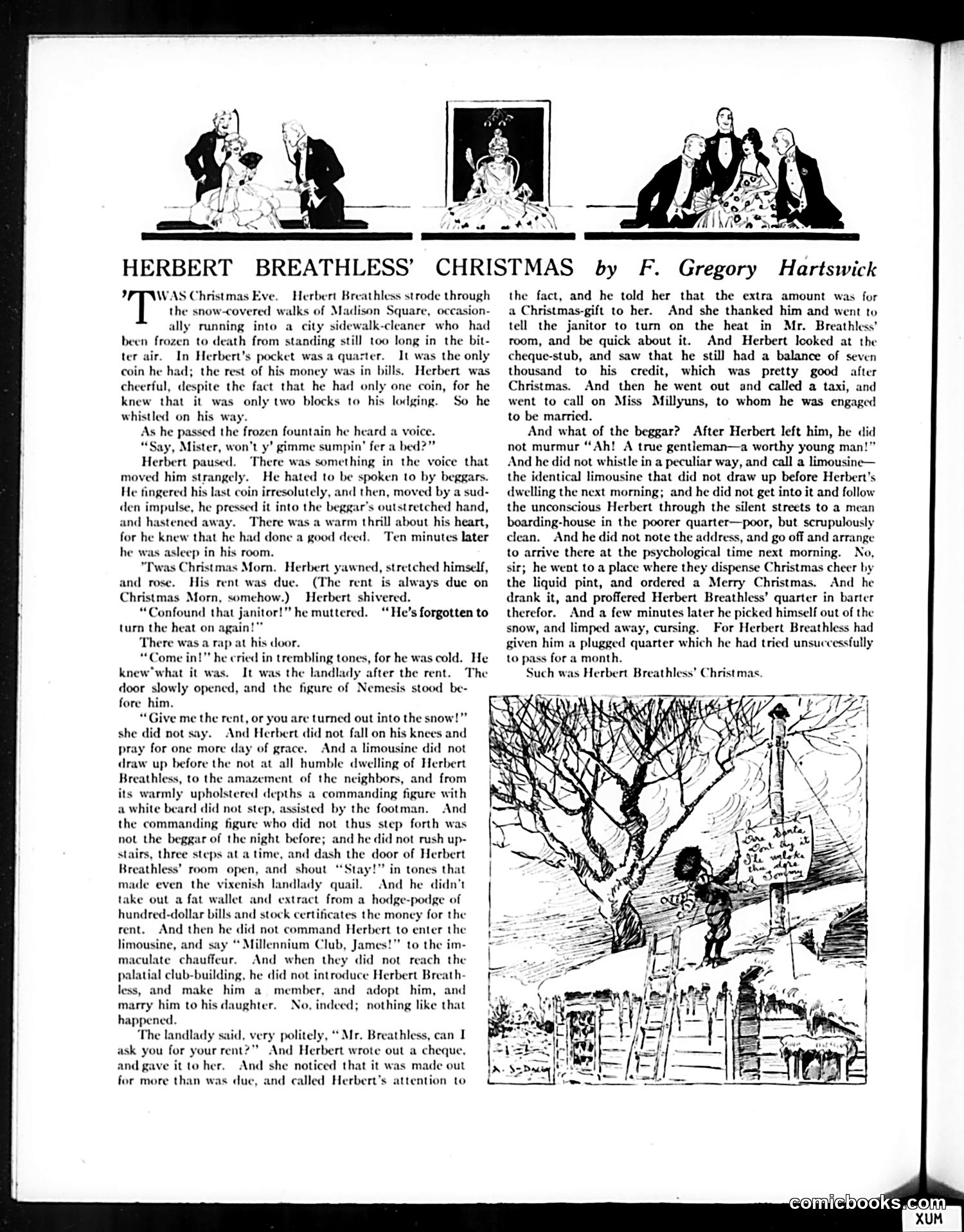
This is a satirical short story mocking sentimental Christmas tales of redemption and charity. The narrative structure employs heavy irony: it describes what *doesn't* happen to Herbert after he gives his last coin to a beggar on Christmas Eve. The satire targets readers' expectations of Victorian "Christmas miracle" stories. Typically, such narratives reward charitable impulses with dramatic reversals—the beggar becomes a wealthy benefactor, the poor man gains fortune and a wealthy bride. Hartswick systematically negates every conventional plot point, using repeated "did not" constructions. The actual resolution reveals Herbert's mundane reality: he's already wealthy (seven thousand dollars in his account), pays his rent with a cheque, and lives an ordinary life. His charity required no sacrifice. The joke exposes how genuine working-class struggle—the frozen sidewalk-cleaners, the desperate beggar—doesn't trigger magical rewards. Only privileged individuals like Herbert benefit from Christmas sentiment. The satirical point: Merry Christmas stories comfort the already-comfortable while ignoring actual poverty.
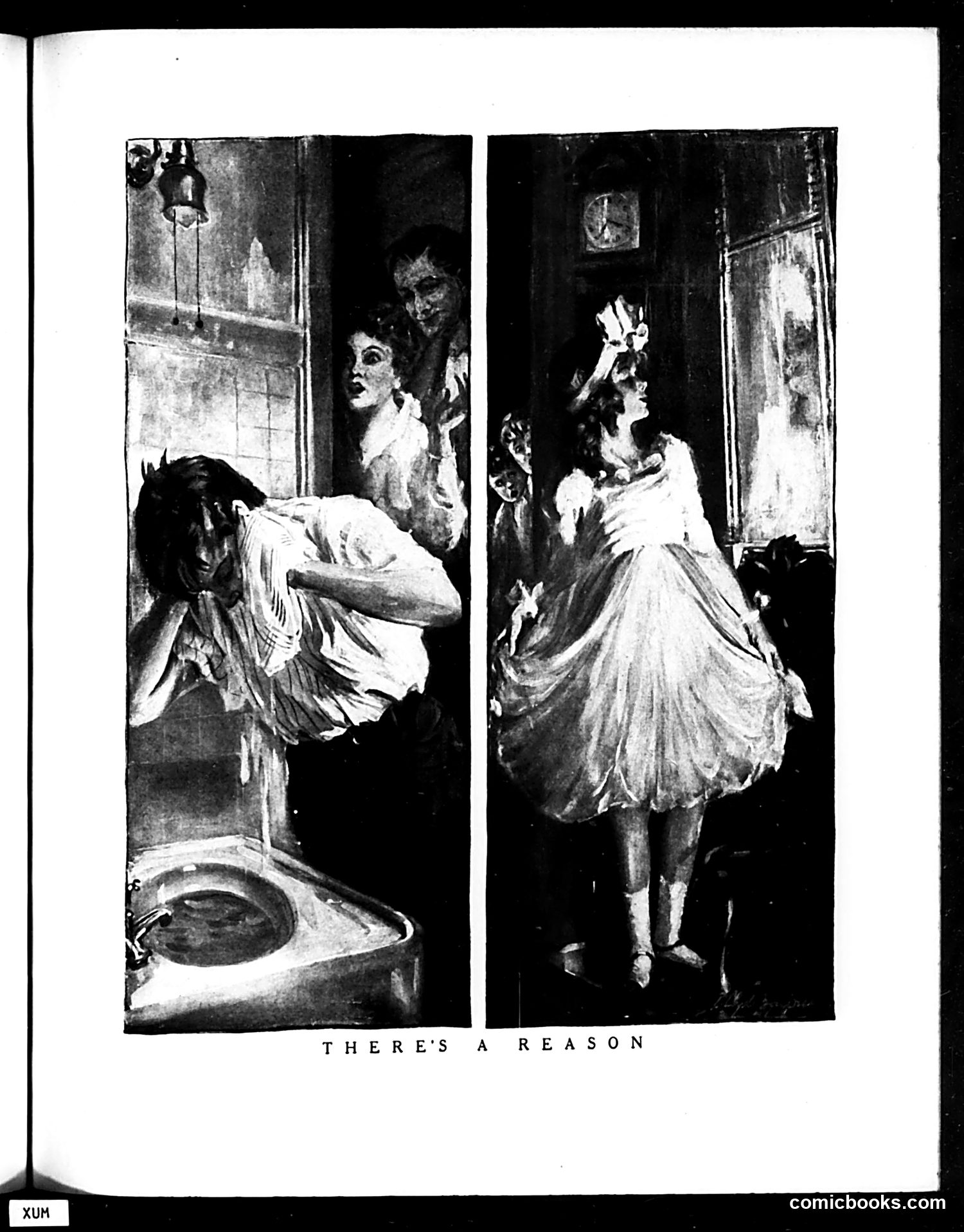
This two-panel satirical illustration is titled "There's A Reason," using visual contrast to make its point. The left panel shows a woman in dishabille in a bathroom, appearing disheveled or distressed near a toilet. The right panel depicts the same woman elegantly dressed in a ball gown, adorned with flowers, looking refined and composed. The satire appears to comment on the stark contrast between a woman's private reality and public presentation—suggesting that despite her refined appearance at social events, there are unglamorous domestic realities behind the scenes. This likely critiques either female vanity, the gap between appearance and reality, or social pretense in general. The joke relies on the viewer recognizing the humor in this juxtaposition of crude private versus polished public personas.
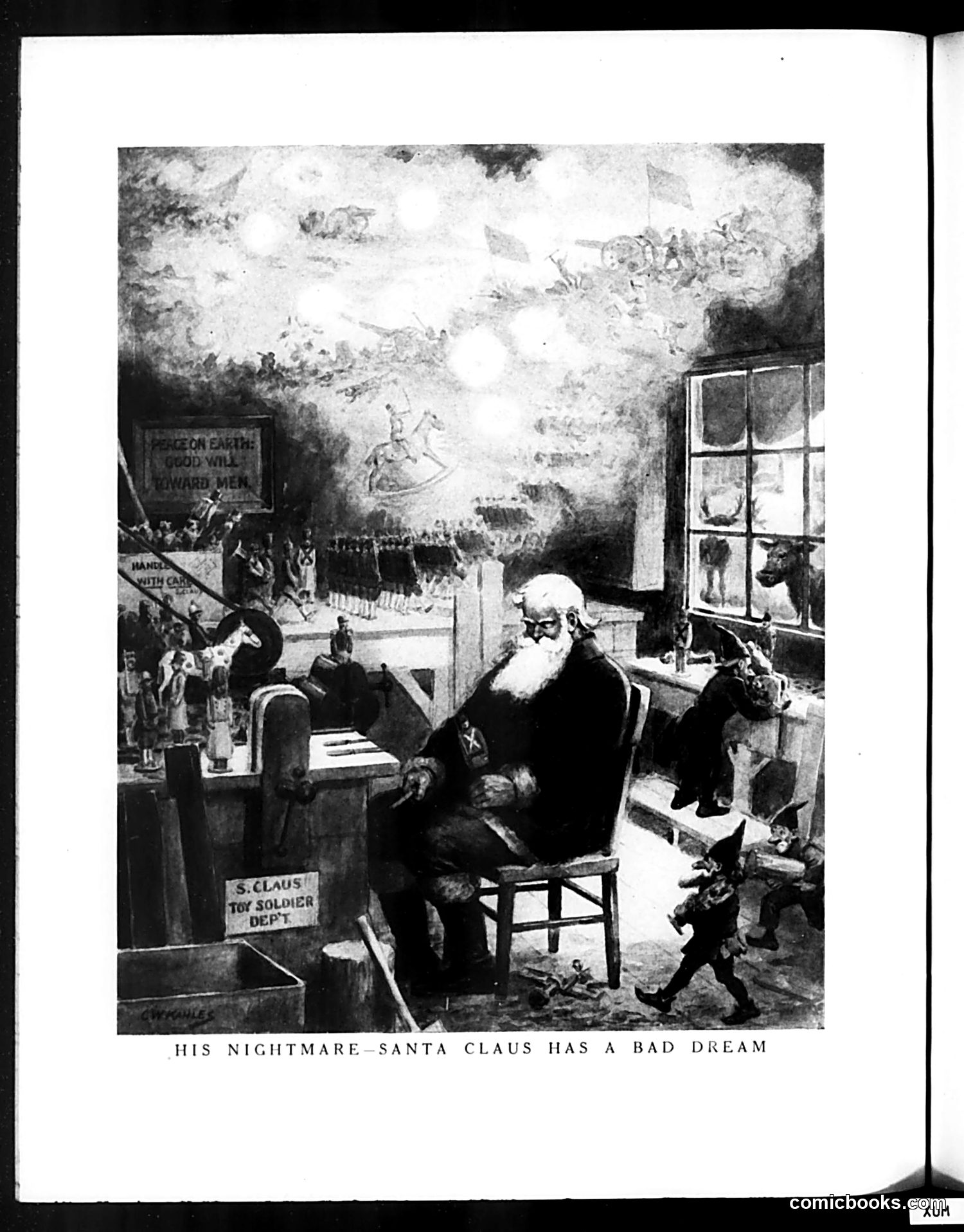
This political cartoon depicts Santa Claus having a nightmare. In the dream sequence (visible through the window), Santa witnesses military conflict—soldiers marching with flags, explosions, and what appears to be warfare or civil unrest. The satire contrasts Santa's traditional role as a figure of peace and childhood joy with the violence and militarism of the era. The "S. Claus Toy Soldier Dept" sign suggests the nightmare concerns toy soldiers and weapons manufacturing becoming real instruments of war. This appears to be anti-war commentary from *Judge* magazine, likely from a period of international conflict (possibly around World War I or another major conflict). The cartoon critiques how militarism intrudes even upon symbols of innocence and peace, turning childhood toys into reminders of adult violence.
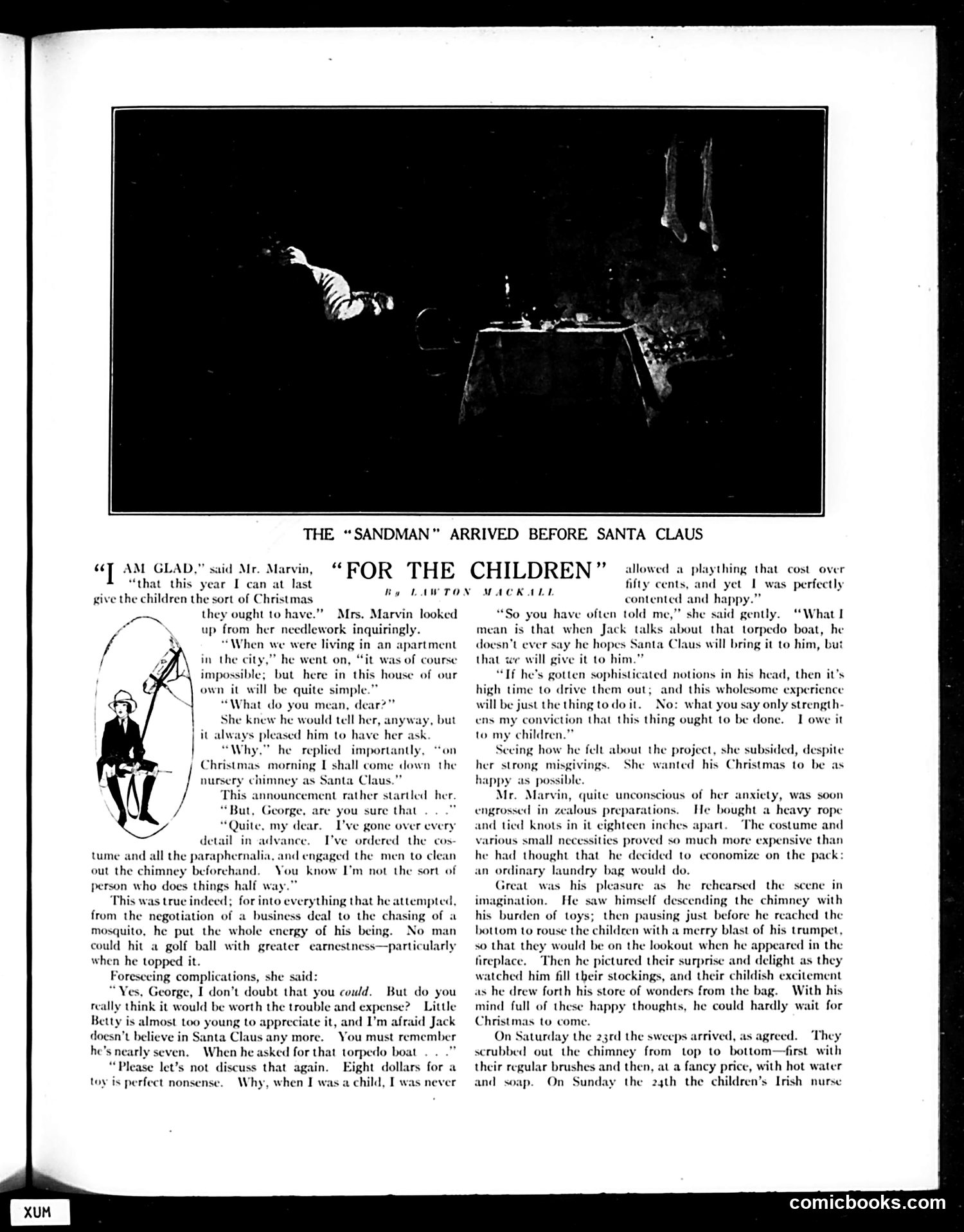
This illustrated story satirizes well-meaning but misguided parental earnestness. Mr. Marvin, a businessman characterized by obsessive over-preparation, insists on descending his home's chimney as Santa Claus on Christmas morning—despite his wife's practical objections and the children's advanced skepticism. The satire targets two things: first, the "self-made man" mentality that applies relentless efficiency to every endeavor, even Christmas magic; second, the disconnect between what parents believe children need versus what children actually want. His son Jack has already stopped believing in Santa and wants a practical torpedo boat, not theatrical surprises. Yet Marvin plows ahead, spending far more than his stated childhood standard of fifty cents, cleaning the chimney, purchasing costumes—all to impose his own nostalgic vision of Christmas onto children who've moved past it. The humor lies in Marvin's earnest blindness to his family's gentle hints that the elaborate scheme misses the point entirely.
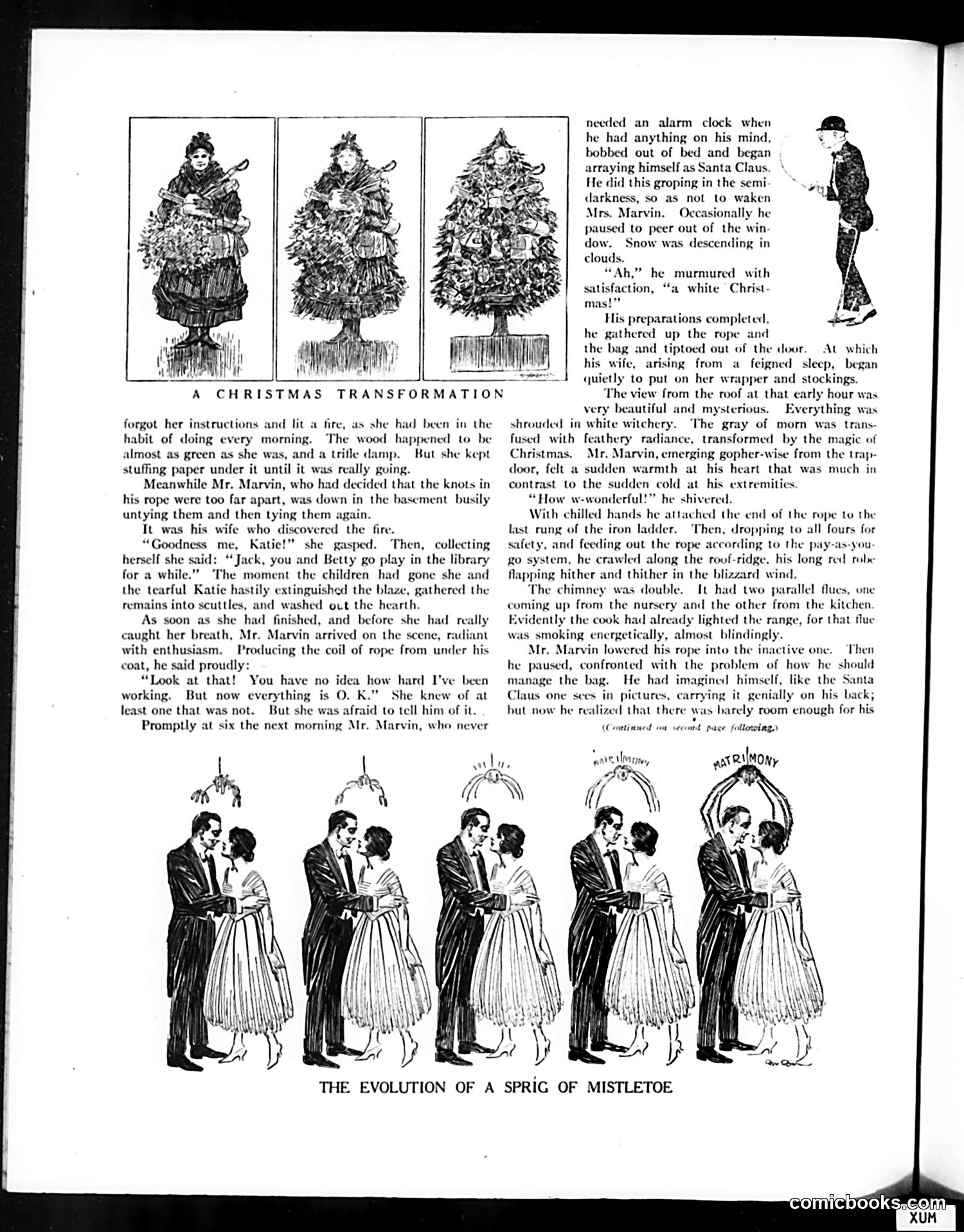
This page contains two humorous stories illustrated with satirical cartoons from *Judge* magazine. **"A Christmas Transformation"** (top) depicts Mr. Marvin's misadventure attempting to play Santa Claus by climbing onto his roof Christmas Eve to descend the chimney. The joke relies on the contrast between his romantic vision of himself as Santa and the reality: his wife discovers he's bungled rope preparation, the house nearly catches fire from her incompetent fire-building, and he now realizes the chimney is too cramped for both him and his gift bag. The satire mocks middle-class domestic life and masculine overconfidence. **"The Evolution of a Sprig of Mistletoe"** (bottom) shows five sequential panels depicting a couple kissing beneath mistletoe with increasing physical intimacy, culminating in what appears to be a marriage proposal. The joke satirizes how a simple Christmas tradition escalates into serious romantic commitment. Both cartoons gently mock Victorian/early 20th-century courtship customs and domestic situations.
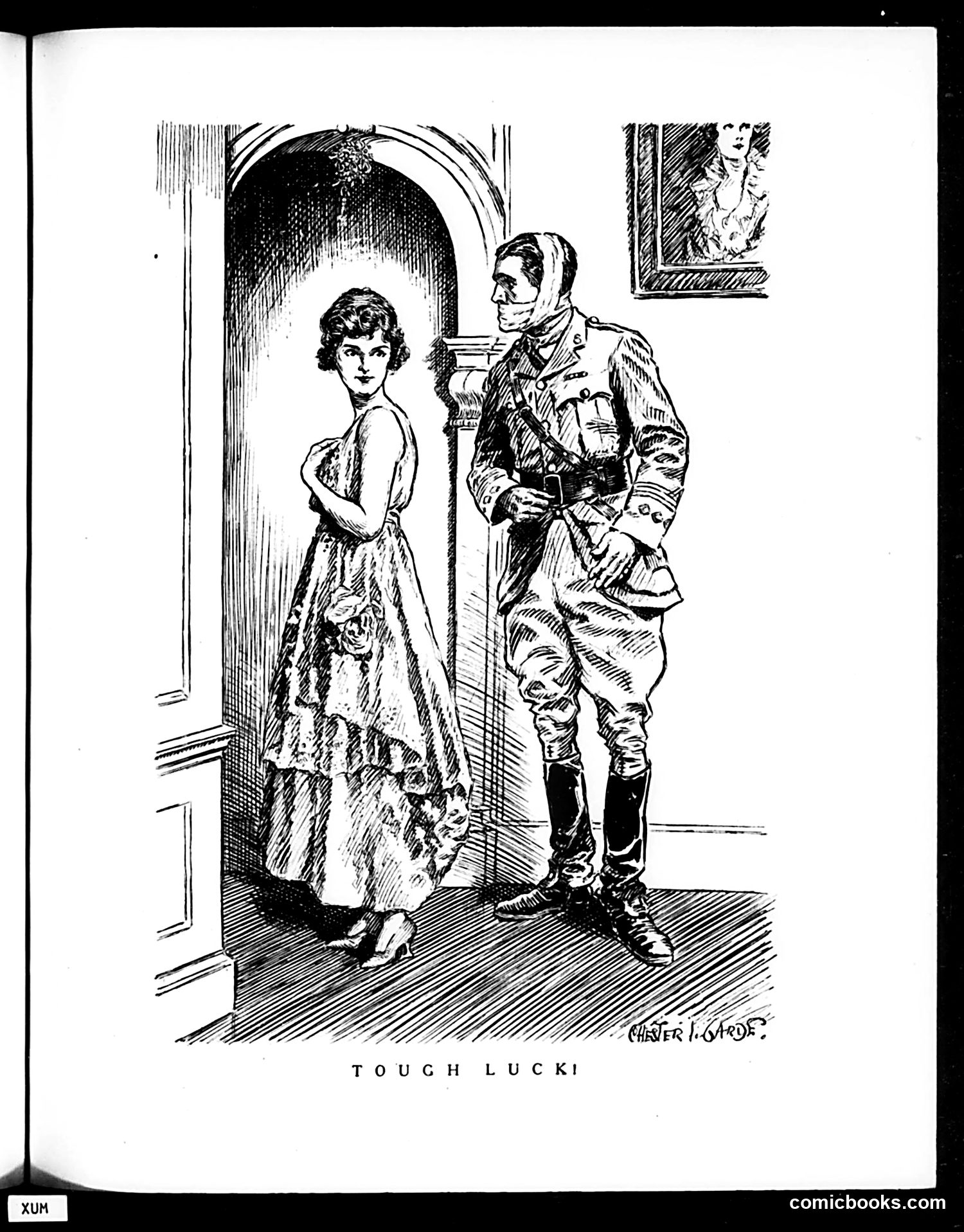
This illustration by Chester Larde depicts a young woman in an elegant evening gown encountering a uniformed military officer in a doorway. The caption reads "Tough Lucki" (intentionally misspelled for comedic effect). The cartoon appears to satirize romantic or social encounters between women and military men, likely from the World War I era based on the officer's uniform style. The "tough luck" reference suggests irony about the woman's situation—perhaps commenting on the unpredictability of wartime relationships or romantic chance encounters. The woman's backward glance and the officer's confident demeanor suggest a humorous take on military courtship dynamics. Without additional context, the specific satirical target remains unclear, but it likely reflects contemporary attitudes toward soldier-civilian interactions during wartime.
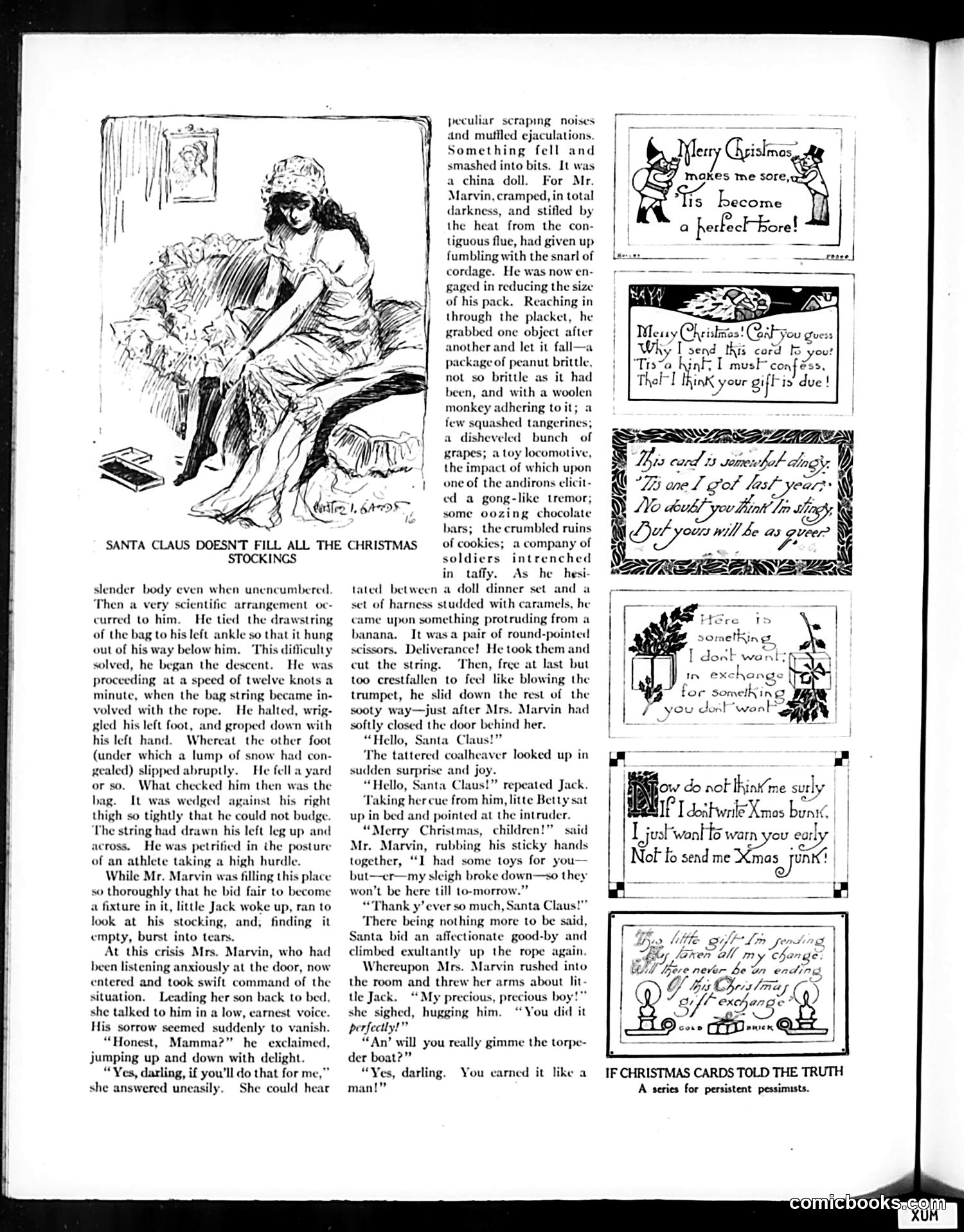
This story satirizes the gap between Christmas ideals and harsh reality. Mr. Marvin, a poor "coalheaver" (manual laborer), attempts to play Santa for his children by climbing down a chimney with gifts. The humor—dark and compassionate—stems from his comical struggle: stuck awkwardly while descending, he desperately jettisons toys to escape, destroying them in the process. The satire targets economic inequality: Marvin cannot afford real gifts, so he must fabricate Santa's visit. His children's joy at his appearance—despite receiving nothing—underscores the article's title point: Santa doesn't fill all stockings, particularly those of working-class families. The accompanying greeting cards on the right reinforce this theme, presenting cynical Christmas messages about the holiday's commercialism and false promises.

This appears to be an advertisement or illustration from *Judge* magazine with the caption "Something for Your Den." The image shows a stylized woman in 1920s-30s fashion—with wavy hair, makeup, and a flowing dress with patterned sleeves—posed in a playful, reclining position. The illustration style is characteristic of vintage commercial art. Without additional context or visible product information, this likely advertised artwork, prints, or decorative items marketed toward men for their personal spaces ("den"). The elegant, glamorous female figure was common in period advertising targeting male consumers. The exact product or brand being promoted is not clearly visible in the image provided.
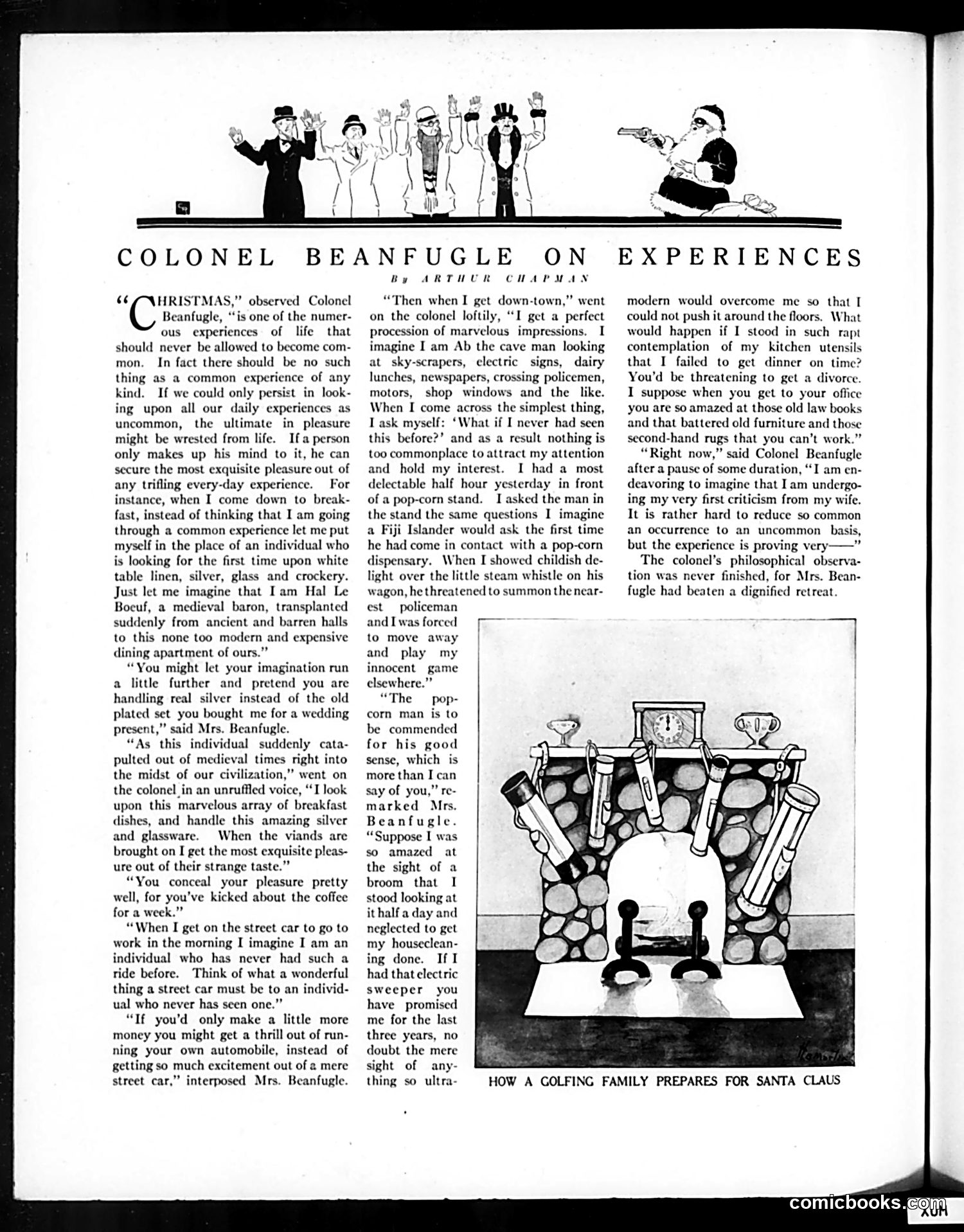
This is a humor piece by Arthur Chapman satirizing a pompous character, Colonel Beanfugle, who espouses a philosophy of finding wonder in mundane daily life by imagining he's experiencing things for the first time (like a "cave man" seeing skyscrapers or a "Fiji Islander" encountering a pop-corn stand). The joke is that his patient wife repeatedly deflates his pretentious musings with practical objections: he complains about coffee while claiming to savor experiences, she notes he'd be more excited about an automobile than a street car, and she points out that if he actually stood amazed at every household task, dinner wouldn't get made and she'd divorce him. The satire mocks masculine self-importance and philosophical posturing, contrasting it with women's domestic realities. The cartoon at top-right shows Beanfugle shooting at figures on a wall—reinforcing his ridiculous, self-absorbed nature.
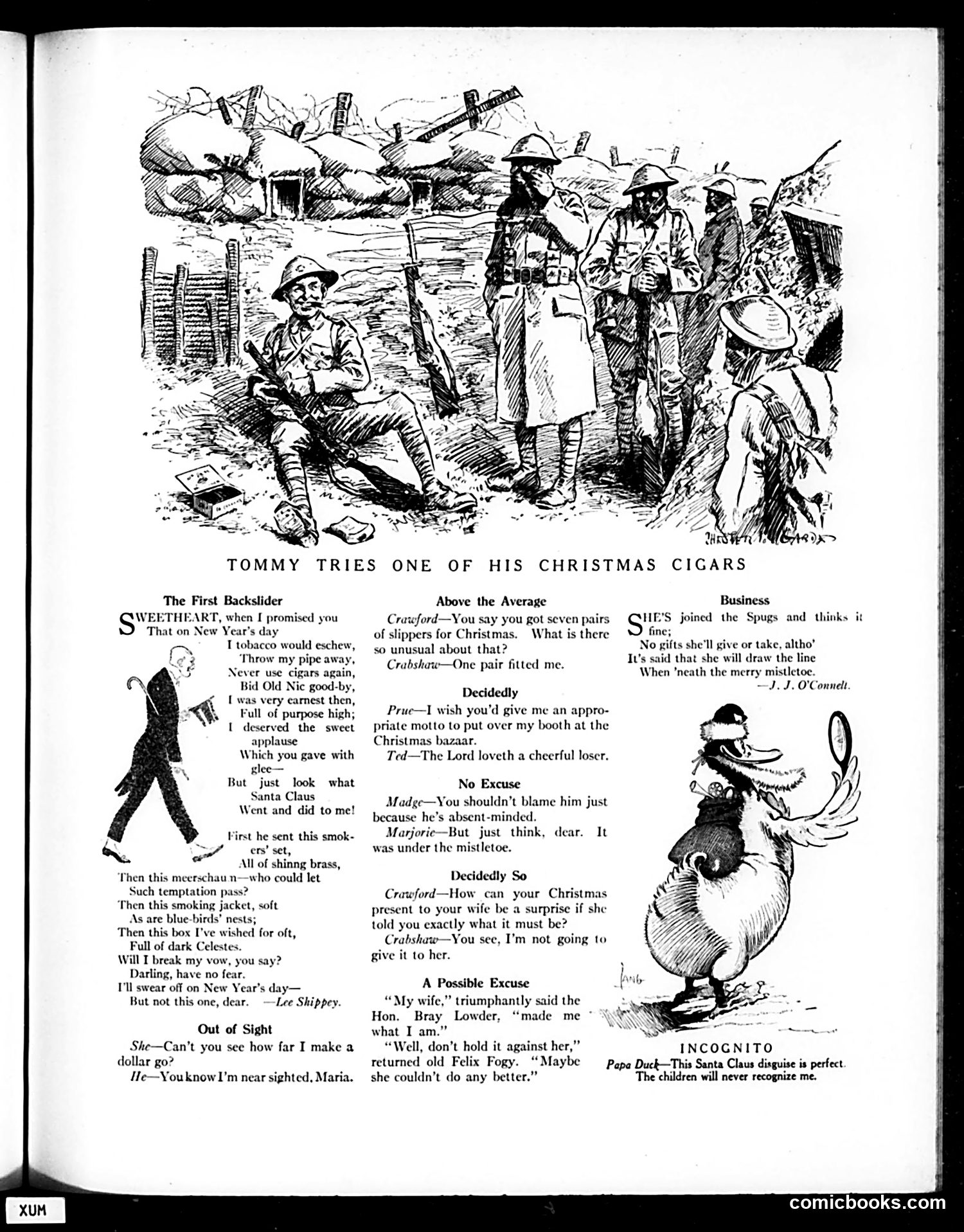
This page collects holiday-themed humor pieces satirizing Christmas gift-giving and marital dynamics of the early 20th century. The main cartoon shows a man breaking his New Year's resolution to quit smoking after receiving luxurious tobacco gifts—smoker's sets, meerschaum pipes, smoking jackets, and cigars. The satire targets male weakness: he pledges abstinence but immediately surrenders to temptation, planning to "swear off on New Year's day—But not this one, dear." The surrounding brief comic dialogues mock related themes: cheap gifts (slippers that don't fit), surprise gifts undermined by wives' demands, and marital discord (a woman making a man "what he is," implied negatively). One final cartoon shows a father in a transparent Santa disguise. The humor assumes readers recognize universal domestic scenarios—broken resolutions, gift-giving disappointments, and the gap between marital promises and behavior—making these situations relatable through exaggeration.
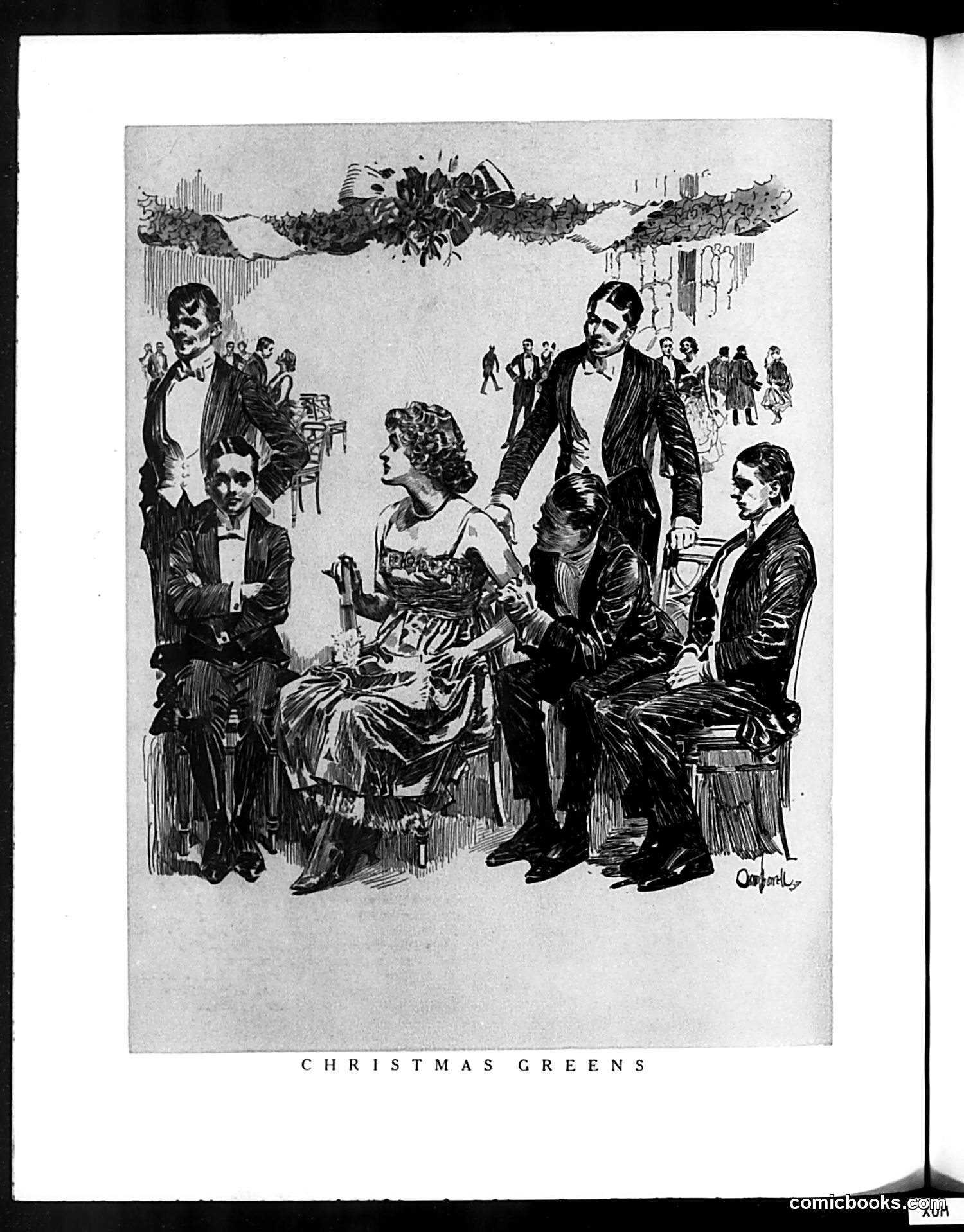
This illustration titled "Christmas Greens" depicts a Victorian-era social gathering with well-dressed men and women in formal attire seated and standing in conversation. The sketch style is characteristic of late 19th-century satirical illustration, signed by what appears to be "Opper" (likely Frederick Opper, a prominent Judge cartoonist). The scene shows an indoor social event with figures in the background, though without additional caption text visible, the specific satirical point remains unclear. The title suggests commentary on Christmas social customs or holiday gatherings among the upper classes. The formal dress and composed poses suggest this may satirize artificial holiday sociability or class-based seasonal traditions, though the exact social or political target cannot be definitively determined from the image alone.
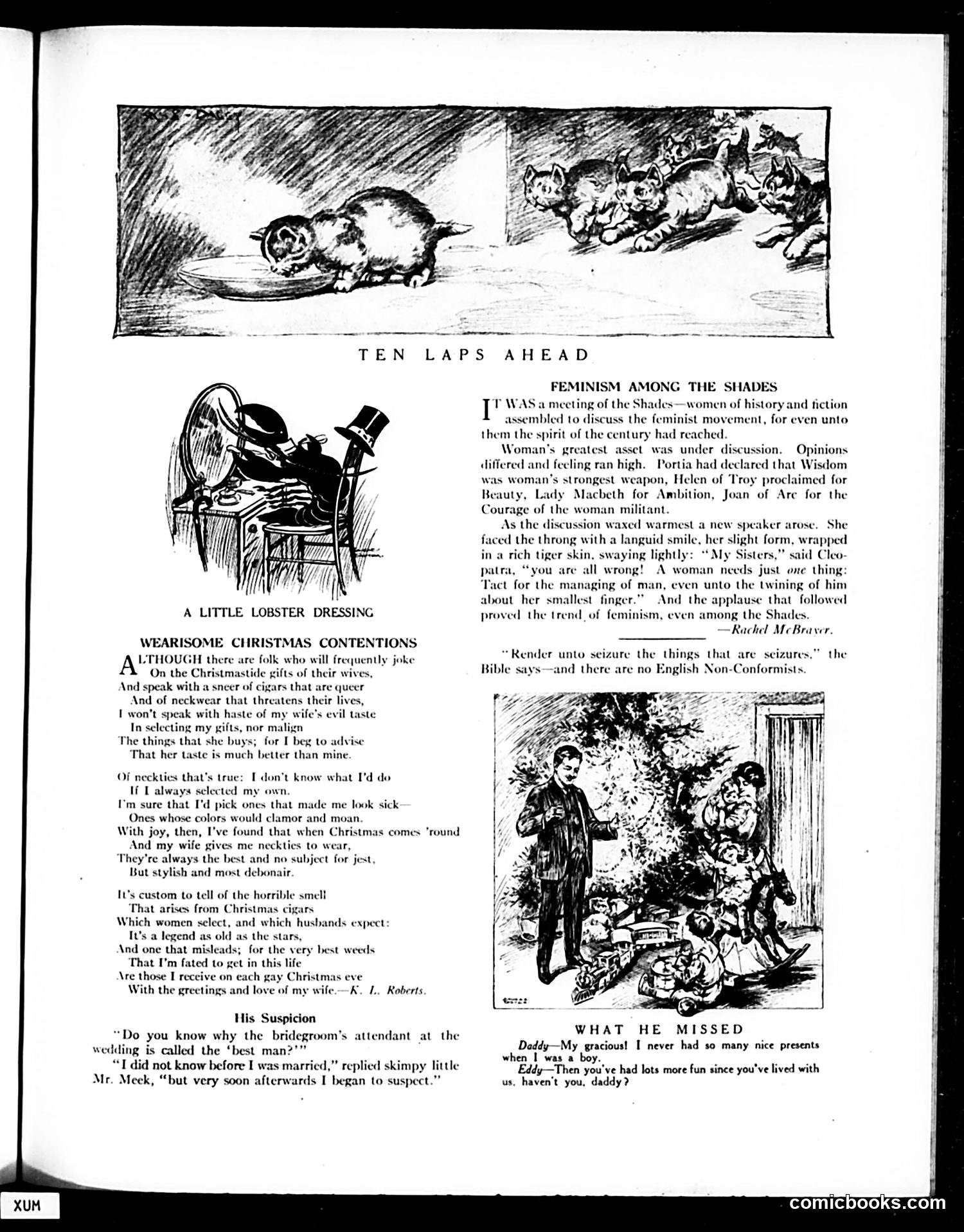
This satirical piece imagines famous historical and fictional women debating feminism in the afterlife. Portia argues for wisdom, Helen of Troy for beauty, Lady Macbeth for ambition, and Joan of Arc for courage as women's greatest assets. Cleopatra interrupts, dismissing all previous answers. She claims a woman needs only one thing: "tact for the managing of man"—the ability to manipulate males through feminine wiles. The applause that follows suggests this view aligns with popular sentiment about feminism. **The satire's point**: Judge magazine mocks the feminist movement by having Cleopatra—historically associated with seduction—"win" the debate. The joke suggests that despite modern feminist discourse about women's independence and strength, traditional feminine manipulation of men remains the real female power. This reflects early 20th-century resistance to feminism, implying suffragists and feminists were deluded about what women actually needed or valued.
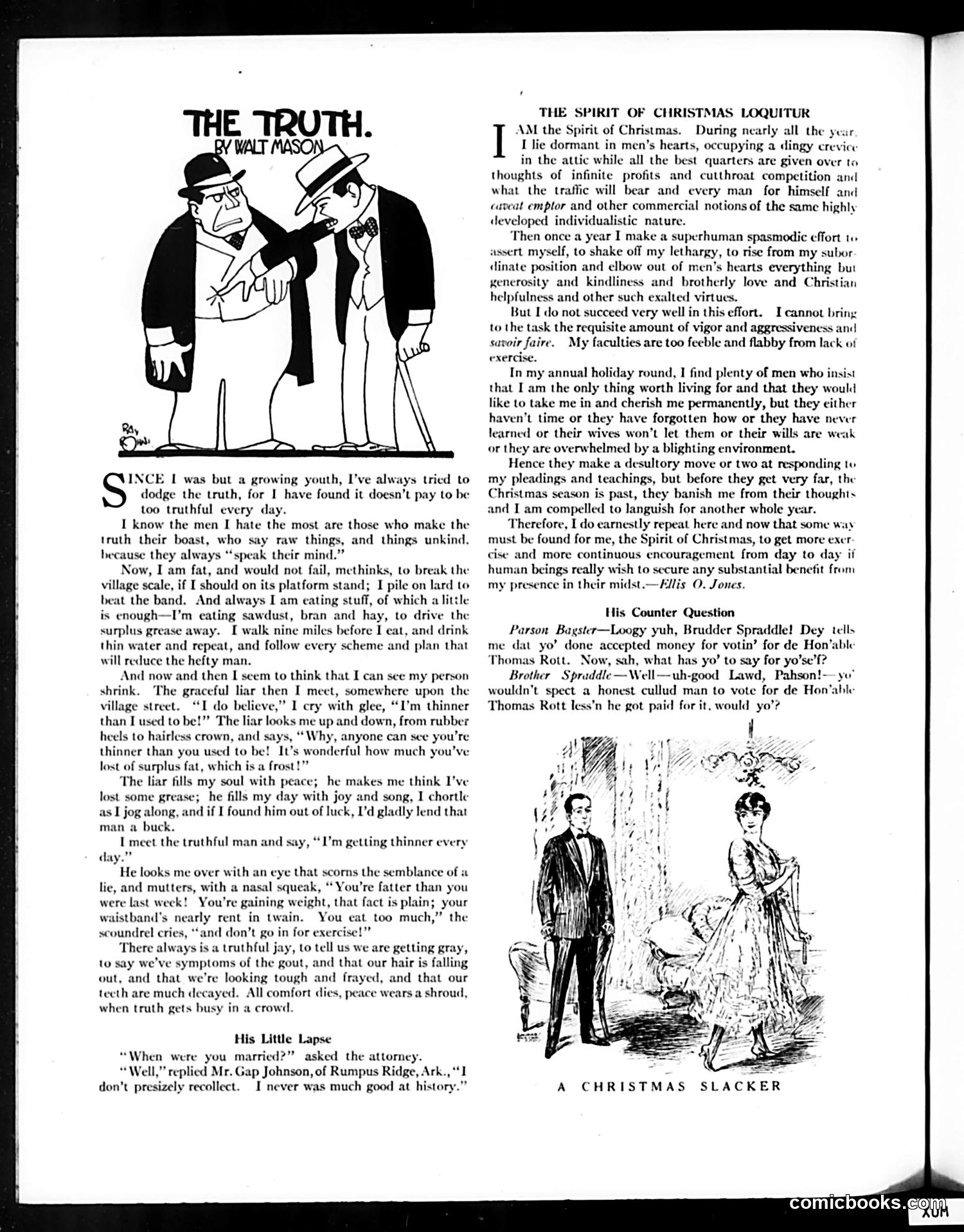
This page features two distinct pieces of social satire from Judge magazine. **"The Truth"** (left) contrasts two character types: the gracious liar who flatters the narrator about weight loss, lifting his spirits, versus the "truthful man" who brutally confirms he's actually gained weight. Mason's satire argues that brutal honesty, while morally superior in theory, causes misery in practice. The message: white lies serve human happiness better than uncomfortable truths spoken without kindness. **"The Spirit of Christmas Loquitur"** (right) personifies Christmas itself as a weak force, dormant most of the year while men pursue profit and competition. The piece satirizes how Christmas's spiritual values—generosity, brotherly love, Christian virtue—are marginalized in American commercial life. People claim to cherish Christmas but lack time or will to truly embrace it before the season ends and materialism resumes. Both pieces critique American values: one favors social comfort over honesty; the other laments how commercialism overwhelms spiritual ideals.
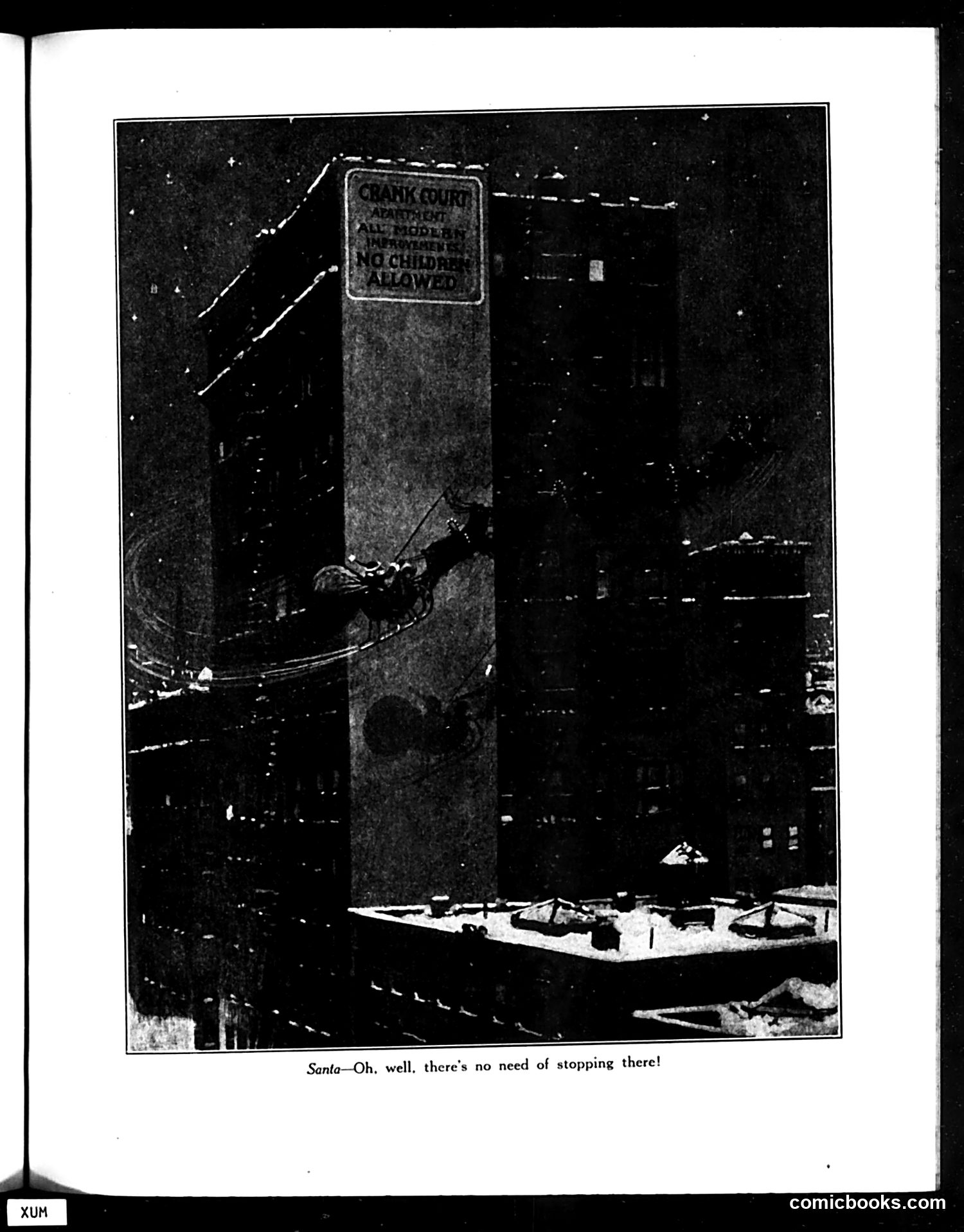
This is a single-panel cartoon depicting Santa Claus encountering a signpost marked "DARK COURT" that reads "ALL MODERN IMPROVEMENTS / NO CHILDREN ALLOWED." The joke plays on the contrast between Santa's traditional role—delivering gifts to children—and this establishment's explicit exclusion of them. Santa's quip ("there's no need of stopping there!") suggests the venue is unsuitable for him anyway, making a lighthearted jab at whatever the "Dark Court" represents. Without additional context about what "Dark Court" specifically referenced in Judge magazine's era, the cartoon appears to be general social satire about adult-only venues or establishments that pride themselves on "modern improvements" while excluding children—implying the improvements are morally questionable or unseemly.
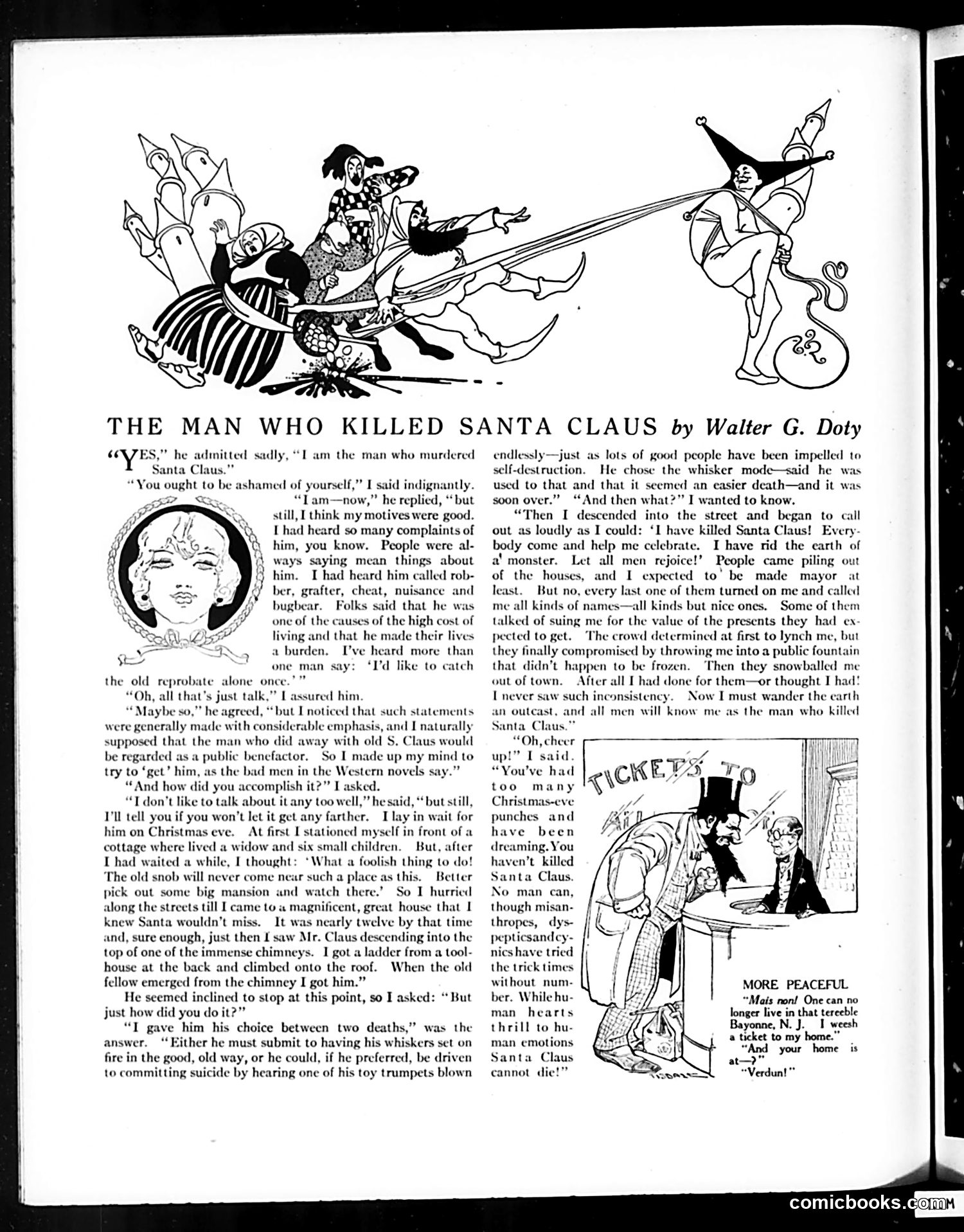
This is a short story by Walter G. Doty satirizing anti-Santa sentiment and misanthropy. A man confesses to "murdering" Santa Claus, claiming he heard widespread complaints that Santa was a "robber, grafter, cheat" who caused the high cost of living—a reference to early 20th-century economic grievances and labor disputes. The satire reveals the absurdity: the man expects to be celebrated as a public hero for eliminating what he saw as a social burden, but instead is attacked by the very people he thought he was helping. The irony is sharp—people who rhetorically "wanted to catch" Santa suddenly defend him when someone acts on their complaints. The conclusion, where another character dismisses this as drunk fantasy, suggests the story mocks both cynics who blame Santa (or scapegoats generally) for societal ills, and the disconnect between people's complaints and their actual values. It's social criticism wrapped in dark comedy.
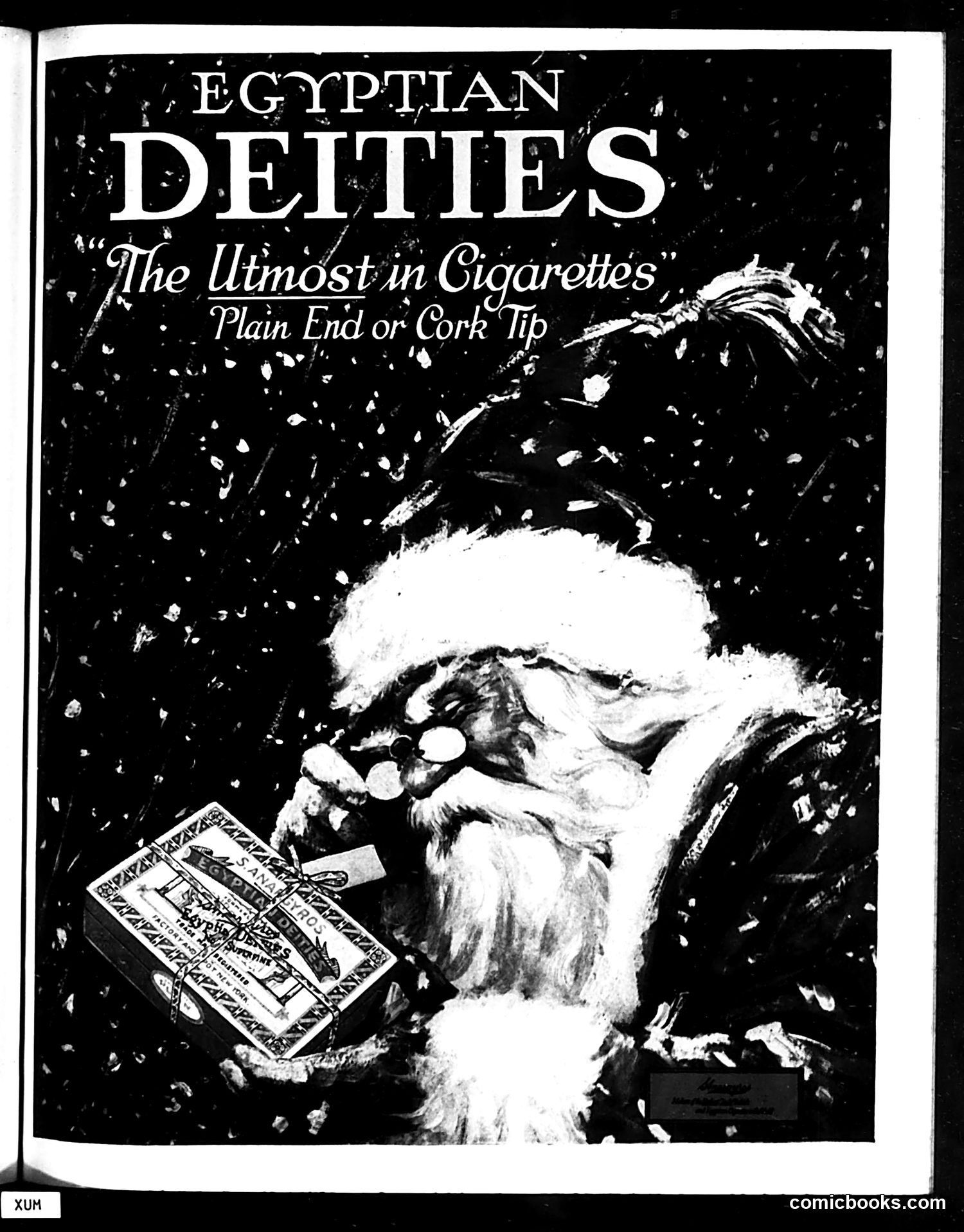
This is an advertisement for "Egyptian Deities" brand cigarettes, offering plain end or cork tip options. The ad features an exaggerated caricature of an Egyptian deity or pharaoh figure—likely representing Thoth or another ancient Egyptian god, given the ibis bird visible at the top. The marketing strategy exploits early 20th-century fascination with Egyptology and "exotic" imagery to sell cigarettes. The ornate headdress, beard, and mystical presentation appeal to consumers' attraction to ancient mysteries and luxury goods. The cigarette package is prominently displayed in the figure's hand. This reflects period advertising conventions that used ethnic and historical stereotypes liberally to market products, without concern for accuracy or sensitivity—simply leveraging popular cultural interests to drive sales.
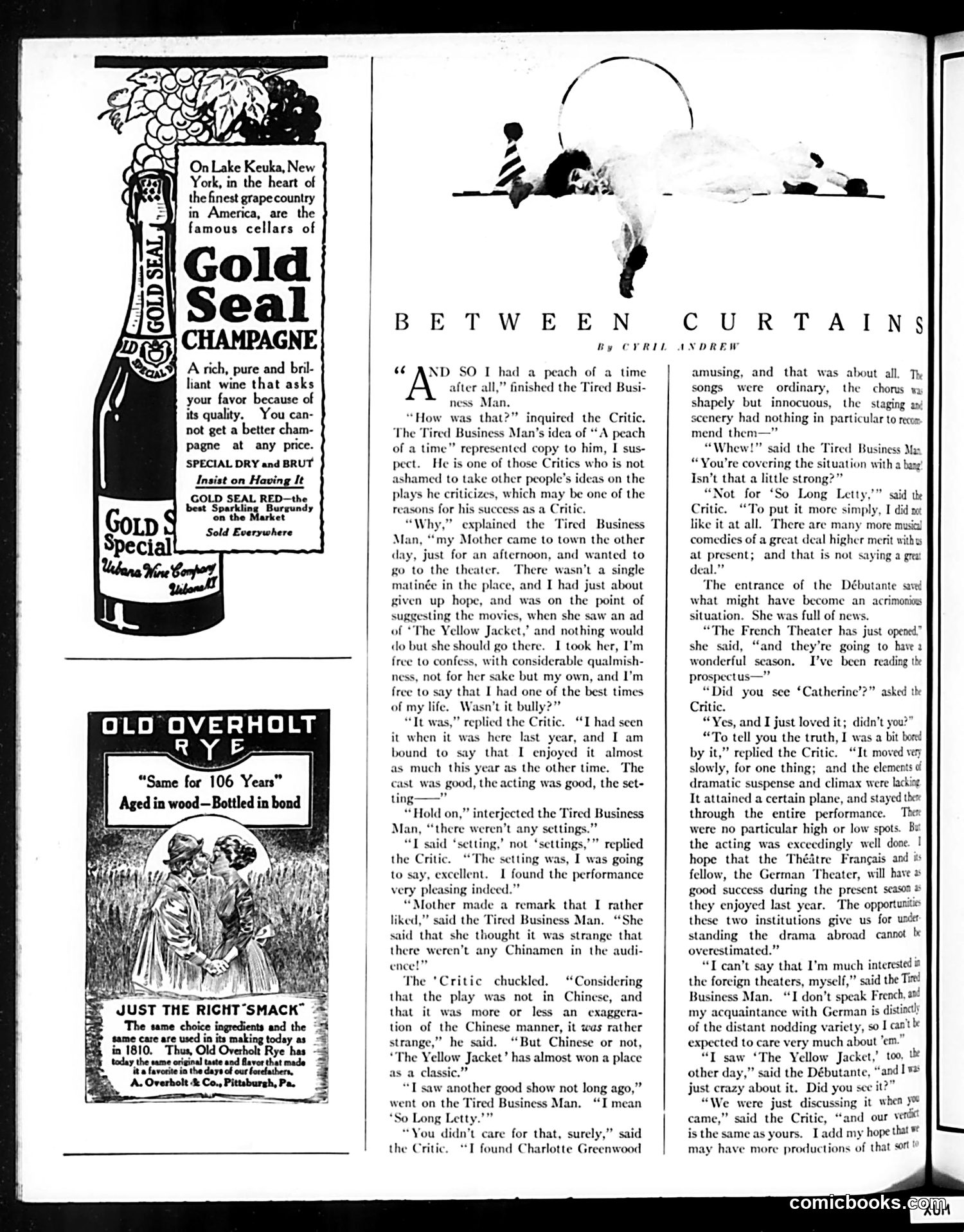
This is a satirical dialogue about theater criticism. The page presents a conversation between a "Tired Business Man" and a pretentious "Critic" who exemplify contrasting attitudes toward theater. **The satire's point:** The Critic claims sophisticated taste but reveals himself as a fraud—he admits to not actually experiencing plays firsthand, instead borrowing others' ideas. He praises obscure artistic merit ("excellent setting" in a play with no sets) while dismissing popular entertainment like "So Long Letty" and "Catherine," appearing deliberately contrary. **The Tired Business Man** represents the average theatergoer who genuinely enjoyed these shows and questions the Critic's exaggerated negativity. **The joke:** Judge mocks pretentious theater critics of the era who prioritized appearing intellectually superior over honest aesthetic response. The Critic's contradictions—praising nonexistent elements, changing his position when challenged—expose professional critics as self-important poseurs rather than genuine arbiters of theatrical quality. The advertisements flanking the text (champagne, whiskey) are typical Judge filler content.

This page is **not a cartoon or satirical content** — it is a straightforward **advertisement for Black & White Scotch Whisky**. The ad features a product bottle and promotional text emphasizing the whisky's quality: it's made from "best materials," aged in wood for ten years, and possesses "rare flavour and mellow purity." The copy claims it should be kept "in the home, both for entertainment and for health." The ad appears in *Judge* magazine, likely from the early-to-mid 20th century. While *Judge* was primarily a humor and satire publication, magazines of this era regularly mixed editorial content with full-page advertisements. There is no satire, political commentary, or joke visible here — just a period whisky advertisement emphasizing craftsmanship and suggesting health benefits, typical of pre-regulation alcohol advertising before modern restrictions on health claims.
This page is primarily **advertising and light humor** rather than political satire. The main text content includes: 1. **"A Christmas Carol"** — a humorous poem by W.D. Nesbit listing absurd gift ideas, ending with the joke that despite vowing to spend less, the list is "endless" and someone must "break the news to father" about the expense. 2. **"Grounds For Suspicion"** — a brief comedic dialogue by S.E. Kiser about a wife seeking divorce. The joke relies on period gender dynamics: the wife claims infidelity because her husband didn't scold her for lunching with an engaged gentleman—his *indifference* proves he no longer loves her. The humor comes from her twisted logic and the judge's bemused responses. The remainder consists of era-typical advertisements for cough drops, mail-order music lessons, tire companies, hotels, and patent services. No identifiable political figures or events appear on this page.
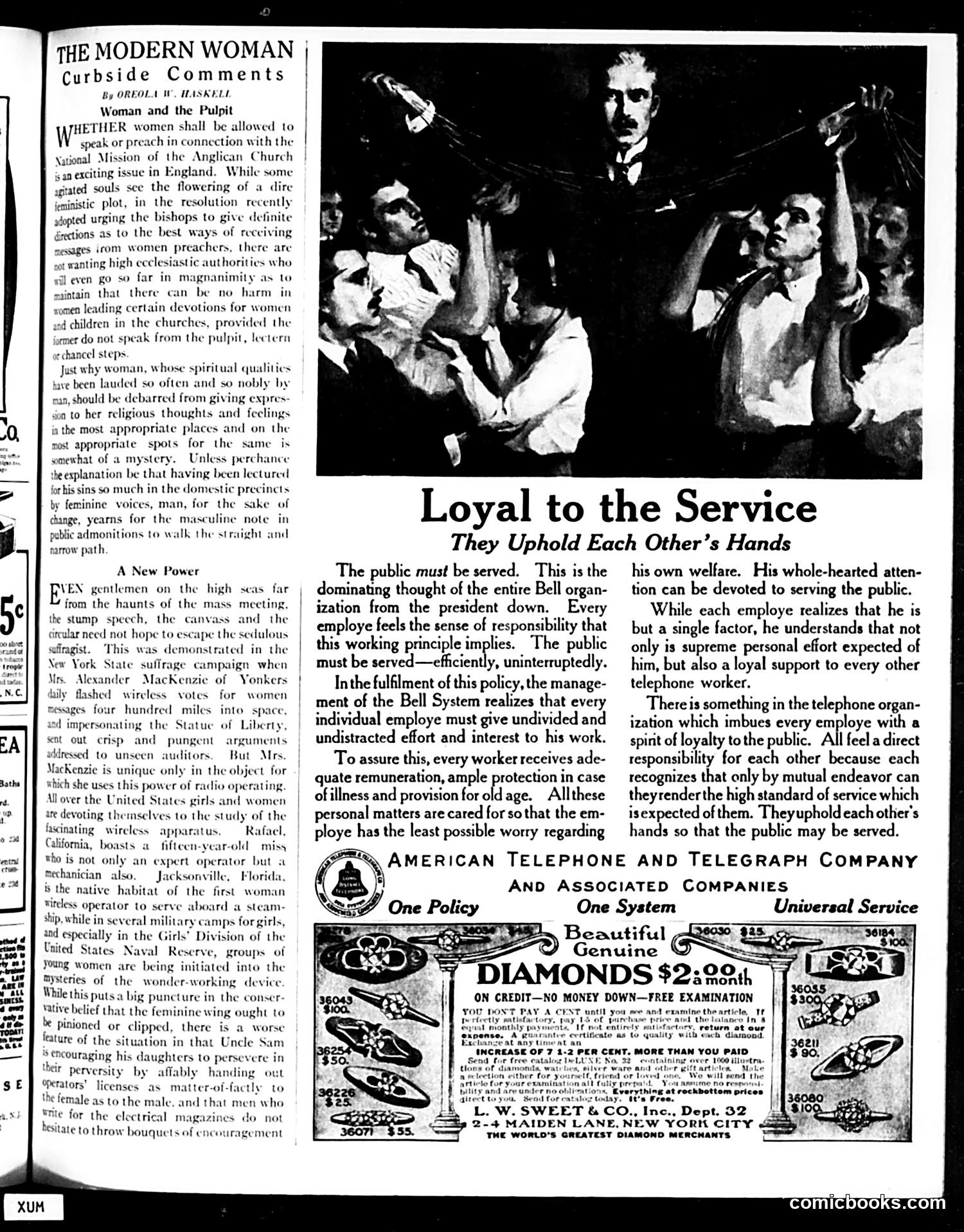
This page combines commentary on women's roles with corporate advertising. **"Woman and the Pulpit"** satirizes the Church of England's debate over whether women could preach during religious services. The author (Oreola W. Haskell) mocks the male clergy's restriction of women speakers to non-pulpit roles, questioning why women's "spiritual qualities" should be excluded from the most appropriate venues for religious expression. The joke hinges on domestic irony: men have endured feminine lectures at home and now wish to escape the "masculine note" in church. **"A New Power"** celebrates women's emerging involvement in wireless radio operation—then cutting-edge technology. It highlights suffragists using radio to campaign, and young women becoming professional operators and mechanics, mocking conservative resistance to female technological participation. **"Loyal to the Service"** is an American Telephone and Telegraph Company advertisement featuring a photo of telephone workers. It emphasizes employee loyalty, public service, and worker welfare benefits—essentially corporate propaganda about labor relations. The page reflects 1920s debates: women's expanding public roles (religious participation, technology, voting) versus traditional restrictions.
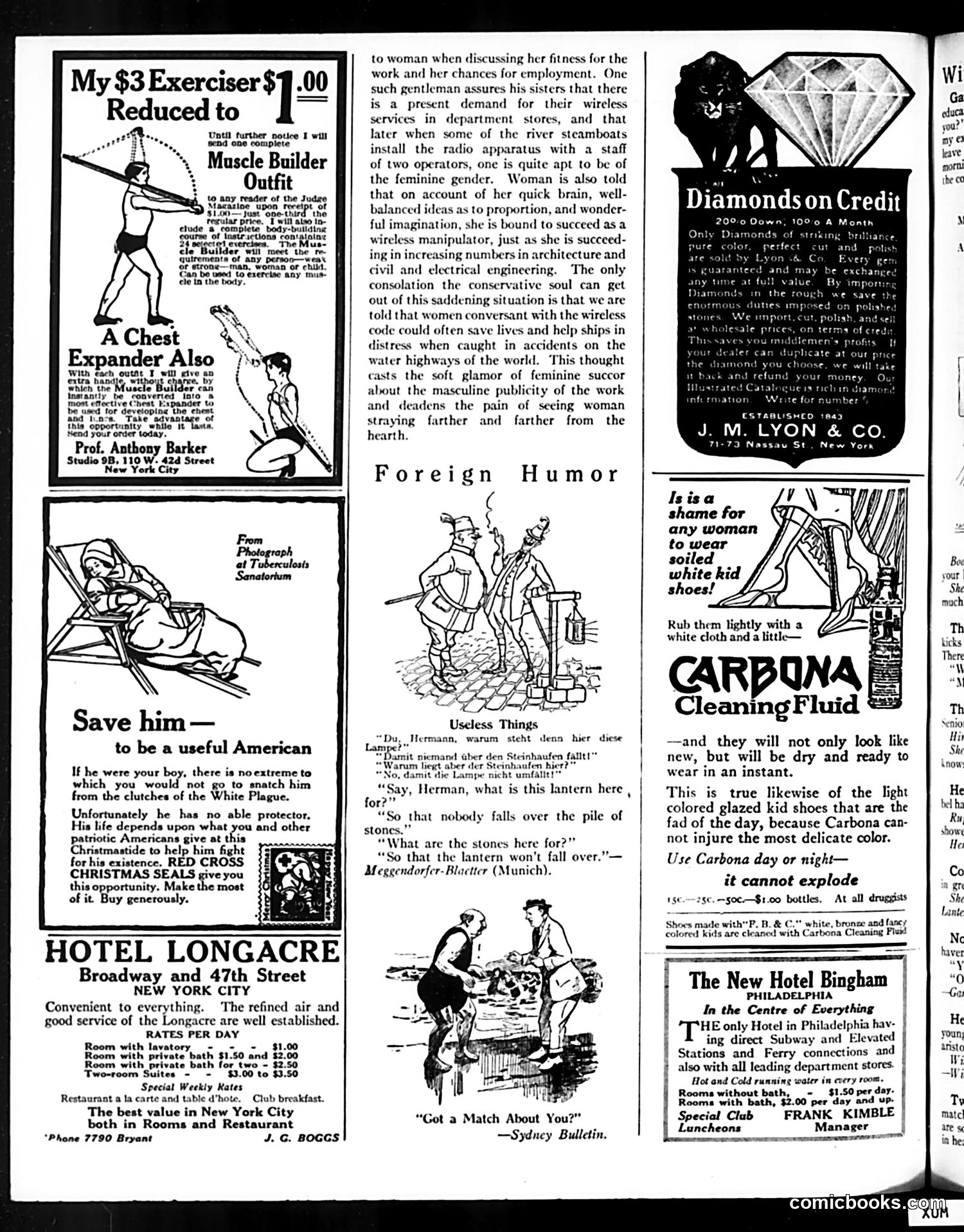
This page combines **advertisements with social commentary** typical of early 20th-century Judge magazine. The main satirical piece (center column) mocks **women entering wireless telegraphy and engineering fields**. A gentleman assures his sisters that women are "bound to succeed" in these male-dominated professions due to their "quick brain" and "wonderful imagination"—clearly ironic. The author expresses anxiety about women "straying farther and farther from the hearth," sarcastically noting that only the consolation that women operators might "save lives" makes this acceptable. This reflects genuine **contemporary anxiety about women's workforce participation and changing gender roles**. The "Foreign Humor" section presents a circular absurdist joke: lanterns protect stone piles; stones protect lanterns from falling—mocking nonsensical reasoning. The remaining content is **product advertising**: exercise equipment, Red Cross Christmas Seals (tuberculosis prevention), hotel accommodations, diamonds-on-credit, and shoe-cleaning fluid. These ads reflect period consumer culture and social concerns (tuberculosis was a major public health issue). The page captures **turn-of-the-century gender anxieties** alongside commercialism.
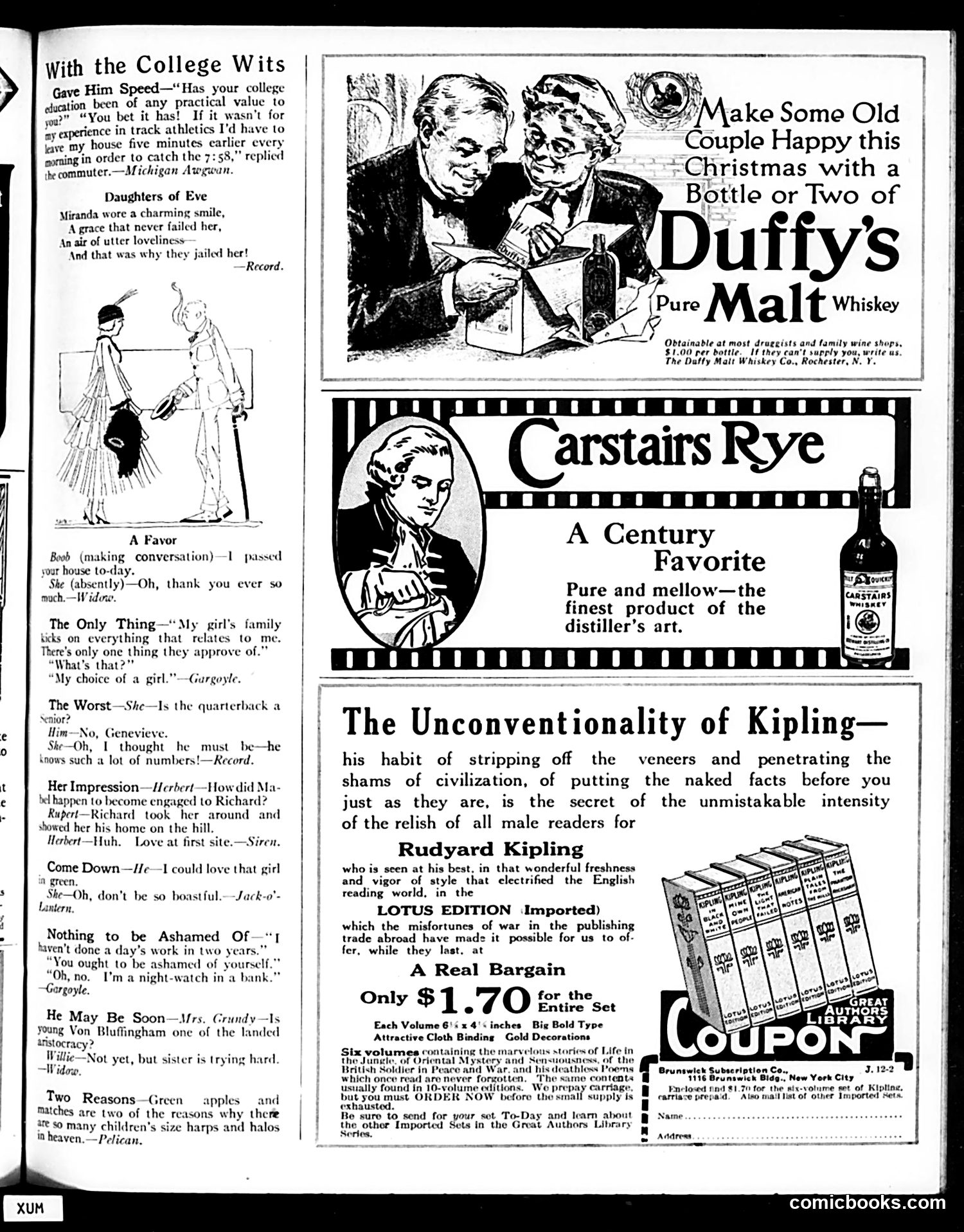
This page contains primarily **humorous short jokes and advertisements** rather than political cartoons. The **left column** features brief collegiate humor pieces ("With the College Wits")—lighthearted jokes about romance, courtship, and daily life among young people, typical of Judge's regular humor section. The **right side is dominated by three advertisements**: 1. **Duffy's Malt Whiskey**—positioned as a Christmas gift for elderly couples 2. **Carstairs Rye**—marketed as a "century favorite" whiskey 3. **Rudyard Kipling's Lotus Edition**—a mail-order book set promoted as capturing the famous author's "unconventionality" and unflinching portrayal of reality The Kipling ad is notable for emphasizing his willingness to strip away "veneers" and expose "naked facts," appealing to male readers' desire for frankness. This reflects early-20th-century literary culture where Kipling was celebrated for realism. The alcohol advertisements are striking to modern readers—presented straightforwardly without warning labels, positioned near family content, and marketed as holiday gifts.
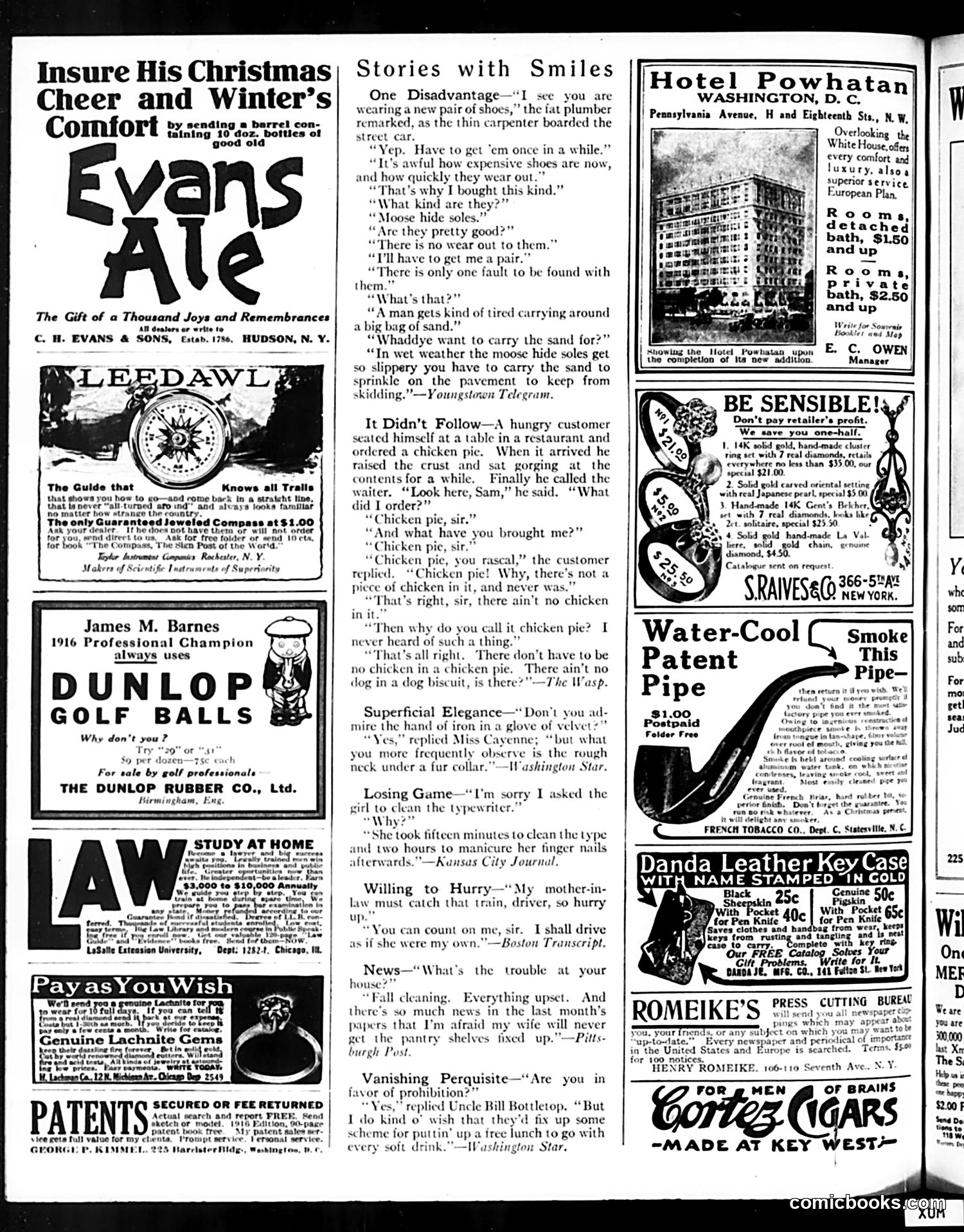
This is primarily an **advertising page** from Judge magazine, with decorative comedic short stories at top. The page contains little political satire. The **short jokes** ("Stories with Smiles") are typical vaudeville-style humor: exaggerated mishaps about moose-hide shoes requiring sand to prevent slipping, a waiter's circular logic that chicken pie needn't contain chicken (like a dog biscuit), and a man's complaint about prohibition removing free lunch offerings. The **advertisements** promote contemporary products: Evans Ale, Dunlop golf balls, patent law services, the Hotel Powhatan in Washington D.C., Lachotte gems, and Romeike's press-clipping bureau. One ad for "Be Sensible!" promotes hand-carved jewelry and gold items. The page reflects early 20th-century consumer culture and humor conventions rather than substantive political commentary. The only oblique social reference is the prohibition joke, reflecting ongoing temperance debate of that era.
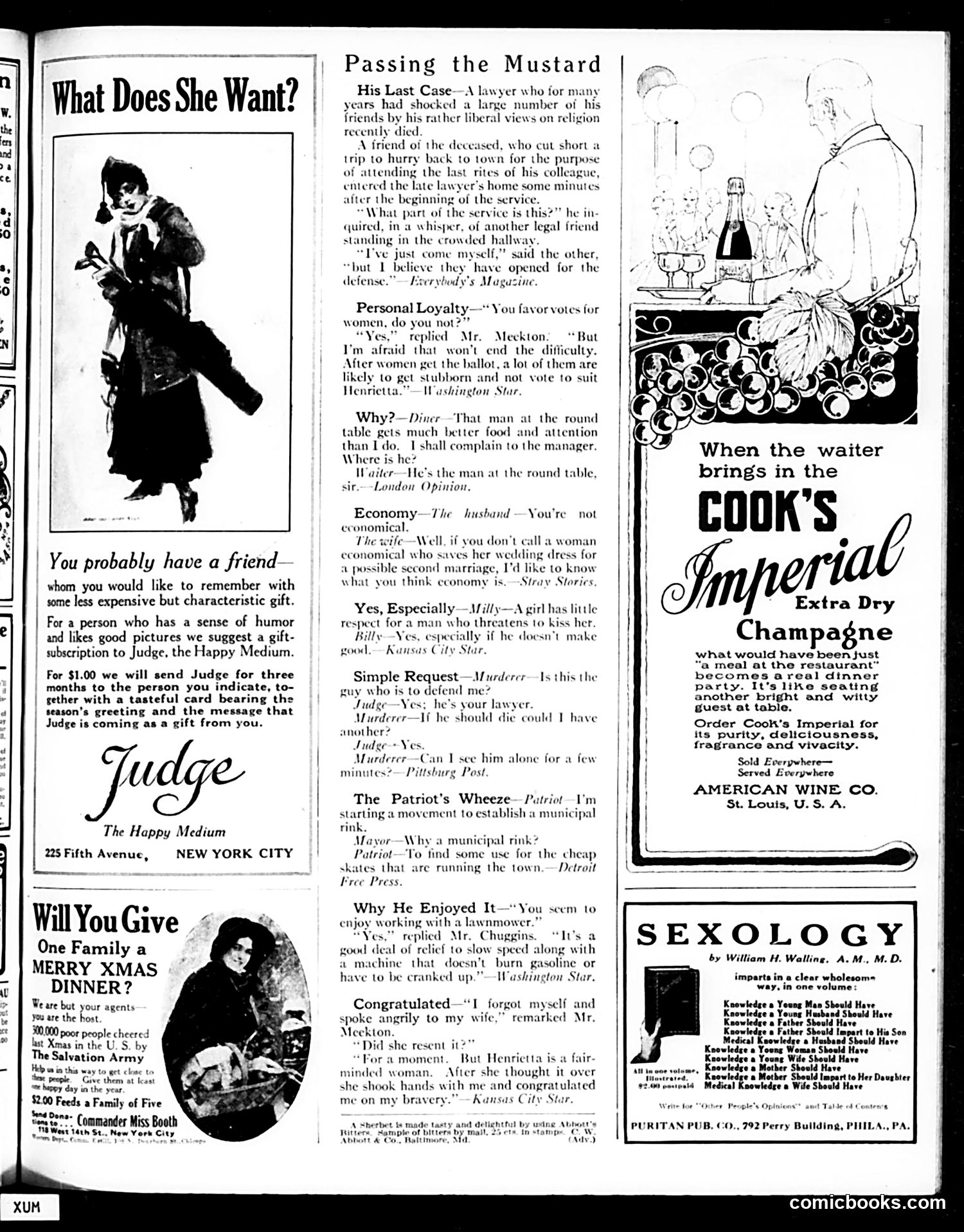
This page from *Judge* magazine contains multiple short humorous anecdotes and advertisements typical of early 20th-century American satirical publishing. The cartoons and jokes mock social conventions and gender dynamics of the era. "Personal Loyalty" satirizes male nervousness about women's suffrage, with a husband worried that voting women will become "stubborn" and vote against his preferences. "Yes, Especially" pokes fun at courtship rituals. "Economy" jokes about women saving wedding dresses for remarriage—a commentary on marriage's precariousness. Several pieces ridicule legal proceedings and politicians: a lawyer's funeral anecdote plays on his atheism; a murderer asks his lawyer absurd questions; a politician proposes a "municipal rink" to mock "cheap skates" (corrupt officials) running town government. The advertisements—for *Judge* subscriptions, Salvation Army charity, Cook's Champagne, and a book on sexology—reflect period consumer culture and social concerns. The left-side illustration showing a fashionably dressed woman likely accompanies gift-subscription advertising. Overall, the page reflects *Judge*'s brand of genteel, class-conscious humor targeting educated urban readers skeptical of social change.
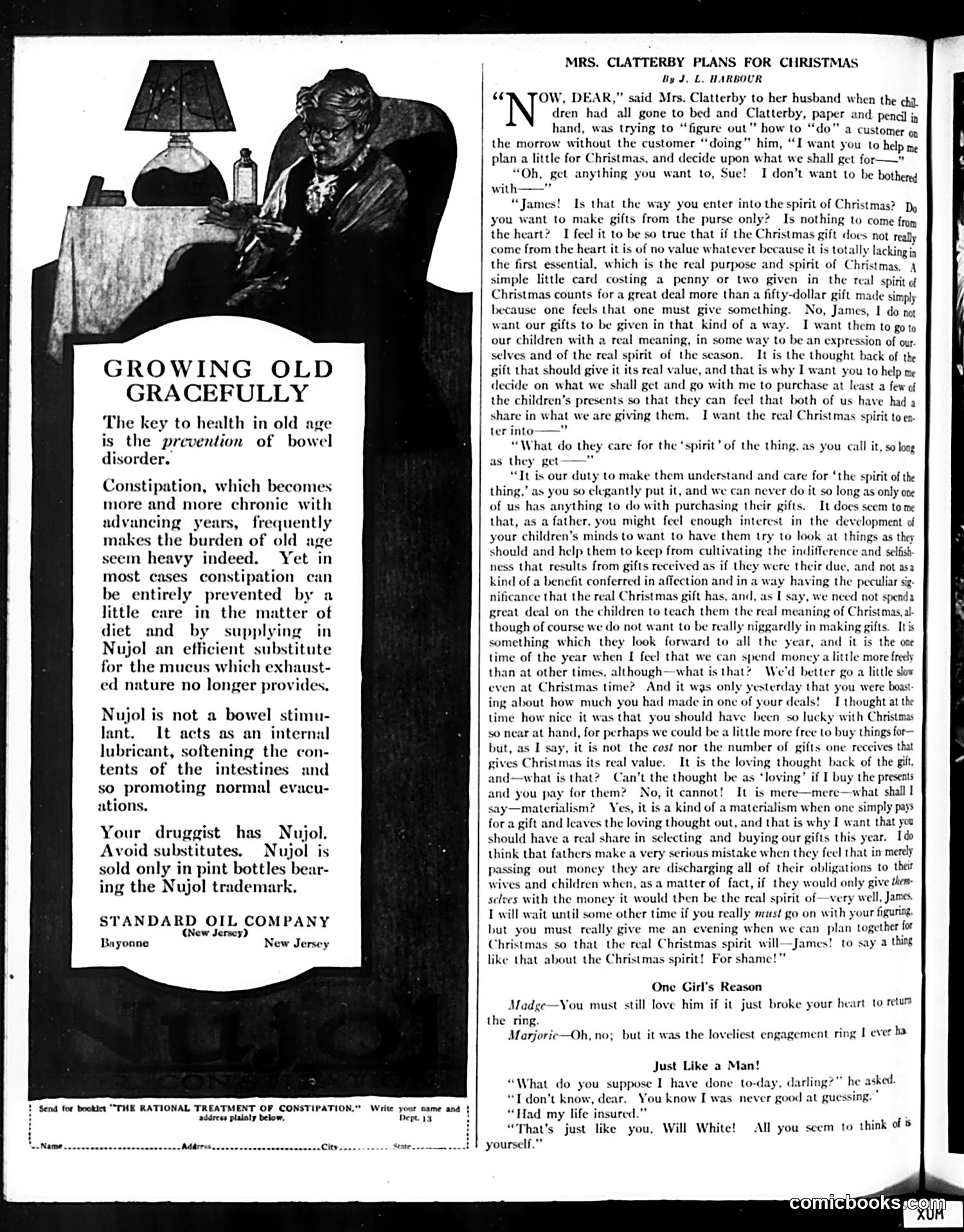
This is a domestic comedy piece (not political satire) depicting a marital disagreement over Christmas gift-giving philosophy. Mrs. Clatterby argues that meaningful gifts should come from genuine thought and shared family effort, not mere expense. Her husband James dismisses her concerns, wanting to simply buy gifts without personal involvement. The satire targets husbands who avoid Christmas planning and those who conflate spending money with meaningful gift-giving. Mrs. Clatterby represents a Progressive-era sentiment about child development and moral education—that gifts should teach children about love and family sacrifice rather than materialistic entitlement. The page also contains a Nujol advertisement (mineral oil laxative) unrelated to the story, promoting bowel health in old age—typical of 1910s-1920s magazine content mixing editorial and advertising material.
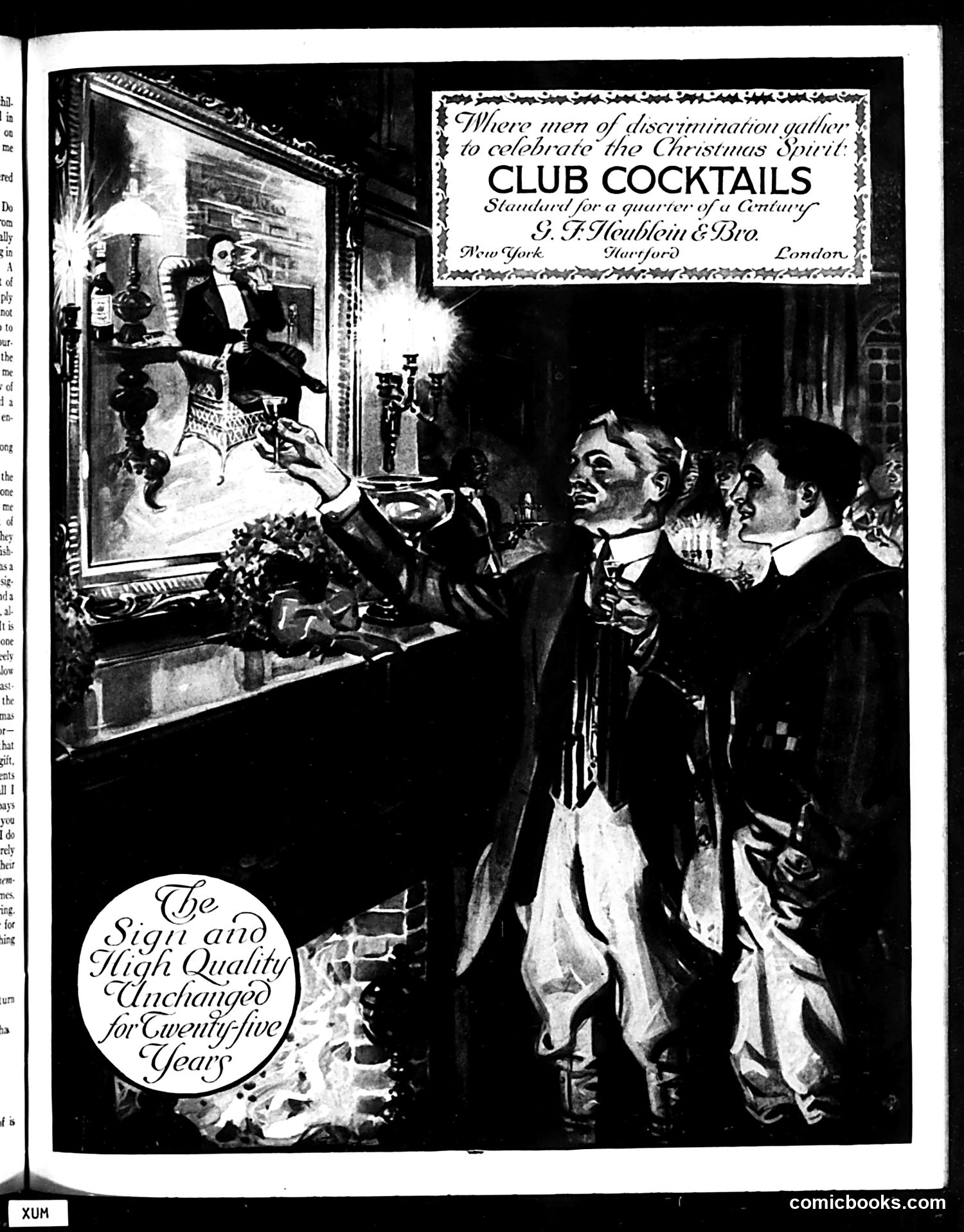
This is primarily a **liquor advertisement** for G.F. Heublein & Bro.'s Club Cocktails, not a political cartoon. The ad depicts well-dressed men admiring a framed painting of elegantly dressed figures, with a Christmas wreath below. The headline frames cocktails as what "men of discrimination gather to celebrate the Christmas Spirit." The circular text claims the product maintains "The Sign and High Quality Unchanged for Twenty-five Years." **The satire is social**, not political: it gently mocks upper-class male pretension and consumerism by suggesting that refined gentlemen celebrate Christmas through branded cocktails rather than traditional religious observance. The irony lies in advertising alcohol as the marker of sophistication and proper holiday celebration—a dig at wealthy urbanites' commercialized values. The "discrimination" referenced is both about taste and, potentially, class exclusivity.
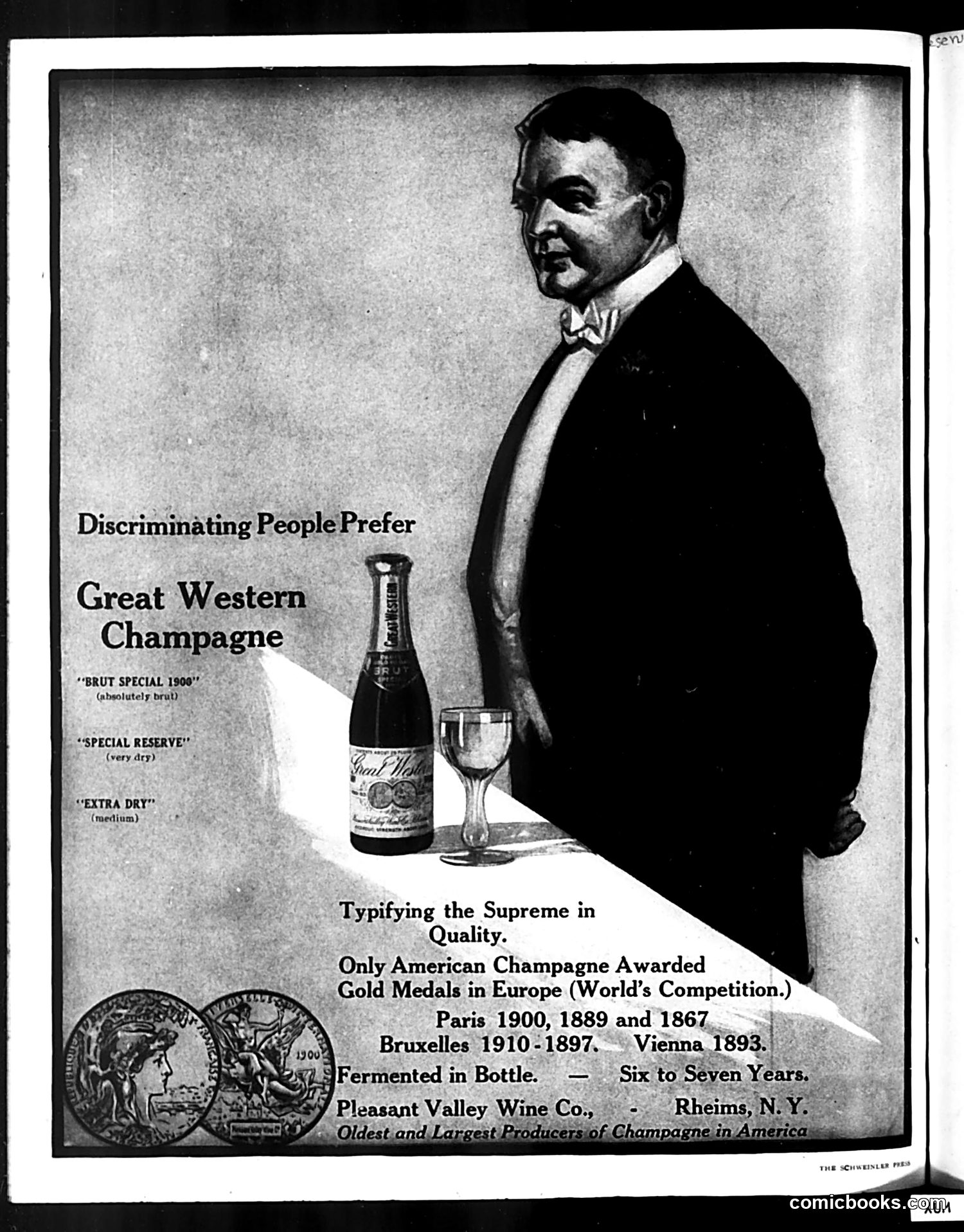
This is primarily a **full-page advertisement**, not political satire. It promotes Great Western Champagne by Pleasant Valley Wine Co. (based in Rheims, New York, despite the French name). The image shows a well-dressed man in formal evening wear examining a champagne bottle and glass. The ad's headline claims "Discriminating People Prefer" this brand, using the gentleman as an aspirational figure representing refined taste. The satire is **subtle and commercial**: the phrase "Discriminating People Prefer" implies that choosing this American champagne demonstrates superior judgment—a mild jab at European champagne pretension. The emphasis on gold medals awarded "in Europe" attempts to legitimize American wine production against continental competition. This reflects early 1900s American confidence in domestic products and the growing market for champagne among the American upper classes. The "World's Competition" claims likely reference actual international wine exhibitions of that era.