
Judge, 1916-12-02 · page 26 of 36
Judge — December 2, 1916 — page 26: what you’re looking at
What you’re looking at
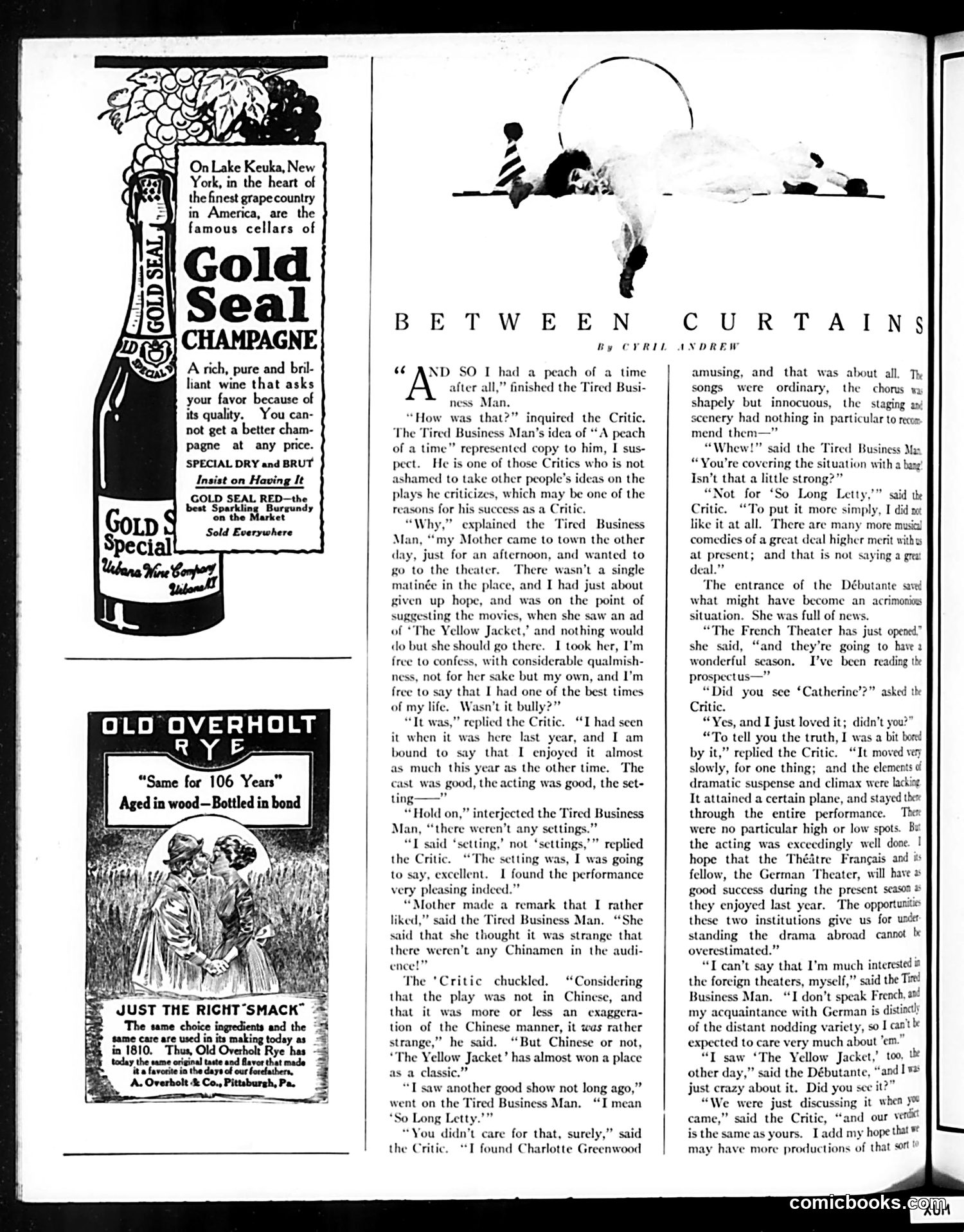
This is a satirical dialogue about theater criticism. The page presents a conversation between a "Tired Business Man" and a pretentious "Critic" who exemplify contrasting attitudes toward theater. **The satire's point:** The Critic claims sophisticated taste but reveals himself as a fraud—he admits to not actually experiencing plays firsthand, instead borrowing others' ideas. He praises obscure artistic merit ("excellent setting" in a play with no sets) while dismissing popular entertainment like "So Long Letty" and "Catherine," appearing deliberately contrary. **The Tired Business Man** represents the average theatergoer who genuinely enjoyed these shows and questions the Critic's exaggerated negativity. **The joke:** Judge mocks pretentious theater critics of the era who prioritized appearing intellectually superior over honest aesthetic response. The Critic's contradictions—praising nonexistent elements, changing his position when challenged—expose professional critics as self-important poseurs rather than genuine arbiters of theatrical quality. The advertisements flanking the text (champagne, whiskey) are typical Judge filler content.
📄 Transcribed text from this page (OCR, searchable)
Machine-transcribed from the original scan — historical spelling and the odd misread are preserved.
On Lake Keuka, New York, in the heart of the finest grapecountry in America, are the famous cellars of BETWEEN CURTAINS By CYRIL ANDREW A rich, pure and bril- liant wine that asks your favor because of its quality. You can- not get a better cham- pagne at any price. SPECIAL DRY and BRUT Insist on Having It oon. SEAL RED the parkling Burgundy on the Market Sold Everywhere OLD OVERHOLT =n 7 | The same choice ingredients and the same care are used in its making today as in 1810. Thus, Old Overholt Rye has today the same original taste and flavor that made ‘it a favorite in the days of our forefathers, NWT rns) 6 AND SO I had a peach of a time after all,” finished the Tired Busi- “How was that?” inquired the Crit The Tired Business Man’s idea of “A peach of a time” represented copy to him, I sus- pect. He is one of those Critics who is not ashamed to take other people’s ideas on the plays he criticizes, which may be one of the ons for his success as a Critic. “Why,” explained the Tired Business Man, “my Mother came to town the other day, just for an afternoon, and wanted to go to the theater. There wasn’t a single inée in the place, and I had just about given up hope, and was on the point of suggesting the movies, when she saw an ad of *The Yellow Jacket,’ and nothing would «do but she should go there. I took her, I’m free to confess, with considerable qualmish- ness, not for her sake but my own, and I’m free to say that I had one of the best times of my life. Wasn’t it bully?” “Tew: replied the Critic. “I had seen it when it here last year, and I am bound to say that I enjoyed it almost as much this year as the other time. The cast was good, the acting was good, the set- ting: “Hold on,” interjected the Tired Business Man, “there w ’t any settings.” “T said i not ‘settings,’” replied the Critic. “The setting was, I was going to say, excellent. 1 found the performance very pleasing indeed.” “Mother made a remark that I rather liked,” said the Tired Business Man. “She said that she thought it was strange that there weren't any Chinamen in the audi- ence!” The ‘Critic chuckled. “Considering that the play was not in Chinese, and that it was more or less an exaggera- tion of the Chinese manner, it wes rather strange,” he said. ‘But Chinese or not, ‘The Yellow Jacket’ has almost won a place as a classic.” “T saw another good show not long ago,” went on the Tired Business Man. “I mean ‘So Long Letty.’” “You didn’t care for that, surely,” said the Critic. “I found Charlotte Greenwood amusing, and that was about all. Tk songs were ordinary, the chorus wa shapely but innocuous, the staging ax scenery had nothing in particular to recon. mend them—" “Whew!” said the Tired Business Max “You're covering the s jon with a bang’ Isn’t that a little strong? “Not for ‘So Long Letty,’ said the Critic. “To put it more simply, I did xe like it at all. There are many more musi comedies of a great deal higher merit withs at present; and that is not saying a grat deal.” The entrance of the Débutante svi what might have become an acrimonios situation. She was full of news. “The French Theater has just opened” she said, “and they’re going to havea wonderful been reading th prospectus— “Did you see ‘Catherine’? Critic. “Yes, and I just loved it; didn’t you?” “To tell you the truth, I was a bit bord by it,” replied the Critic. “It moved vey slowly, for one thing; and the elements ¢ dramatic suspense and climax were lackiog It attained a certain plane, and stayed ther through the entire performance. The: were no particular high or low spots. Be the acting was exceedingly well done. ! hope that the Théditre Francais and é fellow, the German Theater, will have ® good suc during the present season ® they enjoyed last year. The opportuni these two institutions give us for under standing the drama abroad cannot be overestimated.” “T can’t say that I’m much interested # the foreign theaters, myself,” said the Ti! Business Man. “I don’t speak French, a my acquaintance with Germa: stinctls of the distant nodding variety, so I cant ke expected to care very much about ’em. “I saw ‘The Yellow Jacket,’ too, id the Débutante, “and 1 bout it. Did you see it?” “We were just discussing it when y* came,” said the Critic, “and our vero® is the same as yours. I add my hope that 8 may have more productions of that ft! asked the comicbooks.