
Judge, 1916-12-02 · page 29 of 36
Judge — December 2, 1916 — page 29: what you’re looking at
What you’re looking at
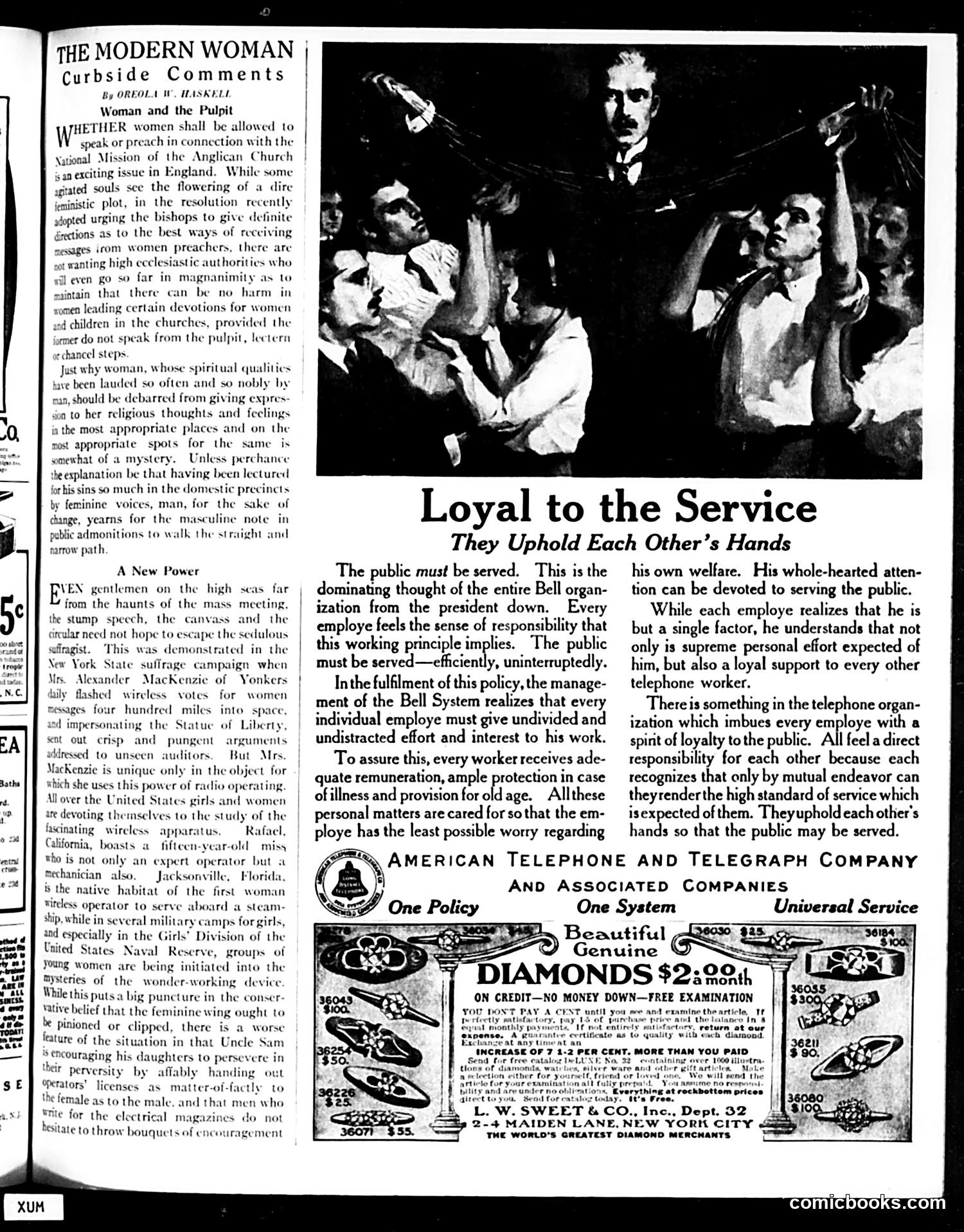
This page combines commentary on women's roles with corporate advertising. **"Woman and the Pulpit"** satirizes the Church of England's debate over whether women could preach during religious services. The author (Oreola W. Haskell) mocks the male clergy's restriction of women speakers to non-pulpit roles, questioning why women's "spiritual qualities" should be excluded from the most appropriate venues for religious expression. The joke hinges on domestic irony: men have endured feminine lectures at home and now wish to escape the "masculine note" in church. **"A New Power"** celebrates women's emerging involvement in wireless radio operation—then cutting-edge technology. It highlights suffragists using radio to campaign, and young women becoming professional operators and mechanics, mocking conservative resistance to female technological participation. **"Loyal to the Service"** is an American Telephone and Telegraph Company advertisement featuring a photo of telephone workers. It emphasizes employee loyalty, public service, and worker welfare benefits—essentially corporate propaganda about labor relations. The page reflects 1920s debates: women's expanding public roles (religious participation, technology, voting) versus traditional restrictions.
📄 Transcribed text from this page (OCR, searchable)
Machine-transcribed from the original scan — historical spelling and the odd misread are preserved.
THE MODERN WOMAN Curbside Comments By OREOLA W. HASKELL Woman and the Pulpit HETHER women shall be allowed to \ speak or preach in connection with the National Mission of the Anglican Church san exciting issue in England. While some sated souls see the flowering of a dire stic plot, in the resolution recently nite ing are sbpted urging the bishops to give de! rections as to the best ways of rece nesages irom women preachers, there wt wanting high ecclesiastic authorities who in magnanimity as to a] even go so f no harm in ain that there can be leading certain devotions for women ind children in the churches, provided the mer do not speak from the pulpit, lectern s chancel steps Just why woman, whose spiritual qualities tave been lauded so often and so nobly by can, should be debarred from giving expres- son to her religious thoughts and feelings in the most appropriate places and on the most appropriate spots for the same is somewhat of a mystery. Unless perchance theexplanation be that having been lectured for his sins so much in the domestic precincts by feminine voices, man, for the sake of ge, yearns for the masculine note in admonitions to walk the straight and narrow path. A New Power VEN gentlemen on the high seas far from the haunts of the mass meeting, the stump speech, the canvass and the circular need not hope to escape the sedulous siiragist. This was demonstrated in the New York State suff campaign when Mr. Alexander M. zic of Yonkers ily flashed wireless votes for women nesages four hundred miles into space, aod impersonating the Statue of Liberty, sat out crisp and pungent arguments essed to unseen auditors. But Mrs nzie is unique only in the object for shich she uses this power of radio operating. All over the United States girls and women are devoting themselves to the study: of the fascinating wireless apparatus. — Rafael, ‘alifornia, boasts a fifteen-year-old — miss to is not only an expert operator but a nechanician also. Jacksonville, Florida, is the native habitat of the first’ woman ¥iteless operator to serve aboard a steam- ship, while in several military camps for gir and especially in the Girls’ Division of the United States Naval Reserve, groups of young women are being initiated into the tysteries of the wonder-working device. While this puts a big puncture in the conser- ‘ative belief that the feminine wing ought to be pinioned or clipped, there is a worse kature of the situation in that Uncle Sam sencouraging his daughters to persevere in Meir perversity by affably handing out tors’ licenses as matter-of-factly to male as to the male. and that men who for the electrical magazines do not Hate to throw bouquets of encouragement | | Loyal to the Service They Uphold Each Other’s Hands The public must be served. This is the dominating thought of the entire Bell organ- ization from the president down. Every employe feels the sense of responsibility that this working principle implies. The public must be served—effciently, uninterruptedly. Inthe fulfilment of this policy, the manage- ment of the Bell System realizes that every individual employe must give undivided and undistracted effort and interest to his work. To assure this, every worker receives ade- quate remuneration, ample protection in case of illness and provision for old age. Alllthese personal matters are cared for so that the em- ploye has the least possible worry regarding OF Policy D One System Beautiful his own welfare. His whole-hearted atten- tion can be devoted to serving the public. While each employe realizes that he is but a single factor, he understands that not only is supreme personal effort expected of him, but also a loyal support to every other telephone worker. There is something in the telephone organ- ization which imbues every employe with a spint of loyalty tothe public. All feel a direct responsibility for each other because each recognizes that only by mutual endeavor can theyrenderthe high standard of service which isexpected of them. Theyuphold each other's hands so that the public may be served. i AND ASSOCIATED COMPANIES Universal Service CO TELEPHONE AND TELEGRAPH COMPANY \ ONDS $2222%h ON CREDIT—NO MONEY DOWN—FREE EXAMINATION YOU PONT PAY NT until perfectly ratietar € you fur we and examine the article, Tf ix INCREASE OF 7 1-2 PER CENT. MORE THAN YOU PAID at atticlo for y tilityand direct to ¥ L. W. SWEET