
Judge, 1916-12-02 · page 34 of 36
Judge — December 2, 1916 — page 34: what you’re looking at
What you’re looking at
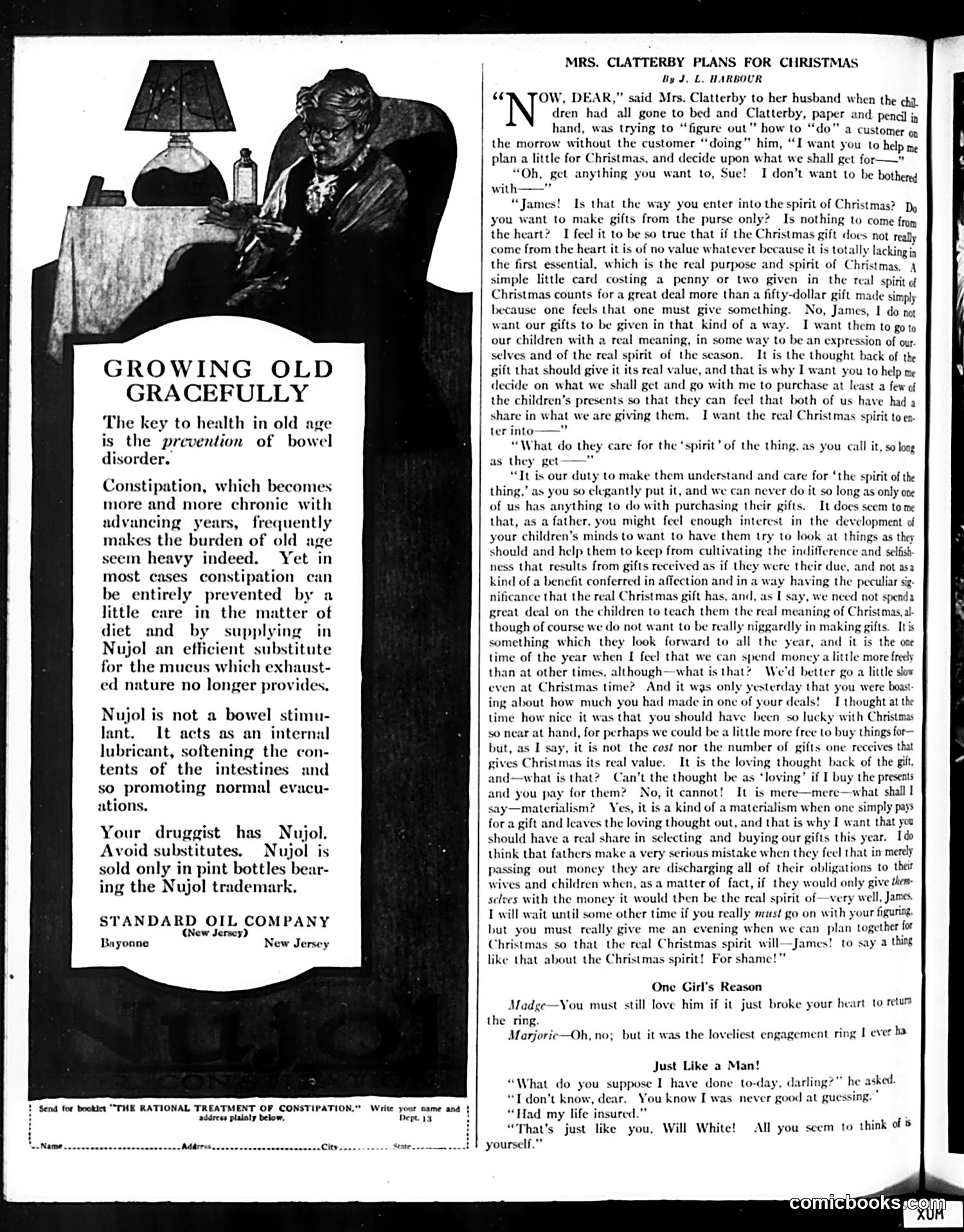
This is a domestic comedy piece (not political satire) depicting a marital disagreement over Christmas gift-giving philosophy. Mrs. Clatterby argues that meaningful gifts should come from genuine thought and shared family effort, not mere expense. Her husband James dismisses her concerns, wanting to simply buy gifts without personal involvement. The satire targets husbands who avoid Christmas planning and those who conflate spending money with meaningful gift-giving. Mrs. Clatterby represents a Progressive-era sentiment about child development and moral education—that gifts should teach children about love and family sacrifice rather than materialistic entitlement. The page also contains a Nujol advertisement (mineral oil laxative) unrelated to the story, promoting bowel health in old age—typical of 1910s-1920s magazine content mixing editorial and advertising material.
📄 Transcribed text from this page (OCR, searchable)
Machine-transcribed from the original scan — historical spelling and the odd misread are preserved.
GROWING OLD GRACEFULLY The key to health in old age is the prevention of bowel disorder. Constipation, which becomes more and more chronic with advancing years, frequently makes the burden of old age seem heavy indeed. Yet in most cases constipation can be entirely prevented by a little care in the matter of diet and by supplying in Nujol an efficient substitute for the mucus which exhaust- ed nature no longer provides, Nujol is not a bowel stimu- lant. It acts as an internal lubricant, softening the con- tents of the intestines and so promoting normal evacu- ations. Your druggist has Nujol. Avoid substitutes. Nujol is sold only in pint bottles bear- ing the Nujol trademark. STANDARD OIL COMPANY (New Jersey! Bayonne New Jersey { Send for booklet “THE RATIONAL TREATMENT OF CONSTIPATION.” address plainly below. Write your eame and { Dept 13. MRS. CLATTERBY PLANS FOR CHRISTMAS By J. L. HARBOUR “ OW, DEAR,” said Mrs. Clatterby to her husband when the chil. N dren had all gone to bed and Clatterby, paper and pencil ip hand, was trying to “figure out” how to “do” a customer op the morrow without the customer “doing” him, “I want you to help m plan a little for Christmas, and decide upon what we shall get fo-——" “Oh, get anything you want to, Suc! I don’t want to be bothered with——” “James! Is that the way you enter into the spirit of Christmas? Dp you want to make gifts from the purse only? Is nothing to come from the heart? I feel it to be so true that if the Christmas gift does not Teally come from the heart it is of no value whatever because it is totally lacking in the first essential, which is the real purpose and spirit of Christmas. 4 simple litle card costing a penny or two given in the real spirit of Christmas counts for a great deal more than a fifty-dollar gift made simply because one feels that one must give something. No, James, I do not want our gifts to be given in that kind of a w: T want them to go to our children with a real meaning, in some way to be an expression of our. selves and of the re; It is the thought back of the gift that should give it its real value, and that is why I want you to help me decide on what we shall get and go with me to purchase at least a few of the children’s presents so that they can feel that both of us have had a share in what we are giving them. I want the real Christmas spirit to es- ter into——" “What do they care for the ‘spiri as they get 8 “Tt is our duty to make them understand and care for ‘the spirit of the thing,’ as you so elegantly put it, and we can never do it so long as only one of us has anything to do with purchasing their gifts. It does seem to me that, as a father, you might feel enough interest in the development of your children’s minds to want to have them try to look at things as they should and help them to keep from cultivating the indifference and selfish- ness that results from gifts received as if they were their due, and not asa kind of a benefit conferred in affection and in a way having the peculiar sig- nificance that the real Christmas gift has, and, as I say, we need not spenda great deal on the children to teach them the real meaning of Christmas, a- though of course we do not want to be really niggard something which they look forward to all the y und it is the one time of the year when I feel that we can spend money a little more freely than at other times, although—what is tha’ We'd better go a little sow even at Christmas time? And it was only yesterday that you were boast ing about how much you had made in one of your deals! I thought at the time how nice it was that you should have been so lucky with Christmas so near at hand, for perhaps we could be a little more free to buy things for— but, as I say, it is not the cost nor the number of gifts one receives that gives Christmas its real value. It is the loving thought back of the gift, and—what is that? Can’t the thought be as ‘loving’ if I buy the presents and you pay for them? No, it cannot! It is mere—mere—what shall | say—matecrialism? Yes, it is a kind of a materialism when one simply pays for a gift and leaves the loving thought out, and that is why I want that you should have a real share in selecting and buying our gifts this year. Ido think that fathers make a very serious mistake when they fecl that in merely assing out money they are discharging all of their obligations to ther and children when, as a matter of fact, if they would only give them selves with the money it would then be the real spirit of—very well, James 1 will wait until some other time if you really must go on with your figuring. but you must really give me an evening when we can plan together for Christmas so that the real Christmas spirit will—James! to say a thing like that about the Christmas spirit! For shame of the thing, as you call it, so long One Girl's Reason Madge—You must still love him if it just broke your heart to retum the ring. Marjoric—Oh, no; but it was the loveliest engagement ring I ever ha Just Like a Man! “What do you suppose I have done to-day, darling?” he asked. “T don’t know, dear. You know I was never good at guessing.” “Had my life insured.” “That's just like you, Will White! yourself.”” All you seem to think of 5