
Judge, 1916-12-02 · page 24 of 36
Judge — December 2, 1916 — page 24: what you’re looking at
What you’re looking at
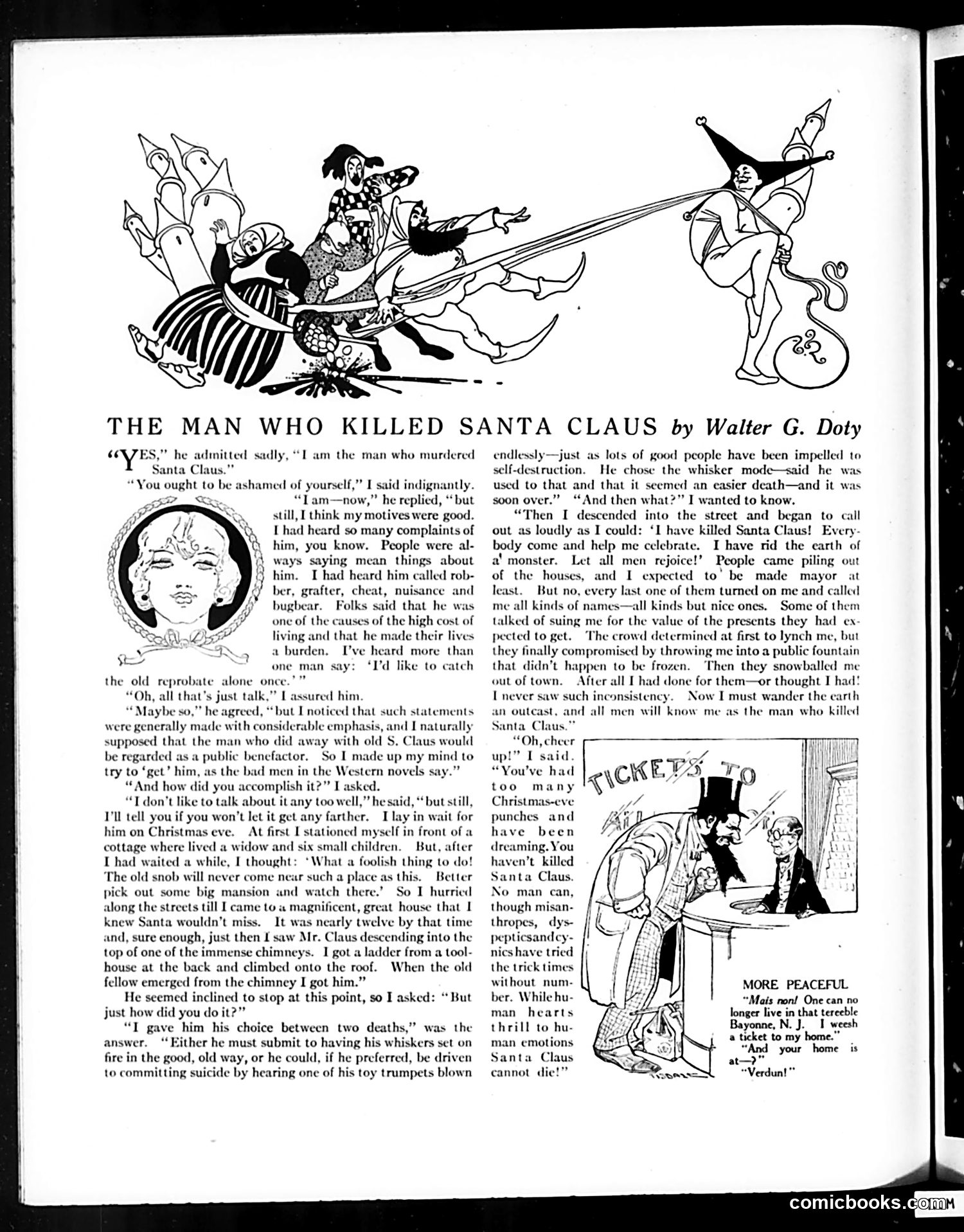
This is a short story by Walter G. Doty satirizing anti-Santa sentiment and misanthropy. A man confesses to "murdering" Santa Claus, claiming he heard widespread complaints that Santa was a "robber, grafter, cheat" who caused the high cost of living—a reference to early 20th-century economic grievances and labor disputes. The satire reveals the absurdity: the man expects to be celebrated as a public hero for eliminating what he saw as a social burden, but instead is attacked by the very people he thought he was helping. The irony is sharp—people who rhetorically "wanted to catch" Santa suddenly defend him when someone acts on their complaints. The conclusion, where another character dismisses this as drunk fantasy, suggests the story mocks both cynics who blame Santa (or scapegoats generally) for societal ills, and the disconnect between people's complaints and their actual values. It's social criticism wrapped in dark comedy.
📄 Transcribed text from this page (OCR, searchable)
Machine-transcribed from the original scan — historical spelling and the odd misread are preserved.
THE MAN WHO KILLED SANTA CLAUS by Walter G. Doty ” he admitted sadly, “Lam the man who murdered Santa Claus.” “You ought to be ashamed of yourself,” I said indignantly. “Tam—now,” he replied, “but still, I think my motives were good. I had heard so many complaints of him, you know. People were al- ways saying mean things about him. I had heard him called rob- ber, grafter, cheat, nuisance and bugbear. Folks said that he was one of the causes of the high cost of ng and that he made their lives aburden. I’ve heard more than one man ‘V’'d like to catch the old reprobate alone once.’ at's just talk,” [assured him he agreed, “but T noticed that such statements were generally made with considerable emphasis, and I naturally supposed that the man who did away with old S. Claus would be regarded as a public benefactor. So I made up my mind to try to ‘get’ him, as the bad men in the Western novels say.” “And how did you accomplish it?” I asked. “T don’t like to talk about it any too well,” he said, “but still, I'll tell you if you won't let it get any farther. I lay in wait for him on Christmas eve. At first [ stationed myself in front of a cottage where lived a widow and six small children. But, after I had waited a while, I thought: ‘What a foolish thing to do! The old snob will never come near such a pl: this. Better pick out some big mansion and watch there.’ So I hurried along the streets till I came to « magnificent, great house that | knew Santa wouldn’t miss. It was nearly twelve by that time and, sure enough, just then I saw Mr. Claus descending into the top of one of the immense chimneys. I got a ladder from a tool- house at the back and climbed onto the roof. When the old fellow emerged from the chimney I got him.” He seemed inclined to stop at this point, so I asked: “But just how did you do it?” “T gave him his choice between two deaths,” was the answer. “Either he must submit to having his whiskers set on fire in the good, old way, or he could, if he preferred, be driven to committing suicide by hearing one of his toy trumpets blown endlessly—just as lots of good people have been impelled to self-destruction. He chose the whisker mode—said he was used to that and that it seemed an easier death—and it was S ver.” “And then what?” I wanted to know. hen I descended into the street and began to call out as loudly as I could: ‘1 have killed Santa Claus! Every- body come and help me celebr: I have rid the earth of a’ monster. Let all men rejoice!’ People came piling out of the houses, and I expected to’ be made mayor at least. But no, every last one of them turned on me and called me all kinds of names—all kinds but cones. Some of them talked of suing me for the value of the presents they had ex pected to get. The crowd determined at first to lynch me, but they finally compromised by throwing me into a public fountain that didn’t happen to be frozen. ‘Then they snowballed me out of town. After all I had done for them—or thought I had! [never saw such inconsistency. Now I must wander the earth “You've had too many Christmas-eve punches and have been dreaming. You aven’t killed nta Claus No man can, though misan- thropes, dys- pepticsandcy- ni ¢ tried the trick times without num- ber. While hu- “Mais non! One can no man hearts longer live in that tereeble thrill to hu- Bay . J. 1 weesh man emotions > Santa Cl. cannot comicbooks.