
A complete issue · 28 pages · 1916
Judge — October 28, 1916
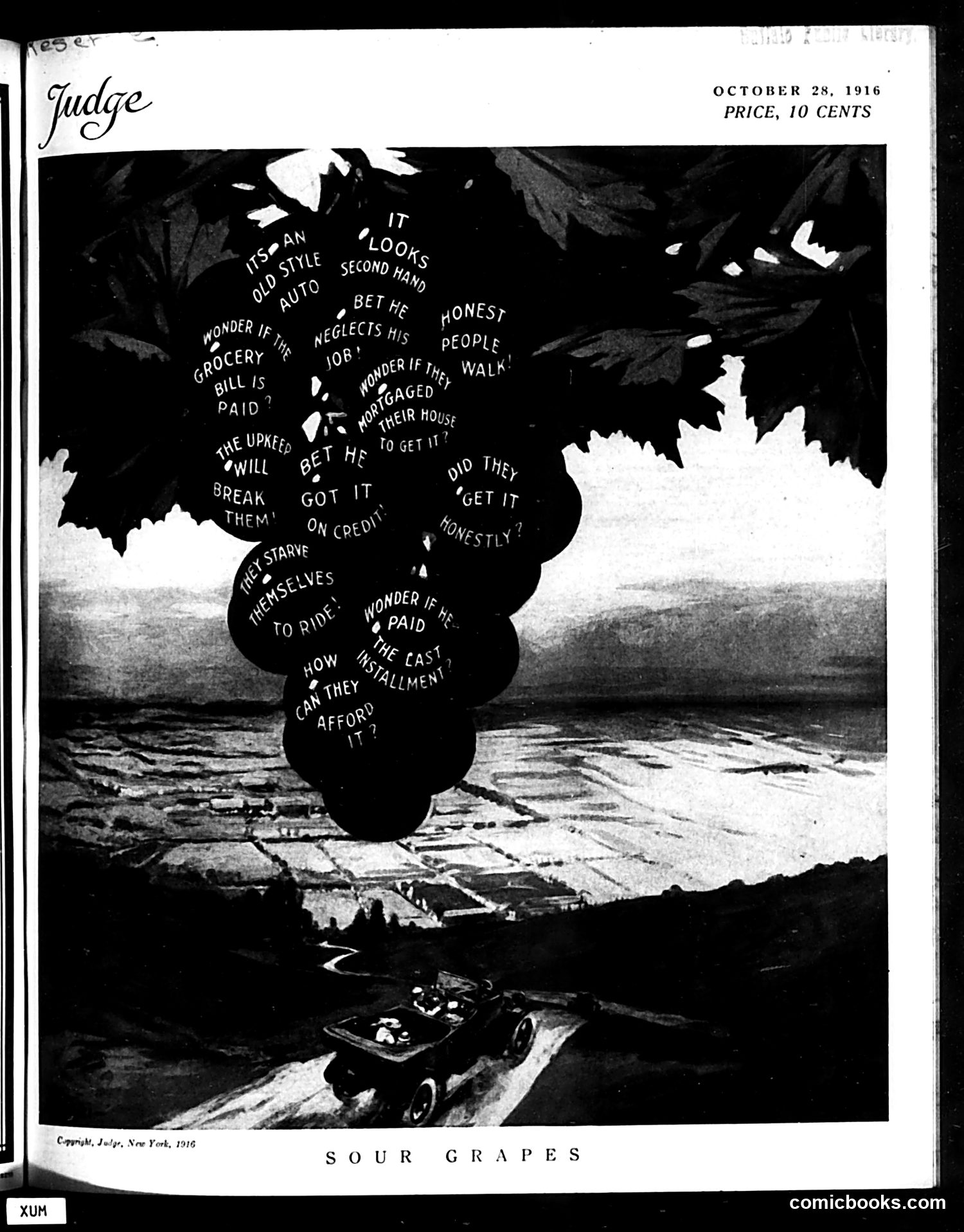
This political cartoon depicts an automobile driver beneath a large dark cloud filled with complaints and worries. The cloud contains various concerns: a secondhand car's poor condition, unpaid grocery bills, mortgaged houses, unaffordable installment payments, and job insecurity. The title "Sour Grapes" suggests the driver is complaining about circumstances beyond his control or making excuses. The imagery appears to critique how automobiles—marketed as signs of prosperity and progress—created financial strain for ordinary Americans through installment buying and maintenance costs. The contrast between the aspirational vehicle below and the storm cloud of debt above satirizes the gap between American consumer dreams and economic reality during this pre-World War I period.
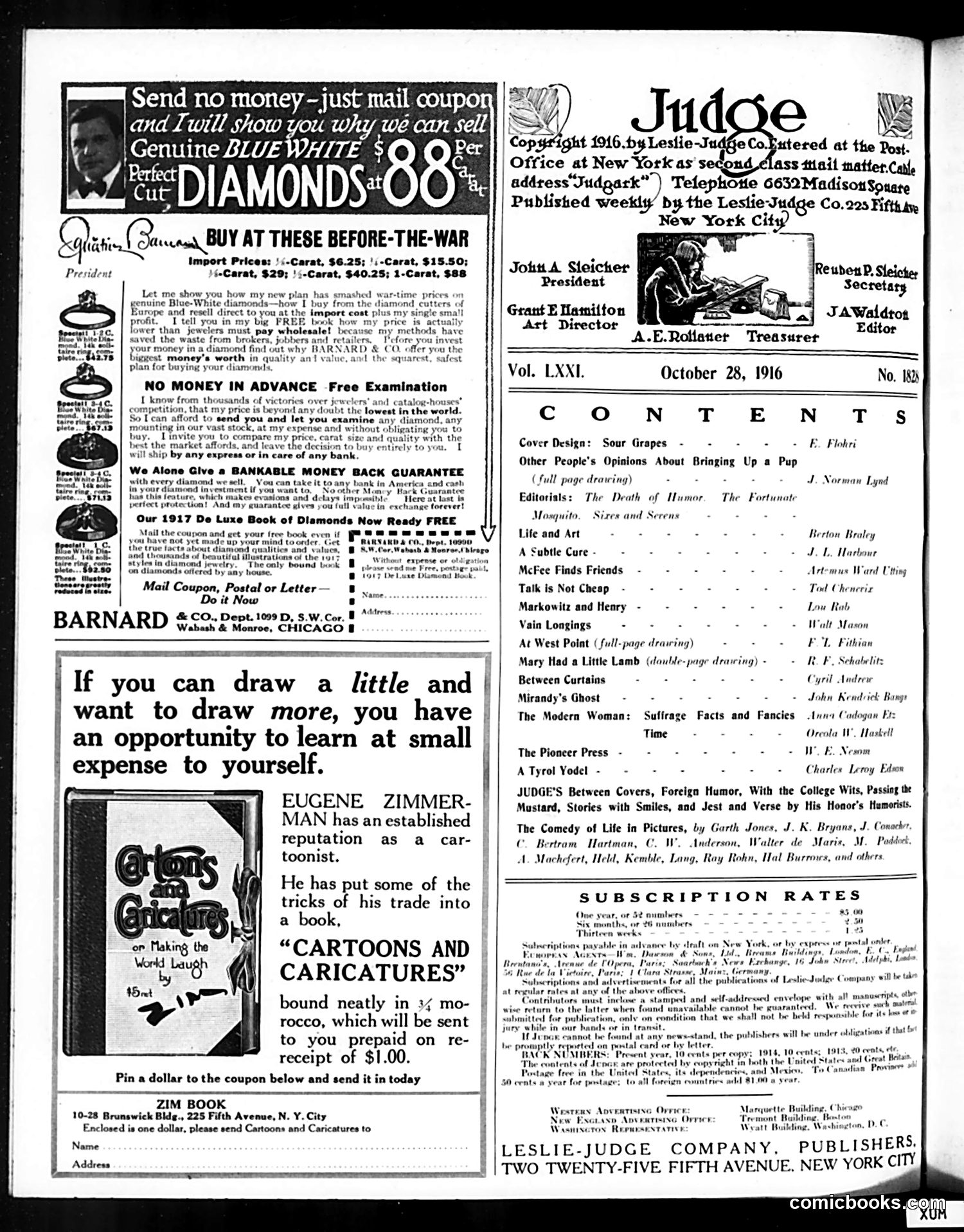
This page is primarily **advertising and subscription information** for Judge magazine rather than political cartoons. The dominant content includes: - A diamond sales pitch ("Genuine Blue White Diamonds at 88¢ per carat") - An ad for Eugene Zimmerman's book "Cartoons and Caricatures" about cartooning techniques - Magazine subscription rates and masthead information The publication date (October 1916) places this during **Woodrow Wilson's re-election campaign**, but this particular page contains no visible political commentary or satire. The "Contents" section lists various articles and illustrations planned for the issue, but the actual satirical cartoons referenced are not shown on this reproduced page.
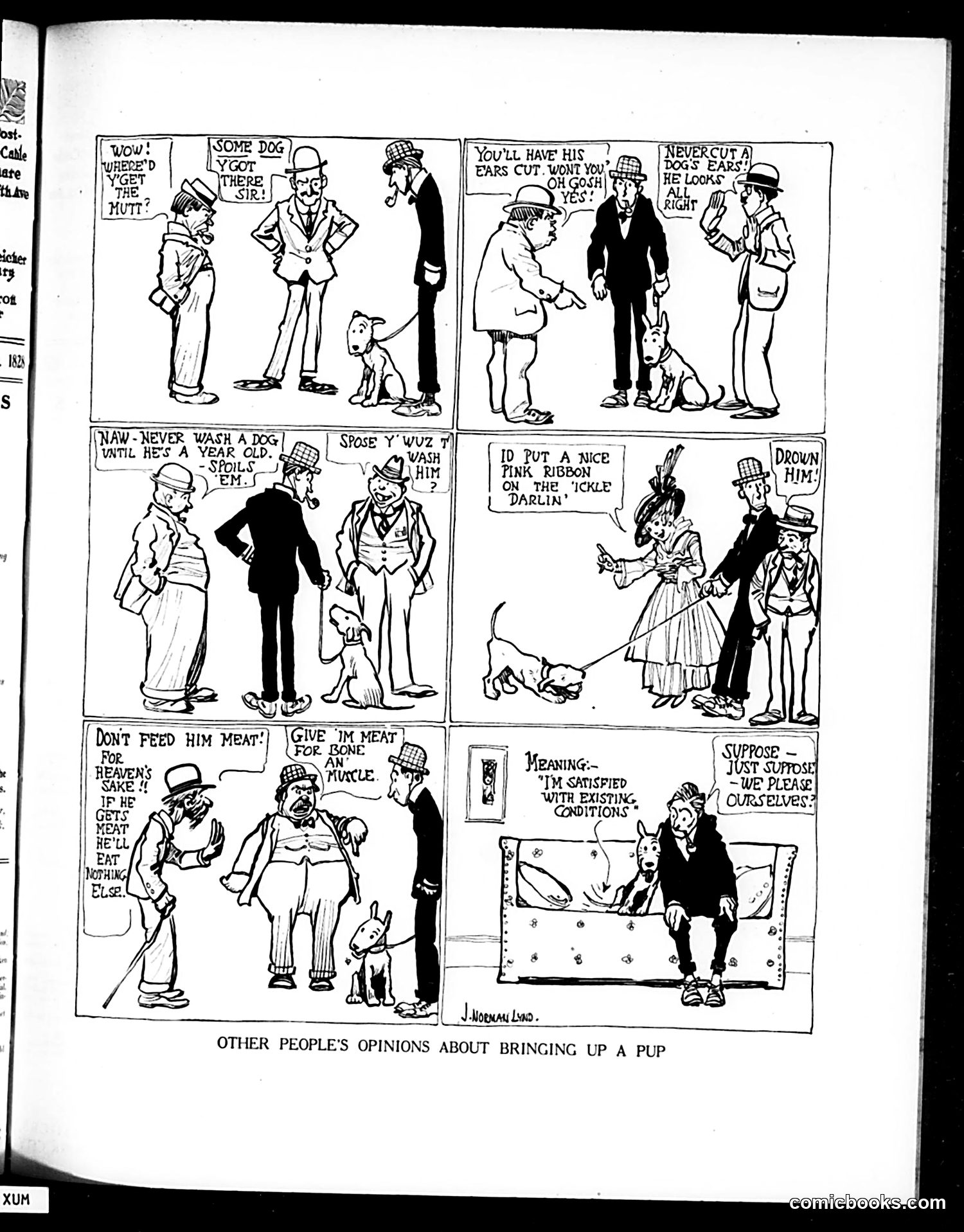
This early 20th-century comic satirizes conflicting advice about dog care that pet owners receive from various people. The panels show: **Different opinions include:** - Ear cropping for appearance ("Never cut a dog's ears") - Washing frequency (wait until one year old) - Diet debates (meat versus bones) - Grooming practices (pink ribbons) - General contentment with existing conditions The humor comes from the contradictory nature of unsolicited advice—each character confidently contradicts the others. This reflects a universal social experience: well-meaning people offering conflicting guidance on pet care. The final panel shows an exhausted owner in bed, having heard all these opinions, suggesting the absurdity of trying to follow such contradictory counsel. The satire mocks how people dogmatically insist their way is correct without acknowledging legitimate alternatives.
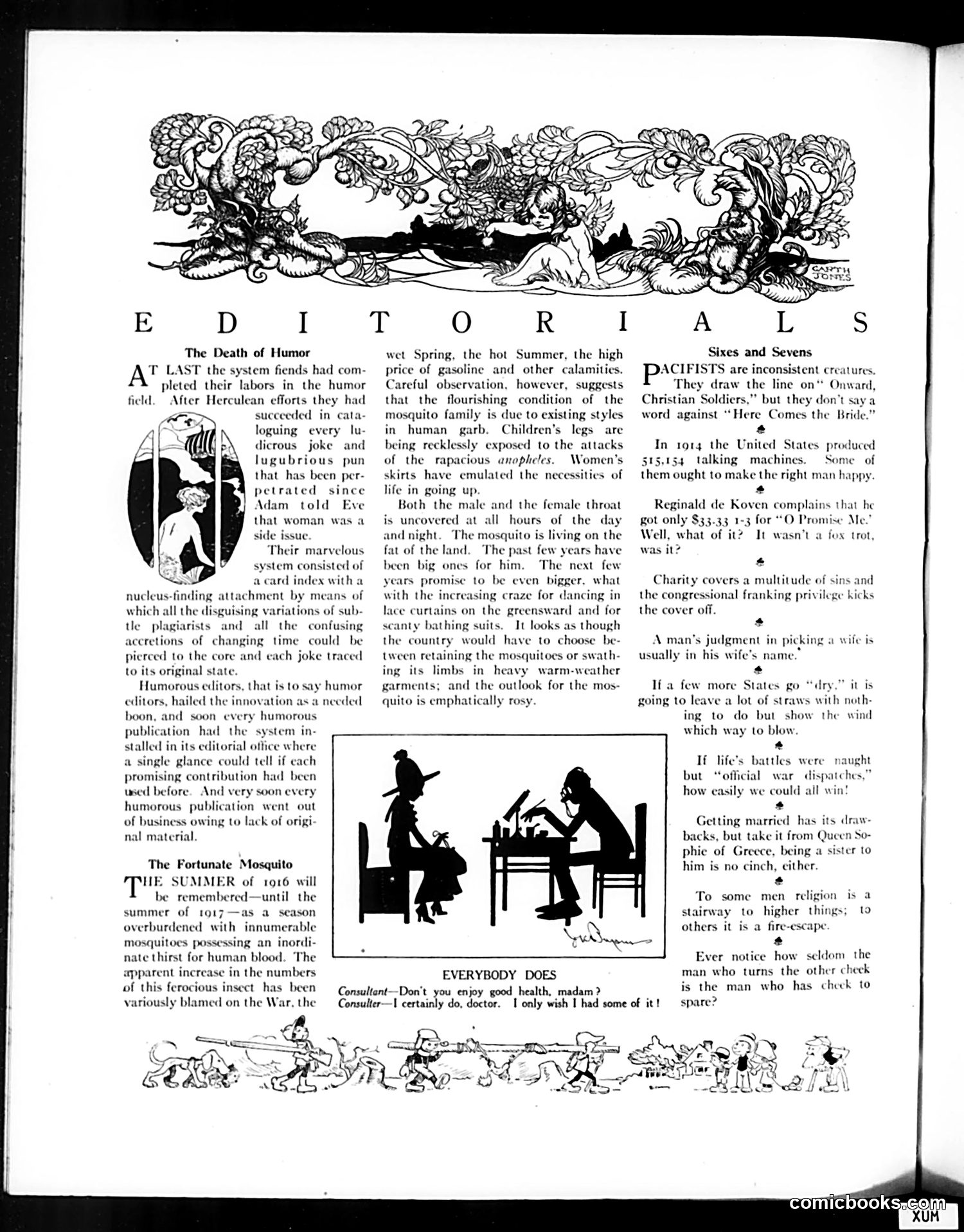
This page from *Judge* magazine contains satirical commentary on contemporary issues circa 1916-1917: **"The Death of Humor"** criticizes how humor publications had become formulaic and derivative, losing original wit through overuse of tired jokes and plagiarism. **"The Pestilent Mosquito"** addresses the summer 1916 mosquito plague, which the text claims was blamed on WWI's disruption but was actually due to changing fashion—women's shorter skirts reducing protective leg coverings, and men's lighter summer clothing. The satire suggests mosquitoes benefited from modern dress trends. **The right column** contains brief social commentary on Pacifists, talking machines, and marriage—typical satirical observations on contemporary life. **"Everybody Does"** is a cartoon dialogue mocking a doctor who enjoys good health while patients suffer from various ailments.
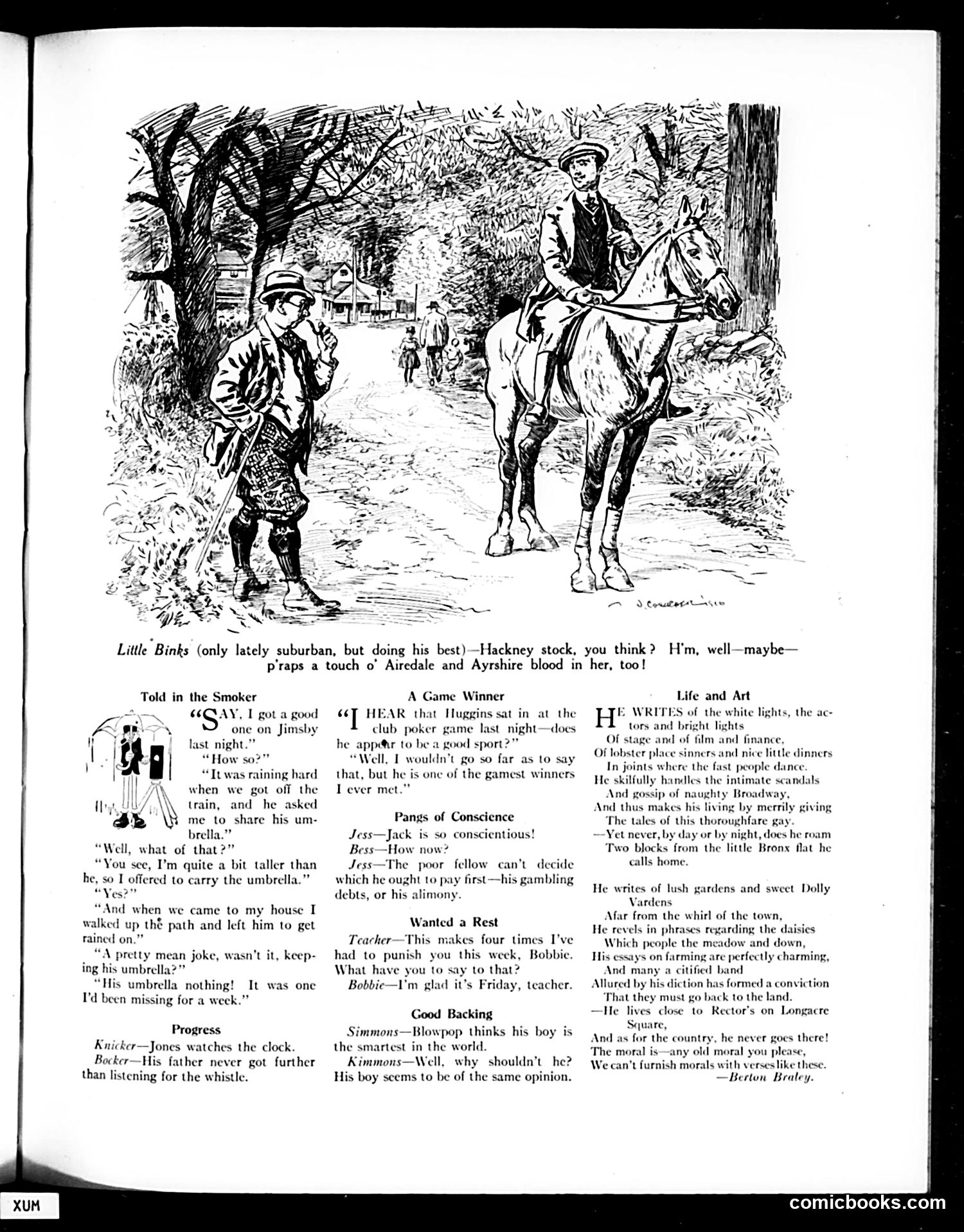
The main illustration depicts a conversation between a man on horseback and a boy standing by a tree on a country road. The caption identifies the boy as "Little Binks (only lately suburban, but doing his best)," addressing the rider about a "Hackney stock" horse—likely a reference to common rental horses from London's Hackney district. The joke appears to be social satire: Little Binks, recently moved from the city to suburbs, is attempting to converse with a country gentleman about horses using dubious expertise, claiming the horse has "Airedale and Ayrshire blood in her, too!" This conflates dog and cattle breeds with horse breeding, mocking suburban newcomers' pretentious but ignorant attempts to adopt rural mannerisms and knowledge.
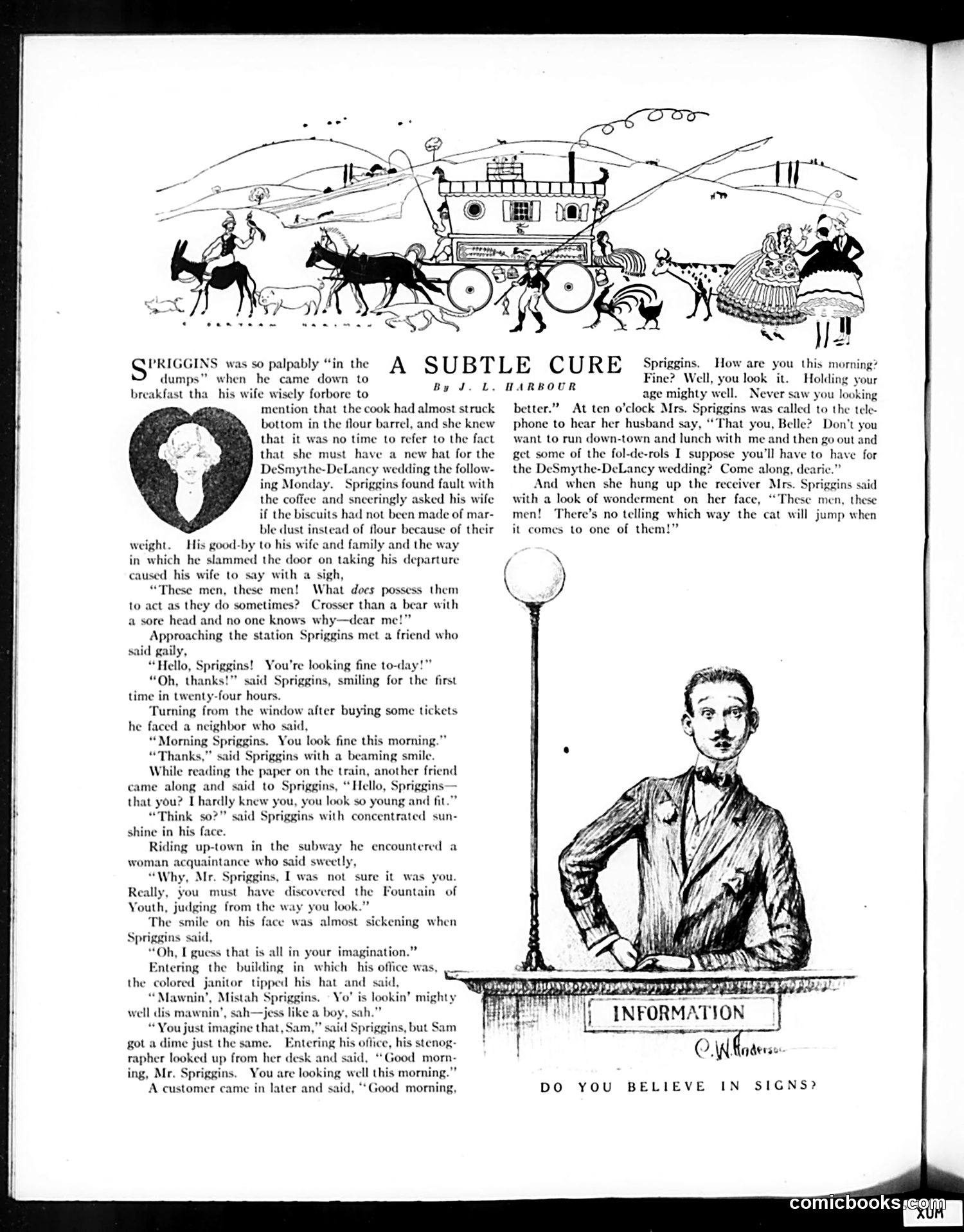
This satirical story mocks the power of external validation and superficial compliments in affecting mood and behavior. **The Setup:** Mr. Spriggins starts his day irritable and surly—complaining about coffee, biscuits, and his wife's need for a new hat for an upcoming wedding. His wife observes his grumpiness with resignation. **The "Cure":** Throughout his day, various people compliment Spriggins's appearance—saying he looks "fine," "young," "fit." Each compliment visibly improves his demeanor, making him increasingly cheerful and generous (he even tips the janitor). **The Point:** The satire suggests that men's moods are absurdly mercurial, swinging from bearish irritability to sickening cheerfulness based entirely on flattery. His wife correctly observed there's "no telling which way the cat will jump." The closing question—"Do You Believe in Signs?"—implies that Spriggins's transformation is superficial theater rather than genuine improvement, driven only by the "signs" (compliments) others give him.
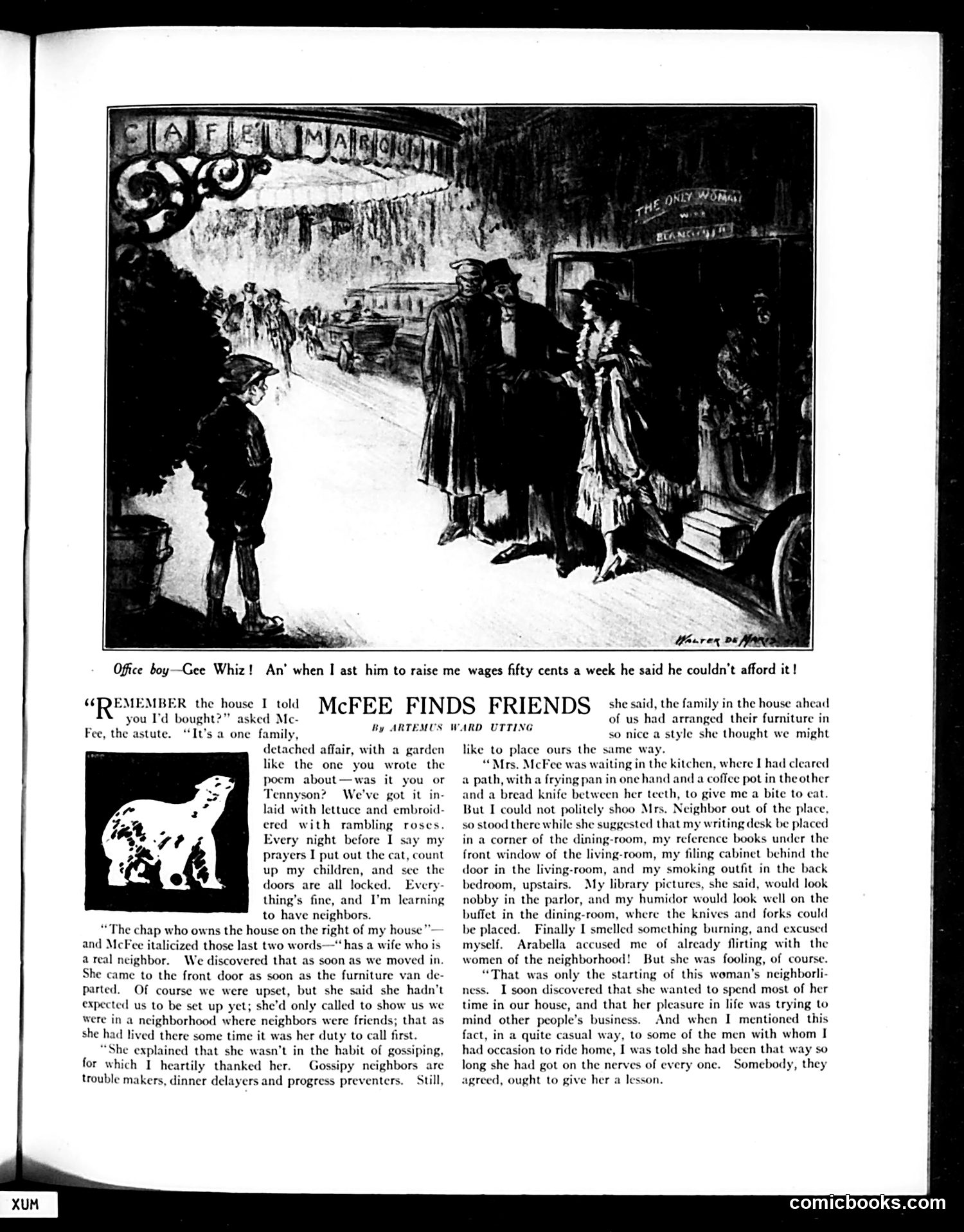
This story satirizes the archetypal meddlesome neighbor—a stock character in early 20th-century American humor. McFee, a new homeowner, discovers his neighbor is an insufferably nosy woman who immediately intrudes upon his household, uninvited, to rearrange his furniture and "help" organize his home. The satire targets several targets: the assumption that neighbors have a "duty" to interfere in others' affairs under the guise of friendliness; the gendered stereotype of women as gossipy busybodies; and the tension between community-minded behavior and personal privacy. The office-boy caption adds irony: the boss claims poverty while clearly affording a house with servants and furnishings—critiquing employer hypocrisy about wages. The humor lies in recognizing this invasive "neighborliness" as transparently self-serving meddling disguised as helpfulness—a timeless social problem.
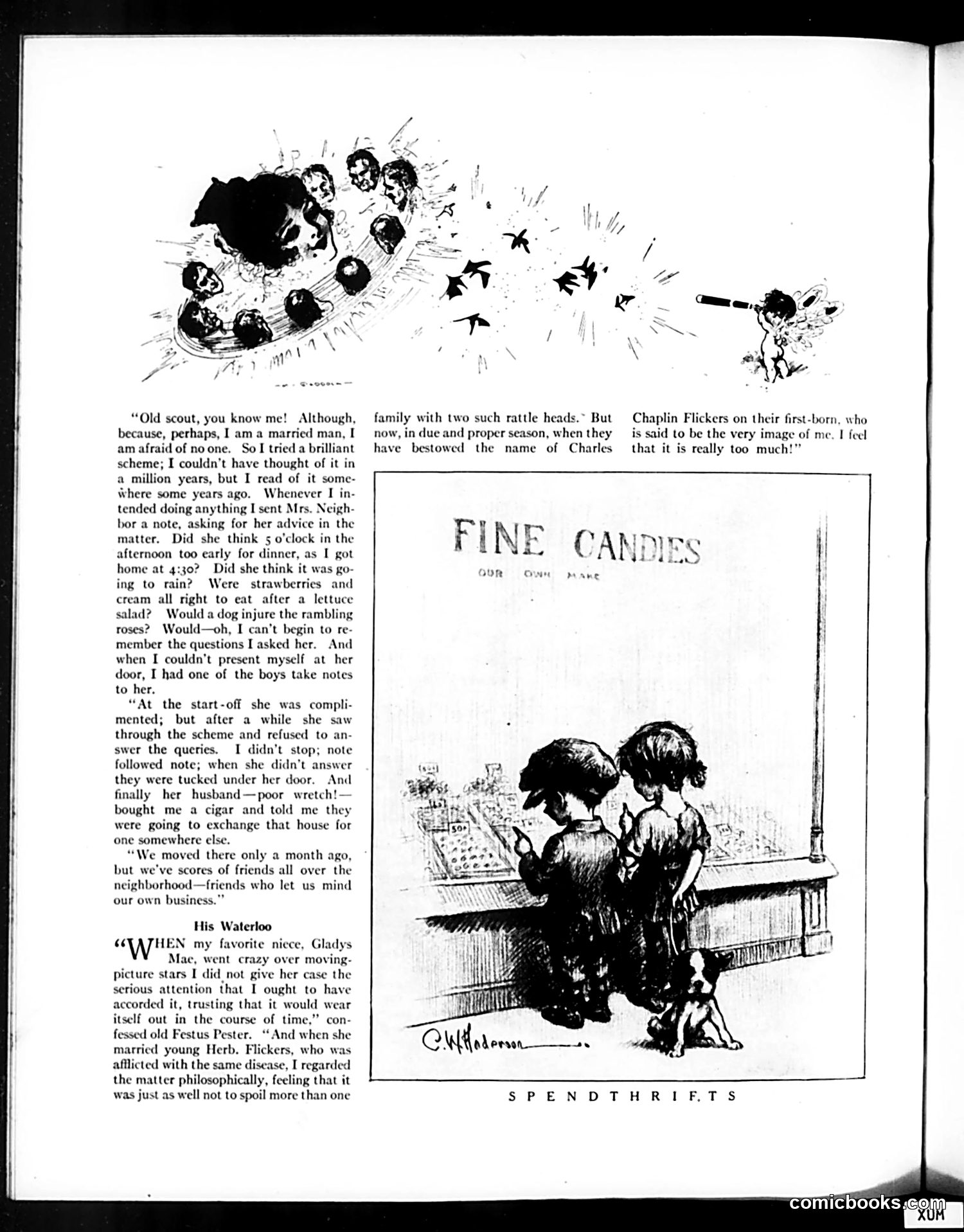
This page contains two satirical anecdotes about marital and social folly, typical of Judge's humor. The first story mocks a married man's scheme to avoid decision-making by constantly consulting his neighbor's wife via notes on trivial matters (dinner time, desserts, gardening). His strategy backfires when she recognizes the manipulation and refuses to answer. He persists until her exasperated husband forces them to move away—the punchline being the narrator claims they now have "friends who let us mind our own business," suggesting his real problem wasn't solved. The second brief anecdote satirizes the era's obsession with movie stars. An elderly man disapproves when his niece marries a film enthusiast named Herb Flickers. He tolerates this "disease" philosophically until they name their newborn "Charles Chaplin Flickers"—after the famous silent-film comedian. The joke: the family's movie-star mania has now infected the next generation, making the situation unbearable. The "Fine Candies" advertisement and "Spendthrifts" illustration appear to be separate commercial content on the page.
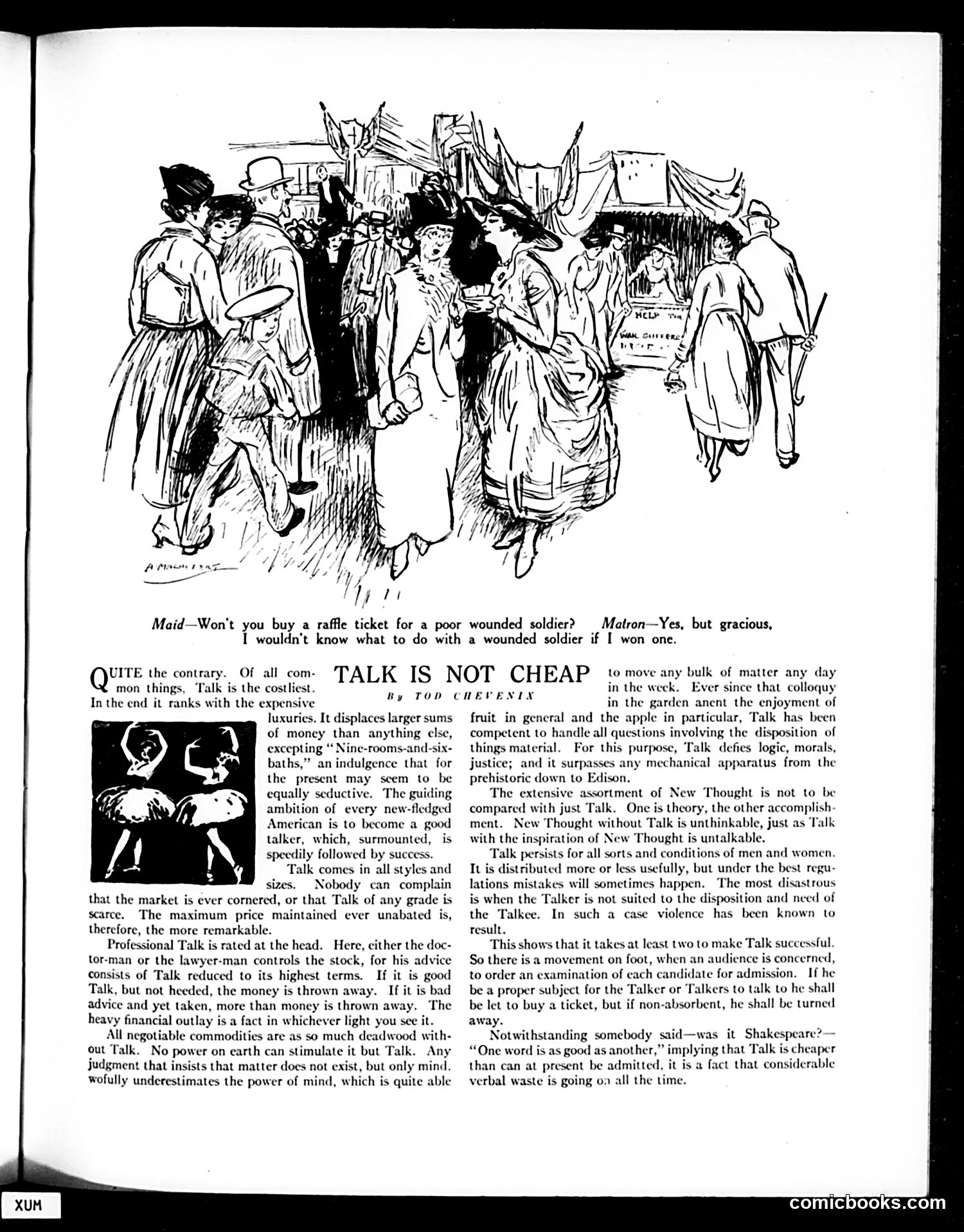
The top cartoon depicts a WWI-era charity scene: a maid solicits a wealthy matron to buy a raffle ticket benefiting "a poor wounded soldier." The matron's reply—that she wouldn't know what to do with a wounded soldier if she won—is absurdist humor highlighting the disconnect between charitable gestures and actual concern for soldiers' welfare. She views the "prize" as an awkward burden rather than a worthy cause, satirizing superficial wartime charity among the upper classes. The main article, "Talk Is Not Cheap," is an essay praising conversation's power and value. It argues that talk—particularly professional advice from doctors and lawyers—commands high prices because it effects real change in the world. The piece contrasts talk's practical utility with mere "New Thought" (likely a contemporary self-help movement), asserting that meaningful communication requires both a competent speaker and receptive listener.
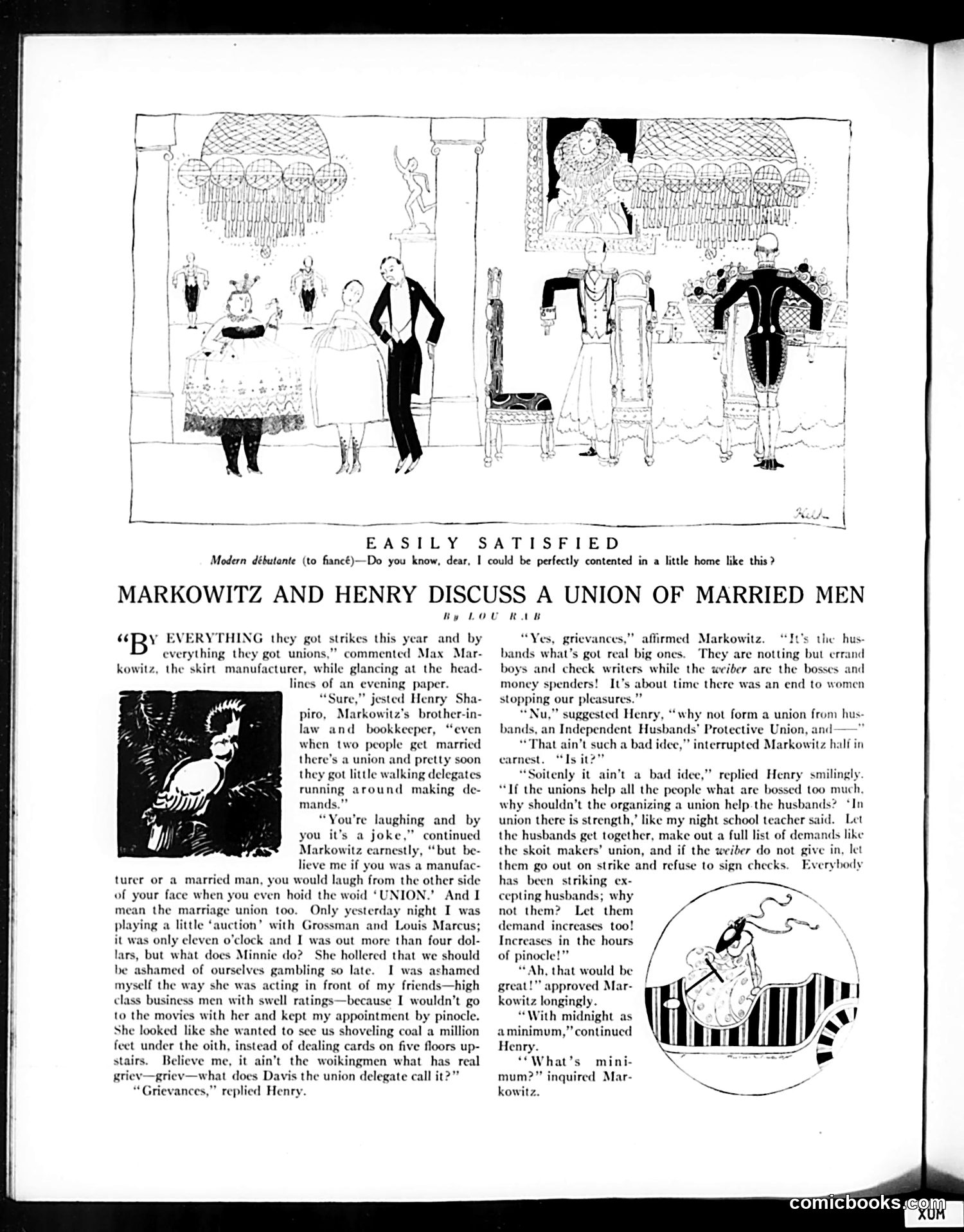
This 1920s satirical piece from *Judge* mocks both labor unions and married men through Yiddish-inflected dialogue between **Markowitz** (a skirt manufacturer) and **Henry Shapiro** (his brother-in-law, a bookkeeper). **The Satire:** The joke conflates labor strikes with domestic marital conflict. Markowitz complains that wives are "bosses" and "money spenders" who interrupt men's leisure (gambling, card games). Henry jokingly proposes an "Independent Husbands' Protective Union"—applying union rhetoric to men's grievances against their wives. **The Point:** The satire cuts multiple ways: it mocks both labor organizers (reducing their legitimate grievances to triviality) and henpecked husbands (treating their complaints as self-pitying). The humor relies on the incongruity of unionizing against wives, and the "demands" (midnight poker games, increased "pinochle hours") trivialize worker demands for better conditions. **Context:** The 1920s saw major labor unrest and union organizing. This piece uses ethnic immigrant characters (Yiddish speech patterns) to satirize working-class concerns as petty domestic squabbles rather than serious economic issues.
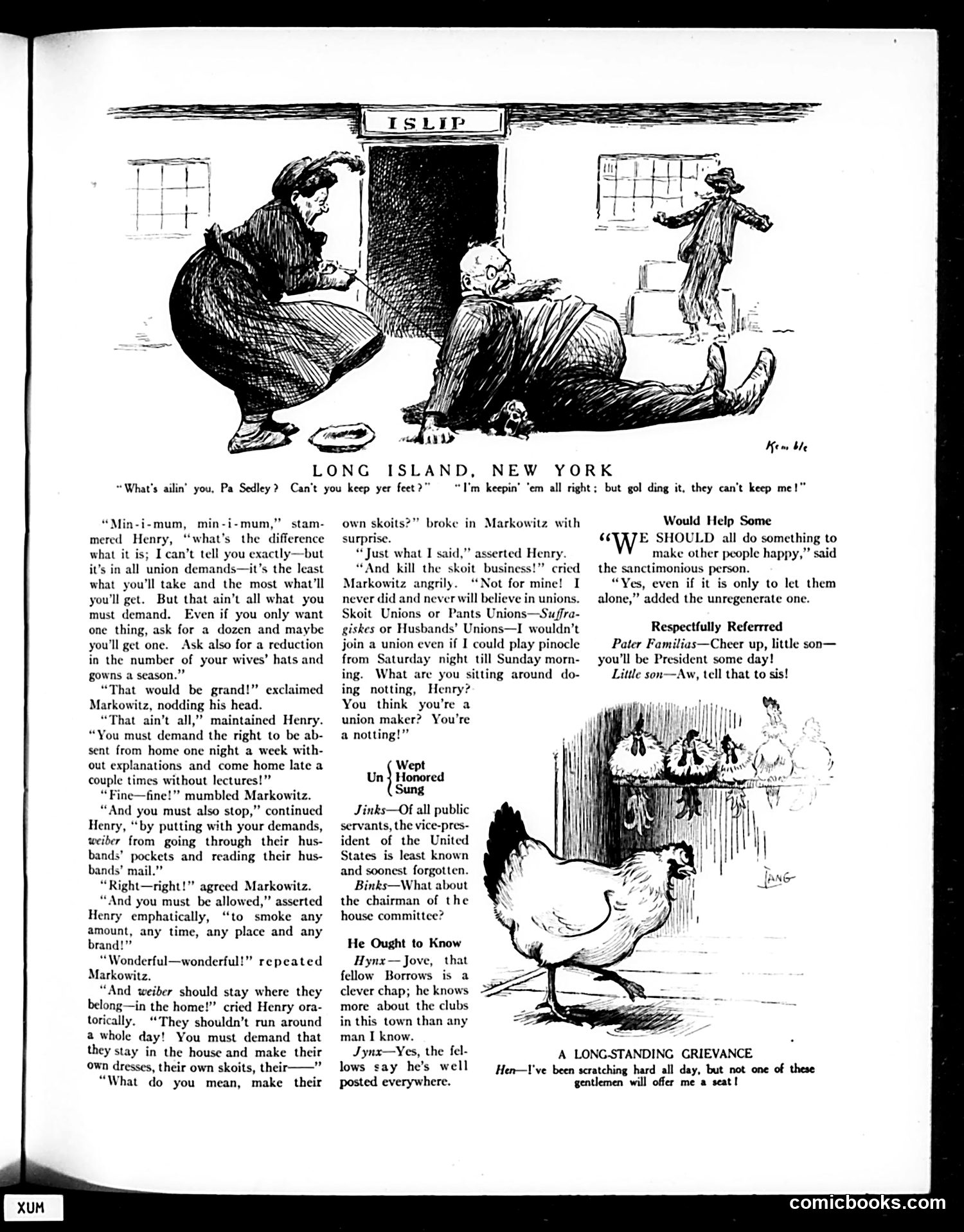
The main cartoon satirizes labor union organizing among immigrants on Long Island. Henry (likely representing a union organizer) lectures Pa Sedley and Markowitz (Jewish immigrants, suggested by dialect and names) about union demands. The satire mocks both overzealous union rhetoric and immigrant workers' priorities: Henry demands absurd domestic concessions (smoking privileges, unsupervised nights out, wives staying home), while Markowitz balks only when unions threaten the garment/skirt business—revealing self-interested hypocrisy beneath union solidarity talk. The accompanying short jokes target politicians (the vice-president's obscurity) and use animal fables for social commentary (the hen unable to get a gentleman's seat—likely satirizing both chivalry's decline and class indifference). The overall tone is mocking toward labor organizing, immigrants, and their perceived contradictions—typical of Judge's satirical stance during the early 20th-century union movement debates.
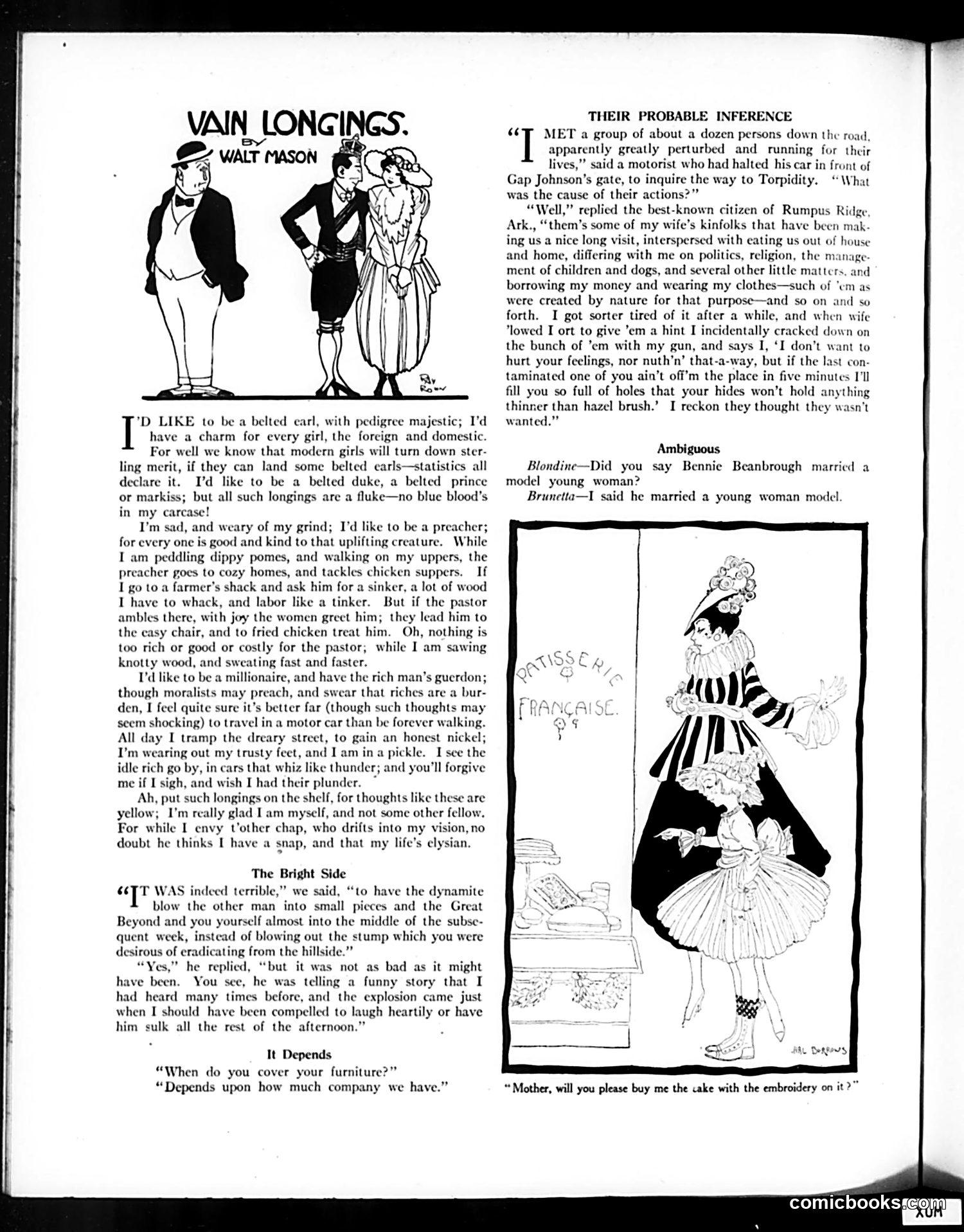
This page contains three separate humorous pieces satirizing American social aspirations and class anxieties circa early 20th century. **"Vain Longings"** is a poem mocking ordinary working men who envy the wealthy and aristocratic. The speaker daydreams of being a "belted earl" or duke (implying European nobility), a privileged preacher enjoying fine dinners, or a millionaire—all while trudging through "dreary streets" for honest wages. The satire suggests such class envy is foolish ("yellow"), ultimately endorsing contentment with one's actual station. **"The Bright Side"** uses dark humor: a man survived a dynamite explosion that killed someone else—fortunately, because the victim had been boring him with a repeated story, sparing him from having to laugh or endure sulking. **"Their Probable Inference"** depicts rural backwoods humor: a motorist asks why locals fled in panic; the reply: the homeowner fired a gun at mooching in-laws overstaying their welcome, warning them to leave or face worse. The illustration shows fashionable women in elaborate striped dress—likely mocking haute couture pretensions.
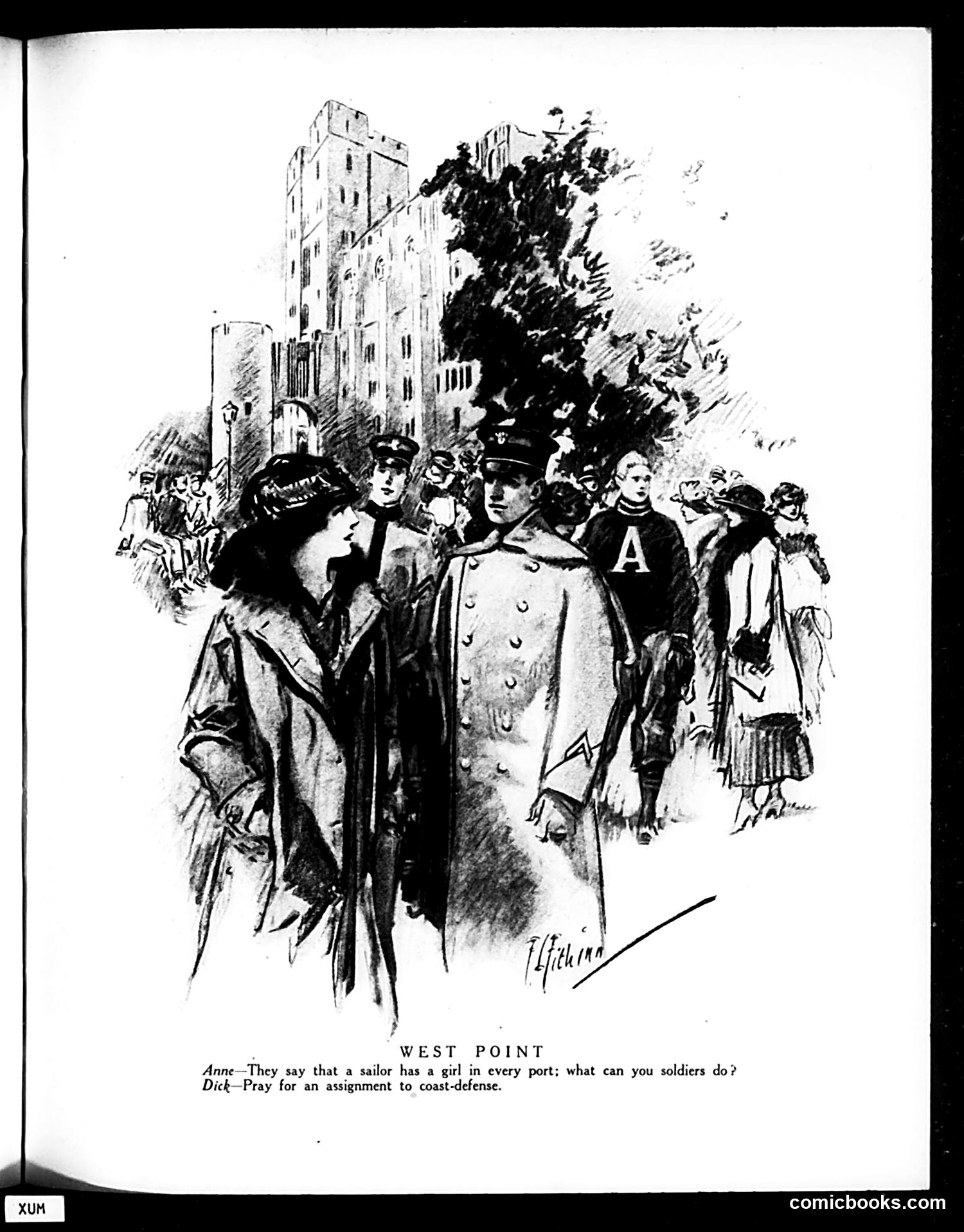
This is a joke about military assignments during what appears to be the early 20th century. The cartoon shows soldiers and civilians at West Point (the U.S. Military Academy). The humor plays on a double meaning: Anne jokes that sailors have romantic conquests in every port, asking what soldiers can do instead. Dick's response—praying for "coast-defense" assignment—is a pun. Coast-defense duties would keep soldiers stationed along American coasts rather than deployed far away, theoretically giving them more opportunities for romantic encounters with local women, similar to sailors' port experiences. The satire gently mocks both military life and the romantic pursuits of young servicemen, using a common era trope about sailors' womanizing to create the joke.
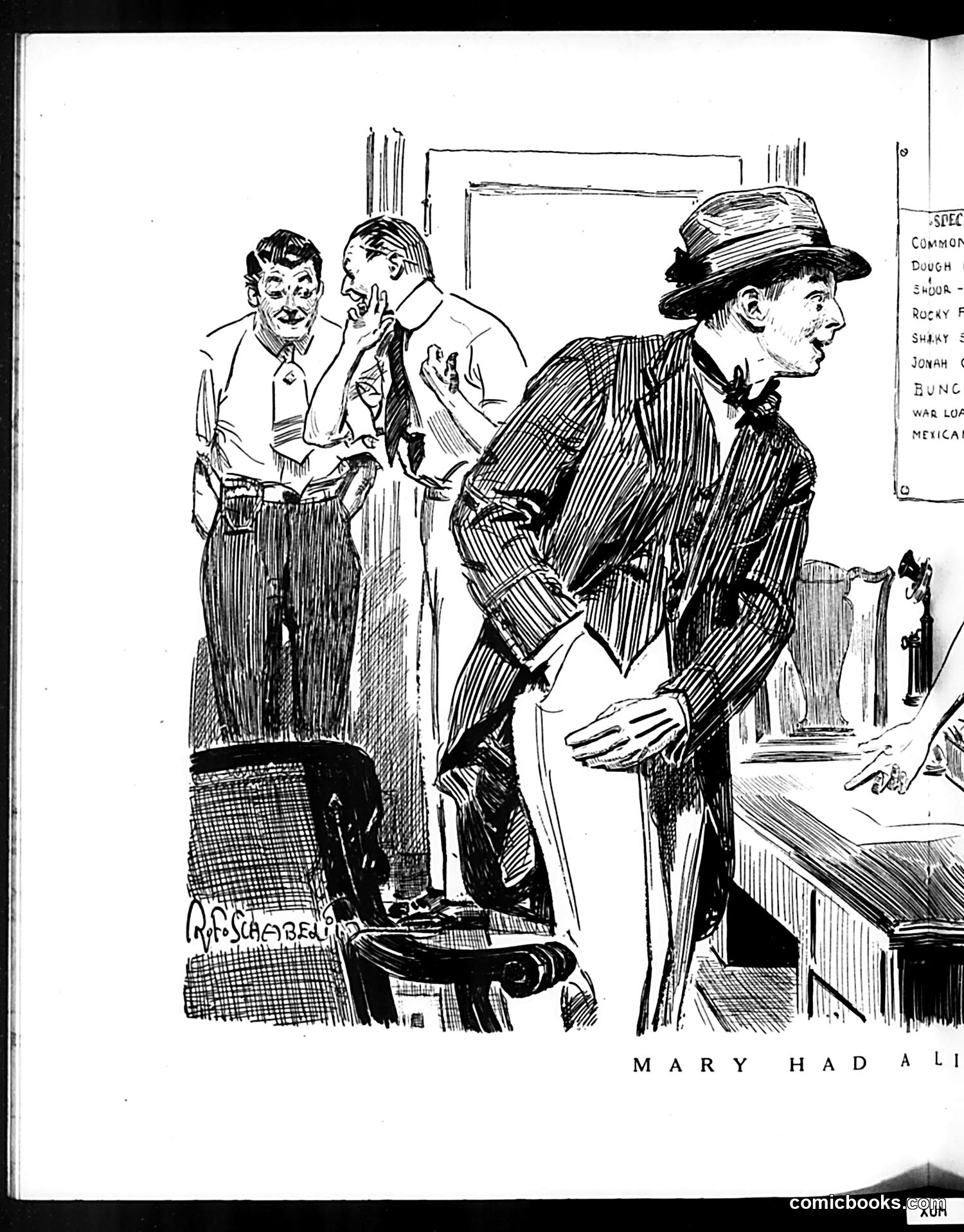
This appears to be a satirical cartoon from Judge magazine featuring three men in what seems to be an office or official setting. The figure on the right, labeled "MARY HADALI" (or similar), wears a bowler hat and striped suit, appearing to be the focus of the scene. Two other men behind him—one in formal dress with a diamond pin, another in profile—seem to be observing or commenting on him. The partial text visible on the right edge references "SPEC," "CINNAMON," "DOUGH," and other terms, though their full context is unclear from this image alone. Without the complete publication date or additional context, I cannot definitively identify the specific political figures or events being satirized. The cartoon's exact meaning requires more information about the historical period and its original caption.
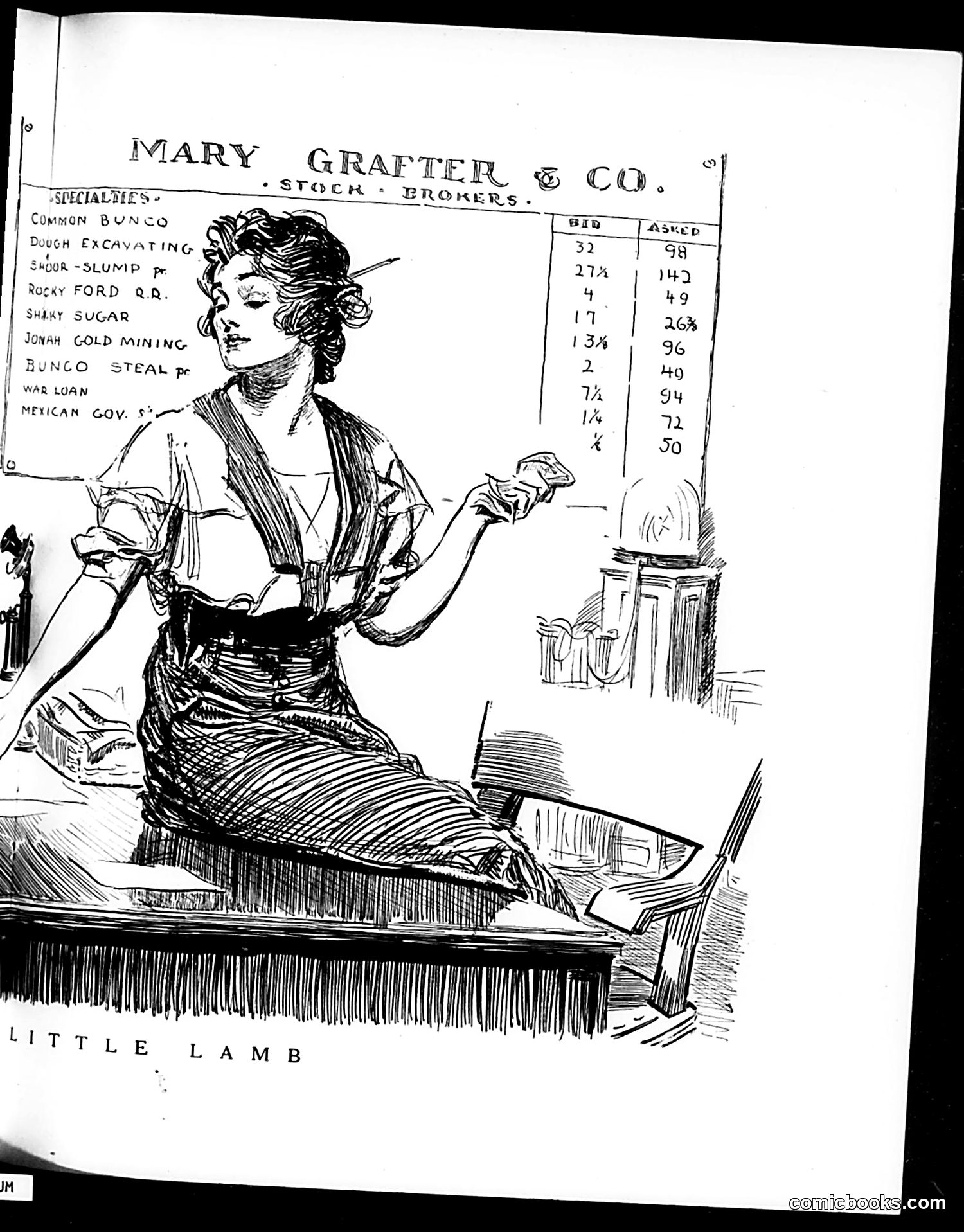
This Judge magazine page satirizes stock market fraud and shady financial schemes. The illustration depicts a well-dressed woman labeled "Little Lamb"—a naive investor—sitting at a desk with a stock broker (Mary Grafter & Co.). The left sidebar lists the broker's fraudulent "specialties": obvious scams like "Common Bunco," "Dough Excavating," "Shaky Sugar," and "Jonah Gold Mining"—all transparent con games. The bid/ask price columns on the right show typical stock quotations. The satire is straightforward: the "little lamb" is an innocent victim about to be fleeced by unscrupulous stock brokers using obviously fake investment schemes. The cartoon mocks both the brazen dishonesty of financial operators and the gullibility of retail investors during an era (likely early 1900s) when stock market regulation was minimal and fraud was rampant.
This satirical piece mocks pretentious theater critics and their disconnect from ordinary audiences. The cartoon depicts a fashionable débutante and her mother discussing a production of "Pierrot the Prodigal." The satire targets a pompous Critic who praises a silent, confusing play as "art" while dismissing the débutante's honest complaint that it was boring and incomprehensible. He quotes obscure references and uses inflated language to justify theatrical obscurity as superior to accessible entertainment. The humor deepens when discussing "The Intruder"—the Critic celebrates its artificiality and argues that reflecting "real life" would diminish its charm. Meanwhile, the mother's simple standard—that genuinely thrilling plays have value—exposes the Critic's pretentious nonsense. The piece satirizes how critics elevate incomprehensibility and artifice as marks of sophistication, while ridiculing the public's legitimate desire for comprehensible, emotionally engaging theater. It's a timeless critique of elitist gatekeeping in the arts.
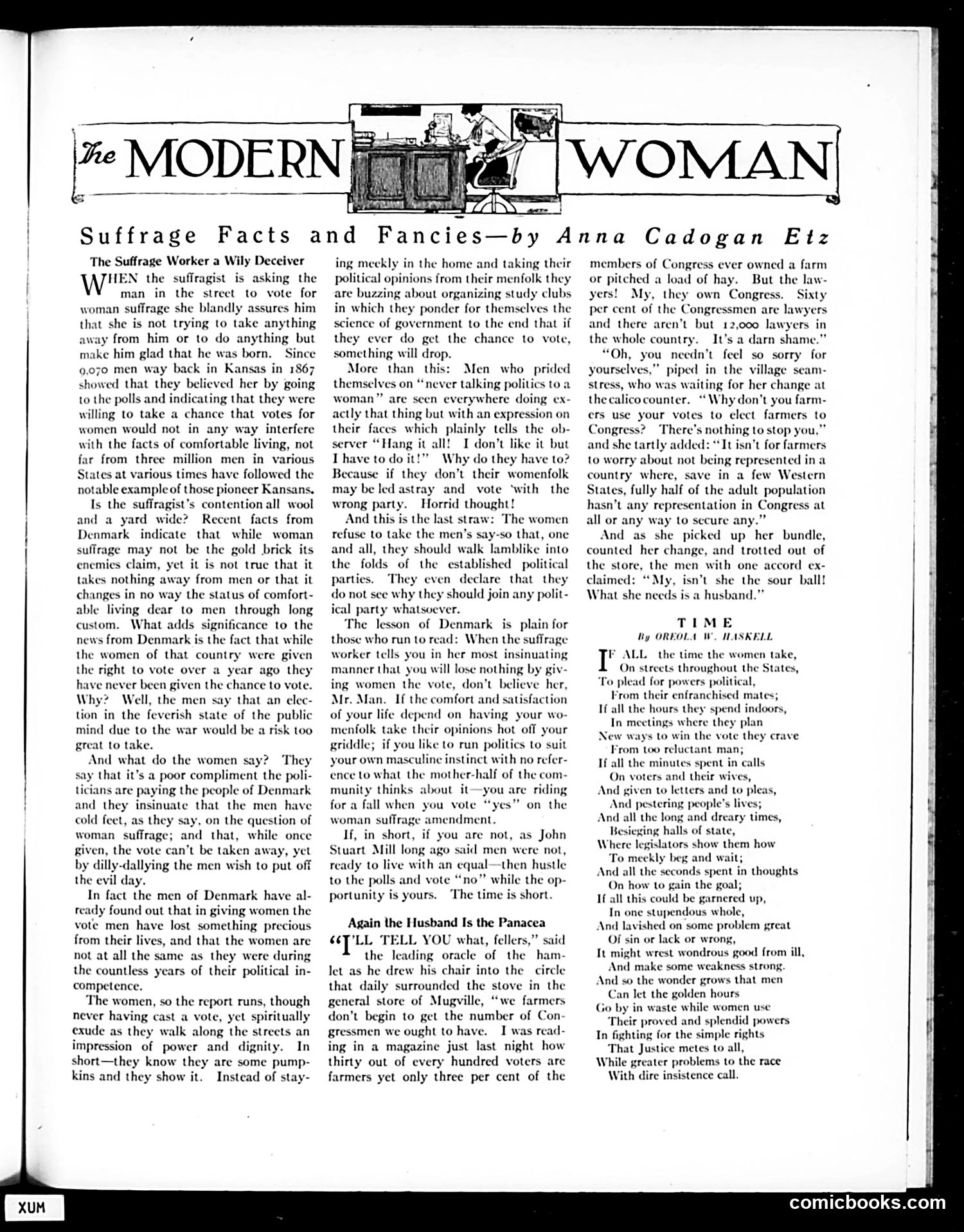
This anti-suffrage article by Anna Cadogan Etz argues that women's voting rights threaten male domestic authority. The piece uses Denmark as a cautionary example: though women gained the franchise there, men have delayed holding elections, claiming wartime instability justifies postponement. Etz's real complaint emerges in her satire of women's newfound independence. Previously obedient to male political guidance, Danish women now form study clubs, discuss government independently, and refuse automatic party loyalty. The article frames this as disturbing—men who "never talked politics to women" now must engage them seriously, and women reject paternal direction. The satire targets suffragists' claims that voting rights won't disrupt "comfortable living." Etz argues they absolutely will: women gain "power and dignity," intellectual autonomy, and political agency, fundamentally altering domestic hierarchies where men previously controlled wives' opinions. The message to male readers: voting rights genuinely threaten male prerogatives, contrary to suffragists' reassurances.
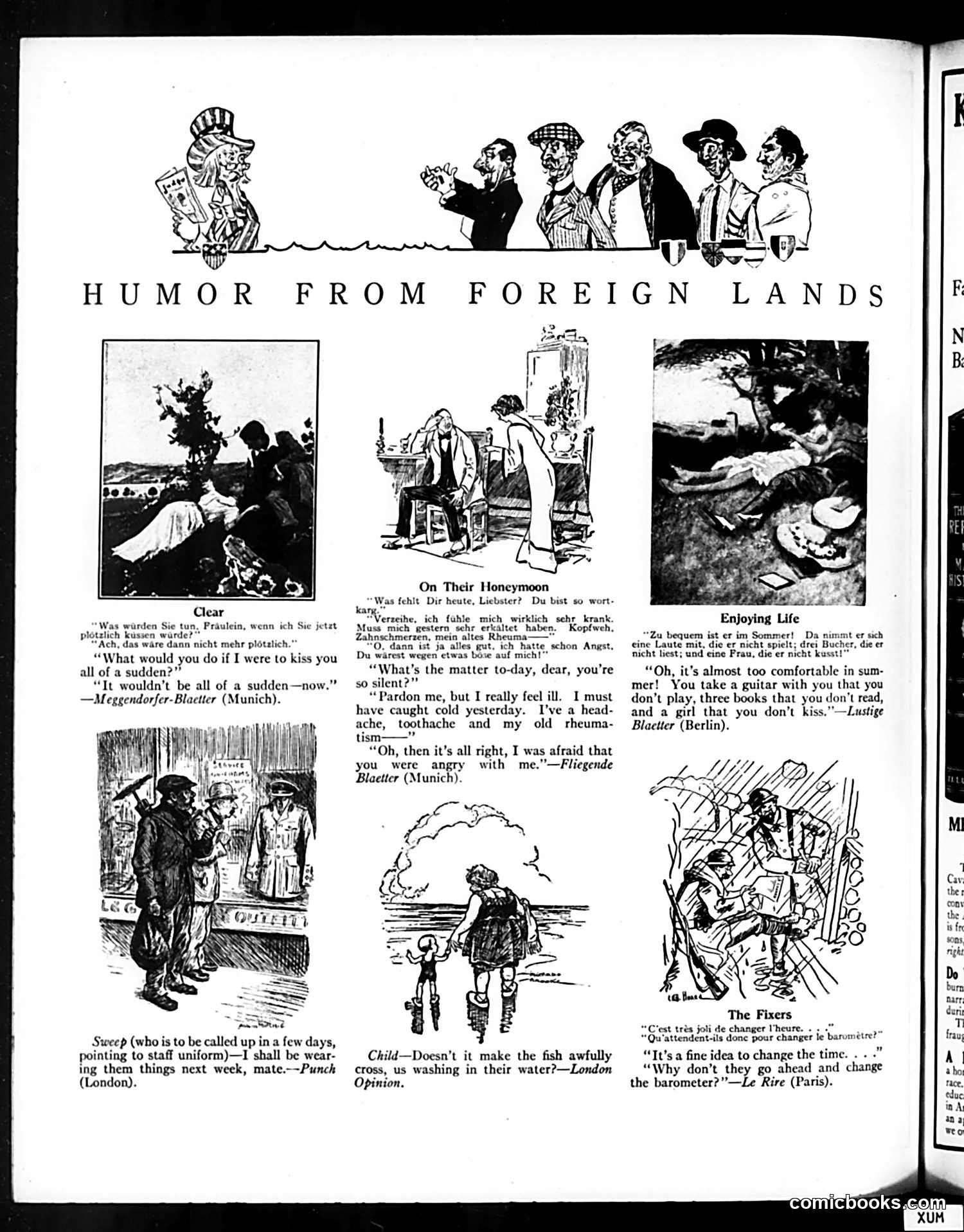
This page collects short jokes and cartoons from European satirical publications (Munich, London, Berlin, Paris). The content satirizes everyday domestic and social situations: **The jokes mock:** - **Romantic awkwardness** (the "Clear" exchange about unexpected kissing) - **Military life** (a street sweeper joking he'll wear a uniform soon, likely referencing conscription) - **Newlywed disillusionment** (a husband feigning illness to avoid confrontation; the wife relieved he's not angry rather than concerned) - **Lazy romanticism** (a man carrying a guitar, books, and courting a girl—none of which he actually uses) - **Bureaucratic absurdity** (changing clock time but not the barometer) - **Childhood logic** (a child worrying about disturbing fish while bathing) The page presents *Judge* magazine's practice of reprinting European humor to demonstrate shared comedic sensibilities across cultures, focusing on universal domestic frustrations and social pretension rather than nationality-specific satire.
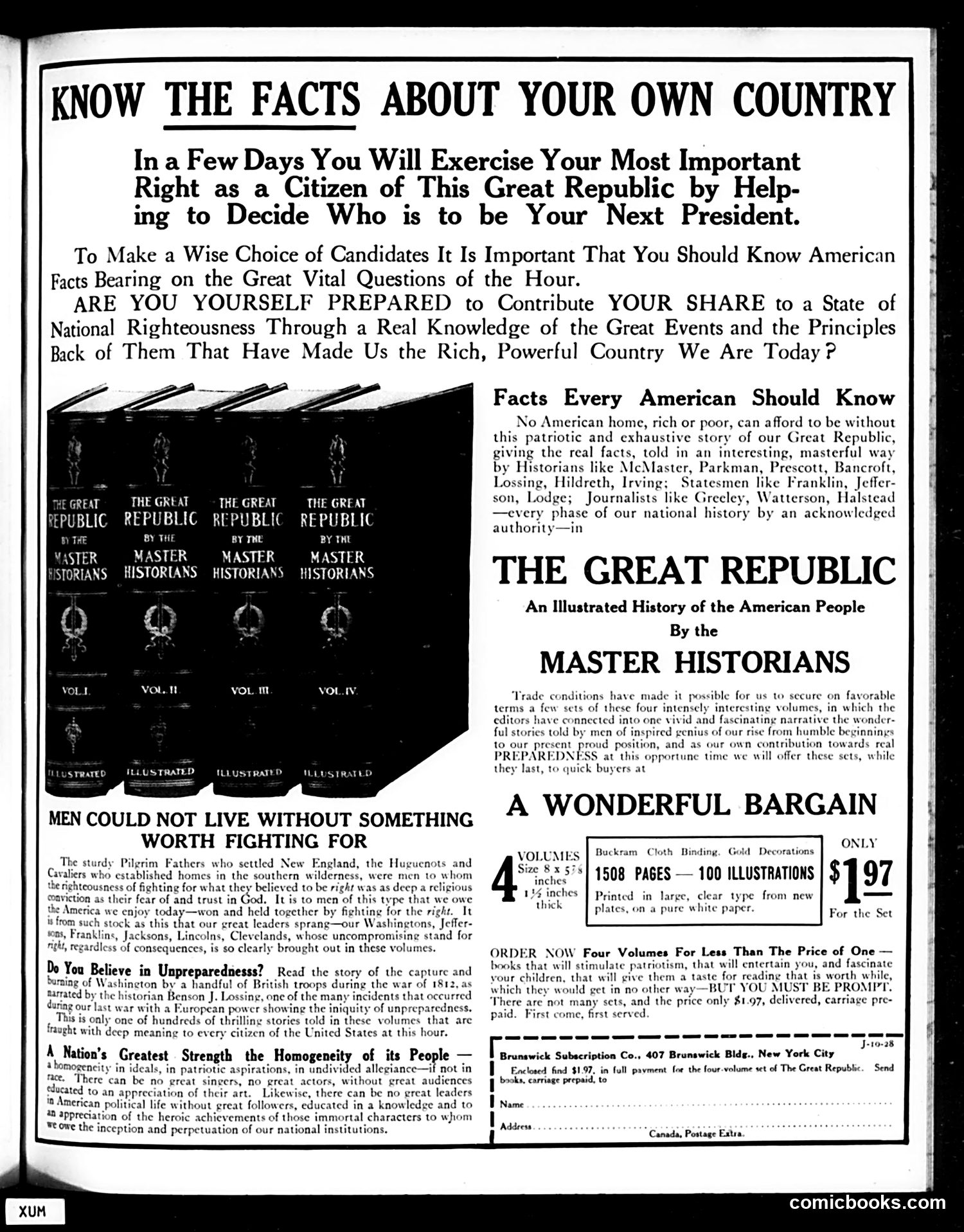
This is primarily a **book advertisement**, not a political cartoon. It promotes "The Great Republic: An Illustrated History of the American People by the Master Historians"—a four-volume set published by Brunswick-Balke-Collender Co. The page frames this commercial appeal around a **presidential election moment** (text references voting "in a few days"). The messaging argues that American citizens need historical knowledge to make informed voting choices, positioning the book as civic preparation. The rhetoric emphasizes **patriotic education**: references to Pilgrims, the founding fathers, and national strength through "homogeneity of ideals." There's a pointed warning about "unpreparedness"—alluding to the War of 1812—which appears to reference contemporary debates about American military readiness, likely relevant to WWI-era concerns. The advertisement conflates **commercial consumption with civic duty**, suggesting purchasing this book is an act of patriotic responsibility before voting. No specific political figures or satirical caricatures appear visible. This reads as earnest marketing rhetoric rather than satire, though modern readers might note the irony: selling historical books as election preparation.
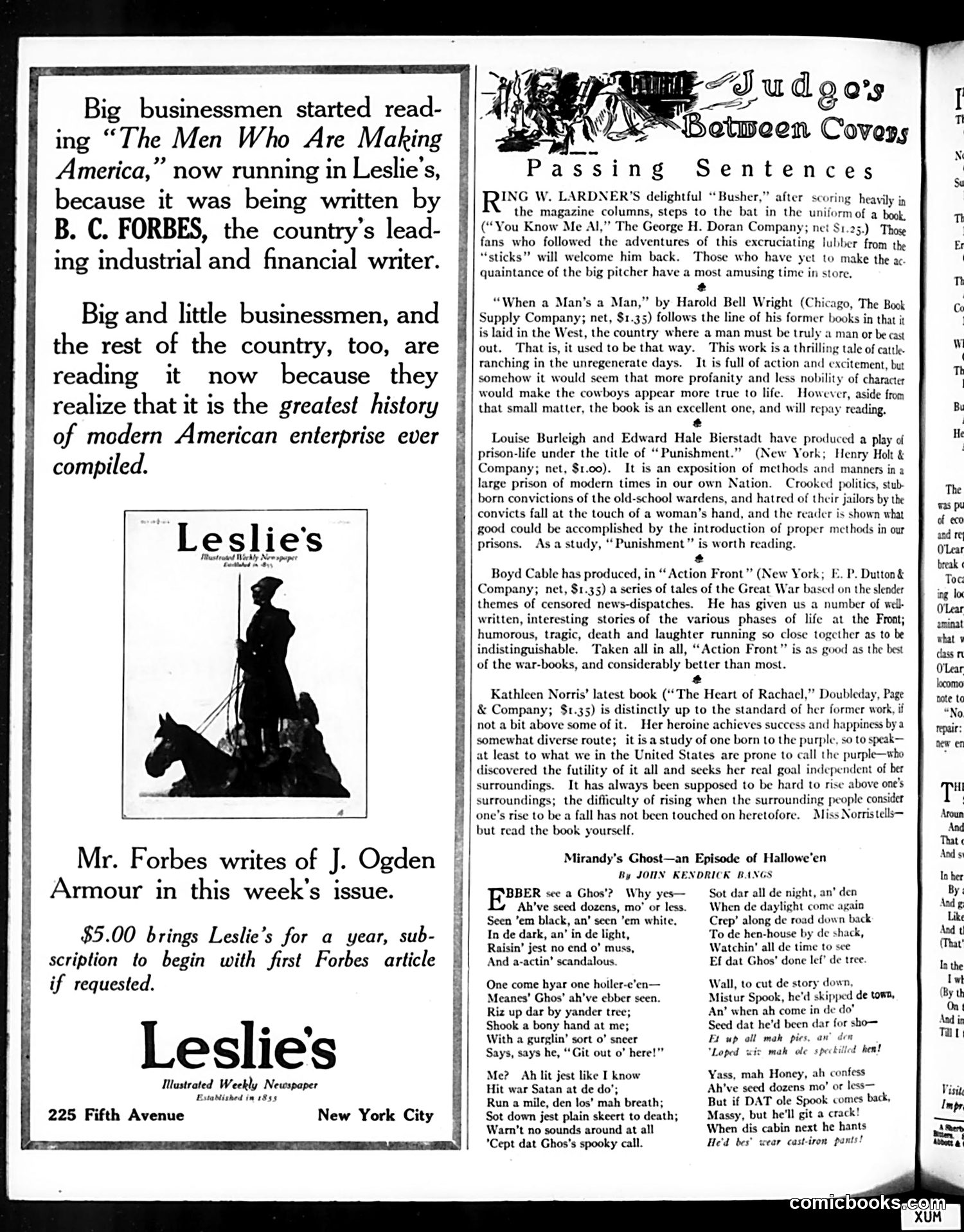
This is primarily an **advertisement for Leslie's Weekly magazine**, not a political cartoon page. The main content promotes B.C. Forbes's serialized article "The Men Who Are Making America" as drawing major readership among businessmen and the general public. The page also contains **book reviews** ("Passing Sentences"), recommending contemporary fiction and war narratives by authors like Ring Lardner and Boyd Cable. At the bottom is a humorous **Halloween poem** ("Mirandy's Ghost") by John Kendrick Bangs, a popular satirist of the era. The satirical angle is subtle: Forbes's industrial journalism is positioned as appealing equally to "big and little businessmen" and "the rest of the country," suggesting shared interest in American enterprise narratives. The silhouette illustration of a man on horseback reinforces masculine, frontier-era American identity—themes consistent with the reviewed books' emphasis on authentic American manhood and Western values.
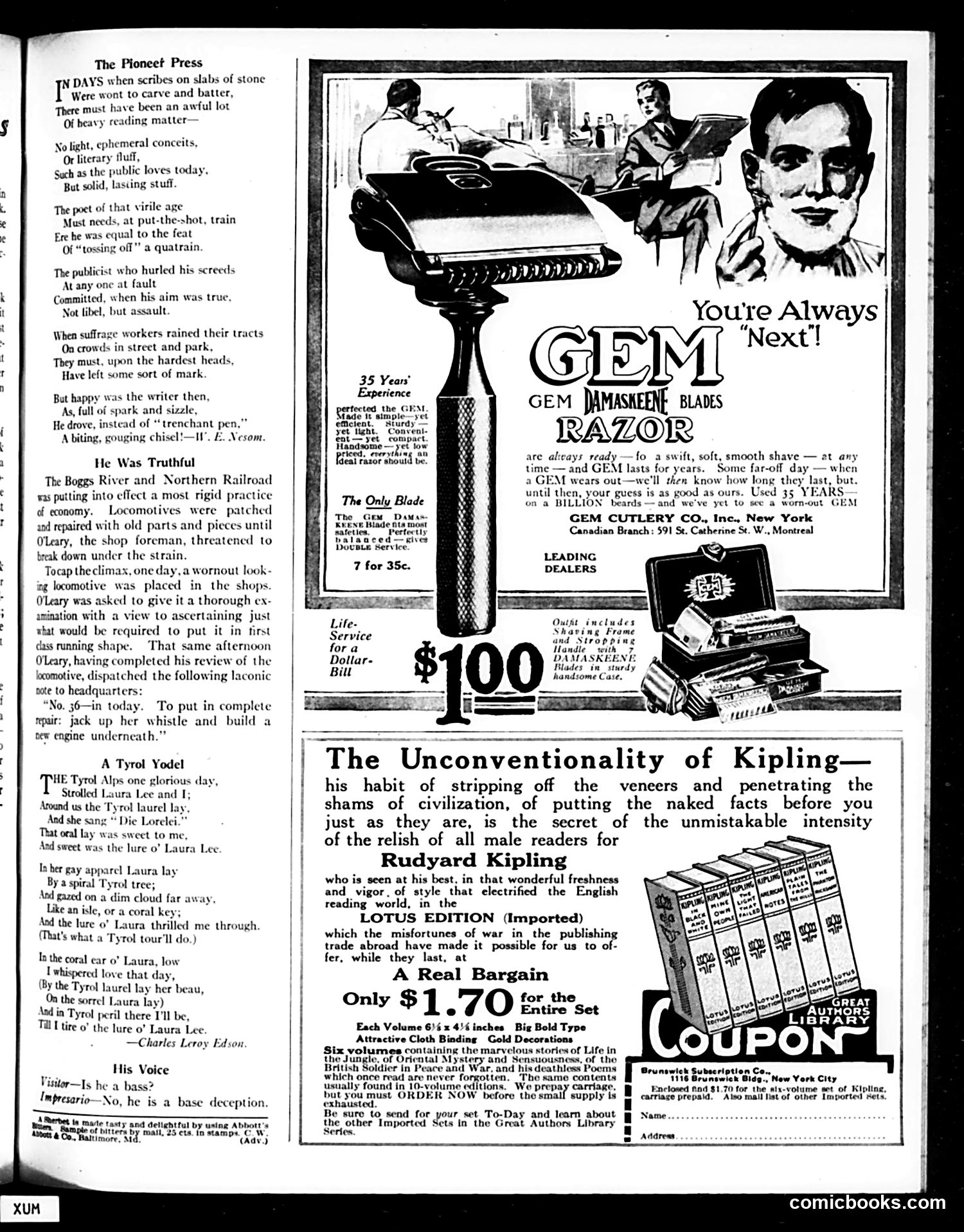
This page consists primarily of **advertisements and light verse**—typical Judge content mixing satire with commercial messaging. The poetry includes humorous pieces: "The Pioneer Press" nostalgically compares ancient stone-carving to modern writing; "He Was Truthful" is a comedic anecdote about a railroad foreman's blunt assessment; "A Tyrol Yodel" is whimsical romantic verse with forced rhymes. The advertisements dominate: a **GEM Damaskeene Razor** ad emphasizing durability (35 years' experience, billion beards shaved); and a **Rudyard Kipling Lotus Edition** book set coupon offering imported volumes at $1.70. The "His Voice" joke is a brief pun—a visitor asks if a performer is a "bass" (voice type); the impresario replies he's a "base deception" (worthless fraud). There are no political cartoons or caricatures visible. This is primarily **advertising content with filler humor**—representative of Judge's commercial-satirical model rather than substantive social commentary.
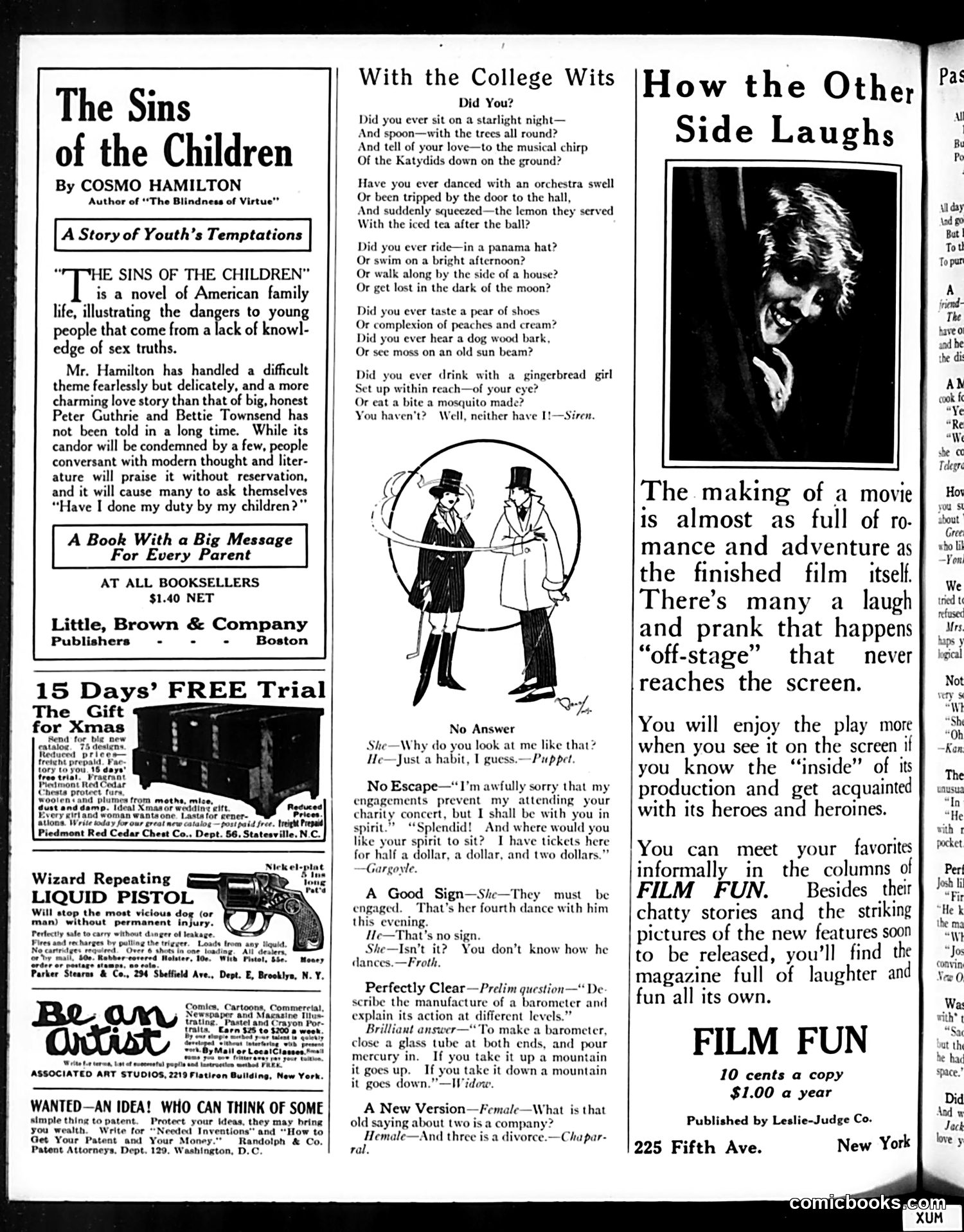
This page is primarily **advertising and humor content** from Judge magazine. The main elements are: **Left side**: A book advertisement for *"The Sins of the Children"* by Cosmo Hamilton—a novel addressing youth sexuality and parental responsibility, positioned as serious and modern for its time. **Center**: A humor section titled "With the College Wits" featuring playful, absurdist jokes from college magazines (*Siren*, *Puppet*, *Gargoyle*, *Froth*, *Widow*). These mock romantic and academic situations through wordplay and nonsense—like "taste a pear of shoes" or a student's circular barometer definition. The humor relies on clever linguistic confusion rather than situational comedy. **Right side**: A promotion for *Film Fun* magazine, emphasizing how movie-making involves "romance and adventure" behind the scenes. The cartoon (two men in top hats) illustrates one joke about why someone looks at another person oddly—establishing it as "just a habit." Overall, this reflects early 20th-century middlebrow entertainment mixing earnest self-improvement messaging with collegiate absurdist humor.
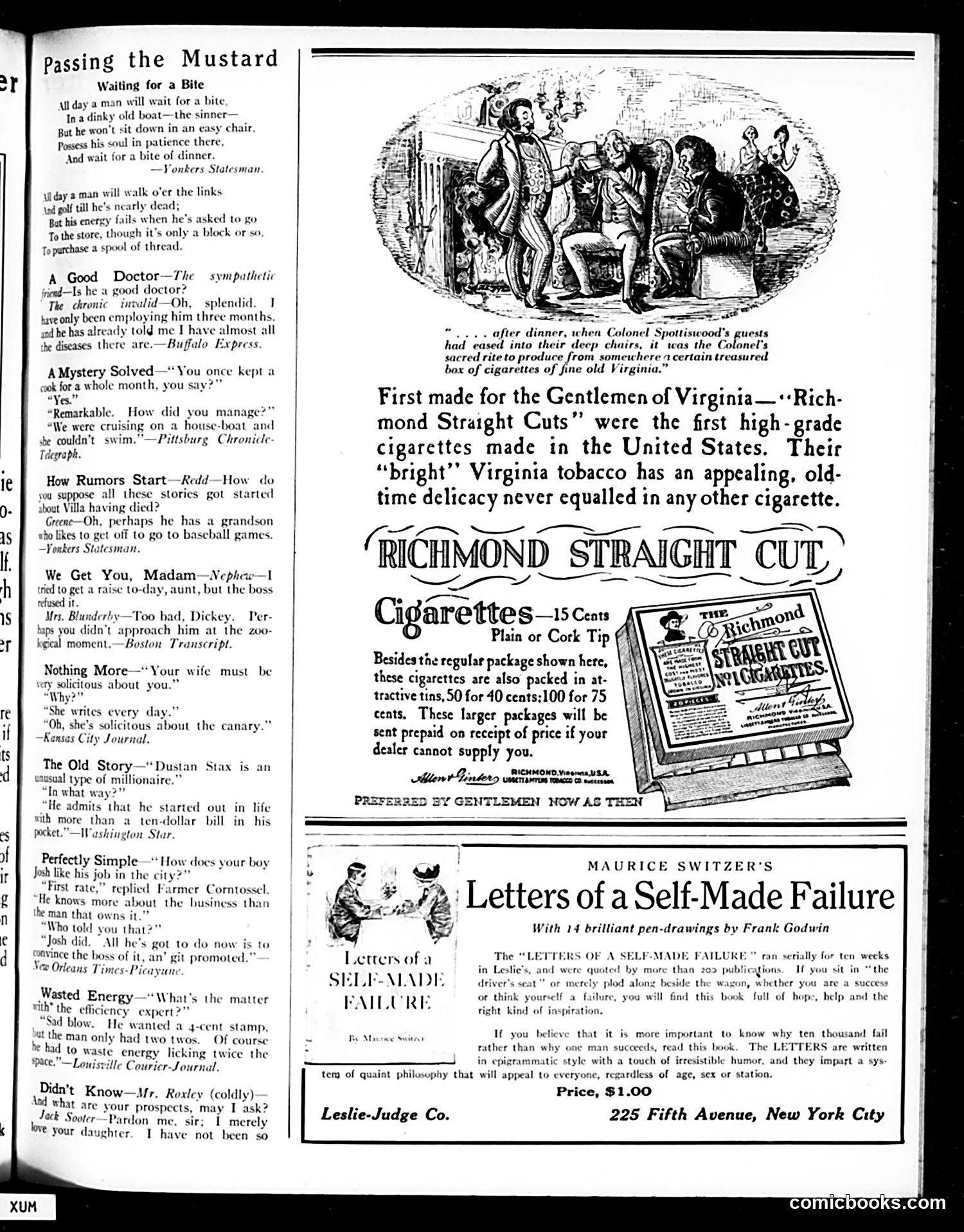
This page contains primarily **short humor pieces and advertisements** rather than political cartoons. The humor section ("Passing the Mustard") collects brief jokes about everyday frustrations: fishermen's patience, golfers' laziness, doctors overstating patient ailments, and marital dynamics. These reflect early 20th-century middle-class anxieties and gender dynamics—particularly jokes about wives' domestic concerns (a canary, nagging husbands). One joke references **Villa**, likely Pancho Villa, the Mexican revolutionary—suggesting the page dates to the Mexican Revolution era (1910s), when Villa's death rumors circulated in American press. The dominant content is **advertising**: Richmond Straight Cut cigarettes (marketed as Virginia's first premium cigarettes, "preferred by gentlemen") and a book titled *Letters of a Self-Made Failure* by Maurice Switzer, illustrated by Frank Godwin. The cigarette ad features a period illustration of gentlemen relaxing after dinner, romanticizing tobacco consumption as a mark of status and gentility.
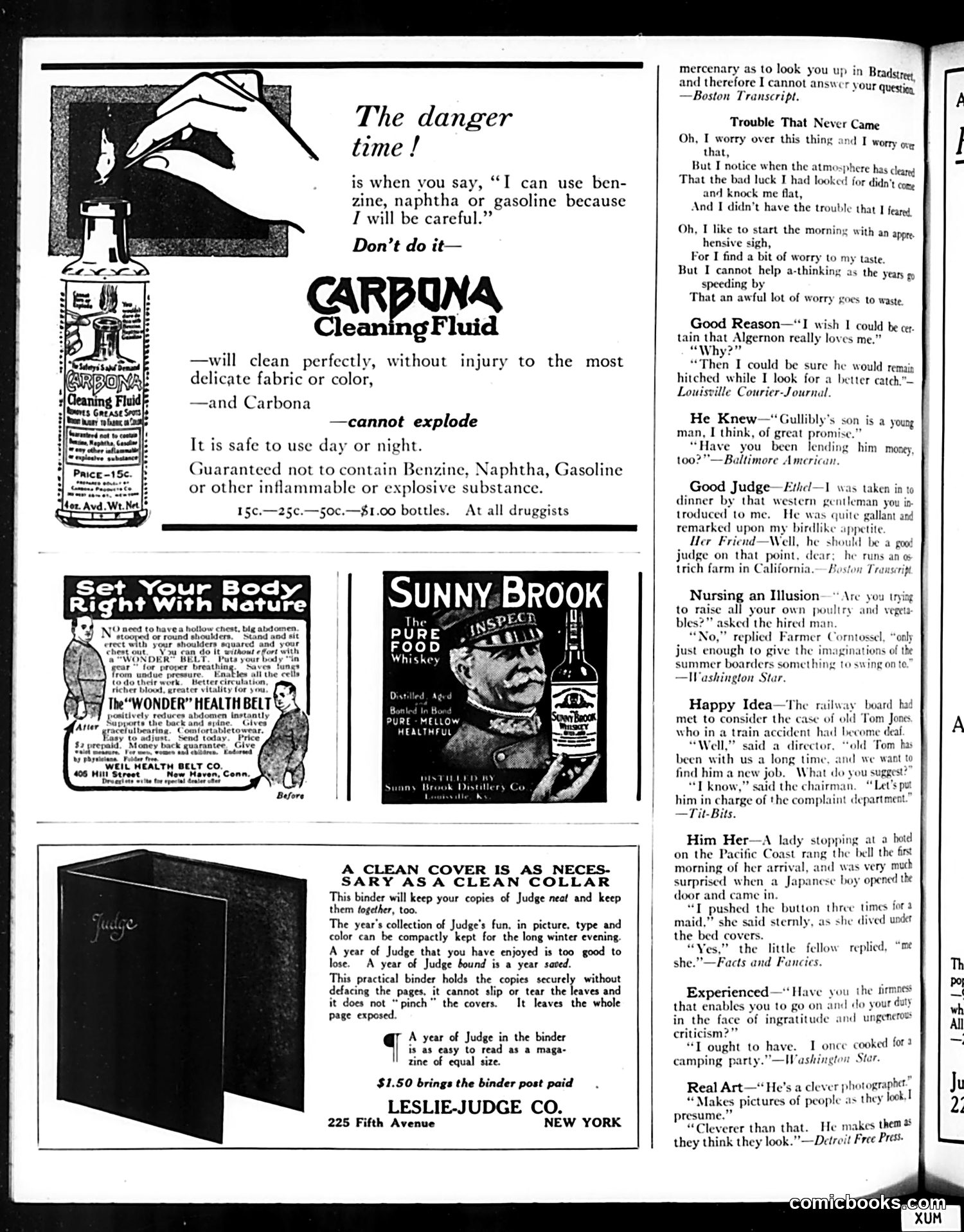
This page is primarily **advertising with some humor columns**, typical of Judge's format. The main advertisement is **Carbona Cleaning Fluid**, warning against using dangerous alternatives (benzene, naphtha, gasoline) for fabric cleaning. The cartoon shows a figure near an explosion, emphasizing the safety danger—a genuine public concern of the era when flammable cleaning agents caused household fires and injuries. Other ads include a "Wonder Health Belt" (a pseudoscientific device claiming to cure posture and vitality issues) and a Leslie-Judge magazine binder for storing back issues. The right column contains **humor anecdotes** on typical Judge topics: romantic uncertainty, financial anxiety, class observations, and domestic mishaps. These brief jokes reflect early 20th-century American middle-class preoccupations—worrying needlessly, social climbing, servants, and gender relations. The humor is gentle, observational rather than biting satire. This page represents Judge's commercial side: serious product warnings mixed with light social commentary for affluent readers.
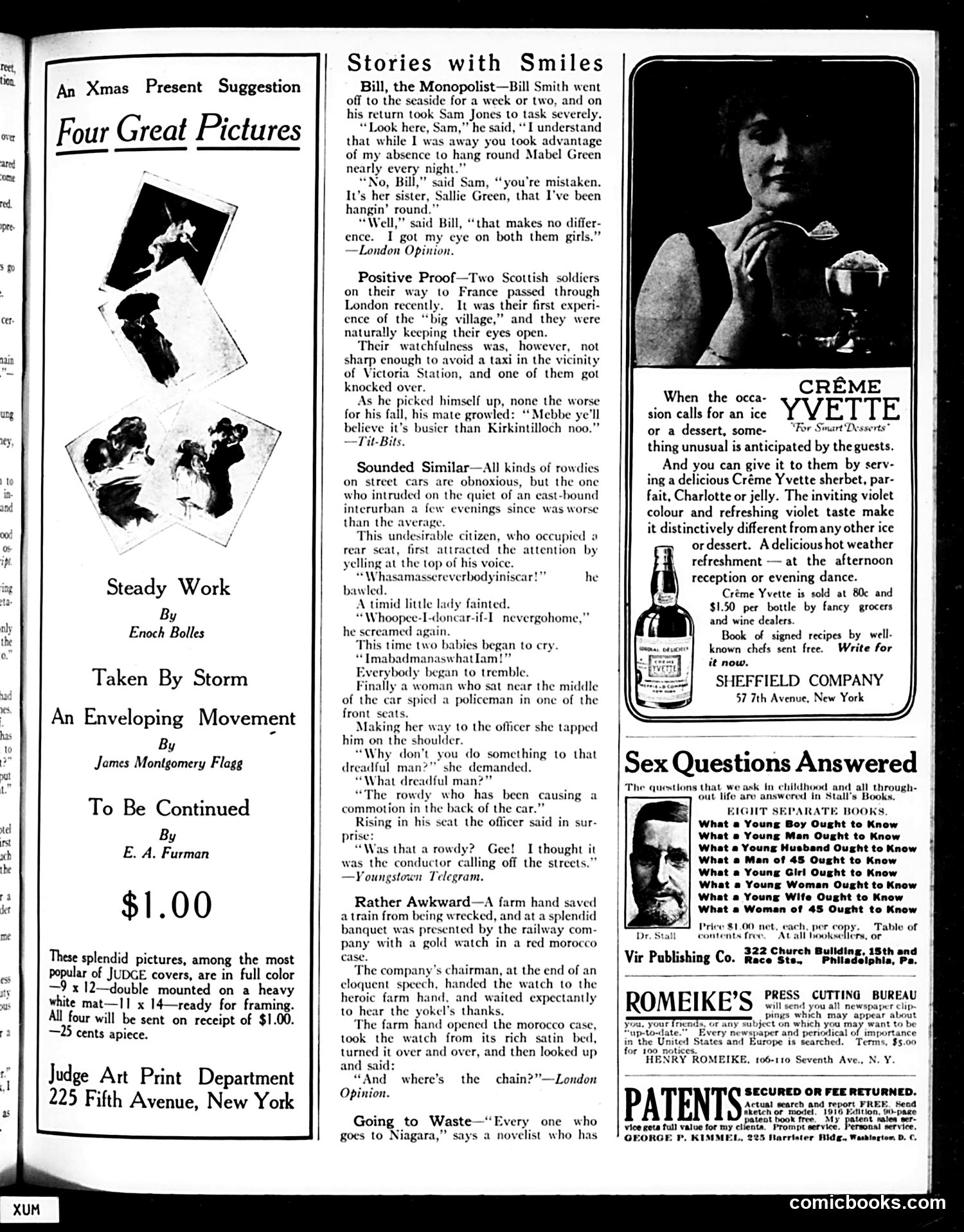
This page from Judge magazine (undated but appears early 20th century) contains mostly **advertisements and short humorous anecdotes** rather than political cartoons. The left side advertises "Four Great Pictures"—reproductions of Judge cover art by artists Enoch Bolles and James Montgomery Flagg, available for $1.00. The center presents several brief joke pieces titled "Stories with Smiles": comedic tales about Bill the monopolist jealously watching a woman, Scottish soldiers unfamiliar with London taxis, a loud passenger on a trolley, a farm worker given a watch without its chain, and a novelist's observation about Niagara. These are gentle, domestic humor pieces with no clear political reference—just everyday misunderstandings and mild satire of working-class characters and British manners. The right side advertises Crème Yvette sherbet and other products (sex education books, patent services, a press-clipping bureau). This is primarily a **commercial page** rather than satirical political content.
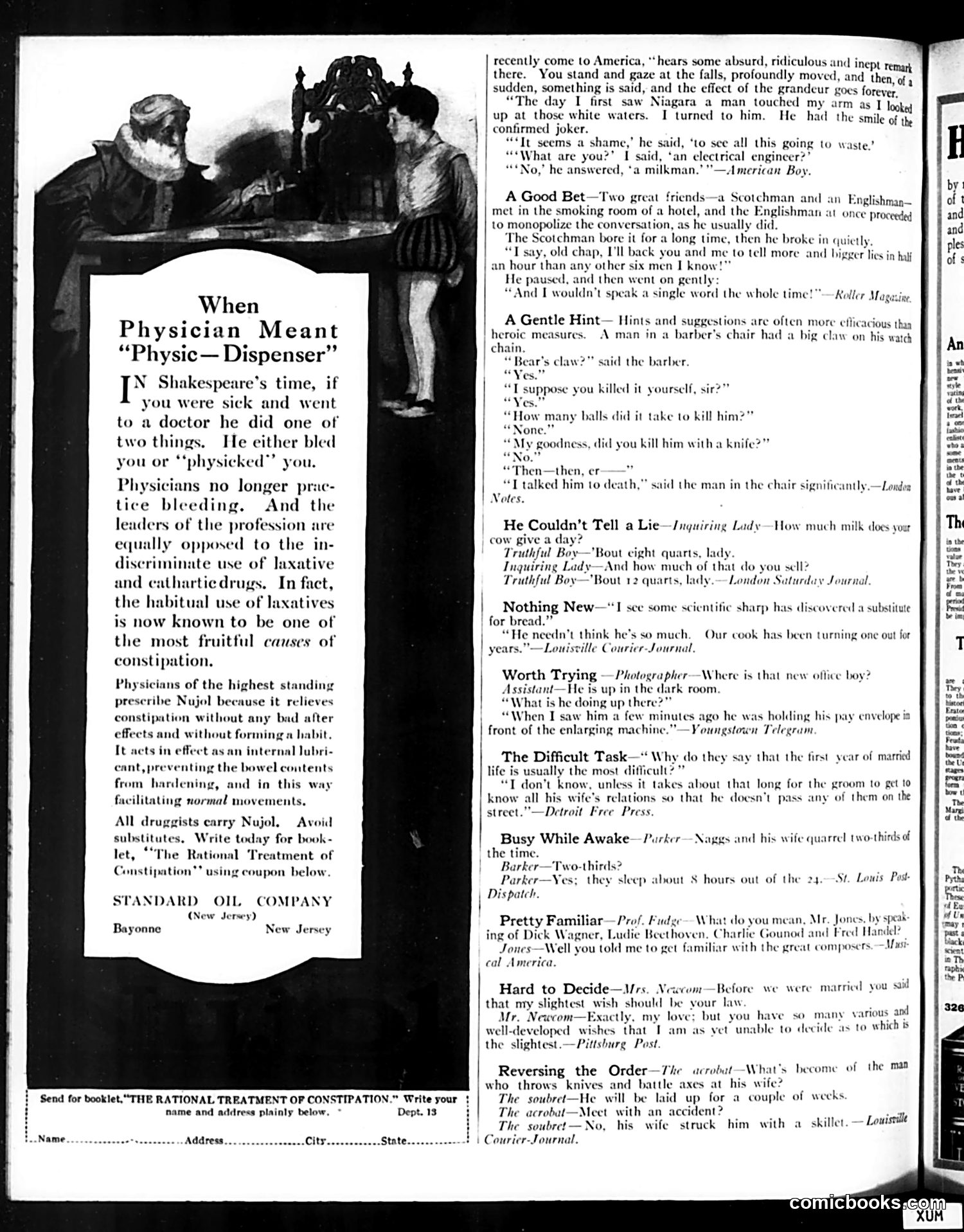
**Main Content: Advertisement for Nujol** The large left-panel advertisement discusses the historical shift in medical treatment. It explains that in Shakespeare's era, physicians either "bled" patients or "physicked" them (administered harsh purgatives). The ad argues that modern doctors now recognize the *irony* that habitual laxatives actually *cause* constipation—so Nujol (a mineral oil laxative made by Standard Oil) is promoted as a safer alternative that acts as an internal lubricant without habit-forming effects. **Right Panel: Miscellaneous Humorous Anecdotes** Multiple brief jokes lampooning human nature: a British tourist at Niagara Falls makes inane commentary; a Scottish friend bests an English braggart by claiming they'd tell larger lies in silence; various witticisms about milk quantity, bread substitutes, office workers, and marital adjustment. These are light social satire typical of Judge's humor—mocking pretentiousness, foreigners, and domestic situations common to early-20th-century American audiences. The page is primarily **advertising-driven**, with humor secondary.
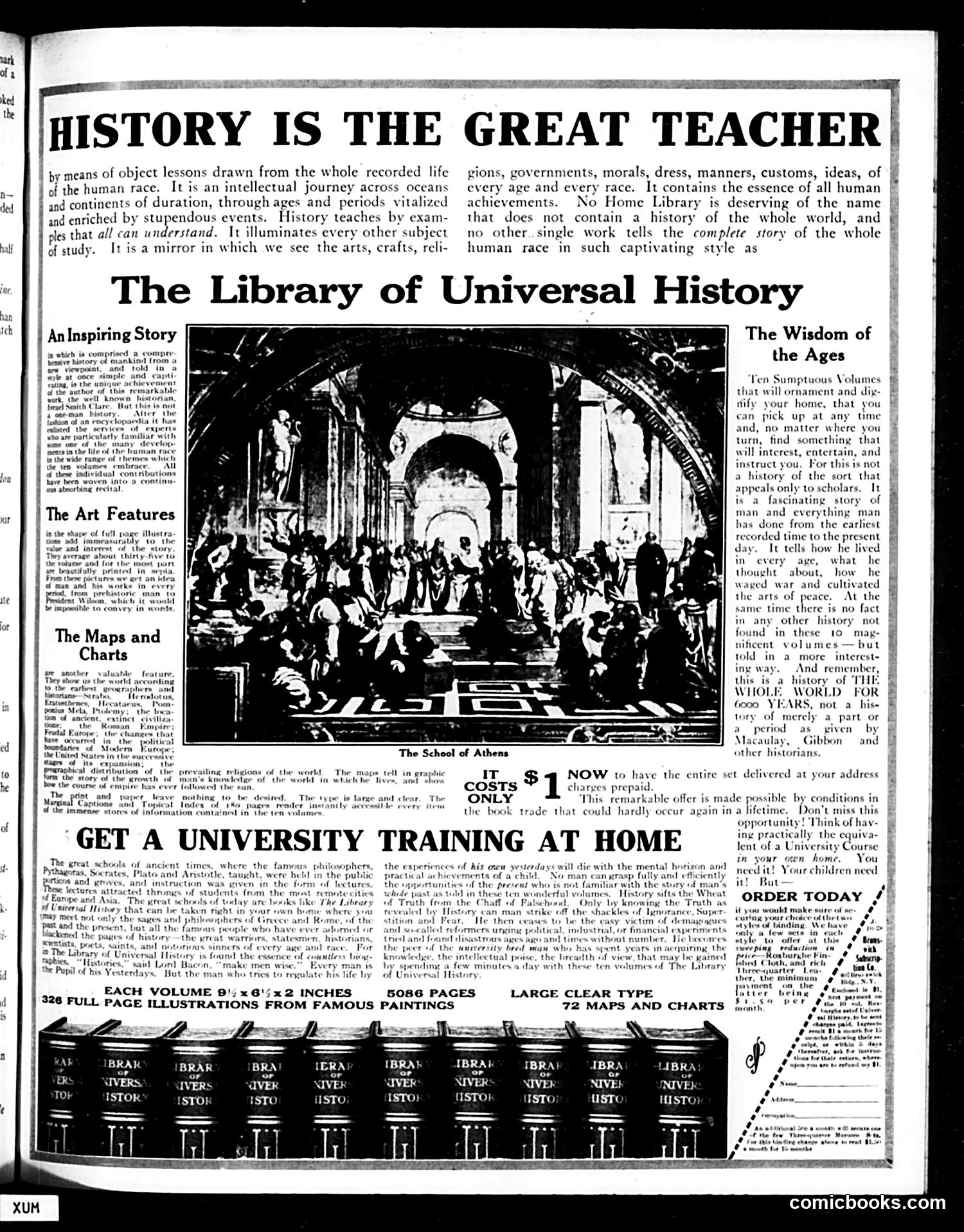
This page is **primarily advertising**, not satire or political commentary. It promotes "The Library of Universal History," a 10-volume encyclopedia set. The advertisement uses the philosophic header "History Is the Great Teacher" to market the product as essential home education. The central image—"The School of Athens," a famous Renaissance painting—lends cultural gravitas to the pitch. Key sales points include: the set contains complete human history from earliest times to present; it's more engaging than academic histories (notably citing Gibbon); it ornaments the home while being intellectually accessible; and at $1 per volume with prepaid delivery, it's positioned as an affordable alternative to university education. The ad targets middle-class families seeking self-improvement and children's education during an era when home libraries signaled respectability. No specific political figures or satire are evident—this is straightforward consumer marketing dressed in educational rhetoric.
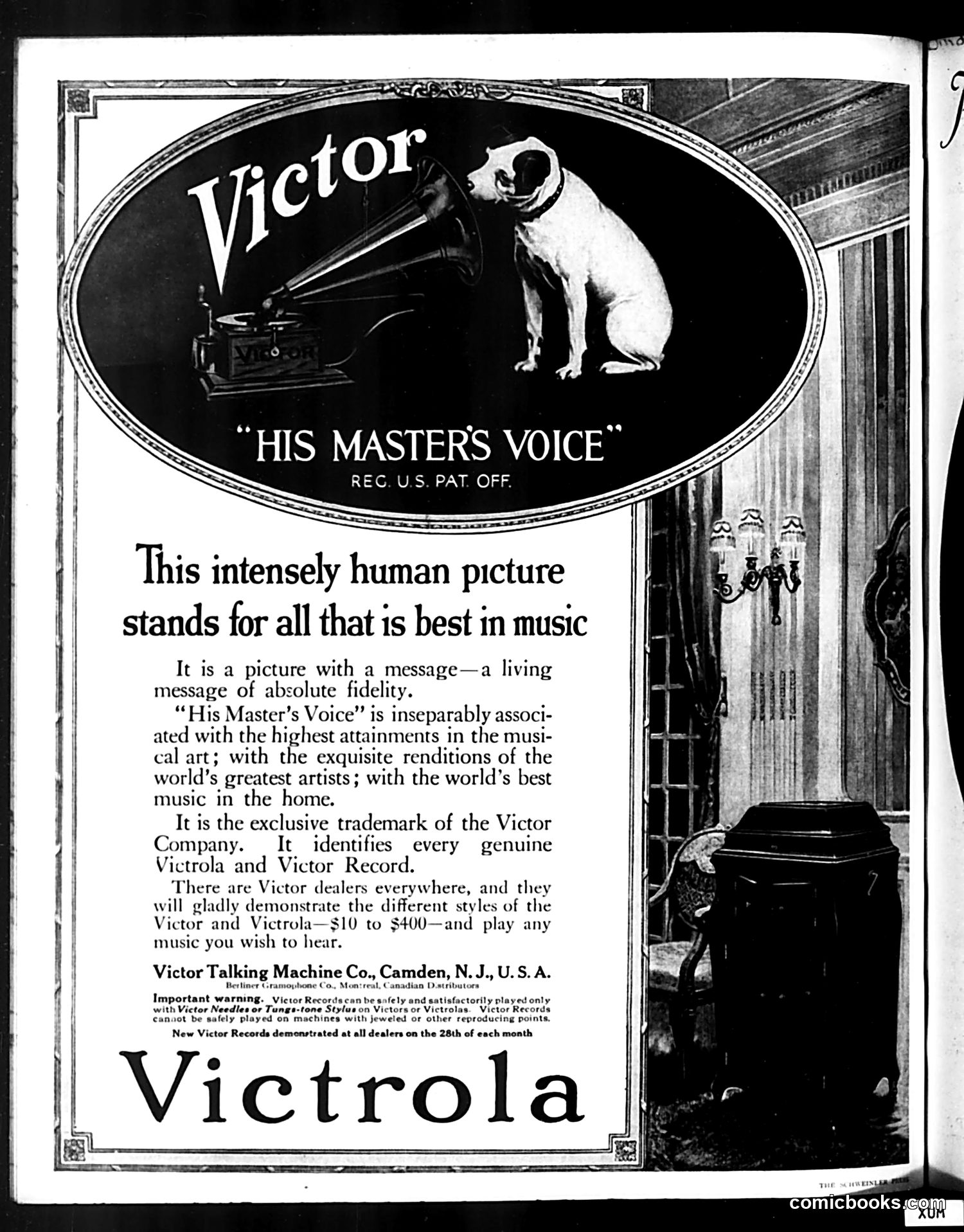
This is a **full-page advertisement**, not a political cartoon. It promotes Victor's "Victrola" phonograph and records, featuring their famous trademark: a dog listening to a gramophone horn. The ad appeals to early 20th-century consumers by associating the product with "the highest attainments in the musical art" and "the world's greatest artists." The dog—listening faithfully to recorded sound—symbolizes absolute fidelity to the original performance, a key selling point when recorded music was still novel technology. The "intensely human picture" language emphasizes that mechanically reproduced music could now bring concert-quality performances into American homes, positioning Victrola as a luxury item ($10-$400—substantial sums then). The warning about using proper needles and stylus indicates competing, incompatible phonograph manufacturers existed. This reflects the early recording industry's competitive push to standardize equipment and establish brand loyalty through emotional association rather than technical specification.