
Judge, 1916-10-28 · page 16 of 28
Judge — October 28, 1916 — page 16: what you’re looking at
What you’re looking at
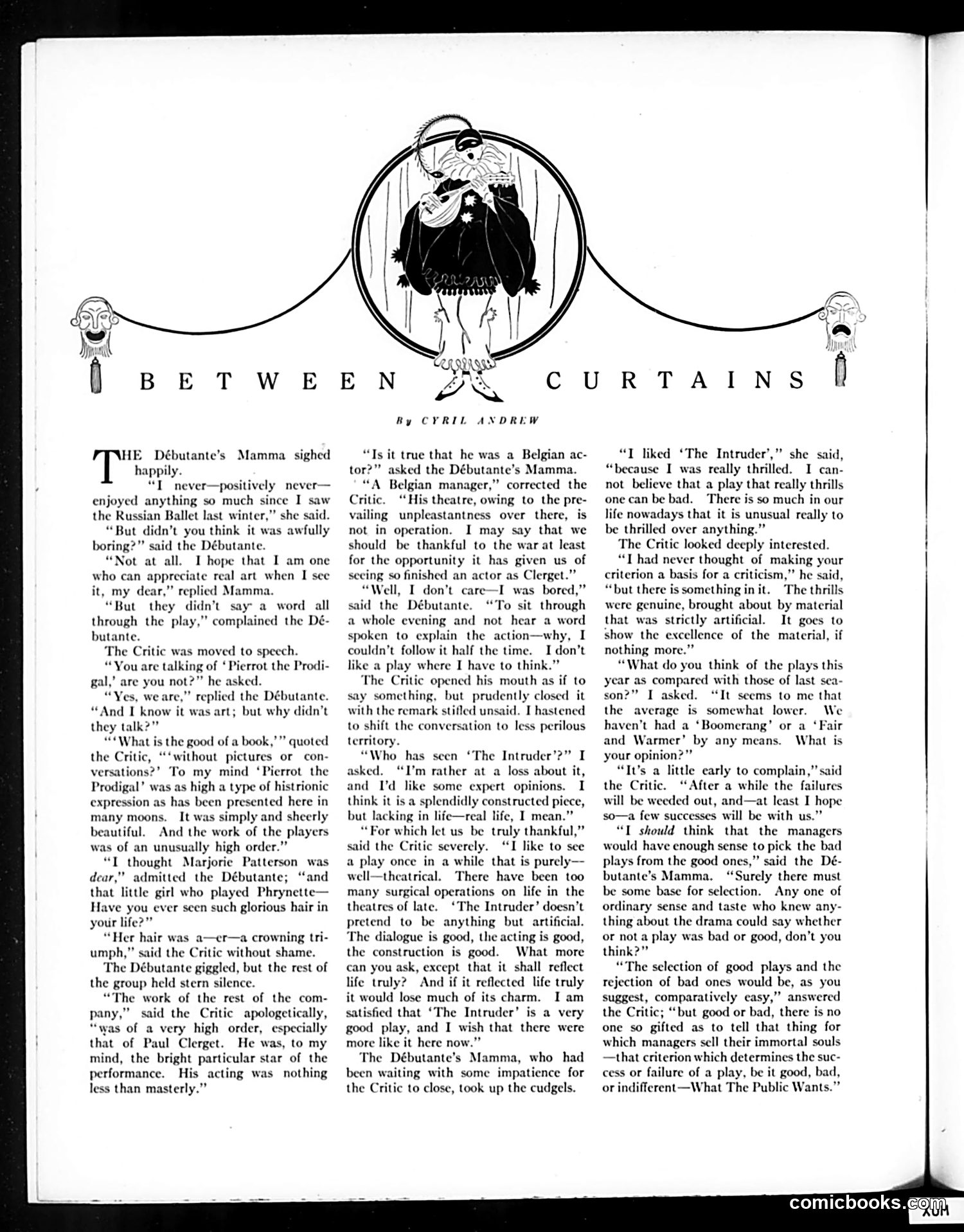
This satirical piece mocks pretentious theater critics and their disconnect from ordinary audiences. The cartoon depicts a fashionable débutante and her mother discussing a production of "Pierrot the Prodigal." The satire targets a pompous Critic who praises a silent, confusing play as "art" while dismissing the débutante's honest complaint that it was boring and incomprehensible. He quotes obscure references and uses inflated language to justify theatrical obscurity as superior to accessible entertainment. The humor deepens when discussing "The Intruder"—the Critic celebrates its artificiality and argues that reflecting "real life" would diminish its charm. Meanwhile, the mother's simple standard—that genuinely thrilling plays have value—exposes the Critic's pretentious nonsense. The piece satirizes how critics elevate incomprehensibility and artifice as marks of sophistication, while ridiculing the public's legitimate desire for comprehensible, emotionally engaging theater. It's a timeless critique of elitist gatekeeping in the arts.
📄 Transcribed text from this page (OCR, searchable)
Machine-transcribed from the original scan — historical spelling and the odd misread are preserved.
HE Débutante’s Mamma sighed “IT never—positively never— enjoyed anything so much since I saw the Russian Ballet last winter,” she said. “But didn’t you think it was awfully boring?” said the Débutante. “Not at all. I hope that I am one who can appreciate real art when I see it, my dear,” replied Mamma. “But they didn’t sayy a word all through the play,” complained the Dé- butante. The Critic was moved to speech. “You are talking of ‘Pierrot the Prodi- gal,’ are you not?” he asked. “Yes, we are,” replied the Débutante. “And I know it was art; but why didn’t they talk?” “*What is the good of a book,’” quoted the Critic, “‘without pictures or con- versations?’ To my mind ‘Pierrot the Prodi, high a type of histrionic has been presented here in many moons. It was simply and sheerly beautiful. And the work of the players was of an unusually high order.” “IT thought Marjorie Patterson was dear,” admitted the Débutante; “and that little girl who played Phrynette— Have you ever seen such glorious hair in your life?” “Her hair was a—er—a crowning tri- umph,” said the Critic without shame. The Débutante giggled, but the rest of the group held stern silence. “The work of the rest of the com- pany,” said the Critic apologetically, “was of a very high order, especially that of Paul Clerget. He was, to my mind, the bright particular star of the performance. His acting was nothing less than masterly.” C By CYRIL ANDREW “Ts it true that he was a Belgian ac- tor?” asked the Débutante’s Mamma. A Belgian manager,” corrected the Critic. “His theatre, owing to the pre- vailing unpleastantness over there, is not in operation. I may say that we should be thankful to the war at least for the opportunity it has given us of secing so finished an actor as Clerget.” “Well, I don’t care—I was bored,” said the Débutante. “To sit through a whole evening and not hear a word spoken to explain the action—why, I couldn't follow it half the time. I don’t like a play where I have to think.” The Critic opened his mouth as if to say something, but prudently closed it with the remark stifled unsaid. I hastened to shift the conversation to less perilous territory. “Who has seen ‘The Intruder’?” I ked. “I'm rather at a loss about it, dd I'd like some expert opinions. I think it is a splendidly constructed piece, but lacking in life—real life, I mean. “For which Iet us be truly thankful,” said the Critic severely. “I like to see a play once in a while that is purely— well—theatrical. There have been too many surgical operations on life in the theatres of late. ‘The Intruder’ doesn’t pretend to be anything but artificial. The dialogue is good, the acting is good, the construction is good. What more can you ask, except that it shall reflect life truly? And if it reflected life truly it would lose much of its charm. I am satisfied that ‘The Intruder’ is a very good play, and I wish that there were more like it here now.” The Débutante’s Mamma, who had been waiting with some impatience for the Critic to close, took up the cudgels. U RTAINS “I liked ‘The Intruder’,” she said, “because I was really thrilled. I can- not believe that a play that really thrills one can be bad. There is so much in our life nowadays that it is unusual really to be thrilled over anything.” The Critic looked deeply interested. “T had never thought of making your criterion a basis for a criticism,” he said, “but there is something in it. The thrills were genuine, brought about by material that was strictly artificial. It goes to show the excellence of the material, if nothing more.” “What do you think of the plays this year as compared with those of last sea- son?” I asked. “It seems to me that the average is somewhat lower. We haven’t had a ‘Boomerang’ or a ‘Fair and Warmer’ by any means. What is your opinion?” “It’s a little early to complain,” said the Critic. “After a while the failures will be weeded out, and—at least I hope so—a few successes will be with us.” “T should think that the managers would have enough sense to pick the bad plays from the good ones,” said the Dé- butante’s Mamma. “Surely there must be some base for selection. Any one of ordinary sense and taste who knew any- thing about the drama could say whether or not a play was bad or good, don’t you think?” The selection of good plays and the rejection of bad ones would be, as you suggest, comparatively easy,” answered the Critic; “but good or bad, there is no one so gifted as to tell that thing for which managers sell their immortal souls —that criterion which determines the suc- cess or failure of a play, be it good, bad, or indifferent—What The Public Wants.” comicbooks.