
Judge, 1916-10-28 · page 20 of 28
Judge — October 28, 1916 — page 20: what you’re looking at
What you’re looking at
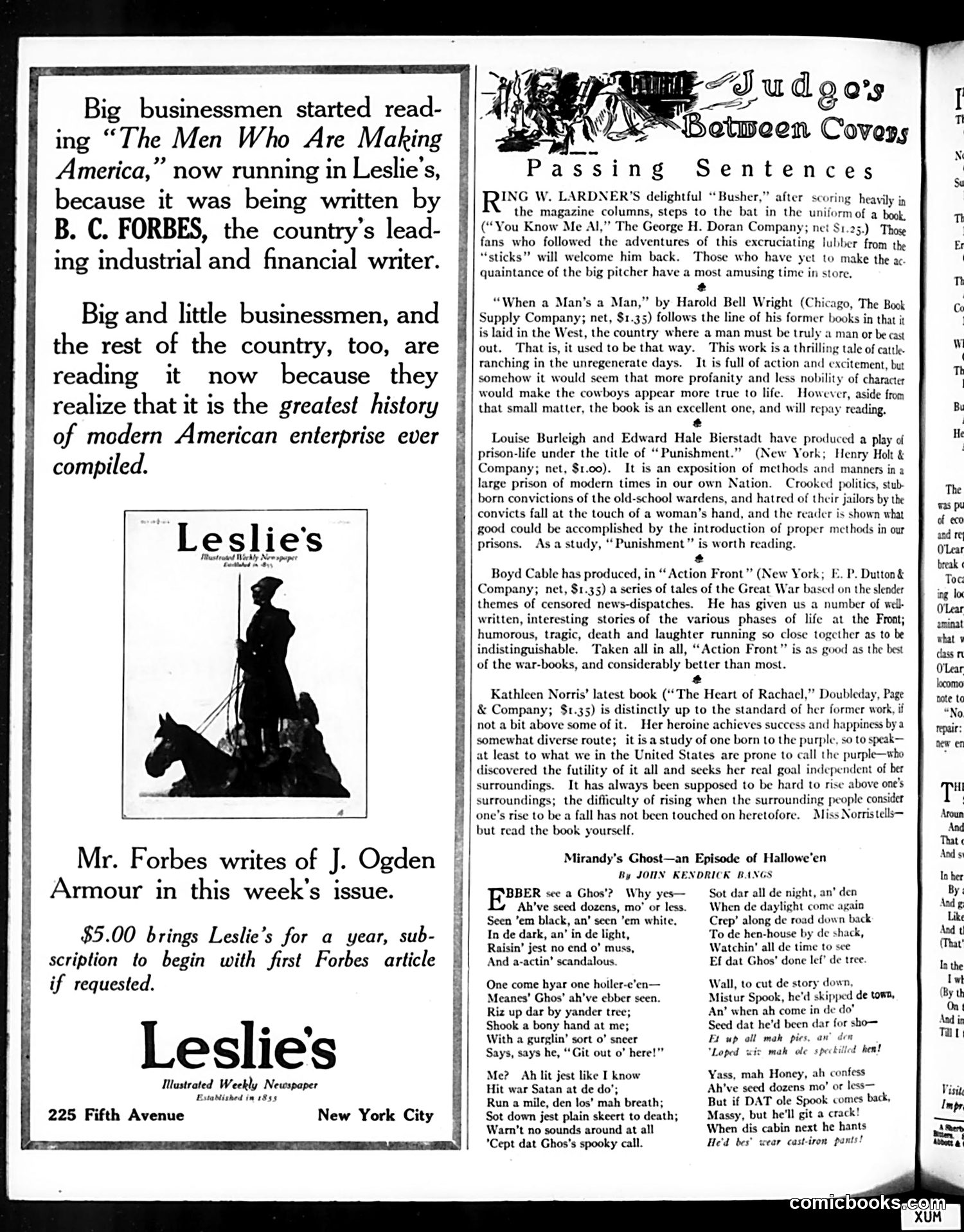
This is primarily an **advertisement for Leslie's Weekly magazine**, not a political cartoon page. The main content promotes B.C. Forbes's serialized article "The Men Who Are Making America" as drawing major readership among businessmen and the general public. The page also contains **book reviews** ("Passing Sentences"), recommending contemporary fiction and war narratives by authors like Ring Lardner and Boyd Cable. At the bottom is a humorous **Halloween poem** ("Mirandy's Ghost") by John Kendrick Bangs, a popular satirist of the era. The satirical angle is subtle: Forbes's industrial journalism is positioned as appealing equally to "big and little businessmen" and "the rest of the country," suggesting shared interest in American enterprise narratives. The silhouette illustration of a man on horseback reinforces masculine, frontier-era American identity—themes consistent with the reviewed books' emphasis on authentic American manhood and Western values.
📄 Transcribed text from this page (OCR, searchable)
Machine-transcribed from the original scan — historical spelling and the odd misread are preserved.
Big businessmen started read- ing “The Men Who Are Making America,” now running in Leslie's, because it was being written by B. C. FORBES, the country’s lead- ing industrial and financial writer. Passing Sentences ING W. LARDNER’S delightful “Busher,” after scoring heavily in the magazine columns, steps to the bat in the uniform of a book, (“You Know Me Al,” The George H. Doran Company; net $1.25.) Those fans who followed the adventures of this excruciating lubber from the “sticks” will welcome him back. Those who have yet to make the ac. quaintance of the big pitcher have a most amusing time in store, & “When a Man’s a Man,” by Harold Bell Wright (Chicago, The Book Supply Company; net, $1.35) follows the line of his former books in that it is laid in the West, the country where a man must be truly a man or be cast Big and little businessmen, and the rest of the country, too, are out. That is, it used to be that way. This work is a thrilling tale of cattle. +) | ranching in the unregencrate days. It is full of action and excitement, but | | somehow it would seem that more profanity and less nobility of character 1) | would make the cowboys appear more true to life. However, aside from { that small matter, the book is an excellent one, and will repay reading. | 4 J reading it now because they realize that it is the greatest history of modern American enterprise ever * compiled. e Louise Burleigh and Edward Hale Bierstadt have produced a play of prison-life under the title of “Punishment.” (New York; Henry Holt & Company; net, $1.00). It is an exposition of methods and manners in a large prison of modern times in our own Nation. Crooked politics, stub- born convictions of the old-school wardens, and hatred of their jailors by the convicts fall at the touch of a woman’s hand, and the reader is shown what good could be accomplished by the introduction of proper methods in our prisons. Asa study, “Punishment” is worth reading. ¢ Boyd Cable has produced, in “ Action Front” (New York; E. P. Dutton& Company; net, $1.35) a series of tales of the Great War based on the slender themes of censored news-dispatches. He has given us a number of wel- written, interesting stories of the various phases of life at the Front; humorous, tragic, death and laughter running so close together as to be indistinguishable. Taken all in all, “Action Front” is as good as the best of the war-books, and considerably better than most. 2 Kathleen Norris’ latest book (‘The Heart of Rachacl,”’ Doubleday, Page & Company; $1.35) is distinctly up to the standard of her former work, if not a bit above some of it. Her heroine achieves success and happiness by a somewhat diverse route;_ it isa study of one born to the purple, so to speak— at least to what we in the United States are prone to call the purple—who discovered the futility of it all and secks her real goal independent of ber surroundings. It has always been supposed to be hard to rise above one’s surroundings; the difficulty of rising when the surrounding people consider one’s rise to be a fall has not been touched on heretofore. Miss Norristells~ | but read the book yourself. Leslie's Mbastrated Weebly New spuper odtaka a yy Mirandy’s Ghost—an Episode of Hallowe'en By JONN KENDRICK BANGS Mr. Forbes writes of J. Ogden Armour in this week’s issue. $5.00 brings Leslie’s for a year, sub- scription to begin with first Forbes article if requested. Established in 1855 225 Fifth Avenue New York City BBER see a Ghos’? Why yes— Ah’ve seed dozens, mo’ or less. Seen 'em black, an’ secn 'em white, In de dark, an’ in de light, Raisin’ jest no end o’ muss, And a-actin’ scandalous. One come hyar one holler-c’en— Meanes’ Ghos’ ah've ebber seen. Riz up dar by yander tree; Shook a bony hand at me; With a gurglin’ sort o’ sneer Says, says he, “Git out o’ here!” Me? Ah lit jest like I know Hit war Satan at de do’; Run a mile, den los’ mah breath; Sot down jest plain skeert to death; Warn’t no sounds around at all 'Cept dat Ghos's spooky call. Sot dar all de night, an’ den When de daylight come again Crep’ along de road down back To de hen-house by de shack, Watchin’ all de time to see Ef dat Ghos’ done lef’ de tree. Wall, to cut de story down, Mistur Spook, he'd skipped de town, An’ when ah come in de do’ Et up all mak pies, an’ *Loped wis mah ole spre Yass, mah Honey, ah confess Ah've seed dozens mo’ or less— But if DAT ole Spook comes back, Massy, but he'll git a crack! When dis cabin next he hants He'd bes’ wear cast-iron pants! COMIcbooks ee