
Judge, 1916-10-28 · page 17 of 28
Judge — October 28, 1916 — page 17: what you’re looking at
What you’re looking at
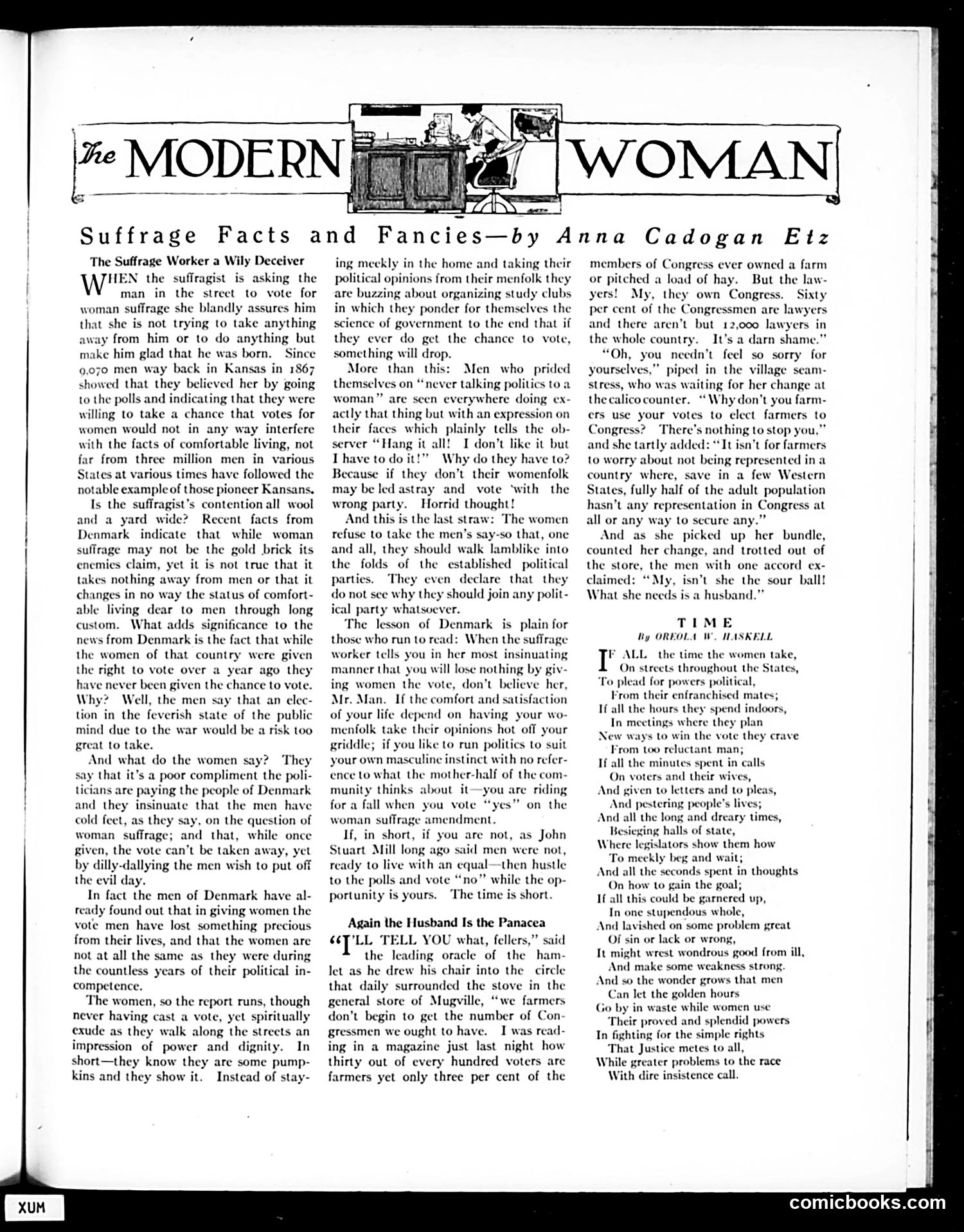
This anti-suffrage article by Anna Cadogan Etz argues that women's voting rights threaten male domestic authority. The piece uses Denmark as a cautionary example: though women gained the franchise there, men have delayed holding elections, claiming wartime instability justifies postponement. Etz's real complaint emerges in her satire of women's newfound independence. Previously obedient to male political guidance, Danish women now form study clubs, discuss government independently, and refuse automatic party loyalty. The article frames this as disturbing—men who "never talked politics to women" now must engage them seriously, and women reject paternal direction. The satire targets suffragists' claims that voting rights won't disrupt "comfortable living." Etz argues they absolutely will: women gain "power and dignity," intellectual autonomy, and political agency, fundamentally altering domestic hierarchies where men previously controlled wives' opinions. The message to male readers: voting rights genuinely threaten male prerogatives, contrary to suffragists' reassurances.
📄 Transcribed text from this page (OCR, searchable)
Machine-transcribed from the original scan — historical spelling and the odd misread are preserved.
e MODERN] Suffrage Facts and Fancies—by Anna Cadogan Etz The Suffrage Worker a Wily Deceiver HEN the suffragist is asking the man in the street to vote for woman suffrage she blandly assures him that she is not trying to take anything away from him or to do anything but make him glad that he was born. Since 9,070 men way back in Kansas in 1867 showed that they believed her by going to the polls and indicating that they were willing to take a chance that votes for women would not in any way interfere with the facts of comfortable living, not far from three million men in various States at various times have followed the notable example of those pioneer Kansans, Is the suffragist’s contention all wool and a yard wide? Recent facts from Denmark indicate that while woman suffrage may not be the gold brick its enemies claim, yet it is not true that it takes nothing y from men or that it changes in no way the status of comfort- able living dear to men through long custom. What adds significance to the news from Denmark is the fact that while the women of that country were given the right to vote over a year ago they have never been given the chance to vote. Why? Well, the men say that an elec- tion in the feverish state of the public mind due to the war would be a risk too great to take. And what do the women say? They say that it’s a poor compliment the poli- ticians are paying the people of Denmark and they insinuate that the men have cold feet, as they say, on the question of woman suffrage; and that, while once given, the vote can’t be taken away, yet by dilly-dallying the men wish to put off the evil day. In fact the men of Denmark have al- ready found out that in giving women the vote men have lost something precious from their lives, and that the women are not at all the same as they were during the countless years of their political in- competence, The women, so the report runs, though never having cast a vote, yet spiritually exude as they walk along the streets an impression of power and dignity. In short—they know they are some pump- kins and they show it. Instead of stay- ing meckly in the home and taking their political opinions from their menfolk they are buzzing about organizing study clubs in which they ponder for themselves the science of government to the end that if they ever do get the chance to vote, something will drop. More than this: Men who prided themselves on “never talking politics to a woman” are seen everywhere doing ex- actly that thing but with an expression on their faces which plainly tells the ob- server “Hang it all! I don’t like it but T have to do it!” Why do they have to? Because if they don’t their womenfolk may be led astray and vote ‘with the wrong party. Horrid thought! And this is the last straw: The women refuse to take the men’s say-so that, one and all, they should k lamblike into the folds of the established political parties. They even declare that they do not se y should join any polit- ical party whatsoever. The lesson of Denmark is plain for those who run to read: When the suffrage worker tells you in her most insinuating manner that you will lose nothing by giv- ing women the vote, don’t believe he Mr. Man. If the comfort and satisfaction of your life depend on having your wo- menfolk take their opinions hot off your griddle; if you like to run politics to suit your own masculine instinct with no refer- ence to what the mother-half of the com- munity thinks about it—you are riding for a fall when you vote “tyes” on the woman suffrage amendment. If, in short, if you are not, as John Stuart Mill long ago said men were not, n equal—then hustle and vote “no” while the op- portunity is yours. The time is short. Again the Husband Is the Panacea sey LL. TELL YOU what, fellers,” said the leading oracle of the ham- Iet as he drew his chair into the circle that daily surrounded the stove in the general store of Mugville, “we farmers don’t begin to get the number of Con- gressmen we ought to have. I was read- ing in a magazine just last night how thirty out of every hundred voters are farmers yet only three per cent of the members of Congress ever owned a farm or pitched a load of hay. But the law- yers! My, they own Congress. Sixty per cent of the Congressmen are law and there aren't but 1 the whole country. “Oh, you needn't feel so sorry for yourselves,” piped in the village se stress, who was waiting for her change at thecalicocounter. “Why don’t you farm- ers use your votes to elect farmers to Congress? There's nothing to stop you,” and she tartly added: “It isn’t for farmers to worry about not being represented in a country where, save in a few Western ates, fully half of the adult population hasn't any representation in Congress at all or any way to secure any.” And as she picked up her bundle, counted her change, and trotted out of the store, the men with one accord ex- imed: “My, isn’t she the sour ball! What she needs is a husband.” TIME By OREOLA W. HASKELL J ALL the time the women take, On streets throughout the States, ‘To plead for powers political, From their enfranchised mates; If all the hours they spend indoors, In meetings where they plan New ways to win the vote they crave From too reluctant man; If all the minutes spent in calls On voters and their wives, And given to letters and to pleas, And pestering people’s liv And all the long and dreary times, esieging halls of state, Where legislators show them how To meekly beg and wait; And all the seconds spent in thoughts On how to gain the goal; If all this could be garnered up, In one stupendous whole, And lavished on some problem great Of sin or lack or wrong, It might wrest wondrous good from ill, And make some weakness strong. And so the wonder grows that men Can let the golden hours Go by in waste while women use Their proved and splendid powers In fighting for the simple rights That Justice metes to all, While greater problems to the race With dire insistence call. comicbooks.com