
Judge, 1916-10-28 · page 7 of 28
Judge — October 28, 1916 — page 7: what you’re looking at
What you’re looking at
This story satirizes the archetypal meddlesome neighbor—a stock character in early 20th-century American humor. McFee, a new homeowner, discovers his neighbor is an insufferably nosy woman who immediately intrudes upon his household, uninvited, to rearrange his furniture and "help" organize his home. The satire targets several targets: the assumption that neighbors have a "duty" to interfere in others' affairs under the guise of friendliness; the gendered stereotype of women as gossipy busybodies; and the tension between community-minded behavior and personal privacy. The office-boy caption adds irony: the boss claims poverty while clearly affording a house with servants and furnishings—critiquing employer hypocrisy about wages. The humor lies in recognizing this invasive "neighborliness" as transparently self-serving meddling disguised as helpfulness—a timeless social problem.
📄 Transcribed text from this page (OCR, searchable)
Machine-transcribed from the original scan — historical spelling and the odd misread are preserved.
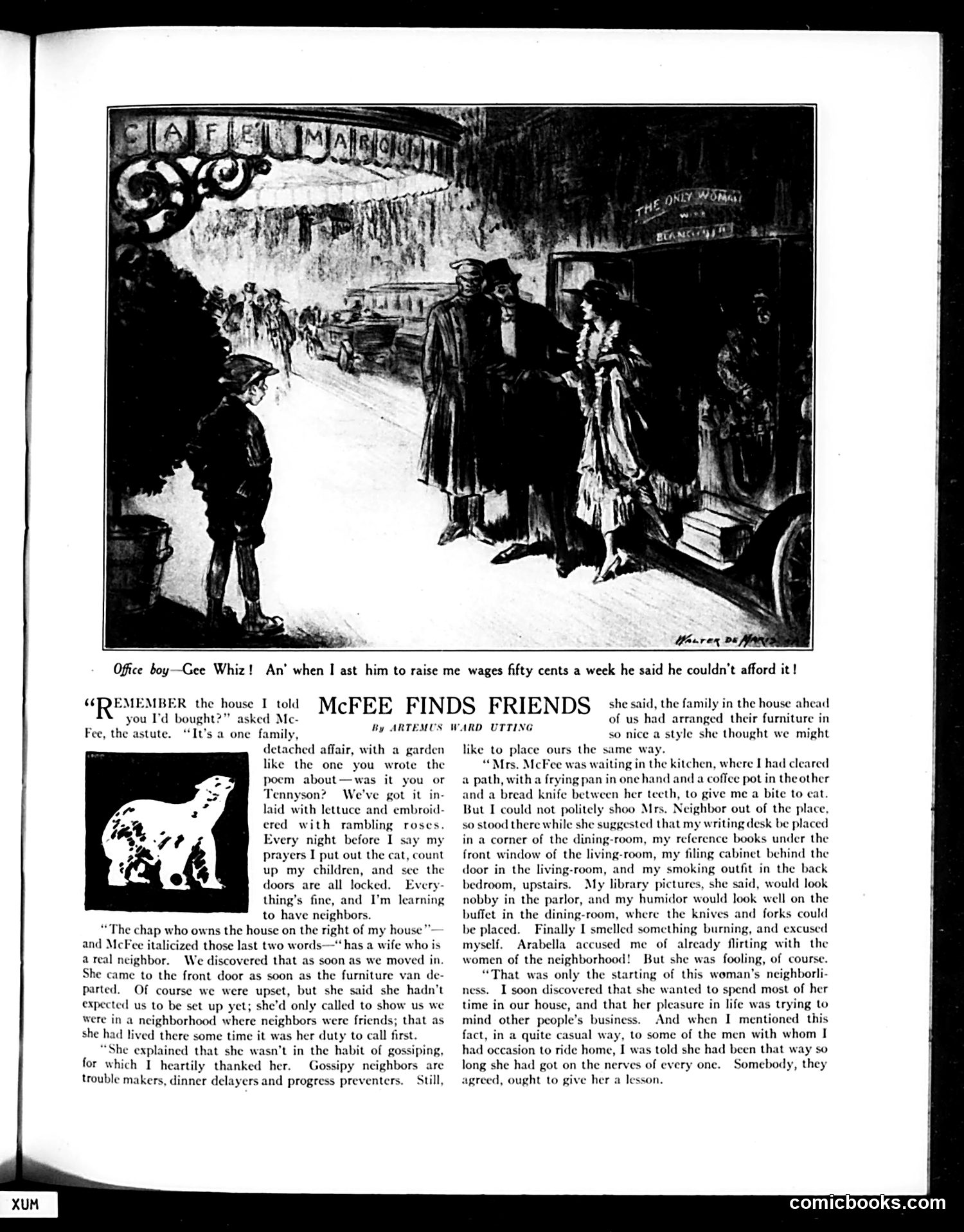
L nit Wome) yl Office boy—Gee Whiz! An’ when I ast him to raise me wages fifty cents a week he said he couldn't afford it! 6¢TQQEMEMBER the house I told you I'd bought?” asked Me- Fee, the astute. ‘It’s a one famil detached affair, with a garden like the one you wrote the poem about—was it you or Tennyson? We've got it in- laid with lettuce and embroid- ered with rambling roses. Every night before I say my prayers I put out the cat, count up my children, and see the doors are all locked. Every- thing’s fine, and I’m learning to have neighbors. “The chap who owns the house on the right of my house” and McFee italicized those last two words—“‘has a wife who is areal neighbor. We discovered that as soon as we moved in. She came to the front door as soon as the furniture van de- parted. Of course we were upset, but she said she hadn't expected us to be set up yet; she'd only called to show us we were in a neighborhood where neighbors were friends; that as she had lived there some time it was her duty to call first. “She explained that she wasn’t in the habit of gossiping, for which I heartily thanked her. Gossipy neighbors are trouble makers, dinner delayers and progress preventers. Still, McFEE FINDS FRIENDS = By ARTEMUS WARD UTTING 1, the family in the house ahead us had arranged their furniture in so nice a style she thought we might like to place ours the same way. “Mrs. Mck as waiting in the kitchen, where I had cleared a path, with a frying pan in one hand and a coffee pot in theother and a bread knife between her teeth, to give me a bite to eat. But I could not politely shoo Mrs. Neighbor out of the place, so stood there while she suggested that my writing desk be placed in a corner of the dining-room, my reference books under the front window of the living-room, my filing cabinet behind the door in the living-room, and my smoking outfit in the back bedroom, upstairs. My library pictures, she said, would look nobby in the parlor, and my humidor would look well on the buffet in the dining-room, where the knives and forks could be placed. Finally I smelled something burning, and excused myself. Arabella accused me of already flirting with the women of the neighborhood! But she was fooling, of course. “That was only the starting of this woman's ncighborli- ness. I soon discovered that she wanted to spend most of her time in our house, and that her pleasure in life was trying to mind other people's business. And when I mentioned this fact, in a quite casual way, to some of the men with whom I had occasion to ride home, I was told she had been that way so long she had got on the nerves of every one. Somebody, they agreed, ought to give her a lesson. comicbooks.com